A Textile Education, Circa 2022

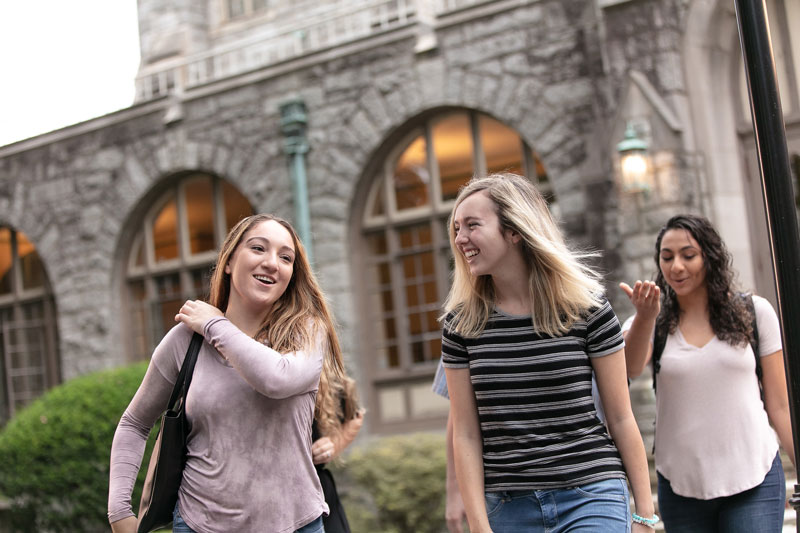
Students at the East Falls Campus of Thomas Jefferson University

Part one in a two-part feature on textile education focuses on college and university offerings.

By Jim Kaufmann, Contributing Editor

S

ome 20 years ago, Textile World published an article about textile education offerings in the United States (See “Making the Grade,” TW, January 2002). Ironically, or maybe not, many of the industry specific comments contained in the article remain entirely viable if not prophetic in 2022. Some of the comments included:

  • “Over the last 20-plus years, the U.S. textile industry has shifted and been altered dramatically, yet the need for qualified, well-educated individuals to assume leadership roles remains constant.”
  • “With the growing prevalence of niche markets and specialized products in the U.S. textile industry, colleges and universities are offering more diverse programs in order to meet the needs of the industry and provide more opportunity for graduates.”
  • “A lingering question in the minds of many prospective students concerns the wisdom of entering an industry many consider to be declining?” The response? “There will always be a textile industry in the United States! No doubt it has changed over the years and will evolve even more in the years to come. Textile management, marketing, chemistry and engineering skills are vital today. I would heartily encourage anyone considering a textile education to pursue it. There is still a lot of opportunity out there!”

Words quoted more than 20 years ago, but each still resoundingly rings true in today’s textile arena.

According to David Hinks, dean of the Wilson College of Textiles at North Carolina State University (NC State), Raleigh, N.C.: “Significant changes in the textile industry in the 1980s and ‘90s with a collective move to producing textiles offshore resulted in closing down many textile mills in the U.S. and intensified the shift towards a negative opinion of the textile industry as a whole. This had a direct effect on the elimination of schools of textiles at colleges and universities and a change in programs specific to textiles being merged into materials sciences programs. As other universities moved away from textiles, it created a challenge, but it also created opportunities for NC State. We did the opposite and doubled down on maintaining the textiles name in our Wilson College of Textiles, textile programs and in our focus on the textile industry.”

Today, NC State’s Wilson College of Textiles remains the largest school focused on textiles in the United States and offers the most comprehensive program offerings devoted to textiles and the textile industry. According to Dean Hinks, “Before the shift, there was a healthy collaboration between traditional textile schools like Clemson, Georgia Tech, Philadelphia Textile, NC State and others. This had become a little eco-system that raised everyone up through a healthy competition for students and also occasional joint programs.”

Today, some of the other textiles schools mentioned by Dean Hinks are still offering textile programs in one form or another, but like the industry it supports, there have been many changes.

“While textile manufacturing at large was exported out of the U.S., you have to understand that the design, engineering and development functions never left. These functions are still thriving in the U.S. and manufacturing is returning,” noted Mike Leonard, academic dean, School of Design and Engineering in the Kanbar College of Design, Engineering and Commerce at Thomas Jefferson University, Philadelphia. Philadelphia University, formerly known as Philadelphia Textile, merged with Jefferson University in 2017, however, textiles continue to be an integral part of its academic offerings. “Yes, textile classes are smaller than decades ago, but they still provide excellent training grounds for addressing today’s textile endeavors that continue to be more complex, involved and engaging,” Dean Leonard said.

Second Verse, Same As The First

While not much has changed, seemingly everything has changed in today’s textile industry. As of this writing, the industry is dealing with the ongoing global pandemic, labor shortages, supply chain concerns, off shoring and reshoring, sustainability efforts, Industry 4.0 adoption, technological advancements, and a broadly expanding list of unique applications. This is not to mention the never-ending battle to reverse the textile industry’s perpetually dismal and negative image.

“In reality, the textile industry continues to be alive and well, and all that textiles do for us remains incredibly important and ever expanding,” said Dean Leonard. “Upon becoming Dean, I made everyone promise to ‘stop talking about textiles in the past tense!’ We need to be positive and looking forward. The main thing we can do for textiles, including for our current and prospective students, is be able to describe a future, a real future for the textile industry, not just give up and say it doesn’t exist anymore.”

Dean Hinks offered a similar view: “The prevailing images that the textile industry has left and all that remains are rusted out buildings and hazardous sites or that its merely not exciting or ‘techy’ enough to garner the interest of younger generations is just simply not true. I always enjoy seeing people’s faces when they come to our facilities for a tour and see all that we’re involved in and where our students end up in industry. They had a vision in their mind that predictably isn’t our reality.”

Many in the industry agree that the timing is right for the industry to mount a collective effort to effectively rebrand textiles, which if presented accurately, would only help in attracting new blood to textiles.

“We find many young people seem to have a bad taste for textiles due to the old-world exposure and faded beliefs originating from adults in their lives,” said Jasmine Cox, director of Textile Technology Programs and Business Innovation at Gaston College’s Textile Technology Center, Belmont, N.C. “There really needs to be more exposure through a positive industry-led effort to reach out to students and young people in general in order to erase these old perceptions and reintroduce today’s textile industry.”

“We need a collective effort throughout the industry to come together to show today’s amazing world of textiles,” Hinks said. “It’s incumbent on us to educate our society on the whole world of textiles, not just the clothing portion, and how textiles as a whole continue to improve the quality of our lives and livelihood.”
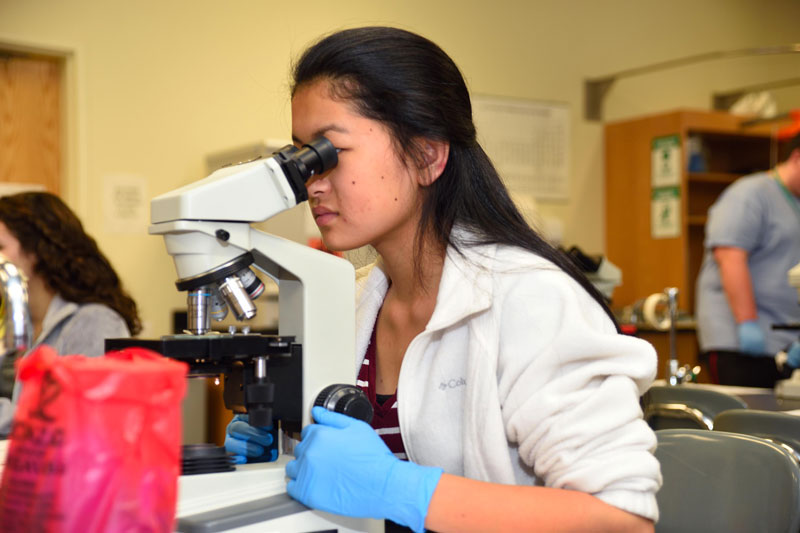
A student performing microscopic analysis at Gaston College’s Textile Technology Center

New Blood

Individual and collective programs are being developed and put into motion that, to a baseball fan, sound very similar to creating a “farm system” for identifying and growing the textile industry’s talent pool. The Textile Technology Center at Gaston College recently introduced its Textile Academy (See “Breaking New Grounds,” TW November/December 2021) offering a variety of education options in order to “cultivate highly skilled workers of all levels for local textile industry employers.”

“The Textile Academy is a culmination of our efforts to meet the local textile industry’s needs and fill a perceived void based on the feedback received from different textile industry avenues,” Cox offered. “A textile education today really depends on the individual’s interests and goals. Most universities only offer four-year or higher degreed programs that may not be right for many individuals. It’s great to have university graduates go into staff positions, but you still need training for workers, technicians, shift managers, and others who may only really need a couple of days to get familiar with textiles. Or perhaps an option for someone just looking to learn more about textiles to get started, who might then entertain a more in-depth program, possibly leading to a four-year program.”

The Textile Academy is a function of the continuing education department at Gaston College. It has established several program offerings akin to attending a trade school, and accredited textiles specific courses that can lead to a two-year associates degree. Gaston College and the Catawba Valley Community College (CVCC) recently announced a “bilateral 2+2 articulation agreement” with NC State’s Wilson College of Textiles. This agreement provides the opportunity for students who graduate from the Textile Technology Degree program with a two-year associates textiles degree — initially in Textile Technology or Textile Management tracks — and who meet eligibility requirements, to possibly transfer those credits into a Bachelor of Science in Textile Technology degree program at NC State. “We’re finding that not everyone is ready for a four-year college commitment, so we are developing these programs as a way to provide an easier entry into academics through local colleges in the form of training classes, certificate courses and associates degrees,” Dean Hinks noted. “Community colleges generally have a high percentage of first-generation attendees and we need to gain and provide access to these individuals. Our intention is to start these partnerships with Gaston and CVCC and learn as we further develop the program. Then there’s no reason not to take a similar approach with other community colleges, continue to grow the program offerings, and subsequently the talent supply. The industry’s talent pool needs to become more diverse in terms of heritage, income levels, and ethnicity, and this program will indeed help.”

This collective effort is geared towards supporting the rural North Carolina textile industry base where according to Dean Hinks, a recent study indicated that within a three-hour drive of Raleigh, one can encounter approximately 50 percent of the U.S. textiles industry. “We really need to put ourselves in a position to supply talent to fill the needs of the textile industry at all levels. Through this program, we can incorporate community college efforts to supply ground level needs as well as potentially feeding those interested into NC State.”
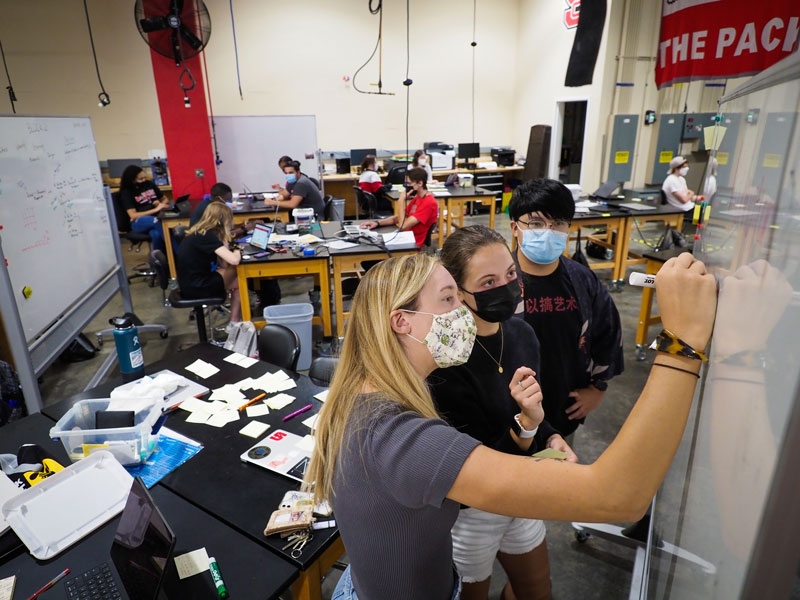
A senior design team from NC State’s Wilson College of Textiles at work on a project.

Soft Goods Versus Hard Goods Mentality

Paul Latten, director of Research and Development at Southeast Nonwovens and a graduate of NC State with a Bachelor of Science degree in Textile Engineering and Science, said: “My textile degree has proven to be useful, valuable and made it easier to relate to both soft and hard goods throughout my career. Soft goods offer a unique value proposition that you need to understand from the onset. For example, how does a polymer and/or fiber behave individually and also in a fabric structure. Then, how does each influence the intended application. This adds a complexity that isn’t necessarily apparent when dealing with hard goods. In fact, one could argue that it’s easier for someone educated in soft goods to transition into hard goods than vice versa. Soft goods just necessitate a different way of thinking.”

Another consideration, often overlooked, is that a textile education tends to be a more effective way to grasp and understand the many layers intrinsic to textile technologies, related terms and nuances specific to the soft goods industry. There is a unique, if subtle, difference in philosophies associated with soft goods compared to that of hard goods such as steel, wood or concrete. According to Dr. Brian George, director of Engineering Programs at Thomas Jefferson University: “We’ve noticed that traditional mechanical engineers transitioning into textiles do tend to have troubles initially. They’re generally amazed by how many variabilities must be considered that factor into textile product decisions. There can be so many different options or paths available to make a textile perform a specific way, which differs greatly from common hard goods perspectives. It’s just a different way of thinking.”

To be clear, having a textile education is not a mandatory requirement for someone to work in the textile industry. All are certainly welcomed and there are countless examples of men and women working throughout the textile industry who did not have a prior formal textile education when hired. Many textile companies historically have simply taken it upon themselves to teach their new hires what it believes they need to know about textiles to do their jobs. However, a textile education does make the indoctrination and assimilation period for new hires shorter and more efficient. The 2002 TW education article noted that, “The general estimate is that it takes roughly two years to bring a generic major up to the same use level as an entering textile major at a support cost to the hiring company of approximately $200,000 per year.”

In And Out Of Sorts

As the textile industry has shifted and evolved over the past few decades — from an industry focused on traditional textiles to one manufacturing high-performance products using increasingly intelligent machinery — so too has the approach taken by institutions of higher learning in redefining the make-up and options available for education. As mentioned by Dean Hinks, NC State has continued to maintain its focus on textiles while other traditional textile schools have incorporated their textile offerings into materials-, science- or fashion-specific curriculums. However, textiles can still be prevalent in these programs depending on the student’s course of study. “In the 90s and 2000s, we were finding that students and colleagues who had a textile engineering degree were having trouble breaking out of textiles and transitioning to, or being accepted in, other industries because of the potentially negative connotations associated with textiles, especially as engineering tools,” Dr. George said. “We heard things like ‘what do they learn about socks or towels that is relevant to our industry?’ So, we reasoned that a more general engineering degree with a concentration in textiles, for example, would allow them to break out into other industries without the textile stigma.”

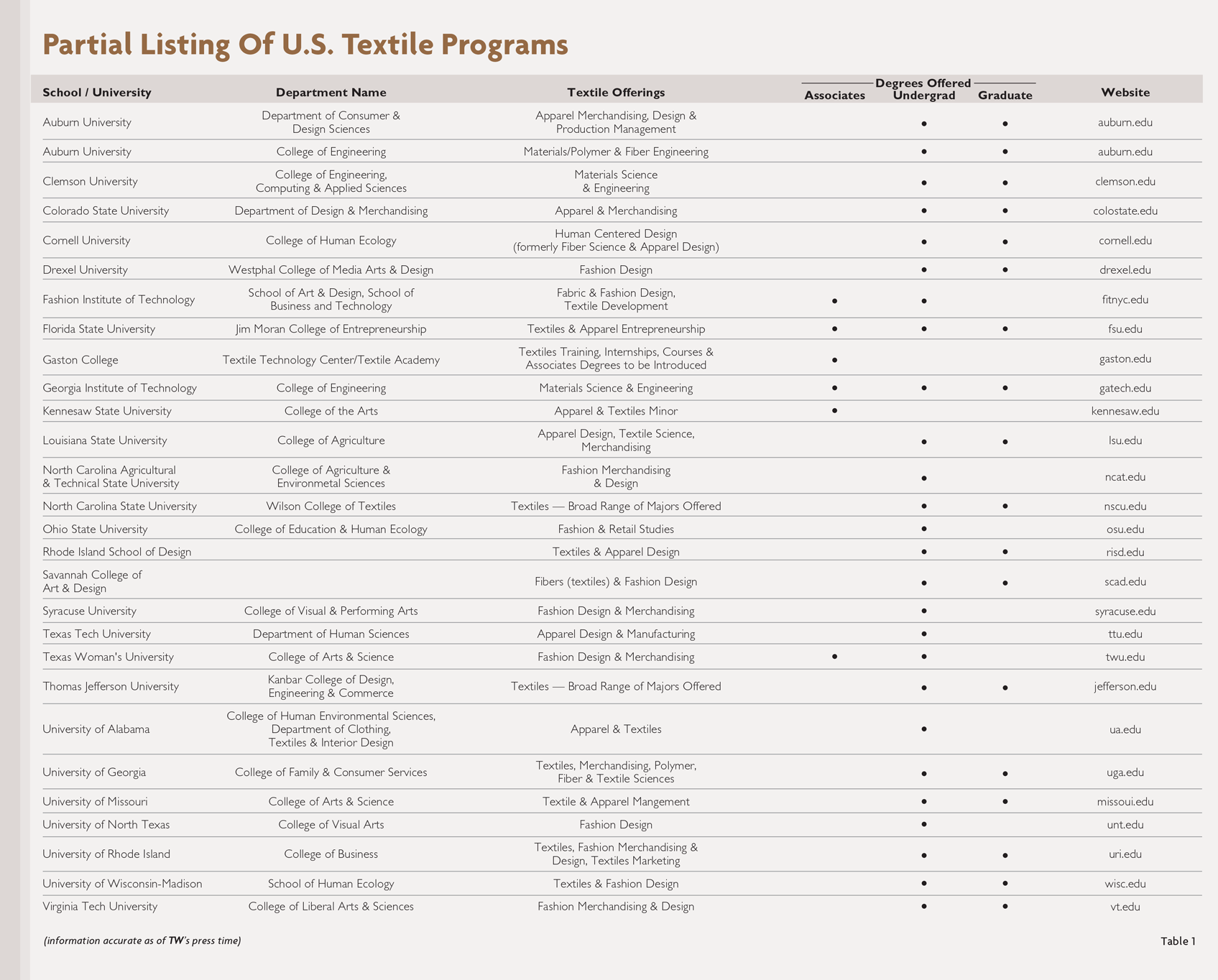
Along with Jefferson, Auburn University, Clemson University and the Georgia Institute of Technology have transitioned their textile programs into their College of Engineering. For example, Jefferson currently offers a B.S. degree in Engineering with a concentration in Textile Sciences and a B.S. in Textile Product Sciences. Jefferson also offers a Master’s in Textile Technology or a Master’s of Science in Engineering with a textile engineering concentration. And for anyone interested in continuing, Jefferson also offers a doctorate in Textile Engineering and Sciences. Texas Tech University’s textile programs are now part of the Department of Human Sciences.

There are, however, a growing number of colleges and universities that offer a variety of textile- and/or fashion-related programs (see Table 1), and interest in textiles is continuing to grow. “There does seem to be a change in perspectives about textiles as people start learning and seeing more about how textiles can be used,” said Dr. George. “Interest in textiles as an engineering and design medium is certainly growing and we’re finding that there are more jobs than applicants. People with textiles knowledge can essentially pick and choose where they want to go and what industry they want to be a part of. That wasn’t the case 20 years ago.”
Emphasis On Technology

“Textiles are definitely complex; and delightfully so,” advised Dean Leonard. “Because of this inherent complexity, we have altered our course offerings to be more inclusive in nature. We want our designers better versed in the technical details of textiles; and conversely, we want our technology and engineering students to be more aware of the design aspects of textiles to better understand the edges of each discipline.” A bigger emphasis on technology across the board helps instill this sentiment at most all universities. Design technologies and patterning software continue to become more complex for both knitting and weaving machines as the designs and applications also become more complicated in fashioning, and 3D knitting and jacquard weaving.

Priya Jyotishi, a graduate of Drexel University with a Masters in Science, Fashion Design and Research, who now works as a textile technologist for Propel LLC, Pawtucket, R.I., actually sought out the technical component when evaluating her school and program options. “The design execution is becoming more technical in nature,” Jyotishi said. “So, having that exposure from my classwork and labs has been very helpful in my current work.”

This technical growth is complicated by the fact that there isn’t a consistency to the design programs or interfaces used by different machine manufacturers. Programs can literally change from year-to-year and even model-to-model. A ground level exposure in school to machine design program fundamentals has proven to be very helpful to designers and engineers alike.
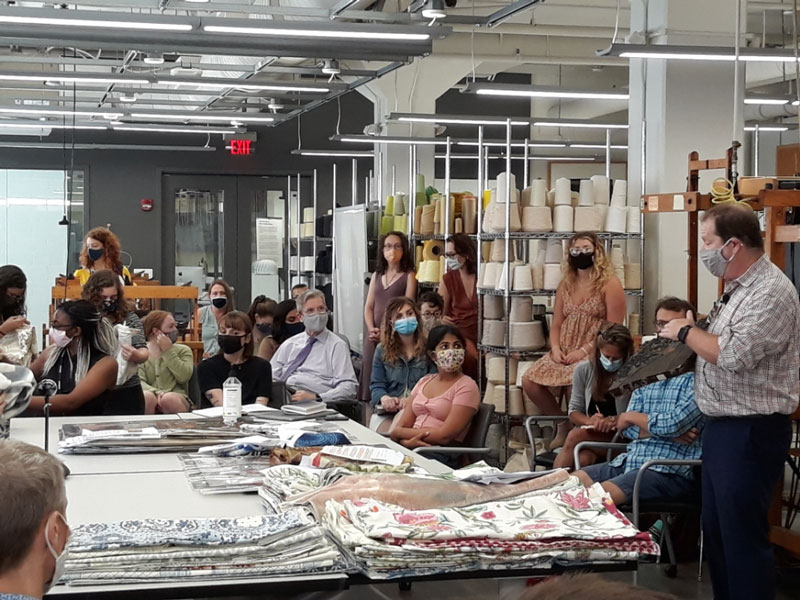
Dean Mike Leonard (third from left, wearing tie), academic dean, School of Design and Engineering, Thomas Jefferson University, sitting in with students during a presentation.

Collaboration Is Key

Collaboration is also a common term used at the universities. “We teach collaboratively at Jefferson,” Dean Leonard said (See “A Study In Collaboration,” TW, September/October 2020). “Departments collaborate with other departments. Students collaborate with each other and with our professors. And in all aspects, we engage our alumni and continue to build our collaboration efforts with the textile industry. Our goal is to create a hybrid student through collaboration. This allows them to address problem solving effectively from all sides and make them more grounded in what they do. You really can’t design or engineer things from only one perspective each time.”

At Gaston College’s Textile Academy, a similar theme rings true. “We’re hoping to rebuild the bridge between industry, both locally and nationally, and education through our collaboration efforts,” Cox said. “The textile industry in the U.S. continues to grow and change and we need to be able to support it throughout all levels.”

As the textile industry becomes more global in scope and nature, many of the universities also are extending their collaboration efforts globally by offering, projects with colleges and universities outside of the United States, international internships, and study abroad options. In most cases, these opportunities are geared specifically to the student’s interests.

Not to be outdone, NC State — with close to 1,000 students enrolled in undergraduate- and graduate-related programs as of Fall 2021, and countless numbers of alumni — is focusing its collaboration efforts on an even grander scale. “Taking a much broader world view helps our students to become more confident, more worldly and better prepared for what awaits them after their graduation,” Dean Hinks said. “We want to support the entire student, not just a part of them.” As a result, at NC State there has been an increase in study abroad options along with a heightened awareness of intern programs offered through local and international textile companies. To carry these efforts even further, the Wilson College of Textiles is preparing to launch “Wilson for Life,” a new directive intended to foster a lifelong relationship with the school. “We want earning that degree to be a mile marker and the beginning of a lifelong relationship that supports our graduates throughout the twists and turns of their career journey,” Dean Hinks said. “This program will include lifelong career support, increased community engagement and relationship building opportunities, and augment what has been done in the past only in a more formal manner. The cost of a four-year degree keeps increasing, and we need to demonstrate the real value of that degree is not just those four years, but much more.”

The Value Of A Textile Education

Textiles continues to offer a more unique value proposition, which really matters in today’s world. Today’s textile industry for a new hires can include most anything from polymer composition and additive chemistry to manufacturing, fashion, industrial and technical fabrics, or fiber reinforced composites. Given this and the fact that student placement rates are almost 100 percent, it’s fair to say a textile education can be an e-ticket ride to a rather interesting career and a wealth of opportunities!


Editor’s Note: Part two of this feature, to be published in an upcoming issue of Textile World, will look at continuing education and training courses offered by the industry’s various associations.


January/February 2022

Supply Chain Challenges

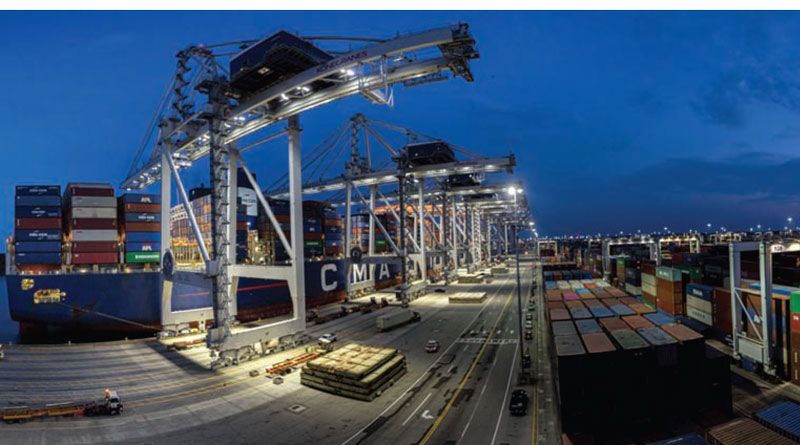
The Georgia Ports Authority achieved a record level of container trade in calendar year 2021, handling more than 5.6 million twenty-foot equivalent container units of cargo.

The Covid-19 pandemic tests the integrated nature of today’s global economy and exposes the fragility of its interdependence.

TW Special Report

The term “supply chain” swiftly entered common usage as the covid pandemic took hold in early 2020. For most consumers, the term and what it refers to was typically of no concern. Consumers relied on retailers and service providers to fulfill their daily demands at a moment’s notice. There was little need to know or understand the breadth of connections in global trade that put food on the table or packages under the Christmas tree.

In general, consumers rarely experience scarcity and empty store shelves — perhaps only in the run-up to a predicted storm that leaves supermarkets devoid of bread and milk, and home improvement stores out of plywood and sandbags. But consumers always had the confidence that once the storm cleared, abundance would be restored.

As the pandemic took hold with no reliable information regarding the depth or duration of the impending crisis, this experience with scarcity would be put to the test.

Trying To Forecast The Unforecastable

Good economic forecasts require stability in data. When data is lacking, and shifts and changes create uncertainty, it is impossible to make accurate forecasts — a fact that became evident as the Covid-19 pandemic unfolded.

Textile World magazine has posted more than 470 Covid-19-related news releases on its website since the pandemic took hold. The first post related to personal protective equipment (PPE). At that stage, the real effects of the disease were still relatively unknown, and no-one knew how important PPE was to become. The first such website posting, on February 3, 2020, was titled “Berry Global Increases Production To Aid In Coronavirus Protection.” The company, a major nonwovens manufacturer, acknowledged the importance of nonwovens “used in face masks, N95 respirators, and protective apparel, all of which have recently been in high demand in the plan to prevent the spread of not only the coronavirus, but also other communicable diseases.”

As the global economy began shutting down in early 2020, “non-essential” workers were furloughed or let go as factories around the world closed. “February is historically a slow month for imports because of Lunar New Year and the lull between retailers’ holiday season and summer, but this is an unusual situation,” said NRF Vice President for Supply Chain and Customs Policy Jonathan Gold in the National Retail Federation (NRF) Global Port Tracker press release in early February 2020. “Many Chinese factories have already stayed closed longer than usual, and we don’t know how soon they will reopen. U.S. retailers were already beginning to shift some sourcing to other countries because of the trade war, but if shutdowns continue, we could see an impact on supply chains,” the report continued.

“Projecting container volume for the next year has become even more challenging with the outbreak of the coronavirus in China and its spread,” Hackett Associates Founder Ben Hackett reported in the same NRF press release. “It’s questionable how soon manufacturing will return to normal, and following the extension of the Lunar New Year break all eyes are on what further decisions China will make to control the outbreak.”

The container ship CMA CGM Marco Polo is loaded and unloaded at the Georgia Ports Authority’s Port of Savannah Garden City Terminal, Savannah, Ga. (GPA Photo/Stephen B. Morton)

The NRF Global Port Tracker report was correct, uncertainty was the state of mind. Unfortunately, this led to several assumptions which, although reasonable at the time, in hindsight would set the stage for supply chain challenges. The general consensus was that if workers aren’t working, consumers have less money to spend and demand for goods in general would fall. In addition, lower levels of manufacturing would lead to less shipping and trade. But, in fact, demand shifted from services to goods, and rather than falling, created unexpected demand in the marketplace.

U.S. Textiles Responds To The Shift

Berry Global’s early warning about the need for PPE in early February 2020, was a sign of things to come. The company’s factories in Nanhai, China, and Suzhou, China, were prioritizing the production of nonwoven healthcare products where “… dedicated teams are working around the clock to manufacture as much of these materials as possible to help prevent the spread of the virus,” said Curt Begle, president of Berry’s Health, Hygiene, and Specialties Division.

On February 25, 2020, National Council of Textile Organizations (NCTO) President and CEO Kim Glas issued an announcement on the industry’s response to the coronavirus crisis stating: “The coronavirus has impacted Asian textile and apparel manufacturing productivity and output, and our concerns lie with the affected companies and workers during this terrible crisis.

“The U.S. textile industry continues to be ready, able, and willing to help in any way possible. Our industries have been in touch with U.S. government officials to help identify key U.S. textile suppliers to provide surgical masks and other items to help contain the spread of the coronavirus. In addition, several companies have donated much-needed medical textile supplies and other sanitary items to help address this outbreak.”

In March 2020, the NRF’s Global Port Tracker reported, “There are still a lot of unknowns to fully determine the impact of the coronavirus on the supply chain,” Gold said. “As factories in China continue to come back online, products are now flowing again. But there are still issues affecting cargo movement, including the availability of truck drivers to move cargo to Chinese ports. Retailers are working with both their suppliers and transportation providers to find paths forward to minimize disruption.”

“Now that we are in the coronavirus environment, uncertainty has expanded exponentially,” Hackett Associates Founder Ben Hackett said in the NRF March 2020 report. “Our projections are based on the optimistic view that by the end of March or early April some sort of normalcy will have returned to trade.”

And soon, as shipments of PPE vital to combating Covid-19 spread globally — from China to Africa, and China to the United States — long established shipping routes and divergent demand would disrupt the flow of shipping containers and a shortage of containers would ensue.

Soon those disruptions would log jam U.S. ports and create shortages of trucks, truck trailers, drivers, warehouse space and more.

Domestic PPE

By early April of 2020, the U.S. textile industry had quickly organized a manufacturing response to demand for PPE. “Coordinating with local hospitals, healthcare organizations, the entire U.S. production chain and federal agencies, the textile industry has been at the forefront of the incredible manufacturing effort, contributing to the country’s rapid response to the rising needs of frontline workers,” said NCTO President and CEO Kim Glas in a press release. “This industry has taken the lead in this effort, utilizing American manufacturing facilities and workers, despite facing many challenges in this environment,” Glas continued. “Our industry will continue to do all they can to serve the American people, frontline hospital workers and patients at this time.”

A broad coalition came together with companies like Parkdale Mills and Beverly Knits organizing a team of more than 25 companies employing some 4,000 American textile and apparel workers, to manufacture personal protective masks.

Shift In Demand And Working From Home

Early demand assumptions quickly backfired as consumers shifted demand from service industries to manufactured goods. Parents faced school closings and distance learning for their children. Trade shows, annual meetings and the like looked for virtual solutions. Business that could, quickly adjusted to work from home policies using virtual meeting solutions. But other businesses struggled and some closed. In addition, many workers, though severely challenged, received government assistance and pumped money into the economy.

Not understanding the duration of the pandemic, retailers didn’t know how best to respond. On March 19, 2020, a Bed, Bath and Beyond press release said the company would: “… temporarily close more than 50 percent of its stores across all its banners, within the United States and Canada, to help reduce the spread of the novel coronavirus (COVID-19).”  The closures affected the majority of its core Bed Bath & Beyond retail stores. Soon, other retailers followed suit as they attempted to manage the situation.

As retail stores closed, consumers shifted purchasing to online shopping. Delivery businesses sprung into action, often the only way restaurants could stay afloat. And virtual solutions took hold.

Port Bottlenecks

Shanghai’s problems were soon U.S. port’s problems. Goods of all stripes stacked up in California’s San Pedro Bay Ports Complex, which consists of the ports of Los Angeles and Long Beach. The ports were bottlenecked with sometimes 80, or close to 100, ships anchored outside the bay standing ready to deliver. Lack of trucks, trailers and drivers intensified the shipping jam. Christmas jitters put even more pressure on the stressed supply chain leading consumers to shop early. By the lead-up to Christmas 2021, trans-pacific shipments had risen 30 percent, the container shortage worsened, and the cost to ship from Shanghai to Los Angeles increased to nearly $20,000 from $2,000 in just 18 months.

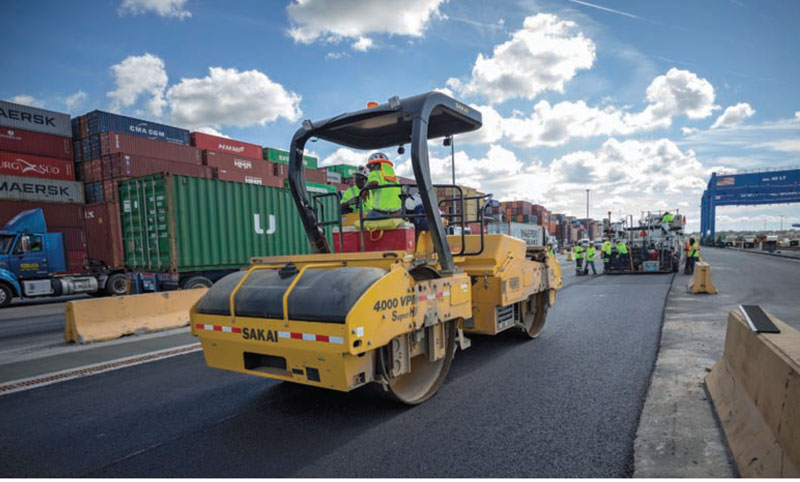
In December 2021, the Port of Savannah in Georgia marked 16 consecutive months of record growth. The Georgia Port Authority’s (GPA’s) response to the crisis was growth. “Infrastructure projects at the Port of Savannah will add 400,000 twenty-foot equivalent units (TEU’s) of annual capacity before January, and 1.6 million TEUs by June,” GPA reported. “The GPA handled nearly half a million TEUs in November. GPA is also expediting the completion of its Berth 1 expansion which will add 1 million TEUs of new berth capacity and eight ship-to-shore cranes at its docks. The project is now 30 percent complete and will come online at the end of Q2, 2023.”

GPA also noted that container storage was a major issue, stating: “Off-terminal, GPA has activated four flexible “pop-up” container yards near manufacturing and distribution centers. The sites in Atlanta, Savannah, Statesboro, and Murray County in Northwest Georgia bring cargo closer to customers and reduce the length of container storage time at the Port of Savannah. The GPA is also arranging additional sites, which will bring the total annual capacity for the off-port locations to 500,000 TEUs.”

Improvements in port congestion, even with growth, was achieved with The Journal of Commerce reporting in early January of 2022, “The number of vessels anchored outside Savannah has fallen to fewer than five, a significant improvement from September when the number was as high as 30.”

U.S. Textile Exports

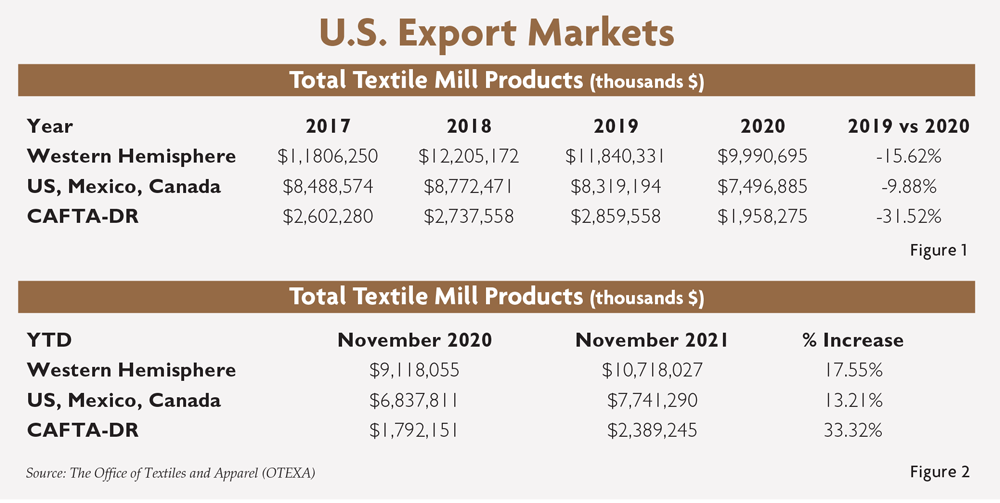
A look at textile exports to major trading regions illustrates the pandemic’s impact on the flow of goods. With data captured by The Office of Textiles and Apparel (OTEXA), Washington, the group “Textile Mill Products” is a strong proxy for a broad swath of U.S. textile manufacturing that, in general, captures textile products that come from the transformation of basic fiber into products, such as yarn or fabrics, that are further manufactured into functional items like apparel, sheets, towels, and bags for individual or industrial use.

For year ending November 2021, a full 70.6 percent of U.S. exports of Textile Mill Products went to the Western Hemisphere, 51.2 percent went to USMCA member countries — Mexico and Canada — and 15.6 percent went to CAFTA-DR member countries — Central America and the Dominican Republic.

As illustrated in Figure 1, U.S. exports of Textile Mill Products to the Western Hemisphere declined 15.6 percent in 2020 from shipments recorded for 2019, a decline of 9.9 percent was exported to USMCA and there was a whopping 31.5-percent decline to CAFTA-DR members.

However, year-to-date November 2020 shipments compared to year-to-date November 2021 show a significant rebound. As illustrated in Figure 2, U.S. exports of Textile Mill Products to the Western Hemisphere increased 17.6 percent in 2021 from shipments recorded for 2020, an increase of 13.2 percent was exported to USMCA and there was an increase of 33.3 percent in shipments to CAFTA-DR members.

U.S. Textile Yarn Exports

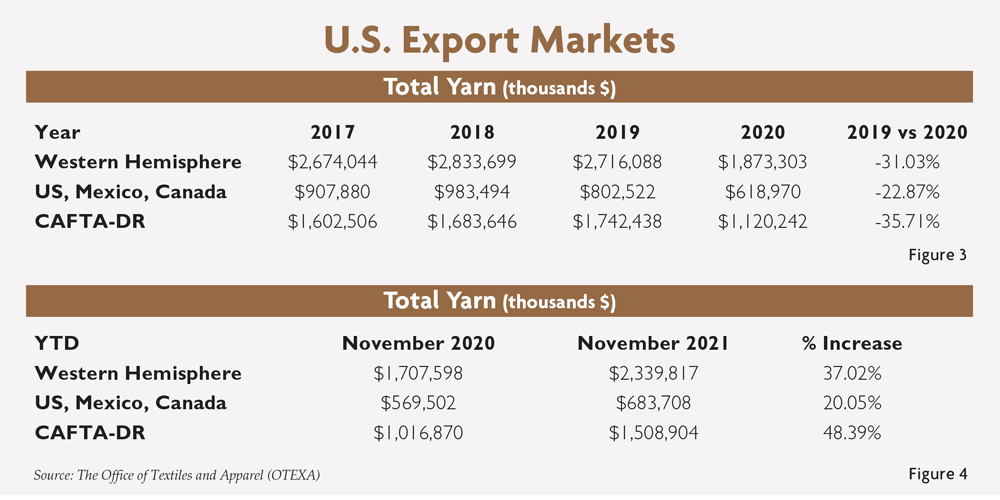
Yarn exports are very important to the U.S. textile industry and benefit trading partners who utilize the “Yarn Forward Rule” — the basis of many U.S. trade agreements.

A similar pattern of recovery is illustrated as displayed with mill products, and the November year-to-date data points to a positive 2021 outcome.

For year ending November 2021, a full 64.9 percent of U.S. exports of textile yarn went to the Western Hemisphere, 19.0 percent went to USMCA members, and 41.8 percent went to CAFTA-DR members.

As illustrated in Figure 3, U.S. exports of textile yarn to the Western Hemisphere declined 31.0 percent in 2020 from shipments recorded for 2019, a decline of 22.9 percent was reported to the USMCA region, and there was a sharp 35.71-percent decline in shipments to CAFTA-DR members. But again, year-to-date November 2020 shipments compared to year-to-date November 2021 show a significant rebound. As illustrated in Figure 4, U.S. exports of textile yarn to the Western Hemisphere increased 37.0 percent in 2021 from shipments recorded for 2020, an increase of 20.1 percent was exported to USMCA and there was a strong recovery of 48.4 percent to CAFTA-DR countries.

This is good news for the textile supply chain, but 2022 is still throwing head winds with rising commodity prices, fuel and energy costs trending higher and spotty delivery of components used in basic textile formulations.

Supply Chain Relief Ideas

In November of 2021, an open letter to President Biden undersigned by a broad coalition of associations, representing agriculture, food service, trucking, warehousing, manufacturing, retail, construction, energy, and other key supply chain participants was issued. The extensive list of undersigned organizations included: the American Apparel & Footwear Association; American Chemistry Council; National Cotton Council; and National Retail Federation, to name just a few.

The letter outlined a plan regarding five immediate supply chain solutions, summarized from original letter following:

  • Younger Driver Pilot Program: A pilot program that will enable employers to create a two-stage, safety-focused apprenticeship program to allow younger, qualified drivers — between the ages of 18 and 20 — who satisfy rigorous safety, training, and technology requirements to operate in interstate commerce.
  • Promotion of Careers in Transportation and the Supply Chain: Encourage federal agencies, including the U.S. Departments of Transportation and Labor, to collaborate with industry and state and local partners to promote transportation and supply chain occupations, particularly commercial truck driving, as a career of choice.
  • Flexibility in Vaccine Mandates: The organizations asked for flexibility for transportation and supply chain essential workers, particularly truck drivers who spend most of their time in their trucks and have minimal contact with colleagues and customers
  • Hours of Service Relief: Continue to support last year’s changes to the hours of service regulations that give commercial truck drivers greater flexibility while improving safety and efficiency. The Biden administration was encouraged to not only retain the changes, but also provide additional flexibilities.
  • Flow of Goods through Ports: Continue to investigate the causes of inefficiencies at the nation’s ports, draw input from a wide variety of supply chain stakeholders, and work collaboratively to minimize the bottlenecks and operational practices that prevent the seamless movement of cargo through the supply chain.
Infrastructure projects at the Port of Savannah are set to add 2 million twenty-foot equivalent units of annual capacity. (GPA Photo/Stephen Morton)

Relief On The Horizon

This year, 2022, is an unprecedented time in a world that has been bound together with global trade and integrated economies, while facing new geopolitical challenges and varying political structures — be it China, Russia, Central and South America, Europe or the United States.

Unfortunately, “supply chain challenges” are just part of the issues facing businesses and consumers today, but the term is on the brink of becoming a catchall phrase that includes all of the problems in today’s economy.

Business and consumers discovered that computer chips are in everything, and that a shortage could lead to a delay in buying a new truck — if one could be found. A supply chain issue? Maybe, but investment in additional microchip plants and equipment may help.

Consumers learned that shortages of commodity products like toilet paper could produce empty shelves for fairly long periods of time, a problem further impacted by some buyers hoarding more than they needed.

Consumers learned that food supply chains could by hit by multiple issues driving food prices ever higher. When fertilizer prices rise, feed crop prices rise, beef prices rise, labor shortages cause an increase in processing costs, and transportation — fuel and labor — costs rise, how can the cost of a hamburger not go through the roof?

Supply chain challenges are real, and some issues will be worked through more quickly than others. The year 2022 presents a real time of reawakening and rebuilding the economy. A new look at labor and the nature of work. A new look at sourcing and locating supply chains. A new look at sustainable manufacturing for other reasons than being green.

The U.S. has a robust, innovative and creative economy — supply chain solutions are on the horizon.

January/February 2022

Essity Acquires Legacy Converting

Philadelphia-based health and hygiene company Essity has acquired Legacy Converting Inc., a producer of roll and folded wipes in a variety of formats based in New Jersey. Legacy Converting produces disinfecting and wipe products under the Environmental Protection Agency-regulated Everwipe™ brand.

“The acquisition of Legacy Converting Inc. strengthens our wiping and cleaning product
expertise and offering and is a step in our expansion of this product area,” said Don Lewis, president, Professional Hygiene, Essity.

January/February 2022

Herrmann Ultrasonics Expands Nonwovens Lab

Herrmann Ultrasonics, Bartlett, Ill., has expanded its nonwovens laboratory at its headquarters to increase its global presence and support the growing North American market with application testing and customer support. The investment includes a ULC 600+ Ultrasonic Lab Calendar, among other technologies.

“Flexible and very thin materials, like 9 gsm, can be better controlled by means of a new web tensioning and control system,” said Uwe Peregi, president of Herrmann Ultrasonics. “With our brand-new quick exchange system for the ultrasonic stations, we can experiment with different ultrasonic technologies — static or rotating — in one single day. As a result, our customers will save time and money.”

January/February 2022

ANDRITZ Reports Sales

Austria-based ANDRITZ recently reported sales.Portugal-based Sasia, a textile recycling company engaged in reducing textile waste, took delivery of its fourth tearing
line — including a seven-cylinder Jumbo tearing machine and the latest Andritz Laroche technology for fiber opening.

Andritz also received an order from the converting/wipes manufacturing partners Switzerland-based Laboratoire Naturel and Russia-based ZetTechnology group of companies — for their first neXline spunlace line. The equipment is scheduled for start up in the second quarter of 2022.

January/February 2022

BFT To Acquire Lumberton Cellulose

Bast Fibre Technologies Inc. (BFT), Victoria, British Columbia, has entered into an agreement with Georgia-Pacific Cellulose LLC to acquire Lumberton Cellulose, a Lumberton, N.C.-based processor of natural fibers.

“Acquiring this state-of-the-art natural fiber processing facility and integrating the great team at Lumberton enables BFT to immediately establish North American manufacturing operations to meet the rapidly growing demand for our sustainable natural fibers,” said BFT CEO and Chairman Noel Hall.

“This acquisition is a key strategic milestone in our mission to build out significant manufacturing capacity while supporting the vast potential of North American grown hemp and flax”, added BFT President Jim Posa.

January/February 2022


New HQ For Natureworks

Natureworks LLC, Minnetonka, Minn., has opened a new headquarters and advanced biopolymer research facility in Plymouth, Mass. The new facility supports research into its Ingeo™ biopolymer including next generation fermentation technology and new applications for a full circular life cycle. The research and development capabilities also will support the company’s planned Ingeo manufacturing complex in Thailand.

“In the face of these challenging times, we’ve designed a space that will enable research, invention, and collaboration between us, our partners, and the market, no matter where we are located in the world,” said Rich Altice, president & CEO of NatureWorks.

January/February 2022

TENCEL™ Turns 30

This year, TENCEL™, the flagship fiber of Austria-based Lenzing AG, is celebrating its 30th anniversary. To mark the occasion, the company has planned a series of brand, employee and consumer activities beginning in February.

“Since its launch 30 years ago, TENCEL has always been envisioned as a solution provider for the textile industry,” said Robert van de Kerkhof, member of Lenzing’s managing board.

“Aligning with the industry-wide shift towards deeper levels of sustainability and transparency, in 2018, the brand evolved from a behind-the-scenes contributor to a front-facing player. …We are thrilled to reach this milestone and are looking forward to driving continuous innovation and building stronger partnerships over the next 30 years and beyond.”

January/February 2022

MonforClean Brings Big Savings For Albarrie

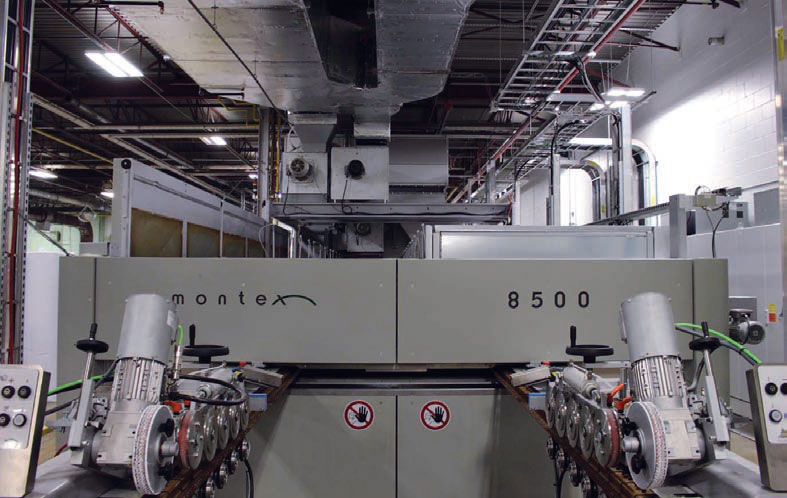
Full configuration of the Monforts and KMA Umwelttechnik line.

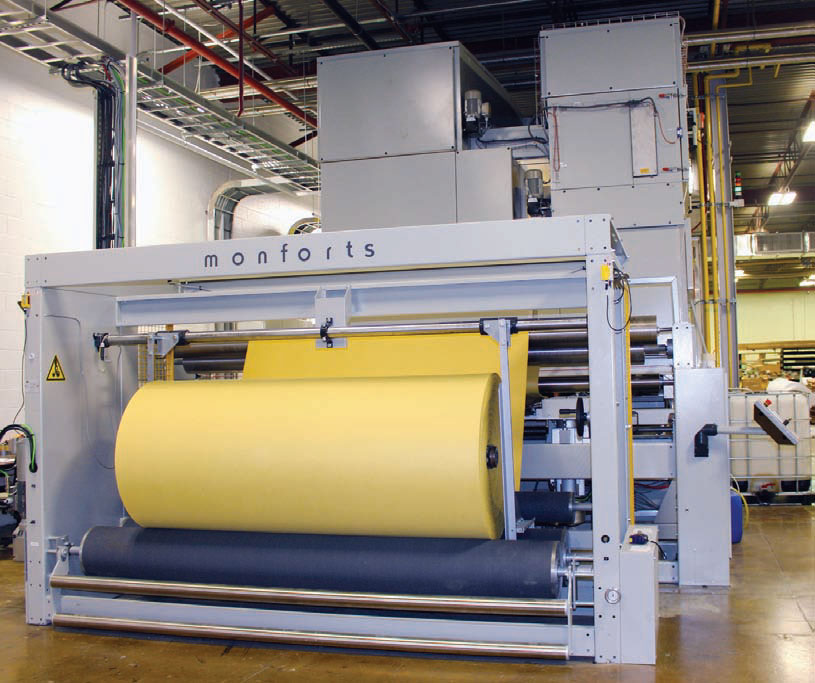
Albarrie – a major player in North America’s industrial nonwovens industry – is now benefiting from one of the first Monforts Montex tenter installations equipped with the full range of MonforClean heat recovery and exhaust air purification technologies.

TW Special Report

With the new three-chamber Montex tenter at its plant in Barrie, Ontario-based Albarrie Canada Ltd. is treating specialized needlepunched nonwovens up to 4 millimeters thick. These nonwovens have applications in a wide range of filter media and performance fabrics.

The new Montex enables Albarrie to heat set and dry its materials to produce denser, higher quality fabrics which can also be finished and delivered to customers more rapidly.

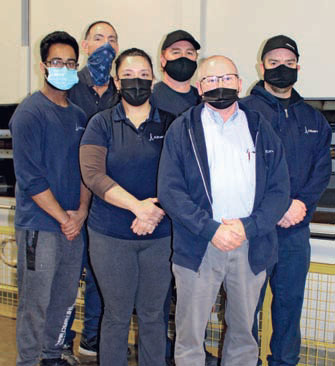
The Albarrie team by the new machine at the company’s plant in Barrie, Ontario.

Across Time Zones

It took a crew of skilled millwrights, electricians and product specialists to build the line which was delivered in 11 shipping containers to Albarrie’s production facility. The line was originally scheduled to be fully operational in the Spring of 2020, but the ongoing global Covid-19 pandemic inevitably led to several delays during the start-up and commissioning process.

“Through the challenges of the pandemic, Albarrie staff worked remotely across time zones with Monforts technologists and product specialists to access and configure the machine and run it through a rigorous testing schedule prior to launch,” said Kevin Horner, Albarrie’s director of Operations.

Assistance closer to home also came from PSP Marketing, which represents Monforts in North America from its base in Charlotte, N.C.

PSP reports that there currently is a push for the replacement of tenter frames in the United States. “There’s a move by a number of our customers to bring more manufacturing back to North America, which is definitely a benefit to us,” said PSP Vice President Alex Franco. “And the trend to smaller lot sizes and speed-to-market is something at which the latest Monforts’ technologies excel.”

Finished roll coming off the line at Albarrie.

Energy Savings

The Albarrie Montex line’s MonforClean capabilities include an air-to-air cross flow heat exchanger and an electrostatic precipitator providing the ability to purify the exhaust air and to recover energy to a maximum of 22,500 cubic meters of air per hour, resulting in a radical reduction in the conventional heat supply required. The MonforClean was developed in cooperation with Germany-based partner KMA Umwelttechnik.

The fully automated system is powered by a Siemens SPS S7 controller and KP 700 touch panel from which the recycled energy can be continuously monitored and savings calculated.

“The further integration of a washing system that automatically cleans the heat recovery and the exhaust air filter is a serious benefit to U.S. manufacturers because the labor costs for the normally manual cleaning work is so high,” Franco said.

The line’s MonforClean capabilities include an air-to-air cross flow heat exchanger and an electrostatic precipitator.

“This is an exciting time here at Albarrie and this new Montex tenter will ultimately open new doors for our business,” Horner noted. “We have noticed significant improvements in many areas compared to our old unit, such as the cleaning access and the ability to easily clean, which reduces down-time, while the efficient burners and exhaust system allow quicker start up and cool down periods. In addition, more controllable features allow for increased quality control and the air filtration system reduces smoke and pollutants, keeping pollutant-free air in our neighborhood.”

The three-chamber Montex tenter is fitted with the latest Monforts Qualitex 800 PLC control system with WebUI, providing ease of operation, a full operating cost overview and maintenance monitoring.

“The new tenter has been very easy to learn for the operators,” Horner said. “It is easy to monitor, and the controls are simple and easy to understand. While reviewing the requirements for the new machine, energy savings were part of our OEM score card. Energy costs are rising, and with carbon taxes being implemented, having our tenter use natural gas will result in energy savings. We are still early in the process of reviewing the consumption data from the new unit compared to the older unit, but currently, the early data indicate that we are consuming on average the same amount of energy, but achieving 1.5 times the amount of BTUs per hour for the same consumption. Most importantly, all of our products run without problems.”

“This was a big investment for Albarrie, but it was an investment for the future, one that will ensure we have the capability to remain competitive in the fabricated textile market for years to come,” added Albarrie’s Executive Director Margaret Driscoll.

January/February 2022

The Resurgence Of Water Repellency Testing

James Heal’s TruRain tester uses an artificial rain shower to determine water repellency.

Water repellency testing helps retailers and manufacturers meet and exceed consumer’s comfort and performance expectations in outdoor apparel.

By Paul Montalto

In 2019, the waterproof, breathable textiles market was valued at $1.7 billion, according to a Market Analysis report. The report further estimates a compound annual growth rate of 6.6 percent over the following six years for that particular market. This trend is driven by a growing awareness of the health benefits of sports and the increased necessity to exercise outdoors. Within this space, water repellent garments have become key performers.

Water repellency describes water beading on the surface of a textile, where the water resists penetrating the fabric. This property often is achieved by combining membranes or coatings with tightly woven fabrics. The benefit of water repellent garments is their breathability. The fabric remains porous making it permeable to air and water vapor, which makes them more comfortable for the wearer. Ultimately, a water repellent garment should offer comfortable protection from intermittent rain.

James Heal’s TruRain water repellency tester.

Why Is Water Repellency Important?

Water repellency is important largely because a change in consumer behavior makes it so.

There has been an increased interest in athleisure for many years now. The sportswear industry has influenced mainstream fashion, and innovations in technology have led to improvements in functionality.

For outdoor wear in particular, the onset of a global pandemic increased demand even further. With the long-term closure of gyms, swimming pools and exercise classes, more and more people headed outdoors to exercise. In addition, more people are holidaying in their home country, which for many, means swapping swimwear and shorts for raincoats and walking trousers. With this increase in demand comes more rigorous performance testing to ensure the garments perform as they should when exposed to the elements.

It is also becoming more common to select accessories such as backpacks for their water repellent or waterproof qualities. Another consideration for brands and manufacturers can often involve more feature specific testing to establish, for example, what role seams, zips and pockets play.

Consumers expect comfort from their garments. Comfort is influenced by fit factors as well as fabric properties such as stretch and recovery, and thermal and moisture management properties. But for outdoor wear in particular, comfort is about finding a balance between keeping water out and letting sweat escape.

Risks Involved In Getting The Breathability Of Water Repellent Fabrics Wrong

Safety is arguably the most important feature that users expect from their performance garments. There are risks involved with getting the breathability of water repellent fabrics wrong, mainly that they can trap sweat and cause the wearer to overheat. This might not seem like an issue for a quick walk around the park, but for wearers on long hikes this could cause serious health risks.

To understand the testing that must be performed, it is important to understand the make-up of a garment, and the role that layers play.

In sportswear, and especially outdoor wear, a three-layer clothing system is often advocated, with each layer in the system performing a different function that complements the whole for maximum comfort.

A layering system typically includes:

  • A base layer;
  • A mid layer; and
  • An outer protective shell layer.

An effective outer layer should have a high level of water resistance as well as a high level of water vapor permeability, or breathability. How this layer is constructed plays a significant part in this permeability.

This is where the challenge for the outer layer comes in — creating a fabric that provides good water resistance is relatively simple, but doing so while maintaining breathability is a more complex process because the two properties have an inverse relationship in typical textiles. A thorough testing regime can prove the balance between these properties have been met.

Testing Water Repellency

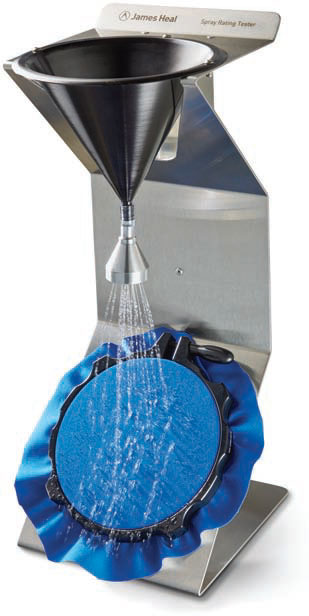
Water repellency is tested by spray methods, using instruments such as the Bundesmann or Spray Rate Tester, where water is run over the surface of the fabric and the repellency is visually graded.

For the Bundesmann method, in particular testing to ISO 9865, the test instrument generates artificial rainfall to simulate the real life conditions the end garment will be used in. Here, three aspects of water repellency are measured:

  • Surface water repellency is visually assessed;
  • Resistance to water absorption is evaluated by weighing the specimen; and
  • Resistance to water penetration is determined by collecting water that has passed through the sample.

As with any testing, there are certain parts of the process to look out for, which can have an impact on the results.

Pro tips for testing include:

  • Clamping the fabric correctly to avoid variance in results;
  • Timing is everything – be ready to assess as soon as the test finishes;
  • Condition the samples in accordance to the standard;
  • Water temperature is important and should be recorded; and
  • The Bundesmann must be run for 15 minutes prior to testing to guarantee water flow is consistent.

Sustainability

Traditionally, the Bundesmann test requires a lot of water, which can be an issue for apparel brands and manufacturers who are tackling sustainability issues.

The UN Partnership on Sustainable Fashion found that fashion is responsible for nearly 20 percent of the world’s wastewater, and 10 percent of global carbon emissions, so there is a lot of pressure to be cleaner, more efficient and ultimately sustainable. Although testing plays a small part in the process, there are significant savings to be made in water usage during testing.

James Heal recently conducted a small research project into the efficacy of water recirculation on its Bundesmann testing instrument.

James Heals’ Spray Tester also may be used to test water repellency.

A typical Bundesmann water repellency tester that runs for eight hours per day, five days per week, is consuming 3,360 liters of water. It is plumbed into the mains and drained directly after a single fall onto the specimen. Recirculating the water would reduce usage, but we had to establish there would be no detrimental effects to testing when doing this.

Concerns included:

  • If the fabric sheds when being washed — and man-made fabrics in particular shed a lot of microplastics — would this shedded material stay in the water and impact the next round of testing?
  • Would the shedded material stick to the next specimen being tested and give a false impression of water repellency for a garment that would then fail when worn?

James Heal conducted significant testing, both in-house and using an external laboratory, to verify that the results would be accurate regardless. The test results concluded that there was consistency from start to end, and by confirming this, the company was able to calculate the savings its recirculation unit could offer, including:

  • An eight-hour working day’s use of the James Heal TruRain Bundesmann recirculation system sees 83 percent total cost savings in energy consumption and total running costs.
  • There is less waste: 99-percent less water is used during testing alone — 150 tests a week equates to a drop in water consumption from 2,100 liters to just 23 liters.
  • Additionally, it is accurate, safe and reliable: Through the use of an effective Water Safety Plan, health and safety can be maintained.

James Heal also found that by using the recirculation unit, it was much easier to maintain the temperature of the water. The percentage of water absorbed by fabrics can increase as the temperature increases, so it is important to control temperature for consistency in results.

Proving Water Repellency

With an increase in demand for water repellent clothing, and the subsequent increase in the popularity of Bundesmann testing, understanding and implementing repeatable testing is crucial to substantiate any claims made about a garment. The challenge for retailers and manufacturers is to meet and exceed consumer’s expectations for comfort and performance, and water repellency is one part of the puzzle for achieving this.


Editor’s Note: Paul Montalto is a Technical Knowledge manager for the Physical Properties Testers Group (PPT Group), an England-based family of brands — James Heal, Mecmesin and Alluris — that design and produce solutions for testing a wide range of physical properties including compression, light fastness, moisture, dry rate, water repellency, abrasion, flammability, and tensile and torque properties.


January/February 2022

Sponsors