Karl Mayer, Primon Develop Robotic Rotary Creel Loading

Karl Mayer Textilmaschinenfabrik GmbH, Germany, and Primon Automazioni, Italy, have jointly
developed robotic rotary creel loading technology to improve the doffing/donning process on Karl
Mayer’s Gir-O-Matic sample warping machine. Karl Mayer reports the technology offers benefits when
yarns must be changed frequently or when working with short warp lengths.

A robot station allows bobbin changing during total or partial yarn creeling and subsequent
automatic knotting of yarn ends. Tools include: pick and place tool to take bobbins from the
loading trolley and for bobbin doffing/donning; yarn-sucking tool; yarn-cutting/positioning tool;
mobile knotting tool; rotary creel bobbin holder release tool; loading trolley; and Karl Mayer
laser monitoring system to measure bobbin diameters as they run out. A modification to the
Gir-O-Matic allows bobbin mounting onto the loading trolley at the robot station rather than
directly onto the rotary creel. Karl Mayer reports the robot station enables a production increase
of 15 percent or more and maximizes the machine’s flexibility.

May/June 2010

Quality Fabric Of The Month: The Auxetic Effect

Typically, if a flexible material is stretched in one direction, it thins out in the other; and if compressed in one direction, it thickens in the other. However, in the case of auxetic materials, the converse is true. For example, if a thin, inelastic fiber is wrapped around an elastic core and then pulled lengthwise, the elastic component bulges outwards. This simple, elegant auxetic effect can be the basis of some revolutionary solutions for all sorts of textile applications.

Zetix™ helical-auxetic fiber technology – developed in the United Kingdom by Dr. Patrick Hook, managing director, Auxetix Ltd., in collaboration with researchers at the University of Exeter and Dow Corning Ltd. – has won several awards, including the Techtextil 2007 Innovation Prize. Hook, an engineer who had been involved in the motor racing arena prior to pursuing a doctorate in engineering with a focus on auxetic materials, established Auxetix to commercialize
the patented technology. Auxetix now has granted an exclusive license to Houston-based Advanced Fabric Technologies LLC (AFT) to develop and market Zetix fabrics for use in blast-mitigation and ballistic-protection fabrics in North America, as well as first right of refusal to market and manufacture the fabrics elsewhere in the world.

QFOM1

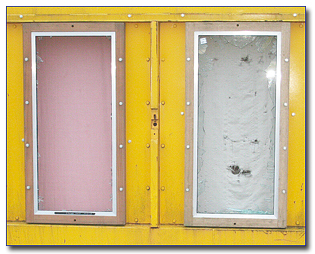
A test conducted by the UK Ministry of Defence compares the performance of a Zetix™ blast
curtain (left) with that of a conventional blast curtain.

“This is a completely new approach to material science, particularly for blast and ballistic mitigation, and we think it’s going to be a game-changing, breakthrough technology,” said Tony Lentini, AFT’s vice president of marketing.

Zetix comprises a series of auxetic yarns, each yarn wrapped using S or Z twist with a high-strength cord — or “power thread,” as Lentini described it — and woven by weft insertion across the warp. Off the loom, the weft becomes the tensile element in the fabric. “When force is
applied,” Hook explained, “the auxetic yarns deform, opening thousands of small pores in the fabric’s surface. In so doing, they absorb the peak pressures from the blast wave and yet allow the
rest to pass through. At the same time, they catch any airborne debris such as glass shards, shrapnel or secondary fragmentation.” In simulated car bomb testing and grenade testing, Zetix has shown “remarkable resilience,” sustaining negligible damage after eight nearby grenade blasts, he added.

“It is the only material on the market that automatically adjusts its strength and thickness in response to explosive forces,” said AFT CEO David O’Keefe. “Because it has memory, it returns to its neutral state when the stress is dissipated.”

The basic Zetix fabric is made with a Spectra®-wrapped polyester monofilament and ballistic nylon; but materials such as Kevlar®, Vectran™, Hytrel®, Nomex®, fiber optics or telemetric materials may be used for specialized applications.

“That gives you the capability to have many generations of Zetix,” O’Keefe said. “We can immediately increase the strength by probably 80 to 85 percent just by substituting Vectran for ballistic nylon.”

QFOM2

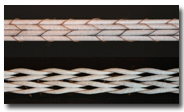
Bungee cords wrapped with inelastic cords and then stretched demonstrate the principles of
helical-auxetic technology.

Potential blast- and ballistic-protection applications include spall liners for armored vehicles, allowing a reduction in armor thickness and a consequent reduction in vehicle weight. Incorporating Zetix in body armor worn by soldiers in the field also could lighten the load they
must bear.

O’Keefe said Zetix will be cost-competitive weight-for-weight with other blast-mitigation fabrics, and its performance advantage will provide added value. “Because it’s not a single-event fabric, the cost of development or installation would be recouped pretty easily,” he said.

Although Zetix has successfully undergone official testing in the United Kingdom, the performance data from those tests is not easily accessible, so AFT is conducting testing in the United States so it can provide specific results to potential users. “We want to provide hard data to support Zetix’s claims, and we’re working with other companies and independent testing labs to generate it,” Lentini said.

AFT is working with US and Canadian manufacturers including Greensboro, N.C.-based BGF Industries Inc. and Quebec-based JB Martin Co. to produce Zetix fabric and is seeking additional
partners along the supply chain for various aspects of production.

“We’re looking for materials that would work well and be low-cost, and we’re looking for a variety of sources,” Lentini said. “For example, a critical component is the wrapping of the power thread because it’s key to the whole auxetic effect. We’re looking for people with capabilities to
do that efficiently and who can supply that thread to the weavers.”

Virtually Unlimited Potential

While the immediate focus for Auxetix and AFT is to provide blast-mitigation and ballistic-protection solutions for military and first-responder applications, there are many other areas in which Zetix technology can play a role. Even those initial solutions have relevance for non-defense applications, such as mine safety, hurricane protection, satellite testing, jet engine shielding — the list goes on. Nomex or a Hytrel flame-retardant yarn could be incorporated to add protection from high-heat or a fireball. With the addition of fiber optics, a Zetix apparel fabric could change color to help camouflage the wearer; or the addition of telemetric materials could allow remote monitoring of a person’s heartbeat or other vital signs. In the medical field, potential applications include adjustable bandages, sutures and medication delivery. There is good potential for filtration, as the behavior of the yarns can allow a filter to self-adjust in response to applied force; and the self-adjusting capability in a seat belt could help minimize
injury from an accident.

“Down the road, your imagination is the only limit to what this might do,” Lentini said. “Way down the road, imagine a military battle uniform that is blast- and shrapnel-resistant, can change color because of fiber optics, has telemetry that will measure a soldier’s vital signs and
could send a signal to adjust a built-in tourniquet. This may be pie in the sky now, but the auxetic effect is so important here, you can let your imagination run wild.”


For more information about Zetix™, contact David O’Keefe 1-281-872-7272; dokeefe@advancedfabrictechnologies.comwww.advancedfabrictechnologies.com


May/June 2010

Steel Heddle® Offers Wide-Width Frame

Belgium-based GTP Global Textile Partner’s Steel Heddle® subsidiary now offers a
5,475-millimeter-wide heddle frame that requires no center support. GTP reports it is the longest
frame ever produced without center support, and is suitable for weaving machines operating at high
speeds, especially those used to produce technical fabrics.

The frame is a modified version of Steel Heddle’s HybridPower 158 aluminum frame with carbon
strips to provide stability for high-speed operation.

May/June 2010

May/June 2010

The
California Fashion Association, Los Angeles, has elected
Won Kim, Fineman West & Co. LLP, to its Advisory Board.

Loves Park, Ill.-based
Zenith Cutter Co. has appointed
Paul Nissen Midwest sales engineer.

PeopleNissen

Nissen

Paris-based
Messe Frankfurt France S.A.S. will award
Manix Wong the Dinard 2010 Grand Prix Homme at Texworld, to be held September
13-16 in Paris.

Texas Tech University, Lubbock, Texas, has named
Stephanie Hartwig, men’s jeans division, and
Becca Pierce, women’s jeans division, winners of the first Denim Runway
competition.

The
American Apparel and Footwear Association, Arlington, Va., has named
Killick Datta, International Brand Partners LLC, chairman of the Board of
Directors.

The
Carpet America Recovery Effort (CARE), Dalton, Ga., has named
Georgina Sikorski CARE Person of the Year.

The
American Association of Textile Chemists and Colorists (AATCC), Research Triangle
Park, N.C., has awarded
Dr. S. Kay Obendorf, Cornell University, the Olney Medal for outstanding
achievements in textile chemistry;
Dr. Martin John Bide, University of Rhode Island, the Harold C. Chapin Award for
outstanding service to the association; and
Nestor Beyer Knoepfler (deceased) the Henry E. Millson Award for Invention for his
work developing a flame-retardant treatment for cotton batting.


PeopleObendorfPeopleBide

Obendorf (left) and Bide

New York City-based
Kaltex America has named
Keith Hull president and CEO.

Shaw Industries Group Inc., Dalton, Ga., has named
Bob Burton divisional vice president, Tuftex product management and marketing.

Energy Savings In Thermal Nonwovens Processes


I
n thermal nonwovens processes, most medium- and long-term costs are not caused by
machinery purchases, but by the thermal energy generated. The most important measures are initial
moisture reduction, exhaust-air flow optimization and heat utilization, and a highly efficient
dryer. The Eco-Heat heat-recovery and Eco-Air exhaust-air cleaning systems from Brückner
Trockentechnik GmbH & Co. KG, Germany, allow considerable cost cutting and are compatible with
all dryer makes.

Production line operating costs have a decisive influence on the total costs of articles
produced. Even nonwovens and technical textiles producers face ever more decreasing profits. One
reason is tough competition due to globalization. Another is that more and more producers want to
share in these segments by diversifying their existing portfolios. In parallel, operating costs
have increased rapidly in recent years, caused mainly by rising energy costs. If nonwovens
producers want to save these costs, they must consider measures resulting directly in lower
specific energy consumption and measures indirectly but positively affecting energy consumption.


Three Production Steps


The nonwovens process comprises mainly three steps: First, a web is formed from individual
fibers. This web, still sensitive to pressure and traction, eventually is treated using bonding
processes to get the required dimensional stability. In the last step, the nonwovens are finished
using different methods to give the requested end-product characteristics.

The complete process requires a corresponding amount of energy, mainly electrical or
thermal. Depending on the process step and the applied methods, the portion of required electric
and thermal power and the relevant energy carrier’s absolute consumption differ very much.

While nonwovens formation requires electric power almost exclusively, the portion of thermal
energy increases significantly for bonding and finishing. Particularly energy-demanding are all
bonding methods, such as spray bonding, hydroentanglement, full bath or foam impregnation. And
nonwovens finishing technologies such as coating, printing, dyeing and others require the
evaporation of water or solvent.
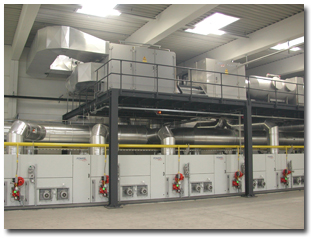
EnergyBruck

Brückner’s Eco-Heat heat-recovery and Eco-Air exhaust-air cleaning systems are shown
installed on a nonwovens finishing line.


Electrokinetic Energy


Apart from thermal energy, it also is possible to save electrokinetic energy. Electrical
energy needs are determined by motor size and efficiency, a drive system that is optimally designed
and fine-tuned for the complete line, and the consequent use of highly efficient gears and motors,
which offers a big savings potential.

Brückner has calculated possible annual savings in a five-digit-euro range for production
lines. In addition, the use of suitable raw materials and high-capacity materials and thus
achievable weight savings also contributes to cost savings.


Thermal Energy


In nonwovens production, thermal energy is required almost solely for bonding and finishing.
Heat transfer from machine components onto the nonwovens is made by heated roller contact, infrared
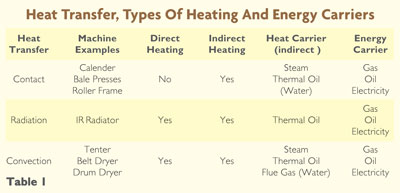
radiation or convection. However, there is a difference between direct and indirect heating: With
direct heating, the heat generated by the energy carrier comes directly in contact with the
substrate. Indirect systems generate the primary heat basically in the same way, but the thermal
energy is first transferred to a carrier medium and then by means of a heat exchanger onto the
nonwoven
(See Table 1).
BrucknerTable1

In this connection, two aspects are of particular importance regarding thermal energy cost.
Direct heating systems are approximately 92- to 96-percent efficient, while indirect systems
provide only 60 to 85 percent of the primary energy. Also, basic prices for the elementary energy
carriers’ power can differ considerably and thus directly affect the cost per generated kilowatt of
thermal energy.


Surprising Results


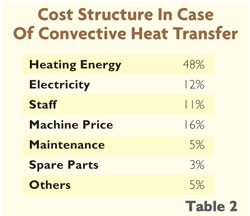
Some years ago, Brückner completed a study regarding life cycle costs, focusing on how a
machine’s operating and energy consumption costs are distributed over time for a convective heat
transfer process. The expenses for heating energy and power represent more than 50 percent of the
total costs
(See Table 2). However, most of the customers participating in the study overestimated
heavily the share of the machinery price, with an average estimate at 40 to 50 percent, whereas
energy costs were predicted only at 30 to 40 percent.

BrucknerTable2

To reduce thermal energy costs in nonwovens bonding and finishing, it is a prerequisite to
know the parameters involved in the process and the corresponding energy inflow and outflow.
Thermal energy is required to heat the web to the desired temperature, evaporate moisture adhering
to the textile, and heat the exhaust air and/or the corresponding quantity of fresh air to remove
the evaporated water.

The evaporation of water and the heat removed with the exhaust air and the heating of fresh
air require most of the consumed thermal energy. The portions for fabric heating and heat losses
due to the transport system and machinery components are rather low in comparison. Heat losses in
modern convection machines are not more than 3 percent of the total heat required. Therefore,
machinery producers focus optimizing efforts mainly on cost drivers where possible savings are
higher. In practice, heat losses are often discussed, and it is correct to strive for improvements
here, too. However, as the use of high-capacity materials leads also to considerable cost increases
for the complete machine, the achievable benefit must be critically analyzed.


Energy Savings


The decisive saving potential is in the energy required for water evaporation, exhaust air
flow and fresh air heating. The first step is to provide for the best mechanical dewatering of the
web, as lower initial moisture leads to lower energy consumption.

The second step is to reduce exhaust-air volume. Drying requires air that is able to absorb
moisture. Lower exhaust-air flow means higher saturation of the circulating air with steam, but
absorptive capacity decreases with increasing humidity, and the dew point sets a physical limit.
The moisture in the dryer interior or in the exhaust-air ducts condenses when maximum saturation of
the circulating air is exceeded. Exhaust-air-flow reduction is always connected to dryer
performance and is thus a problem for optimization. According to Brückner, the optimization is
between 80 and 140 grams of moisture in the exhaust air per kilogram of exhaust air. A control
system allows setting this optimum for each drying process by automatically adapting exhaust-air
volume flow independent of exhaust-air moisture.

Control of exhaust-air volume flow and recovery of exhaust-air heat make up the third step.
It is possible to recover efficiently most of the heat discharged with the exhaust air by means of
heat-recovery systems. A possibility is to heat fresh air, which is then supplied to the convection
machine. In this context, there is a considerable difference in the heat-setting process: The use
of exhaust-air heat is also important because there is no measurand for the exhaust-air flow
control. Also, here, the exhaust-air flow should be as low as possible. However, condensation of
finishing vapors must be avoided. The only possibility for such processes is manually controlled
exhaustion.


Heat Recovery


Brückner provides two systems for exhaust-heat recovery: air-to-air; and air-to-water. Both
can be combined and varied and adapted to any convection machine or to customer specifications.
Also, when combined with an electrostatic precipitator, this efficient method of economic energy
utilization can be enlarged to be used as a high-capacity exhaust-air purification system. This
heat-recovery system can be used with a range of dryers, ovens and heat-treatment chambers.

Using an air-to-air system, process heat can be reduced by 12 to 15 percent; and using
heat-setting processes, by 33 to 36 percent. Another possibility is to use the hot fresh air to
air-condition the factory. With an air-to-water system, water can be heated to 90°C. These are
excellent savings possibilities regarding the overall energy balance of a plant for nonwovens
producers that use hot water for their wet-finishing.


Editor’s Note: Stefan Müller is sales director, Nonwovens, at Brückner Trockentechnik GmbH
& Co. KG.


May/June 2010

Recent Developments For Spunlacing


T
he nonwovens market is showing steady growth, especially for hydroentangled products,
also called spunlaced nonwovens. From the first rigid, paper-like products, production technologies
have reached a level at which products truly have a textile appearance in terms of hand, softness
and also fabric weight.

Spunlaced products are enjoying a rising interest around the world. There is growing demand
for lightweight hydroentangled products for medical and hygiene applications  especially in
Asia, where the Chinese market plays a major role.


Fibers


The fibers used for the spunlace process generally have been developed especially for this
process and should be specified as such, notes Germany-based chemical company Zschimmer &
Schwarz GmbH & Co. KG, adding that appropriate fiber finishes, such as hydrophilic finishes,
must be selected. The company reports its products designed for the spunlace process show
excellent, homogeneous web formation, even at high carding speeds and low web weights, because they
have good antistatic properties and high fiber-on-fiber friction. There also is very low foam
formation in the process water and in the filtering stages.

Nonwovens1

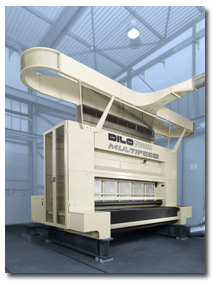
Even at highest throughputs of about 400 kg/m of working width per hour with 1.7-decitex
fibers, DiloSpinnbau’s Multifeed can provide an evenness in the cross direction of CV 2 to 3 within
the flock mat before the card infeed.


Carding


Germany-based DiloSpinnbau’s carding systems for web forming in wide working widths, made
for high web speed applications, are used as direct cards. Within the last few months, the company
has sold four carding installations of this type in working widths ranging from 370 to 510
centimeters (cm). Spinnbau developed random roller card technology and profits from many years of
experience with random and condenser rolls in card doffing systems. The technology offers
throughputs of more than 400 kilograms per meter (kg/m) of working width per hour with fine fibers,
and a fiber orientation to achieve the desired cross strength.

DiloSpinnbau reports its Multifeed offers breakthrough performance with regard to fiber
throughput and evenness. Even at throughputs of about 400 kg/m of working width per hour with
1.7-decitex fibers, a cross-direction evenness of CV (coefficient of variation) 2 to 3 within the
flock mat before the card infeed can be achieved. Machine direction evenness is controlled by an
additional apron scale that controls the card’s infeed speed. The feeder is available in working
widths greater than 500 cm.

The carding systems consist mainly of two, but occasionally three, cards, depending on
several technical features that allow high productivity and web homogeneity as well as easy
operation and maintenance. The result is high availability and production efficiency for Fleissner
or Perfojet hydroentangling production lines.

Nonwovens2

The trend in spunlaced products, made on Fleissner’s AquaJet system, is toward lightweight
nonwovens in the range of 25 to 50 g/m
2.


Lightweight Products


Germany-based Fleissner GmbH — a subsidiary of Germany-based AquaJet system manufacturer
Trützschler Nonwovens — reports there is a trend toward lightweight nonwovens in the range of 25 to
50 grams per square meter (g/m
2). This tendency is owing mostly to the constant evolution of the manufacturing lines.
Line widths range between 360 and 450 cm for wipes, and between 180 and 260 cm for cotton products
such as wipes or pads.

Thanks to throughputs of more than 400 kg/m of working width per hour for fine fibers, the
Fleissner production lines can produce at high speed with a pressure of some 80 bar in
pre-entangling, and 120 to 150 bar in the final stage. A question mark in hydroentangling always is
water consumption. Fleissner estimates average water consumption is 100 cubic meters (m
3) per hour for an average wipes production line, and some 150 m
3 for perforated products. Water reclaim in the whole circuit is at 96 percent without
backwashing; and with backwashing, only 1 percent of the water is lost.

The main products on these AquaJet lines are wipes made of viscose, polyester, polypropylene
or lyocell; cotton products; and also filter media interfaced with mechanical needling. Years ago,
to treat fiber material such as flax, hemp or even bicomponent spunbonds was unthinkable, but this
also is possible today.


New Owner For Perfojet


In December 2009, the Andritz Group, parent company of Andritz Küsters GmbH, Germany,
acquired France-based Perfojet from the Rieter Group, Switzerland. Küsters is well-known for
calenders that also are incorporated into nonwovens production lines. With this acquisition,
Andritz Küsters has moved on from being a supplier of finishing machinery alone to a supplier of
web forming machinery as well.

Andritz Küsters reports Perfojet’s spunlace and SPUNjet
® systems as well as the through-air dryers complement its own portfolio, which now
includes two bonding technologies: Küsters’ thermal bonding and Perfojet’s hydroentanglement. The
latest generation of Perfojet JETlace
® 3000 equipment is capable of producing spunlace fabrics weighing from 30 to 500 g/m
2. Perfojet claims its recent Jetlace Essentiel is especially suitable for production of
wipes from 30 to 80 g/m
2. Another recent launch by Perfojet in the spunlaid market is a new Spunjet technology
for hydroentanglement of continuous filaments, thus creating a new generation of nonwovens. It is
said to offer high fabric properties with regard to bulk, softness, drape, and tensile strength.


Finishing


Zschimmer & Schwarz develops customized products for specialized applications for the
man-made fibers, ceramics, surfactants, leather and fur industries. The company also offers a wide
variety of spin- and secondary finishes for a range of staple fiber and nonwoven applications.

The Man-made Fiber Auxiliaries Division has expanded the scope of its activities across a
broad range of applications, including nonwovens. The current focus is on developing customized
auxiliaries to match the diverse demands of a wide range of nonwoven product end-uses.

Currently, Zschimmer & Schwarz is focusing on developing its range of permanent
hydrophilic products, which are reported to offer high specification and performance to meet the
exacting demands of different spunbonds. For hygiene products, it is necessary to provide products
with exceptional toxicological data as well as to offer special additives that provide even caring
effects. According to the company, the spin- and secondary finish is essential especially for these
applications, for which the finish provides the necessary hydrophilicity and determines the end-use
as well as the properties of end products such as diapers, and incontinence and feminine products.

During spunlacing, the spin finish typically is washed off the fibers, leaving fiber
materials like polyester or polypropylene to exhibit their relatively hydrophobic characteristics.
For many application fields, a hydrophilic spunlace material is specified. Adding hydrophilic
finishes in a wet-on-wet-process after hydroentanglement eliminates the need to incorporate
hydrophilic fibers such as viscose, as has been the custom in the past, Zschimmer & Schwarz
explains.

The company’s in-house nonwovens pilot line enables products to be applied in conditions
very similar to the customer’s actual production processes. At its center of fiber excellence, new
developments are tested on a lab-line using different application systems, such as kissroller or
spraying. Direct feedback of data to the research and development department reduces development
times and leads finally to more competitive products.

May/June 2010

NCTO Officials Map New Strategies


T
extile industry leaders and government trade officials are honing a new set of tools to
deal with the declining textile industry, and taking actions they hope will lead to eventual
recovery and growth opportunities.

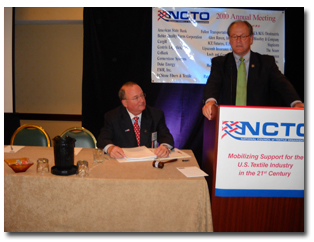
As some 100 industry and government officials met recently in Washington for the seventh
annual meeting of the National Council of Textile Organizations (NCTO), a subtitle for the 
meeting’s theme – “Knowledge, Innovation, Speed and Integrity: Leveraging the U.S. Advantage” –
might well have been “Thinking Outside the Box.” Assistant U.S. Trade Representative for Textiles
Gail Strickler used that term in talking about government assistance for export financing. NCTO
President Cass Johnson did the same as he described NCTO’s lobbying activities. And Janet Labuda of
U.S. Customs and Border Protection (CBP) seemed to be saying the same thing as she described a new
program to crack down on Chinese import fraud.

NCTOmtgBright

Rep. Bobby Bright, D-Ala. (right), emphasizes the need for job creation and calls for tax
incentives to encourage manufacturers to hire new workers, as outgoing NCTO chairman Wally
Darneille looks on.

In his state-of-the-association report, NCTO Chairman Wally Darneille said 2009 had been a
“tough year for textiles,” pointing out that the nation faced the worst economic downturn since the
Great Depression. At the same time, Chinese imports surged after the removal of import safeguards;
subsidized imports from India, Pakistan, Bangladesh and Vietnam “gobbled up an even bigger share of
our market”; and textile exports to North America Free Trade Agreement (NAFTA) and Central
America-Dominican Republic Free Trade Agreement (CAFTA-DR) nations fell off by 20 percent.
“Hopefully, the worst is behind us,” he said, noting that NCTO members are reporting increased
orders and prices are inching up a little, although input costs also are going up.

Darneille urged NCTO members to “focus daily on the competitive advantages we can create
within our supply chain,” saying: “Our knowledge, innovation, speed and integrity give us a total
value proposition that is clearly superior. We know what our customers want better than suppliers
in other parts of the world. We constantly innovate our products and our processes and stay ahead
of the curve. We can react to changes more quickly, and shorter supply chains mean lower
inventories for our customers, and they know they can depend on our integrity to deliver them the
proper quality on a timely basis. Our challenge is getting our customers to quantify that.”

In a report covering trade issues, Johnson cited as a major problem the steady decline in
trade with Western Hemisphere nations with which the United States has preferential trade
agreements that require use of U.S. and/or regional yarn and fabrics in duty-free apparel imports.
NCTO issued a report showing a drop in trade in a range of products including trousers, underwear,
T-shirts, socks, knit shirts and brassieres. The data show that qualifying regional apparel imports
between 2008 and 2009 were down 14 percent within the CAFTA-DR region, 16 percent within the NAFTA
region, 43 percent within the Andean region and 16 percent under the Caribbean Basin Initiative.
Johnson said China is the “major contributor to the decline.”

He added that there is a dangerous trend line and “we are trying to prevent worse things
happening.” He cited the need for meaningful actions against China and other nations that illegally
subsidize their exports. He also said NCTO is working with government agencies on innovative means
to obtain export financing. Another high-priority area is working with CBP and Congress to develop
better means to combat illegal imports.


Legislation


NCTO’s staff outlined a number of legislative issues and placed considerable emphasis on the
need for immediate passage of the duty suspension bill, which grants duty-free treatment to imports
that do not compete with U.S.-made products. There are a number of textiles on the list of duty
exemptions that expired at the end of last year, and some  products have been added. Johnson
said failure to act on the bill “is coming at the worst possible time.” NCTO supports legislation
calling for tougher Customs enforcement, measures in the House and Senate that would make it easier
to take anti-dumping and countervailing duties against countries that manipulate their currencies,
extension and expansion of the Buy America requirements for government procurement, and extension
of the Andean Free Trade Agreement.

Listed as threats are bills under consideration that would grant assistance to Haiti;
preference reform legislation that would grant duty preferences to Cambodia and Bangladesh; and the
cap-and-trade environmental control legislation. With respect to Haiti, NCTO says it has taken a
leadership role in supporting measures the would help bolster the Haitian apparel industry, but it
feels some measures under consideration by Congress would permit inputs from Asian nations that
would result in U.S. textile job losses. NCTO is opposed to granting new trade preferences to
Cambodia and Bangladesh, as they already are major suppliers to the U.S. market without special
treatment.

NCTObox


Thinking Outside The Box


A number of speakers at the meeting discussed new and innovative approaches to addressing
problems. Labuda described a new Customs program designed to crack down on Chinese import fraud
stemming from undervaluing exports. She said her agency has uncovered countless cases of imports
entering the United States at declared values that are only a fraction of their actual value. She
said her agency is investigating how the declaration system is being abused, and that, where
possible, it will levy fines and exclude entry of offending products. Johnson said Labuda has
“discovered a large hole in the system [and she is] pressing the government to fill it.” Labuda
also said her agency is monitoring the performance of trade preference programs to ensure that they
are being properly enforced, and the agency is stepping up its training of textile and apparel
specialists.

Strickler discussed new inter-agency efforts to help facilitate exports of textiles and
apparel. She noted export financing is a major problem, as many of the countries that present
market opportunities do not have the resources and effective systems to come up with the credit
needed to finance trade. She said the office is working with the Export-Import Bank, the Commerce
Department and other agencies, and that it is in contact with factors and others in the industry
who can contribute to developing new ways to address export financing.

NCTO reported on the creation of TexNet, a new grassroots network that draws on the
resources of outside organizations that have similar interests in the area of international trade.
This effectively doubles the number of employees involved in issues on the textile industry agenda.

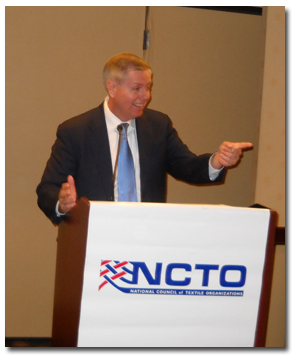
NCTOmtgGraham

Sen. Lindsey Graham, R-S.C., addresses problems with Chinese trade and says his
anti-currency manipulation bill would pass the Senate by a wide margin.


Congress And Textiles


Members of Congress speaking at the meeting emphasized the importance of trade to the U.S.
economy but said it must be not just free trade, but also fair trade. Sen. Lindsey Graham, R.-S.C.,
addressed problems with China trade and said, “We must bring balance to an imbalanced system.” One
way to do that would be to enact his bill, which for the first time would permit anti-dumping cases
to be brought based on currency manipulation. In view of widespread concern about China trade, he
believes his bill would pass the Senate by 75 to 80 votes. Rep. Bobby Bright, D-Ala., a member of
the Blue Dog Coalition of conservative Democrats, called for bipartisan legislation to bring down
the record level of unemployment, and said one step would be to improve credit access for small and
medium-size manufacturers to help them export. He also supports tax breaks for companies hiring new
employees. Saying there are many ways to promote fair trade, Rep. Linda Sanchez, D-Calif., called
for renewed efforts to open export markets but at the same time attack illegal subsidies of imports
and require fair labor standards in exporting countries. “We want to promote trade, and if we do it
right, we can boost our economy,” she said.

May/June 2010

Lenzing: Master Of Cellulosic Fiber Production


A
ustria-based Lenzing AG is the undisputed world leader in cellulosic fiber production.
From its humble beginnings in 1938, the company has become a global player. Lenzing provides the
global textile and nonwovens industries with high-quality products. The Lenzing Group is the only
manufacturer worldwide to produce all three man-made cellulosic fiber generations: classic viscose,
modal and lyocell. In an exclusive interview with Textile World, Friedrich Weninger, member of
Lenzing’s Management Board, explains why.

“Fibers are the core business,” Weninger said. “Our company philosophy is to be the leading
fiber innovation company.”

In 2009, Lenzing produced 570,000 metric tons of viscose fibers, and 88.4 percent of the
Austrian production was exported. The most important markets for Lenzing are Indonesia, China, the
United States, Turkey, Europe in general, and Austria as a country of origin.

ExecforumWeninger

Friedrich Weninger


The Person


Weninger, a sporty engineer, holds a master’s degree, and is married and the father of two
children. His hobbies are golf, skiing, reading and his family. And what is his personal challenge?

Weninger: For my family, I want to provide our kids with the optimal education so
that they can manage their future properly. In my job, Lenzing should achieve high profits on a
sustainable basis. This shows that it is possible to survive as a fiber producer in high-cost areas
like Europe — in an industry that is facing competitors mainly sitting in the low-cost areas [such
as India and China]. Nearly all the former European and American fiber producers shut down their
[domestic] units and left the industry. But Lenzing is still expanding in Europe and the U.S. The
key elements are commitment and innovation.


R&D At Lenzing


TW
: As an innovation-driven company, does Lenzing have machinery or process patents?

Weninger: “As a global market leader, Lenzing holds about 2,000 patents. The
Lenzing Group as the leader in technology and innovation has been setting standards in the world of
cellulosic fibers for decades. Continuous development of viscose, lyocell and pulp technology
ensures that Lenzing will continue to enhance its lead in the future.


TW
: Where do you set priority in your R&D work?

Weninger: We are setting priority in innovative applications of all our fibers,
especially in new applications for nonwovens, technical applications and high-end textiles. Some
150 people are directly involved in R&D.


TW
: You call Lenzing an innovation leader. Can you give some current examples?

Weninger: With pleasure. Tencel® [lyocell] in powder form enables enhanced
moisture absorbency: Lenzing and Eurofoam [a division of Germany-based Greiner Group] – a leading
European producer of foam plastic – jointly developed cellpur, an innovative filling material for
mattresses, making it the first successful incorporation of Tencel in foam plastic and creating a
material with high moisture absorbency. It not only provides first-rate moisture management, but
breathability and permeability as well. Body moisture released while sleeping is absorbed and
transported, thus creating an even more comfortable sleep.


TW
: At Heimtextil 2010 in Germany, you mentioned that you will launch Tencel in carpets.

Weninger: This is another example of innovation: This year, we launched Tencel as
the first cellulosic fiber worldwide to be used in carpets. For the first time, we can transfer all
the advantages of cellulosic fibers into the wall-to-wall carpeting industry. The special
moisture-management properties inherent in Tencel help to optimize the indoor environment and to
avoid mold. We can combine soft touch with perfect durability and a maximum of hygienic standards –
absolutely moth-free for decades. We expect a very strong market perception for this innovative
application.


Large Fiber Portfolio


The viscose process covers all cellulosic fibers except Tencel lyocell, which has a totally
different technology approach. Lenzing’s  fiber production is based on the four pillars
Lenzing Viscose®, Tencel, Lenzing Modal® and Lenzing FR®. Weninger said viscose is the most
important fiber at the moment regarding turnover.


TW
: What is the environmental impact of each process? The lyocell process is a closed loop, but
what about the other viscose processes? Is Lenzing’s rayon process more environmentally friendly
than other rayon processes?

Weninger: In the lyocell process, no critical chemicals are involved. The viscose
process is a bit more challenging in terms of environmental issues as there are chemicals involved
like sulphur, zinc and others. Lenzing developed a production technology with almost closed process
cycles that enables us to produce viscose fibers on a very environmentally friendly basis.


TW
: Buhler Quality Yarns Corp., Jefferson, Ga., now offers a MicroTencel® yarn in the
United States. What is the difference between Tencel and MicroTencel?

Weninger: Microfibers generally spun into yarns give a different feel, touch,
softness and optical effect because more fibers are in the cross section of the yarn. Fine yarn
counts need finer fibers.


Market Situation


TW
: How do you see the current market situation? Was Lenzing hurt by the recent financial
crisis?

Weninger: After a very challenging first quarter in 2009, we saw a market upswing
in all major fibers markets in the course of 2009. Up to now, we are faced with very encouraging
demand for Lenzing fibers, and the absolute top seller at the moment is Lenzing Modal.


TW
: Lenzing’s reputation is to be a market leader. What do you think are the reasons for that
image?

Weninger: Well, we are the world leader in cellulosic fibers in terms of fiber
capacity, innovation, technology and service. We are setting the standards — in the last decades,
all major developments came from Lenzing. We are the only company worldwide that can provide all
three generations of cellulosic fibers – viscose, modal and lyocell — on an industrial basis. We
are proud of what we have achieved in the last 70 years, but this does not mean we will stop our
efforts to serve the textile and nonwovens markets with the highest possible innovation and service
in the next decades.


TW
: Comparing today’s market requirements and those of 10 years ago, what are the biggest
differences, and why?

Weninger: China has boosted the viscose industry by high expansion — viscose is
not seen any more as a niche product, but as a substitute for cotton now. China and India have
become big end-consumers for textile and nonwoven products as their per capita income has risen.
This will boost global fiber demand. These countries look very much for specialties and
differentiation.


TW
: Is there any influence from the retailers?

Weninger: Retailers are looking much more for differentiation. They want new
products and not just [price differentiation]. I think it’s much easier to innovate new ideas with
retailers than it was 10 years ago.

ExecForumview

Lenzing’s headquarters site in Lenzing, Austria, is home to the company’s largest
integrated pulp and viscose production globally. Photograph courtesy of Lenzing AG


The Future


TW
: What will you do to keep your market position?

Weninger: We will keep our position as the global market leader through our speed
of innovation, the highest R&D expenses in the industry, an excellent technical service and
support as well as our global distribution power. We provide our customers with optimum quality for
their individual purposes. They get the best technical support and service worldwide. And we
guarantee reliability and environmentally sound production of our fibers.

Weninger is very optimistic that the strong demand for cellulosic fibers will continue over
the next couple of years, stating, “Reasons are the growing wealth in the emerging markets, the
fact that world cotton production has come to a limit, and the demand for fibers based on renewable
resources and produced on some environmentally friendly basis will steadily grow.”

May/June 2010

Changing Chinese Ground Rules


A
shifting trade strategy will continue to bear close monitoring. It’s now pretty clear
that by year-end, the value of China’s currency, the yuan, will be running somewhat above recent
levels — hopefully enough above at least to start slowing the tidal wave of Chinese shipments
abroad. And it’s coming none too soon for textiles and apparel, as U.S. imports of these products
recently have been running 25-percent above a year ago —  in sharp contrast to the 3.5-percent
increase in imports of these products from all other countries. Even the Chinese are beginning to
realize these huge increases in their exports can’t be maintained indefinitely. But aside from
correcting some huge trade imbalances, there are other compelling reasons for a shift in Beijing
thinking. A stronger yuan lowers costs of imports by China, which would help many Chinese
manufacturers who have been complaining increasingly about the high cost of energy and other raw
materials they must import. Revaluation also would allow China to boost interest rates — a move
urgently needed to dampen inflationary pressures; keep the economy from overheating to the point at
which it could cause a real-estate crisis; and reduce the need for its central bankers to purchase
low-yield U.S. Treasury securities.

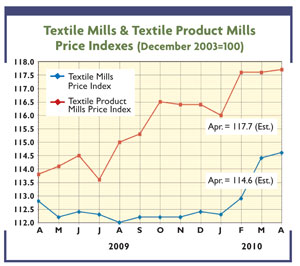
bfchart


Gauging The Results


Chinese currency moves will still leave one big question unanswered: How much upward yuan
revaluation will eventually be needed to level today’s badly-tilted international playing field?
The answer depends on whom one talks to – with estimates ranging from just over 10 percent to as
high as 50 percent.

Textile World
sees the yuan’s value having to increase some 20 to 40 percent if current trade
imbalances are to be corrected. But odds of this happening overnight, or even over the next year or
so, are practically nil. Internal Chinese political pressures would seem to rule out any big
one-shot move. Much more likely: a slow, gradual upward revaluation such as occurred in the
2006-2008 period just prior to the recent worldwide downturn. Equally important, it will take time
for currency changes to work their way through the system and ultimately make a real difference.
Federal Reserve Chairman Ben Bernanke recently noted that moving the exchange rate would not have a
significant short-term effect. Given this kind of thinking, don’t expect any quick miracles. Thus,
while the recent huge monthly increases in incoming Chinese shipments are not likely to be
repeated, it would be unrealistic to expect any big slowdown in overall textile and apparel imports
over the next few quarters. Best bet: anywhere from a 5- to 10-percent boost over the current year.
On the other hand, if all goes well, U.S. textile and apparel import gains should begin to taper
off – averaging out in the tolerable 3- to 5-percent range over the 2011-2013 period.


Another Long Look Ahead


Meantime, new Bureau of Labor Statistics employment projections provide another perspective
on how the U.S. textile and apparel industries will be faring over the coming years. The key
finding: Jobs will decline an eye-opening 48 percent over the decade ending in 2018. But no need to
push the panic button – the slippage isn’t nearly as bleak as first blush would seem to indicate.
Remember, we are talking 10 years here. Convert this 48-percent figure to a compounded annual rate,
and the yearly pace of decline drops down to a not-all-that-bad 4 percent. Further consider that
during the first year of the forecast – recession-ridden 2009 – employment dropped 16 percent.
Upshot: Annual slippage over the next nine years is likely to be only somewhere in the 3- to
3.5-percent range. Moreover, translate this annual job decline into an annual decline in industry
output,  and things begin to look even better. This conversion from jobs to production can
best be accomplished by adjusting employment projections for productivity gains, which are likely
to continue running at about a 2- to 3-percent annual rate. Do the math, and annual textile and
apparel production declines are estimated at only around 1 percent or so. That’s a lot better than
the average double-digit drops of the last three years – and pretty much in line with

TW
‘s long-term demand forecasts spelled out in last month’s column

(See
“Business & Financial: An Encouraging First Quarter,” April 20, 2010)
.

May/June 2010

Move Expected On Chinese Currency


I
t is becoming increasingly clear that China is willing to revalue its currency, but it
will likely happen gradually, and it will not be a major increase. Chinese government officials
have made it clear that it will be done in their own way and in their own time, and they will save
face at home and abroad by saying they are not reacting to outside pressure. In a recent meeting
with President Barack Obama, Chinese President Hu Jintao made that point, and Obama responded by
saying he understands the Chinese position. He added that he believes “a more market-oriented
currency approach would be in China’s and our own best interests, as it would help China reduce its
dependence on exports and encourage more domestic consumption.”

In recent weeks, there has been more talk along that line from Chinese government officials
and economists.

By linking the yuan to the dollar, China makes its exports cheaper and imports more
expensive, something U.S. manufacturers maintain is an illegal trade subsidy.

Although members of Congress continue to urge the Obama administration to brand China a
currency manipulator and take action under U.S. trade laws and impose sanctions, the administration
continues to call for a diplomatic approach, not only with China, but with other countries as well.
Treasury Secretary Timothy Geithner has said there are some high-level meetings coming up in the
next three months at which there will be opportunities to address the issue with policies “that
will help create a stronger, more sustainable and more balanced global economy.” Geithner said
China’s inflexible exchange rate has made it difficult for other emerging market economies to let
their currencies appreciate, and a move by China to a more market-oriented exchange rate will make
an essential contribution to global rebalancing.

However, during a recent visit to Beijing, Commerce Secretary Gary Locke said that even if
China permits its currency to float, the impact will not amount to much unless China removes some
of its trade barriers. “It’s like two steps forward and one step back,” Locke said. “They can
revalue their currency, but if they have market barriers or if they favor domestic companies, then
that revaluation of currency will not make much of a difference.” Federal Reserve Board Chairman
Ben Bernanke also indicated that the U.S. problems with China trade go beyond the currency issue.
While charging that the yuan is undervalued “to promote a more export economy,” Bernanke said that
moving the exchange rate alone would not have a major short-term effect but could have some impact
over time.

Sen. Lindsey Graham, R-S.C., who is sponsoring get-tough legislation on the currency issue,
told a recent meeting of textile executives that the currency issue has become a “defining moment”
in U.S.-Chinese relations and “we are going to press hard to get the administration to act.”
Graham’s bill would for the first time permit U.S. manufacturers to pursue anti-dumping cases based
on currency manipulation. Although there is considerable support in Congress to go the legislative
route, the pending bills are not very likely to be enacted into law in view of the administration’s
reluctance to go that route. The legislation does, however, serve to put pressure on both the
Chinese and U.S. governments to try to resolve the issue.

The next developments are likely to take place around the next U.S.-China Strategic Economic
Dialogue in Beijing and a meeting of the G-20 largest developed nations in Toronto in June.


Working With New Allies


As the U.S. textile and apparel industry has seen its employment fall from more than 1
million to 421,000 over the past decade, the once-powerful fiber/textile/apparel coalition has lost
some of its clout with Congress and various administrations. But that is in the process of being
turned around. Industry representatives in Washington are joining a wide array of coalitions and
business groups that share some common goals, particularly in the area of international trade, and,
as a result, their influence is increasing.

This past year, the National Council of Textile Organizations says it has worked with the
American Iron and Steel Institute, Fair Currency Coalition, Unite Here, AFL-CIO, National
Association of Manufacturers, and Citizens Trade Campaign as well as the traditional allied
organizations – the National Cotton Council, American Manufacturing Trade Action Coalition,
American Fiber Manufacturers Association and National Textile Association. Much of the work with
these organizations involved international trade issues, but the new alliances were helpful in
connection with the cap-and-trade environmental legislation and other issues in which the groups
have a common interest.

On top of this, textile lobbyists have been working with various congressional caucuses to
make direct appeals to members of Congress beyond those that have been reached traditionally
through the House Textile Caucus and an ad hoc Senate textile caucus. Contacts have been made with
the Blue Dog Coalition, which has more than 50 House members. This coalition was formed 15 years
ago by Southern Democrats, but since then, it has been expanded to include members of Congress from
25 states coast-to-coast. It has worked primarily on fiscal responsibility issues, but it now has
expanded its scope to focus on job creation, and that has meant becoming involved in international
trade issues. Textile lobbyists also are plugged into the House Trade Working Group, with 
more than 100 members who are sponsoring legislation calling for a major overhaul of U.S. trade
policy. Members of this group also have mounted an effort to pressure the Obama administration to
address the China currency issue.

All of this adds up to a much stronger voice for dealing with textile issues in Washington.


Some Legislation Expected This Year


Although Congress generally is reluctant to deal with international trade issues in an
election year, this year may be a different story because of the emphasis on the need to address
the nation’s economic woes and find ways to create jobs. Some bills are what have often been
described as “press release bills” that show members of Congress are working on issues of interest
to their constituents but that have little chance of enactment. Others, such as the currency
manipulation measures, are designed to put pressure on the Obama administration to act. There is a
pretty good likelihood Congress will enact legislation providing for more direct assistance and
trade liberalization with Haiti because of the urgency of the situation and the strong desire of
Congress and the administration to help that beleaguered nation.

Textile and apparel trade will be a major element in whatever Congress and the administration
come up with. Congress is likely soon to extend the duty suspensions on imports that do not compete
with U.S.-made products but are important components in a number of products, including textiles
and apparel. In connection with the reauthorization of Customs and Border Protection, there appears
to be an opportunity to incorporate some provisions, sought by U.S. textile manufacturers, that
would provide Customs with additional authority and resources to combat illegal imports.

May/June 2010

Sponsors