Herculite Products to Showcase Textile Solutions at Techtextil North America

EMIGSVILLE, Pa. — March 31, 2025 — Herculite Products Inc., a manufacturer of high-performance textiles, is pleased to announce its participation in Techtextil North America 2025, which will be held May 6-8 in Atlanta.

As a pioneer in developing advanced textile solutions, Herculite will present its latest innovations designed to meet the evolving needs of industries such as healthcare, architecture, transportation, and military applications. Attendees visiting Herculite’s booth 4015 will have the opportunity to explore a range of American-made performance textiles engineered for durability, performance, and technical capabilities.

“We are excited to engage with industry professionals at Techtextil and showcase our latest advancements in technical textiles,” said Chad Twombly, vice president of Direct Sales at Herculite Products Inc. “This event provides an excellent platform for us to demonstrate our commitment to innovation, domestic manufacturing, and to collaborate with partners seeking high-quality solutions.”

Techtextil North America is recognized as a premier global event for technical textiles, nonwovens, and textile technologies. It brings together industry leaders, innovators, and professionals worldwide with top-tier educational programming and networking opportunities.

For more information about Herculite and to receive a code for complimentary exhibit all access visit www.herculite.com/techtextil

Posted: March 31, 2025

Source: Herculite Products Inc.

Orion S.A. Announces Reciend Group As New Distributor In Peru

HOUSTON — March 31, 2025 — Orion S.A., a global specialty chemicals company, announced today that the Reciend Group will be its distributor of Specialty carbon black product lines in Peru.

For more than 20 years, Reciend has been Orion’s agent and distributor in Colombia.

“We know the same dedication and technical work that transformed the Colombian market will be the key factors to drive the evolution for the coatings and plastics market in Peru,” said Eduardo Belisle, a technical business manager at Orion. “We look forward to supporting Reciend on this new journey.”

Alejandro Mejía, chief strategy officer of Reciend, said the collaboration is a strategic milestone that strengthens his company’s mission of bringing specialized solutions to Andean markets.

“It is an excellent opportunity to create even more value for our customers and principals through our talented team, committed to delivering high-performance solutions to industrial markets — such as coatings, plastics, printing systems and battery applications — where we have strong expertise and a broad ingredients portfolio,” Mejía said. “After decades of working with Orion’s carbon blacks, we’ve established a solid foundation, and now the expansion of our collaboration into Peru enables us to replicate that success in this important and growing market.”

Posted: March 31, 2025

Source: Orion S.A.

European Nonwoven Industry Returns To Pre-COVID Level With 3 Million Tonnes Produced In 2024

BRUSSELS — March 31, 2025 — EDANA, the global association and voice for nonwovens and related industries has published its annual overview of the high-level figures from the EDANA Statistics Report on Nonwovens Production and Deliveries for 2024.
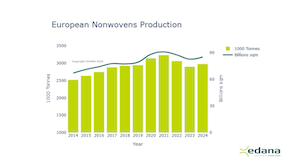
According to the latest data, in 2024, compared to data from 2023, nonwovens production in Greater Europe increased in volume by 2.6% to 2,976, 400 tonnes, and by 2.9% in surface area resulting in 85.1 billion square meters of nonwovens being manufactured. However, differing trends were observed at the national level when comparing production between Greater European countries, and also when assessing the various production processes of nonwovens and market segments.

Jacques Prigneaux, EDANA’s Market Analysis and Economic Affairs Director, further expanded on the trend: “In the aftermath of two consecutive declines of more than 5% in 2022 and 2023, the production of nonwovens in Greater Europe has reverted to its pre-pandemic level in terms of weight. At the same time, the production in surface area grew faster, resulting in an average grammage of 34.9 gsm, as opposed to the 37.2 gsm recorded in 2019.”

Wetlaid nonwovens, which experienced a significant decline in 2023, demonstrated the most substantial growth rates this year. Conversely, airlaid was the only web-forming process to register a decline in 2024, yet it was also the sole process to exhibit growth the previous year. Spunmelt production continues to dominate in terms of surface area.

Drylaid exhibited limited growth, attributable to the positive developments seen in the production and sales of Air-through and Hydro-entangled materials.

The predominant end-use for nonwovens continues to be the hygiene market, accounting for 27% of deliveries, amounting to 797,300 tons, and exhibiting a 1.7% growth in 2024. Last year, the most substantial growth sectors for nonwovens were building and roofing materials (+14.2%), food and beverage applications (+13%), cotton pads (+4.9%), and personal care wipes (+4.8%).

Prigneaux added “thanks to data collected in two units, our statistics provide EDANA members with the opportunity to thoroughly analyze trends in tonnage and surface area across 11 production processes and at least 83 market segments.”

EDANA extends its appreciation to all contributing companies that participated in the data collection process. Their valuable input ensures an accurate and detailed representation of the nonwovens market. “Without the input from participating companies”, Jacques Prigneaux noted, “these figures could have not been compiled, and we would like to thank them again for their efforts in sending their input to us. This data, combined with continuous monitoring of the industry, guarantees that EDANA statistics serve as a valuable planning and benchmarking instrument for all member companies.”

A comprehensive analysis, including deeper insights into production trends, market evolution, and strategic outlooks, is available exclusively to EDANA members. This report serves as a critical resource for companies looking to navigate the evolving nonwovens landscape. In addition, in November 2024, EDANA, together with INDA, the Association of the Nonwoven Fabrics Industry, released the Global Nonwoven Markets Report, A Comprehensive Survey and Outlook, 2023-2028. This edition offers a comprehensive analysis of global nonwoven macro drivers, supply and demand trends, and an expanded regional trade section. The report forecasts a steady growth in demand for nonwovens across key sectors over the next five years. This report is available for purchase in the following page:

https://www.edana.org/trainings/publications/statistics-nonwovens-report2023-2028

EDANA remains dedicated to supporting the nonwovens industry by providing market intelligence, advocacy, and networking opportunities.

Posted: March 31, 2025

Source: EDANA 

AATCC’s Textile Testing Demonstration Is Back For Functional Fabric Fair Spring

PORTLAND, Ore. — March 28, 2025 — AATCC recently introduced a new feature during the Functional Fabric Fair Portland show. Last year, AATCC brought two iterations to the spring and fall Functional Fabric Fair shows, the AATCC Testing and Standards Exhibition and the AATCC Textile Test Zone.  In the exhibition, attendees participated in live demonstrations of textile testing to better understand lab testing. Attendees thoroughly enjoyed interacting with the various components to learn more about textile testing and how it relates to other aspects of the product development process.

AATCC is once again bringing this exhibition back to the show floor during the Spring 2025 show in April. The AATCC Textile Test Zone features the following stations: Color Acuity & Viewing Environment, Color Fastness, Laundering, Assessments After Laundering, and Moisture Management & Water Resistance Testing.

Color Acuity & Viewing Environment

To ensure accurate color assessment, it is vital to thoroughly test visual capabilities. Maintaining color vision expertise is critical to providing reliable, data-driven insights to your customers. Explore tools for color acuity such as the Farnsworth-Munsell 100 Hue Test and the Pseudoisochromatic Plates used for a Color Blindness assessment. Evaluate the impact of lighting on color proficiency with more specialized measurement tools such as a Simultaneous Color Viewer for side-by-side comparisons. Match fabric swatches to Gray Scales for Staining or Color Change to see how they compare.

Color Fastness

Colorfastness testing stands at the forefront of textile quality assessment, evaluating a fabric’s ability to maintain its color integrity under various challenging conditions. It is a critical requirement for most textile products, especially those intended for clothing, recreation, uniforms, and personal protective equipment. Visualize how a Rotary Crockmeter can aid in evaluating color transfer when textiles are under mechanical friction. Check out samples of fabric that have been through a Scorch Tester to witness the impact of heat on colorfastness.

Laundering

Laundering is an important part of the lifecycle for many textile products. Laundering can impact the size, shape, color, and smoothness of textiles. Explore the variables in the laundering process—and how to control them. Get to know the specialized test methods and tools that ensure dependable results and good approval decisions. Plus, find out how AATCC detergents and test methods support your sustainability initiatives.

Assessments After Laundering:

Dimensional Stability and Appearance Testing

Dimensional stability and appearance of your textile products are important performance characteristics. Check out how to properly evaluate these features and get acquainted with the tools for proper evaluation, including Shrinkage Scales, and Shrinkage and Skew Rulers.  Find out the options for properly evaluating smoothness, wrinkles, and creases. By conducting these and other standardized tests, you can confidently verify your textiles exceed customer expectations for dimensional stability and appearance.

Stain Testing

To thoroughly assess the stain and soil resistance of textiles, AATCC offers several test methods. Take the opportunity to review the stain resistance for carpet and household soils. These assessments demonstrate textiles’ ability to maintain their clean, vibrant appearance even when exposed to real-world stains and soils.

Fiber Fragment

So-called “microfibers” are tiny fragments making big news. These fiber fragments can break off or come loose from textile yarns and fabrics during production, use, and laundering. Fiber fragments find their way to waterways, remote mountaintops, and human tissue. AATCC provided the first textile standard for quantifying this problem as a first step in addressing this in home laundering— AATCC TM212. Come to the Test Zone and get hands-on practice with the l test apparatus for measuring fiber fragment release in laundering.

Moisture Management and Water Resistance

Many textile products claim water repellency, water resistance, or other moisture management properties. Impact penetration and spray testing are critical components of comprehensive moisture management evaluations in textile performance. These advanced testing techniques simulate real-world environmental and mechanical challenges that fabrics may encounter, providing critical insights into material durability and protective capabilities. Put fabric samples through a Spray Tester to visualize how fabrics are rated for water-repellent finishes. Compare how fabrics perform under an Impact Penetration Tester to evaluate water resistance or water repellency.

Posted: March 28, 2025

Source: The American Association of Textile Chemists and Colorists (AATCC)

National Council Of Textile Organizations: State Of The U.S. Textile Industry

WASHINGTON — March 27, 2025 — National Council of Textile Organizations (NCTO) Chairman Charles Heilig delivered the trade association’s State of the Industry overview at NCTO’s 21st Annual Meeting on March 27.

Heilig’s speech outlined:

  1. The U.S. textile industry’s major challenges and achievements accomplished last year;
  2. U.S. textile supply chain, economic, trade data; and
  3. NCTO’s 2024 and 2025 policy priorities for domestic textile manufacturers.

“Our industry’s resilience and innovation is unparalleled and strong, despite economic and trade headwinds that have impacted our sector and our customers,” Heilig noted in the speech.

“The breadth of challenges we face every day is astonishing — economic downturns, predatory trade practices, such as the use of forced labor in supply chains, ill-conceived trade policies, inadequate customs enforcement of trade fraud, post-pandemic inventory related issues, freight and logistics challenges, and race-to-the-bottom business models that — all combined — are suppressing growth and investment, leading to a persistent and severe downturn in business,” he adds. “Despite the economic downturn and unfair trade practices impacting the industry in 2024, our metrics remained stable or registered only slight declines, with the exception of employment in the cotton and wool sectors. This again underscores the industry’s ability to adapt during challenging times and remain viable even while registering painful losses.”

A link to his full remarks as prepared for delivery are included here along with a link to a data infographic prepared by NCTO illustrating the current economic status of the U.S. textile industry.

Heilig is president of American manufacturer of yarn and cotton consumer products Parkdale Mills, based in Gastonia, N.C.

NCTO’s annual meeting was held March 24-27 at the Mayflower Hotel in Washington, D.C.

NCTO is a Washington-based trade association that represents domestic textile manufacturers.

  • U.S. employment in the textile supply chain was 471,046 in 2024.
  • The value of shipments for U.S. textiles and apparel was $63.9 billion in 2024.
  • U.S. exports of fiber, textiles and apparel were $28.0 billion in 2024.
  • Capital expenditures for textiles and apparel production totaled $2.98 billion in 2022, the last year for which data is available.

Posted March 27, 2025

Source: National Council of Textile Organizations (NCTO)

Universal Fiber Systems Acquires FIT – Formerly Known As Fiber Innovation Technology

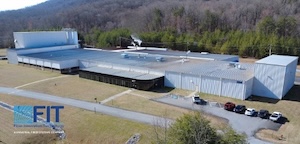
JOHNSON CITY, Tenn.— March 27, 2025 — Innovative fiber technology firm, FIT — formerly known as Fiber Innovation Technology — is now a part of Universal Fiber Systems. This latest investment in Johnson City, Tenn., represents a strategic expansion of Universal Fiber Systems capabilities and commitment to innovation and customer service to our expanding global market, now serving twenty-two diverse segments.

Arial image of FIT in Johnson City, TN, recently acquired by Universal Fiber Systems

“We’re thrilled to add FIT to Universal Fiber Systems! I’ve long admired FIT and am impressed with what Chris Parris and his team have accomplished,” said Marc Ammen, CEO of Universal Fiber Systems. “We will be supporting FIT by expanding its production capacity in the very near future to continue advancing our market leadership.”

FIT, known for its cutting-edge approach to fiber solutions, has been at the forefront of technological innovations in the industry. “FIT and I are very excited to join the Universal Fiber Systems’ team,” remarked Parris, general manager of FIT. “We look forward to the new growth this venture will bring, and continuing our tradition of innovation, expertise, and unparalleled customer service, now under the Universal Fiber Systems umbrella.”

This acquisition underscores Universal Fiber Systems’ dedication to enhancing its product offerings and service capabilities. The integration of FIT into Universal Fiber Systems not only expands its operational footprint but also enriches its technical prowess and response to market needs.

“Adding FIT’s innovative capabilities and expert team to our portfolio enhances our ability to serve and respond to our customers more effectively,” added Ammen. “It ensures we remain at the cutting edge of fiber technology and continue to push boundaries in the ever-evolving industries we serve.”

The partnership marks a significant step in Universal Fiber Systems’ strategy to lead the industry in sustainable, high-performance fiber solutions while diversifying our portfolio in fiber technology, empowering both Universal Fiber Systems and FIT to better serve global customers with enhanced products and services.

Posted: March 27, 2025

Source: Universal Fiber Systems LLC

Hohenstein Releases 2024 Sustainability Report

BOENNIGHEIM, Germany — March 27, 2025 — Responsible action is a defining value for Hohenstein, a global testing and research provider. Its 2024 Sustainability Report provides transparency through documented progress and detailed insights into how sustainability is embedded. It covers both the existing sustainability measures at the Germany headquarters and the company’s goals for 2025 and beyond. The direct and indirect greenhouse gas emissions (Scope 1, 2 and 3) of its worldwide locations were recorded for the first time.

Hohenstein sees ecological, social and economic sustainability as success factors for the future and has taken important action over the past year:

  • Environmental: In addition to a new combined heat and power plant, a photovoltaic system was installed at the headquarters. An environmental team and the newly appointed environmental officer are supporting the environmental management system in accordance with EMAS (Eco-Management and Audit Scheme). Future reduction targets and measures will be comprehensively developed based on the initial greenhouse gas emissions.
  • Social: Through support, training and transparent exchange, Hohenstein is working to implement respectful cooperation with all its global employees. The work-life balance also remains a focus. An internal satisfaction survey shows that 85 percent of employees are satisfied or very satisfied with Hohenstein as an employer. Most of the improvements that employees suggested in the survey have been implemented.
  • Corporate Governance: Hohenstein management creates a motivating work environment by promoting autonomy, meaning and expertise. Regular colloquia and HR consultations were expanded to include additional formats for communicating with management and increasing exchange. The Sustainable Development team was expanded.

Hohenstein has been implementing various measures to protect the environment and conserve resources for decades. This was confirmed by external KEFF+Check in 2024. Next year, the goal will be further optimized as part of the EMAS introduction. “Sustainability and the responsible use of our planet’s resources are a matter of course for us,” explains CEO Dr. Stefan Droste. “The increasing number of extreme weather events around the world clearly shows that every individual is called upon to contribute to safeguarding our common future. For this reason, environmental and climate protection is a top priority at Hohenstein.”

The family-owned company wants to take responsibility, not only in its own sustainable actions, but also as a reliable partner for its customers: “2024 was characterized by new regulations. In the EU alone, numerous directives were adopted, but in some cases their introduction was postponed while their content is being finalized,” explained Katja Hetzer, Sustainability Development manager at Hohenstein. “We support our clients in developing a solid strategic direction and selecting suitable measures. Thanks to our expertise in various specialties, we cover many aspects, not only for the fulfilment of corporate due diligence obligations, but also for sustainable product development.”

Posted: March 27, 2025

Source: Hohenstein Institute America, Inc.

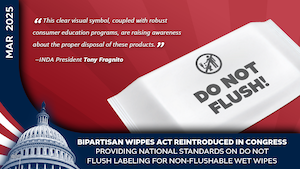
Bipartisan WIPPES Act Reintroduced In Congress To Provide National Standards On Do Not Flush Labeling For Non-Flushable Wet Wipes

CARY, N.C. — March 27, 2025 — INDA, the Association of the Nonwoven Fabrics Industry is thrilled to announce the reintroduction of the Wastewater Infrastructure Pollution Prevention and Environmental Safety (WIPPES) Act, sponsored by U.S. Senators Jeff Merkley (D-OR) and Susan Collins (R-ME), U.S. Representatives Lisa McClain (R-MI) and Kevin Mullin (D-CA).

INDA and its members have supported this bipartisan legislation since it was first introduced in the 117th Congress. Developed through years of collaboration between the nonwovens industry and wastewater stakeholders, this federal solution reflects the successes of similar “Do Not Flush” labeling requirements for non-flushable wipes already enacted in seven states. The WIPPES Act will establish a uniform national standard, ensuring that non-flushable wipes feature clear and prominent “Do Not Flush” labeling on their packaging.

“The reintroduction of the WIPPES Act represents years of bipartisan support in Congress and collaboration between our industry and wastewater agencies. This legislation, along with its companion bill, is poised to establish a single federal standard for ‘Do Not Flush’ labeling for wipes manufacturers which will ensure consumers in every market are informed on the proper disposal methods of the products they have purchased,” said Wes Fisher, INDA director of Government Affairs. “INDA appreciates the continued leadership of Senators Merkley and Collins, as well as Representative McClain, in advancing this important legislation. We are also pleased to welcome Representative Mullin as a sponsor and look forward to working together to drive meaningful progress on this issue.”

“INDA is proud to continue its support for the WIPPES Act, which was passed by the U.S. House of Representatives by an overwhelming bipartisan margin in 2024. The industry is committed to responsibly managing wipe products that are not designed to be flushable, protecting public infrastructure and the environment,” said INDA President Tony Fragnito. “The passage of this important legislation will have positive impacts on the environment, wastewater agencies, consumers, and manufacturers by mandating uniform ‘Do Not Flush’ labeling for covered products. This clear visual symbol, coupled with robust consumer education programs, are raising awareness about the proper disposal of these products. INDA applauds the sponsor’s vision to address this issue in a comprehensive and meaningful way. We look forward to our continued collaboration with the wastewater sector and other stakeholders to support this bill’s swift passage in Congress.”

The WIPPES Act (H.R. 2964) received strong bipartisan support during the 118th Congress. Last year, the bill was reported out of the House Committee on Energy and Commerce before it passed on the House floor by a vote of 351-56. This decisive, bipartisan vote reflects a shared commitment from both political parties to promoting clearer consumer guidance through standardized labeling requirements at the federal level, helping to protect wastewater infrastructure and ensure more responsible disposal practices. The legislation was not scheduled for a committee hearing in the Senate before the end of the 118th Congress.

INDA and our partners will continue to advocate for standardized labeling laws, both at the state and federal levels. Over the years, INDA has worked with lawmakers in seven states and counting to draft and pass “Do Not Flush” labeling requirements while promoting consumer education, notably in the projects carried out by the Responsible Flushing Alliance. These state-level laws have collectively contributed to improved “Do Not Flush” labeling on non-flushable wipes, serving as a foundation for the federal standards proposed in the reintroduced version of the WIPPES Act.

The latest text of the WIPPES Act (H.R. 2269 / S. 1092) can be accessed here.
The press release from Congressional sponsors can be found here.

For questions, contact Wes Fisher, Director of Government Affairs, wfisher@inda.org

Posted: March 27, 2025

Source: INDA, the Association of the Nonwoven Fabrics Industry

NRI Industrial Sales Inc. Expands Leadership In Circular Economy With European Market Growth

MISSISSAUGA, Ontario/WARSAW, Poland— March 27, 2025 — NRI Industrial Sales Inc. is redefining how businesses recover value from surplus industrial assets while minimizing environmental impact. As a specialist in industrial asset recovery and sustainable surplus management, the company has helped manufacturers and distributors across North America optimize their supply chains, reduce waste, and increase operational efficiency. Now, with its expansion into Europe, NRI Industrial is bringing its proven circular economy model to an even broader global audience.

Over the years, NRI Industrial has developed a strong reputation for its ability to recover, redistribute, and repurpose surplus assets. The company processes millions of pounds of industrial equipment and components annually, ensuring that valuable resources remain in circulation rather than becoming obsolete. Through advanced technology and an extensive global distribution network, NRI has successfully connected businesses with surplus solutions that reduce storage costs, streamline asset liquidation, and support environmental sustainability. By leveraging data-driven asset tracking and AI-powered inventory management, NRI continues to refine its approach to surplus recovery, ensuring maximum value and tax efficiency for its clients.

This expansion into Europe reflects NRI’s commitment to helping manufacturers and industrial partners improve their surplus asset management strategies. By working with European manufacturers, distributors, and system integrators, NRI is providing solutions that align with sustainability goals and evolving regulatory requirements. With the industrial sector placing greater emphasis on circular supply chains, this expansion positions NRI as a key player in the global movement toward waste reduction and responsible asset recovery. Companies across Europe will now have access to NRI’s expertise, ensuring they can seamlessly integrate surplus management into their operations while maintaining compliance with their regional sustainability policies.

To further highlight its impact and industry expertise, NRI Industrial will be exhibiting at ANEXPO 2025 from June 16-18 in Warsaw, a premier event dedicated to automation and industrial solutions. This opportunity allows NRI to connect with manufacturers and distributors seeking to improve their surplus management strategies. Attendees can gain insights into how NRI Industrial’s services can help transform their surplus assets into revenue and tax streams while reducing their environmental output, and learn how NRI Industrial can become a trusted partner in sustainable surplus logistics and management. As part of NRI Industrial’s presence at ANEXPO 2025, join us as we present the Revolutionizing the Circular Economy: NRI Industrial’s Role in Sustainable Asset Recovery topic with a focus on the sustainable asset recovery and the circular economy, and its impact on North America.

Companies are looking for innovative ways to optimize all their resources while meeting their environmental responsibilities. With a growing international footprint and a stronger European presence, NRI Industrial can help companies and industries deliver smart, sustainable solutions for surplus recovery.

NRI Industrial is offering one-on-one meetings at ANEXPO 2025 to help manufacturers and distributors explore tailored strategy solutions for surplus recovery. These individual discussions can provide a valuable opportunity for companies to learn how NRI Industrial can partner with them to strengthen their asset management strategies while reducing environmental impact. Companies can learn more about NRI Industrial’s services by visiting nrisolutions.com.

Posted: March 27, 2025

Source: NRI Industrial Sales Inc.

BASF Starts Up Its First Plant For Recycled Polyamide 6 — loopamid Now Commercially Available

LUDWIGSHAFEN, Germany/SHANGHAI, China — March 27, 2025 — BASF announced the start-up of the its commercial loopamid® plant. The production facility at the Caojing site in Shanghai, China, has an annual capacity of 500 metric tons and marks an important step in the supply of sustainable products for the textile industry. “The startup of this plant once again demonstrates BASF’s innovative strength,” said Stephan Kothrade, member of the Board of Executive Directors and chief technology officer of BASF SE. “As an integral part of our Winning Ways strategy, we utilize our chemistry to develop solutions for the biggest challenges of our time. loopamid transforms textile waste into a valuable resource, helps save raw materials and closes the textile loop.”

loopamid is a recycled polyamide 6 that is entirely based on textile waste. The new production facility supports the growing demand for sustainable polyamide 6 fibers in the textile industry. “I am proud of our team, which has worked with great passion and dedication to achieve the commercialization of loopamid,” said Ramkumar Dhruva, president of BASF’s Monomers division. “The technology behind loopamid allows textile-to-textile recycling for polyamide 6 in a wide variety of fabric blends, including those with elastane. I am convinced that loopamid not only makes a significant contribution to the textile circular economy, but also helps our customers achieve their sustainability goals.”

GRS certification for plant and loopamid products

The plant as well as the quantities of loopamid produced are certified according to the Global Recycled Standard (GRS). This certification guarantees to consumers and textile manufacturers that loopamid is made from recycled materials and that the production processes comply with specific environmental and social criteria. In addition, first yarn manufacturers are successfully using loopamid.

Post-industrial and post-consumer textile waste as basis for loopamid

To produce loopamid in its new plant, BASF currently utilizes industrial textile waste from textile manufacturing and will gradually increase the share of post-consumer waste. This feedstock includes cutting scraps, defective cuts, offcuts and other production textile waste from the textile industry. These materials are collected and provided to BASF by customers and partners. End-of-life garments made from polyamide 6 and other textile products can also be utilized for the production of loopamid. All these waste materials are challenging to recycle because they typically consist of a mixture of different fibers and materials as well as dyes and additives. Additionally, for post-consumer waste recycling, buttons, zippers and accessories must be removed in advance. BASF works closely with partners and customers to accelerate the development of collection and sorting systems.

loopamid®

With loopamid, BASF has developed an innovative solution to improve circularity in the fashion industry and recycle polyamide 6 textile waste. Due to its capability to tolerate all fabric mixtures like PA6 and elastane, the technology behind loopamid allows textile-to-textile recycling of post-industrial and post-consumer textile waste. The fibers and materials can be recycled over multiple cycles. At the same time, the material characteristics are identical to those of conventional virgin polyamide.

Posted: March 27, 2025

Source: BASF

Sponsors