AMHERST, Mass. — February 25, 2021 — OrthoLite®, provider of branded, high performance and comfort footwear solutions, unveils OrthoLite O-Therm™, an innovative new thermal insole technology that sets a new standard in cold-weather footwear protection. O-Therm offers all of the known benefits of open-cell PU-foam, while combining the world’s lightest and most insulative cold barrier protection. This technology is only possible with O-Therm’s proprietary aerogel’s unmatched thermal properties and is unrivaled in any other footwear offering. For the consumer, this means your feet will stay warmer, you can stay outdoors longer, feel more comfortable, perform better and go farther in cold weather conditions.
O-Therm is the first and only aerogel-infused, open-cell PU foam. This new technology creates a thermal barrier that blocks the cold and maintains footwear temperature regulation. Using an advanced aerogel, the world’s most insulating material, the proprietary combination of materials in O-Therm delivers unmatched thermal insulation and all-day comfort underfoot for cold-weather protection.
“OrthoLite’s proprietary aerogel is O-Therm’s secret sauce,” explained Rob Falken, vice president of Innovation at OrthoLite. “Our advanced aerogel traps micro-pockets of air without the need for loft, and it won’t lose its effectiveness when compressed under foot. OrthoLite’s aerogel is unlike any other aerogel solution in that it is nano-porous inside of a multi-porous structure, and that creates a supreme thermal barrier which blocks both cold and heat. In addition, O-Therm’s advanced silica aerogel powder is the lightest man-made material, weighing in at only three times the weight of air,” Falken notes.
O-Therm advanced aerogel is also exceptionally hydrophobic, which means it repels water and moves moisture away from the foot to provide a drier, more comfortable shoe environment. Exclusive to OrthoLite, this proprietary advanced aerogel requires no special handling or encapsulation – a world’s first.
OrthoLite worked with third-party thermal test laboratory, New York City-based Vartest Laboratories, to quantify the thermal performance of O-Therm aerogel insoles under extreme cold conditions -78°C (-108°F). The third-party test results validate that O-Therm is a breathable thermal barrier that is 54% more effective on average in comparative testing to other thermal insoles when tested at -78°C (-108°F).
O-Therm retains all of the comfort and performance benefits of OrthoLite open cell PU foam. O-Therm is a 2mm base-layer thermal foam that can be combined with a wide range of OrthoLite top-layer foams to create a custom insole solution tailored to a broad range of footwear categories, including: outdoor, casual, work, ski and snowboard, fashion, and other cold weather footwear categories. The innate thinness and moldability of O-Therm also makes it an ideal thermal barrier solution for footwear linings and strobel layers—bringing unsurpassed cold block technology without adding bulk or weight.
“We are proud to introduce this new thermal innovation to the footwear industry,” said John Barrett, president of OrthoLite. “We see tremendous potential in the market — in cold weather footwear applications and beyond.”
As a vertically integrated U.S. company with facilities around the world, OrthoLite collaborates with its brand partners to create and produce custom insole formulations that deliver unrivaled comfort and performance.
For a number of spinners, 2020 was a tumultuous year. What started out on an unusually high note rapidly crashed and burned when the COVID-19 pandemic virtually shut down the global economy.
Businesses closed, or were open only sporadically. Orders kept plummeting. The low point, according to several spinners, was around the transition from the second to third quarters.
Some spinners saw revenue drops of 20 to 40 percent. “The outlook was bleak around mid-year,” said one spinner. “Big companies were taking a huge hit, and some smaller companies were in danger of folding completely.”
Fortunately, some spinners found a place in the personal protective equipment (PPE) space and were able to recoup some of the revenue lost from other sources. The bulk of PPE material, however, is made in China, which prompted some trade groups to call for the establishment of more U.S. production.
Yet, when things seemed darkest and with no end in sight, business began picking up again. As many consumers became resigned to the concept of “sheltering in place,” online orders began flooding in. The holiday season was much more robust than any would have imagined just a month or two earlier.
“A big boost for business came when people unable to leave their homes began looking around and assessing what they needed around the house,” said one industry professional. “There was a significant increase in orders for home fashions — sheets, bedroom accessories, towels, washcloths and the like. The demand for home furnishings increased. And a lot of people went back to work.”
For some spinners, the uptick in business was almost enough to offset earlier losses. Some came close — or even met — pre-pandemic yearly forecasts.
Now, with the start-up of massive vaccine distribution, spinners look forward to a better 2021, hoping for a year similar to — or better than — the one they had forecast for 2020. “Once it is safe to be among large numbers of people, I expect you will see a massive increase in consumer spending,” said an industry analyst. “Having been semi-quarantined for so long, a lot of people are going to want new wardrobes, new cars and new luxuries. All of this promises good times for spinners and the rest of the U.S. fiber/textile/apparel complex.”
Yarn Manufacturers, Fabricators And Finishers Face Possible New Regulations
Spinners, weavers, knitters and dye houses, have come under increasing scrutiny over the past few years because of their impact on the environment. Even further, according to The National Law Review, more issues have arisen over alleged supply-chain transparency, climate-related disclosures, and misleading environmental and sustainability claims.
“Globally, climate disclosures are increasingly changing from voluntary to mandatory, recognizing the importance to investors of understanding climate risks, as well as corporate environmental impacts,” according to the publication. “The U.S. may be the next to follow this trend. The Biden Administration has announced its intent to require ‘public companies to disclose climate risks and greenhouse gas emissions in their operations and supply chains, presumably by amending current U.S. Securities and Exchange Commission reporting requirements. The process of making such disclosures mandatory, as opposed to part of a voluntary sustainability disclosure framework.”
Misleading statements have also become an issue. The U.S. Federal Trade Commission has brought enforcement actions against several “name” retailers, such as Nordstrom, Bed Bath & Beyond and Macy’s for claiming products were made from eco-friendly bamboo when the products were actually made from rayon yarn.
Also at issue are products incorrectly labeled. The USDA’s “Organic Oversight and Enforcement Update Summary of Activities – May 2019” report details numerous activities taken again products deceptively labeled as organic.
The National Law review recommends that, “… given the many changes to come, U.S. fashion and textile industry stakeholders should continue to closely track legislative, regulatory and enforcement developments, particularly with respect to direction from the Biden administration on mandatory non-financial disclosures, expanded green marketing enforcement by FTC,” as well as such issues as human rights abuses by import partners. “In addition,” the publication continues, “ensuring effective supplier oversight and accountability will help to address potential compliance risks, especially with respect to new requirements that might prevent access to key markets like the EU.”
Cotton Prices Continue To Rise
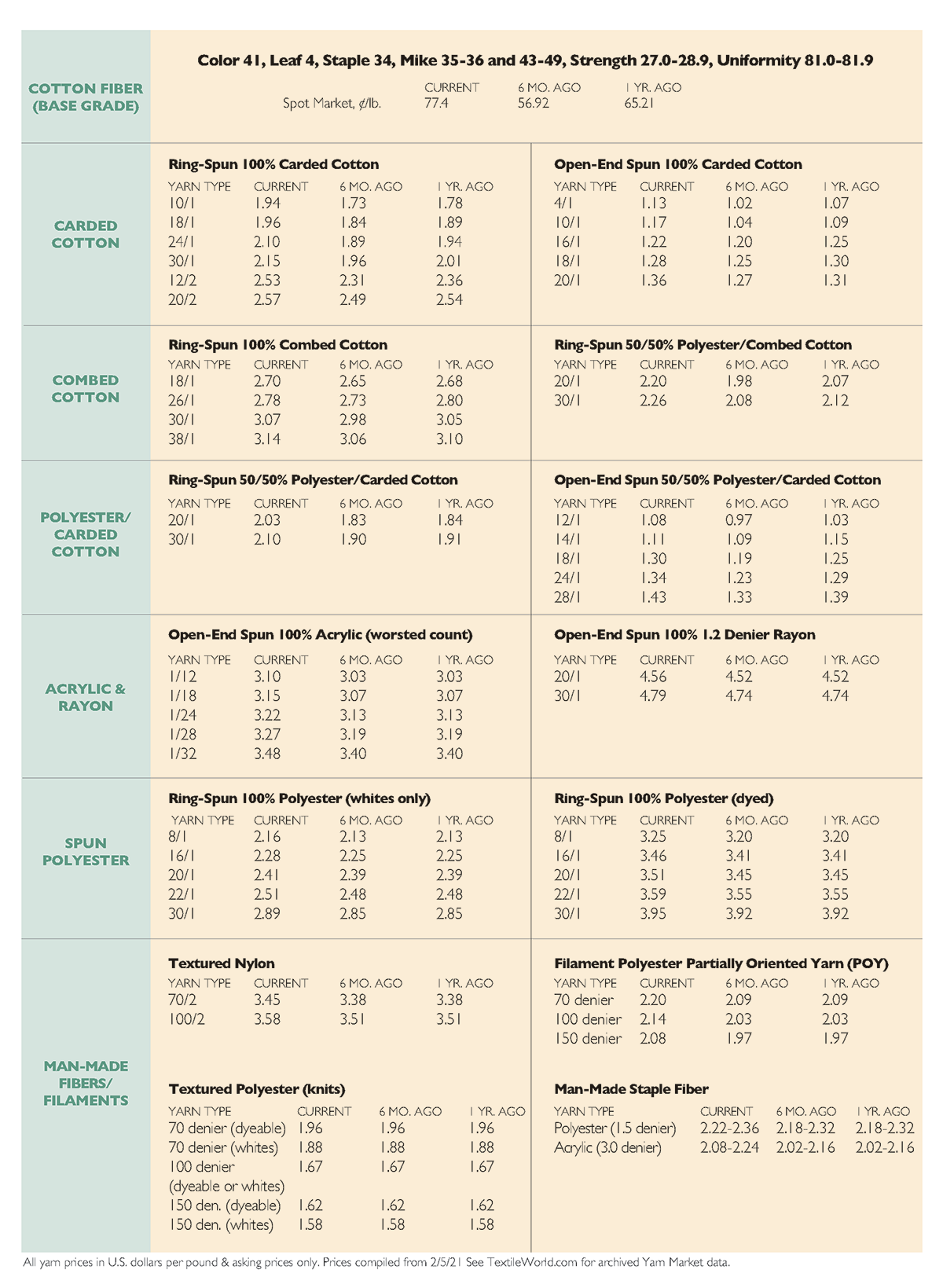
Before the beginning of the global COVID-19 pandemic, cotton prices had been trending upward. Then, beginning in February 2020, prices began falling, hitting a 10-year low by mid-year. By May 2020, spot market prices for the base quality of cotton (color 41, leaf 4, staple 34, mike 35-36 and 43-49, strength 27.0-28.9, and uniformity 81.0-81.9) in the seven designated markets measured by the USDA averaged 52.8 cents per pound.
However, in late 2020, prices began to rebound. For the week ended February 4, spot market prices averaged 77.40 cents per pound.
According to various sources, several factors have combined to create such a rapid rise in prices. First, cotton production for the 2020/2021 period, which began in August, is projected to be the lowest since the 2016/2017 season. The latest U.S. Department of Agriculture (USDA) estimates indicate that world cotton production in 2020/21 is projected at 112.9 million bales—approximately 7.5 percent below 2019/20. The United States, the third-largest cotton producer, behind India and China, accounts for more than half of the decrease.
During the first week of February, buyers for domestic mills purchased a moderate volume of color 41, leaf 3, and staple 36 for second through fourth quarter delivery. Reports indicated that mills continued to incrementally increase operating schedules as warranted by increased finished product demand. Yarn demand was good. Mills continued to produce personal protective equipment for frontline workers and military supplies.
WILMINGTON, Mass. — February 25, 2021 — UniFirst Corp., a North American provider of customized work uniform programs, corporate attire, and facility service products for business, has long offered hygienically clean laundering as part of its managed uniform rental services. With the coronavirus (COVID-19) pandemic shedding a renewed light on the need for hygiene, cleaning, and disinfecting, the convenience and safety of a managed, hygienically clean uniform program has become a top priority for many companies across the nation. Leading uniform suppliers such as UniFirst continue to answer that call, with programs and services that help employees stay safe and healthy on the job.
In a study performed by the Association for the Advancement of Medical Instrumentation (AAMI), “hygienically clean” is defined as “free of pathogens in sufficient numbers to cause human illness.” The primary benefit of utilizing managed uniform and industrial laundry services with properly documented laundering techniques is the drastic reduction in the risk of cross-contamination of chemicals, biological substances like bacteria and viruses, and other soiling agents between the workplace and the home.
The National Institute for Occupational Safety and Health (NIOSH)—part of the Centers for Disease Control and Prevention (CDC)—conducted a survey of contamination in workers’ homes by hazardous substances transported from the workplace. Work clothing was identified as a major route of exposure that caused various negative health effects among workers’ families. This finding is of particular importance in the healthcare industry, as frontline workers contend daily with pathogens, bacteria, and viruses that they certainly do not want to be bringing into their homes on soiled scrub apparel.
“Laundering facilities that deliver hygienically clean uniforms and workwear have the ability to regulate and control virtually all aspects of the laundering process,” says Adam Soreff, director of marketing and communications for UniFirst. “From strict temperature moderation of both washers and dryers to the use of high-powered, environmentally friendly detergents that are specifically formulated for varying industries and different types of soiling, managed uniform and laundering services provide health and safety advantages that are simply not attainable in a home setting.”
UniFirst uniform rental programs that deliver hygienically clean garments provide businesses with numerous advantages that company-managed or at-home programs simply cannot. Aside from the elimination of upfront investments, cost savings over time, and the aforementioned health and safety benefits, managed service programs also offer:
Enhanced business and employee image;
Tailored, individual sizing and fitting;
Customized, high-definition emblems and embroidery;
Regularly scheduled pickup and delivery;
Weekly maintenance and quality checks of all garments;
Automatic repairs and replacements as needed; and
Complete program management.
The many benefits of a UniFirst uniform rental program are clear, but perhaps nowhere more so than in the area of health and safety. Whether in the midst of a pandemic or not, the peace of mind provided by hygienically clean laundering, scheduled pickup and delivery, maintenance, and the reduced need for bringing soiled or tainted workwear home is enough to make companies nationwide choose hygienically clean uniforms for their staff.
REMSCHEID, Germany — February 25, 2021 — This year’s trade fair appearance of Oerlikon’s Manmade Fibers Division at ITMA ASIA + CITME will focus on the latest machine and plant developments as well as customer services around the motto “Clean Technology. Smart Factory.” In Hall 7 of the China National Exhibition and Convention Center (NECC), Shanghai, Oerlikon will present as one of the leading suppliers for high-end technology solutions for the entire manmade fibers industry its innovations from June 12-16, 2021, at its hybrid booth A48 on more than 225 m².
Oerlikon offers its customers solutions along the textile value production chain. The division with the competence brands Oerlikon Barmag, Oerlikon Neumag and Oerlikon Nonwoven thus supplies technology “From Melt to Yarn, Fibers and Nonwovens” for PET, PP, PA6 and other materials. Accordingly, the offers at the ITMA ASIA + CITME booth will be.
Due to the travel restrictions in the context of the Corona pandemic, Oerlikon relies on a hybrid booth concept. In addition to various new component exhibits from the fields of continuous polycondensation including gear metering pumps, filament (POY, FDY, IDY, BCF) and staple fiber spinning, texturing as well as nonwovens production, the dialog with customers will now more than ever after such a long time without a fair be at the center of the trade show activities. All Oerlikon experts from outside China will be able to be connected online in order to provide comprehensive support for the trade fair visitors together with the Chinese sales staff, technologists and engineers onsite. Especially in the field of digitalization and new solutions for the “Smart Factory”, the intercontinental dialog at the whole time of the exhibition is a mandatory prerequisite for a successful trade fair.
Faced with a crisis, the U.S. textile industry is a dependable responsive force that provides solutions. Various war efforts throughout history have called upon the industry to answer the call and use not only its capacity, but also to innovate to heed the call.
The COVID-19 pandemic has proved to be no different. In its early days in spring 2020, the demand for and understanding of personal protection equipment (PPE) shortages were just coming to light. Test kits for the virus and the search for a vaccine were in their infancy, but came on strong.
In retrospect, there wasn’t much clarity on a response, but as information developed the U.S. textile industry along with other industries responded quickly to fill the void.
Terms like PPE and ventilators entered the common lexicon swiftly and manufacturers shifted gears.
As we enter the second year of the pandemic and as hospitalizations and death rates slow, the U.S. textile industry hasn’t wavered. More importantly, the analysis is underway.
Will demand for PPE be here to stay? Will this be a near-shoring stimulus to not get caught off-guard, short supplied again? Is it a stable enough environment to warrant the significant investment demanded? Should companies really pivot their product and manufacturing mixes to chase the opportunity?
Many would say, “Yes, you are overthinking the opportunity of a lifetime.”
In this issue, “Beverly Knits Inc.: Investing For The Future” talks about the company’s COVID-19 response. Back in April 2020, Beverly Knits was part of a coalition of some 31 U.S. textile manufacturers that came together to meet the demand for PPE. In a press release Beverly Knits’ CEO Ron Sytz stated: “We have tremendous U.S. textile companies that are retooling quickly to make these masks. The cooperation of the group is amazing in sharing information and parts as well as working together. Our goal is to make it happen as fast as possible to flatten the curve on COVID-19.” The release noted that once its facilities were qualified, production began in early April with a goal to produce 200,000 masks the first week, ramping up to 2 million masks per week shortly thereafter.
As the pandemic lingers and precautions stay in effect, the U.S. textile industry continues to rise to the occasion. Interestingly there are unforeseen consequences as product mixes shift. A manufacturer who uses a fairly ubiquitous nonwoven to make a common packaging material reported this week that he was told by the major nonwoven manufacturer it will no longer be able to supply the commodity product. The manufacturer has a one-week-supply on hand. One can only guess that the commodity capacity might be supporting shifting demand, and wonder what other shifts will occur.
BANGKOK — February 25, 2021 — Indorama Ventures Public Co. Ltd. (IVL), a global chemical producer, announced its full year and fourth quarter 2020 financial results as follows.
2020 Performance Summary
IVL full year sales volumes grew 18 percent to 14.08 million tons;
IVL full year Core EBITDA declined 3 percent to $1.11 billion;
IVL full year operating cash flows grew 6 percent to $1.39 billion; and
Total capex of $2.6 billion in 2020 including Spindletop (IVOX), funded via $0.7 billion from operating cash flow and $1.9 billion from new debt
Platform, People, Systems
2020 stress tested our businesses, proving that we have created a portfolio that is resilient, sustainable and positioned for growth. Management team used 2020 to “prepare for growth” by re-organizing the business, building strong leadership teams at every vertical. Additionally, IVL is undergoing various transformative initiatives, on our journey towards establishing institutional excellence and efficiency. The cornerstone for operational excellence lies in the successful implementation of companywide one ERP, i.e. S4 HANA, of which we are progressing well on track.
Project Olympus
Execution of the company’s cost saving and business transformation project, named “Project Olympus”, is off to a strong start as IVL is ahead of first year plan by 21 percent or more in cost savings. Encouraged by internal assessment and outperformance, we have increased our Project Olympus ambition to deliver $610 million extra EBITDA on an annual basis by 2023 over 2019 (versus $352 million announced last year), comprising of 2,400+ Cost Transformation and Business Full Potential initiatives.
Corporate Strength
With a liquidity of $2.6 billion in Dec20 and operating cash flow of $1.39 billion in 2020, IVL is well positioned. On a pro-forma basis, IVL operating debt improved at end of 2020 over 2019, our interest rates decreased and we have locked in 70 percent of debts at these historical low rates. We anticipate to use our free cash flow of 2021 into strategic projects (including recycling growth), pay down debts, improve shareholder’s returns and IVL ROCE.
Outlook
With 123 operating sites in 33 countries we are well positioned to reap the benefits from consumptions recovery in 2021 in all three segments and the various businesses therein. With the rollout of vaccines and easing of COVID restrictions, we expect a rebound in polyester fiber demand, consequently improving PX, PTA and MEG demand and spreads, as well as demand for our Lifestyle Fibers. Increased mobility is expected to improve demand for Mobility Fibers, while higher gasoline demand is expected to improve MTBE spread. The rising crude oil price has provided a nice boost to MEG spreads, as well as to MTBE, with our shale gas advantage. Demand for our PET, Hygiene Fibers, and HVA IOD portfolios are expected to remain robust.
Aloke Lohia, Group CEO of Indorama Ventures, said: “The biggest learning for us from 2020 is that we have built a portfolio of three strong segments that provides us with diversified sources of earnings with integration and resilience, and primed for growth. We emerged from the year with no structural damage to the end markets that we serve. Safety and hygiene remain key characteristics to our offerings and the pandemic has only further proven the sustainability of our products. In 2020, we launched the company on a journey of transformation, emboldening our leaders with the right tools, and strengthening us from within with systems that will carry us forward. With this we prepare ourselves for the next chapter in our story, towards an enhanced IVL that is resilient, agile, and innovative.”
STOCKHOLM — February 24, 2021 — We aRe Spin Dye (WRSD) continues its collaboration with H&M Group and today further new garments are launched in H&M Womenswear produced with recycled fibers and durable dyeing from WRSD.
The launch is completely in line with the investment and the brands that We aRe Spin Dye wants to work with in the long term.
“We are of course very happy and proud to participate as a supplier to H&M Womenswear, which is really an important milestone for us,” says We aRe SpinDyes CEO Andreas Andrén and continues, “We can thus show a good example of our production capacity which is partly scalable with immediate effect, and partly can offer a flexible price picture. We see this as a start to something very exciting and we are pleased that the market is starting to open its eyes to the resource-efficient and sustainable dyeing alternative that we offer.”
BIELLA, Italy — February 24, 2021 — “Filo continues to operate and never stops. We will return to normal soon, we will meet at the fair and experience first-hand the know-how of Filo’s spinners”: these are the words chosen by Paolo Monfermoso, general manager of Filo, to start “Con le mani”, a series of meetings in view of the 56th edition of the Salone, to be held September 29-30, 2021, at MiCo in Milan.
“Con le mani – Episode I” is available on the Filo website (www.filo.it), on the Facebook page and on the Twitter account of the Salon starting from February 24, 2021, that is from the day on which the 55th edition of Filo should have been opened, if not canceled for the well known reasons.
However, Filo wanted to send a message of confidence to its exhibitors and visitors.
In his speech, Monfermoso also announced the initiatives that Filo intends to undertake on the way to the 56th edition in September. The most significant is the series of interviews with some important testimonials from the textile world, who have always been close to Filo in their respective roles. With them Filo will address relevant issues: internalization, supply chain, sustainability, human capital.
All video interviews will be released through the Filo website and Filo’s social networks (Facebook, Twitter, Instagram).
The FilonewsLetter is also renewed, with greater spaces reserved to the exhibitors and a totally new section: “Pronto? Filo!”. Curated by Gianni Bologna, creativity and style manager of Filo, “Pronto? Filo!” proposes short flash interventions with suggestions on types of yarns and fabrics aimed particularly at the short-term market.
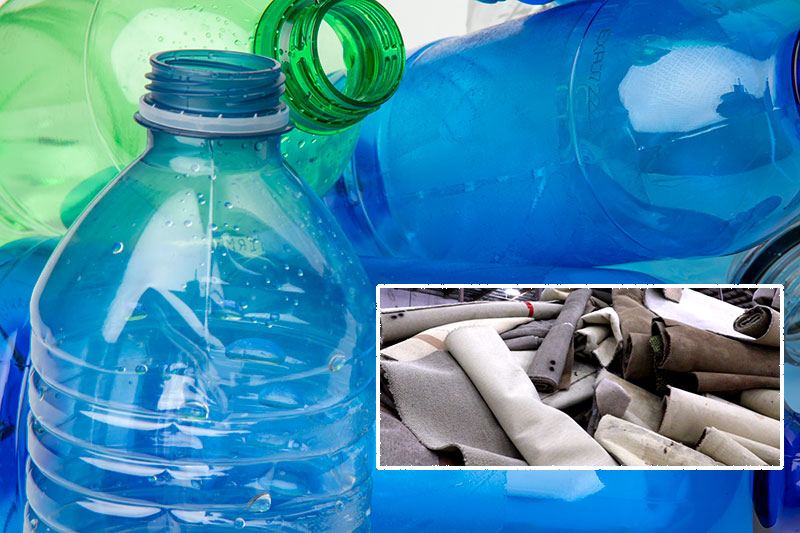
Eastman’s molecular recycling technologies can recycle almost any plastic waste an infinite number of times including colored water bottles and discarded carpet (inset).
Molecular recycling technologies from Eastman allow plastic waste of almost any kind to be recycled an infinite number of times into feedstock that is indistinguishable from virgin materials in quality.
TW Special Report
Increased demand for recycled plastic and a rising focus on solving the global waste crisis have created demand for technology solutions to develop a sustainable lifecycle for plastics. The scope of the global plastic waste crisis — about 300 million tons of plastic produced globally and only about 15 percent of it being recycled today — means there is no time to waste in doing something about it. That reality has driven Eastman Chemical Co., Kingsport, Tenn., to apply innovation to the problem, with the result being commercialization of its Advanced Circular Recycling technologies. These molecular recycling technologies enable the company to recycle almost any kind of plastic waste an infinite number of times and deliver recycled content that is significantly lower in carbon footprint compared to processes using fossil feedstocks, and indistinguishable from virgin materials in terms of materials quality.
Eastman began this journey two years ago and, in late January 2021, took its biggest step yet: The company announced a $250 million investment to build a new molecular recycling facility that will recycle polyester.
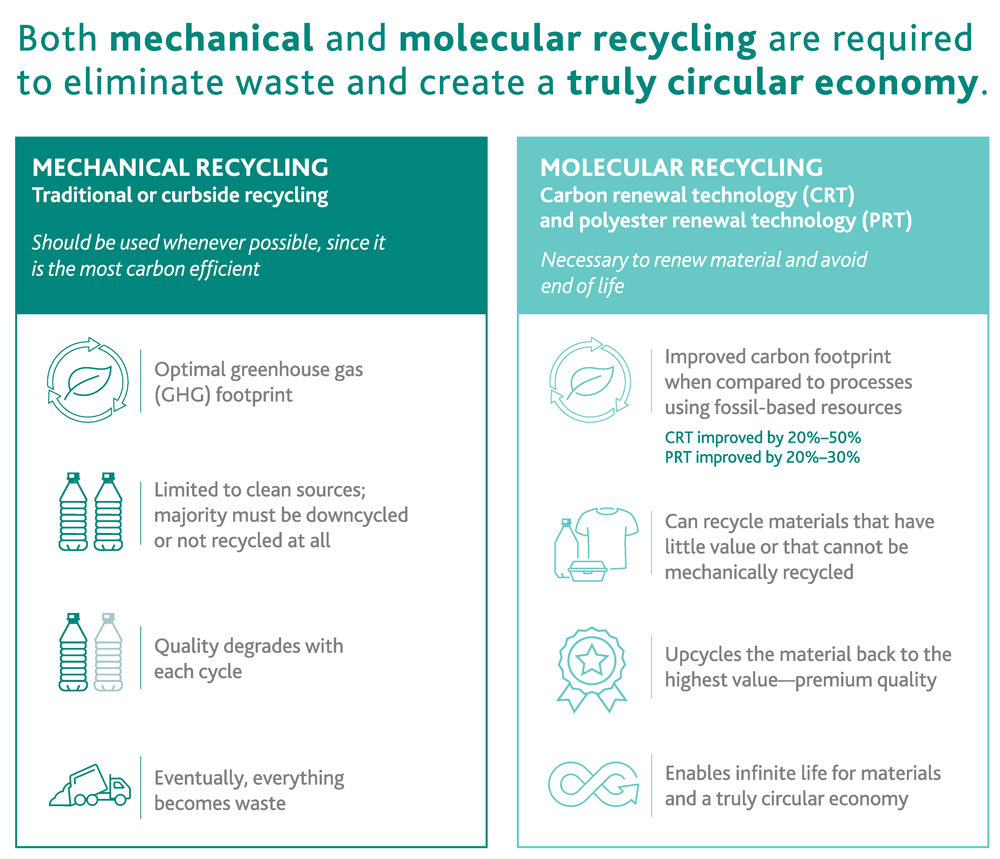
Historically, plastic recycling is associated with mechanical recycling — this basic method is a well-known, mainstream method of dealing with plastic waste. In general, it involves gathering the product, sorting, washing for decontamination, shredding and melting. The order may vary, but the result is similar.
The downside to this approach is the level of purity. To be used effectively in a recycled polyester (rPET) fiber product, the recycled material often must be blended with virgin polyester. Keep in mind that the melt product, usually in the form of pellets, is polymerized polyester, not the monomers or raw materials that form the polymer chains that are polyester.
There are seven types of plastic resins produced and identified with Resin Identification Codes (RIC) 1 through 7. Mechanical recycling only processes RIC 1 (PETE) and RIC 2 (HDPE). Eastman’s molecular recycling doesn’t impose those limitations — the company has developed innovation technologies that give it the capability to recycle almost any plastic waste. Eastman’s molecular recycling technologies complement mechanical recycling to reimagine recycling as the world knows it, creating a future where almost all plastic products, even at end of life, are still regarded as valuable and do not become waste.
Eastman’s molecular recycling can process RIC 1-7 with the exception of RIC 3 — polyvinyl chloride.
Eastman employs two molecular recycling solutions: carbon renewal technology (CRT) and polyester renewal technology (PRT).
Polyester Renewal Technology (PRT)
Eastman’s PRT is a form of molecular recycling that enables the company to process a wide range of polyester plastic waste, which includes materials such as soft drink bottles, carpet and textiles, diverting these materials from landfills or incineration. This waste stream goes beyond clear, single-use water bottles to include products such as colored plastic bottles and food containers, and polyester carpet.
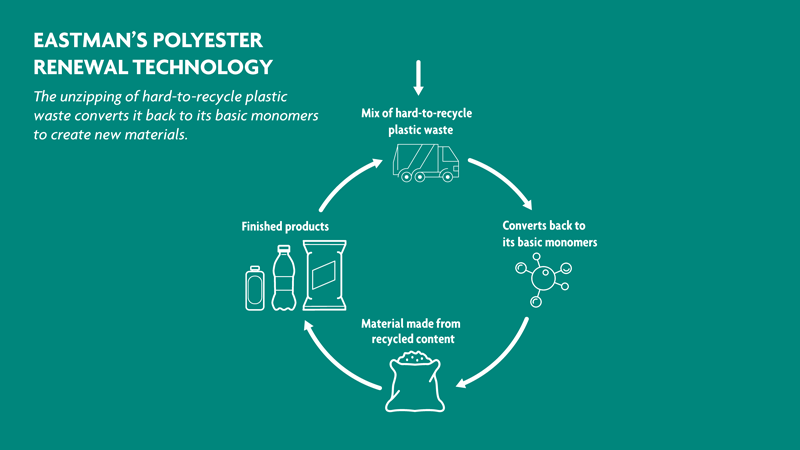
PRT unzips polyesters and converts them into their basic monomers to create new materials. The molecules produced are indistinguishable from materials made with virgin or non-recycled content. This process, also known as depolymerization, allows Eastman to recycle polyester waste over and over again without degradation over time and reduces greenhouse gas emissions by 20 to 30 percent compared to processes using fossil fuels.
Eastman currently has a glycolysis-based PRT process operational in Kingsport, Tenn. with a new facility using the process of methanolysis that will be mechanically completed in 2022.
Molecular Recycling Facility Will Be One Of The World’s Largest
For almost two years, Eastman has asserted its commitment to accelerate the circular economy, and on January 29, that commitment increased by orders of magnitude. That’s the day Eastman Board Chair and CEO Mark Costa announced the company’s significant investment in the new, aforementioned molecular recycling facility, in Kingsport. The facility will provide intermediates that will enable the production of between 150 and 200 kilo metric tons (KMTs) of polymer production, depending on product mix. The feedstock for the facility will be hard-to-recycle polyester waste.
In announcing the new facility — with construction slated to begin in March — Costa said this material-to-material solution will not only reduce the company’s use of fossil feedstocks but also reduce its greenhouse gas emissions by 20 to 30 percent relative to processes that use fossil feedstocks.
Eastman set ambitious sustainability goals in December 2020. Those commitments include a goal of recycling more than 250 million pounds of plastic waste annually by 2025 and more than 500 million pounds of plastic waste annually by 2030. Eastman also set a goal of achieving carbon neutrality by 2050.
“With the growing demand for products made with recycled content and the urgent need to address the global plastic waste crisis, now is the time for Eastman to take this step,” Costa said.
Carbon Renewal Technology (CRT)
Eastman commercialized CRT first among its technologies because the company was able to convert existing assets to recycle complex plastics on the molecular level. By leveraging an existing asset, the company was able to go from announcing its plans for CRT to commercialization within nine months.
Eastman uses PRT and CRT to recycle different kinds of complex plastics, and through different processes.
PRT is specifically applicable to recycling polyester, and CRT can be used to recycle almost any kind of plastic. The technologies each provide materials with certified recycled content for different end-market products: PRT materials are used in Eastman’s polyester stream for products such as Tritan™ Renew; and CRT materials are used for products in its acetyls stream such as its Naia™ Renew cellulosic fiber. The two technologies share an important attribute in that both produce new materials from plastic waste that is indistinguishable from materials made from traditional processes.
Textile World recently had the opportunity to speak with Tim Dell, vice president, Corporate Innovation and Circular Economy, Eastman, to learn more about the company’s molecular recycling technologies.
TW: Why is it the right time for molecular recycling? What products has Eastman developed and with which systems and in what forms?
Tim Dell, vice president, Corporate Innovation and Circular Economy, Eastman
Tim Dell: Molecular recycling isn’t new for Eastman — we actually were pioneers of advanced recycling technology more than 30 years ago when our company was part of Eastman Kodak. Back in the 1980s, there was a need to recover silver from PET film. We developed and operated a commercial scale methanolysis facility that converted the scrap film to monomers used to produce polyesters. We revisited the technology at different times through the years, but Eastman’s technology was ahead of the marketplace, even as recently as five years ago.
The time is right now because the market has changed. The world has changed. More sustainable solutions are in demand by our customers and their consumers. Many of the world’s biggest brands have announced ambitious goals for recycled content in their products, and for brands to meet those goals, recycled materials from molecular recycling must be part of the mix. It would be nearly impossible for all brands to meet their goals with mechanically recycled content alone.
In 2019, we commercialized CRT, our first molecular recycling technology. We use waste plastics to replace hydrocarbon feedstocks in the production of our cellulosic products. In 2020, we commercialized PRT, which we use to convert waste polyester to new polyester products. Our Eastman Renew materials are contributing to the right choice — now — in end markets that include eyewear, cosmetics packaging, textiles, reusable water bottles, kitchen appliances, medical equipment, and more. In our specialty plastics portfolio, customers are choosing Eastman Tritan™ Renew and Cristal™ Renew.
In textiles, which utilizes CRT, we’re incredibly excited about what Naia™ Renew can do for fashion by offering sustainability without compromise. Naia Renew launched in September 2020, and it was only a couple of months later that H&M announced it would be first to market with its Conscious Exclusive A/W20 made from Naia Renew.
It’s an exciting time for our circular economy program because we see this as an important element of our innovation-driven growth strategy, and we can help contribute impactful solutions to significant world challenges.
TW: Do you see other forms of chemical recycling showing promise?
Dell: A number of different companies are at various stages of developing chemical recycling technologies for material-to-material solutions. We’re supportive of these efforts and would like to see more innovative technologies in use. The magnitude of the global waste issue is so large that no one company or single technology can solve it alone. Eastman is committed to doing our part by investing in our own molecular recycling technologies, which have been at commercial scale for more than a year. We’ve already recycled millions of pounds of plastic waste and have set recycling goals that we think will make a difference and serve as a crystal-clear example that this can work. I can say this for sure — we can’t solve the global waste crisis without molecular recycling.
TW: How do you for see these technologies being implemented in the future?
Dell: Circularity is a core solution to addressing big, global challenges — such as climate change and the waste crisis — which is why Eastman is taking a leading role. We believe that plastic and textile waste must not only be eliminated but used, reused, recycled and recreated over and over again.
It’s also important to note that no one entity alone can solve the problem. It’s going to take multiple stakeholders — all of us, really — working together to solve this. We’ve learned at Eastman that no collaborative effort is complete without advocacy. The technologies alone aren’t enough. We need a reimagined recycling infrastructure that collects and delivers plastic to a better end than landfill or incineration. We need smart policies that will drive investment in economical, efficient infrastructure that gets more discarded materials into recycling facilities and then back into new, high-quality products.
TW: Eastman’s new molecular recycling facility will be a big step forward towards circularity. How easy is it to replicate your methanolysis technology? What makes Eastman’s approach different?
Dell: This technology is not easily replicated. Methanolysis requires significant expertise and know-how. We’re a science-based company with a 100-year history that possesses world-class competencies in process chemistry and polymer science, and those elements are significant in building and operating a methanolysis recycling facility. But those aren’t the only elements. We are world experts in this chemistry in particular, and we also have engineering competencies and site-integration advantages that enable us to scale up a commercial operation quickly.
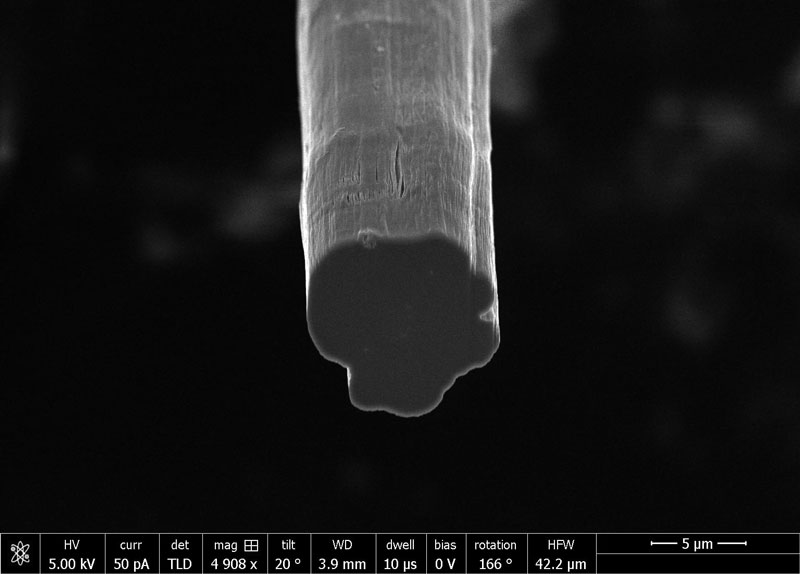
The cross-section of a fiber produced at Rice University contains tens of millions of carbon nanotubes. The lab continually improves its method to make fibers, which tests show are now stronger than Kevlar. Image courtesy of the Pasquali Research Group
Rice lab makes case for high-performance carbon nanotube fibers for industry
By Mike Williams
Carbon nanotube fibers made at Rice University are now stronger than Kevlar and are inching up on the conductivity of copper.
The Rice lab of chemical and biomolecular engineer Matteo Pasquali reported in Carbon it has developed its strongest and most conductive fibers yet, made using long carbon nanotubes processed through a wet spinning process.
In the new study led by Rice graduate students Lauren Taylor and Oliver Dewey, the researchers noted that wet-spun carbon nanotube fibers, which could lead to breakthroughs in a host of medical and materials applications, have doubled in strength and conductivity every three years, a trend that spans almost two decades.
While that may never mimic Moore’s Law, which set a benchmark for computer chip advances for decades, Pasquali and his team are doing their part to advance the method they pioneered to make carbon nanotube fibers.
They are also part of the Carbon Hub, a multi-university research initiative launched in 2019 by Rice with support from Shell, Prysmian and Mitsubishi to create a zero-emissions future.
“Carbon nanotube fibers have long been touted for their potential superior properties,” Pasquali said. “Two decades of research at Rice and elsewhere have made this potential a reality. Now we need a worldwide effort to increase production efficiency so these materials could be made with zero carbon dioxide emissions and potentially with concurrent production of clean hydrogen.”
“The goal of this paper is to put forth the record properties of the fibers produced in our lab,” Taylor said. “These improvements mean we’re now surpassing Kevlar in terms of strength, which for us is a really big achievement. With just another doubling, we would surpass the strongest fibers on the market.”
The flexible Rice fibers have a tensile strength of 4.2 gigapascals (GPa), compared to 3.6 GPa for Kevlar fibers. The fibers require long nanotubes with high crystallinity; that is, regular arrays of carbon-atom rings with few defects. The acidic solution used in the Rice process also helps reduce impurities that can interfere with fiber strength and enhances the nanotubes’ metallic properties through residual doping, Dewey said.
The cross-section of a fiber produced at Rice University contains tens of millions of carbon nanotubes. The lab continually improves its method to make fibers, which tests show are now stronger than Kevlar. Image courtesy of the Pasquali Research Group
“The length, or aspect ratio, of the nanotubes is the defining characteristic that drives the properties in our fibers,” he said, noting the surface area of the 12-micrometer nanotubes used in Rice fiber facilitates better van der Waals bonds. “It also helps that the collaborators who grow our nanotubes optimize for solution processing by controlling the number of metallic impurities from the catalyst and what we call amorphous carbon impurities.”
The researchers said the fibers’ conductivity has improved to 10.9 megasiemens (million siemens) per meter. “This is the first time a carbon nanotube fiber has passed the 10 megasiemens threshold, so we’ve achieved a new order of magnitude for nanotube fibers,” Dewey said. Normalized for weight, he said the Rice fibers achieve about 80 percent of the conductivity of copper
“But we’re surpassing platinum wire, which is a big achievement for us,” Taylor said, “and the fiber thermal conductivity is better than any metal and any synthetic fibers, except for pitch graphite fibers.”
The lab’s goal is to make the production of superior fibers efficient and inexpensive enough to be incorporated by industry on a large scale, Dewey noted. Solution processing is common in the production of other kinds of fibers, including Kevlar, so factories could use familiar processes without major retooling.
“The benefit of our method is that it’s essentially plug-and-play,” he said. “It’s inherently scalable and fits in with the way synthetic fibers are already made.”
“There’s a notion that carbon nanotubes are never going to be able to obtain all the properties that people have been hyping now for decades,” Taylor said. “But we’re making good gains year over year. It’s not easy, but we still do believe this technology is going to change the world.”
Co-authors of the paper are Rice alumnus Robert Headrick; graduate students Natsumi Komatsu and Nicolas Marquez Peraca; Geoff Wehmeyer, an assistant professor of mechanical engineering; and Junichiro Kono, the Karl F. Hasselmann Professor in Engineering and a professor of electrical and computer engineering, of physics and astronomy, and of materials science and nanoengineering. Pasquali is the A.J. Hartsook Professor of Chemical and Biomolecular engineering, of chemistry and of materials science and nanoengineering.
The U.S. Air Force Office of Scientific Research, the Robert A. Welch Foundation, the Department of Energy’s Advanced Manufacturing Office and the Advanced Research Projects Agency-Energy supported the research.
Editor’s Note: Mike Williams is a senior media relations specialist in Rice University’s Office of Public Affairs.