Philadelphia-based health and hygiene company Essity has acquired Legacy Converting Inc., a producer of roll and folded wipes in a variety of formats based in New Jersey. Legacy Converting produces disinfecting and wipe products under the Environmental Protection Agency-regulated Everwipe™ brand.
“The acquisition of Legacy Converting Inc. strengthens our wiping and cleaning product
expertise and offering and is a step in our expansion of this product area,” said Don Lewis, president, Professional Hygiene, Essity.
Herrmann Ultrasonics, Bartlett, Ill., has expanded its nonwovens laboratory at its headquarters to increase its global presence and support the growing North American market with application testing and customer support. The investment includes a ULC 600+ Ultrasonic Lab Calendar, among other technologies.
“Flexible and very thin materials, like 9 gsm, can be better controlled by means of a new web tensioning and control system,” said Uwe Peregi, president of Herrmann Ultrasonics. “With our brand-new quick exchange system for the ultrasonic stations, we can experiment with different ultrasonic technologies — static or rotating — in one single day. As a result, our customers will save time and money.”
Austria-based ANDRITZ recently reported sales.Portugal-based Sasia, a textile recycling company engaged in reducing textile waste, took delivery of its fourth tearing
line — including a seven-cylinder Jumbo tearing machine and the latest Andritz Laroche technology for fiber opening.
Andritz also received an order from the converting/wipes manufacturing partners Switzerland-based Laboratoire Naturel and Russia-based ZetTechnology group of companies — for their first neXline spunlace line. The equipment is scheduled for start up in the second quarter of 2022.
Bast Fibre Technologies Inc. (BFT), Victoria, British Columbia, has entered into an agreement with Georgia-Pacific Cellulose LLC to acquire Lumberton Cellulose, a Lumberton, N.C.-based processor of natural fibers.
“Acquiring this state-of-the-art natural fiber processing facility and integrating the great team at Lumberton enables BFT to immediately establish North American manufacturing operations to meet the rapidly growing demand for our sustainable natural fibers,” said BFT CEO and Chairman Noel Hall.
“This acquisition is a key strategic milestone in our mission to build out significant manufacturing capacity while supporting the vast potential of North American grown hemp and flax”, added BFT President Jim Posa.
Natureworks LLC, Minnetonka, Minn., has opened a new headquarters and advanced biopolymer research facility in Plymouth, Mass. The new facility supports research into its Ingeo™ biopolymer including next generation fermentation technology and new applications for a full circular life cycle. The research and development capabilities also will support the company’s planned Ingeo manufacturing complex in Thailand.
“In the face of these challenging times, we’ve designed a space that will enable research, invention, and collaboration between us, our partners, and the market, no matter where we are located in the world,” said Rich Altice, president & CEO of NatureWorks.
This year, TENCEL™, the flagship fiber of Austria-based Lenzing AG, is celebrating its 30th anniversary. To mark the occasion, the company has planned a series of brand, employee and consumer activities beginning in February.
“Since its launch 30 years ago, TENCEL has always been envisioned as a solution provider for the textile industry,” said Robert van de Kerkhof, member of Lenzing’s managing board.
“Aligning with the industry-wide shift towards deeper levels of sustainability and transparency, in 2018, the brand evolved from a behind-the-scenes contributor to a front-facing player. …We are thrilled to reach this milestone and are looking forward to driving continuous innovation and building stronger partnerships over the next 30 years and beyond.”
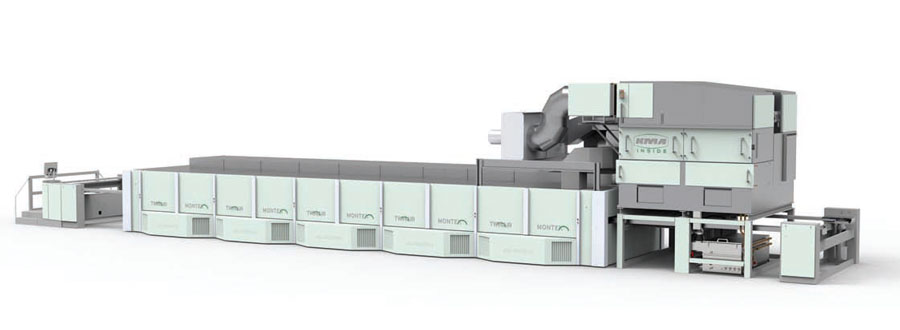
Full configuration of the Monforts and KMA Umwelttechnik line.
Albarrie – a major player in North America’s industrial nonwovens industry – is now benefiting from one of the first Monforts Montex tenter installations equipped with the full range of MonforClean heat recovery and exhaust air purification technologies.
TW Special Report
With the new three-chamber Montex tenter at its plant in Barrie, Ontario-based Albarrie Canada Ltd. is treating specialized needlepunched nonwovens up to 4 millimeters thick. These nonwovens have applications in a wide range of filter media and performance fabrics.
The new Montex enables Albarrie to heat set and dry its materials to produce denser, higher quality fabrics which can also be finished and delivered to customers more rapidly.
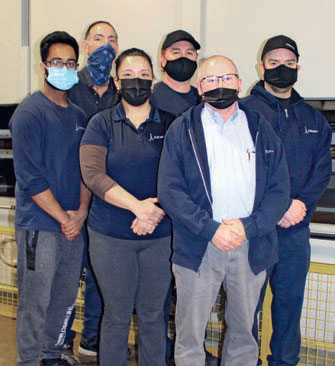
The Albarrie team by the new machine at the company’s plant in Barrie, Ontario.
Across Time Zones
It took a crew of skilled millwrights, electricians and product specialists to build the line which was delivered in 11 shipping containers to Albarrie’s production facility. The line was originally scheduled to be fully operational in the Spring of 2020, but the ongoing global Covid-19 pandemic inevitably led to several delays during the start-up and commissioning process.
“Through the challenges of the pandemic, Albarrie staff worked remotely across time zones with Monforts technologists and product specialists to access and configure the machine and run it through a rigorous testing schedule prior to launch,” said Kevin Horner, Albarrie’s director of Operations.
Assistance closer to home also came from PSP Marketing, which represents Monforts in North America from its base in Charlotte, N.C.
PSP reports that there currently is a push for the replacement of tenter frames in the United States. “There’s a move by a number of our customers to bring more manufacturing back to North America, which is definitely a benefit to us,” said PSP Vice President Alex Franco. “And the trend to smaller lot sizes and speed-to-market is something at which the latest Monforts’ technologies excel.”
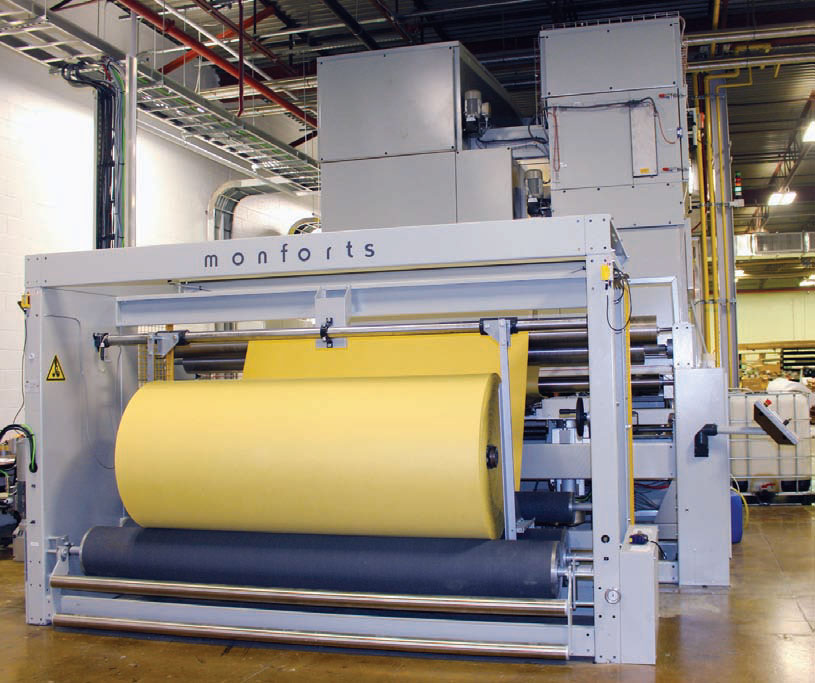
Finished roll coming off the line at Albarrie.
Energy Savings
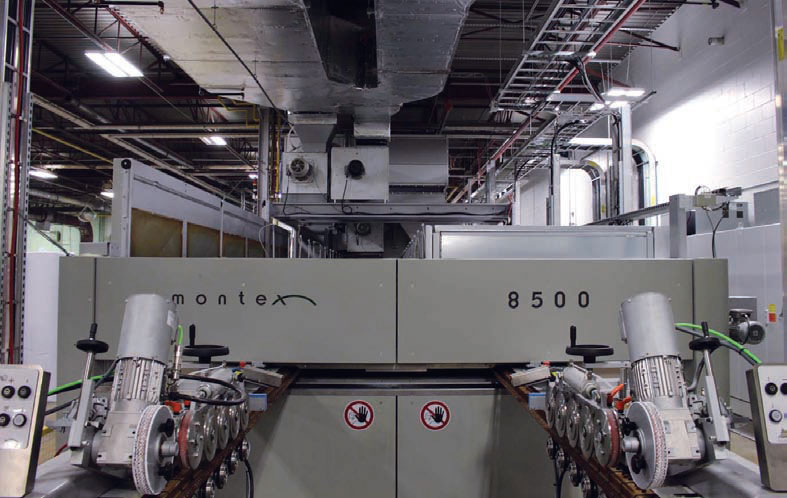
The Albarrie Montex line’s MonforClean capabilities include an air-to-air cross flow heat exchanger and an electrostatic precipitator providing the ability to purify the exhaust air and to recover energy to a maximum of 22,500 cubic meters of air per hour, resulting in a radical reduction in the conventional heat supply required. The MonforClean was developed in cooperation with Germany-based partner KMA Umwelttechnik.
The fully automated system is powered by a Siemens SPS S7 controller and KP 700 touch panel from which the recycled energy can be continuously monitored and savings calculated.
“The further integration of a washing system that automatically cleans the heat recovery and the exhaust air filter is a serious benefit to U.S. manufacturers because the labor costs for the normally manual cleaning work is so high,” Franco said.
The line’s MonforClean capabilities include an air-to-air cross flow heat exchanger and an electrostatic precipitator.
“This is an exciting time here at Albarrie and this new Montex tenter will ultimately open new doors for our business,” Horner noted. “We have noticed significant improvements in many areas compared to our old unit, such as the cleaning access and the ability to easily clean, which reduces down-time, while the efficient burners and exhaust system allow quicker start up and cool down periods. In addition, more controllable features allow for increased quality control and the air filtration system reduces smoke and pollutants, keeping pollutant-free air in our neighborhood.”
The three-chamber Montex tenter is fitted with the latest Monforts Qualitex 800 PLC control system with WebUI, providing ease of operation, a full operating cost overview and maintenance monitoring.
“The new tenter has been very easy to learn for the operators,” Horner said. “It is easy to monitor, and the controls are simple and easy to understand. While reviewing the requirements for the new machine, energy savings were part of our OEM score card. Energy costs are rising, and with carbon taxes being implemented, having our tenter use natural gas will result in energy savings. We are still early in the process of reviewing the consumption data from the new unit compared to the older unit, but currently, the early data indicate that we are consuming on average the same amount of energy, but achieving 1.5 times the amount of BTUs per hour for the same consumption. Most importantly, all of our products run without problems.”
“This was a big investment for Albarrie, but it was an investment for the future, one that will ensure we have the capability to remain competitive in the fabricated textile market for years to come,” added Albarrie’s Executive Director Margaret Driscoll.
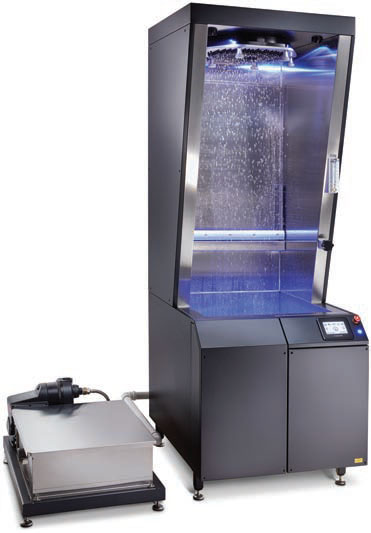
James Heal’s TruRain tester uses an artificial rain shower to determine water repellency.
Water repellency testing helps retailers and manufacturers meet and exceed consumer’s comfort and performance expectations in outdoor apparel.
By Paul Montalto
In 2019, the waterproof, breathable textiles market was valued at $1.7 billion, according to a Market Analysis report. The report further estimates a compound annual growth rate of 6.6 percent over the following six years for that particular market. This trend is driven by a growing awareness of the health benefits of sports and the increased necessity to exercise outdoors. Within this space, water repellent garments have become key performers.
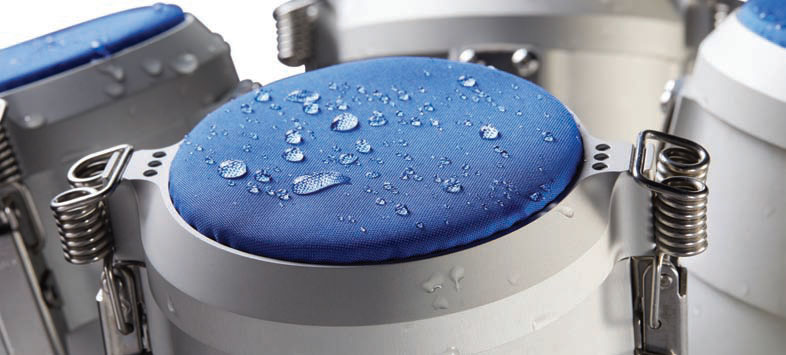
Water repellency describes water beading on the surface of a textile, where the water resists penetrating the fabric. This property often is achieved by combining membranes or coatings with tightly woven fabrics. The benefit of water repellent garments is their breathability. The fabric remains porous making it permeable to air and water vapor, which makes them more comfortable for the wearer. Ultimately, a water repellent garment should offer comfortable protection from intermittent rain.
James Heal’s TruRain water repellency tester.
Why Is Water Repellency Important?
Water repellency is important largely because a change in consumer behavior makes it so.
There has been an increased interest in athleisure for many years now. The sportswear industry has influenced mainstream fashion, and innovations in technology have led to improvements in functionality.
For outdoor wear in particular, the onset of a global pandemic increased demand even further. With the long-term closure of gyms, swimming pools and exercise classes, more and more people headed outdoors to exercise. In addition, more people are holidaying in their home country, which for many, means swapping swimwear and shorts for raincoats and walking trousers. With this increase in demand comes more rigorous performance testing to ensure the garments perform as they should when exposed to the elements.
It is also becoming more common to select accessories such as backpacks for their water repellent or waterproof qualities. Another consideration for brands and manufacturers can often involve more feature specific testing to establish, for example, what role seams, zips and pockets play.
Consumers expect comfort from their garments. Comfort is influenced by fit factors as well as fabric properties such as stretch and recovery, and thermal and moisture management properties. But for outdoor wear in particular, comfort is about finding a balance between keeping water out and letting sweat escape.
Risks Involved In Getting The Breathability Of Water Repellent Fabrics Wrong
Safety is arguably the most important feature that users expect from their performance garments. There are risks involved with getting the breathability of water repellent fabrics wrong, mainly that they can trap sweat and cause the wearer to overheat. This might not seem like an issue for a quick walk around the park, but for wearers on long hikes this could cause serious health risks.
To understand the testing that must be performed, it is important to understand the make-up of a garment, and the role that layers play.
In sportswear, and especially outdoor wear, a three-layer clothing system is often advocated, with each layer in the system performing a different function that complements the whole for maximum comfort.
A layering system typically includes:
A base layer;
A mid layer; and
An outer protective shell layer.
An effective outer layer should have a high level of water resistance as well as a high level of water vapor permeability, or breathability. How this layer is constructed plays a significant part in this permeability.
This is where the challenge for the outer layer comes in — creating a fabric that provides good water resistance is relatively simple, but doing so while maintaining breathability is a more complex process because the two properties have an inverse relationship in typical textiles. A thorough testing regime can prove the balance between these properties have been met.
Testing Water Repellency
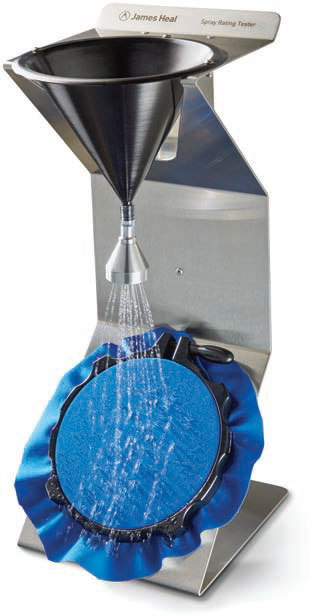
Water repellency is tested by spray methods, using instruments such as the Bundesmann or Spray Rate Tester, where water is run over the surface of the fabric and the repellency is visually graded.
For the Bundesmann method, in particular testing to ISO 9865, the test instrument generates artificial rainfall to simulate the real life conditions the end garment will be used in. Here, three aspects of water repellency are measured:
Surface water repellency is visually assessed;
Resistance to water absorption is evaluated by weighing the specimen; and
Resistance to water penetration is determined by collecting water that has passed through the sample.
As with any testing, there are certain parts of the process to look out for, which can have an impact on the results.
Pro tips for testing include:
Clamping the fabric correctly to avoid variance in results;
Timing is everything – be ready to assess as soon as the test finishes;
Condition the samples in accordance to the standard;
Water temperature is important and should be recorded; and
The Bundesmann must be run for 15 minutes prior to testing to guarantee water flow is consistent.
Sustainability
Traditionally, the Bundesmann test requires a lot of water, which can be an issue for apparel brands and manufacturers who are tackling sustainability issues.
The UN Partnership on Sustainable Fashion found that fashion is responsible for nearly 20 percent of the world’s wastewater, and 10 percent of global carbon emissions, so there is a lot of pressure to be cleaner, more efficient and ultimately sustainable. Although testing plays a small part in the process, there are significant savings to be made in water usage during testing.
James Heal recently conducted a small research project into the efficacy of water recirculation on its Bundesmann testing instrument.
James Heals’ Spray Tester also may be used to test water repellency.
A typical Bundesmann water repellency tester that runs for eight hours per day, five days per week, is consuming 3,360 liters of water. It is plumbed into the mains and drained directly after a single fall onto the specimen. Recirculating the water would reduce usage, but we had to establish there would be no detrimental effects to testing when doing this.
Concerns included:
If the fabric sheds when being washed — and man-made fabrics in particular shed a lot of microplastics — would this shedded material stay in the water and impact the next round of testing?
Would the shedded material stick to the next specimen being tested and give a false impression of water repellency for a garment that would then fail when worn?
James Heal conducted significant testing, both in-house and using an external laboratory, to verify that the results would be accurate regardless. The test results concluded that there was consistency from start to end, and by confirming this, the company was able to calculate the savings its recirculation unit could offer, including:
An eight-hour working day’s use of the James Heal TruRain Bundesmann recirculation system sees 83 percent total cost savings in energy consumption and total running costs.
There is less waste: 99-percent less water is used during testing alone — 150 tests a week equates to a drop in water consumption from 2,100 liters to just 23 liters.
Additionally, it is accurate, safe and reliable: Through the use of an effective Water Safety Plan, health and safety can be maintained.
James Heal also found that by using the recirculation unit, it was much easier to maintain the temperature of the water. The percentage of water absorbed by fabrics can increase as the temperature increases, so it is important to control temperature for consistency in results.
Proving Water Repellency
With an increase in demand for water repellent clothing, and the subsequent increase in the popularity of Bundesmann testing, understanding and implementing repeatable testing is crucial to substantiate any claims made about a garment. The challenge for retailers and manufacturers is to meet and exceed consumer’s expectations for comfort and performance, and water repellency is one part of the puzzle for achieving this.
Editor’s Note: Paul Montalto is a Technical Knowledge manager for the Physical Properties Testers Group (PPT Group), an England-based family of brands — James Heal, Mecmesin and Alluris — that design and produce solutions for testing a wide range of physical properties including compression, light fastness, moisture, dry rate, water repellency, abrasion, flammability, and tensile and torque properties.
Los Angeles-based Ambercycle, a company founded in 2015 by Shay Sethi and Moby Ahmed focused on building circularity in the fashion industry, reports it has closed an oversubscribed $21.6 million Series A financing from H&M CO:LAB, KIRKBI, Temasek, BESTSELLER’s Invest FWD and Zalando. This brings the total figure raised by the company to $27 million.
Ambercycle’s Ambercycling™ process separates and purifies post-consumer waste at the molecular level to make regenerated materials that may be used by brands and designers in new garments. The company’s first material, cycora®, can replace virgin polyester materials and offers similar functional characteristics, according to Ambercycle.
The company has a pilot plant in Los Angeles and plans to use the new funds to scale up production of cycora.
“The transition to circularity in fashion is inevitable” said Shay Sethi, co-founder and CEO of Ambercycle. “We are building an ecosystem in which materials can exist in harmony with humans and the environment.”
England-based Alchemie Technology reports it has shipped one of its Endeavour™ digital dyeing machines to Taiwan. Endeavour produces no wastewater and reduces energy consumption by 85 percent compared to traditional dyeing processes. The machine will be installed at JSRTEX Group as part of an Alchemie demonstration hub and showroom to communicate the benefits of the technology to potential customers in Asia. Alchemie has plans to establish more showrooms around the globe.
“Alchemie plans to deliver a significant number of Endeavour low energy, waterless dyeing machines into Asia in the next two years, where most of the world’s dyeing and finishing takes place,” said Dr. Simon Kew, managing director of Alchemie Technology. “This will also require the support of governments through investment, grants and legislation, and the critical effort of brands and pioneering manufacturers in their supply chains. Having an Endeavour demonstration hub in Taiwan is another important milestone on our journey towards transforming the fashion industry and helping to reduce its climate impact. We are excited to be delivering the long-awaited transition to more sustainable textile dyeing.”