Controlled trials show that textile waste origin — not just fiber composition — can strongly influence fiber quality, carding performance and yarn outcomes in mechanical recycling.
Textile World Special Report
Researchers at Institut fuer Textiltechnik Augsburg gGmbH, in collaboration with Technische Hochschule Augsburg and Trützschler Group SE, recently reported on the role of material classification in mechanical textile recycling. Their work shows that textile waste origin can have a major impact on fiber quality, spinning preparation and final yarn performance, even when fiber composition remains the same. The report that follows highlights those findings and underscores why classification comes first in building an effective recycling route.
Introduction
Mechanical textile recycling is increasingly important in the transition toward a circular textile industry. A central question is under which conditions textiles and textile waste can be reprocessed into spinnable raw material and ultimately into high-quality yarn. Systematic material classification is essential for this purpose. It enables reliable assessment of heterogeneous waste streams, selection of appropriate recycling routes and adjustment of machine settings in spinning preparation.
In the approach presented here, textile recycling is treated as a continuous, interconnected system. Material classification, tearing, fiber assessment, carding, fiber preparation and yarn production are considered linked stages within a closed value chain rather than isolated steps. The objective is not only to recover fibers from waste, but to return them to new textile products at the highest possible quality. This framework allows material streams of different origins to be analyzed systematically and translated into reproducible process windows.
Why Different Textile Waste Streams Require Different Recycling Routes
Secondary raw materials differ not only in fiber composition but also in history, contamination, construction and mechanical condition. Distinguishing between waste types is therefore essential in mechanical recycling. A practical classification differentiates post-industrial, pre-consumer and post-consumer material streams, capturing fundamental differences without excessive complexity.
Post-industrial textiles, such as cutting waste or production residues, are generally well controlled. They originate from known processes, have defined fiber compositions and contain minimal foreign matter.
Pre-consumer materials, such as unsold goods, also have known compositions but may include seams, coatings, labels or other additional components.
Post-consumer textiles are the most challenging. Having been used, they may be soiled and contain both textile and non-textile components such as zippers, buttons, reinforcements or linings.
In this study, three material categories were examined under controlled conditions: worn workwear (65% cotton, 35% polyester) as post-consumer material; identical unused garments as pre-consumer material; and the same fabric supplied as yard goods as post-industrial material. This ensured identical fiber composition and textile construction across all categories.
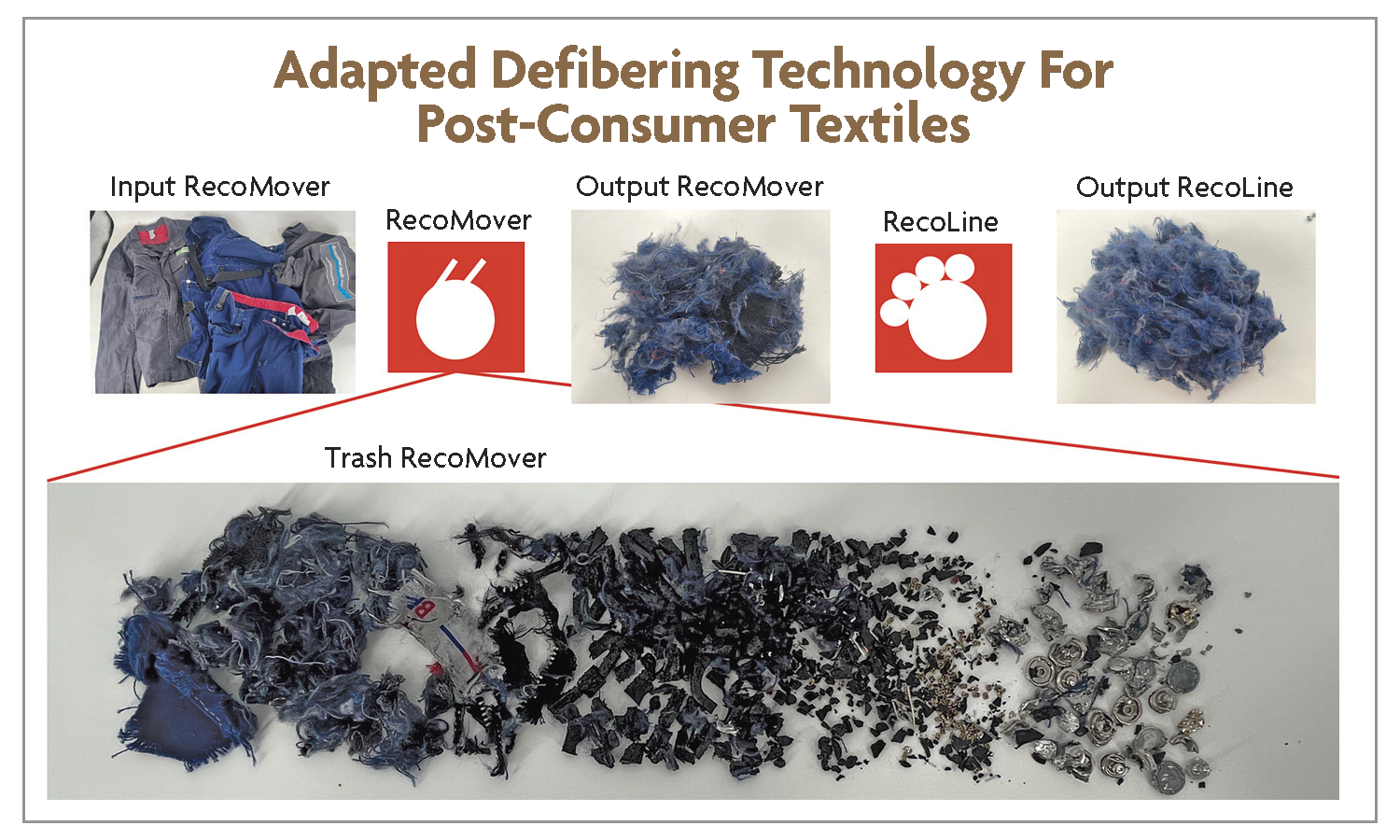
A two-stage tearing system was employed in collaboration with Ommi S.r.l. (Prato, Italy). The RecoMover, equipped with coarser clothing, performs automated contaminant removal and initial opening. The downstream RecoLine, with progressively finer clothing and six workers, ensures gentle opening to the individual fiber level. Post-consumer and pre-consumer materials pass through two RecoMover drum units and four RecoLine drum units, whereas post-industrial materials are processed solely through six RecoLine drum units.
Fiber Quality: Visible And Hidden Differences
The quality of torn fiber material is critical for producing spinnable raw material. It is evaluated using fiber length distribution, mean fiber length L(n), short fiber content SFC(n), degree of opening, waste content, dust and nep levels. These parameters directly affect yarn strength, evenness and process stability.
Fiber length was measured using an AFIS Pro 2, while degree of opening and usable fiber proportion were assessed with a Shirley Trash Analyzer. Despite identical initial compositions (65% cotton, 35% polyester), notable differences were observed. Post-industrial fibers exhibited the lowest quality, with L(n) of 10.4 mm and SFC(n) of 67.5%. Pre-consumer material achieved L(n) of 14.2 mm and SFC(n) of 45.3%, while post-consumer material reached L(n) of 12.4 mm and SFC(n) of 55.0%.
NIR analysis confirmed no chemical differences apart from color and washing had no significant effect on fiber quality. The shorter fiber length in the post-industrial stream is therefore attributed to differences in the tearing process. Due to limited machine availability, identical configurations could not be applied; further trials are planned.
These results demonstrate that material classification must extend beyond fiber composition. Textile construction, garment features, pre-treatments, finishes and tearing parameters must also be systematically documented for reliable process control.
Spinning Preparation As A Quality-Defining Step
After fiber opening, spinning preparation determines whether heterogeneous recycled fibers can form stable card slivers and yarn. The card plays a central role by opening, cleaning, individualizing and aligning fibers, thereby influencing sliver evenness, nep formation and short fiber content.
Experiments were conducted using a TC 11 card (Trützschler Group SE) at the ITA Augsburg Recycling Atelier to examine the effects of material type and process parameters on sliver and yarn quality. The study addressed three questions: the influence of material type on carding behavior, the effect of carding on process and yarn stability and the relationship between fiber and yarn quality.
A mixed-level full-factorial design was applied. The material blend consisted of 70% virgin cotton and 30% recycled material, producing an Nm 34 ring-spun yarn. Variables included material-related factors and machine settings in pre-carding and main carding zones, such as the number and spacing of carding elements and cylinder speed.
This design allowed clear distinction between material effects, process effects and their interactions. Such differentiation is critical for industrial practice, as settings that perform well for one material stream may result in increased neps, poor evenness or instability in another.
Material Effects Dominate Carding Behavior
Statistical analysis showed that material type is the dominant factor affecting spinning preparation. Pareto analysis identified it as a significant influence on carding behavior, particularly for fiber-related parameters. Highly significant effects were observed for L(n) and SFC(n), with additional significant impacts on total nep count and yarn neps.
Relevant interactions between material and process parameters were also identified. Recycled materials respond differently to identical machine settings; parameters such as carding element configuration and cylinder speed have material-dependent effects.
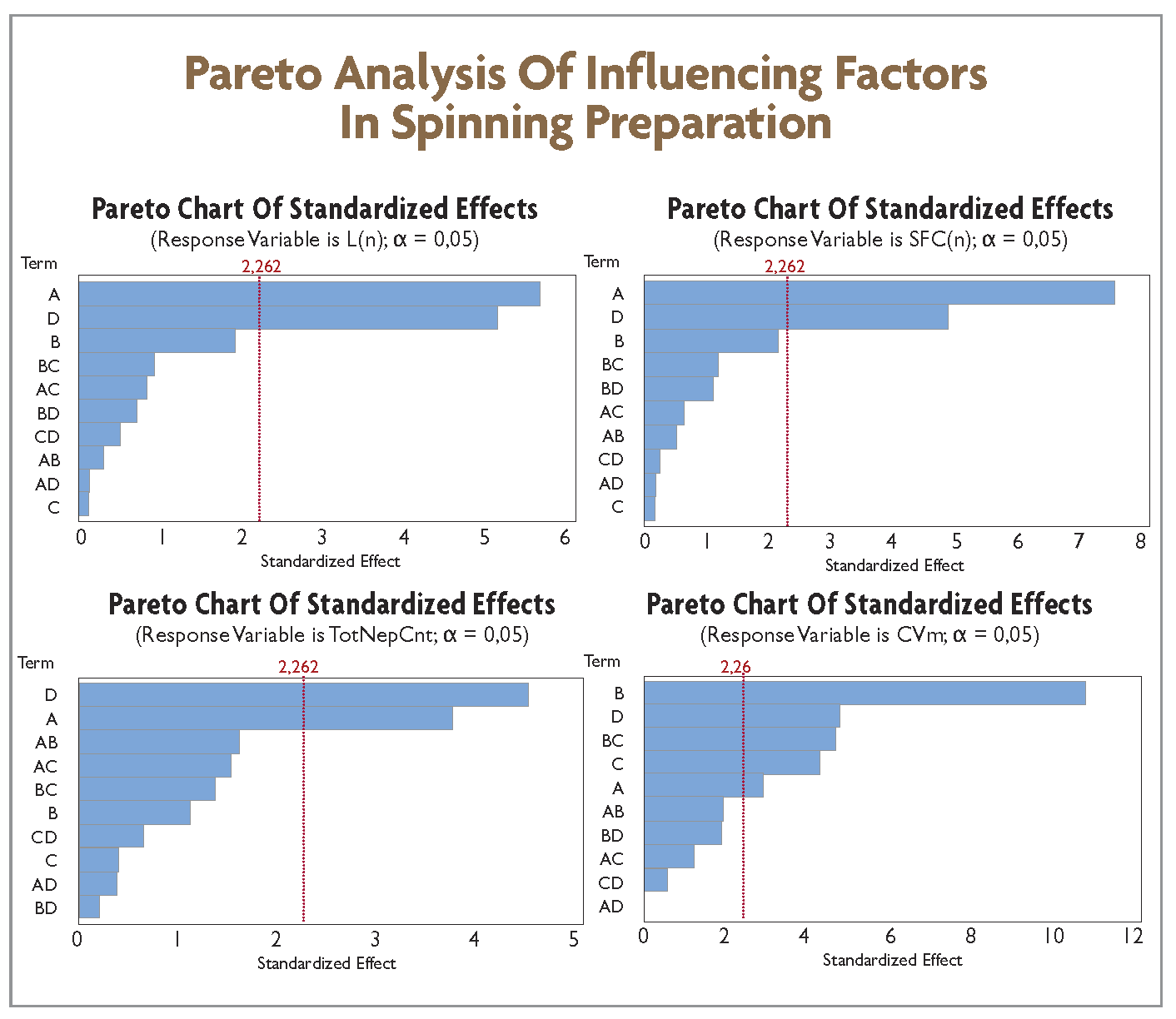
A = Material; B = Number of Twintops; C = Distance of Twintops; D = Cylinder Speed
Source: presentation “From Torn Fiber to Yarn” / Recycling Atelier Augsburg.
Consequently, a universal card setting is inadequate for recycled fibers. Material classification must precede process optimization. Only after characterizing a material in terms of origin, composition, fiber quality and processing behavior can suitable parameters be defined. While process adjustments can partially compensate for material differences, they remain dependent on the material itself. In practice, this requires adaptive parameter windows tailored to each material class.
Yarn Quality: Compensation In Spinning
Despite clear differences in fiber and sliver quality, yarn parameters did not always reflect these differences to the same extent. Variations in yarn evenness (CVm) were less pronounced, indicating that spinning processes can compensate for certain inconsistencies through blending, fiber guidance and twist.
However, this does not diminish the importance of fiber and sliver quality. Critical differences must be detected early, before they manifest as instability, increased waste, restricted process windows or yarn defects. Yarn quality parameters alone may not reveal underlying risks.
Based on eight key parameters —including L(n), SFC(n), total nep count, card sliver CVm, yarn CVm, thin and thick places, and yarn neps — a ranking of material performance was established. Pre-consumer materials performed best, followed by post-industrial and post-consumer materials. These results confirm that material homogeneity and low contamination improve processing conditions, while more challenging streams can be partly compensated through appropriate process control.
From Classification To Predictive Process Control
Material classification is not merely a sorting step but a process-defining factor. It determines the appropriate tearing route, cleaning stages and carding parameters. In mechanical fiber-to-fiber recycling, it is the foundation for reproducible quality.
Industrial implementation requires three key measures. First, material streams must be described in detail, including origin, construction, color, finishing, garment features, contamination and expected mechanical behavior. Second, material characterization must directly inform process control, influencing tearing, cleaning and carding decisions. Third, systematic data documentation is required to establish reliable process windows and predictive models.
With highly variable input materials, conventional machine optimization is insufficient. Applying uniform parameter sets inevitably leads to quality fluctuations. Predictive process control must therefore start with the material, integrating classification, characterization and process routing into a unified system.
Conclusion
The study demonstrates that the origin and classification of textile secondary raw materials strongly influence mechanical recycling, fiber quality and carding behavior. Material type and history affect fiber length, short fiber content, degree of opening and contamination, which in turn determine spinning preparation performance and required machine settings.
While process adjustments can partially compensate for material variability, effective control depends on systematic material characterization. Material classification must therefore be integrated into process development as the basis for adaptive carding strategies, stable processing windows and high-quality recycling.
High-quality mechanical recycling does not begin at the machine but with understanding the material. Only when both visible and hidden material properties are identified and translated into process control can recycled fibers become a reliable raw material for new yarns.
What This Means For Spinners
For spinners committed to a more circular textile industry, this report makes one point clear: recycled fiber performance starts with understanding the material origin. Post-industrial, pre-consumer and post-consumer inputs may share the same nominal fiber blend, but they can behave very differently in processing.
For spinning operations, that means recycled inputs cannot be handled with a single standard setting. Material origin, construction and condition all affect fiber quality, carding performance and yarn results.
Spinners most likely to succeed with higher recycled content will be those that classify incoming material carefully, track key fiber characteristics and match each stream to the right process route and machine settings.
— Textile World Editors
Editor’s Note: Acknowledgements. This report was submitted by Dr. Lukas Lechthaler, Expert R&D Technology, Trützschler Spinning, and authored by Bettina Cherdron, Amon Krichel and Mesut Cetin of Institut fuer Textiltechnik Augsburg gGmbH and Technische Hochschule Augsburg; Prof. Stefan Schlichter of Technische Hochschule Augsburg; and Lukas Lechthaler and Luisa Verbocket of Trützschler Group SE.
2026 Quarterly Issue III