Century Of Excellence

Century of Excellence

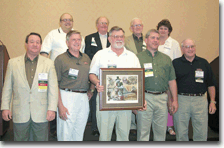
ATMA draws a full house at the Grand Casino for its 100th anniversary meeting. The Alabama
Textile Manufacturers Association (ATMA) celebrated its 100th anniversary at its annual meeting,
held at the Grand Bayview, Biloxi, Miss.Founded in 1901 as the Alabama Cotton Manufacturers
Association, ATMA is more focused than ever on the future of the textile industry in the state of
Alabama. ATMA President Tommy Johnson, president and CEO, Yarn, Russell Corp., commented that after
100 years, the industry still faces many challenges, and the organization continues to change to
meet those challenges. Johnson stated that today, with members in 65 of 67 Alabama counties, ATMA
is a leaner, more efficient and effective organization focused on grass-roots Alabama politics. He
called for local action to ensure a positive environment for textiles in Alabama. After 100 years,
there will be change we have to manage that change, he said.At the opening reception, Johnson
surprised recently retired ATMA Executive Vice President David Seagraves with a number of
proclamations presented by past ATMA presidents. The proclamations recognized Seagraves dedication
and years of service to the Alabama textile community.Seagraves, though retired as ATMA executive
vice president, remains the organizations legislative director. He provided an overview of the
groups activities over the past year. Rebecca Camerio, ATMAs assitant director for 10 years, was
named director.The TEXPAC Governmental Affairs breakfast featured Congressman Robert Aderholt
(R-Ala.), who is currently serving his third term in the U.S. House of Representatives,
representing the Fourth Congressional District.The meeting featured presentations by Jeff
Thredgold, president, Thredgold Economic Associates; and Ronald Sorini, president, Trade
Negotiations and Legislative Affairs, Sadler TravisandRosenberg LLC.American Textile Manufacturers
Institute (ATMI) President Chuck Hayes, unable to attend due to family matters, presented by way of
video, with the assistance of Carlos Moore, ATMI executive vice president, a message calling for
unity accross the textile industry.James Rutledge, Alabama Textile Citizen of the Year in 2000,
also addressed the gathering. 


ATMA 2001-2002 Officers

President Bill Shugart II, W.Y. ShugartandSons Inc., Fort Payne, Ala.Vice President Hollis
Mann, plant manager, Mount Vernon Mills Inc., Tallassee, Ala.Treasurer Mark Sheffer, plant manager,
Tyco Adhesives, Albertville, Ala.Secretary Steve Adair, senior vice president, marketing/sales, JI
Fabrics Division, Johnston Industries, Phenix City, Ala.Director Rebecca Camerio, ATMA, Montgomery,
Ala.

June 2001

Comfortable Living


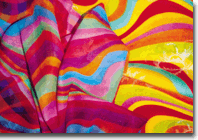
Home fashion trends reflect diverse consumer tastes. If there is one word to describe
home fashions today, that word is eclectic. Even though there may be trends in certain directions
for instance, toward special fabrics or constructions, new textures and fibers or fiber blends, or
stronger color there are so many varied influences that one could choose almost any style or color
and not be far outside some fashion mainstream. Perhaps this eclecticism can be credited to the
glut of information and images available in the current global environment.Burlington HouseSusan
Beiser, director of trend and style forecasting, Upholstery, Burlington House, Greensboro, N.C.,
confirmed this notion as she described how new seasonal collections are assembled: We are covering
the full spectrum from traditional to transitional to contemporary in a very wholehearted and
design-wise way. We used to zero in on lifestyles, but consumer tastes have become so eclectic that
it is necessary to cover everything, even trends that have nothing to do with upholstery.The
Merchandising Group at Burlington House prepares its forecast of upcoming colors and styles through
Fashion Forecast 360. Ideas might come from museum exhibitions, various entertainment sources or
current apparel fashions. Input is received from each division at Burlington. As a result of this
collaboration, were able to put more thought into color selection and end up with a more efficient,
more flexible palette, said Beiser. Were also able to create a more global variety in the colors,
textures and constructions we offer. Thanks to this rich diversity, our customers will appear to
have sourced their fabrics from all around the world.As for color, Beiser said, Everyone wants more
color. This is refreshing to us also. The palette for 2001 includes earth colors such as Mineral,
Steel and Mica and rich, lustrous highlights; as well as basic staples. Theyre substantial colors
that can easily go from organic to luxurious to very contemporary, she said.Natural fibers are
popular for upholstery fabrics, as are rayon/cotton blends, rayon chenilles and other chenilles.
Mixing fibers and processes provides a variety of textures and allows a full spectrum of looks.
Burlington House has introduced its Inspire Collection of chenille upholstery fabrics that have
been finished in a new way. The process combines blends of raw material, new equipment and process
steps to create distinct attributes in the fabrics, making them lustrous or giving them a classic
look, like a Fortuny velvet. They also affect the drapability and hand. The resulting fabrics are
comfortable as well as luxurious.In bedding, a trend toward alternative fabrics including jacquards
and voiles was noted by Charlie Barress, executive vice president, BeddingandBath. Burlington House
is using combinations of fabrics for top-of-bed ensembles that include comforters and duvets and
are heavily accessorized with pillows and other decorative elements. Color is increasingly more
important, with a move away from traditional neutrals to purples, reds and blues.Were more
master-bedroom driven, he said. This is a high-end market, which is overall more traditional, but
there is a move toward casual presentations as well.Coordinating bedsheets are 100-percent cotton
with high thread counts. The ensembles themselves are often of blended fabrics, particularly
cotton/rayon. Rayon gives a softer hand to the fabrics. Consumers are considering softness and hand
more and more as they choose among the products offered in the marketplace.For the bath, Barress
noted a trend toward sheers and burn-outs, both printed and embroidered, for shower curtains.
Traditionally, color in the bath has been dictated largely by such factors as the color of the tile
and fixtures, and more color is being seen also in this area. Weve been selling red shower
curtains, he commented.Marcia Weiss, vice president of design, Windows, noted that over the past
two to three years, the range of window fabrics has expanded to include apparel fabrics, such as
taffeta, chiffon, organza and organdy. These are happening in windows and look great, she said.
There is a growing interest in luster and opulence, but not glitz.Weiss also noted strong interest
in surface embellishments, such as crewel, embroidery, crushing or other extras. Even plain fabrics
have heather yarns or special finishes, she added.She was pleased to see a growing interest in
color for window treatments. It is exciting to see buyers moving from ivories and neutrals to
colors, she said. The whole warm palette of red/paprika/gold is doing very nicely.Acknowledging the
cyclical nature of style evolution, Weiss said pinch pleats are currently strong at the
specialty-store level. They are being shown on decorative hardware. There is also a continual
development of new top treatments that are flexible and easy to hang.When asked about shades and
blinds, she said Burlington supplies fabric to other companies for shades and blinds in the
higher-end market. She noted that where they are being used in the home, they are often combined
with soft treatments.WaverlyNew York City-based Waverlys Fall 2001 fabrics are used for upholstery,
window treatments and bedding throughout the home. The collection includes Bella Tuscany;
WILLIAMSBURG
® American Spirit; and Story Time, a childrens line. Bella Tuscany captures the color
and light of this sunny region of Italy. Textures, as seen in old stucco walls and ancient frescos,
are also important elements, according Pam Maffei-Toolan, design director, Waverly Lifestyle Group.
Our fabrics also represent both the understated villa style and more rustic summer cottage looks
that co-exist in Italy, she said.Among 13 printed designs are floral patterns, scenes of daily
life, Tuscan herbs and fruits, potted fruit trees and nondirectional patterns. Ten woven
constructions include stripes combined with herringbone or damask and Swiss dots; gingham with
diamond dobby construction; two-tone constructions; ribbons; formal but rustic cotton damask;
matelassith diamond tissue-pick; and chenille. Fabrics are cotton or blends of polyester/cotton,
rayon/ cotton or cotton/polyester/acrylic.WILLIAMSBURG American Spirit includes woven 100-percent
cotton fabrics inspired by 18th and 19th century designs found in the archives of Colonial
Williamsburg. The line is produced under license from the Colonial Williamsburg Foundation, whose
educational program benefits from the sale of these products.Stripes, solids and checks are shown
in a traditional palette of sage, red, blue, green, linen and straw. Constructions include
matelass44; damask and herringbone. Yarn-dyed sheers in checks or windowpane plaids coordinate with
solid matelassr damask for the window. A natural or white sheer features palm embroidery.Decorative
pillows and window treatments use fabrics from Bella Tuscany and Story Time. Free-standing window
coverings include textures and sheers and are topped by scarves and valances. Pillows have
self-welts or contrasting welts. There are also new designs for needlepoint pillows including
potted fruit trees, topiaries, palm trees, a Tuscan floral bouquet, a rooster and shells. Waverlys
line of bed ensembles includes two luxury ensembles, one using the colorful Bella Tuscany fabrics,
and the other in an ebony/cream colorway with an American flavor. There are also bright,
all-American looks and three childrens sets. Jhane Barnes
Burlington House and Waverly design their products to appeal to a wide range of buyers.
Attracting a narrower, more independent-minded market is New York City-based Jhane Barnes, winner
of numerous awards for her mens fashions, as well as for her upholstery and drapery fabrics, carpet
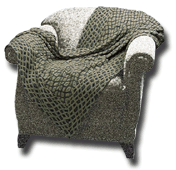
and furniture for the contract and commercial markets. Many of her fabrics feature innovative
fractal-patterned jacquard weaves and knits, including a patented stretch woven jacquard and a
unique plaited intarsia sweater knit fabric. Last year, Barnes introduced a line of throws for the
home. They are available in her stretch woven fabric and the plaited intarsia fabric. There is also
a line of jacquard throws handwoven under license by Textillery Weavers, Bloomington, Ind.The
stretch woven fabric is a blend of Lycra®, wool and rayon chenille. It has a soft, luxurious hand
and a weighty drape. The plaited intarsia fabric is a wool/nylon blend and is produced on knitting
machines that produce both plaiting and intarsia using a new technology that combines knitting and
weaving elements. Both warp and weft are present, as in woven fabrics, and the colors are knitted
vertically as well as horizontally, producing a unique interlaced effect. The patterns created can
have up to 48 colors four times as many as those produced on regular knitting machines.No Place
Like Home
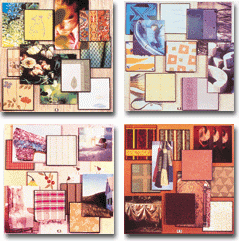
Cotton Incorporated, Cary, N.C., looks forward to 2003 in its latest trend forecast for home
fabrics, No Place Like Home. Four fabric trends are included. Homespun includes feminine elements
such as embroidery, ribbons, beads and trims on pleated, tucked and topstitched gingham,
crewelwork, lace and damask constructions. In Natural Intelligence, high-tech mixes with natural
motifs in fabrics ranging from primitive to slubbed and multi-textured. Patterns include classic
and abstract designs in stencil-like motifs, botanical prints, ethnic animal motifs and oversized
tropical prints.Frank Lloyd Wright- and Joan Mirspired geometric shapes with a soft-edged, rounder,
more feminine aspect appear on sculpted velours and terries, linear metallics, seersucker and
chenille in Geometrics Take Heart. Courageous Behavior features sateen, velvet, gilded fabrics,
metallics, mercerized cotton and woven moirn vivid jewel tones.Six color palettes refer to Dorothys
odyssey in The Wizard of Oz. Kansas features soft and pale neutral colors. Twister suggests
saturated, stormy gray, ochre, dusty green and purple. The stronger neutral hues of peach, aqua,
taupe and evergreen are included in Journey. Bright blue and gray, pink, citrus and purple appear
in Technicolor. Lollipop hues are also bright, with acidic tones. And, finally, the Jewel palette
includes rich, saturated jewel tones. Research And DevelopmentAt Cotton Incorporated, Eike
Heymer, director, fabric development and research implementation, oversees current development in
the decorative and upholstery area. We put more emphasis on construction and weaves, he said.
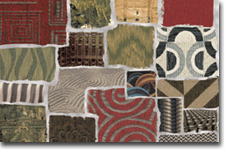
Almost all are dobby constructions including steep and fancy twills, very pronounced patterns,
honeycomb, herringbone and other such constructions for texture. We are also developing new
computer-generated weaves and weave combinations. The computer is able to generate new patterns
randomly, and we are discovering new constructions as a result. Heymer noted a tendency toward mock
lenos and other open, airy weave constructions for lighterweight drapery and tablecloth fabrics. He
also noted the crossover between apparel and home fashions: We are looking at similar fabrications
but using different finishes, such as soil-release and Teflon® finishes, for home fabrics than for
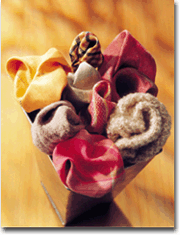
apparel fabrics, which require softer finishes.In towels and bathroom rugs, multicolor,
rainbow-like constructions are being developed using stock-dyed singles yarns with a space-dyed
feel. These products are intended for a mid-range market and have been very well received. Heymer
said Cotton Incorporated is also developing more and more concepts for area rugs. One example is a
stock-dyed rug mixing mercerized and unmercerized yarns for tone-on-tone effects. The rugs are
produced using a Tapistron tufting machine, which produces jacquard-like patterns in carpet and
rugs.Tone-on-tone effects are also seen in rugs mixing cationically pretreated chenille and
shoe-string yarns. Sisal looks using a tea-washed cotton/ hemp blend have an antique look. New
higher-end concepts include blends of cotton/wool, cotton/wool/ mohair and cotton/wool/cashmere.
Softness is the selling point for these rugs, said Heymer.Moving to sheets, Heymer said new
constructions in 180- to 200-count blended sheets for the mass market have higher percentages of
cotton. New spinning technologies are making it possible to improve the performance in these
sheets.The denim look is popular in both apparel and home fashions. For the home, yarns are
stock-dyed using fiber-reactive dyes to give a washed-down denim look. Coarser yarns are used in
area rugs, and 13s or 16s are used in towels. The color, however, is not limited to indigo blue.
These products can be made in any color.

June 2001

James H Heal Develops New Burst Strength Tester

United Kingdom-based James H. HealandCo. Ltd. has developed the new computer-controlled
Truburst burst strength tester, which exceeds the requirements of the new ISO 13938-2 (1999)
standard.Truburst measures both distension and pressure at burst and specifies an accuracy of ± 1
millimeter (mm) up to a distension of 70mm, all called for in the ISO standard.The digital control
system provides digital indication of pressure, distension and time to burst and automatically
detects which one of four specimen sizes has been used. The digital control system also regulates a
proportion-control valve to ensure a uniform, linear rate of pressure increase to achieve bursting
within a specified time and to provide maximum repeatability of test results.James Heal offers an
optional air compressor, which allows Truburst to operate at pressures up to 12.5 bar (1250 kPa).

June 2001

Cone Mills Announces Changes In Corporate Roles

GREENSBORO, N.C., May 25 /PRNewswire/ — Cone Mills Corporation (NYSE: COE) today announced that
its Board of Directors has elected Tom McKenna and Mike Whisenant Executive Vice Presidents of the
corporation. Tom McKenna directs market strategy for the Cone Textile Group (denim and khaki),
including merchandising, sales, marketing, and customer service.After joining Cone Mills in 1981,
McKenna worked in the San Francisco,Belgium, and Singapore sales offices before moving into
division management.He has since assumed increasingly responsible positions in sales and marketing,
most recently as Senior Vice President, Sales and Marketing.McKenna graduated from the University
of Maryland with a degree in marketing. Michael J. Whisenant is responsible for the company’s denim
manufacturing,product quality, product/process development, engineering, transportation, and
warehousing operations. After joining Cone Mills in 1967, Whisenant worked inplant management,
product development and product quality. He assumed progressively more responsible positions in
manufacturing operations, most recently as Senior Vice President, Operations. Whisenant graduated
from North Carolina State with a degree in textiles. Cone Mills has also announced that Samir M.
Gabriel has been elected Controller of the corporation, responsible for accounting, financial
systems,inventory control and business planning. Gabriel worked for Deloitte and Touche before
joining Cone Mills in 1988. He has held a variety of positions in Cone’s Finance function,
including Director of Accounting and Director of Cost Accounting. A CPA, Gabriel is a graduate of
Lenior Rhyne College with a degree in accounting. In other action, the Cone Board of Directors
endorsed the consolidation of the sales function into James Payne’s current responsibilities as
Senior Vice President of Cone Finishing. Payne directed the operational “turnaround” of Carlisle in
1999 and is now assuming responsibility for the Finishing division’s sales force. Since joining
Cone Mills in 1971, Payne has progressed through several management positions. He graduated from
theCollege of Textiles at N.C. State with a degree in textiles. Founded in 1891, Cone Mills
Corporation, headquartered in Greensboro, NC,is the world’s largest producer of denim fabrics and
the largest commissionprinter of home furnishings fabrics in North America. Manufacturingfacilities
are located in North Carolina and South Carolina, with a jointventure plant in Coahuila
Mexico.SOURCE Cone Mills Corporation Web Site: http://www.cone.com Copyright 2001 PR Newswire

Quality In Demand

Quality in Demand
Premiere Vision exhibitors report sales increases despite lower attendance.Along with the
global economic downtrend, attendance was off at the most recent Premiere Vision, held in Paris in
March, dropping from 40,308 in March 2000 to 36,996 in 2001.However, all was not gloom and doom.
Most of the 776 exhibitors reported visitors were serious about finding the right fabrics for
Spring/Summer 2002. Generally, buyers were looking for novelty and quality. Fabric companies that
cater to niche markets and are flexible in their product offerings reported a record number of
sample orders.Irish Linen converter John England said that not only did he take more sample orders,
but a lot of customers placed substantial orders for yardage. England attributed part of his
success to his presentation: We had a colorful, exciting display that attracted a lot of interest.
One customer purchased our entire display for his own showroom.Ed Harding, Barn Hill, U.S. agent
for several European firms that show at Premiere Vision, concurred: Most of our lines were
constantly crowded with serious shoppers. The Americans in Paris for this show were there to work.
We sell a lot to bridge markets. They are looking for quality, and they are on the lookout for
performance fabrics that go beyond the basics.British exhibitors got an extra boost with a visit by
Cherie Booth, wife of Prime Minister Tony Blair. Booth was at Premiere Vision to help promote
British Textiles.Liquid Stretch Knits At WelbeckWelbeck Fabrics Ltd., British innovator of
technologically advanced knitted fabrics, said this was its busiest show ever. A lot of its line
goes into intimate apparel and activewear by La Perla, Victorias Secret, Vanity Fair, Armani,
Calvin Klein and Donna Karan.Welbeck is one of the first to come out with a line of
aroma-encapsulated fabrics. New scents of bergamot, juniper, apple and cinnamon bring the total to
40. Another successful line contains moisturizers. New for Spring are smooth, liquid stretch knits
of trilobal Tactel® or a micropolyester/Lycra® blend. There are shantung effects, fine and sheer
pleats, iridescent jacquards, laser patterns, layered or laminated mesh, punched or embossed
surfaces, and two new granular-effect stretch fabrics. Easy-Case Linen With A Traditional
Look


In the linen sector, traditional fabrics with easy-care qualities are selling.
Pauline Delli-Carpini, U.S. representative, Masters of Linen, said, Our members report that
designers are buying 100-percent linen fabrics and blends that have a traditional look but are
updated with easy-care finishes, a touch of sparkle, stretch or a laminated coating.Masters of
Linen membership includes more than 10,000 linen growers in France, Belgium and the Netherlands, 22
spinners in Italy, France, Northern Ireland, Belgium, Austria and Germany and 96 Western European
weavers. Its regional office in New York City disseminates information about linen, suppliers and
trends for apparel and home furnishings. Linen/Lycra fabrics include a washable mid-weight blend
from French weaver Deren. This company also has a group of creased and crinkled 100-percent linen
fabrics.Libeco Lagae reports that stretch, menswear stripes and solid coordinates of 100-percent
linen with a delavinish are selling across the board for menswear and womenswear. Sheer, mini-check
and stripe cross-dyed coordinates are also popular.Stretch linens at John England are available in
linen/viscose/Lycra or linen/polyester/Lycra blends. Some have a washed finish to resemble denim.
There is also a double-faced fabric containing Lurex®. Two fabrics are adhered with a dissolveable
bonding. Finished garments can be washed to remove the bonding, thus eliminating the production
steps of cutting and basting the lining fabric.Bronze metallic fabrics at John England have subtle
glimmer. There are distressed-finished butcher linens, crisp-hand rustic looks, linen/silk blends
that resemble indigo denim, slick finishes, ultra-light polyurethane-coated fabrics, laser-cut
patterns and polyurethane droplet patterns on 100-percent linen.Bright, yarn-dyed linen checks are
standouts in washable coordinates at Hauterive. Some are large and tonal; others are iridescent.
Crespi has metallic satin weaves and rustic surfaces. Some have an invisible polyurethane finish.
Solbiati shows classic seersucker stripes in a linen/cotton blend.Another linen innovator, Linea
Tessile Italiana, has tie-dyed linen gauzes and sheer linens woven with thick and thin yarns. Mesh
in a blend of linen/cotton/nylon is embellished with flocking, embroidered in all-over abstract
patterns or printed with large, watery flowers.At Giuseppe Bellora, striped ultra-sheer linen/silk
blends are selling to shirt makers for both menswear and womenswear. There are washable linen
shirtings and crisp-hand linen gauzes, some embroidered with abstract patterns.The Austrian firm J.
M. Fussenegger has done copper printing on rustic linens. Some resemble burlap, while others are
light and refined. Copper-printed flowers give the fabrics a damask look.Classic ComebackUpdated
classics are best-sellers at Gordon Textiles International, which represents French weavers Emanuel
Lang and Carreman; and Italian weavers Milior, Gartex, Segalini and Blue Line. Neat patterns and
traditional weaves in blends are treated to a variety of finishes to provide comfort and easy
care.Jim Gordon, president, Gordon Textiles, reports that Emanuel Langs small checks and stripes in
100-percent cotton are increasingly popular for womenswear. Newly revived are jacquards and
seersuckers. Shirtings containing Lycra are selling to designers of haute couture.Carreman is
selling suiting-weight fabrics with a traditional menswear look. Mini-checks, and pin and chalk
stripes in blends of polyester/viscose/elastane are buyer favorites.In Miliors line, abstract
geometric patterned cotton/polyester/Lycra blends are popular. There are classic mens stripes woven
with metallic and Lycra yarns, and a group of high-tech double-faced fabrics. One going into
year-round outerwear reverses from poplin to twill, contains 13-percent Lycra and is breathable.At
Gartex, sheer jacquards; burn-outs; light, slubbed linens; crinkles; and stripes are current
preferences with American designers. Most are blends of natural and synthetic fibers, and a lot
contain Lycra.Prints from Segalini include romantic flowers in soft, summery colors. Some have an
abstract, misted look; others are reminiscent of small Liberty styles. Shantung and rayon georgette
are two popular base cloths. Blue Line is selling plissacquards, shantung and gossamer sheer
stripes in silk blends. Stretch seersucker is another favorite here.Stretch, Jacquards And Demin At
NuvotexThe versatile Spanish company Sedera, French denim producer Milag and Italian knitter Mabu
are handled in North America by Nuvotex.Stretch jacquards are a highlight of the Sedera line.
Small, neat tonal patterns in an acetate/cotton/Lycra blend are selling for sportswear and pants.
Double jacquards reverse color and texture. They are piece-dyed, coordinate with solid fabrics and
are lightweight. Others are woven with high-twist yarns for a crepe touch. Prints are done on a
variety of fabrics. Among the most popular are stripes with color-coordinated outlined florals on
polyester matte jersey, heavy stretch cotton or chiffon.At Milag, warp- or weft-stretch denim is
printed with camouflage designs, bold graphics, peacock feather patterns or silver foil abstracts.
Other fabrics range from romantic florals on sheer plissand georgettes to piquand jacquards. Some
are sueded; others are lightly coated and slick.Mabu jersey is selling mini-Greek-key patterned
jacquard jersey coordinates to Versace. These cotton/nylon blends are going into shirts.Other
popular fabrics at Mabu are eyelash effects knitted with metallic yarns, variegated stripes and
ribs in cotton/silk/viscose blends and subtle glitter jacquards of nylon/polyester. Jim Molina, a
partner at Nuvotex, noted that sales of dressy fabrics are slowing. Double mercerized cotton and
raw silk knitted in rustic looks are in demand.


Color In Wovens

Color is selling at Barn Hill. Yarn dyes in smaller patterns by Isoule are going
into casualwear, sportswear and dresses. Most are blends of linen with viscose or polyester; all
contain Lycra. Open-work patterns woven with Paul Bontes dissolving yarn, Chimere, are other good
sellers.Recolored classics are popular at Liberty of London. Gingham, sophisticated geometrics with
a 1930s feeling and small conversationals are highlights. Conversational motifs include
mini-automobiles and oriental parasols. Stretch jersey of cotton/Lycra is a popular base cloth.At
Reynaud Rexo, piece-dyed, bi-colored jacquards with widely spaced floral patterns in a
polyester/acetate blend are selling to the dress trade.Essenza, a first-time exhibitor at Premiere
Vision, was happy with the numbers of new customers and orders placed at the show. Linen tie-dyes,
some over-printed, and cotton/viscose stretch bottom weights are among the favorites. At shirting
fabric specialist Borgomaneri, sportswear designers sampled cotton stretch top and bottom weights.
Heathers and stripes were of special interest.


Men’s Shirt Fabrics For Womenswear

Quality shirting fabrics from the Austrian firm Getzner, sold here through Filtex,
are starting to sell well to bridge-level womenswear firms. Bright plaids and stripes are popular.
Josef Otten, also at Filtex, reports stretch rayon jersey and printed shirting-weight cottons among
its strongest sampling fabrics. Nautical shell and coral designs and small animals are popular.
Some are over-printed on burn-outs.Weisbrod Zuerrer, noted for jacquards, had a strong showing at
Premiere Vision. The patterns for Spring are spread out with an open, airy feeling. Some are done
on textured grounds with Lurex; others are on crinkled piquwoven with cotton/silk. Small geometric
patterns are especially popular. Best-selling colors are lime green and denim blue.Richard Nissan
of Filtex notes an interest in fine silk crepes in bright colors from Weisbrod Zuerrer. Some
fabrics have a water-repellent finish. A group of sheer, fluid solids; pleated fabrics; and
georgettes have been picked up for layering.Innovation At Fitzsimmons Fabrics


A major portion of Spanish producer AGBs line contains Tencel® blended with linen,
cotton, polyester or wool. A lot contains Lycra. There are slubbed linen looks; ultra-sheer
Tencel/wool blends; sparkling stretch chambrays; and silky touch, semi-lustrous, Teflon®-coated
lightweight poplins. One new techno-development is a moisture-moving antibacterial twill in
cotton/polypropylene.Two French jacquard weavers handled by Fitzsimmons are Dutel and Romain. Dutel
is showing stretch satin jacquards in both large-and small-scale abstract patterns, and optic
designs in cotton/polyester or polyester/nylon blends.Romain has lustrous linen/cotton/nylon
jacquards with a dry, crisp hand. Other fabrics include linen/ acrylic cloques, crepe satin sheers,
lightweight silk/nylon eyelash stripes and a group of acetate/Lycra crocodile-embossed
patterns.Fantasy sheers, embellished silks and featherweight cobweb knits are specialties of Paul
Dulac. Irregular leaf patterns are embroidered on silk/cotton. Some are tonally shaded, while
others have touches of metallic yarns. Other patterns include Greek key motifs, squares and wavy
lines.At Bianchini, ultra-fluid fabrics have the look of liquid metal. The hand is slippery and
sensuous. There are crisp, noisy, foil-look sheers embossed with crocodile or sunburst patterns.
Warp-printed taffeta, white-on-white patterned piqu#44; and supple polyurethane-coated fabrics are
other popular looks.The next Premiere Vision will feature fabrics for Fall/Winter 2002/03. It will
take place in Paris, October 4-7 at Parc des Expositions. In 2002, the dates for Premiere Vision
will be February 20-23 and September 18-20.Expofil Shows Fall 2002Taking a stand at Premiere Vision
for the first time, the producers of Expofil, the bi-annual yarn fair held in Paris in June and
December, showed Fall/Winter 2002/03 trends.Sylvie Tastemain, Expofil fashion director, said there
continues to be a strong desire for luxury and novel products. Garments must be easy to wear, light
and comfortable, and easy to maintain. The boundaries between masculine and feminine, and between
natural and synthetic are becoming increasingly blurred.There will be 11 new exhibitors, including
non-European spinners and fiber producers, at Expofil, June 5-7, at Parc des Expositions.
June 2001

Global Growth Eases World Production Lower

Global Growth Eases;World Production LowerGlobal yarn and fabric production eased over the fourth
quarter 2000, according to a report issued by Switzerland-based International Textile Manufacturers
Federation (ITMF). The ease in production was accompanied by a small increase in world stocks and a
moderate decline in orders.World yarn production continued to decline during the quarter, falling
by 3.2 percent. The decline reflected an 8.9-percent drop in U.S. output and a 3.1-percent
reduction in Asian production. In contrast, European yarn production rose by 5.8 percent over the
quarter.Globally, fabric production was stable, declining 0.5 percent. Compared to the fourth
quarter 1999, U.S. fabric production has declined 6.8 percent, while European output has risen 1.3
percent and Asian production has gained 7.7 percent.
June 2001

BASF Introduces Reductive Post-Clearing Product

Cyclanon® ECO, released by Germany-based BASF AG, is a new reducing agent designed for
post-clearing dyeings on polyester, polyester blends and acetate.Cyclanon ECO can be applied at
acid pH levels. Such application can result in reduced time, energy and water costs. The product is
aliquid that can easily be metered, has low toxicity and is safe to handle, is bioeliminable, and
has no unpleasant odor.Adding Cyclanon ECO to the dyebath reductively destroys unfixed disperse dye
particles so that waste water leaving the dyehouse is largely decolorized, according to
BASF.Cyclanon ECO also destroys direct dyes on fiber blends and may be used to lighten direct
dyeings.

June 2001

Burlington To Sell Decorative Mats Business To Ronile

GREENSBORO, N.C., June 20 /PR Newswire/ — Burlington Industries, Inc.(NYSE: BUR) announced today
that it has signed a definitive agreement to sell its decorative mats business, marketed under the
Bacova(R) name, located in Low Moor and Bath County, Virginia to Ronile, Inc. The sale is subject
to normal closing requirements, which are expected to be complete by the end of the month. George
W. Henderson, III, Chairman and CEO of Burlington, said, “We are pleased to reach this agreement.
This has been a good business for us, and we are confident that the Bacova(R) brand will lead
Ronile into new and exciting markets. The sale of this operation completes the divestiture of the
Burlington House Floor Accents division. This action is in line with our initiatives to reduce debt
and focus our resources on our core businesses.” Burlington Industries, Inc. is one of the world’s
largest and most diversified manufacturers of soft goods for apparel and interior furnishings.
Ronile, Inc. is one of the world’s leading suppliers of custom dyed accent yarns located in Rocky
Mount, Virginia. This press release contains statements that are forward-looking statements within
the meaning of applicable federal securities laws and are based upon the company’s current
expectations and assumptions, which are subject to a number of risks and uncertainties that could
cause actual results to differ materially from those anticipated. Such risks and uncertainties
include,among other things, global economic activity, the success of the company’s overall business
strategy, the company’s relationships with its principal customers and suppliers, the success of
the company’s operations in other countries, the demand for textile products, the cost and
availability of raw materials and labor, the company’s ability to service its existing debt and to
finance its capital expenditures and working capital needs, the level of the company’s indebtedness
and its exposure to interest rate fluctuations,governmental legislation and regulatory changes, and
the long-term implications of regional trade blocs and the effect of quota phase-out and lowering
of tariffs under the WTO trade regime and of the changes in U.S.apparel trade as a result of
recently-enacted Caribbean Basin and Sub-Saharan African trade legislation. Other risks and
uncertainties may also be described from time to time in the company’s other reports and filings
with the Securities and Exchange Commission.SOURCE Burlington Industries, Inc.Web Site:
http://www.burlington-ind.com Copyright 2001 PR Newswire

Thomaston Mills Files Chapter 11

THOMASTON, Ga., June 19 /PR Newswire/ — Thomaston Mills, Inc.(OTC Bulletin Board: TMSAE.OB,
TMSBE.OB) announced today that it has filed a voluntary petition for reorganization under Chapter
11 of the U.S. Bankruptcy Code in the U.S. Bankruptcy Court for the Middle District of Georgia at
Macon.During the bankruptcy proceedings, the Company expects to continue certain operations while
seeking a purchaser for all or part of its assets under court protection from creditors. “The
decision to file a Chapter 11 petition was an extremely difficult one, but we believe it is the
only alternative that may provide the breathing space and relief necessary to find a purchaser for
the Company, or, if none can be found, an orderly wind-down of the Company’s operations,” said
A.William Ott, Acting President and Chief Executive Officer of Thomaston Mills.As part of recent
efforts to reduce the Company’s operating expenses and overhead costs during its search for a
purchaser, the Company last week ceased operations at its Peerless manufacturing facility in
Thomaston, Georgia,thereby discontinuing the spinning and weaving operations for its home
furnishings lines. This shut-down has resulted in the furlough of approximately 540 employees who
worked at the Peerless facility. “We deeply regret the hardship that these changes will cause to
many of our employees who have been loyal to Thomaston Mills over the years,” said Mr. Ott.
Thomaston Mills operates three textile plants in the Thomaston, Georgia area with approximately 900
employees. The Company produces sheets,pillowcases and comforters for retail customers, and also
produces textiles for the home furnishings and piece dyed markets. FORWARD-LOOKING STATEMENTS:
Certain of the above statements contained herein constitute forward-looking statements within the
meaning of the Private Securities Litigation Reform Act of 1995. Such forward-looking statements
involve known and unknown risks, uncertainties and other factors which may cause the actual
results, performance or achievements of the Company to be materially different from any future
results, performance or achievement sexpress or implied by such forward-looking statements. Such
factors include,among other things, business conditions, volatility of commodities markets,ability
to control operating costs, developing successful new products and maintaining effective pricing
and promotion of its products.SOURCE Thomaston Mills Web Site: http://www.thomastonmills.com
Copyright PR Newswire

Nextec Secures Financing

Nextec Applications Inc., Vista, Calif., has secured $14.6 million in financing to increase the
companys total funding to $62 million.Part of the funding will go towards a new high-tech
manufacturing plant in Singapore, which should be operational later this year. Future plans also
call for new facilities in Japan and Europe. Capital will also be used to market the companys
Encapsulated Protection Inside Clothing (EPIC) by Nextec fabrics. The fabrics are water-repellent
and windproof, yet remain breathable, as well as soft and flexible, even in cold weather, Nextec
claims.With this latest round of financing, we have raised ample capital to take the company
through break-even cash flow to profitability, said Peter Ellman, president and CEO.

June 2001

Sponsors