
COLUMBIA, S.C., June 22 /PRNewswire/ — CMI Industries, Inc. announced today that the Company and
the creditors which filed an involuntary bankrupt cypetition against the Company on May 3, 2001,
have filed a joint motion to dismiss the bankruptcy petition. The parties have agreed to use their
best efforts to obtain the entry of a final order granting such relief on or before July 20. In
conjunction with the joint dismissal motion, the parties have also agreed to an interim order
outlining the terms and conditions for the parties to continue working together to develop a
cooperative approach to restructure the Company’s debt structure outside of bankruptcy. Said Joseph
L. Gorga, President of the Company, “The Company continues to express its appreciation to all of
its customers, vendors and associates fortheir continued support over the last few weeks. The
Company, its petitioning bondholders and non-petitioning bondholders are committed to restructure
the Company’s capital structure outside of bankruptcy in a cooperative and time efficient manner. I
believe the framework for achieving this goal is now in place. We continue to have access to
significant borrowing capacity under our secured credit facility with Fleet Capital. The Company
expects to continue operating in the ordinary course and today’s announcement will enable the
Company to aggressively move forward with its strategic initiatives to growits Elastics Division.”
Said Daniel J. Arbess of Triton Partners (Restructuring) which i was assisting the petitioning
creditors, “The agreement creates the basis for an orderly restructuring of CMI’s capital structure
for the benefit of the creditors and other relevant stakeholders. We are now looking forward to
moving ahead to achieve an acceptable restructuring as quickly as possible and without disruption
of the Company’s commercial operations.” CMI Industries, Inc., and its subsidiaries manufacture
textile products that serve a variety of markets, including the home furnishings, wovenapparel,
elasticized knit apparel and industrial/medical markets.Headquartered in Columbia, South Carolina,
the Company operates manufacturing facilities in Clarkesville, Georgia; Clinton, South Carolina;
Greensboro,North Carolina; and Stuart, Virginia. The Company had net sales from continuing
operations of $194.7 million in 2000. This press release contains statements that are
forward-looking statements within the meaning of applicable federal securities laws and are based
upon the Company’s current expectations and assumptions, which are subject to a number of risks and
uncertainties that could cause actual results to differ materially from those anticipated. Such
risks and uncertainties include,among other things, global economic activity, the success of the
Company’soverall business strategy, the Company’s relationships with its principal customers and
suppliers, the demand for textile products, the cost and availability of raw materials and labor,
the level of the Company’s indebtedness and the exposure to interest rate fluctuations,
governmental legislation and regulatory changes, and the long-term implications of regional trade
blocs and the effect of quota phase-out and lowering of tariffs under the WTO trade regime,
restrictions on the Company’s business and operations imposed by the Company’s lenders and the
court processes, and the Company’sability to operate under current industry conditions.SOURCE CMI
Industries, Inc.Copyright 2001 PR Newswire
CMI And Petitioning Creditors File Joint Motion To Dismiss Involuntary Bankruptcy Petition
Synalloy Announces Agreement To Acquire Company In Dalton Georgia
SPARTANBURG, S.C., May 31 /PR Newswire/ — Synalloy Corporation (Nasdaq: SYNC), a producer of
specialty chemicals,dyes and pigments, stainless steel pipe, vessels and process
equipment,announces that is has signed an agreement to acquire the business and certain assets of
Global Chemical Solutions, Inc. Global, which is located in Dalton,Georgia, supplies dyes and
chemicals to carpet and rug manufacturers primarily in the Dalton area. The acquired business will
relocate to a facility in Dalton that will have warehousing, laboratory, dry blending, sales and
administrative functions. Manufacturing will be performed at Manufacturers Chemical, L.P., in
Cleveland, Tennessee, a subsidiary of the Company. This arrangement will position Global to provide
its customers with more extensive manufacturing capabilities and products while maintaining its
loca lwarehousing and technical services. The acquisition is expected to close inmid July. For more
information about Synalloy Corporation, please visit our web siteat http://www.synalloy.com.SOURCE
Synalloy Corporation Copyright 2001 PR Newswire
Process Control Adds To Line Of Guardian Blenders
Process Control Corp., Atlanta, has added the 2.5kg Guardian® to its line of low-cost, accurate
gravimetric batch blenders.The blender is available with two to four ingredient hoppers and
throughput rates of up to 500 pph. All hoppers are removable to allow for easy cleaning and
changing of ingredients. Each hopper has a built-in metering gate, so no material gets left behind
in the blender, and hoppers can be material-specific without the risk of material contamination.
The 2.5kg blender uses PCCWeb server to monitor and control the blending equipment.
June 2001
Area Dust Monitor From SKC
SKC Inc., Eighty Four, Pa., now offers the SPLIT2 real-time datalogging dust monitor. Combined with
a 2-liters-per-minute personal sample pump and a cyclone or IOM sampling head, the SPLIT2 provides
active personal or area monitoring, as well as concurrent gravimetric sampling of respirable,
thoracic or inhalable dust from 0.1 to 100 micrometers in size. A gravimetric filter sample
collected during monitoring can be used to create a real-time profile of dust concentration over an
8-hour period.SPLIT2 clips to a workers belt, and the unit has a large, easy-to-read LCD.
June 2001
Voice Activated Tensile Tester From ESL
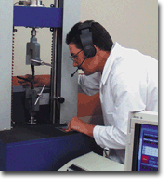
Electro Standards Laboratories (ESL), Cranston, R.I., has introduced the ESLTest II tensile
testing system featuring voice actuation, for hands-free testing. The ESLTest II is a digital test
system that performs such materials tests as tensile, compression and peel tests.By speaking into
the wireless remote headset, the operator can control the tester, place data marks during a test
and save and plot results. Voice command recognition replaces pip cords and hand-held keypads.The
ESLTest II is currently available in 500-pound and 1000-pound capacity test systems. A complete
turnkey solution is available, which includes the mechanical load frame, grips, tester electronics,
host computer, printer, wireless headset and Windows-based graphical user interface software.
Custom systems can also be configured.
June 2001
Easy Set Lycra Introduced For Ready-To-Wear And Intimates
Wilmington, Del.-based DuPont Apparel and Textile Sciences (ATS) presents Easy Set Lycra®, a new
elastane for circular knit and woven fabrics. Easy Set was specifically designed for use in
conjunction with heat-sensitive fibers such as cotton, rayon, wool, nylon and Tencel®. Fabrics made
with Easy Set can be heatset at lower temperatures than those made with standard elastanes. In
certain blends, such as nylon/Lycra or wool/Lycra, this translates into fabrics with clearer colors
and whiter whites.DuPont partnered with more than 30 Lycra Assured mills around the world to test
and refine Easy Set Lycra. By involving our Assured partners early on in the process, we were able
to greatly increase our speed to market and provide our development partners with significant
lead-time, said Greg Vas Nunes, president, ATS Ready-to-Wear.According to Robert Kirkwood,
director, Global Ready-to-Wear, the initial Easy Set product will be targeted toward staple blends.
Another version, optimized for use with filament fibers, will be introduced later this summer. In
addition to ready-to-wear and menswear, we expect the Easy Set Lycra products will offer
significant advantages in intimate apparel, particularly in molded garments where loss of whiteness
has been a real issue, Kirkwood said.
June 2001
BBA Nonwovens Inaugurates Plant Expands Offerings
BBA Nonwovens, Old Hickory, Tenn., has begun operations at its new airlaid plant in Tianjin, China.
BBA selected a dry forming, semi swing air-laid production line from M and J Fibretech for the
plant. The new plant produces air-laid fabric for a variety of applications, including feminine
hygiene, adult incontinence or baby diapers, absorbent food pads, pre-moistened hygiene or
industrial wipes, medical substrates and filtration.In other news, Germany-based BBA Industrial
Nonwovens GmbH, a member company of BBA Nonwovens, has added several items to its filtration media
offerings. The UltraFlo® range of filtration media has been expanded by the addition of meltblown,
off-line SMS, off-line TMS and pure spunbond. Needlefelt products and high electrical conductivity
products are also new items.
June 2001
Fire Devastates Jimtex Yarn Plant
Fire Devastates Jimtex Yarn PlantOn March 26, 2001, a massive fire resulted in approximately $10
million in damages at the Woodruff, S.C., plant of Philadelphia-based Jimtex Yarn, an affiliate of
Martex Fiber Southern Corp., Spartanburg, S.C. The fire started in an area not leased by Jimtex,
but spread quickly and destroyed almost all of the equipment, inventory and finished stock owned by
Jimtex.Jimtex is working on acquiring a new location in the greater Spartanburg area. Officials
expect the company to be operational with expanded capacity by November of this year. Ideally, we
would like our own facility, where we can have the highest level of control of the safety of our
employees and equipment, said Jimmy Jarrett, general manager, Jimtex. The new plant will need to be
substantially larger to accommodate growing demand for the yarn. We want to do the right thing, and
that means moving as quickly and thoughtfully as we can, Jarrett said, summing up the companys
momentum.Jimtex manufactures recycled yarn made predominantly from pre-dyed cotton blended with
acrylic or polyester fiber.
June 2001
Milliken Research Corporation

Jerry Cogan’s exceptional legacy lives on at research arm of Milliken & Company.
By Jim Phillips, Executive Editor
Innovation. Invention. These two words have more to do than any others with the ascendancy of the United States to the top of the world economic ladder. Many U.S. companies have been the embodiment of innovation and invention over the years. Names such as DuPont, 3M, Motorola, Dow and others come to mind. But nowhere are invention and innovation more revered or realized than at Milliken & Company, the Spartanburg, S.C.-based textile giant that is this years recipient of the Textile Industries Innovation Award.
Much of the company’s success in innovation can be traced to a corporate culture that fosters free thinking, idea exchange and continuing education. The attitude at Milliken is apparent from the moment one exits the interstate onto Milliken Road in Spartanburg. The sprawling campus of Milliken resembles a major research university more than the headquarters for one of the worlds largest textile companies. The buildings are architecturally simple, yet stately and elegant. They are neither dated nor modern and are finished in a subdued ivory that, amid the carefully landscaped lawns and gardens, creates the impression of continuous learning. It is almost incongruous to watch dapper executives in navy and gray business suits on their way in and out of the buildings; one expects to see students garbed in T-shirts and jeans dashing about, books under arms, hoping to avoid the tardy bell.
Committment To Research And Development
While business is conducted here on a global scale, it is not too far off the mark to call the complex an institution of higher learning. Milliken has been in the knowledge business for a very long time. Certainly, the commitment the company has made to research and development is known throughout the world. Since the humble beginnings of Milliken Research Corporation back in the mid-1940s, more than 1,500 patents have been sought and won in the company’s continuing quest to develop chemicals, yarns, and fabrics with enhanced properties.

What is perhaps less well-known is that Milliken & Company requires its management associates to complete a minimum of 40 hours of study every year in an effort to keep the company on the cutting edge of technology and development. Virtually all of Milliken’s management associate work force is recruited directly out of college, according to Richard Dillard, Milliken’s director of public affairs. The company’s continuing education program prevents the stagnation in middle management that tends to plague so many enterprises that keep the same people in place for a number of years. This is a major reason why, while other companies have come and gone, Milliken has remained among the very elite of the worlds textile industry.Considering the humble beginnings of the company it was founded by Seth Milliken and William Deering in 1865 as a small woolen fabrics jobbing firm in Portland, Maine the ascension of Milliken and Company to its current position is nothing short of amazing. The reasons are many. Education, as mentioned previously, is one. Another is the continuity inherent in family ownership. The current chairman and CEO, Roger Milliken, is the grandson of the company’s founder. Roger Milliken’s father, Gerrish Milliken, was instrumental in transitioning the company from a brokerage house into a major manufacturing concern.
Research Drives Milliken’s Success
But the mainstay of Milliken the corporate mindset that makes the company what it is today is research. Milliken has been, perhaps, the most active company in the world in this regard since the founding of Milliken Research Corporation. It was at that time that Roger Milliken, only several years away from inheriting the presidency of the company, made the commitment to bet the company’s future on the outcome of its efforts in product development.

For most of its history, Jerry A. Cogan, who retired last year after almost 40 years with Milliken & Company, has headed Milliken Research. Under Cogans direction, Milliken Research garnered more than 1,280 patents, including such world-famous processes and names as Visa® and Millitron®.
The research unit of the company, originally known as Deering Milliken Research Trust, was initially located in a small house in Clemson, S.C. A few years later, it was relocated to the manufacturing plant in Pendleton, S.C., just a few miles from Clemson. Milliken Research relocated to Spartanburg in the late 1950s.
“We did some very good work in those early days when we were at Clemson and Pendleton,” said Demitry M. Gagarine, a researcher who has been retired from the company for the past 16 years. Like many Milliken associates, however, Gagarine has never completely severed ties with the company and is intensely loyal to both the company and its management.
Among the projects that came out of Milliken Research in the early days was the development of Agilon®, which was a textured synthetic filament. Much of the worlds carpet, as well as women’s hosiery and other items, were manufactured using filament.
“Essentially,” said Gagarine, “the idea started with an engineer who wondered what would happen if one pressed a round filament over a sharp edge. The idea was generated from watching the edges of a ribbon curl after being cut by scissors. Would filament do the same thing Indeed it did. Agilon grew into a very large business for us at the time. DuPont traded some of its patent licenses to Milliken for the right to use Agilon for carpet filament.”
Another significant discovery for Milliken Research while still housed at Pendleton was the invention of Belfast®, which imparted wet memory and eliminated the need for ironing fabric constructed from cellulose fibers.
“Both Agilon and Belfast made wonderful progress in the marketplace,” Gagarine said. “Agilon was particularly important when miniskirts first began appearing in the 1960s. Belfast was licensed in many countries and had about seven licensees in the United States. Belfast was successful for a number of years until polyester blends became popular. Milliken & Company then left Belfast in the wake and began working mainly on polyester blends and 100-percent polyester.”
Recalling those early days of research, Gagarine, who joined Milliken in 1953, said: “Mr. Milliken is a superb leader, both of his company and in research and development endeavors. He would review research in large meetings with engineers, chemists, company management and some of the absolute best research minds in universities from throughout the world.”
Among those people were Drs. Ed Gilliland and Jimmy Wei, both of whom headed the chemical engineering department at the Massachusetts Institute of Technology (MIT), and who were considered among the preeminent minds in chemistry of their era. Milliken & Company later named a plant after Gilliland.
“Mr. Milliken and the company were able, through these meetings, to get a complete picture of the research and development efforts, including opportunities, problems, etc.,” Gagarine said.
Quest For The Best
It was the interaction with the bright engineers and chemists from within his own company, as well as the stars of the academic world, that prompted Roger Milliken to embark upon an aggressive recruitment program for MRC.
“Mr. Milliken challenged us to look for the very best brains in the world,” Gagarine said. “He commissioned us to contact schools that were prominent in chemistry, chemical engineering and mechanical engineering and find out who the best students were over the previous 10 years. We were then to contact those people and find out what they were doing in the business world.
“It was out of this effort that the company attracted two of the very best minds the company would ever see, both of whom happened to have attended MIT. One was Jerry Cogan and the other was Dr. John O’Neill [another Milliken associate who has made valuable research contributions].”
Both Cogan and O’Neill were working for DuPont at that time. DuPont was then the unquestioned leader in research and development. “We decided to pry those two away from DuPont, but it proved to be a very difficult thing to do.”
Gagarine wrote Cogan a number of letters over about a six-month period, but he kept receiving polite replies that Cogan was happy at DuPont and was not interested in leaving. “I guess I must have impressed him with my persistence because he finally agreed to stop by and visit us on his way to vacation in Florida. Jerry Cogan met Mr. Milliken and the management team but still declined our offer.
“Mr. Milliken must have impressed him, however, because several months later he wrote to tell us that he would accept the job.”
Jerry Cogan: A Man Of Honesty And Vision
Cogan, according to Gagarine, brought to Milliken dedication, determination and an uncanny ability to mix with people and solve problems. “Jerry Cogan has many marvelous characteristics,” he said, “two of which really stand out. The first is his complete honesty. Most management decisions are colored to justify either the objectives of the project or
the person in charge of the project what today we call ‘spin.’ Jerry Cogan was completely devoid of spin. He just told you exactly as it was with no attempts to sway one side or the other. It was very refreshing for Mr. Milliken, me and the other people who were associated with him.
“His second marvelous attribute was his ability to have a broad vision of a large number of problems, crises and other issues without getting lost or getting so bogged down in the details that he couldn’t see a solution. He could deal with all areas exceptionally well. He has an enormous grasp of both chemistry and physics.”
Among the developments in which Cogan played a part was the creation of a radiation permanent-press project that ultimately resulted in Milliken & Company’s famous Visa
program.

“We in research were interested in radiation to determine how it would modify fiber by creating free radicals to which we could attach reactive chemicals,” Gagarine said. “We thought this might give us an opportunity to make some enhancements in certain areas. Originally, we wanted to buy a very small machine that would enable us to measure these enhancements. Mr. Milliken, however, insisted that we buy a large state-of-the-art machine so that we would feel the need to justify the investment. So we bought a radiation machine and opened up an underground laboratory. The result was a permanent-press finish coupled with soil-release properties for poly/cotton fabrics.”
Gagarine continued: “We launched this program under the trade name of Visa, and it made an immediate hit in the marketplace. Primary applications were in tablecloths, industrial uniforms and other things that had to be repeatedly laundered under very harsh conditions.”
At the time of development, both the permanent-press and soil-release characteristics carried equal weight with researchers, Gagarine said. Soil-release properties quickly became the dominant area of focus, however. The soil-release program worked so well that industrial uniforms and tablecloths often soiled with oils, grease, etc. no longer needed heavy-duty industrial laundering to come clean. So the radiation method was abandoned in favor of a resin treatment to impart both permanent-press and soil-release properties.
The original Visa program was developed for natural fibers and blends with polyester. When the transition was made from radiation to resins, however, Milliken began looking at how to program could be expanded to include 100-polyester and textured yarn.The challenge was considerable. Fibers are either hydrophilic meaning they attract water or hydrophobic, which means they repel water. Hydrophobic fibers are generally oleophilic they repel water and attract oils. Much of the soil that dirties fabric is oil-based. Polyester, being an inherently oleophilic fiber, attracts oils and does not easily release them. The mission, then, for a soil-release development to be successful is to transform the properties of polyester so that it becomes hydrophilic, which facilitates the release of oils.
“It was quite a challenge, Gagarine said. But our hypothesis proved true and worked out very well. Visa, as everyone knows, has been a hugely successful program.”
So much of what Milliken Research accomplished can be attributed to the leadership skills of Cogan, Gagarine said. “He could really pull a group together, identify opportunities and see right to the heart of problems.”
Ongoing Recruitment Of Talent
A constant at Milliken & Company since the inception of the research corporation has been the ongoing recruitment of talented people. Gagarine was instrumental in the recruitment of Cogan, and Cogan was a key player in hiring Dr. Thomas J. Malone, who is now Milliken’s president and COO. Dr. Malone, along with Cogan and O’Neill, had a hand in developing the Millstar® and Millitron® dyeing programs for carpet. Millitron is capable of instantly reproducing exact color matches and patterns to customer specifications.
“Always with an eye toward new product development and innovation, Jerry Cogan emphasized the importance of patents to his research scientists,” Dillard said. “Cogan, himself, is credited with driving the concept of computerized digital jet printing for patterned textiles, which has had an extraordinary impact on our company. In particular, this program has resulted in the Millitron Jet Dyeing of carpets, rugs and mats. This concept has also spread and been successful developed in a variety of other computer-controlled processes within the company.”
Key to each of the projects undertaken under Cogan’s direction, according to Dillard, is his insistence that research efforts be based on good science and make a real impact on the profitable growth of the company. Cogan carried this so far as to call his associates inventors instead of researchers.
A Vision For The U.S. Textile Industry
Milliken’s success is obviously attributable to its commitment of resources and its
determination to employ bright, driven people. But another huge factor is the company’s vision for the textile industry in the United States. Many of the company’s efforts are centered on keeping the U.S. industry competitive with others around the world. Few companies can claim such an expanded vision or such a selfless desire to accomplish what is good for the industry as a whole.
The company is actively involved in organizations that facilitate the transfer of research and technology ideas within the textile industry. Milliken is an instrumental part of such organizations as the National Textile Center, [TC]2 and others. Roger Milliken served as chairman of the Institute of Textile Technology for 49 years. Malone was instrumental in the creation of, and chaired the AMTEX partnership a collaborative program among the industry, federal agencies and universities. Milliken, Malone and Cogan have all played major rolls as board members in these and many other organizations.
The company’s commitment to research and development transcends product innovation,
however. Milliken as a company is a serious student of techniques and systems and often implements improvements upon those programs that have proven successful in other cultures. As a result, Milliken is the only company to have won all of the worlds four major quality awards: the Malcolm Baldrige National Quality Award in the United States: the European Quality Award; the British Quality Prize; and the Canadian Quality Award.
Among the company’s many motivational phrases for its associates is that there is “no saturation in education.” For Milliken as a company, there appears, as well, to be no saturation in pursuit of excellence and innovation.
Dilo Delivers DI-LOOM PMF Hyperpunch Needle Loom
Dilo, Germany, sole owners of Spinnbau, also based in Germany, is to deliver a large needle loom
the DI-LOOM PMF to Wurttembergische Filztuchfabrik D. Geschmay GmbH, Germany. The machine has a
working width exceeding 13 meters (m) and is equipped with four needling zones. The machine is 17.5
m long, 12 m wide and 10.8 m tall, with a total weight of 600 tons.Spunbond needling with very high
throughput speeds, web consolidation during the production of synthetic leather, and pre- and
finish-needling of paper machine felts are the main applications of the Dilo Hyperpunch technology.
Most of the Hyperpunch machines Dilo has sold have been purchased by companies in the paper machine
felts business.The elliptical needling path of the Hyperpunch offers reduced dimensional changes
and even weight profile when used for pre-needling, and less needle breakage and higher throughput
speeds in finish needling.
June 2001



