Textile Makers Outline Agenda


A
coalition of trade associations representing cotton, man-made fiber, yarn and fabric
manufacturers and the New York City-based labor union UNITE HERE has outlined its Unity 2005
international trade agenda. Industry officials see this agenda as a blueprint for survival in a
world of textile trade that has changed dramatically with the end of the import quota system.
Citing the loss of 447,400 textile and apparel jobs and numerous plant closings in the last five
years, coalition members decried what they say is a “relentless outsourcing of US jobs and US
wealth.” The textile manufacturers and labor leaders said the US government should take ”vigorous
and immediate actions” to strengthen domestic manufacturing, preserve jobs and reduce the $600
billion US trade deficit.

To achieve these goals, the coalition has endorsed a six-point platform asking US elected
officials to: commit to the reimposition of import quotas on Chinese textiles using a safeguard
mechanism that permits quotas when market disruption or a threat of market disruption can be
demonstrated; support efforts to prevent global dominance of textile trade by countries that use
unfair trade practices; support expansion to other federal procurement agencies of a Defense
Department requirement to Buy American; oppose any free trade agreements that contain unnecessary
loopholes to requirements to use participating-country fiber, yarn, thread, fabric, and fabric
dyeing and finishing and printing; oppose any reduction of US textile and apparel tariffs or
weakening of US trade laws through the World Trade Organization (WTO); and support enforcement of
US trade laws to address illegal activities.


China Hit For Role In Record Trade Deficit

Textile trade officials in Washington are blaming rapidly growing textile and apparel imports —
particularly those from China — and slow-growing exports as major factors in the record US
international trade deficit in 2004 of $617 billion.

The textile and apparel trade deficit amounted to $73.1 billion, an increase of 8.7 percent
over 2003. China’s textile trade deficit was a record $17.5 billion, up by $3.5 billion — a
25-percent increase.

In a development that is of concern to importers and textile manufacturers, imports from free
trade and trade preference regions like Canada, Mexico, the Caribbean Basin and Central America
fell sharply. Imports from those countries generally contain yarn and fabric made in the
participating countries, including the United States.

The American Manufacturing Trade Action Coalition (AMTAC), Washington, which represents a
range of US industries, called for a moratorium on new free trade agreements and urged the US
government to “aggressively use access to US markets” to force countries such as China to halt what
AMTAC calls “predatory practices” such as currency manipulation and other types of government
subsidies.


Retailers Mount Counterattack

The National Retail Federation (NRF), Washington, put international trade at the top of its 2005
agenda. The NRF cited its opposition to the textile industry’s efforts to limit its overseas
sourcing by attempting to clamp down on Chinese imports and the industry’s opposition to the
Central American Free Trade Agreement.

Predictably, the NRF puts an entirely different spin on how textile and apparel manufacturers
and their customers — the retailers — should deal with global trade issues. The NRF and the New
York City-based US Association of Importers of Textiles and Apparel believe it is a mistake to
become too dependent on Chinese trade, but they also want the flexibility to make sourcing
decisions on their own and not be encumbered with quotas, the threat of quotas or what they view as
“onerous” rules of origin in free trade agreements. The NRF’s trade expert, Eric O. Autor, said
retailers have been “loath to put all their eggs in the Chinese basket,” but unreasonable and
counterproductive rules of origin in free trade agreements have pushed them in that direction.

In testimony before the US-China Economic Security and Review Commission, Autor said textile
rules of origin have made it difficult for importers to do business with countries that could be
alternatives to China. He said retailers have been seeking trade with India, Pakistan, Honduras and
other countries rather than dealing with some of the uncertainties surrounding trade with China. He
said that while price is an important consideration with importers, more critical factors are
proximity to the retailer; quick turnarounds; and the ability of fiber, textile and apparel
manufacturers to deliver fully integrated packages. He noted some textile companies — including
Milliken & Company, Spartanburg; and Wilbur L. Ross’s International Textile Group, Greensboro,
N.C. — have adjusted to the global trade environment, and other companies are currently developing
export opportunities.


Foreign Trade Groups Join In The Fray

wasshingtonContending
that global textile trade problems require a global solution, a group of trade associations from 54
countries comprising the Global Alliance for Fair Textile Trade (GAFTT) has joined with US industry
and labor in supporting many of the positions in the 2005 platform. Representatives of trade
associations in the United States, Mexico, the European Union, and a number of other developed and
developing countries held a summit meeting in Washington to address their concerns and recommend
solutions. They focused on the possibility that China and India could capture the bulk of
international trade in textiles now that virtually all import quotas have been abolished. They
urged the United States, Canada and the European Union to immediately implement the WTO China
safeguard mechanism to prevent China from monopolizing worldwide trade, and they called on the WTO
to undertake “an urgent review” of the impact of the quota elimination on what they say are “market
distorting practices.”

GAFTT cited an analysis by the Washington-based National Council of Textile Organizations (NCTO)
that shows imports from China in product categories removed from quota control in 2002 had taken 73
percent of the US market by November 2004, compared with 10 percent before quotas were removed. The
next-biggest supplier is Thailand, with 3 percent of the market for those products. In terms of
overall textile and apparel imports, according to US Department of Commerce data, China accounts
for 24.8 percent of imports, and Canada and Mexico — which at one time were the leaders — now have
7 percent and 8.8 percent, respectively.


Trade Official Sees Completion Of Doha Round In 2006

A top US trade official believes the 148 nations in the WTO can complete the Doha round of trade
liberalization negotiations by the end of next year, but he sees anything but a smooth road ahead.
Following a series of meetings with both developed and developing country trade officials, Deputy
US Trade representative Peter F. Allgeier said he senses “widespread readiness among WTO members to
accept the challenge of completing the negotiations successfully next year.” Allgeier added that
much needs to be done in terms of market access, eliminating or reducing tariffs and phasing out
subsidies to agriculture and industrial products. US textile manufacturers and importers are poles
apart with respect to tariff cuts, as the textile industry is hanging tough on its insistence that
other countries reduce their tariffs before the United States makes any further concessions.

With China very much on everyone’s mind, Allgeier said the best way to deal with Chinese
trade issues is “within the system of rules and dispute settlement in a non-discriminatory way.” He
said he would strongly object to withdrawing Normal Trade Relations status for China in the United
States, as has been suggested by some, saying that is not “the most productive way” to deal with
China trade. Allgeier strongly defended US anti-dumping and countervailing duty laws, which have
been criticized by many countries.

Summing up his comments, Allgeier said no nation can succeed these days without being “
effectively integrated” into the global economy.


March 2005


Synalloy Finalizes Sale Of Blackman Uhler

Spartanburg-based Synalloy Corp. has completed the sale of its Blackman Uhler LLC dye business to
Greenville Colorants LLC, Greenville, for $4,950,000. Terms of the sale include all Blackman Uhler
inventory, and certain property and equipment related to Blackman Uhler, as well as the licensing
of certain intellectual property.

March 2005

Weaving Update


F
ollowing are some of the most recent developments in the field of weaving machines and
accessories, destined to increase weaving mill productivity, while at the same time achieving
significant savings in labor and energy.


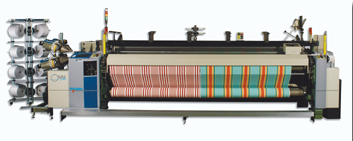
Dornier

Lindauer Dornier GmbH, Germany, used this year’s International Textile Machinery Trade Fair
(ITMEX Americas) 2005 in Sao Paulo, Brazil, as a platform to emphasize its drive in technological
progress. New developments cover the complete weaving machine product line. The new performance
generation of air-jet and rapier weaving machines; and the ServoTerry® machine for terry weaving
are complemented by innovative advances in leno technology with the EasyLeno® weaving machine for
technical and decorative fabrics.

ServoTerry is used in the home textiles sector. Its advantage over existing systems is its
direct drive for terry movement using a servomotor while retaining precise but gentle reed impact.
This allows varying pile weave and adjustable pile heights during operation. The 260-centimeter
(cm)-wide machine is equipped with a Staubli dobby with 16 shafts for the production of three-width
terry bath towels at varying speeds of 540 and 600 revolutions per minute (rpm).

Other developments include the AS air-jet weaving machine, which runs with new, patented
ServoControl® pressure regulation. This minimizes thread load and allows automatic, reproducible
pressure adjustments for yarn lot changes to be made, and ensures higher performance with improved
final fabric quality, according to Dornier.

Another recent development is the AirGuide® patented air cushion guide for Dornier rapier
weaving machines. The linear movement of the rigid rapier rod is ideal for this new system – the
perfect technical solution for contact-free, aerostatics support.

The EasyLeno system for rapier and air-jet weaving machines enables up to 100-percent higher
performance in leno technology, and opens up options for completely new fabric design in the
technical textiles and home furnishings sectors.


Jakob Muller

Jakob Muller AG, Frick, Switzerland, offers weaving machines for the production of patterned
elastic and non-elastic narrow fabrics and lace articles, including satin ribbons and tapes. Its
needle weaving machines include models such as the NF, NG and Varitex V5Ni.

The company has improved the NF model, which now is able to insert up to six weft colors,
substantially increasing weft pattern options. The choice of weft colors is practically unlimited.
Length changes are achieved by electronic single heddle control, programmed and controlled via the
Mudata system.The NG3 model is equipped with a Quick-Style-Change system for reeds, heddles, drop
wires and heddle frames; this option also is offered for the warp frame beam. The NG3 is designed
to provide optimum performance for belts, and non-elastic and elastic fabrics.


Picanol

Picanol NV, Belgium, manufactures several kinds of high-tech weaving machines for different
applications in the textile industry. The OMNIplus air-jet machine for the weaving of staple
fibers, filament, high-twist yarns, elastic yarns, chenille and texturing yarns, among others, uses
up to six colors and different types of fillings.The OMNIplus comes in reed widths of 190, 220,
250, 280, 340, 380 and 400 cm. It can produce fabric rolls 720 millimeters (mm) wide, or up to
1,500 mm wide with Picanol’s separate Picanol Batching Motion system for rolling of fabric.

Other advantages include digital adjustments and synchronization of the complete weft insertion
cycle; a separate frame for style change in less than 30 minutes; a high level of weft insertion
performance, allowing more weaving using less air; rapid change of the roll and the warp; low
construction with ergonomic characteristics; and a Sumo main motor for the direct drive of the
machine.


picanols

Picanol’s OMNI
plus air-jet weaving machine is available in a variety of reed widths.


Promatech-Itema Group

Promatech S.p.A., Italy (formed by the merger of Somet and Vamatex), is a member of the Itema
Group, also based in Italy. It is well known for its line of rapier and air-jet weaving machines,
including models such as the Mythos, Thema Super Excel and Alpha (from Somet); as well as the
Leonardo and K88 (from Vamatex).

The latest developments from Promatech include the high-speed, versatile Mythos Tec air-jet
weaving machine. Recently, the company sold several of these machines to a textile manufacturer in
Brazil.

Promatech’s Alpha 3200 negative rapier weaving machine is available with a jacquard machine for
double width for use in upholstery production.

Other weaving machines offered by Promatech include the Alpha 2200, equipped with dobby suitable
for the production of high-quality woolen fabrics; the FTS, which works without using hooks and is
suitable for a variety of applications; and the Leonardo Silver, which is equipped with a rapier
guidance system.


SMIT

SMIT S.p.A., Italy, is an international leader in weaving machine technology, supplying
cutting-edge products and prompt and effective after-sales support.

Numerous weaving machine models have been developed since the company introduced the first
gripper weaving machine. These models include the TS, TP, TTPS, FAST, TerryJet, GS900, JS900, G6300
and G6300F models.
(See “SMIT Solutions,”
www.TextileWorld.com, March 2005)
.


Staubli

Switzerland-based Staubli AG’s range of shedding machines and accessories is extensive and
covers all fields. The range includes cam motions, negative dobbies and rotary dobbies; as well as
high-performance harness motions, quick links and frames. Depending on the type of machine,
mechanical controls by cams or electronic controls are used.

Staubli dobbies are simple and user-friendly. The company offers dobbies adapted to all types of
weaving machines and all weft insertion systems, as well as for the production of all types of
fabrics from basic fabrics to technical fabrics and double-pile fabrics and carpets.

The CX 160 electronic jacquard machine is particularly suitable for personalizing flat fabrics
with written selvages. It may be equipped with up to 96 hooks, enabling great production
flexibility.

The CX 990 is a double-lift jacquard machine used in the production of carpets and velvet
fabrics. It is equipped with the CX modulus (Staubli Patent), which does not require any
maintenance, according to the company.

The Delta automatic drawing-in machine is known throughout the world and has demonstrated its
capability in many diverse applications. One of the main advantages of this system is the
reduction of labor costs owing to automation and rationalization, with great flexibility to adapt
to varying needs of the market.The Topmatic tying machine guarantees maximum efficiency during the
warp change process. The use of all yarn types and optimum tying quality lead to minimum
downtime.Stlis Warplink warp welding device enables the laying-in and start-up weaving of newly
drawn-in or stationary tied warps to be accelerated and simplified. The company reports resultant
time savings at style change may exceed 30 minutes.


_staubli

Staubli’s Topmatic tying machine helps makethe warp change process more efficient.


Sultex-Itema Group

The Sulzer Textil G6500 from Switzerland-based Sultex Ltd. – another member of the Itema Group –
continues the company’s long tradition in rapier technology. With its many innovative features,
this machine stands apart thanks to its performance, gentle handling of warp and weft materials,
compact dimensions and economically efficient production of top-quality fabrics, according to
Sultex.

This new rapier weaving machine already is producing successfully under industrial conditions in
several weaving mills around the world. The machine is offered with several options; its main
characteristics are sturdiness and flexibility.Sultex also offers the G6500 B220 N8/4 SP, a machine
of very high production speed and low vibration levels.The company’s newest machine is the L5500
air-jet weaving machine, which it introduced at ITMEX Americas 2005
(See “Sultex Debuts L5500 Air-Jet Machine At ITMEX,”
www.TextileWorld.com, this
issue)
.


sulzer_Copy_4

The Sulzer Textil G6500 features compact dimensions, and gentle handling of warp and weft
materials, according to Sultex Ltd.


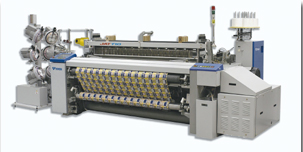
Toyota

The JAT710 air-jet weaving machine manufactured by Toyota Industries Corp., Japan, was designed
along the same lines as its predecessor, the JAT610, to produce high-quality fabrics at the lowest
possible cost. The machine features such characteristics as a higher speed, reduced vibration and
low energy consumption.

The machine comes equipped with the latest in electronic technology, including a new panel for
the control of colors, and has the capability to be connected to the Internet.The main features of
the JAT710 are: reduced air consumption by up to 20 percent; maximum speed of up to 1,250 rpm due
to a new weft insertion system and new frame structure; and a central processing unit.


JAT710air

The JAT710 air-jet weaving machine from Toyota Industries may be connected to the
Internet.


Tsudakoma

Tsudakoma Corp., Japan, offers its ZAX-e air-jet machine equipped with an iT control panel. This
panel automatically adjusts several machine functions. The easy-to-use iT panel has a touch-screen
feature with color display interface that automatically adjusts data and diagnoses problems.

New, built-in electromagnetic valves stabilize the air jet and the pressure pulse. New
sub-nozzles contribute to significant savings in energy, even at high operating speeds.


Van de Wiele

NV Michel Van de Wiele, Belgium, a manufacturer of weaving machines for carpets and other
applications, offers new machine models such as the Shaggy Rug eXplorer SRX82; the Carpet and Rug
eXplorer with eight color frames; and a machine for the manufacture of sisal-look carpet with
visible fillings of different colors and cut pile.

March 2005

Honeywell Receives EPA Award For Landfill Gas Plan

Morris Township, N.J.-based Honeywell International has received the US Environmental Protection
Agency’s (EPA’s) 2004 Landfill Methane Outreach Program (LMOP) Project of the Year Award for an
initiative to recover methane-rich landfill gas for use at the Honeywell Nylon plant in Hopewell,
Va. Co-recipients of the award include Charlotte-based Enerdyne Power Systems Inc. and
Houston-based Waste Management Inc. (WMI), which partnered with Honeywell to build a 23-mile
pipeline from the WMI Atlantic Waste landfill in Waverly, Va., to the nylon plant. The pipeline
went on-line in January 2004 and has reduced consumption of natural gas fuel by 15 percent.

“The reduction in [carbon dioxide] air emissions over the life of the landfill is equivalent to
planting 5,544 square miles of trees and saving 1.2 billion gallons of oil,” said Keith Togna, site
energy leader for the Honeywell Hopewell plant. LMOP promotes landfill gas as a valuable local
energy source that can serve as an alternative to conventional sources of energy.

March 2005

Dornier Celebrates Milestones With German Weaver

Lindauer Dornier GmbH, Germany, recently participated in celebrations at Joh. Hohmann GmbH and
Co. KG, a Germany-based family-owned weaver of curtain and drapery fabrics. Dornier has supplied
Hohmann with weaving machinery for 30 years, and is the sole supplier of such machinery to the
company, which is its largest German customer.

Hohmann held the celebration to inaugurate a new 6,000-square meter production facility, which
provides space for 144 weaving machines and a high-performance tenter frame.

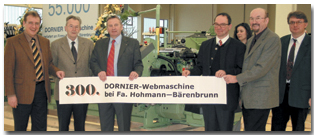
As part of the inauguration, the guests of honor were invited to install the 300th Dornier
weaving machine at Hohmann. The machine also is the 55,000th shuttleless weaving machine delivered
to a customer by a German weaving machinery manufacturer.

Hohmann weaves 40,000 meters of curtain and drapery fabrics per day. The company has 330 rapier
weaving machines installed with eight filling colors for dobby, jacquard and leno weaving. It also
has ordered 32 new PTS rapier weaving machines.

dornier_Copy_10

Left to right: Martin Buchta, managing director, and Karl Hohmann, senior director,
Hohmann; Bernd Hering, City Hall district administrator; Peter D. Dornier, manager, Dornier; Carmen
Hubsch, Bavarian government body; Hans Schmidt, deputy mayor, Bnbrunn (Helmbrechts), Germany; and
Thomas Fischer, senior executive officer, Bavarian government body, participated in the
installation of the 300th Dornier weaving machine at Hohmann.


March 2005

Springs To Close Two Plants, Reduce Capacity And Invest $10 Million

Springs Industries Inc. announced today it will close two fabric weaving plants and invest $10
million in its remaining weaving plant in Chester County, S.C. The company will add new technology
and relocate equipment from other Springs facilities to Katherine Plant as part of its strategy to
adapt to a smaller number of highly flexible facilities that can compete in a global
environment.

As previously announced to employees last year, the company also said it will reduce
manufacturing capacity and jobs at Grace Complex in Lancaster County, S.C.

“Despite last year’s good performance and the investments Springs has made to stay competitive,
recent events have affected expectations for our bedding business,” said Tom Gaffney, executive
vice president and president of the company’s bedding business. He said the removal of quotas on
Jan. 1, 2005, has created significant pricing pressure as new suppliers throughout the world now
compete for access to the U.S. marketplace.

“As a result, world prices for products like those we make are falling significantly, which
means we must act now,” Gaffney said.

Springs will close the Elliott and Frances plants in Fort Lawn, S.C., on or about May 15 and
July 1, respectively. The facilities weave bedding fabrics and together employ about 250
people.

At Grace Complex, about 450 employee jobs will be affected as fabric finishing and sewing
capacity is reduced in phases, mostly during the summer and into the fall. Normal turnover and
attrition during this time frame will create some job openings, Gaffney noted, and the company will
work hard to find opportunities for all affected employees. About 3,000 people will be employed by
Springs in Chester and Lancaster counties after the layoffs take effect.

Gaffney said Springs continues to carry out strategies to remain competitive in a rapidly
changing environment.

“We believe our U.S.-based facilities can be a competitive strength, and we will compete by
balancing what we make in our U.S. plants with what we buy so we can deliver products to customers
faster than any overseas supplier.”

Press Release Courtesy Of Springs Industries Inc.

March 1, 2005

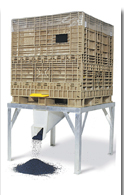
Linpac Introduces ROPAK Hopper Bottom

Georgetown, Ky.-based Linpac Materials Handling has introduced the ROPAK Hopper Bottom reusable,
collapsible container for dispensing granular-type materials such as powders, dry chemicals, bulk
solids, preforms and resins, among others. The container uses gravity and a simple-to-use chute to
dispense materials easily and accurately, according to the company. Secondary removal processes are
not necessary, which helps reduce labor, material handling and packaging costs.

ROPAK Hopper Bottom collapsible container from Linpac Materials Handling

The Hopper Bottom features a steeply inclined, smooth interior and adjustable side-mounted
sliding gate. Constructed of high-density polyethylene, the container has a maximum weight capacity
of 2,000 pounds and comes in three sizes, with volume capacities ranging from 25.3 cubic feet (ft3)
to 34.8 ft3 to 37 ft3.Optional accessories include plastic liner bags, discharge inserts and side
discharge stands, and vibration units for automated dispensing.

March 2005

ActiveSeam Offers Improved Seam Bonding

Sonobond Ultrasonics, West Chester, Pa., has added the new ActiveSeam to its SeamMaster line of
ultrasonic bonders for the apparel industry.

Sonobond Ultrasonics’ ActiveSeam is suitable for bonding seams in such applications as technical
outerwear.

The new system, described by the company as the only ultrasonic bonder on the market that is
designed to produce taped seams, feeds fabric and an adhesive layer or tape through the bonding
unit using a feed dog mechanism that enables material and adhesive to flow uninterrupted through
the bonding process. The system uses ultrasonic energy to fuse the adhesive tape into the seam.

According to Sonobond, ActiveSeam produces flat bonded seams up to three times faster than
comparable hot-air equipment. The company also reports the seams exhibit superior waterproofness,
durability and strength.

March 2005

Fabric Week In New York

.

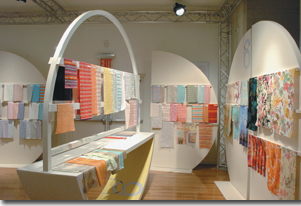
European Preview set up a special display to provide attendees with an overview of fabric
trends presented at the show.


F
abrics from Europe, Turkey and Asia, along with surface design from international
studios, attracted record numbers of buyers to a series of shows held recently in New York
City.

All of the shows, which previewed fabrics for Spring/Summer 2006, were impacted by the
euro/dollar exchange rate and textile imports from low-wage countries. Although the falling dollar
drove up prices of European fabrics, the 137 exhibitors at European Preview reported excellent
reactions to their new lines from the more than 3,000 visitors who attended the show.

The range of fabrics shown by 49 companies at the Turkish Fashion Fabric Exhibition (TFFE),
organized by the Istanbul Textile and Apparel Exporters Association (ITKIB), included classic
suitings, denims, knits, prints and shirtings. Buyers came from firms such as Calvin Klein, Gap,
Paul Stuart, Ralph Lauren and Tommy Hilfiger. Innovation Asia, organized by Lenzing AG, Austria,
showcased 23 mills from China, Hong Kong, Japan, Korea, Taiwan and India. Many of the exhibitors
are vertical, selling yarn, fabric and apparel.

Two shows that focus on surface design, Direction and Printsource, have expanded their scope.
This year, there were about 150 studios from Europe, Asia, Israel, and North and South America at
each show.


European Preview

Now in its 10th season, European Preview has a waiting list of exhibitors. The mix of
participating companies and their focuses are changing. Absent this time were many that sell
expensive fabrics aimed at couture markets, such as Bianchini, Bucol, Mantero, Ratti and
Solstiss.

Frans Damide, president and CEO, Solstiss/Bucol America, New York City, said that when the
dollar and euro were on a par, firms in designer and bridge markets would shop his lines for that
something extra. “We know how to reach our regular customers. It was the surprise visits by those
we don’t work with on a regular basis that made it a good show for us. Now they cannot afford us,”
he said.

This sentiment was echoed by others at the show. Picking up on that something extra, exhibitors
showed fewer basic fabrics. Quality, novelty and performance fabrics give more individuality.

At Milior S.p.A., Italy, the emphasis was on new finishes. The company showed compact cottons
and linen/nylon blends with enzyme finishes to give them an ultra-soft hand, overdyed printed
canvas, diamond finishes, washed fabrics and yarn-dyed twills that can be overdyed or garment-dyed.
Paper yarns in thick, shiny/dull weaves are bulky and lightweight. There is a lot of stretch and
special weave effect. According to Milior, jacquards and prints will be added.

Ulster Weavers Apparel Ltd., Ireland, showed new finishing treatments, blends and textures.
There are metallic and chintz surfaces that keep their luster through multiple washings, crinkles,
seersuckers and stretch linens. Linen is sometimes blended with Supima® cotton, Tactel® nylon or
viscose. Some linens are subtly printed with gold and silver. There also are yarn-dyed shirtings in
linen/Lycra® blends, and summer tweeds designed for golfwear.

Donna Karen used lace from Solstiss in this evening dress.

Fred Rottman, who heads the New York City office of Italy-based Picchi Mills S.p.A., said
Picchi’s line is more refined than in seasons past. There are linens and linen/cotton blends with
pearlized coatings, and blends that have been polyurethane-printed. Matte/sheen jacquards that have
dimensional patterns are available in a wide range of weights, and are woven in acetate/viscose/
cotton blends. Tweeds and jacquards at France-based Tournier and Fils are woven with fancy yarns in
multifiber blends of cotton/viscose/ silk/linen, often with nylon or Lurex® added for a subtle
touch of shine. Pearly pastel shades and tonal colors were pointed out. Another France-based firm,
Isoule Textil, mentioned interest in whitened colors, black and white, and touches of sparkle.
Stretch linens, silk tweeds and shantung are some of its early offerings. Tintore-Turull S.A.,
Spain, showed yarn-dyed plaids of 100-percent linen that are overdyed with silver and washed to
give them subtle luster and a slightly faded appearance. Cotton piques  have been treated in a
similar fashion. There also are dyed and piece-washed rustic linens, jacquards and piques.

 Lanficio Lamberto, Italy, displayed sheers, stretch and jacquards in linen and blends.
There are crinkled stretch fabrics with metallic stripes, dvndigo dyes that have a refined denim
look, pleated sheers with ribbon flower appliquand opaque/sheer linen checks. At Wilhelm Becker,
Germany, customers are looking for novelty and fabrics with hidden functions. Armani buys jacquards
here. There are large-scale jacquard-weave herringbones, natural stretch crepes that don’t wrinkle,
summery cotton tweeds, and stripes woven with a cotton warp and stretch nylon weft. Nanotechnology
imparts soil-release finishes. Bamboo yarns are popular. Fabrics with a dry hand are selling well
in Europe, according to the company.


Fabrics With Memory

Fabrics with a high percentage of metal are called memory fabrics because they keep their
wrinkles when they are crushed, and can be hand-smoothed. Steel turns up frequently. Metal has made
a strong comeback at Schoeller Textil AG, Switzerland, which introduced it to its line several
years ago. One of the newest fabrics is a lustrous, iridescent taffeta woven in a blend of 75
percent metal/20 percent nylon/5 percent elastane. Schoeller reports color-reverse, lightweight,
soft-stretch fabrics finished with 3XDRY® technology also are selling well. They are wind- and
water-repellent and breathable, and provide moisture control. Linea Tessile Italiana S.p.A., Italy,
has linen/steel blends in 180-grams-per-square-meter (gr/m2) jacquard weaves that have a soft
touch. Bright shades of yellow, orange and tomato red sometimes are combined with brown or black.
There are sheer satin stripes printed with spots and splashes of metal, printed and embroidered
polyester/ viscose crushed satin, and light silk shantung. Prints are large in scale and have an
Oriental or Indian look. Dvinens in weights ranging from 190 to 300 g/m2 were pointed out.

Reynaud Rexo, France, specializes in cocktail and eveningwear fabrics. It is showing shiny
taffetas and organzas woven of 70-percent polyester and 30-percent metal. Some have ombre grounds.
Philea Textil, France, is showing metal covered with cotton. Many fabrics in this line are woven
with novelty or printed yarns. Shiny stretch shantung, lustered taffeta, pigment-dyed crinkle
crepes washed to give a vintage look, stretch satiny washed twills and multicolored chenille
stripes are some of the firms best sellers.


Sportswear

For sportswear and outerwear, Olmetex S.p.A., Italy, has polyurethane-coated lightweight
iridescent taffeta woven in a blend of metal/micropolyester. Many fabrics in this line are
color-reverse, coated and water-repellent. Some have enzyme finishes; others have a rubber touch.
Polyester microfiber/silk blends have been splattered or crystal-printed in circle patterns. There
also are soft linens with a denim look and bonded Mackintosh-type fabrics.

The line at Frantissor Creations, France, is traditional mixed with sophistication. Neutrals,
muted brights and pastels are shades of note. Cotton/nylon twills are jacquard-patterned and
embroidered for a rich look. Spain-based denim specialist Tejidos-Royo has developed dyeing
techniques for special effects. Yellow-core-yarn denim is overdyed with indigo. When it is
sandblasted, the yellow comes through to give a vintage look. Denim woven with multicolored yarn
and indigo-dyed has a mottled look when the fabric is abraded. There are comfort-stretch denim with
1-percent Lycra and pigment-dyed slubbed denim. Flocking is a specialty of Wonder S.r.l., Italy. It
is done on a variety of fabrics from denim with a distressed look to iridescent cotton and linen.
Some of the fabrics are soft and sueded. There are large- and small-scale coordinating
patterns.


Knits

Innovation and performance are key in the knit sector. Switzerland-based Greuter-Jersey AG had a
good reaction to fabrics knitted with its Clima yarns. Spun with Meryl® Nexten/cotton/Micromodal®,
these yarns have moisture-transport, insulation and fast-dry properties. Another yarn, Clima Plus,
is bacteriostatic. Dryarn® jersey contains micro-polypropylene. It is soft, water-repellent and
odor-free. Another yarn contains microcapsules of aloe vera that remain effective through 10
washing cycles. At Marioboselli Jersey S.p.A., Italy, there is a group of fabrics knitted of
94-percent linen/6-percent Lycra. They are lightweight and slubbed, and have a dry hand. Another
group includes fluid, soft and sheer fabrics that contain Modal®/nylon or viscose/Lycra blends.
Jacquards of 100-percent linen are styled for T-shirts and beach dresses. Swimwear knits are
dazzling gold, smooth and slippery.
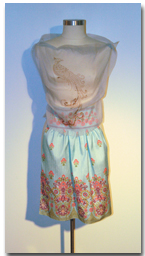
Tom Cody Design combined prints and embellishments at Printsource for bohemian and gypsy
looks.

France-based knitter Billon Freres has a group of tight stretch knits created for yoga and
performance apparel. Knit of Meryl Microfiber with 13-percent Lycra, they have brightly colored,
dimensional patterns. Other fabrics include printed opaque/sheer stripes, shiny/dull jacquards,
puckered and lacy knits and iridescent mesh. There are bright stripes with touches of Lurex, new
paisleys and yarn-dyed jacquards with global ethnic influences.


Silks

Collections in the silk sector are dazzling, woven with metallic yarns, appliques with sequins,
luster-coated and brightly printed. “It’s color, color and color,” said Susanne Tamavongs,
export/sales manager, Weisbrod-Zuerrer AG, Switzerland. Warp-printed jacquards in garden-bright
shades and global ethnic designs are some of the firms early ideas. It will be adding ink-jet
prints on silk and cotton jacquards.

Gratacos S.A., Spain, showed an ultra-sheer memory fabric woven with nylon/polyester/metal.
Iridescent organza woven with 67-percent silk/33-percent Lurex has a glittery cellophane
appearance. There are printed shantungs appliques with beads and sequins, and jacquards that have
shiny coated finishes.

At  A.B. Creations by France-based Fabien Doligez, textures, patterns, weights and
treatments coordinate. There are cotton sateens and voiles with groups of prints that work
together, yarn-dyed raschel knits in stripes and zigzags that coordinate with one another and with
stretch seersucker, color-reverse jacquards and groups of global ethnic designs. There also are
sparkling woven or printed fabrics that contain metallic yarns, and coordinating cotton/steel/nylon
stripes and solids that have a casual elegance.


Prints

Splashes of glitter, bursts of color, cool linens, and sheer silks and cottons are favorite
printed fabrics. At Miroglio S.p.A., Italy, there is more silk than in seasons past; a lot of print
designs have a tendency towards high fashion and away from basics. There are printed silk chiffons
with Lurex, as well as lacy meshes and viscose crinkles. Prints range from rich, urban ethnic
designs to newly styled skins and paisleys. Many have touches of gold; most are large in scale or
very small and neat. Pasarela S.L., Spain, specializes in polyester. Sometimes it is blended with
viscose or Lycra. Many of the base fabrics are jacquards and piques. Tie-dyed grounds are
overprinted with flowers or African designs. A group of Victorian-inspired flowers is printed to
look like crewel embroidery.

France-based Komar is printing on linen/viscose and linen/cotton fabrics. Border patterns are
richly colored. There are feminine flowers printed on cotton lawn or stretch bottomweights, and
gypsy-inspired ethnics. Black and white, chalky pastels, and rich bright shades are shown. Texture
and embellishment are in abundance. Spicy colors and whitened pastels containing Lurex are at
France-based Chaine et Trame S.A. Global ethnic patterns on mesh, voile or rayon/spandex knits were
pointed out. There are paisley variations colored in olive/turquoise/orange or plum/
pink/olive.


Turkish Fashion Fabric Exhibition

According to ITKIB, textile and apparel production in Turkey account for 32 percent of total
export earnings. In 2004, it reached $17.6 billion. Turkish fabrics are basic, of high quality and
priced lower than European offerings, but higher than Asian. Bossa, part of the Sabanci Textile
Group, has become the largest integrated textile company in Turkey, with five manufacturing plants
producing outerwear, shirting, denim and sportswear fabrics. Sportswear fabrics for womenswear were
shown in crisp-touch fabrics in pastel colors with dimensional effects. Madeira, orange and green
were prominent colors. All-cotton, no-iron shirting fabrics are one new innovation at Bossa;
another is antibacterial treatments. Designs include dobbies, jacquards and stripes. There are
cotton/ nylon stretch fabrics, cotton/linen textures and crepons. Colors are toning down and less
sharp than they were a year ago. There is a lot happening in the Bossa denim division. All Bossa
denims are ring-spun. Based on market demand, the company is adding capacity with new spinning
frames and new looms. A patchwork denim blanket showed 11 different colors sewn together. It was
stonewashed for 90 minutes to give customers an idea of how different dyes react. According to the
company, Europeans have opted for greener-cast denim; customers in the United States are buying red
casts. Bamboo-content denim is a success story. It offers a soft hand and subtle luster. Stretch is
selling well in menswear, especially comfort stretch with 1- or 2-percent spandex.
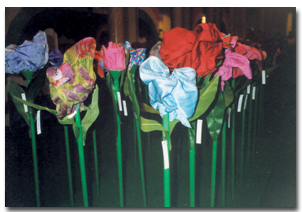
The Turkish Fashion Fabric Exhibition presented fabrics from 49 companies.

At Altinyildiz, linen and linen blends in classic yarn-dyed checks are popular. New finishes
give fabrics a silk touch. Bottomweight twills dyed in metallic colors and washed were pointed out
at Dynamo. Linen/cotton canvas, multicolored striped shirtings and slightly crinkled surfaces are
other fabrics of note.

At Btd, New York City-based agent Francesca DeVito said summer bottom- and suitweight fabrics
are among its current best sellers. She pointed out stretch polyester/ viscose/spandex twills in
solids, classic checks and suiting stripes; and for casualwear, she showed a sateen of 97-percent
cotton and 3-percent spandex.

Linen fabrics have a crisp hand or are enzyme-treated for a velvet touch. “Our fabrics have an
Italian feel at lower prices,” she said. At Yunsa, color and texture are emphasized. Crepe weaves,
dobbies, linen/viscose, cotton/viscose and washable wool/polyester/Lycra suiting fabrics are
popular. Knitted fabrics at Sucuka are ultra-soft. There are sheer flocked nets, lacy knits,
metallic prints and crinkles. Nylon with a cotton touch and nylon/Lycra blends are selling to the
lingerie market.

Kokteyl has cotton/bamboo/spandex knits that are going into sportswear. Organic cotton with
moisture-transport properties, silky-touch Tencel/spandex and viscose with silk nubs are other new
items. Popular prints at Confetti Fabrics include African and South Sea Island motifs. Base cloths
include cloques, burn-outs, and matte/sheen stripes and jacquards.


Innovation Asia

Basic yarns, fabrics and garments at good prices attracted buyers to Innovation Asia, a showcase
of products containing Tencel and Modal. Of special interest was a new compact spinning process
called Ecosil developed by Korea-based Samil Spinning Co. Ltd. Fine, smooth yarns that are less
hairy than ring-spun or open-end yarns are produced. The price is the same as that of ring-spun
yarns. Ecosil is being used for knitted and woven fabrics for apparel and the home.

Nam Kwang Textile Co. Ltd., Korea, is using Ecosil yarns for knitted fabrics. Especially popular
are stripes that have been washed for a vintage look.

Mozartex Co. Ltd., China, is selling Tencel/cotton with a soft touch to Dockers for pants. There
are Tencel/polyester/cotton fabrics with water-repellent finishes that last through 30 washings,
embossed fabrics that have the look of jacquards, embroidered shirtings, yarn dyes and pigment
prints.

Willgold Industrial Co. Ltd., Taiwan, reports dobbies, jacquards, yarn-dyed stripes and prints
that have been enzyme-washed for a peach-skin hand are of interest. They are knitted and woven with
Tencel or Modal blended with cotton, linen, nylon or polyester.


Upstairs/Downstairs For Print and Pattern

Direction and Printsource, two shows that specialize in surface design, are held at the same
time and at the same location. Printsource is held in the Hotel Pennsylvania Penthouse Pavilion,
while Direction is held at street level in the Penn Plaza Pavilion. Not only do the shows attract
the same buyers, but some of the same exhibitors are at both shows. Tom Cody Design, which has
locations in New York City and London, and New York City-based Splash Ltd. showed sophisticated
designs for womenswear downstairs; fabrics for juniors and childrenswear were shown upstairs.

Tom Cody’s upstairs look was whimsical, with bold stripes and borders in rainbow colors and
carnival-inspired prints in sorbet colors. Downstairs, there were gypsy bohemian looks in earthy
shades and sheer romantic patterns for tops. Prints and embellishments often are combined. All were
shown on fabrics shaped to suggest a finished garment. Cody’s customers run the gamut, from fabric
converters to garment manufacturers and retailers. His best seller is a newly styled paisley. The
emphasis at Splash was on global ethnics, with prints shown on batik and ikat grounds. They are
selling to all markets, including boys, swimwear and sleepwear. Tonal tropicals and placed designs
were pointed out.

Brazil-based Santa Mistura, representing 24 Brazilian designers, was a new exhibitor at
Direction. Print styles for apparel and the home vary from ethnic to abstract to romantic at this
design firm. All are created using Pantone colors.

Ethnic print nationalities run the gamut, from African tribal, South Sea Island tropical and
Japanese ikat to European gypsy, Aztec, Incan and Native American. The newest prints are globally
inspired, combining motifs of many countries. The Colorfield Design Studio and Marilyn Kern Textile
Designs Inc., both based in New York City, showed global ethnic designs. Paisleys at Colorfield
have a gypsy look, while linear and geometric designs have a Bauhaus look, and flowers are small
and detailed or combined with geometrics. At Marilyn Kern, flowers are botanical or small in
scale.


Scottish Cashmere: Maintaining Quality

The Scottish Cashmere Club recently embarked on a brand campaign, Truth in Cashmere, to alert
the textile, fashion and retail industries that there are differences among cashmere products.
“Cashmere isn’t just cashmere,” said Graeme Sands, consulting project manager and spokesman for the
club. “A product with the Cashmere Made in Scotland hang tag is manufactured in Scotland to the
highest level of workmanship.” Membership in the club is limited to Scotland-based yarn spinners,
weavers and knitters that conform to the strictest standards of fiber, yarn and manufacturing
quality. Yarns must be 100-percent cashmere spun in Europe. Fibers must be Chinese or Mongolian in
origin, and must be a minimum of 34 millimeters in length and have a maximum thickness of 16.5
microns. Products are tested, starting with the fiber and continuing through every stage to the
finished product, whether yarn, apparel, accessories or home furnishings. There are multiple tests
to ensure that Cashmere Made in Scotland fully lives up to its reputation as the highest-quality
cashmere in the world. Yarn-spinner members of the club are Todd and Duncan and Z. Hinchliffe and
Sons Ltd. Weavers include Begg Scotland, Johnstons and Lochcarron of Scotland. Others involved with
knitwear and accessories are Ballantyne Cashmere, Hawick Cashmere Co., John Laing of Hawick Ltd.,
Murray Allan Cashmere, Peter Scott and Co. Ltd., Scottand Charters (Havick) Ltd. and William Lockie
and Co. Ltd.

Johnstons, a member of the Scottish Cashmere Club, produces cashmere knitwear.

Members have invested in the latest state-of-the-art technologies. Forget the stodgy reputation
frequently associated with Scottish woolens. Colors, weaves, patterns and textures going into
Scottish cashmere products are versatile and fashionable. Members are creating new concepts each
season and working with customers through the supply chain to deliver quality products that have a
luxurious look; soft, sensual touch; and a high level of performance.

“Washing Scottish cashmere improves its bloom,” Sands said. “Properly handled, there is less
pilling and greater durability. We want the trade and consumer alike to be aware of the difference.
Cashmere with our Cashmere Made in Scotland hang tag lives up to its reputation for integrity in
fashion and quality.”

All branded product must be sold as first-line merchandise; discounts should never be
applied.

Cashmere quality control also is an issue in the United States. Commenting on quality control at
the retail level in the United States, Karl Spilhaus, president, Cashmere and Camel Hair
Manufacturers Institute (CCMI), Boston, mentioned that one of the functions of CCMI is to test
products purchased at retail to verify fiber content and performance that is listed on hang tags
and labels. “You’d be surprised at how many major and prestigious retailers have mislabeled
merchandise, and how many times we have sued them,” he said.


March 2005

Industry Seeks Relief From Chinese Imports

Textile and apparel trade data for January – the first month after removal of import quotas –
show a major surge in Chinese imports, triggering calls from textile manufacturer for the US
government to act immediately on a process that could result in new import quotas on Chinese
imports. Industry and labor representatives in Washington called on administration trade officials
to self initiate the so-called safeguard mechanism provided for in the Chinese Word Trade
Organization (WTO) agreement. Industry representatives and the labor union UNITE HERE have filed a
number of petitions asking for safeguard quotas based on market disruption or a threat of market
disruption. The threat approach currently is being blocked by court action in a case filed by the
United States Association of Importer of Textiles and Apparel (USAITA) .The January data show a
47-percent increase in Chinese imports in January including an increases of 1,000 percent in cotton
trousers. Other major increases were recorded in men’s, women’s, boys and girls cotton shirts and
several other categories of trousers and underwear. The data show that China has a 35-percent share
of the US import market for textiles and a 22-percent share for apparel. The overall market share
of 29-percent is the highest of any single country in history. Somewhat surprisingly, imports from
Hong Kong, Macao and Taiwan were down about 25 percent, a development that industry trade officials
say is a reflection of China’s cutting back on transshipments through those countries. Caribbean
Basin Initiative countries showed a 16-percent increase in what could be a reflection of importers
looking to nearby countries for more of their sourcing. Industry officials say that because
Januarys import numbers contain a significant amount of goods shipped from China while China was
still under quota restraints the figures are only a portent of what is to come.

As the data were released, Bruce Raynor, president of UNITE HERE, issued a statement at a
Washington news conference: Quotas have expired, imports from China are soaring, and nearly 10,000
apparel and textile workers have lost their jobs in the first 60 days of 2005. These job losses
highlight the immediate need to implement the China safeguard. The US government has the power to
act and it must do so immediately.

Claiming the Chinese import surge is just the tip of the iceberg, Auggie Tantillo, executive
director of the American Manufacturing Trade Action Coalition, said: “If history is any indication,
Chinese imports will continue to soar until they gain a virtual monopoly of the US, market. If the
US government fails to act immediately to implement the WTO safeguard, it will be an act of
reckless disregard of the available evidence, costing hundreds of thousands of US jobs as a
consequence.”

US government trade officials expressed their concern over the import surge and indicated they
are looking at ways to limit imports from China. Actions could range from negotiated quotas to
imposition of unilateral quotas under the safeguard provisions.

Reacting to the data, USITA said, “There is no current basis for safeguard measures whether self
initiated or by request of the U.S. industry.”


March 1, 2005

Sponsors