
NCTO Leaders Discuss State Of Textile Industry


L
eaders of the National Council of Textile Organizations (NCTO), at its annual meeting
held recently in Washington, took a look at the state of the industry and where it is likely to be
headed in the near future. Despite some positive developments, there also are difficult times
ahead. On the plus side are signs Congress and the Obama administration seem more inclined than
Congresses and administrations in recent years to address some industry issues, particularly in the
area of international trade. But on the other hand, the worldwide recession, a chronic trade
deficit and a global oversupply of production present daunting challenges.

In an overview of industry conditions, NCTO Chairman Anderson Warlick, Parkdale Mills Inc.,
cited significant accomplishments during the past year, but he warned the industry must step up its
efforts to have a greater impact on issues being addressed in Washington. Warlick said that while
the industry faces a variety of issues, “the greatest threat is apathy,” and he challenged every
CEO in the industry to become more involved in Washington-related issues and make it a part of
their daily jobs. He cited increased funding for the NCTO political action committee, “Hill to
Mill” visits by members of Congress to manufacturing facilities and contacts executives made with
their representatives in Washington as key elements in some of the successes the industry enjoyed
in the past year.
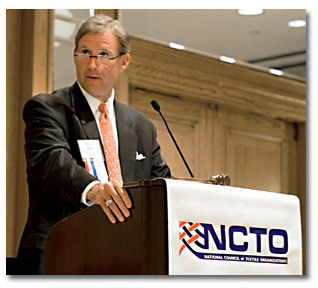
NCTOWarlick

NCTO outgoing Chairman Anderson Warlick said

the textile industry must broaden its political reach

if it hopes to influence government decisions

impacting the industry. He called on

industry CEOs to join with NCTO in an

effort to become more politically active.


Major Accomplishments Seen


NCTO cited a number of successful efforts during the past year, including a reinvestment
program for cotton textile products that could provide US textile mills with as much as $75 million
annually for capital investments. Under the program, mills may receive 4 cents per pound of
eligible cotton used and must use the funds to invest in updating plants and equipment. The program
is seen as a key element in making the industry more competitive.

Another major accomplishment was getting a letter from President Barack Obama saying he is
“especially aware of the trade challenges faced by those working in our textile industries.” Obama
gave his support for a textile import monitoring program to pin down problem areas and said he
would use the monitoring system to ensure that imports from China do not violate applicable laws
and treaties.  He endorsed the idea of Buy American requirements for textile purchases by the
Department of Defense (DoD) and other agencies, and he also supported a yarn-forward provision in
free trade agreements to ensure that those special trade agreements do not become conduits for yarn
and fabric sources outside of the participating countries.


Also in the past year, and continuing into this year, NCTO developed a strategy to deal with
problems arising from the elimination of Chinese safeguard import quotas including a statistical
monitoring program and consideration of trade remedy actions under US anti-dumping and
countervailing duty laws. It also is looking for violations of World Trade Organization (WTO)
rules. The industry succeeded in getting Congress to extend for two years a trade agreement with
Colombia, Peru and Ecuador that grants duty-free access to the US market for apparel made from US
yarn and fabrics. In order to combat illegal textile and apparel imports, Congress funded $9
million specifically for textile customs enforcement. And after years of failed efforts, the
industry and its supporters in Congress got the DoD Buy American textile and apparel procurement
requirement expanded to include agencies of the Department of Homeland Security.

Despite these and other accomplishments, NCTO sees some major problems on the horizon.


Global Trade Outlook


At the meeting’s opening session, Robert Antoshak, president of FCStone Fibers and Textiles,
a global consulting firm that keeps a close watch on textile trade developments, outlined a number
of major challenges the US textile industry faces in today’s global economy. He predicted major
changes in textile trade as nations cope with the combination of the global recession and
overcapacity not only in manufacturing, but also with retailers. He warned that prices are being
squeezed downward and there is little room to pass on rising costs. The key to success, and even
survival, Antoshak believes, lies in a textile company’s ability to make high-value products and
manage the risks in today’s changing business climate. That, he says, will require four basic
elements: doing a better job of managing costs; placing more emphasis on technology; developing new
products; and using better marketing techniques. He predicted the next year and beyond will see
more volatility in textile trade, with many risks, but he believes those companies that attempt to
understand those risks and have plans to address them will survive.
NCTOtable


Ambitious Trade Agenda


Looking ahead, NCTO leaders have an ambitious trade agenda as they seek ways to cope with a
persistent trade deficit, continuing job losses and what they believe are unfair trade practices
running rampant throughout the world, particularly in China. They see a need to find ways to combat
unfair trade practices and open more overseas markets to US goods through bilateral and regional
trade agreements, and they will be making efforts to remove barriers that make it difficult if not
impossible for US exports to enter a number of markets. High on the agenda is an effort to do
something about Chinese currency manipulation, which they believe is an illegal subsidy that gives
China an unfair advantage in international trade. NCTO has joined with other affected industries
and labor unions in a broadly-based Fair Currency Coalition that has launched a renewed effort to
support legislation pending in Congress that would declare currency manipulation an unfair trade
practice and provide for greater use of US anti-dumping and countervailing duty laws to offset that
trade advantage. Although similar anti-currency-manipulation legislation died in the last Congress,
it appears to be gaining more bipartisan support in the current Congress. NCTO also strongly
supports textile import monitoring programs conducted by two government agencies and designed to
pinpoint problems with import surges and illegally subsidized imports. These efforts could result
in impositions of tariffs and/or quotas.

In addition to addressing the currency issue, NCTO will launch major efforts under three new
initiatives during the coming year. It has joined with other import-impacted industries to support
legislation that would address a long-standing problem with value-added tax programs used by many
US trading partners. It also supports legislation that would permit duty-free treatment for
finished apparel imports that use US-made yarn and fabric, and it is considering filing cases with
the US International Trade Commission seeking relief from import surges from China in a number of
product categories in which safeguard quotas were removed at the beginning of this year.

NCTO also is keeping a wary eye on efforts to restart the WTO’s deadlocked Doha Round of
trade liberalization talks, as textile manufacturers have problems with some proposals currently on
the negotiating table.

July/August 2009

Avery Dennison Debuts Universal Track And Trace Labeling Solution

Pasadena, Calif.-based Avery Dennison Corp. has introduced a labeling solution enabling
manufacturers to fulfill US Consumer Product Safety Improvement Act (CPSIA) tracking requirements
and manage tracking data online.

The Universal Track and Trace solution comprises Avery Dennison printers, tag and label
design software, and the D2Comm™ online data management tool. The user prints a contractor label
containing a unique alphanumeric identifier, or serial number, then connects to the D2Comm website,
which captures and stores the label data in a table for viewing and tracking.

“Universal Track and Trace requires no custom programming,” said Michael Dancausse, product
manager, in-plant printing solutions, Avery Dennison. “It allows users to print and capture
specific label data that is mandated by CPSIA, and then add a unique serial number on the label
that ties it to additional product data.”

CPSIA’s regulations – which went into effect Aug. 14, 2009, and facilitate recalls of unsafe
children’s products – require a product to have a permanently applied label containing its
manufacturer’s name as well as production location, date, and batch or lot number.

Label designers wishing to save a fabric lot’s purchase order number that is not printed on
the label may use Universal Track and Trace to capture the information. The solution then uses the
serial number to match it with a bundle, cut order or specific garment. That number also allows a
factory to retrieve data about a specific component in a fabric lot, so if there is a recall, the
garment’s fabric supplier can be identified.

August 25, 2009

Birdair To Build World’s Second Tensotherm™ With Nanogel® Roofing System

Buffalo, N.Y.-based Birdair Inc. – a specialty contractor for lightweight, long-span roofing
systems and custom tensile architecture applications – has been chosen as the roofing subcontractor
for the Talisman Centre for Sport and Wellness in Calgary, Alberta, Canada. The company will
install a Tensotherm™ with Nanogel® roofing system as a replacement for the athletic facility’s
original 162,000-square-foot fabric roof.

Birdair developed Tensotherm in partnership with Boston-based Cabot Corp. and Suffern,
N.Y.-based Geiger Engineers. The translucent composite – having a thickness of less than 2 inches
and a R-12 insulation value – comprises a Nanogel aerogel layer sandwiched between two layers of
structural polytetrafluoroethylene fabric. Tensotherm allows high natural light transmission that
results in energy-efficient, glare-free daylighting. The system also controls moisture and reduces
sound.

The new roof will match the aesthetics of the Talisman Centre’s current roof, but will offer
five times as much insulation value and also will solve condensation problems, according to
Birdair. This is the second Tensotherm with Nanogel roofing system to be installed worldwide. 

August 25, 2009

Gerber Technology Debuts Gerberconnect Solution

Gerber Technology – a Tolland, Conn.-based supplier of integrated software and hardware automation
systems for sewn products and flexible materials applications, and a business unit of South
Windsor, Conn.-based Gerber Scientific Inc. – has introduced its Gerberconnect remote service
solution for real-time system diagnostics. When a customer’s Gerber system senses a possible error,
the equipment can “call home,” and Gerber Service Professionals will access the system remotely and
securely to perform fault detection and troubleshooting.

“Gerberconnect will allow us to support our customers with a more proactive and predictive
approach,” said Mark Hessinger, executive director, Gerber Worldwide Customer Service. “Our field
service team supports a very large and globally dispersed customer base. Gerberconnect will allow
us to extend the reach and expertise of our technicians to manufacturing facilities across the
globe, providing faster and more accurate resolution to product issues.”

Gerber will first launch the solution to customers using Gerbercutter XLc7000 and Z7
automated cutting machines, and is planning further rollouts for use with the company’s hardware
and software product line.


August 25, 2009

TMC Offers Certified And Traceable Non-Mulesed Merino

The Merino Co. (TMC), Australia – a global provider of vertically integrated merino wool fiber
solutions for retail and brand partners – has introduced the first certified and traceable
non-mulesed merino (n.m.m.) wool brand platform. The platform guarantees that n.m.m. wool is
sourced from growers who have never practiced or have quit the practice of mulesing, an invasive
and reportedly painful procedure performed on merino sheep to prevent insect infestations and which
has become a subject of public debate concerning humane sheep-raising practices.

“We don’t accept any forms of mulesing under the n.m.m. brand, including clips, tail
stripping, or surgical mulesing,” said William Lempriere, CEO, TMC. “Our n.m.m. wool brand
customers are committing to an animal welfare standard, indicating to consumers that they will be
receiving a product that is animal friendly.”

In order to qualify for the brand, merino wool must have legal documentation from the
relevant body or woolgrower that it is non-mulesed, which must be verified by a third-party
organization. TMC then confirms the n.m.m. wool is processed separately and the integrity of the
batches is not compromised during processing. The company also offers customized Web-based
traceability programs to its customers.

August 25, 2009

Select Comfort Offers In Balance™ Sheets With Outlast® Technology

Boulder, Colo.-based Outlast Technologies Inc., developer of Outlast® temperature-regulating
technology and phase-change materials (PCMs) and applications, has announced that Minneapolis-based
Select Comfort Corp. has added a sheet set and lightweight blanket to its line of In Balance™ sleep
products featuring Outlast technology. Select Comfort’s Outlast Sleep System also includes Sleep
Number® mattresses, mattress pads and layers, and pillow protectors.

Outlast technology features microencapsulated Thermocules™ that absorb excess body heat,
store it and then release it when the body is cold, thereby balancing a sleeper’s skin temperature,
according to Outlast. The company reports the Outlast Sleep System of bedding products provides
optimal sleep for everyone from normal sleepers to thermally incompatible couples and women
experiencing menopause.

The 350-thread-count, machine-washable In Balance sheets and pillowcases are made using a
50-percent cotton/50-percent Outlast Viscose fiber blend.

August 25, 2009

Madura Garments Implements Lawson PLM Solution

India-based apparel company Madura Garments recently implemented St. Paul, Minn.-based Lawson
Software’s Lawson Fashion Product Lifecycle Management (PLM) solution, a Web-based suite of
applications used to help manage products from design through production. Madura chose Lawson’s
solution to help streamline its business and product development processes.

According to Lawson, the solution allows information to be more clearly communicated across
the supply chain and for Madura to work on product development activities simultaneously, reducing
time-to-market. Before implementing the PLM solution, Madura tracked technical specifications
manually; now, the company maintains key data on a central server. Madura also can search for
product information from previous collections and seasons.

“We are already experiencing the benefits of implementing Lawson Fashion PLM,” said Natwarlal
Bhattad, group manager product development, Madura Garments. “It has allowed us not only to capture
fabric information from the mill, but also saves two to three weeks in the fabric sample request
process.”

August 25, 2009

Delta Galil USA Selects AL Systems’ Software Solution

Secaucus, N.J.-based Delta Galil USA – a subsidiary of Israel-based Delta Galil Industries Ltd., a
global manufacturer of apparel sold under brands such as Calvin Klein, Hugo Boss and Nike – has
chosen Rockaway, N.J.-based AL Systems Inc.’s integrated supply chain software solution to help
lower its distribution costs.

AL Systems will install an automated conveyor system featuring its Warehouse Control System
(WCS) and DynaPick pick-to-light system at Delta Galil’s distribution center. Delta Galil expects
that implementing the software solution will result in an eight-month return on investment and will
increase order accuracy to approximately 99.9 percent. According to AL Systems, its solution will
enable Delta Galil to improve service to its major retailers while reducing labor requirements.

August 25, 2009

BASF Announces Price Increases

Effective September 1, or as contracts allow, Florham Park, N.J.-based BASF Corp. will implement a
price increase of 6 cents per wet pound in the United States and Canada on all Acronal® and Acronal
Optive® all-acrylic latex products; Acronal styrene-acrylic latex products; and Basonal®
multi-monomer latex products used in fiber bonding, adhesives, paper and construction and
architectural coating markets. The company cited inflation of propylene, styrene and acrylic
monomer costs in announcing the price increase.

August 25, 2009

Talbots Enters Sourcing Agreement With Li & Fung

The Talbots Inc. – a Hingham, Mass.-based retailer of women’s apparel and accessories – has entered
into an agreement with Hong Kong-based Li & Fung Ltd. – a brand and retail supply chain manager
– in which Li & Fung will be the exclusive global apparel sourcing agent for the Talbots brand,
effective September 2009. Li & Fung will be the exclusive agent for nearly all of Talbots’
apparel products, and a non-exclusive agent for swimwear, intimate apparel, footwear, jewelry,
handbags and accessories.

“By leveraging Li & Fung’s position as a best-in-class sourcing agent, we will be able
to simplify and centralize our sourcing activities, which we anticipate will further reduce our
costs of goods sold and internal operating expenses, while improving our time to market,” said
Trudy F. Sullivan, president and CEO, Talbots. “Together with Li & Fung, we plan to develop a
single, world-class supply chain organization that will strengthen our competitive position.”

“Under Talbots new leadership, we see great potential for their business going forward,”
said Bruce Rockowitz, president, Li & Fung (Trading) Ltd. “With our strong network of over 80
offices in over 40 economies, we are confident that our dedicated merchandising team will be able
to further strengthen the positioning of the Talbots brand as we deliver the highest quality
products.”

August 25, 2009

Sponsors


