Wrangler® Introduces Women’s Workwear Line, Addressing Increasing Demand For Fashionable & Functional Women’s Workwear Options 

GREENSBORO, N.C. — March 9, 2020 — The Wrangler® brand, a global icon in jeanswear and casual apparel, today announced the expansion of its Wrangler RIGGS Workwear® line to include apparel specifically designed for women. Recognizing an industry need for inclusive apparel on the jobsite, Wrangler is introducing a new line of workwear built off the brand’s successful workwear apparel line, while addressing common issues women face when looking for the perfect fit for their on-the-job needs.

“With our Wrangler RIGGS Workwear line, we have been outfitting jobsites for more than fifteen years,” said Jenni Broyles, vice president and general manager, Wrangler North America. “Today, we are proud to offer a collection that provides the exceptional fit that female consumers know and love from Wrangler, while meeting the functional and performance benefits found in all Wrangler RIGGS Workwear apparel. The women’s Wrangler RIGGS Workwear line is designed to be as strong and protective as the woman who wears it, leaving her feeling empowered, confident and comfortable without compromising her style on the job.”

Built to Help Women Tackle Any Job

The Wrangler RIGGS Workwear for Women collection enhances the brand’s existing female fits in both tops and bottoms by combining the comfort and durability needed to get any job done with confidence. Unique workwear-essential styling such as Room2Move® comfort, reinforced pockets and stitching, and moisture-wicking fabric ensure unparalleled comfort and function on and off the job.

Products available in the Wrangler RIGGS Workwear for Women collection include:

  • Women’s Wrangler RIGGS Workwear pants and jeans – based off the best-selling Wrangler Retro® Mae – featuring Room2Move comfort, a four-way stretch technology that allows for enhanced freedom of movement. Pants and jeans are available in multiple washes of stretch denim, or multiple colorways of stretch canvas, all offering tough, durable construction. Added durability benefits include reinforced back pockets and a patented reinforcement on the front pocket of the jeans.
  • Women’s Wrangler RIGGS Workwear shirts, performance T-shirts, Henley shirts and work jackets are built for adaptability on the jobsite. The tops boast consumer-driven performance benefits like moisture-wicking and stretch fabric for comfort, gusset details for range of motion, and reinforced stitching for longevity. Thoughtful utility features such as chest and sleeve pockets offer added functionality.

Wrangler RIGGS Workwear for Women is available now online and in select specialty retailers, offering inclusive sizing from sizes 0 to 20 and XS to 3XL. Price points range from $29-$49 and all products come with a limited lifetime warranty.

Posted March 9, 2020

Source: Wrangler®, a Kontoor Brands brand

Sinopec Puts Its First Meltblown Nonwoven Fabric Line Into Production

Sinopec to build a meltblown nonwoven fabric plant in 12 days

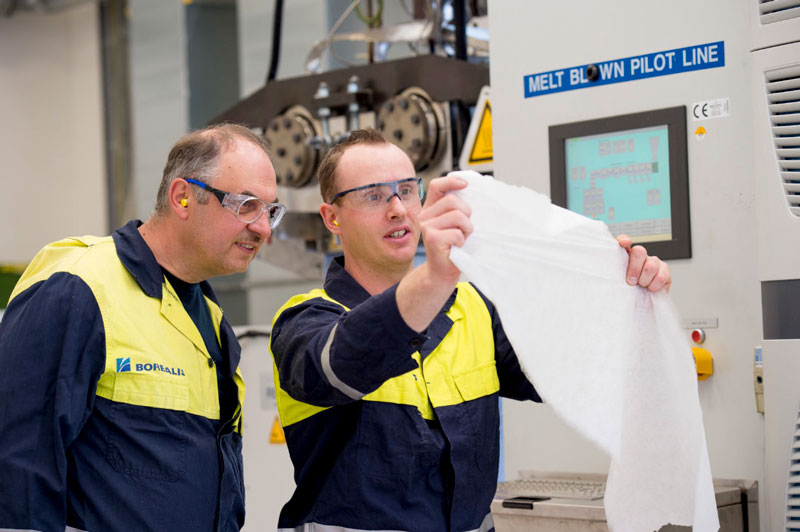
BEIJING — March 8, 2020 — Forty-eight hours ahead of schedule, Sinopec Corp., a energy and chemical company, put its first melt-blown nonwoven fabric assembly line into operation at its Yanshan factory in Beijing on March 6. The Yanshan factory is a converted 3,600-square-meter warehouse that has found new life as a global production base following the challenges brought by the coronavirus outbreak.

The 14,400-ton capacity Yanshan facility is one of Sinopec’s two melt-blown nonwoven fabric assembly bases and is co-managed with China National Machinery Industry Corp. The base has two non-woven production lines and three spunbond production lines and can produce up to 4 tons of melt-blown fabric for 1.2 million N95 disposable masks or 6 tons for 6 million disposable masks per day.

The new facility also takes advantage of Sinopec’s integrated upstream supply-chain by sourcing local materials from Yanshan and support from the on-site synthetic resin production line.

“It normally takes about half a year to complete the construction of a 10,000-ton melt-blown fabric factory — we have done it in 12 days, 48 hours ahead of schedule. In a challenging time like this, saving 48 hours means that we can produce an extra 12 million disposable masks,” said Lv Dapeng, spokesperson of Sinopec Corp.

The largest medical material supplier in China, Sinopec is a significant supplier of polypropylene, a key component in the production of disposable masks for medical use. The new assembly line will ensure a stable supply of medical supplies, such as masks and clothing, can be distributed across the nation and worldwide.

“We are privileged to support those who are protecting us from the virus. Sinopec will utilize all of our resources to ensure supplies to the frontline are guaranteed,” said Lv.

Sinopec’s other eight melt-blown non-woven fabric production lines in Yizheng, Jiangsu are currently under construction and are expected to enter operation by mid-April.

Posted March 9, 2020

Source: Sinopec Corp.

The National Retail Federation: Coronavirus Impact On Imports Expected To Be Larger And Last Longer Than Previously Expected

WASHINGTON — March 9, 2020 — The coronavirus outbreak is expected to have a longer and larger impact on imports at major U.S. retail container ports than previously believed as factory shutdowns and travel restrictions in China continue to affect production, according to the Global Port Tracker report released today by the National Retail Federation and Hackett Associates.

“There are still a lot of unknowns to fully determine the impact of the coronavirus on the supply chain,” NRF Vice President for Supply Chain and Customs Policy Jonathan Gold said. “As factories in China continue to come back online, products are now flowing again. But there are still issues affecting cargo movement, including the availability of truck drivers to move cargo to Chinese ports. Retailers are working with both their suppliers and transportation providers to find paths forward to minimize disruption.”

“Now that we are in the coronavirus environment, uncertainty has expanded exponentially,” Hackett Associates Founder Ben Hackett said. “Our projections are based on the optimistic view that by the end of March or early April some sort of normalcy will have returned to trade.”

This month’s report comes as a separate NRF survey of members found 40 percent of respondents said they are seeing disruptions to their supply chains from the virus and that another 26 percent expect to see disruptions as the situation continues.

U.S. ports covered by Global Port Tracker handled 1.82 million Twenty-Foot Equivalent Units in January, the latest month for which after-the-fact numbers are available. That was up 5.7 percent from December but down 3.8 percent from unusually high numbers a year ago related to U.S. tariffs on goods from China. A TEU is one 20-foot-long cargo container or its equivalent.

February was estimated at 1.42 million TEU, slightly above the 1.41 million TEU expected a month ago but down 12.6 percent from last year and significantly lower than the 1.54 million TEU forecast before the coronavirus began to have an effect on imports. March is forecast at 1.32 million TEU, down 18.3 percent from last year and less than the 1.46 million TEU expected last month or the 1.7 million TEU forecast before the virus.

April, which had not previously been expected to be affected, is now forecast at 1.68 million TEU, down 3.5 percent from last year and lower than the 1.82 million TEU forecast last month.

While the coronavirus makes forecasting difficult, the report calls for imports to jump to 2.02 million TEU in May, a 9.3 percent increase year-over-year, on the assumption that Chinese factories will have resumed most production by then and will be trying to make up for lower volume earlier. June is forecast at 1.97 million TEU, up 9.6 percent year-over-year, and July is forecast at 2.03 million TEU, up 3.3 percent year-over-year.

Imports during 2019 totaled 21.6 million TEU, a 0.8 percent decrease from 2018 amid the ongoing trade war but still the second-highest year on record. The first half of 2020 is forecast to total 10.23 million TEU, down 2.8 percent from the same period last year and below the 10.47 million TEU forecast a month ago.

Global Port Tracker, which is produced for NRF by the consulting firm Hackett Associates, provides historical data and forecasts for the U.S. ports of Los Angeles/Long Beach, Oakland, Seattle and Tacoma on the West Coast; New York/New Jersey, Port of Virginia, Charleston, Savannah, Port Everglades, Miami and Jacksonville on the East Coast, and Houston on the Gulf Coast.

Posted March 9, 2020

Source: The National Retail Federation (NRF)

Monforts Advanced Technology Centre (ATC): Adventures In Aquaculture

A modern seawater fish farm off the coast of Slovenia.

MÖNCHENGLADBACH, Germany — March 9, 2020 — Monforts has recently been involved in a number of R&D trials aimed at improving the performance of the fishing cage nets employed in fish farming operations at its Advanced Technology Centre (ATC) in Mönchengladbach, Germany.

The cultivation of both freshwater and saltwater fish populations under controlled conditions is a global industry valued at around $200 billion annually and only made possible with the use of huge aquaculture nets.

Monforts Head of Technical Textiles Jürgen Hanel (left) with ATC manager Fred Vohsdal, who has now worked for the company for 51 years and has a wealth of accumulated know-how to share with customers.

Biofouling

“These nets are very prone to biofouling and to avoid its negative impacts, high-pressure robotic jets are now used to clean them,” explained Monforts Head of Technical Textiles Jürgen Hanel. “Net cleaning is expensive and can also damage current antifouling coatings on the nets, causing contamination as well as fish health and welfare risks.

“The abrasion resistance of the nets is also extremely important, because in addition to the general wear and tear of the underwater environment, they also contain a lot of potential food for predatory bigger fish, such as sharks. Even sea lions have been known to be attracted to these fish farming cages, but have the advantage of being able to jump over the top of them if they’re not sufficiently protected.”

The development of more effective antifouling coatings for fishing cage nets has been one aspect of R&D work at the Monforts ATC, while the use of how alternative fibres could potentially be coated or finished to replace the polyamide which is currently most widely used has also been explored.

The issue of plastics and synthetic fibres in the oceans has generated global media attention recently, and the aquaculture industry is exploring all avenues that will lead to more sustainable practices.

Diverse applications

“We are asked to investigate a wide range of fabric finishes and coatings at the ATC, where our customers can test their own textiles and technical fabrics on Monforts dyeing, finishing and coating machines under fully confidential, real production conditions,” Hanel said.

“The range of textiles finished or coated with Monforts technologies is already extremely diverse, including standard knits and wovens, as well as advanced denim. When it comes to technical textiles, our lines are already being used commercially for treating substrates for digitally-printed soft signage, carbon fabrics for composites, filter media which must perform in extreme temperatures and flame retardant barrier fabrics, to name just four applications, but the list gets longer all the time.”

More than 3 million euros have been invested in industrial-scale equipment at the Monforts Advanced Technology Centre (ATC) in Mönchengladbach, Germany.

Expansions

Since its opening in 2013, over 3 million euros has been invested in equipment at the Monforts ATC, which over an area of 1,200 square meters houses two full finishing lines, engineered to accommodate an extremely diverse range of processes, in addition to a Thermex range for the continuous dyeing of denim.

Recent expansions have included the installation of the latest Monforts texCoat coating system, with its multi-head capability, and the CYD yarn dyeing system for denim, both of which received an enthusiastic reception at last year’s ITMA show in Barcelona.

“We have subsequently demonstrated the potential of these new technologies to many customers during their visits to the ATC, in addition to running full trial programmes on our industrial-scale machines,” Hanel concluded. “The intended end-uses may not always be as unusual as fishing cage nets, but whatever the application, trials in real production conditions yield the results that enable us to make many recommendations for improving fabric finishes and coatings.”

Posted March 9, 2020

Source: A. Monforts Textilmaschinen GmbH & Co. KG

INX International Becomes First North American Ink Company To Achieve ISO 45001 Certification

SCHAUMBURG, Ill. — March 9, 2020 —  INX International Ink Co.’s North American ISO Certified facilities have been recognized with certification for the ISO 45001 Occupational Health & Safety Standard. As the first ink company in North America to do so, INX certified locations are now registered to three integrated standards: ISO 9001 and ISO 14001, as well as the new ISO 45001.

ISO 45001 is the world’s international standard for occupational health and safety, issued to protect employees and visitors from work-related accidents and diseases. According to many health and safety experts, it represents a landmark breakthrough. For the first time, businesses of all sizes can access a single framework that offers a clear pathway to developing better and more robust occupational health and safety measures.

ISO 45001 is regarded as a new standard and not as a simple revision or update of OHSAS 18001. The transition from that standard to ISO 45001 was mandatory as the International Standards Organization fully implemented ISO 45001. The transition to it by INX was seamless.

“We are very pleased to receive our official certificate for this standard,” said Rachel Glowacki, director of Quality Systems for INX International Ink Co. “The new standard, along with ISO 9001 and 14001, allowed us to complete the transition goal we strived for in 2019 and gives us an integrated Business Management System. A lot of hard work, long hours, and many lengthy discussions and internal audits by multiple groups and personnel were devoted to this project. I appreciate the support everyone provided to make this happen.”

Audits were conducted at INX’s manufacturing facility in Appleton, Wis., and at four locations in Illinois. This included the R&D Center and manufacturing facility in West Chicago, another manufacturing plant in Homewood, and corporate headquarters, including HR, MIS and the Customer Service Center, in Schaumburg.

Posted March 9, 2020

Source: INX International Ink Co.

UniFirst Corp. Continues Hygienically Clean Food Safety Certification Commitment

ALEXANDRIA, Va. — March 6, 2020 — UniFirst Corp.’s Dorchester, Mass., laundry has recently qualified to renew its Hygienically Clean Food Safety certification. This accomplishment reflects UniFirst’s commitment to best management practices (BMPs) in laundering as verified by on-site inspection and its capability to produce hygienically clean textiles as quantified by ongoing microbial testing. UniFirst currently has 55 laundries that hold this certification; their locations are (one in each state except where noted): Ariz.; Calif. (four); Colo.; Conn.; Fla. (three); Ga. (two); Ill.; Kan. (two); La.; Mass. (two); Md. (two); Maine (two); Miss.; Mo.; N.C. (four); N.H. (two); N.J.; Nev.; N.Y. (two); Ohio; Okla.; Ore.; Pa. (two); S.C. (two); Texas (seven); Utah; Va.; Wash.; and Wis. Canadian provinces represented are Alberta (two) and British Columbia.

The Hygienically Clean Food Safety certification confirms the laundry’s dedication to compliance and processing garments and linens using BMPs as described in its quality assurance documentation, the focal point for inspectors’ evaluation of critical control points (CCPs) that minimize risk. The independent, third-party inspection must confirm essential evidence that:

  • Employees are properly trained and protected;
  • Managers understand legal requirements;
  • OSHA-compliant; and
  • Physical plant operates effectively.

To maintain their certification, laundry plants must pass quarterly testing of outcome-based microbial testing, indicating that their processes are producing Hygienically Clean garments and other reusable textiles with diminished presence of harmful bacteria. Testing ensures that as laundry conditions change, such as water quality, textile fabric composition and wash chemistry, laundered product quality is consistently maintained. This process eliminates subjectivity by focusing on outcomes and results that verify textiles cleaned in these facilities meet appropriate hygienically clean standards and BMPs for animal processing, dairies, fruit/vegetable, bakeries, grain and other food and beverage industry segments.

Hazard Analysis and Critical Control Points (HACCP) practices are examined in the Hygienically Clean Food Safety inspection process, evaluating the plant’s techniques for:

  • Conducting hazard analysis;
  • Determining CCPs, monitoring their control, correcting them if not under control;
  • Validating and verifying HACCP system effectiveness; and
  • Documenting and record-keeping to show ongoing conformance.

On-site inspections also evaluate practices relevant to handling and processing textile products used in food manufacturing/processing establishments for adherence to U.S. Food and Drug Administration (FDA) and Centers for Disease Control and Prevention (CDC) directives. Introduced in 2014, Hygienically Clean Food Safety brought to North America the international cleanliness standards for laundering garments and other textile products for food manufacturing used worldwide by the Certification Association for Professional Textile Services and the European Committee for Standardization.

“More and more, we’re seeing our customers in food-related industries looking for third-party validation that our specialized Product Protection Process and our Hygienically Clean standards are consistent with HACCP and GFSI guidelines,” said Adam Soreff, director of marketing and communications at UniFirst Corp., Wilmington, Mass. “Working with a Hygienically Clean Food Safety certified laundry helps reassure them that their managed uniform program is working in concert with their own food-safety protocols to help them ensure food safety for consumers.”

Posted March 6, 2020

Source: TRSA

Web Industries Introduces Functional Ink Printing Capability

MARLBOROUGH, Mass. — March 6, 2020 — A new functional ink printing capability for communicating changes in a garment’s or material’s condition is now available from the Personal & Home Care business unit of Web Industries Inc., a precision formatter of flexible materials. The capability enables two- or three-part ink chemistries to be printed on nonwovens, paper, tissue, films, or textiles to signal a change in material condition. It is designed for personal care items including incontinence wear, diapers and feminine hygiene products, but also has potential uses in industrial applications.

Functional ink refers to printed coatings that register a change when exposed to reagents such as moisture. The change could involve fading or becoming a different color, releasing a telltale odor or triggering an increase or decrease in temperature. Web Industries’ Fort Wayne, Ind., printing facility can apply functional ink coatings to a variety of materials on behalf of manufacturing customers.

“Functional ink is all about providing information to product users,” said Business Development Manager Courtney Robinson. “Garments or materials printed with functional ink indicate changes and can prompt corrective actions. Personal care product manufacturers, for example, can employ functional inks to indicate the status of incontinence wear, where the ink will fade or alter color when exposed to moisture, alerting caregivers to change the garment.”

Industrial Applications

Functional ink coatings also have a wide range of industrial uses. “The ability to build chemical or bio-reactive markers directly into personal protective equipment or other product components can provide an added level of awareness and safety for first responders and other users,” Robinson noted. “For instance, a tailored coating could be applied to specific areas of single-use hazmat suits that would change color to indicate the presence of specific levels of a contaminant. By providing passive monitoring during an emergency situation, these ‘sensing areas’ would allow the wearer to focus on their specific task while knowing that their exposure to harmful chemicals or bio-agents was being assessed.

“Another high-potential use is in industrial control systems,” Robinson said. “For instance, an electrically-conductive functional coating could be applied to a substrate that breaks down in the presence of excessive heat. Used as a sensor component, an overheating condition would cause the material to degrade, breaking the electrical connection and signaling the equipment’s PLC/computer.”

Posted March 6, 2020

Source: Web Industries

MaterialDistrict Rotterdam 2020 Has Been Postponed Until June 23-25, 2020

NAARDEN, Netherlands — March 6, 2020 — MaterialDistrict Rotterdam 2020 has been postponed to June 23-25, 2020, the organizer announced today. This decision was made in close consultation with the exhibitors and event partners. Reason to postpone the inspiration event for (interior) architects are the precautionary measures more and more organizations are taking due to the corona virus. “We see a growing trend that organizations prohibit their employees from attending events because of the corona virus. As a result, we cannot guarantee our exhibitors and visitors the quality and experience they are used to,” stated Jeroen van Oostveen, director of MaterialDistrict.

Although the Dutch government has so far imposed no restrictions or additional measures for the continuation of trade shows and events in the Netherlands, the organization has nevertheless decided to postpone the material event to June this year. “In recent days, we have had intensive contact with our exhibitors, there are many concerns about the safety of their staff, but especially about the expected negative effect on the number of visitors. We also see that more and more countries are imposing restrictions on the organization of events; in the Netherlands, we are already seeing the first steps in this regard at a local level. That is an increasing risk for our exhibitors and for us as show organizers as well.”

To provide clarity and certainty to all exhibitors and visitors, it was decided to move MaterialDistrict Rotterdam 2020 to June 23-25, 2020, in Rotterdam Ahoy. The layout of the exhibition floor, the exhibitors involved and the speaker program will be fully transferred to this new date. The exhibitors have since been informed and are happy and understanding about the decision taken. People who have already registered their ticket will be informed and can of course also use their ticket on the new date.

Posted March 6, 2020

Source: MaterialDistrict Rotterdam

FESPA Global Print Expo 2020 Events Postponed

DORKING, England — March 5, 2020 — In light of the rapidly evolving situation regarding COVID-19 in mainland Europe, and in close dialogue with its national Associations and exhibitors, FESPA has today taken the decision to postpone FESPA Global Print Expo 2020, European Sign Expo 2020 and Sportswear Pro 2020, originally scheduled to take place at IFEMA Madrid from March 24-27, 2020.

Based on feedback from exhibitors, FESPA will now seek to reschedule the events for a later date, precise timing and venue still to be determined based on venue availability.

FESPA CEO Neil Felton explained: “Until this week, our actions with regard to COVID-19 — including the pre-emptive action taken in February regarding exhibiting companies from China — have been informed by guidance from the relevant international and national authorities, with the primary objective of safeguarding the health and wellbeing of exhibitors and visitors. However, in light of the recent spread of the virus in specific areas of mainland Europe, we have consulted with our stakeholders and have concluded that it is in the best interests of our community to defer the events to a later date.”

FESPA will provide an update regarding revised event dates in due course.

Founded in 1962, FESPA is a global federation of Associations for the screen printing, digital printing and textile printing community. FESPA’s dual aim is to promote screen printing and digital imaging and to share knowledge about screen and digital printing with its members across the world, helping them to grow their businesses and learn about the latest developments in their fast growing industries.

Posted March 6, 2020

Source: Federation of European Screen Printers Associations (FESPA)

Tailored Brands Closes The Sale Of The Joseph Abboud Trademarks To WHP Global For $115 Million

FREMONT, Calif. — March 5, 2020 —  Tailored Brands Inc. today announced that it has closed the sale of the Joseph Abboud trademarks to WHP Global for $115 million. In conjunction with this transaction, Tailored Brands entered into a licensing agreement with WHP for the exclusive rights to sell and rent Joseph Abboud branded apparel and related merchandise in the U.S. and Canada.

As previously announced, the company plans to use the proceeds from the transaction for debt repayment, which will strengthen our balance sheet and provide additional financial flexibility to invest in our customer-facing transformation strategies.

WHP Global is focused on the future of brand management. The New York-based firm specializes in acquiring global consumer brands and strategically investing in high-growth distribution channels and global digital commerce platforms, in addition to introducing new product categories that are relevant to today’s consumer.

Tailored Brands is a omni-channel specialty retailer of menswear, including suits, formalwear and a broad selection of business casual offerings. We help our customers look and feel their best by delivering personalized products and services through our convenient network of stores and e-commerce sites. Our brands include Men’s Wearhouse, Jos. A. Bank, Moores Clothing for Men and K&G.

Posted March 6, 2020

Source: Tailored Brands Inc.

Sponsors