Mask Production: Nothing Runs Without Textile Machinery

FRANKFURT — July 21, 2020 — Protective masks, everyday masks, disinfecting wipes and surgical gowns are goods in demand in times of corona. In their manufacture, textile machines are at the beginning of the production chain.

The production of the textile raw material is the first step of the usually multi-stage production processes. Members of the VDMA Textile Machinery Association are at the beginning of this technological chain.

The production of protective masks starts with the manufacture of the filter material, which for surgical masks as well as FFP2 and FFP3 respirator masks consists of fine-pored nonwoven fabric to intercept coronaviruses. In addition to the systems, machines and components used for this purpose, measurement and control technology ensures the highest quality of important parameters such as basis weight and air permeability. Nonwovens used for respiratory masks have to meet the same high-quality requirements as the masks — to ensure the protection of the mask wearer.

Members of the VDMA Textile Machinery Association have reacted to the new market requirements in a very short time and developed new technologies for knitted, warp knitted as well as woven mouth and nose masks that can be produced without the need for sewing. For surgical masks, FFP2 respirators and social distancing masks, a wide variety of other materials and combinations of materials are used (nonwovens, woven fabrics, knitted or warp knitted fabrics and laminates thereof). Elastic bands are required to wear the masks and several association members provide technologies for their production.

Materials for masks can be treated with textile chemicals to make them antiviral and antibacterial. For this purpose, the VDMA member companies offer application systems which apply the corresponding chemicals to fabric webs. As already mentioned, quality assurance is extremely important for medical products. For this purpose, member companies of the VDMA offer software systems with which each mask can be traced through the entire production process.

VDMA members also offer solutions for the assembly of respirator masks, some of which were developed at short notice. These solutions enable respirators to be produced that meet the relevant standards and the highest quality requirements of customers and market surveillance. This applies to systems for the production of surgical masks and FFP respirators. At the end of the production chain, machines are used to pack masks in single or multiple packs.

In pandemic times, the demand for protective gowns (so-called surgical gowns) also increases. The same applies to disinfecting wipes. For these textile products, too, VDMA members manufacture tailor-made machines for production through to packaging. The quality of the products is ensured by means of measurement and control technology.

An Internet article at http://www.machines-for-textiles.com provides detailed information on process steps and the range of services offered by the members of VDMA Textile Machinery. The overview is continuously updated. For research purposes, the manufacturers’ directory at http://www.machines-for-textiles.com is also available, as are the industry experts by sending an enquiry to txm@vdma.org.

In the wake of the corona crisis, VDMA Textile Machinery has launched a new series of web events called “Textile Machinery Webtalk”. Here, experts from up to four VDMA member companies present their innovative technologies on a specific topic in a maximum of 90 minutes and are available to answer questions from participants. The presentations are held in English. Participation in the web events is free of charge.

Topics of the first two webtalks were:

  • Technologies for the production of melt-blown nonwovens for respiratory protection masks (FFP masks and surgical masks); and
  • Technologies for the production of respiratory protection masks (FFP masks and surgical masks).

The format was well received. Around 180 people from more than 30 countries took part in the first two webtalks. With this format, the VDMA reaches both textile and nonwovens manufacturers who already manufacture these products and companies that want to invest in new business areas.

The next webtalk will take place on July 23, 2020, from 14.00 to 16.00 (CEST) on the current topic “Technology solutions to produce fully-fashioned community face masks.” Experts from KARL MAYER, STOLL by KARL MAYER and Jakob Müller will be presenting their technologies for producing everyday textile masks to an international expert audience. Interested parties can register here: https://register.gotowebinar.com/register/2607744021751510284

Further webtalks are in preparation. Up-to-date information on this will be published at www.machines-for-textiles.com/webtalk.

Posted July 21, 2020

Source: VDMA
Eliminating EtO Issues With Low Shrink SAF

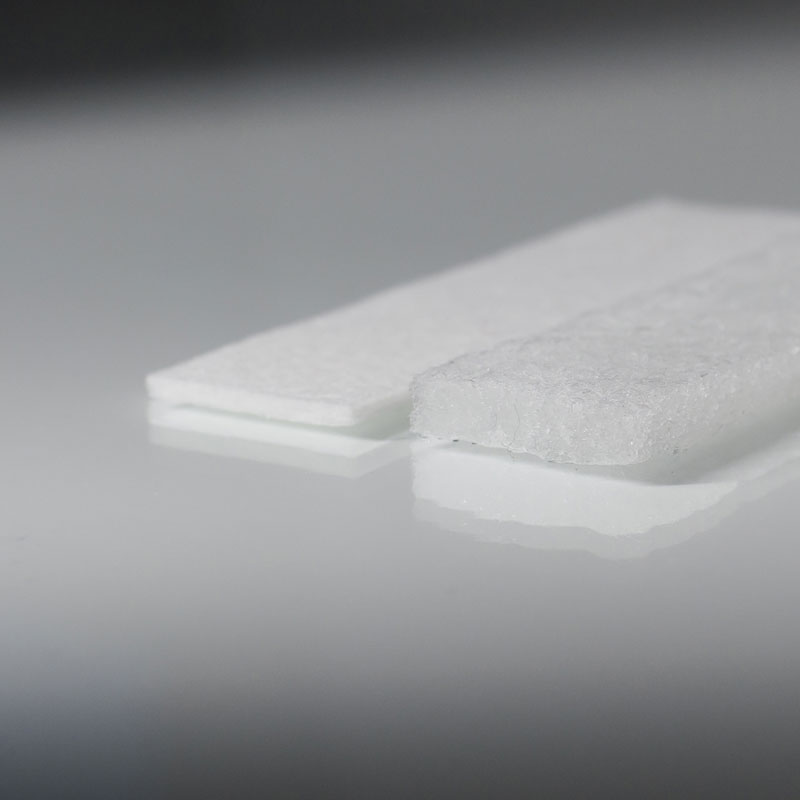
SAF nonwovens can absorb up to 200 times their own weight in water.

ENGLAND — July 21, 2020 — Technical Absorbents Ltd. (TAL) has developed a new grade of superabsorbent fiber (SAF) specifically for use within a new range of SAF nonwoven fabrics that are more resistant to shrinkage.

The new SAF was developed in response to the demand from the medical industry for a superabsorbent fabric suitable for use in advanced wound pad dressings. The fiber had to be capable of withstanding the moisture used in the EtO sterilization process that is frequently employed in the production of the pads, in order to ensure product safety and compliance.

EtO sterilization is a low-temperature process, typically between 37 and 63°C, that uses ethylene oxide gas to reduce the level of infectious agents. While generally applied in gas form, however, the EtO is usually mixed with other substances — and often steam.

“Obviously superabsorbents and moisture generally aren’t a good combination at this stage in processing and can cause problems,” says TAL Product Development Director Dr. Mark Paterson. “Other methods can be used, but when silicone materials are included, which is more frequently becoming the case, EtO is the preferred treatment method. Regular SAF grades tend to shrink a little and can become hard, which is often not desirable. This innovative SAF grade significantly reduces such potential problems.”

The amount of shrinkage caused by EtO sterilization depends very much on the product design and construction, he adds, but in general, the new SAF has been tested and proven to reduce fabric shrinkage by around 70 percent. It is suitable for use in all SAF nonwoven formats, whether needlepunched, thermally bonded or airlaid.

While the proprietary process developed at TAL for the production of this new fiber and resulting fabrics was prompted by the specific requirements of wound pad dressings, TAL sees opportunities for its application in other areas as well.

“It’s an extremely flexible fiber that can be easily switched with existing SAF grades when manufacturing fabrics and we have a number of current projects in which we’re exploring other end-uses,” Mark concludes. “We believe this new range could also open up entirely new application areas on the market.”

Posted July 21, 2020

Source: Technical Absorbents Ltd.

Texworld USA, Apparel Sourcing USA Summer Virtual Sourcing Event Opens Today

ATLANTA — July 21, 2020 — Today, for the first time ever, Texworld USA, alongside Apparel Sourcing USA, will open its 2020 summer edition virtually. Traditionally held at the Jacob K. Javits Center in New York City, the Sourcing Event of the Summer is opening to an even larger audience for three days of sourcing, education and networking.

“The industry was searching for an alternative solution to reach global suppliers during these challenging times. As evidenced by the tremendous support from participating companies, exhibitors and attendees alike, Texworld USA is that solution. We have always been dedicated to providing a platform for the textile sourcing community and we are excited to continue to do so now until we are able to meet again face-to face,” stated Jennifer Bacon, Show Director, Fashion and Apparel, Messe Frankfurt North America.

As the East Coast’s largest sourcing event, Texworld USA represents the industry’s most important marketplace where international mills and manufacturers can showcase the next material innovation. With thousands of professionals, from fabric buyers, product R&D specialists, designers and others, the premier of the virtual event draws from every corner of the United States and interest from brands worldwide.

More than 450 exhibiting companies from 16 countries, including Italy, Canada, Pakistan, Peru, China, Taiwan, India, Turkey, the United States and others will be on hand with their high-quality apparel fabrics, trims and accessories available at reasonable prices.

Together, Texworld USA and Apparel Sourcing USA cover nearly 40 different product categories. All of which will be represented on the virtual platform with more than 20,000 product listings. Visitors can take advantage of the AI-powered matchmaking capabilities to get a list of recommended textile suppliers, set up video meetings and chat to cultivate stronger business relationships.

Amidst a virtual connection to more than 450 textile manufacturers, 12 compelling educational sessions covering a host of globally relevant topics will be streamed during the three day live event. Led by a list of highly regarded brands and experts in various textile and apparel fields, this not-to-be missed program offers access to case studies and solutions to several of today’s unprecedented challenges.

Held alongside Texworld USA and Apparel Sourcing USA is the co-located event, Home Textiles Sourcing, for those manufacturers, retailers, converters, contract specifiers and designers seeking new fabrics and products for their latest home collections.

Registration is still open. To register or for more information on any of these events, please visit us online.

Posted July 21, 2020

Source: Messe Frankfurt

Coca-Cola European Partners (CCEP) Invests In Creation Of Circular Economy For PET In Western Europe

UXBRIDGE, England — July 20, 2020 — Coca-Cola European Partners (CCEP), the world’s largest independent Coca-Cola bottler, has taken an important step on its journey towards 100-percent rPET for its plastic bottles by funding CuRe Technology — a recycling start-up which seeks to provide a new lease of life for difficult to recycle plastic polyester waste.

The funding from CCEP, through its innovation investment fund, CCEP Ventures, will enable CuRe to accelerate its ‘polyester rejuvenation’ technology from pilot plant to commercial readiness. Once the technology is commercialized, CCEP will receive the majority of the output from a CuRe-licensed, new-build plant.

Once operational, CuRe has the potential to support CCEP’s ambition, in partnership with The Coca-Cola Company in Western Europe, to eliminate virgin oil-based PET from its PET bottles within the next decade. This will contribute to removing of a total of over 200,000* tonnes of virgin oil-based PET from CCEP’s packaging portfolio a year and support the transition to a circular economy for PET packaging.

CuRe Technology — a start-up, created and led by a consortium of world-leading recycling innovators and experts led by the Morssinkhof Group and the Cumapol/DuFor Group, with strategic partners DSM-Niaga and NHL Stenden University of Applied Science — will initially apply its end-to-end partial depolymerisation recycling process to transform opaque and difficult to recycle (ODR) food grade PET to high quality recycled PET (rPET) that can be used again for food and drink packaging in one continuous process on the same site.

Towards a Circular Economy

The CuRe funding from CCEP Ventures builds on existing strategic investments by The Coca-Cola Company to explore and support the scaling of ‘enhanced’ full depolymerization recycling technologies in order to make a circular economy for PET a reality.

Depolymerization recycling technologies complement existing mechanical polymer recycling processes. They have the potential to upcycle lower grade PET that cannot currently be recycled via mechanical recycling means and is instead currently downcycled, incinerated or sent to landfill. These depolymerization technologies could play a role in significantly increasing the supply of rPET whilst also accelerating the transition to a circular economy for PET bottles by reducing the reliance on virgin oil-based PET.

The Coca-Cola system in Western Europe is working towards a future source vision for its PET material which will help remove the need for virgin oil-based PET — figurative future sources of PET in Western Europe: 70-percent derived from mechanical recycling with 25 percent from depolyemrization recycling and 5-percent PET from plant-based renewable sources, all while remaining 100% recyclable*.

About CuRe Technology

CuRe Technology uses a partial depolymerization process — shortening the polymer chains just enough to allow the removal of many impurities and to rejuvenate food grade PET to high quality rPET — and can be less energy intensive than full depolymerisation offering lower associated C02 emissions. It’s like pressing a ‘reset’ button to partially break down plastic PET into its component building blocks to produce a high quality rPET. Due to the modularity of the process, the longer term ambition for this technology is to upcycle all polyester waste streams including product to product rejuvenation of carpets and textiles.

Joe Franses, vice president, Sustainability at Coca-Cola European Partners said: “CuRe is an exciting technology start-up with transformational potential developed by an experienced consortium, making it an ideal investment for CCEP Ventures. Our investment in CuRe underlines our commitment to supporting innovations that have the potential to drive growth in our business and our sustainable packaging goals. It also offers us the potential to access vital rPET volume that will help to accelerate delivery of our 100-percent rPET ambition for our PET bottles.”

As part of their joint Sustainability Action Plan, This is Forward, Coca-Cola European Partners and Coca-Cola in Western Europe have pledged that by 2025, Coca-Cola will: collect a can or bottle for every one  it sells and ensure that all its packaging is 100-percent recyclable and by 2023 will: ensure that at least 50 percent of the content of its PET bottles will come from recycled content, accelerating towards its ambition to use zero oil-based PET in its PET bottles in the future, using instead 100 percent recycled or renewable content.

Josse Kunst, chief commercial officer at CuRe Technology said: “Polyester is one of the world’s most reversible plastics and should not go to waste. In the pilot plant phase of the CuRe process, we were supported with a subsidy from the European Union and the three northern provinces of the Netherlands. Now our ambition to create an energy-efficient solution for product to product polyester transformation will be accelerated because of this funding.

The support of CCEP Ventures will enable us to start with opaque and difficult to recycle food grade PET and take the first step towards our ultimate vision of recycling all polyester, again and again.”

*By 2019, CCEP was already using 60,000 tonnes of rPET in its bottle and has committed to using 50 percent rPET by 2023.

Posted July 20, 2020

Source: Coca-Cola European Partners

AFFIX Labs Launches Long-Lasting Surface Treatment To Kill The Coronavirus

HELSINKI — July 20, 2020 — Chemical binding expert AFFIX Labs reports it has harnessed its global experience in disease prevention to create a long-lasting surface treatment proven to kill COVID-19. Si-Quat combines a safe and well-established disinfectant and a proprietary chemical binding technique, so that the active ingredient can kill viruses, including SARS-COV-2. Testing at Portugal’s Biochemistry Institute at the University of Lisbon proves that Si-Quat effectively kills the COVID-19 pathogens that it comes into contact with.

“Tragedies have unfolded across the globe, affecting different countries at varying degrees. The second waves of COVID-19 are just appearing on the horizon. This long-lasting surface treatment is a viable, accessible solution across cultures. By killing the COVID-19 pathogen on surfaces before it can infect people, the Si-Quat solution is a game changer. It can provide increased security and peace of mind to your communities, as well as your customers,” said Tom Sam, CEO of AFFIX Labs.

Si-Quat has been tested to kill 99.99-percent of microbes within minutes, while still being fully safe to touch. Proven to be effective for about a month on frequently touched surfaces, it is the longest lasting anti-viral surface treatment available to reduce the spread of the novel coronavirus. The product is non-corrosive, free from silver salts and heavy metal nanoparticles, and perfectly safe to touch.

Several major agencies around the globe have already accepted quaternary ammonium, the main ingredient in the surface coating, to be an effective surface treatment against the novel coronavirus, including the World Health Organization (WHO), the US Environmental Protection Agency, the American Chemistry Council (ACC) and the European Chemical Agency (ECHA).

Si-Quat was invented in January 2020 by the AFFIX Labs’ Repeltec development team to specifically help combat the COVID-19 outbreak. The product is based on the trusted and safe disinfectant quaternary ammonium, which is chemically bound to align silane quaternary ammonium molecules (silane quats) in a highly effective manner. Positively charged nitrogen particles then actively attract viruses and bacteria, penetrating the membranes and killing them within minutes.

Rigorous testing has shown Si-Quat to adhere to almost any surface, performing as the most durable surface treatment commercially available. Due to its incredibly strong layer, the solution only wears down on surfaces after thousands of touches or multiple cleaning cycles. This means that on heavily used surfaces, such as door handles and counters, Si-Quat will be effective for about a month. On rarely touched surfaces like walls, it has the potential to protect for years. Since the product is incredibly easy to apply, technicians require minimal training and only basic protection. They simply have to brush or spray Si-Quat onto the surface and allow it to dry for six hours.

“Other sanitising solutions require reapplication to every surface several times daily, interrupting business operations. This results in additional costs and disruptions at a time when many companies are already struggling,” Sam explained. “By combining proven efficacy, safety and long durability, Si-Quat is emerging as an important weapon in the battle against the spread of COVID-19.”

AFFIX Labs has begun to roll out the distribution of Si-Quat across the globe, with new regions being serviced every week. It is currently looking for distribution partners in local markets.

The project leading to the development of Si-Quat included funding from the European Institute of Innovation and Technology, a body of the European Union, under the Horizon 2020 Framework for Research and Innovation.

Posted July 20, 2020

Source: AFFIX Labs

Hyosung Introduces Sustainable Solutions At Outdoor Retailer Online

SEOUL, South Korea — July 20, 2020 — As lives have been radically disrupted due to the coronavirus pandemic, consumers are seeking comfort and security from their daily surroundings that range from the home where we are living in and working from, to the clothes we wear.

This global condition has accelerated the desire for comfortable, versatile, and sustainable apparel that can be worn for multiple uses, that is made to last, and is in synch with their individual style.

Materials play a key role in the comfort, performance and sustainable features consumers crave in these crossover garments. To fill this need, the fiber giant Hyosung has expanded its 100-percent recycled multi-function fiber offering, which it will present at Outdoor Retailer Online show July 21-23, 2020.

“At Hyosung, our objective is to reduce waste,” said Mike Simko, Hyosung global marketing director.

“Whether it’s our spandex or nylon or polyester, it’s all made with 100% reclaimed waste so that we’re maximizing the positive impact.”

In addition to Hyosung’s new GRS 100-percent recycled creora® regen spandex collection, the company will highlight the following new recycled polyester and nylon yarns (among others) with added performance features during Outdoor Retailer Online.

Keep Cool with Comfort

A balance between comfort and function — Hyosung’s 100-percent recycled regen askin polyester with cooling technology offers cool touch, UV protection and rapid drying features created for those who like to play hard in the sun.

For a Better Future

With every ton of 100-percent reclaimed waste Hyosung uses to produce its GRS certified creora® regen spandex, consumers will be happy to know it is saving approximately 2 tons of non-renewable raw material being extracted from the earth.

Recycled. Robust. Resilient.

Hyosung’s Mipan® regen robic is the first GRS certified recycled high-tenacity nylon made from 100-percent reclaimed waste developed for eco-conscious enthusiasts who rely on their gear wherever the adventure takes them.

Staying Connected

Due to the coronavirus, many trade shows around the world have pivoted from live to digital events. To stay better connected with its customers, Hyosung has increased its digital marketing initiatives to participate in virtual trade shows and events such as Outdoor Retailer Online and the recent Kingpins24 and Performance Days online shows. The company is also developing new Hyosung Performance Textiles social platforms to include a forthcoming blog along with LinkedIn, Instagram and YouTube pages, which will go live in August 2020.

Posted July 20, 2020

Source: Hyosung

The 54th Edition Of Filo: Yarns Restart

BIELLA, Italy — July 20, 2020 — Today the 54th Filo edition, the international Exhibition of yarns and fibers for orthogonal weaving, circular knitting weaving and technical textiles, has been launched. The show will be held on Wednesday and Thursday, October 7-8, 2020, at MiCo – Milan Convention Centre (via Gattamelata 5, Milan). The presentation has been made through a webinar which was attended by many professionals of the textile industry.

Paolo Monfermoso, general manager of Filo, said: “The choice to present the 54th edition of Filo through a webinar comes from the exceptional times we are living. However, it has been a winning choice, that enabled us to communicate with many exhibitors, operators, and the press, both nationally and internationally, in just one meeting. On the other hand, however advantageous digital technology may be, still a physical fair is key, especially for those exhibitions like Filo which are set upstream of the supply chain, since it allows operators to ‘understand’ the product, observe its qualities and think about possible textile evolutions. For this reason, it is fundamental that the textile supply chain returns to show itself to the entire world through the trade fairs. Therefore,  a lot of attention has turned on around the October edition of Filo, as proved by the high number of exhibitors’ subscriptions we have already received: it represents a strong signal of the recovery of the system, instrumental to the recovery of companies on international markets, which are more than ever attentive to quality, processes, sustainability of products and production processes. Together with Fiera Milano we are of course implementing all measures and steps to make Filo totally safe for its participants.

Today’s webinar made it possible to propose one of the most awaited and followed appointments by operators, both Italian and foreign: the presentation of Filo’s product development proposals. They have been carried out by Gianni Bologna and they are inspired to “Chromatic Reflections”. Gianni Bologna highlights: “We can remember the past months as a long grey period lived in black and white. I propose now exactly the opposite: colors. The new format of the presentation (more filmed and animated) — that it would be the same even in normal times — wants to convey the rediscovered desire of dynamism and motivation. We should remember that mentioning such a basic and direct element as color allows us also to hint at the next behavior of luxury’s consumption, extremely important for Made in Italy industry, which will be oriented towards a more basic look: a ‘silent’ luxury, clearly based on the intrinsic quality of products and their processing. It is a new minimalism which calls for some prerequisites: environmental awareness, ethics, respect for expertise on the job”.

Posted July 20, 2020

Source: Filo

Joint Statement On Policy Objectives For Reshoring And Safeguarding Domestic PPE Manufacturing

As trade associations and other organizations representing every segment of the textile, apparel and personal protective equipment (PPE) supply chain in the U.S., servicing both the Department of Defense and consumer retail, we are united in our support of important principles that must be adopted in order to address our current public health needs and guarantee our nation is better prepared to respond to future emergencies.

The COVID-19 pandemic poses a severe threat to our nation, and our association and organization members have moved swiftly to convert manufacturing facilities and build supply chains to produce desperately needed PPE. In many cases, these supply chains were created virtually overnight and at great expense, highlighting the ingenuity, commitment, and passion of U.S. manufacturers and workers in responding to this generational crisis.

However, the coronavirus has exposed severe gaps in our national readiness to respond to a public health emergency of this magnitude. We agree with the strong bipartisan consensus building in Washington and across the country that the United States must have domestic capacity to produce PPE and other vital medical supplies without relying on imports from other countries. In fact, our continuing reliance on foreign sources for these vital public health resources is a severe vulnerability to both our public health and national security.

Therefore, creating and maintaining domestic supply chains capable of producing PPE and key medical supplies in sufficient quantities to meet a national health emergency is of paramount concern for every citizen of this country.

We stand united in supporting several principles as necessary elements of our national response to the COVID-19 pandemic, principles that will both meet current needs and ensure a reliable domestic PPE manufacturing base capable of meeting our public health needs during a future crisis. We call on Congress and the Trump administration to adopt and implement the following principles through legislation, Executive Order, or other appropriate means:

Create strong domestic procurement rules for federal PPE purchases substantially similar to the Berry Amendment and the Kissell Amendment

Taxpayer dollars should not go to China and other offshore PPE producers, only to have those same producers withhold access to vital supplies and equipment in the face of global shortages. New federal government domestic purchasing requirements for PPE will create the stable demand for U.S.-made PPE that will incentivize investment in domestic PPE manufacturing.

Implement forward-looking policies to shore up the Strategic National Stockpile and to identify, incentivize, and maintain a robust domestic supply chain for PPE and medical supplies

Our Strategic National Stockpile (SNS) must be better prepared to answer our needs efficiently and adequately during a pandemic or other public health emergency. This will require additional advance planning by the executive branch and proper oversight by Congress. The SNS must also conduct critical domestic supply chain mapping to identify gaps in the supply chain and develop recommendations to meet existing and future supply chain needs.

Create federal incentives for private sector purchases of domestically produced PPE

Expanding the domestic customer base for PPE beyond the federal government and to the private sector will provide long-term stability to U.S. PPE producers and enhance our national manufacturing capacity.

Provide funding assistance for companies to reconstitute domestic PPE supply chains

The federal government should provide grants to companies that took the initiative to repurpose their factories and purchase equipment in order to rapidly increase domestic production of critical PPE items amid the COVID-19 crisis. Further support mechanisms such as additional grants and/or special tax credits for companies that make future investments in domestic PPE production should also be provided.

Strengthen the Berry Amendment

Domestic procurement requirements under the Berry Amendment have been gradually eroded in recent years. Congress must permanently re-set the Berry threshold to $150,000 and eliminate loopholes for foreign-made products.

We stand ready and willing to assist Congress and the administration in developing these policies into legislative concepts and executive action.

AFL-CIO
Alliance for American Manufacturing
American Iron and Steel Institute
American Sheep Institute
Coalition for a Prosperous America
Georgia Association of Manufacturers
Hand Tools Institute
INDA: Association of the Nonwoven Fabrics Industry
Narrow Fabrics Institute
National Cotton Council
National Council of Textile Organizations
Parachute Industry Association
Rhode Island Textile Innovation Network
SEAMS: Association of the U.S. Sewn Products Industry
SEIU
South Carolina Textile Council
U.S. Industrial Fabrics Institute
United States Footwear Manufacturers Association
United Steelworkers
Warrior Protection and Readiness Coalition
Workers United/SEIU

Posted July 20, 2020

Source: NCTO

Industry Coalition Releases Statement On PPE Policy

WASHINGTON— July 20, 2020 — An industry coalition representing the full spectrum of domestic personal protective equipment (PPE) production released a statement today outlining policy principles and objectives needed for reshoring and safeguarding domestic PPE manufacturing.

The COVID-19 pandemic, which exposed severe shortages in our nation’s PPE supply and an over-reliance on foreign sourced products, underscores how important it is for the U.S. government to incentivize, support and maintain domestic manufacturing capacity for PPE.

Our association members, encompassing every segment of the U.S. textile, apparel and PPE supply chain, as well as unions representing workers, acted swiftly to convert manufacturing facilities and build supply chains virtually overnight to produce desperately needed PPE.

“We are united in our support of important principles that must be adopted in order to address our current public health needs and guarantee our nation is better prepared to respond to future emergencies,” the 21 associations said in the joint statement.

The associations are calling on Congress and the Trump administration to adopt principles outlined in the statement through legislation, executive order and other appropriate means.

See the full joint statement and principles here.

The statement was signed by the following organizations:

  • AFL-CIO
  • Alliance for American Manufacturing
  • American Iron and Steel Institute
  • American Sheep Institute
  • Coalition for a Prosperous America
  • Georgia Association of Manufacturers
  • Hand Tools Institute
  • INDA: Association of the Nonwoven Fabrics Industry
  • Narrow Fabrics Institute
  • National Cotton Council
  • National Council of Textile Organizations
  • Parachute Industry Association
  • Rhode Island Textile Innovation Network
  • SEAMS: Association of the U.S. Sewn Products Industry
  • SEIU
  • South Carolina Textile Council
  • U.S. Industrial Fabrics Institute
  • United States Footwear Manufacturers Association
  • United Steelworkers
  • Warrior Protection and Readiness Coalition
  • Workers United/SEIU

Posted July 20, 2020

Source: NCTO

Northwest Health Care Linen Service Recertifies For Hygienically Clean Healthcare

ALEXANDRIA, Va. — July 17, 2020 — Northwest Health Care Linen Service, a family-owned and -operated full-service healthcare laundry processor and linen company that serves the greater Puget Sound region of western Washington, has recently qualified for renewal of the Hygienically Clean Healthcare certification. The recertification reflects their continued commitment to best management practices (BMPs) in laundering as verified by on-site inspection and its capability to produce hygienically clean textiles as quantified by ongoing microbial testing.

The Hygienically Clean Healthcare certification confirms the organization’s continuing dedication to infection prevention, compliance with recognized industry standards and processing healthcare textiles using BMPs as described in its quality assurance documentation, a focal point for Hygienically Clean inspectors’ evaluation. The independent, third-party inspection must also confirm essential evidence that:

  • Employees are properly trained and protected;
  • Managers understand regulatory requirements;
  • OSHA-compliant; and
  • Physical plant operates effectively.

To achieve certification initially, laundries pass three rounds of outcome-based microbial testing, indicating that their processes are producing Hygienically Clean Healthcare textiles and diminished presence of yeast, mold and harmful bacteria. They also must pass a facility inspection. To maintain their certification, they must pass quarterly testing to ensure that as laundry conditions change, such as water quality, textile fabric composition and wash chemistry, laundered product quality is consistently maintained. Re-inspection occurs every two to three years.

This process eliminates subjectivity by focusing on outcomes and results that verify textiles cleaned in these facilities meet appropriate hygienically clean standards and BMPs for hospitals, surgery centers, medical offices, nursing homes and other medical facilities.

Hygienically Clean Healthcare certification acknowledges laundries’ effectiveness in protecting healthcare operations by verifying quality control procedures in linen, uniform and facility services operations related to the handling of textiles containing blood and other potentially infectious materials.

Certified laundries use processes, chemicals and BMPs acknowledged by the federal Centers for Disease Control and Prevention (CDC), Centers for Medicare and Medicaid Services, Association for the Advancement of Medical Instrumentation, American National Standards Institute and others. Introduced in 2012, Hygienically Clean Healthcare brought to North America the international cleanliness standards for healthcare linens and garments used worldwide by the Certification Association for Professional Textile Services and the European Committee for Standardization.

Objective experts in epidemiology, infection control, nursing and other healthcare professions work with Hygienically Clean launderers to ensure the certification continues to enforce the highest standards for producing clean healthcare textiles. Northwest Health Care Linen Service also holds the TRSA Clean Green Certification for its practices with regard to environmental stewardship.

“Congratulations to Northwest Health Care Linen Service on their recertification,” said Joseph Ricci, TRSA president and CEO. “This achievement proves their commitment to infection prevention and that their laundry takes every step possible to prevent human illness.”

Posted July 17, 2020

Source: TRSA

Sponsors