Helsinki-based Suominen recently announced a capacity increase for one of its production lines located in Bethune, S.C. The investment is valued at approximately $7 million. The project is expected to be finalized during the second half of 2021, and will broaden the company’s U.S. offerings for customers.
“This investment allows us to produce new innovative, top quality products which are the result of joint product development with one of our major customers,” said Petri Helsky, president and CEO of Suominen.
The Jones Family of Companies, Humboldt, Tenn., has acquired Rontex America LLC, a producer of engineered needled nonwovens based in Amherst, N.H. Rontex will continue to operate out of its Amherst facility, which will allow Jones to distribute its products in the northeast region. Matt Buck, Jones’ vice president of technical nonwovens, was named general manager of Rontex America.
“Rontex’s expertise and experience in engineered nonwovens will be a powerful addition to our family of companies and bolster our aspirations to drive long-term growth,” said CP Davis, president and CEO of the Jones Family of Companies. “We are very proud to have Rontex join our family. Rontex has a strong history and reputation for quality, customer service and innovation. This move further enables Jones to deliver comprehensive non-woven solutions designed to improve comfort, protection, and sustainability.”
Turkey-based Mogul Tekstil reports it will add two new meltblown nonwoven lines to its existing four lines currently in operation as a result of strong demand for personal protective equipment (PPE). Its facility in Gaziantep will house the 160-centimeter-wide lines, which will meet the requirements for N95 and higher efficiency masks with their electrostatic charge capabilities. The first line is expected to be operational by January 2021, with the second line in operation by June 2021.
Dr. Behnam Pourdeyhimi, executive director of The Nonwovens Institute at NC State University, comments on HanesBrands surgical face mask innovation
By Jim Borneman, Editor In Chief
Winston-Salem, N.C.-based HanesBrands recently announced the U.S. Food and Drug Administration authorized a proprietary surgical face mask for use by health care professionals as personal protective equipment (PPE).
According to HanesBrands: “ … the proprietary surgical face mask [was] developed in conjunction with North Carolina State University, the University of North Carolina at Chapel Hill and UNC Health. The two-ply, single-use surgical mask features a unique fabric developed by NC State’s Nonwovens Institute combined with a fit design created in collaboration with UNC-Chapel Hill and NC State biomedical engineers and UNC Health infection prevention experts.”
The Nonwovens Institute (NWI) at NC State University, Raleigh, N.C., has a long history of development of spunbond nonwoven microfibrillation technologies, which was a focus from 2004 to 2008. These technologies were then modified in 2018 and 2019 to form a mechanical High-efficiency particulate air (HEPA) filter, which was again modified in March to form the basis for a filter for facemasks. Three new patents are pending in this area.
The duckbill shape of the Hanes mask offers improved breathability.
The HanesBrand Mask
HanesBrands reports: “The use of unique spun-bond fabric developed by the Nonwovens Institute, the world’s first accredited academic program for the field of engineered fabrics, eliminates the need for a third filtration layer for cost efficiency and filtering effectiveness. The spunbond fabric is composed of two different polymer materials to make a single fiber that has significant strength and bulk that is as effective in filtration as current materials on the market.”
“The Nonwovens Institute is proud to be a part of this collaboration to ensure that high-quality and affordable protective gear remains available to frontline health care workers during the pandemic,” said Dr. Behnam Pourdeyhimi, NWI executive director.
On a personal note, Pourdeyhimi lost his brother, Farrokh Pourdeyhimi, to COVID-19 in September 2020, no doubt giving the research that much more meaning.
Pourdeyhimi recently spoke with Textile World editors to discuss recent nonwoven developments and the HanesBrands two-ply, single-use surgical mask.
Textile World: Welcome, Dr. Pourdeyhimi. NWI must be operating at full speed at the moment!
Pourdeyhimi: We have been working since early March, and some of the facilities are running around the clock. Our staff are the true heroes working long hours to make a difference.
TW: What unique technologies were utilized in the nonwoven fabric used for the two-ply, single-use surgical mask?
Pourdeyhimi: This new spunbond has been in development for some time. The structure is partially fibrillated to form fine fibers; the mixture of fine and coarse fibers allows for high efficiency at low pressure drops.
TW: Why are two different polymers used?
Pourdeyhimi: To fibrillate fibers, one requires polymers that are incompatible. Examples are nylon and polyester, or polyester and polypropylene (PP) or polyethylene. We chose polylactic acid (PLA) and PP since we have previous experience in running this combination at high speed.
TW: This was a multi-team development. How do you coordinate the work to be efficient as possible?
Pourdeyhimi: A lot of communication and listening to the voice of the customer. The team was motivated to make a difference quickly, and we spent a lot of time testing and retesting materials, material combinations and designs.
TW: What are the challenges in achieving a U.S. Food and Drug Administration (FDA) Emergency Use Authorization?
Pourdeyhimi: Testing. It is required that results are generated by certified labs such as Nelson and Intertek. The time it takes to accomplish this is simply too long. Fortunately, the Nonwovens Institute has the facilities and expertise to do the same tests. Therefore, during the development phase, all tests were performed at the institute. Only the final samples were submitted to the certified labs.
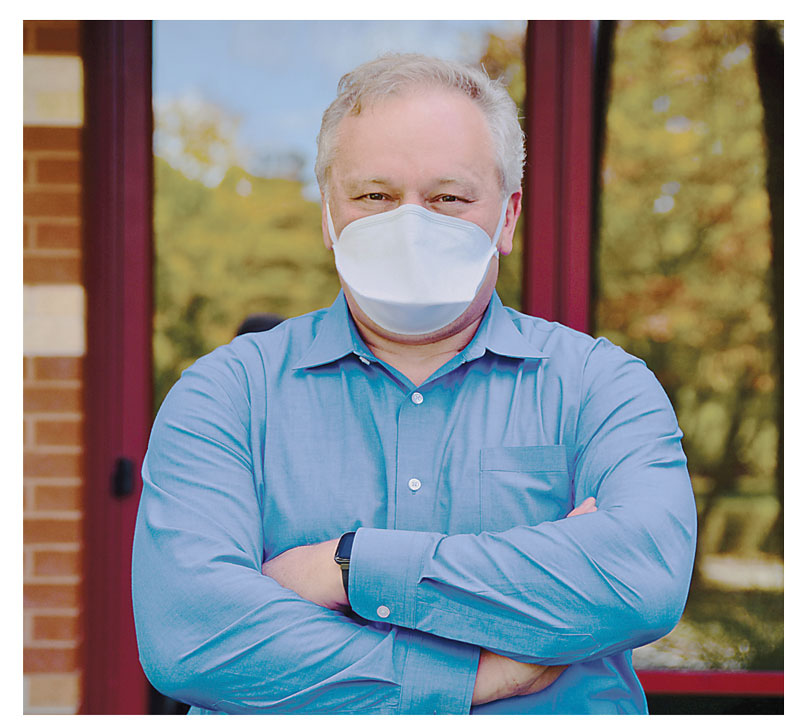
Mike Abbott, director of research and development for HanesBrands, credits collaboration for the quick development of the mask.
TW: The United States’ dependency on foreign-made PPE was quite alarming to many. What do you see in terms of changes in domestic production?
Pourdeyhimi: There are several challenges — most importantly, the shortage of the meltblown filter media which is historically what has been used in filtration media and the ability to convert the base materials to masks. While one could establish mask manufacturing facilities in several months — and many companies did so — the shortage of the meltblown media continues to date and many are scrambling to source media. Another challenge is the lack of know-how in producing quality meltblown structures.
The institute developed an alternative to meltblown to help alleviate some of this challenge. The institute has also helped many companies with their needs in terms of testing and validation, product design, etc., and offered a series of online webinars on the topic of PPE and meltblown and spunbond processes as it pertains to the formation of filters. Additional online resources are being developed weekly.
TW: Have you seen more interest in nonwovens production from new entrants into the industry?
Pourdeyhimi: Yes. The challenge is still lack of expertise and know-how. One cannot simply buy a meltblown machine and press a button to form a filter. While the machinery makers are trying to help with the set up and training, there continues a significant need for establishing a quality management system, maintenance and operations. To help with this, the institute has developed training programs for several companies interested in setting up and running nonwoven equipment.
TW: What have you observed in terms of new investments?
Pourdeyhimi: Primarily in surgical masks — three-layer pleated — some flat masks similar to KN95, and a few molded cup styles apart from what the industry leaders such as 3M, Moldex and Honeywell produce. There are a few meltblown machines — those from the United States and Europe take 10 to 16 months to be delivered; while meltblown machines from China are delivered anywhere from 3 weeks to 3 months. More importantly, the institute helped several companies redirect production from liquid filters for uses such as swimming pools and spas to filters for facemasks. This switch helped alleviate some of the shortage, but it was not by any means a trivial task.
TW: What other COVID-19 related developments are taking place at the institute?
Pourdeyhimi: NWI also has developed facilities for testing gloves, and helped several companies with the development of gowns using alternate materials.
TW: What other technologies are coming along that may support a multi-use mask or common-use consumer mask?
Pourdeyhimi: Electrospinning is being used as an alternative to meltblowing; however, the impact has been minimal given the scarcity of facilities and low production rates.
There are many cloth masks being offered today. Unfortunately, these are not as effective, and many offer poor breathability. Lack of appropriate standards, beyond what is used for medical masks, has led to offerings with unfounded claims. One of the key features in masks is their electrostatic charge. This charge elevates the performance significantly. Cloth masks are not charged, and cannot be charged or will have poor charge stability. Another feature found in nonwovens is the fine fibers of 1 to 2 microns or less. Most textile fibers are much larger.
Microfiber nonwovens such as Evolon and Madeline are being used to create consumer barrier masks. These work well because of their fine fibers.
NWI’s new spunbond offers amazing breathability and offers filtration efficiencies ranging from 80 to more than 95 percent depending on composition. This is because the structure contains fine fibers and is also inherently charged. The institute’s partners have been offering single-layer consumer masks for some time.
TW: What stands out as a major takeaway from the COVID-19 pandemic?
Pourdeyhimi: This has been a difficult period because we were all caught by surprise. Complete dependence on imports is clearly not the way of the future. It is time we take onshoring seriously.
RICHMOND, Va. — December 7, 2020 — Governor Ralph Northam today announced that International Automotive Components Group (IAC Group), a global supplier of automotive components and systems, will invest $4.6 million to expand its manufacturing operation in the Town of Strasburg and add new auto component lines and products to its existing capabilities at the facility. Virginia successfully competed with Ohio for the project, which will create 47 new jobs.
“International Automotive Components Group has been a valued employer in Shenandoah County for more than a decade, and we are thrilled that the company is reinvesting in its operation and employees,” said Governor Northam. “IAC Group exemplifies the success that major businesses can find in rural Virginia and we thank the company for its continued confidence in Virginia and for creating high-quality manufacturing jobs at a critical time in our economic recovery.”
Headquartered in Luxembourg, International Automotive Components Group is a leading supplier of automotive components and systems, including instrument panels, console systems, door panels, headliners, and overhead systems to automakers around the world. IAC Group operates more than 45 manufacturing facilities in 16 countries and has more than 60 total locations in 18 countries, including 14 business and innovation centers. The company employs more than 18,000 people globally.
“As a major global player in the automotive sector, IAC Group’s growth in Shenandoah County serves as a testimonial to other industry leaders,” said Secretary of Commerce and Trade Brian Ball. “We are confident the region’s infrastructure and dedicated workforce will contribute to the operation’s future longevity.”
“A seasoned team with a history of successful launches as well as access to additional talent around the region made the Strasburg, Virginia facility the smart choice for IAC,” said Nick Proctor, director of Manufacturing for IAC Group.
The Virginia Economic Development Partnership (VEDP) worked with Shenandoah County, the Town of Strasburg, and the Shenandoah Valley Partnership to secure the project for Virginia. VEDP will support IAC Group’s job creation through the Virginia Jobs Investment Program (VJIP). VJIP provides consultative services and funding to companies creating new jobs in order to support employee recruitment and training activities. As a business incentive supporting economic development, VJIP reduces the human resource costs of new and expanding companies. VJIP is state-funded, demonstrating Virginia’s commitment to enhancing job opportunities for citizens.
“Shenandoah County is extremely pleased that IAC has selected Shenandoah County for its expansion,” said Vice Chairman of the Shenandoah County Board of Supervisors Steve Baker. “This facility has been a major employer in the region for many years and is a staple for our local economy. We appreciate the cooperative effort on behalf of the Virginia Economic Development Partnership and the Governor in making this expansion occur.”
“Strasburg couldn’t be more excited about the announcement that one of our mainstay businesses is expanding and investing in our community again,” said Michelle Bixler, director of Community Development for the Town of Strasburg. “We have been developing good relationships with our partners in Shenandoah County, the Commonwealth, and in the private sector for years, and this exemplifies why. We welcome opportunities to strengthen those networks through workforce and community development and education because it benefits our local businesses and the community as a whole.”
“Thanks to IAC working in partnership with the Commonwealth and Shenandoah County, we have another expanding business providing more job opportunities for our citizens,” said Senator Mark Obenshain. “I commend IAC for its continued economic investment in the Shenandoah Valley.”
“International Automotive Components Group has been a vital factor in driving economic progress locally and has been a leading employer in Shenandoah County,” said Delegate Todd Gilbert. “I am pleased that this investment in expansion and jobs will benefit our shared community, and I appreciate the efforts and collaboration that made this possible.”
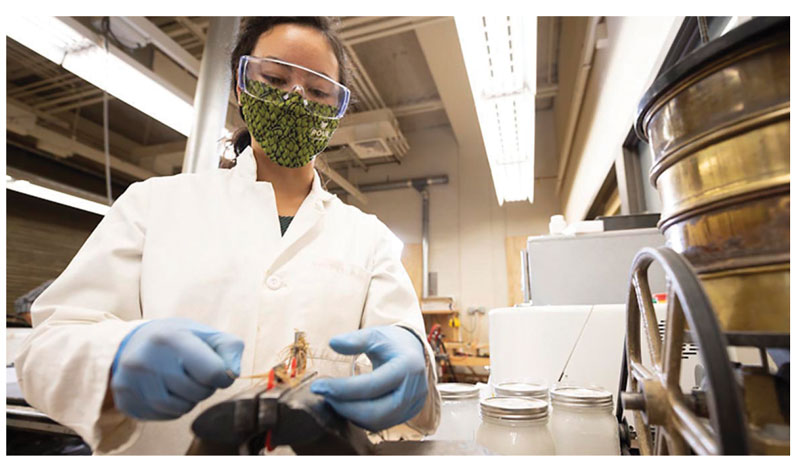
University of Idaho student Maggie Zee is researching how to turn hops by-product into a useable fiber for textile applications.
University of Idaho student explores uses for hops waste, including as a fiber for textile applications.
By Amy Calabretta
Hops are famous for adding bitterness, flavor and aroma to beer. The hop flower, or cone, is used in the brewing process while the remaining plant, or bine, is often mulched into compost. But, what if that hops waste could be used for something else — maybe something you’d want to wear? That’s the question University of Idaho College of Agricultural and Life Sciences student Maggie Zee is hoping to answer.
A Unique Opportunity
Wakima, Wash.-based Yakima Chief Ranches, an integrated crop management company specializing in breeding new hop varieties, sees a lot of hops waste and is looking for practical uses besides compost. A fortuitus meeting at the University of Idaho’s Career Fair in February 2019 resulted in a new partnership.
Zee happened by the Yakima Chief Ranches booth at the career fair. When representatives learned she was majoring in apparel, textiles and design, they presented her with a unique opportunity.
“They have been trying to figure out how to use their hops waste at the end of harvest,” Zee said. “They want to find other practical uses for it so it’s not just sitting around and composting. They presented to me this idea to figure out what to do with this hops waste. So, I decided to try it out.”
Zee contacted Armando McDonald, professor of renewable materials chemistry in the University of Idaho College of Natural Resources, and, using hops bine from Yakima Chief Ranches, the two set out to discover what could be done with the by-product.
“We’ve been trying to figure out the feasibility of hops bine as a textile material,” Zee said. “So far we’ve been able to use it as a nonwoven material to make paper.”
Zee researched other bast fibers — strong, cellulosic fibers obtained from the outer bark of plants like hemp — and how they were processed to make paper. The bine was put into a steamer basket with sodium hydroxide and boiled to see if the bark would rip off and reveal the fibers. Bleach was then added to help further break down the bine.
“From there, the fibers would easily pull apart so we could separate them from the nice, fine bast fibers versus the coarse hurd fibers or the stalk,” Zee said.
She used a food processor to pulp the fibers and a paper press to sift through the pulp and form sheets. The sheets were then dried with a hot press.
“The paper is really strong,” Zee said. “I think that’s just a property of the hops, just by the characteristic of the fibers, they have this kind of zigzag pattern and they’re really strong.”
A Source For Textiles
Making paper was just the first step in the project. Now the team is investigating the use of the fibers as a textile source with help from the University of Idaho’s College of Science.
Brian Petty, scientific instrument maker in the Department of Physics, fabricated a decortication machine that strips off the bark so that Zee can extract the fibers. The machine is based on similar designs used for extracting fibers from hemp plants.
“It’s something that we thought would be the best fit for our product and we can use it for other bast fibers if we wanted to research other things,” Zee said. “It seemed like this was the most practical machine to create.”
The hops bine is fed into the machine and paddles break off the bark and strip it so that only fibers remain. From there, Zee combs the fibers and spins them together to create a yarn.
“The texture of the hops fiber is unlike that of hemp or cotton,” Zee said. “To me, it almost feels like coconut fiber. It’s coarse, wavy and thicker than the hemp fiber I’m working with.
“My goal with this material is to make it as sustainable as possible,” Zee added. “Not only am I making a value-added by-product, but it’s intended to be recycled or composted once usage is done.”
Zee worked with Ashley Hale, special projects coordinator with Yakima Chief Ranches, to source longer strands of bine and hopes to create clothing items as part of her senior capstone project.
“For me and for our company, because sustainability is such a huge aspect, this student is doing something really cool and we want to support her,” Hale said. “I think using hop waste in an alternative way is a really cool project to get behind.
“If she does find a way to turn it into a textile, I think our growers all the way to our brewing customers would really like something made with a certain percentage of hops waste. I think the opportunities are endless.”
Yakima Chief Ranches may use the hops paper as bottle labels, coasters or packaging.
“If more people can get on board with using their by-product towards a renewable product, it seems like we’d be able to become more sustainable in our practices and have locally sourced materials to create endless amounts of things,” Zee said. “That’s ultimately my goal.”
Maggie Zee
A New Career
Zee happened upon apparel, textiles and design by chance after earning a bachelor’s degree in geology from the State University of N.Y. at Potsdam and spending nine years working in various seasonal fisheries and natural resources jobs.
“I was sick of the seasonal, but I was also feeling very tired of doing the same thing over and over again and feeling like a cog in the wheel and not seeing the end result of the field work I was doing,” she said. “I started playing around with different art forms and trying to get back in touch with my creative side.”
Zee was a ski and snowboard instructor at Brundage Mountain in McCall, Idaho, when inspiration hit — designing clothing for jobs and activities that she loved to do.
“I never thought of myself as someone that is fashionable,” she said. “I was just trying to look for something different. Another catalyst was that I had been working so many jobs outside in the field and never found any clothes that really fit. I came into this program trying to change that with better fitting clothes for women. Fashion is not my end goal, function is.”
Zee met with Lori Wahl, instructor in the Margaret Ritchie School of Family and Consumer Sciences, and after touring facilities on the Moscow campus, decided to make the career change.
“It’s hard making that decision when you’re already in debt from your first degree and going back for another bachelor’s degree,” she said. “It was just something that I felt I needed to do because if not now, then I’d never do it.”
Zee’s research project has also led her to plans for her next career — a business creating women’s outdoor clothing that fits, is functional and — potentially — made from hops.
“If I am successful in making hops into a woven textile then I would like to be my own supplier for my own clothing company,” she said. “Much like vertical integration, I like the overarching holistic idea of creating a more sustainable fashion industry with the production of textiles from locally sourced fibers into a wearable garment.”
Editor’s Note: Amy Calabretta is marketing and communications manager at the University of Idaho’s College of Agricultural and Life Sciences.
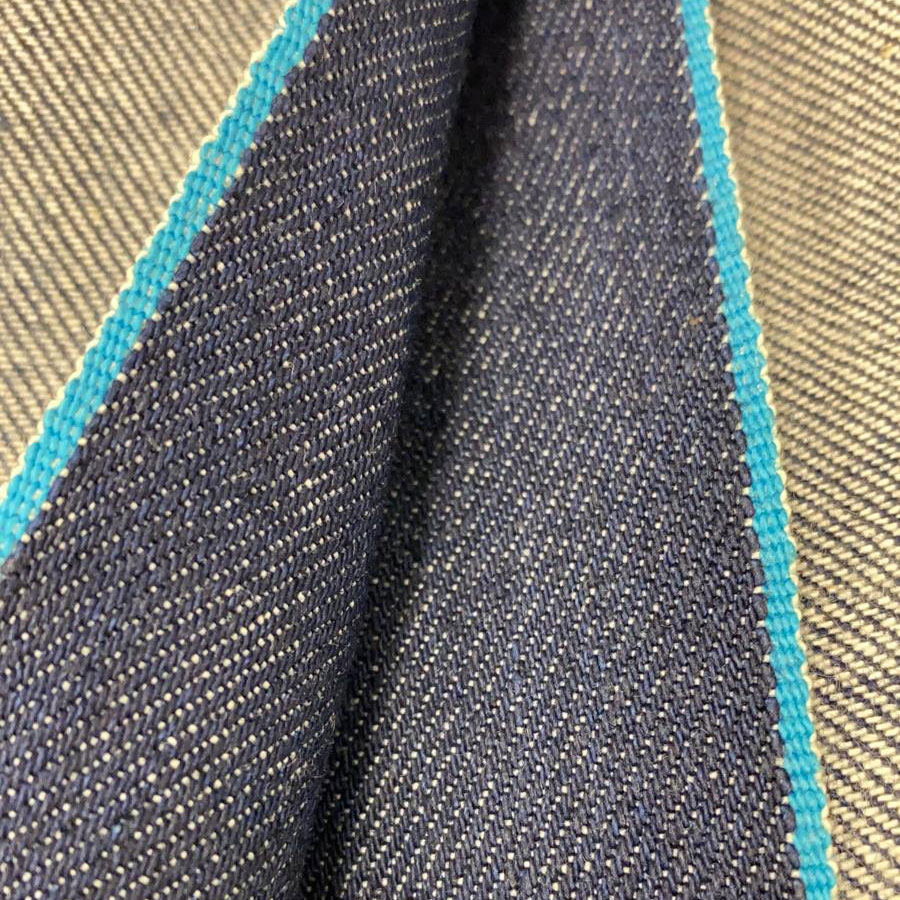
Greensboro, N.C.-based Cone Denim® recently launched Clean Water selvage denim, the latest fabric in the Cone Community Collection. The fabric, made using 100-percent organic cotton with comfort stretch, is identified by a teal color in the selvage to represent water conservation awareness. Cone used eco-friendly Distilled Indigo to dye the Clean Water denim. According to Cone, the fabric supports “efforts to end the global water crisis and increase access to clean water around the world.” Cone pledged to donate a portion of the proceeds from sales of Clean Water denim to international non-profit Water.org.
“Access to clean, potable water should be a basic human right and Cone is excited to introduce its newest Cone Community denim designed to help bring more awareness to this global crisis,” said Steve Maggard, president, Cone Denim. “Water is a precious resource and Cone remains committed to responsible water hygiene and conservation efforts. I am excited by our team’s efforts to drive sustainable innovation and produce denim in a way that uses less water and fewer chemicals, minimizing environmental impact and returning cleaner water back into the environment.”
Sock manufacturer Renfro Brands recently introduced a direct-to-consumer marketplace named Loops & Wales.
New York City-based sock marketer and manufacturer Renfro Corp. recently announced a name change to Renfro Brands. In total, Renfro stewards more than 20 brands spanning essentials, fashion, athletics, outdoors, work and wellness categories. Hot Sox and K. Bell joined the Renfro portfolio in 2007 and 2010, respectively. Customers include Macy’s, Walmart and Costco.
The rebranding includes a new visual identity with redesigned logo and direct-to-consumer marketplace named Loops & Wales.
“Our rebrand and launch of Loops & Wales represents the unique combination of strengths we’ve honed over the years. With these changes, we aim to honor our heritage while focusing on what our next 99 years can look like,” says Stan Jewell, CEO of Renfro Brands. “We are brand stewards and laser focused on driving brand equity and brand health across the board. The trends were really moving towards more and more consumers purchasing socks directly online — we were behind and needed to catch up.”
Denver-based VF Corp. has entered into a definitive merger agreement with Supreme®, a privately-owned streetwear brand. The Carlyle Group and Goode Partners, current investors, are selling their stakes in Supreme. The transaction is expected to close before the end of 2020, and is subject to customary closing conditions and regulatory approval.
James Jebbia, the brand’s founder, and the senior leadership team will remain with the company, which is headquartered in New York City.
“We are thrilled to welcome Supreme to the VF family and to build on our decades-long relationship as we create value for all of our stakeholders. VF is the ideal steward to honor the authentic heritage of this cultural lifestyle brand while providing the opportunity to leverage our scale and expertise to enable sustainable long-term growth,” said Steve Rendle, VF’s chairman, president, and CEO. “
RALEIGH, N.C. — December 5, 2020 — Riverside Furniture Corp., a furniture and home furnishings manufacturer, will create 50 new jobs with a $5.4 million investment for a warehouse and distribution center in Caswell County, Governor Roy Cooper announced today.
“Growing companies know they can succeed with North Carolina’s skilled workforce, location, and infrastructure to support their distribution operations. Riverside Furniture’s increased presence fits with North Carolina’s reputation as the furniture capital of the world,” said Governor Cooper.
Founded in 1946, Riverside Furniture Corporation designs, manufactures and distributes residential furnishings to 3,000 furniture retailers across the United States. Since opening their first plant in Arkansas nearly 75 years ago, the company has experienced exponential growth. Riverside’s additional 300,000-square-feet of distribution and warehouse operations in Caswell County will reduce shipment lead times to retailers in the Eastern United States from receipt of order. In addition to this next phase of growth, Riverside is currently renovating the historic YMCA on Main Street in High Point to create a state-of-the-art showroom and product development center for year-round utilization for the furniture industry.
“Riverside’s investment in North Carolina, including both the new High Point showroom and the Caswell County distribution center, is a combined $15 million, which is a reflection of our growth as a company and the expansion of service to our customer base,” said Fred Henjes, CEO and president of Riverside Furniture Corp. “Because the distribution center is situated on 50 acres of land, the campus will give us the ability to expand.”
“Riverside Furniture is applying a 21st century touch to one of North Carolina’s earliest manufacturing industries,” said Commerce Secretary Anthony Copeland. “We commend them for the success that has led to this exciting expansion and look forward to supporting their continued growth.”
The North Carolina Department of Commerce led a team of partners in supporting Riverside Furniture’s decision to locate to North Carolina. New positions will include shipping and receiving staff, forklift operators and supervisors. Annual salary for the positions is expected to average $39,260, creating a payroll impact of more than $1.9 million per year for the surrounding community. Caswell County’s overall average annual wage is $36,427.
A performance-based grant of $150,000 from the One North Carolina Fund will help facilitate Riverside Furniture’s expansion. The One NC Fund provides financial assistance to local governments to help attract economic investment and to create jobs. Companies receive no money upfront and must meet job creation and capital investment targets to qualify for payment. All One NC grants require a matching grant from local governments and any award is contingent upon that condition being met.
In addition to the North Carolina Department of Commerce, the Economic Development Partnership of North Carolina and Caswell County, other key partners in the project include the North Carolina Community College System and Piedmont Community College.
Fort Smith, Arkansas-based Riverside Furniture is a leading supplier of high-fashion, mid-priced quality bedroom, dining room, home office, home theater and occasional furniture. Founded in 1946, the company distributes its whole home furniture collections and some 1,000 furnishings items to retailers nationwide.