New York City-based Gerber Technology recently held its annual ideation conference in a fully virtual format. More than 2,200 professionals from some 90 countries participated in the three-day event. Tracks for fashion and apparel; furniture; transportation; personal protective equipment (PPE); and sign and graphics were featured in order to cater the content to each attendee’s interests.
At ideation, Gerber continued to build on its PPE Task Force Initiative by offering knowledge and tools for each sector of the industry to help companies accelerate their digital transformation to making PPE.
Ideation 2020 also hosted a second annual Executive Forum attended by 100 executives from across all industries. The forum featured a Thought Leadership panel comprised of Murray Pitts, Burlington Medical; Matthew Wallace, Project DXM; Whitney Cathcart, 3DLOOK; Stephen Lamar, AAFA; and the National Council of Textile Organizations’ Kim Glas. The panel was moderated by The Interline’s Ben Hanson.
The Italy-Pakistan Textile Technology Center (IPTCC) recently opened at the National Textile University, Faisalabad, Pakistan. The center — a partnership between the Association of Italian Textile Machinery Manufacturers (ACIMIT) and the International Polytecnic for Industrial and Economic Development — was inaugurated by the Italian Ambassador to Pakistan Andreas Ferrarese and Crescent Bahuman Ltd. CEO Rizwan Shafi. The IPTCC is equipped with Italy-made machinery — from Brongo, Tonello and Triventa Grandi Impianti — and will support development of the local textile industry through research and innovation.
“With the creation of the Italy-Pakistan Textile Technology Center, ACIMIT wishes to strengthen previously existing fruitful relations with the Pakistani textile industry,” said Alessandro Zucchi, president of the via video call during the inauguration ceremony.
In the first half of 2020, Pakistan was the third largest foreign market for Italian textile machinery behind Turkey and China.
The Crypton Companies®, Bloomfield Hills, Mich., named Brian Burke vice president of product development for Abercrombie Textiles, Mooresboro, N.C.
Germany-based International Federation of Knitting Technologists (IFKT) has expanded its activities into Mexico and appointed Hitesh Kumar Sharma president of the IFKT national section in Mexico, in addition to his existing sections of North America and Canada.
Greg Hall
Greg Hall has joined HanesBrands, Winston-Salem, N.C., as chief consumer officer. In addition, HanesBrands announced the retirement of Chief Administrative Officer, General Counsel and Corporate Secretary Joia M. Johnson. She plans to retire May 2021.
The International Textile Manufacturers Federation (ITMF), Zurich, elected its board members for the 2020-2022 term during its recent hybrid annual conference. Ruizhe Sun, China National Textile and Apparel Council president, was elected ITMF president. K.V. Srinivasan, India, and Juan Parès, Spain, were elected ITMF vice presidents. Earnesto Maurer, Switzerland, was elected treasurer; and Loek de Vries, The Netherlands; Michelle Tjokrosaputro, Indonesia; and Mohammad Kassem, Egypt, were reelected to the board. New board members elected are Mustafa Denizer, Turkey; Uday Gill, Thailand/Indonesia; Salman Ispahani, Bangladesh; Suchita Jain Oswal, India; Taejin Kang, Korea Rep.; and Yingxin Xu, China. Rafael Cervone, Brazil; John Cheh, Hong Kong; Andrew Macdonald, Brazil; and Muharrem Kayhan, Turkey; were co-opted as board members. In addition, Kihak Sung, Korea Representative, was elected Honorary Life Member of the Federation in recognition of his outstanding contribution to ITMF as vice president from 2016-2018 and president of ITMF from 2018-2020.
Textile Exchange, Lubbock, Texas, has named La Rhea Pepper CEO and Claire Bergkamp COO.
The founder and chairman of Fi-Tech Inc., C.L. “Lee” Bassett, recently passed away at the age of 82. Opened in 1972 and based in Richmond, Va., the company grew from a small manufacturers representative firm for the man-made fibers industry into an advanced supplier of polymer, man-made fiber, nonwoven, textile, converting, perforating and tobacco technologies. Bassett retired from the company in 2012 leaving his two sons, Jeffrey and Todd, to run the company as managing directors. His daughter, Julie, serves on the company’s board of directors.
Jason Johnson was promoted to technical sales and business development director at Allertex of America Ltd., Cornelius, N.C.
Ballew
Dalton, Ga.-based Shaw Industries Group Inc. has promoted 25-year company veteran Kellie Bellew to vice president of global sustainability.
New York City-based Calvin Klein Inc., a wholly owned subsidiary of PVH Corp., named Jessica Lomax executive vice president, global head of design.
Vancouver, British Columbia-based lululemon athletica inc. recently named Meghan Frank CFO. She is the company’s first female CFO. Lululemon also appointed Loop Capital Markets President Kourtney Gibson to its board of directors.
Amsterdam-based Tommy Hilfiger, a PVH Corp. company, has appointed Avery Baker president and chief brand officer.
Schellenberg
Dollfus-Muller CEO Hugues Schellenberg was recently elected president of the French Textile Machinery Manufacturers Association (UCMTF), Paris. He replaces Bruno Ameline who retired.
The American Floorcovering Alliance (AFA), Dalton, Ga., named a new board of directors at its 41st annual membership meeting. Piedmont Carpets’ Paul Yacobucci stepped down as president and is replaced by John Karr, ProdTek. Yacobucci will serve as vice president. Jim Shaheen, Shaheen Carpets, will continue to serve as secretary/treasurer. Charlie Armitage, Sellers of US; Mark Krueger, Nichols, Cauley & Associates; and Rex Jones, Essex, will continue to serve on the board. AFA also added two new board members: Eric Ruppert, Engineered Floors; and William Thornton, Tarkett Sports.
Asheesh Saksena has joined the senior leadership team at Gap Inc., San Francisco, as chief growth officer. Sandra Stangl has joined the company as president and CEO of Banana Republic.
England-based Carrington Textiles has launched the Carrington Mask, which is antimicrobial-treated, machine washable and reusable. The fabric used in the mask is treated with HeiQ Viroblock technology.
Jowat now offers a biobased polyurethane hot melt adhesive.
Jowat, Germany, has expanded its Jowatherm-Reaktant® GROW product line with the addition of 631.20, a biobased reactive polyurethane hot melt adhesive for textile laminating.
New York City-based Nanowear has received FDA Class II 510(k) Clearance for its SimpleSENSE cloth-based wearable remote diagnostic monitoring platform.
Winston-Salem-based Champion® Athleticwear partnered with Nintendo® to introduce a limited-edition capsule collection celebrating the 35th anniversary of Super Mario Bros.™ The Champion x Super Mario Bros. collection features Super Mario Bros. graphics on classic Champion apparel.
Carhartt, Dearborn, Mich., has updated its Yukon Extremes collection of warm, durable gear for cold conditions. The 25-year-old collection was reinvented to be warmer and tougher without the weight; and also includes clothing for women and fleece for the first time.
Atlas Copco’s new AIRkeeper mobile app.
Atlas Copco, Rock Hill, S.C., recently launched AIRkeeper, a mobile app for remote monitoring and control designed for its G-range of compressors between 10 and 30
horsepower.
JCPenney, Plano, Texas, has introduced the Stylus™ apparel brand as part of its styleleisure™ line of introductions. The company is separating the Stylus apparel from athleisure wear and reports the items are designed for everyday wear and are not just activewear.
Switzerland-based specialty chemicals supplier Archroma was ranked number one in the industrial chemicals list published by the Institute of Public & Environmental Affairs (IPE) for driving Transparency in its supply chain. The company also ranked number 47 in IPE’s list of Green Supply Chain CITI Evaluation Top 50.
Belgium-based Avery DennisonPerformance Tapes has released a white paper titled “The benefits of choosing the right diaper closure system.” The paper, which documents how diapers made using ISO-certified materials can help save the lives of premature babies as well as the elderly, may be viewed at personalcare.averydennison.com/white-paper.
Gildan Activewear Inc. reports it was listed on the 2020 Dow Jones Sustainability North America Index, marking the eighth consecutive year the company was included on the list.
Indorama Ventures Public Co. Ltd., Bangkok, reports it was named to the Dow Jones Sustainability World Index for the second consecutive year, and the Dow Jones Sustainability Emerging Markets Index for the fourth consecutive year.
Ascend has introduced new HiDura™ grades.
Houston-based Ascend Performance Materials has introduced new grades of its HiDura™ long-chain nylons — PA 610 and 612 — that offer dimensional stability and long life as well as resistance to chemicals, impact and abrasion in engineered plastics, monofilament and cable tie applications.
Mission®, Hawthorne, N.Y., has introduced the All-Season Adjustable Multi-Layered Gaiters, which feature VaporActive™ heat-release technology and moisture-management fabrics, for adults; as well as the Multi-Layered Youth Gaiter for children.
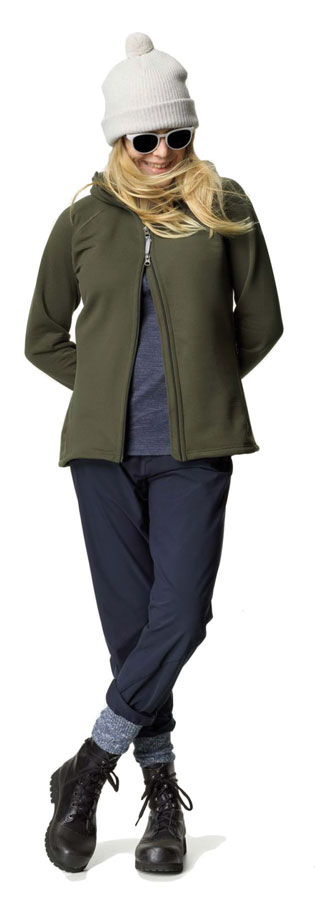
Houdini’s Mono Air Houdi jacket made using Polartec® Power Air™ is helping to fight plastic waste.
By Rachael S. Davis, Executive Editor
Plastic is a large contributor to marine debris, and microfiber shedding from clothing during laundering has been identified as a contributor to microplastics — plastic debris less than 5 millimeters in length — in oceans and lakes. It’s an emerging field of study, and the full impact of such microplastics is not yet known. But companies are taking notice and introducing products designed to reduce the environmental impact of textiles.
Andover, Mass.-based Polartec LLC — a Milliken & Company business — recently introduced Polartec® Power Air™. The knit construction of the fabric is designed to encapsulate air and retain warmth while also reducing the amount of microfiber shedding, which can be especially problematic with fleece-type fabrics. According to Polartec, the fabric “offers advanced thermal efficiency by encapsulating lofted fibers within a multilayer, continuous yarn fabric construction which reduces shedding,” by at least five times when compared to other premium mid-layer-weight fabrics.
Polartec Power Air is made using recycled polyester and elasterall-p, which makes it 100-percent recyclable and circular, according to the company. The fabric also is highly durable and resists pilling.
Sweden-based Houdini — an outdoor company focused on sustainable apparel — selected Polartec Power Air for its Mono Air Houdi fleece jacket. As part of its mission to help designers fight plastic waste, Houdini has made the work behind the jacket — including the design, stitching patterns and list of components — available online for download through the Project Mono Air open-source initiative. The company’s goal is to encourage the apparel industry to become circular and waste-free — a vision that Houdini believes will require collaboration and considerable transformation in the industry.
“The apparel industry is advancing when it comes to sustainable solutions, which is great,” said Eva Karlsson, Houdini CEO. “But we need to speed up the pace. The insight that sparked the idea of Project Mono Air was that if we want to really change the industry for the better, we can’t keep our innovations and discoveries to ourselves. If we all share the problem, why not also share the solutions?”
“The goal with the open-source project is not to create identical copies of the Mono Air, but to let the work behind it become useful in the development of new products,” said Jesper Danielsson, head of Design and Innovation, Houdini. “If this can lead to new circular breakthroughs in the fashion industry — be it in the hands of a basement designer or billion-dollar brand — we are on the right path.”
“Polartec Power Air is a step forward in reducing the environmental impact of what we make and wear,” said Steve Layton, Polartec president. “It’s processes and constructions like these, which make circularity possible. And it’s designs like Houdini’s which help show the world how clothing can be made sustainably.”
For more information about Polartec® Power Air™, contact Emerald Stocker, +281-546-0777; emerald@fieldingmiller.com; polartec.com.
For more information about Project Mono Air, visit houdinisportswear.com.
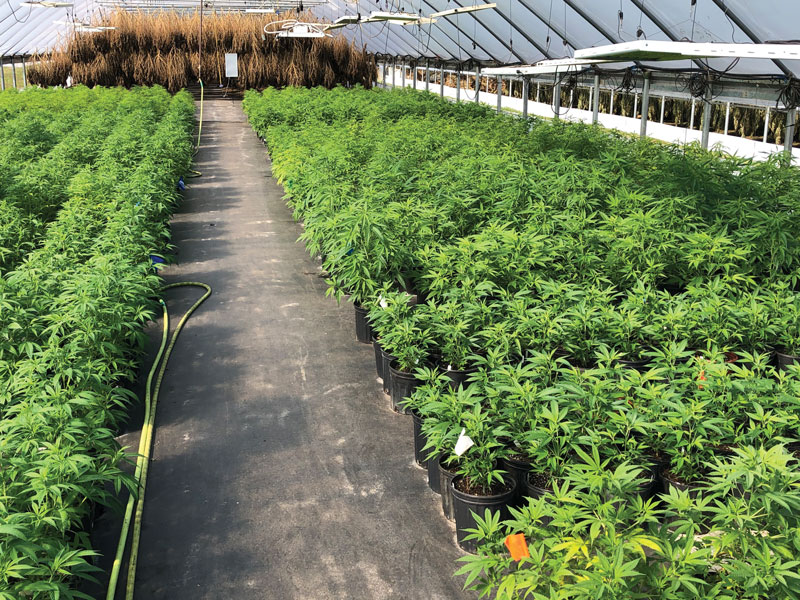
A Kentucky hemp farm grow room where new hemp plant strains are developed.
Educating the consumer to correct misconceptions about hemp will aid growth of the plant in textile applications.
By Jim Kaufmann, Contributing Editor
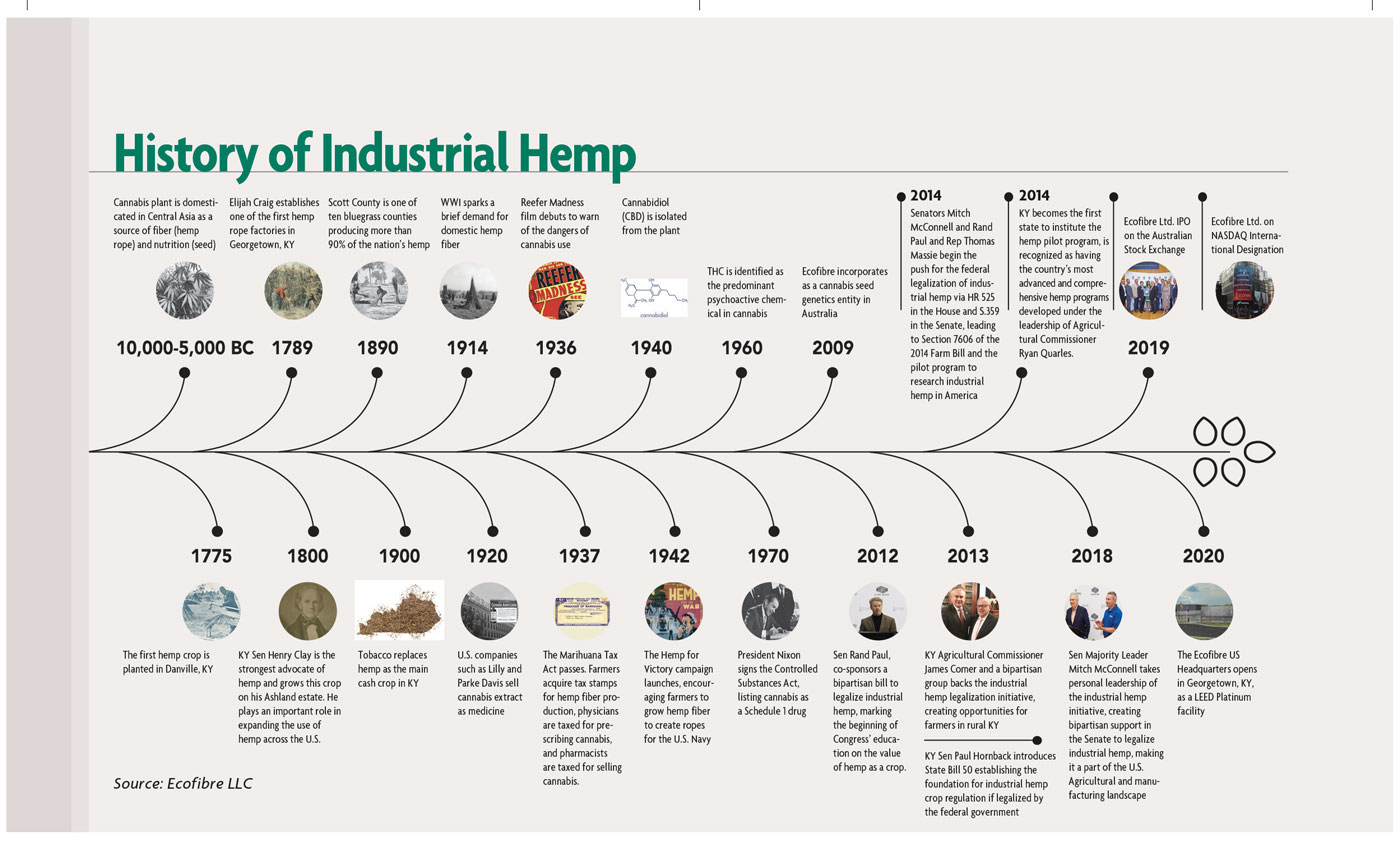
Hemp, one of the earliest known textile fibers, has seen heightened interest and a true resurgence since it was formally legalized, or perhaps relegalized, in the United States with the signing of the Farm Bill Act in 2018. The bill effectively removed industrial hemp from inclusion in the Controlled Substances Act (CSA). The effort to legalize hemp originated in 2014 with several bipartisan legislators initiating a push for the legalization of industrial hemp. Section 7606 was included in the original 2014 Farm Bill, which allowed the creation of state-led pilot programs and sanctioned the investigation of hemp for varied commercial and industrial applications. Kentucky was the first state to institute a hemp pilot program under this new legislation. The 2018 Farm Bill formally made commercial production of hemp legal. The renewed focus on hemp has generated much curiosity and interest, as well as technical studies, real and fake news — not to mention product offerings — and flat-out misinformation passed through various communication channels.
Hemp Versus Marijuana
It’s difficult to talk about hemp specifically without acknowledging its more publicized kin, marijuana. To be clear, while both plants are derived from the cannabis family, hemp is not marijuana. Marijuana is generally thought of singularly as a drug; while hemp has been used for centuries in a variety of ways and uses including foodstuffs, oils, rope, household and industrial textile products, as well as for homeopathic or medicinal purposes. Technically, the two primary differences between hemp and marijuana center around the respective amounts of two specific cannabinoids, delta-9 tetrahydrocannabinol (THC) and cannabidiol (CBD) that each plant contains. THC is the chemical component in cannabis plants that can create mind-altering effects and get one “high.”
As part of the Farm Bill Act of 2018, it was determined that marijuana be specifically defined as having a THC content level greater than 0.3 percent. This definition kept marijuana on the controlled substances list. Conversely, the THC level of hemp is almost always significantly less than 0.3 percent so it was removed from the controlled substances list — Of note: CBD must also contain less than 0.3-percent THC in order for it to be legally sold. So, using the simplest of differentiators, marijuana will get you “high,” hemp will not.
CBD is a non-toxic chemical substance produced by the hemp plant that has been used and proclaimed by multiple cultures going back to ancient times as a dietary supplement with medicinal and healing properties. These beliefs continued into the modern era, but by the end of World War II and with the advent of modern medicines, misinformation and negative perceptions towards cannabis plants in general grew. The result of this misperception made it illegal to cultivate marijuana and hemp.
The Marijuana Tax Act of 1937 effectively killed the hemp industry except for a brief respite during World War II where hemp growth was encouraged to produce rope in support of the war efforts. Ultimately, hemp’s use was greatly diminished in the United States until new research and a changing social climate in the 1990s led to some states legalizing the use of cannabis in treating certain medical conditions. Since then, research into CBD, hemp extract and other derivatives, including as a sustainable textile fiber and input, have grown substantially reigniting hemp’s interest and acceptance.
Textile Applications; Changing Perceptions
While hemp’s CBD content has been the primary driver in its recent resurgence, interest in its use as a textile fiber also still persists. Historically, hemp may be one of the earliest, if not the first sustainable industrial performance driven fibrous raw material used in the production of textile products. And ironically, it’s long and checkered history with numerous highs and lows in many ways mirrors the highs and lows and resurrection of the textiles industry both in the United States and globally. There is evidence of hemp fiber being used to improve pottery as far back as 10,000 years ago, and it potentially was one of the first known agricultural crops. Some of the earliest uses of hemp as a fiber for textiles can be found dating back to 4,000 BC in China and Turkestan making its initial use in textiles roughly 1,000 years earlier than that of cotton.
According to Kent Masterson Brown, a Kentucky historian and award-winning producer of several documentaries on American history: “The first planting of a hemp crop in the United States is believed to have been in the 1600s at Jamestown in Virginia from hemp seeds brought over by European settlers; who it should be noted, arrived aboard sailing ships rigged with sails and rope made from hemp. Hemp was introduced to Kentucky in the late 1700s where it was found to grow well, becoming one of Kentucky’s largest cash crops.”
Brown should know as he currently is raising the funds required to produce a new documentary film detailing the history of hemp in the United States. The documentary’s working title is “The Seed and Fiber of Wealth” and will tell the story of hemp’s growth in the United States from the original settlers through the early 1900s, the perceived negativity and demise associated with cannabis during the mid and later 1900s and hemp’s present day rebirth.
“History told correctly helps people warm to things and see them up front and personal,” Brown said. “I’m hoping that this documentary will help people to understand hemp’s history and that it is truly a sustainable plant of the future.”
As the U.S. welcomed in the 19th century, hemp found consistent increased growth as a textile fiber, where it was made into products including rope, sailcloth, clothing, paper and linens. “Hemp was a crop that governments generally wanted to flourish because of its increasingly vital use in military applications, especially for naval needs because of its natural resistance to rot and mildew,” Brown offered. And keep in mind that in the 19th century, naval ships meant sailing ships with large sails and intricate rope riggings. For example, the USS Constitution — the famous naval sailing vessel also known as Old Ironsides — “carried over 130,000 pounds of hemp rope on it in addition to roughly 30,000 pounds of hemp sail cloth,” Brown noted. “That’s over 160,000 pounds of hemp on just one vessel.”
Hemp is one of the strongest of available natural fibers for textile processing. It is significantly stronger and more durable than cotton and provides better ultraviolet (UV) protection than other natural fiber-based fabrics. Hemp also checks off virtually all of the boxes required to be considered sustainable. It is naturally hypoallergenic, antiviral, antibacterial and antimicrobial, which also is beneficial to farmers because it can be grown in a more ecofriendly environment with greatly reduced needs for fertilizers and pesticides. It requires less water to grow than cotton and is generally acknowledged as being regenerative of the soil leaving it in better condition than cotton growth. As a result, farmers are able to rotate crops more effectively with hemp plantings.
According to Brown: “Hemp is an annual plant that has become acclimated to and continues to grow well in Kentucky, likely due to the soil’s limestone content. With hemp’s recent legalization, it has again become a leading crop for many of the local farmers.”
Because of the different application needs of hemp plants, farmers have bred the plant into different strains based on intended applications. For fibrous applications, mostly in traditional textile configurations, a hemp strain has been genetically modified to produce taller plants with lengthy fibrous stalks and fewer leaves or flowers. Because CBD extract and oils are mostly derived from the hemp flowers, these plants have been genetically modified to grow with very little stalk, less fibrous material, and a much shorter growing height — but with an abundance of flowering buds, which is then harvested in a similar manner to tobacco. For the hemp strains, the goal is to maximize the consistency of resultant hemp products or derivatives from one grow year to the next. Farmers then will harvest and process the hemp plant, separating the fiber and stalk from the flower and selling the resultant components to various customers.
Applications for hemp and its by-products also continue to grow as there is more and more interest in bio-friendly, sustainable consumer and industrial products. Hemp fiber now is used, reconsidered and/or developed for numerous textile applications in nonwovens, wovens and knit configurations where its inherent natural physical properties show exceptional promise. Research also is evaluating hemp for fiber reinforcement in new composite applications where the sustainability, fiber strength, elongation and potential cost benefits are intriguing. The CBD oil, full spectrum hemp extract, pure extract from the hemp plant, and other hemp derivatives continue to inspire all kinds of opportunities in homeopathic and medicinal applications as well (See “Hemp Black: Unique Technologies Derived From A Unique Input,” TW, this issue). This, in addition to a variety of innovative possibilities under development or still a thought in the back of someone’s brain, and the future for hemp is indeed very bright.
However, proper education of the consumer remains a big challenge and focus of the hemp industry. According to Eric Wang, managing director of Ecofibre, an Australia-based industrial hemp company focused on the development and manufacture of hemp derived products: “Our current challenge is the real versus fake products in the marketplace and the perceptions or misperceptions they can create. Real is science-based, fake is those making a quick buck off of some version of CBD. There remains lots of misinformation about hemp that creates a bad name that is really not deserved. CBD products can indeed help people. They’re proven, healthy and present a real alternative to big pharma. It’s our job to make the best hemp derived products we can and educate our customer base that the benefits of the hemp plant and its derivatives are real.”
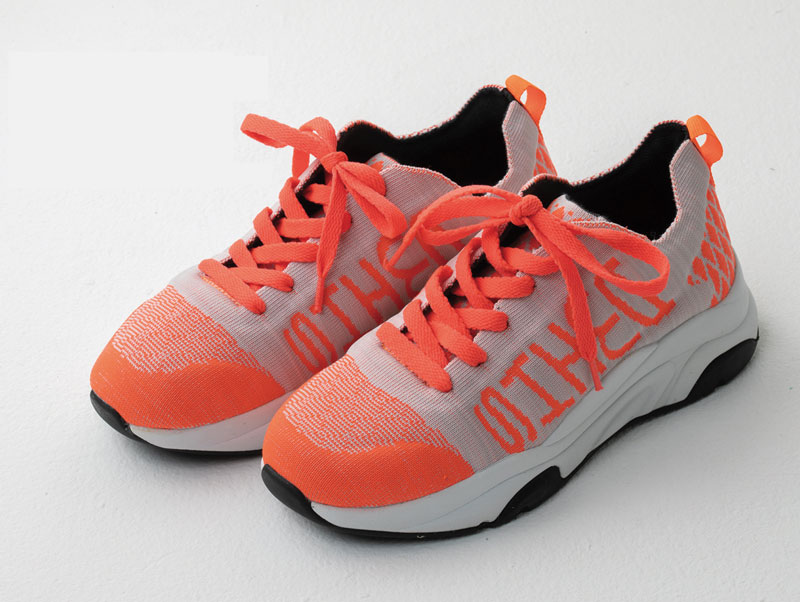
Figure 1: Knitted shoe uppers are becoming more commonplace with 3D structures and single panel designs all possible using the latest knitting technology. Image courtesy of SHIMA SEIKI
NC State student’s research project evaluated how natural fibers performed compared to man-made fibers in knit structures commonly found in shoe uppers.
By Zoe Newman
Textile research and innovation is important for many students, faculty, and staff at the Wilson College of Textiles at North Carolina State University in Raleigh, N.C. It is also not uncommon for the campus community to be aware of the latest fashion trends. The introduction of knit footwear by Nike and Adidas in 2012 became popular on campus and around the world. Access to advanced technology and machinery at the Wilson College of Textiles led to a study focusing on the integration of natural yarns in knit footwear uppers. Sustainability is of increasing importance in the industry. This study was prompted by the current global environmental crises and textile impacts currently facing our world.
Climate Change; Sustainable Textiles
In 2015, the Paris Climate Agreement brought nations together to fight climate change and reduce global warming.
The fashion and textile industries are contributors to climate change, producing a copious amount of waste, including footwear materials. However, the introduction of knit footwear to the industry was groundbreaking for sustainable initiatives. The product changed how some footwear is made, using only a single piece of fabric for the upper of a shoe as opposed to multiple pieces that produce waste in a cut-and-sew process. The Adidas Primeknit shoe is one example of a shoe featuring a single panel of fabric.
In such a shoe, as in many knit footwear pieces, man-made or recycled man-made polymers are used. Man-made polymers offer unparalleled strength in comparison to natural fibers. However, the use of man-made polymers is detrimental to the environment. Man-made waste in landfills results in runoff containing microplastics, which travel to bodies of water and eventually impact our ecosystem. One study showed 35 percent of microplastics in the oceans come from man-made textiles.* The introduction of recycled man-made polymers has been groundbreaking for this reason. Companies such as Parley for the Oceans and Greensboro, N.C.-based Unifi Inc. have developed recycled man-made fibers made using plastic bottle waste diverted from or found in the oceans. The use of this yarn in many products has been helpful to delay man-made plastic waste in landfills, however it is not a solution to the environmental crisis our world is facing.
Ideation
The goal of the research project was to evaluate how natural fibers compare to man-made fibers in the development of knit structures commonly found in footwear uppers. This study may allow product developers and researchers to consider more natural components for use in footwear. While footwear made using natural fibers may not be as strong as those using man-made fibers, it may have a beneficial impact on our environment.
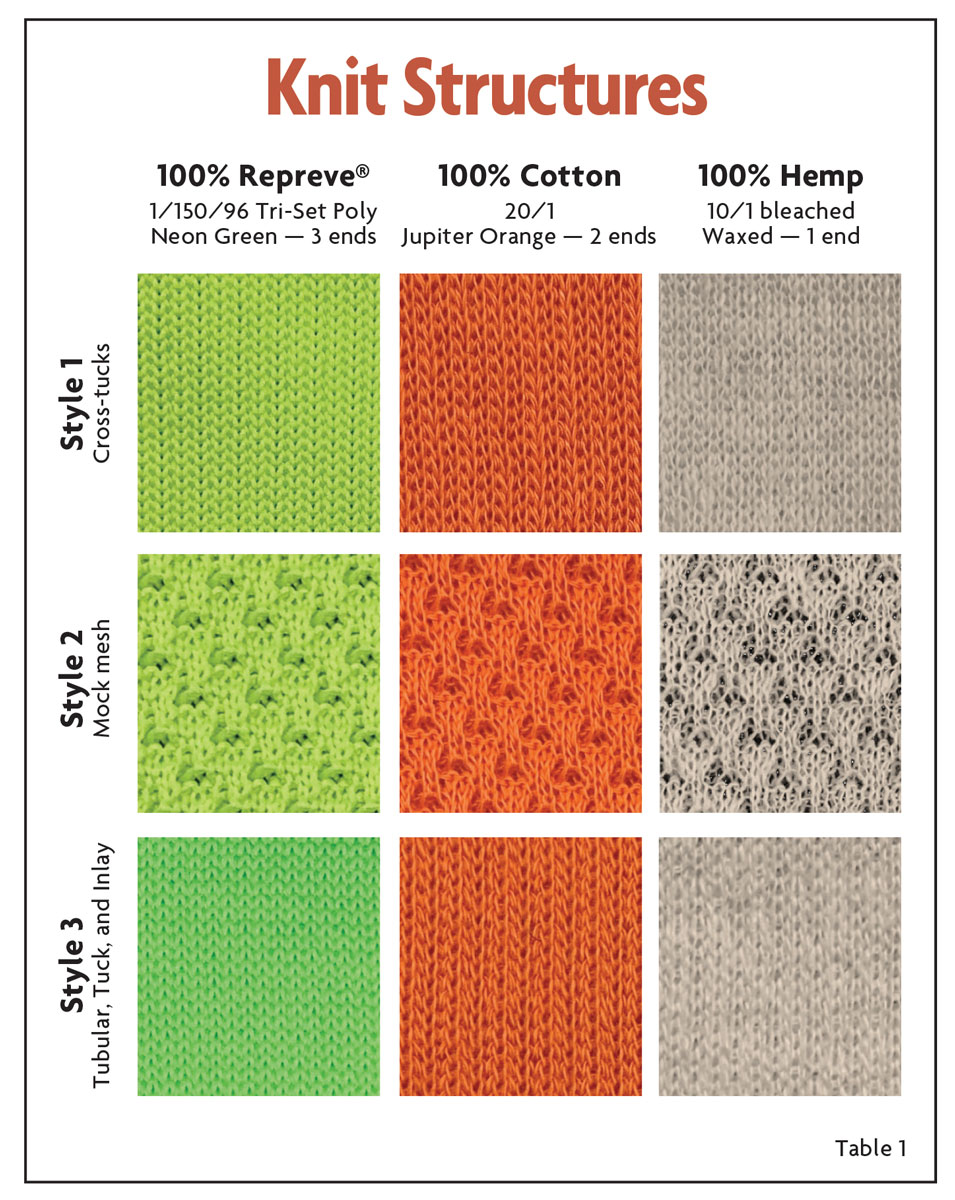
In the study, three knit structures were developed using Unifi’s Repreve®, 100-percent cotton, and 100-percent hemp yarn (see Table 1).
Research was limited to Shima Seiki’s N.SVR123 weft flatbed knitting machinery, and did not test all types of man-made or natural yarns. Repreve was chosen as a regenerated man-made fiber for this study because of its popularity in the industry for such footwear uses. Cotton was chosen for its known comfort and strength; while hemp was chosen for its emerging market in the United States as well as its possible applications in other components of footwear, including, but not limited to, composites for soles.
The following research questions were addressed:
How does yarn content impact the performance attributes of knit structures?
How does the knit structure impact the physical properties of fabrics for footwear applications?
Fabrication
Table 1 shows specifics regarding the fabrics that were developed. Each fabric was controlled for best performance on the knitting machine.
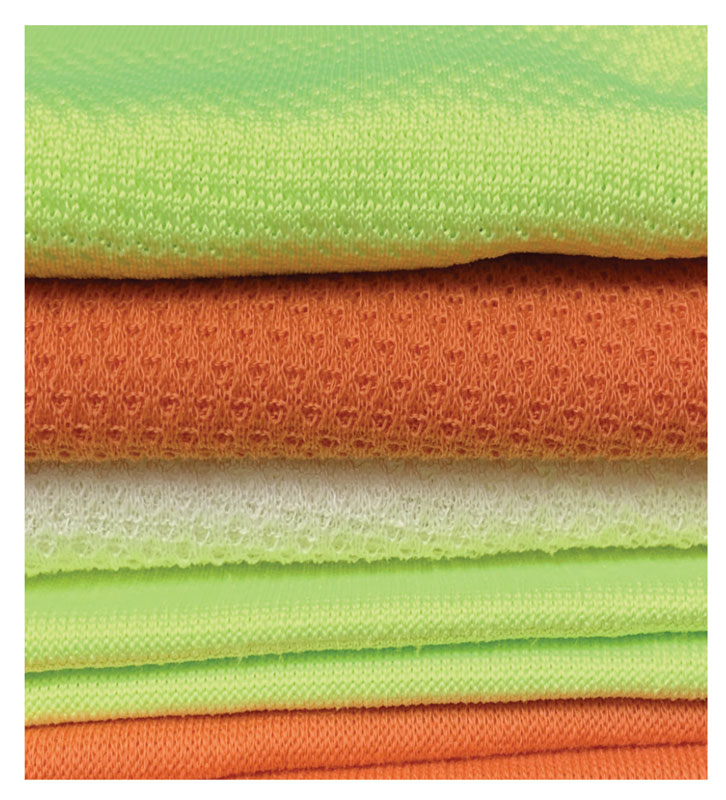
Figure 2: Fabrics developed for the study (top to bottom) Repreve®, cotton and hemp (Image by Zoe Newman)
Testing
Each fabric was tested for thickness, weight, abrasion resistance, air permeability, moisture regain, burst strength and elongation. The Repreve fabric performed markedly well in many of the categories as a result of its crystalline orientation developed during processing and extrusion. In comparison to hemp, the cotton fiber performed well in the air permeability, burst strength and moisture regain categories. Hemp had a low burst strength likely due to the processing of the fiber, and the use of only one end in the making of the fabric. The hemp fiber also provided greater moisture regain results than cotton, which may be useful in certain footwear markets. The fabrics developed for the study are shown in Figure 2.
Conclusions
The results of the study may conclude that a breathable, open structure such as the mock mesh may be expected to perform with greater air permeability and lower burst strength standards. The integration of an inlay yarn will develop a stronger fabric for footwear applications. Ultimately, further research may address the use of different structures in footwear and it will be necessary to evaluate the efficacy of hemp and other natural fibers in the footwear market. The research in this study may act as a steppingstone for future footwear development with the integration of natural yarns. Future research may be performed in which natural fibers are blended to provide certain properties in a footwear fabric. It may also be important to evaluate the performance of natural fibers in wet environments.
The development of knit footwear using natural yarns is a step in the right direction in addressing the environmental crisis. Eventually, we may see students at the Wilson College of Textiles and universities around the world wearing knit footwear derived from natural fibers.
Editor’s Notes: Zoe Newman is a student graduating with a Master of Science in Textiles in December 2020, and graduating with a Ph.D in Textile Technology Management in December 2022 from NC State’s Wilson College Of Textiles, Raleigh, N.C. If you are interested in supporting this project or would like more specifics on this research including fabric specifications, please contact Zoe Newman (zlnewman@ ncsu.edu) or Dr. Andre West (ajwest2@ncsu.edu), Director, Zeis Textile Extension, TATM.
Braskem, São Paulo, and Haldor Topsoe, Denmark, report they have managed to produce biobased monoethylene glycol (MEG) — a raw material used in the production of polyethylene terephthalate (PET) — by transforming sugar into renewable MEG using a demonstration MOSAIK™ technology unit. Next steps involve sampling the products with strategic partners to test the raw material and gain validation for the biobased MEG.
“This first-ever production of MOSAIK-MEG is a major step forward in our project and underlines Braskem’s commitment to the Circular Economy through renewable chemicals,” said Gustavo Sergi, executive officer of Renewable Chemicals and Specialties, Braskem.
France-based CARBIOS reports it has used its enzymatic waste recycling technology to produce bottles containing 100-percent recycled purified terephthalic acid (rPTA) from textile waste containing a high PET content. Carbios notes that this capability opens up access to a 42-million-ton waste stream per year, which is worth more than $40 billion. It also allows polyester textile fibers to be upcycled into a high-quality grade of PET suitable for clear bottle production when they currently are landfilled or downcycled into such applications as padding or rags.
“This major innovation allows us to expand our sources of supply which, until now, consisted primarily of PET plastic waste,” said Professor Alain Marty, chief scientific officer of Carbios.
Sweden-based Södra reports it has added 20-percent used textiles to its OnceMore® dissolving pulp. The company launched its technology in 2019 using 3-percent recycled textile content. Since then, Södra has worked to increase the recycled content with a goal to reach 50 percent.
“OnceMore has the potential to shake up the fashion industry and will enable large volumes of used cotton and cotton-polyester blends to be turned into new clothing and textiles,” said Johannes Bogren, vice president of Södra Cell Bioproducts. “We are delighted with the progress achieved so far. We have invested in the pulp mill where we have produced standard dissolving pulp for some time and where we can now also manufacture OnceMore.”