Teknor Apex Acquires The Business Of Nu-Pro Polymers  

PAWTUCKET, R.I. — April 11, 2023 — Teknor Apex, a material science company with multiple specialty plastics divisions, reports it has acquired the business of Nu-Pro Polymers Inc., Wheeling, Ill., late last year. Nu-Pro works with clean post-industrial (PIR) streams and converts them into new PVC compounds which perform equivalently to prime compounds. Nu-Pro specializes in clear, natural and black reprocessed compounds in a range of durometers. Under the acquisition, Nu-Pro will continue to produce products for Teknor Apex at this time, under the Cycle-Tek brand as a subsidiary of Teknor Apex.

“We are very excited about this acquisition that will further enable us to develop innovative compounds that meet the performance and sustainability requirements of our customers,” said Lou Cappucci, executive vice president, Teknor Apex.

“Our flexible, reprocessed and recycled PVC compounds incorporate up to 90 percent post-industrial recycled content,” said Don Brown, co-owner, Nu-Pro Polymers. “Our goal is to convert PVC waste streams into products that perform for our customers.”

“Teknor Apex prides itself on providing innovative and sustainable products, whether through development, expansion or partnerships. The acquisition of the Nu-Pro business is another step in ensuring vinyl continues to be a sustainable option in the plastics manufacturing market,” added Sunny Mahajan, senior technical manager – Teknor Apex, and Business Manager – Cycle-Tek.

Posted April 11, 2023

Source Teknor Apex

Cone Denim x AMK Atelier x Tonello Launch Collaborative Collection At Kingpins Amsterdam

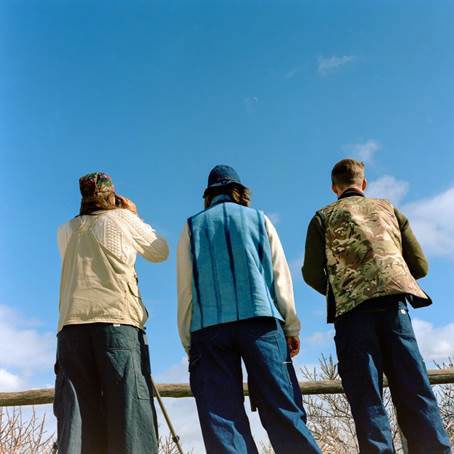
GREENSBORO, N.C. — April 11, 2023 — Cone Denim® will debut Wander, a denim collaboration with AMK Atelier, garment finisher Tonello and videographer Eduard Nijgh at Kingpins Amsterdam April 12-13. The collaborative collection was inspired by the outdoors and the mental health benefits of being immersed in nature. Wander, designed by AMK Atelier Founder Maria Gunnarsson, includes garments in a range of Cone Denim fabrics with the Cone® Community Mental Health Awareness selvage as its hero.

“Project Wander grew organically after a conversation with Maria last year at Kingpins Amsterdam. We worked together on a prior Cone Denim collaboration, The Very Best of Times, and our shared passion for how being outdoors can benefit an individual’s mental health inspired this collection,” said Cone Denim Design Director Pierette Scavuzzo. “The opportunity to work with AMK Atelier, Tonello and Eduard Nijgh on a cause-oriented collaboration and raise awareness through our reach in the industry has been a profound experience.”

Wander carries a dual meaning. On one hand, our minds can wander and cause our mental health to be challenged. On the other hand, wandering in nature positively affects our mental health. Being nurtured by nature benefits both our physical and mental well-being, as reported by the International Journal of Mental Health and Addiction. Their research cites the benefits of nature therapy on mental health and wellness. Studies have shown that spending time in nature is therapeutic. The simple act of spending time outdoors has been associated with lower rates of depression and reduced stress.

“I was born on a farm in the Swedish countryside, and spending time in nature has been a big part of my upbringing. Now that I live in Amsterdam, I value nature even more. My partner Arne and I try to get out as often as we can in our camper car to change the scenery from the city life,” said AMK Atelier Founder and Designer Maria Gunnarsson. “With this background, it was natural to design an outdoor collection based on our lifestyle in the mental health fabric from Cone Denim. I would be honored if this collection could inspire anyone to take a breath, go for a walk and look outside for what nature has to offer.”

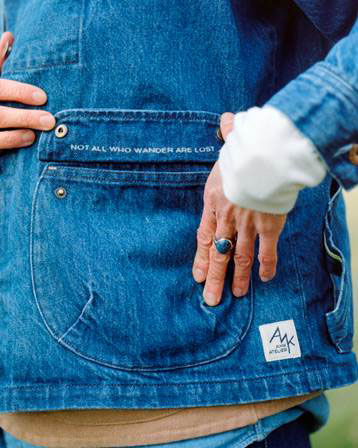
The Wander capsule collection on display at Kingpins will showcase 13 garments inspired by nature and the outdoors. Gunnarsson’s concept for the collection focused on nature, recovery and function. Maria featured the Cone Community Mental Health Awareness fabric with its neon green ID, symbolizing the importance of mental well-being as a central element in her designs. Each garment has the well-known J.R.R. Tolkien’s quote, ‘all who wander are not lost,’ lasered into the fabric.

“The Wander collaboration with Cone Denim and AMK Atelier was a bit like getting lost, only to find yourself again. A finding oneself understood as being in greater contact with nature, as well as in finding a balance with it,” said Alice Tonello, marketing and R&D director for Tonello. “All of this inspired us in making the washes and dyes, which were very responsible and gentle.”

Created in 2019, The Cone Community Collection of fabrics supports and raises awareness for worthy causes that align with the values of Cone Denim. Mental Health was the fourth to launch in the collection and has a neon green ID symbolic for mental health awareness. Made from Cone Denim selvage, this collection has an authentic, 80s-inspired construction in 100% cotton. Cone Denim donates a portion of sales from this collection to the Child Mind Institute.

According to the Child Mind Institute, as many as 1 in 5 children struggle with mental health and learning challenges. Due to stigma, misinformation, and a lack of access to care, the average time between the onset of symptoms and any treatment is over 8 years. This is the reason the Child Mind Institute was created.

The Child Mind Institute is an independent, national nonprofit dedicated to transforming the lives of children and families struggling with mental health and learning disorders by giving them the help they need. They have become the leading independent nonprofit in children’s mental health by providing gold-standard evidence-based care, delivering educational resources to millions of families each year, training educators in underserved communities, and developing tomorrow’s breakthrough treatments.

Scavuzzo continued: “We are excited to, once again, bring some of the greats in the industry together to support such an important cause. Tonello is one of the global leaders in garment finishing technologies and was able to bring beautiful, authentic washes to life. With Maria’s impeccable craft and design details and Eduard Nijgh contributing with his storytelling, we are happy to bring a collection that inspires and supports those facing mental health struggles.”

Posted April 11, 2023

Source: Cone Denim

Textile Recycling: The Sorting Challenge

TW Special Report

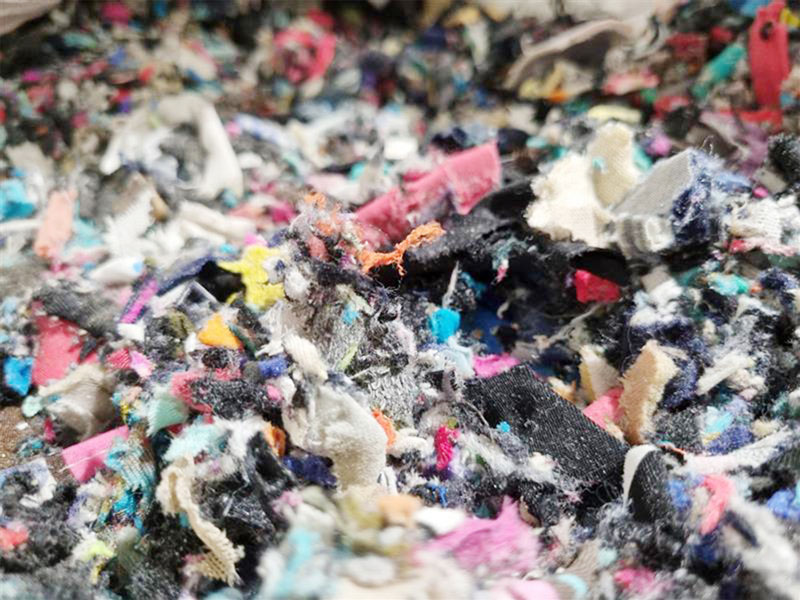
To this day, only a tiny fraction of discarded textiles is recycled. While the clothing industry has doubled production in the last 15 years, the time garments are worn has fallen by more than 30 percent. At the same time, the rising demand for low-cost fast fashion is driving a decline in the quality of the materials, which makes them more difficult to re-use or recycle. According to the Ellen MacArthur Foundation, it is estimated that 114 million tonnes of textile waste are generated every year. Of the clothing that is collected for recycling, 12 percent is downcycled into lower-value applications such as insulation material, and less than 1 percent is used to make new clothing in a closed-loop circular economy. The high content of polyester in fast fashion also means that an increasing quantity of discarded textiles are incinerated in waste-to-energy plants because of its high calorific value.

The environmental impact of textile waste

The rising consumption of clothing, coupled with the decreasing wearing time and increasing use of synthetic materials such as polyester and nylon, is worsening the negative impact on the environment. Large quantities of plastic microfibres shed through the washing of textiles are leaked into the ocean, accounting for 35 percent of microplastic pollution1. Improper disposal can also result in flat textiles released into the environment, endangering wildlife on land2 and marine life3.
Regulatory drive for the development of textile recycling

Policymakers have a key role to play in driving an increase in recycling. In Europe, in 2022 the Commission presented an EU Strategy for Sustainable Textiles4, which includes extending the lifetime of textiles by recycling the materials they contain into new quality products. The revised Waste Framework Directive requires EU member countries to establish systems for separate collection of textile waste by the beginning of 2025, and at the same time, new collection and recycling targets will kick in. The infrastructure for collecting, sorting and recycling these materials will need to expand fast in readiness for the new regulations.

The textile sorting challenge

Clothing is made of different fabrics, fixtures and accessories, such as buttons or zips, and they contain a variety of raw materials — combinations of natural and synthetic fibers, plastics and metals. This makes disposing of it sustainably a complicated matter.

“The recycling industry requires pure fractions or very specific mixtures,” explained Annika Ludes, engineer for Digital Solutions at STADLER. “This means removing the fixtures and accessories from the fabric. The different materials in the garment — the outside fabric, the lining, the seams — need to be separated, then the different fibers in each fabric — cotton, elastane, polyester, etc. — must be sorted.”

Today, textile sorting is done manually, and only a small portion of the output material is suitable for recycling. However, research is ongoing on automating the process with the aim of producing the high-quality fractions required to address the recycling challenge.
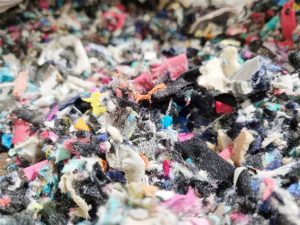
Automated sorting: the path to a textile circular economy

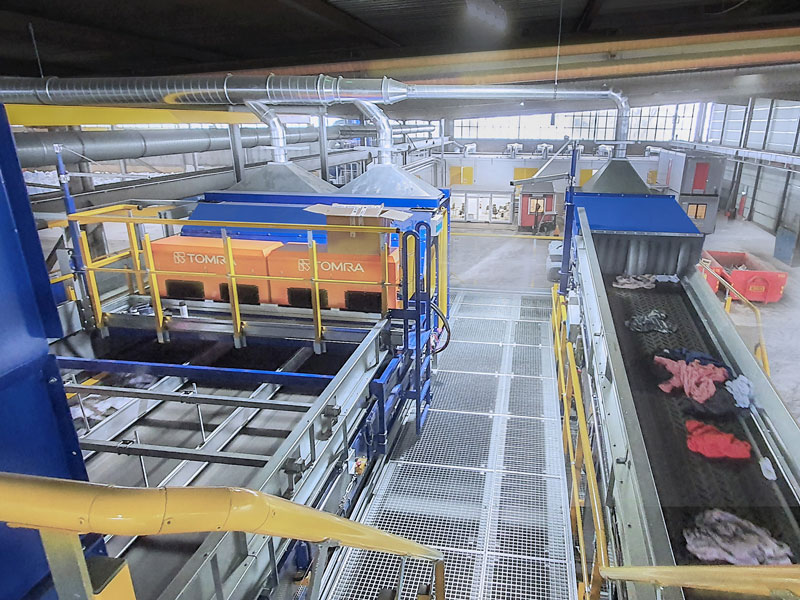
STADLER — a supplier of sorting plants for the recycling industry — is researching automated sensor-based solutions for textile sorting. In 2017, in partnership with TOMRA, it has designed and built a small pilot project plant in Avesta, Sweden, in the second phase of the government-funded Swedish Innovation Platform for Textile Sorting (SIPTex) project, which aims to develop a sorting solution tailored to the needs of textile recyclers and the garment industry. This was followed in 2020 with the third phase of the project: the first industrial-scale fully automated mixed textile waste plant in the world, which is capable of achieving the purity and recovery required for recycling and reutilization.

This facility, located in Malmö, processes preconsumer waste from textile producers (clippings and rejects) and post-consumer waste, which consists of clothing and household textiles, and may contain non-textile parts such as buttons and zippers. The material is delivered in bales weighting from 350 to 500 kg and is sorted whole. The plant has the capacity to process up to 4.5 metric tons per hour in one line.

The textile sorting process

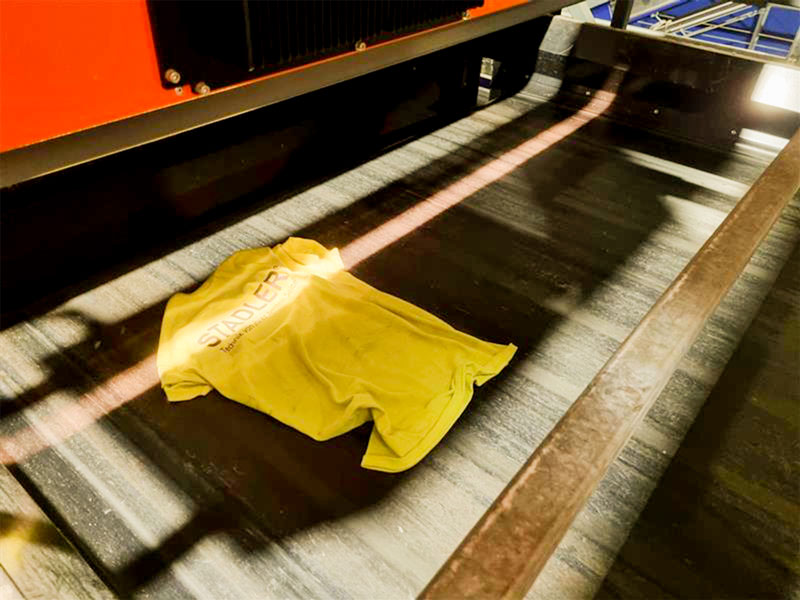
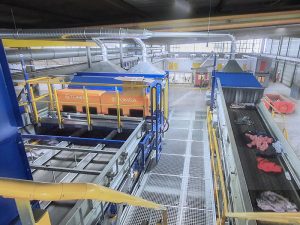
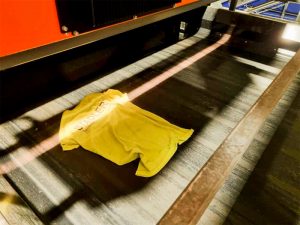
The process developed by STADLER with the cooperation of TOMRA in the SIPTex project starts with the waste textiles entering the plant in batches, dosed, fed by conveyor belts into four sensor-based TOMRA AUTOSORT® units.

“Because of the nature of the textile material fed into the plant, the feeding system and dosing are very important to the success of the sorting process,” explains Dr. Bastian Küppers, Engineer for Digital Business Development at STADLER. “The STADLER dosing drum features mechanical components specially designed to handle the soft, flexible textile materials, of various shapes and unpredictable sizes, prone to tangling. Similarly, the design and layout of the conveyor belts, hoppers and chutes need to be designed to avoid tangling of long pieces of fabric.”

The TOMRA NIR (Near Infrared) sorting technology is also key to the process and capable of recognizing and differentiating various types of textiles in a first step. A second optical sorter is added for further cleaning of impurities.

Towards a textile circular economy

As the textile industry is moving towards a circular economy, driven by public opinion and legislation, the demand for textile sorting equipment is set to grow at an accelerated pace. STADLER has already seen an increase in interest for textile sorting plants and has been approached by companies in the recycling sector. “At STADLER we are seeing many interested parties who would like to visit the textile sorting plant we designed and built in Malmö,” comments Annika Ludes.

STADLER is uniquely well placed to meet this new demand, bringing to the table its extensive know-how in the design and construction of sorting plants and the specific experience it has acquired through the SIPTex project, as well as the expertise of its technological partners such as TOMRA. With its holistic approach, it is able to develop complete solutions tailored to the requirements of the individual customers.

Sources:
1.     Boucher, J.; Friot, D. Primary microplastics in the oceans: A global evaluation of sources. IUCN International Union for Conservation of Nature, 2017 / Büks, F.; Kaupenjohann, M. Global concentrations of microplastics in soils – a review SOIL Band:6; H. 2, S. 649–662; 2020
2.     Macklin, Malorie: 5 Ways Plastic Pollution Impacts Animals on Land
3.     Center for Biological Diversity; Ocean plastics pollution – A global tragedy for our oceans and sea life
4.     EU strategy for sustainable textiles

April 11, 2023

Moss Wins IFES Development + Innovation Award for SustainaTex Ocean

FRANKLIN PARK, Ill. — March 14, 2023 — Moss Inc., a provider of high-quality graphics and tension fabric structures, has won the coveted first-place prize at the IFES Development + Innovation Awards (IDIA) for its SustainaTex Ocean, a fabric blend produced from upcycled marine plastic, post-consumer waste, and recycled polyester. The prestigious award was presented at EuropShop, an event for the global retail industry.

SustainaTex Ocean sets a new industry standard for brand impact using 100-percent recycled eco-friendly graphic materials. A breakthrough product that tackles the growing problem of plastic waste in our oceans, SustainaTex Ocean is made entirely from recycled materials, including plastic recovered from the ocean, and is a sustainable and eco-friendly textile that is perfect for event graphics, exhibition design, and retail environments.

“We are thrilled to have won the IDIA first-place prize for SustainaTex Ocean,” said Jason Popp, president and CEO of Moss. “Our team has worked diligently to offer a product that not only meets the highest standards of design and performance but also addresses a critical environmental issue.”

IDIA recognizes exceptional products and companies that showcase outstanding design, innovation, and sustainability in the industry. This designation reflects Moss’ unwavering commitment to the environment and ongoing pursuit of innovative materials and technologies that minimize waste and advance sustainability in the industry. Moss is fully dedicated to responsible manufacturing practices and reducing their environmental footprint. As a crucial first step towards becoming carbon neutral, the Company has partnered with ClimatePartner to offset the carbon emissions generated by their North American and European plant operations.

“Our role as stewards of the environment is not only to lessen the footprint of our operations but also to assess and reduce the impact of our suppliers and customers too,” Popp added. “This is an excellent challenge for the ingenuity of Moss.”

Moss exclusively launched SustainaTex Ocean as part of its alliance with the SEAQUAL INITIATIVE, a community that works with ocean clean-up programs worldwide to transform recovered marine litter into Upcycled Marine Plastic. As further dedication to this initiative that drives positive change through sustainable solutions, Moss will only ship in bags made from 100% recycled content that are fully recyclable in Europe and the United States.

Posted April 11, 2023

Source: Moss

Alliance For European Flax-Linen & Hemp To Host Expanded Natural Fibre Village And Release New Vibration Damping Report At JEC World 2023

PARIS — April 3, 2023 — Responding to demand from manufacturers for reinforcements that are scientifically proven to be sustainable and high-performing, Alliance for European Flax-Linen & Hemp (previously known as the European Confederation for Flax and Hemp) will once again partner with the JEC Group to host an expanded Natural Fibre Village at JEC World 2023. The group will also showcase its new visual identity and name having rebranded in December 2022.

Alliance for European Flax-Linen & Hemp members Bcomp, Demgy Group, Depestele, EcoTechnilin, Flipts&Dobbels, Safilin and Terre de Lin will be joined at the 2023 Natural Fibre Village by first time exhibitors CultureiN and Texinov Tech, making it one of the largest natural fiber villages at JEC to date. Members will exhibit a wide range of flax products designed for industrial-scale-use, from building materials and performance parts for automotive vehicles, to motorsport components, consumer goods and products for the marine industry. For this latest edition, a central networking and social area will also be added to the Natural Fibre Village for increased collaboration amongst members and their partners.

As well as the latest developments exhibited on member stands within the village, highlights on display at the JEC World 2023 Innovation Planets will also include:

  • Alpine A110 E-ternite with flax fibre composite parts by Terre de Lin
  • Harley Davidson LiveWire electric motorcycle with Bcomp ampliTex™ flax bodywork
  • K2 touring skis using Bcomp ampliTex™ natural fibre reinforcements

Alliance for European Flax-Linen & Hemp will also publish a new technical fiber technical report at JEC World 2023 with the latest addition to its document library featuring a detailed study of the vibration damping benefits of flax and hemp fibers in composite structures. In addition, the Alliance will continue to reinforce the value of its European Flax® certification, that provides manufacturers of composites with fully traceable and certified premium-quality flax fibers that are sustainably grown in Western Europe.

Further, as part of the JEC Composite Exchange sessions during the show, Alliance for European Flax-Linen & Hemp will present a session titled, “Flax and Hemp fibre composites, The biobased solutions for the Industry,” when it will discuss the latest natural fiber composite developments, vibration-damping properties of flax and hemp in composites, and updates on its work on environmental trajectory, life-cycle analysis (LCA) of flax-fiber reinforcements. The session, presented by the experts of the enlarged European Scientific Council of the Alliance, will take place on 25 April at 4.00PM on the Agora Stage in Hall 5.

“We are clearly stating our ambition of making European Flax-Linen and Hemp the preferred sustainable premium fibers worldwide. To this end, our strategic trajectory focuses on three pillars: growing our Flax-Linen and Hemp ecosystem; becoming an innovative and sustainable international reference; and, finally, guaranteeing quality and embodying desirability. Today, the European Flax-Linen and Hemp ecosystem thus embodies an innovative and sustainable European textile dynamic that meets the needs of consumers and brands.” Bart Depourcq, President, Alliance for European Flax-Linen & Hemp.

“The composites industry is striving to make its products more environmentally sustainable, without compromising the low weight and excellent mechanical properties for which they are prized. The use of flax-fiber reinforcements could make a significant contribution to meeting these challenges, and we look forward to promoting the latest developments from our members at JEC World 2023.” Valentin Depestele, president of Technical Uses, Alliance for European Flax-Linen & Hemp.

Posted April 11, 2023

Source: Alliance For European Flax-Linen & Hemp

AATCC Partners With Industry For LED Conversion

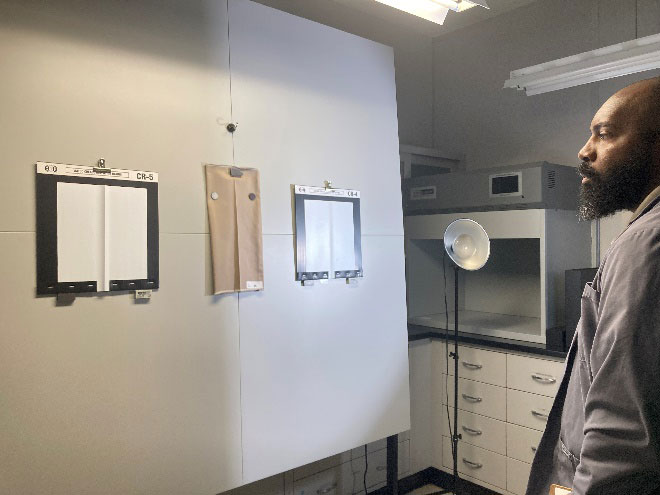
A technician evaluates crease specimens using the current AATCC TM88C viewing conditions.

RESEARCH TRIANGLE PARK, N.C. — April 11, 2023 — For more than 50 years, labs around the world have used the same lighting conditions as well as standardized sample preparation, laundering procedures, and grading scales for consistent evaluation of textile appearance. Now, AATCC is combining that consistency with more energy efficient options.

Lighting conditions impact the appearance of textile products — and just about everything else. As the world transitions to new lighting technology, AATCC is working with specialists from the lighting industry as well as textile experts to identify alternative light sources for existing test methods.

A task group of AATCC committee RA61 Appearance Retention Test Methods is currently studying the influence of viewing environment on appearance evaluation. The group includes representatives from AATCC, Cotton Incorporated, Telelumen, Textile Color and Sourcing Solutions, VeriVide, and several other organizations. Adam Dakin, sales manager for VeriVide, spoke about why his company works with AATCC committees. “At VeriVide we understand the importance of accurate and repeatable viewing conditions for visual and digital assessment,” Dakin said. “For many years we have supported the AATCC with specialized visual assessment equipment to assist with their textile test methods. So, we were pleased to be asked to provide our technical support and to develop an up-to-date futureproof solution for the appearance retention test methods.”

A technician evaluates crease specimens under LED illumination. The viewing board and lamps were donated to the AATCC Technical Center by VeriVide Ltd as part of a collaborative research project.

The goal of the project is to approve light emitting diode (LED) lamps that give the same test results as traditional light sources. Pending ort existing regulations have made the currently specified lamps — and 8-foot fluorescent tube and a 500-watt incandescent flood lamp — increasingly difficult to source. AATCC sells the flood lamp but quantities are limited.

VeriVide donated a viewing board with LED illumination for the study. Four experienced evaluators from Cotton Incorporated and AATCC did a preliminary round of testing in March. They viewed creased specimens (AATCC TM88C) under three different lighting conditions. Statistical analysis of the data will be used to make recommendations for additional experiments and test method revisions. Labs with the standard fluorescent and incandescent lamps will be able to continue using them. Labs that need new or replacement lamps will soon have easier, less expensive, and more environmentally friendly options for evaluating fabric smoothness, seam smoothness, crease retention, product appearance, and stain release.

AATCC committee RA36 Color Evaluation Test Methods is also looking at LEDs. The committee is exploring ways to help retailers choose standard illuminants for viewing color that represent what consumers see in their stores.

To learn more about these and other committee projects, register to attend AATCC Research Committee meetings at www.aatcc.org/aatcc-events/research. Attendance is free and open to all. Join remotely from anywhere or attend in person to take full advantage of networking and learning opportunities.

Posted April 11, 2023

Source: AATCC


Australian Environmental Company EPOC Enviro, A PFAS Remediation Company, Selects Iredell County N.C., For Its First North American Operation

RALEIGH, N.C. — April 11, 2023 — EPOC Enviro, a PFAS remediation company, will create 226 new jobs in Iredell County, Governor Roy Cooper announced today. The company will invest more than $4.1 million to locate its first North American production site to Statesville.

“It’s great to welcome EPOC Enviro to Iredell County in the nationally recognized top state for business with the best workers in the world,” Governor Cooper said. “Our fight against polluted water and climate change will be bolstered by this company’s innovative products and its commitment to sustainability.”

EPOC Enviro is a subsidiary of OPEC Systems, an Australian firm with three decades of global environmental engineering experience. With award-winning SAFF®, a Surface Active Foam Fractionation technology, EPOC provides a clean and sustainable remediation solution that removes harmful per- and polyfluoroalkyl substances (PFAS) from water, soil, and industrial systems. The company patented SAFF in 2016 as a natural process using air to permanently, and rapidly, remediate PFAS with zero harm to the environment. The new location in Statesville will provide 260,000 square feet of manufacturing space to serve and expand its U.S. market.

“After looking at possible sites all over America we are delighted to have settled on North Carolina as the hub for our U.S. business activities,” said Peter Murphy, president of EPOC Enviro. “Statesville is perfectly situated in a beautiful corner of the country, and it is exactly the kind of community we were hoping to become an integral part of.”

“Global manufacturers like EPOC are attracted to places with a diverse and skilled workforce,” said N.C. Commerce Secretary Machelle Baker Sanders. “North Carolina not only has the largest manufacturing workforce in the southeastern United States, but it also has a strategic economic development plan that prioritizes our workforce and training systems to help prepare our talent for the jobs of today and tomorrow.”

The North Carolina Department of Commerce led the state’s efforts to support EPOC’s location to North Carolina. New positions include electricians, engineers, fitters, managers, technicians, and administrative personnel. Although salaries for the new positions will vary, the average annual salary for the new positions is $64,464, which exceeds the Iredell County average wage of $64,433. The project could create a potential annual payroll impact of more than $14.5 million per year for the region.

EPOC’s project will be facilitated, in part, by a Job Development Investment Grant (JDIG) approved by the state’s Economic Investment Committee earlier today. Over the course of the 12-year term of this grant, the project is estimated to grow the state’s economy by $712 million. Using a formula that takes into account the new tax revenues generated by the new jobs, the JDIG agreement authorizes the potential reimbursement to the company of up to $1,265,250 spread over 12 years. State payments only occur following performance verification by the departments of Commerce and Revenue that the company has met its incremental job creation and investment targets. JDIG projects result in positive net tax revenue to the state treasury, even after taking into consideration the grant’s reimbursement payments to a given company.

Because EPOC chose a site in Iredell County, classified by the state’s economic tier system as Tier 3, the company’s JDIG agreement also calls for moving $421,750 into the state’s Industrial Development Fund – Utility Account. The Utility Account helps rural communities across the state finance necessary infrastructure upgrades to attract future business.

“EPOC could have selected any place in the world for this expansion and we’re delighted they chose Statesville,” said N.C. Senator Vickie Sawyer. “Manufacturers can reach more than 70% of the nation’s population in two days from Iredell County, and is near one of the world’s busiest airports, making it a great area for foreign direct investment.”

“This is an outstanding win for Iredell County and the entire state,” said N.C. Representative Jeffrey C. McNeely. “We sincerely appreciate the local and state officials and economic development professionals that helped bring these good-paying jobs and this new investment to our community.”

In addition to the North Carolina Department of Commerce and the Economic Development Partnership of North Carolina, other key partners in the project include the North Carolina General Assembly, the North Carolina Department of Environmental Quality, the North Carolina Community College System, Mitchell Community College, Iredell County, Iredell County Economic Development Corporation, the City of Statesville and Charlotte Regional Business Alliance.

Posted: April 11, 2023

Source: North Carolina Office of the Governor

Lectra Brings Production Back In-House With The Inauguration Of Its Manufacturing Facility In Tolland, Connecticut

TOLLAND, Conn. — April 11, 2023 — Lectra recently celebrated the inauguration of its manufacturing facility in Tolland, Conn. The implementation of operations in this facility marks an important milestone in Lectra’s 2023-2025 strategic roadmap as the company expedites bringing manufacturing in-house for improved quality and customer satisfaction.

With this additional factory, Lectra’s complete line of single ply cutters, including the Z1, Taurus, and DCS series, will be manufactured in-house, enabling Lectra to meet customer demands quicker, while reducing lead times by 60 percent. A larger investment in inventory coupled with a move towards leaner and more modern production systems will also enable Lectra to provide a higher quality service for customers.

April 4, 2023, marked the inauguration ceremony of the manufacturing facility in Tolland. Daniel Harari, CEO of Lectra, honored the occasion with a ribbon cutting ceremony along with the company’s executive leadership team, who toured the facility to observe the extensive manufacturing workspace and industry leading equipment. Media across the fashion, furniture and textile markets attended the event, in addition to members of leading industry associations. Connecticut state representative and Tolland’s town manager were also in attendance.

“A big part of our strategy is focused on manufacturing in-house and across our main regions. The opening of our Tolland manufacturing facility will enable us to better control production,” Harari said. “It will also enable us to hire more employees and give back to the communities where we live and work. As we look to the future, our focus remains on providing best-in-class Industry 4.0 solutions for our customers and further developing our three strategic market sectors.”

At the ribbon-cutting event, Harari described Lectra’s 4.0 strategy and outlined the Corporate Social Responsibility pillar, aimed at integrating social, ethical and environmental responsibilities within Lectra’s strategy. The facility will enable Lectra to reduce the environmental footprint of its activities and contribute to the design of eco-responsible offers, as part of the company’s global commitment to sustainability.

Posted: April 11, 2023

Source: Lectra

IACMI Receives Funding Renewal From The U.S. Department Of Energy To Continue Composite Research And Development

KNOXVILLE, Tenn. — April 11, 2023 — The Institute for Advanced Composites Manufacturing Innovation® (IACMI), headquartered in Knoxville, Tenn., announced today it is receiving a funding renewal from the Department of Energy (DOE). IACMI becomes the first clean energy institute to be renewed by DOE. IACMI will be receiving federal funding across five fiscal years, with a first-year investment of $6 million to further technological R&D and accelerate commercialization in the domestic composites manufacturing sector. This federal funding builds upon initial institute funding of $70 million from DOE and over $130 million from IACMI’s member partners.

“IACMI is living, breathing proof that when we connect our nation’s leading experts across the manufacturing value chain to listen, learn, and share ideas and best practices, we can have a big impact,” said DOE’s Acting Assistant Secretary for Energy Efficiency and Renewable Energy Alejandro Moreno. “The Department is committed to seeing how IACMI will continue to leverage that collaborative spirit into actionable and innovative progress as our partnership continues.”

Since its establishment in 2015, IACMI has emerged as a leader in advanced composite design, manufacturing, technical innovation, and workforce development. During this eight-year period, IACMI has:

  • Managed more than 60 collaborative and industry-led technical projects, representing more than $200 million in R&D investment
  • Catalyzed over 25 new composite-based products to commercialization
  • Supported the creation of 3,000 jobs at composite materials and parts manufacturers
  • Spurred investment of $75 million in five states for R&D and Scale Up Facilities

“Composites have the power to improve everyday lives,” said Chad Duty, Chief Executive Officer for IACMI. “Composite technology will continue to play a crucial role as we develop more sustainable solutions to our country’s energy, transportation and infrastructure challenges. DOE’s continued investment in IACMI will accelerate our progress toward achieving these goals.”

The funding will be applied to the continued research and development of advanced composites technologies that support U.S. decarbonization and strengthen IACMI’s three strategic pillars: technology, economy, and workforce development.

Since 2015, IACMI, state economic development organizations, and DOE have invested in a shared infrastructure that collectively delivers a breadth and scale of open-access composites manufacturing R&D capabilities that stand unmatched in the U.S. These facility and infrastructure investments have been led by IACMI’s core innovation partners in Colorado, Indiana, Michigan, Ohio, and Tennessee. Today, these capabilities uniquely position IACMI, along with DOE and its industrial collaborators, to leverage their achievements thus far to advance composites manufacturing innovations that will de-risk and accelerate decarbonization efforts in the United States.

Examples of state-of-the-art scale-up facilities include:

  • Manufacturing Demonstration Facility at Oak Ridge National Laboratory (ORNL)
  • Carbon Fiber Technology Facility at ORNL
  • Fibers and Composites Manufacturing Facility at University of Tennessee, Knoxville
  • Laboratory for Systems Integrity and Reliability at Vanderbilt University
  • The Composites Laboratory at the University of Dayton Research Institute
  • The Composites Manufacturing & Simulation Center at Purdue University
  • The IACMI Scale-Up Research Facility (SuRF), managed by Michigan State University
  • The Composites Manufacturing Education and Technology Facility (CoMET) at National Renewable Energy Laboratory (NREL)

IACMI has leveraged these facilities to undertake transformational R&D, such as helping Volkswagen of America redesign and validate a liftgate for the VW Atlas with composites, reducing its weight by 35 percent and lowering its cost by 9 percent compared with steel. Another example is the scaling, manufacture and testing of novel thermoplastic wind turbine blades that are recyclable and lower in cost.

Today, IACMI Working Groups provide a robust model to engage in R&D for high rate aerostructures fabrication, digital twins, future mobility, wind energy, infrastructure and construction, and the circular economy through recycling and novel materials.

IACMI is one of 16 national Manufacturing USA® institutes established to catalyze advanced manufacturing and materials applications and the first to receive a second round of funding from the DOE. Advanced composites have already shown tremendous promise in automotive, aerospace, infrastructure and renewable energy sectors and have been identified as one of the top three strategic manufacturing materials by President Biden’s Council of Advisors on Science and Technology. Composite materials are durable, stronger than concrete, lightweight, corrosion resistant, temperature tolerant, and have a relatively low life-cycle carbon footprint. In this next chapter for the institute, IACMI will further its mission to convene, connect, and catalyze the composites community by attracting startups and small enterprises and opening doors of opportunity with large enterprises, national labs, and universities.

Posted: April 11, 2023

Source: The Composites Institute

ITMA 2023 Exhibitor Preview: AB Card Clothing Pvt. Ltd.

NEW DELHI — April 10, 2023 — AB Card Clothing Pvt. Ltd., a member of Ashton group and  manufacturer of precision components, will show its products at ITMA, Milan, Stand No. E113, Hall No. H1 from June 8th to 14th, 2023.

ABCC aims to reduce costs and improve productivity by quality & cost effective products.

  • Felting Needles for non woven needle punching machines.
  • Metallic Card Clothing for non woven, woolen, worsted, semi-worsted, waste 
opening, recycling, garneting, etc.
  • Flexible Card Clothing for carding wools, synthetics, cotton and blends.
  • Raising/Brushing Fillets for fabric finishing. 
Other products from group companies:
  • Synthetic Condenser Rubbing Aprons for wool, recycled, synthetic cotton waste etc.
  • Condenser Tapes – Web diving tapes having synthetic & natural leather for wool, synthetic, cotton & blends etc.
  • Plain / Spiked Lattice Conveyors – Fibre, web & cross lapping conveyors in various Combination & Permutations in wood, plastic, aluminium, PVC & PU.
  • Leather / Rubber Nylon Sandwich Belts & Spindle Tapes
  • Wooden / Aluminium Lags With Pins for rag tearing & waste opening
  • Doffer Comb Blades
  • PU Round Belts
  • Combing Aprons & Leather Aprons

Contact persons will be available Ashwani Bindal & Rohan Bindal at the booth.

Posted: April 10, 2023

Source: AB Card Clothing Pvt. Ltd.

Sponsors