2026 State Of The U.S. Textile Industry

Chuck Hall

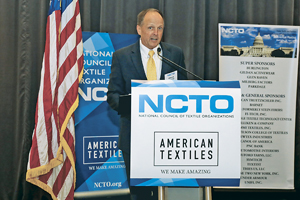
Outgoing NCTO Chairman Chuck Hall outlined the U.S. textile industry’s major challenges and achievements of last year during his “State of the U.S. Textile Industry” address at NCTO’s 22nd annual meeting in Washington.

By Chuck Hall

It is a privilege to stand before you and deliver this year’s State of the Industry address on behalf of the U.S. textile industry — an industry that is not simply part of our manufacturing base, but also a strategic pillar of it.

The U.S. textile industry produces components for everything from wearing apparel and automotive interiors to advanced industrial applications; products for our hospitality markets and industrial markets; and our military and defense systems. Our integrated textile and apparel supply chain employs 453,122 American workers and generates $60.9 billion in annual output.

Each year, our industry supplies more than $1.8 billion in uniforms and textile-based equipment to the Department of War. We provide over 8,000 different textile products to our armed forces. From flame-resistant fabrics to advanced ballistic materials, American-made textiles are essential to mission readiness and national security.

A Year Of Historic Wins And Challenges

In 2025, the industry faced significant challenges in response to economic upheavals and rapidly evolving trade policy developments.

Sweeping global tariff increases on nearly every country and imported products also triggered uncertainty and injected unpredictability into global markets.

At the same time, predatory trade practices intensified. Illegal transshipments surged. Customs fraud continued. Logistics breakdowns rippled across supply chains.

And in just two and a half years, more than 40 U.S. textile plants have closed.

Let that sink in.

Forty facilities — many in rural communities where a textile mill is the economic backbone — shut their doors. Families were impacted. Communities were shaken.

NCTO’s Leadership In A Time Of Upheaval

Throughout this unprecedented time, the National Council of Textile Organizations (NCTO) initiated a strategic campaign to confront policy threats and elevate the industry’s strategic importance at the highest levels of government.

I’d like to focus some attention on the role NCTO plays in facilitating access to key policymakers. Access provides opportunities for our industry to impact policy. Without it, there is no way to impact policy.

Thanks to the hard work behind the scenes by NCTO President and CEO Kim Glas, staff and industry leaders, we had access to the most influential administration and White House officials, which helped shape and effect change in this evolving trade environment.

Last year, we had face-to-face meetings with Treasury Secretary Scott Bessent, U.S. Trade Representative, Ambassador Jamieson Greer and Commerce Secretary Howard Lutnick. We also had access to key members of the Department of War and Defense Logistics Agency, and those meetings elevated our industry as a strategic sector and impacted policy. We made national and international news on our de minimis advocacy that closed this disaster once and for all. We played on both the offense and defense. And our voices were heard at the highest levels of the administration and on Capitol Hill. We made a meaningful difference in 2025 and we are positioned well to achieve some of our top priorities in 2026.

Before highlighting NCTO’s key policy wins, I want to quickly share a recap of the key data points from 2025 that highlight our industry’s resilience and staying power.
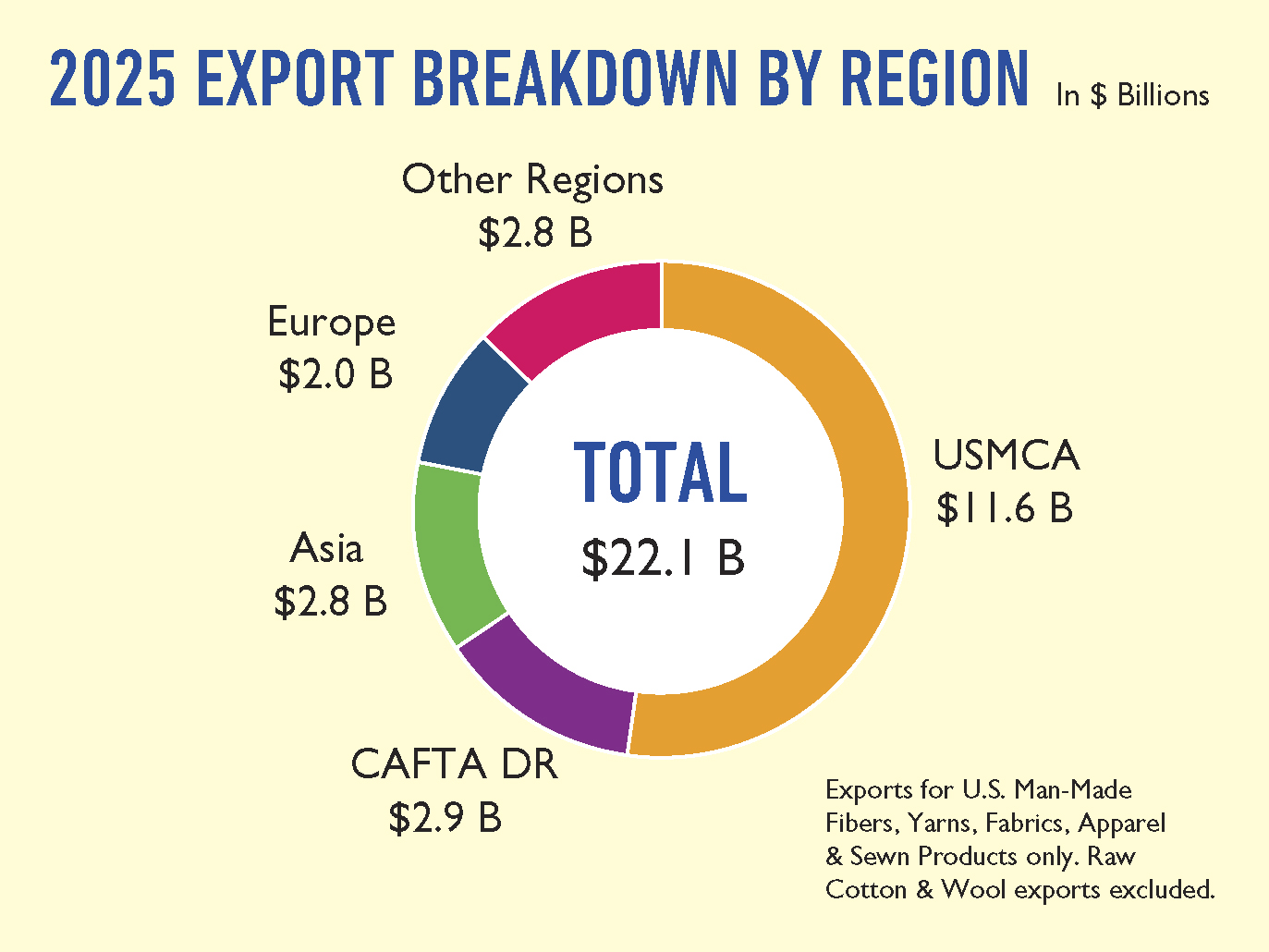
Source: U.S. Department of Commerce data for Export Group 0: Textiles and Apparel.

By The Numbers

In 2025, the industry’s key metrics registered slight declines across the board but remained stable relative to major trade and economic disruptions throughout the year. This again underscores the industry’s ability to adapt during challenging times and remain viable even while registering some losses.

Here are a few key industry facts for 2025:

  • The estimated total value of U.S. man-made fiber, textile and apparel shipments was $60.9 billion compared with $63.9 billion in shipments in 2024.1
  • U.S. exports of fibers, textiles and apparel were $27 billion in 2025 compared with $28 billion in 2024.2
  • From 2017 to 2024, our industry invested $34.3 billion in advanced manufacturing here in the United States.3
  • The United States remains the second largest individual country exporter of textile-related products in the world.
  • The U.S. textile and apparel industry invested $5.5 billion in new plants and equipment in 2024, the last year for which this data is available.4

Despite weakening in some fundamentals, I remain cautiously optimistic that the industry will once again navigate the disruptions and remain resilient this year.

Several policy wins and significant progress in key priority areas will generate more business opportunities for the industry, and thus provide a basis and foundation for optimism in 2026.

Policy Issues

Through high-level meetings, executive fly-ins, direct engagement with Cabinet secretaries and policymakers on Capitol Hill, as well as sustained grassroots advocacy, we secured a series of major policy wins in 2025 and early 2026.

Let me highlight some of the most consequential wins.

Closing The De Minimis Loophole

No issue defined 2025 more than de minimis.

At its peak, the de minimis loophole allowed 1.4 billion duty-free ship-ments — more than 4 million packages per day — to enter the United States unchecked and duty free.

An estimated half of those shipments were textiles and apparel. Many were linked to forced labor, counterfeit goods and fentanyl trafficking. This loophole was the largest backdoor in U.S. trade policy and it was devastating to domestic manufacturers.

NCTO’s sustained advocacy led to a full closure of de minimis for commercial shipments globally through an executive order signed by President Trump, which took effect at the end of August. Our efforts also culminated in the passage of bipartisan legislation codifying the closure of de minimis, effective July 1, 2027.

These actions have led to a dramatic decline in small package shipments to the United States since the loophole has been closed. They also restored a level playing field, enhanced national security and sent a powerful signal that American manufacturing matters.

NCTO will continue engaging with the administration to ensure this loophole remains closed through every available authority.

Securing Western Hemisphere Tariff Exemptions

The administration’s sweeping tariffs in 2025 aimed to rectify unfair trade practices and chronic U.S. trade deficits, and bolster U.S. manufacturing and jobs. While we have long supported the goal of leveling the playing field, there have been unintended consequences associated with these global tariffs.
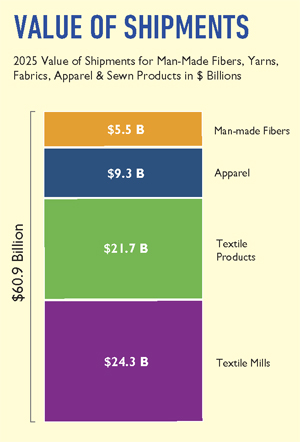
Source: U.S. Census Bureau, Manufacturers’ Shipments, Inventories, and Orders (M3) Survey, and Annual Survey of Manufacturers (ASM), value of shipments for NAICS 313, 314, 315 & 32522. 2021 data used to estimate 2025 NAICS 32522 figure.
The implementation of tariffs on nearly every country under the International Emergency Economic Powers Act (IEEPA) in 2025 created massive uncertainty at a moment when our industry was already under strain.

To address this, NCTO launched a focused campaign outlining refinements to the administration’s trade agenda to ensure it strengthens — not inadvertently weakens — U.S. textile producers.

As I noted, we raised concerns directly with Commerce Secretary Lutnick, Treasury Secretary Bessent and USTR Greer — and our engagement led to concrete and meaningful change, and results for the industry

NCTO’s focused engagement with the administration led to an early achievement: an exemption for qualifying textile and apparel imports from Mexico and Canada under the U.S.-Mexico-Canada Agreement (USMCA).

In November, NCTO notched another significant win in securing an exemption from reciprocal tariffs for qualifying textiles and apparel imports from Guatemala and El Salvador under the Dominican Republic-Central America Free Trade Agreement (CAFTA-DR).

The Supreme Court subsequently invalidated the IEEPA tariffs in a decision handed down in February this year; and the Trump administration imposed a sweeping 10 percent global tariff under Section 122 of the Trade Act of 1974.

NCTO’s advocacy and leadership this year in strong support for maintaining benefits for qualified trade can also be credited for the administration’s decision to exempt USMCA qualified trade and most recently CAFTA-DR qualifying textile and apparel imports from the 10 percent global tariff.

Preserving preferential treatment for qualified trade in the Western Hemisphere, which accounts for 70 percent of the U.S. textile industry’s exports, is absolutely critical to the U.S. textile industry and will provide incentives for more companies to onshore even greater production capacity, giving a boost to American textile manufacturers and their workers.

And we continue to engage at the highest levels to gain exemptions for inputs and machinery we don’t make here. I know NCTO is working on this tirelessly to help our industry get this done.
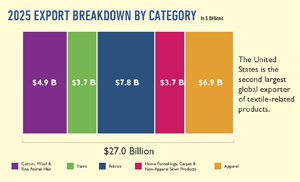
Source: U.S. Department of Commerce and U.S. International Trade Commission.

Protecting The Berry Amendment And Strengthening Defense Procurement

In 2025, we strengthened and expanded defense procurement of American-made uniforms and textiles under the Berry Amendment as we intensified efforts to protect and expand Berry to all federal agencies.

We also fought back efforts by some to erode the Berry Amendment which would have crippled our industry and threatened our national security.

NCTO and more than 30 industry leaders met with the Defense Logistics Agency and the White House Made in America Office in the fall to underscore our strategic importance, and plot together to develop a plan to strengthen contracting procedures and provide certainty to the industry moving ahead. NCTO is in weekly touch with the Department of War to implement a strategic effort to help enable the industry to grow into the future.

In another win earlier this year, NCTO’s dedicated campaign to expand the Berry Amendment to all federal agencies led to the Department of Interior announcing a commitment to prioritize purchasing uniforms and textiles made in the United States.

NCTO is pressing the administration to implement an executive order to extend the Berry Amendment to all agencies that purchase textiles.

In addition, the Fiscal Year 2026 National Defense Authorization Act included robust support for expanding federal investments in the textile industrial base and improving oversight, forecasting and capacity assessments.

Elevating Customs Enforcement Plan

We elevated a customs enforcement plan to combat rampant fraud as a cornerstone of the administration’s trade agenda.

NCTO continued to press all corners of the government to step up enforcement against China’s and other foreign competitors’ unfair trade practices causing damage to U.S. textile producers, from Uyghur Forced Labor Prevention Act (UFLPA) violations, to false origin claims, to abuse of “de minimis” tariff exemptions.

These efforts included meetings with the Department of Homeland Security and Customs and Border Protection (CBP) leadership.

We outlined the essentials of a customs textile enforcement plan for officials, including robust enforcement of free trade agreement rules of origin; stronger penalties for customs fraud; full enforcement of the UFLPA; and a textile-specific enforcement strategy.

NCTO will keep pushing for greater transparency and accountability in CBP’s enforcement activities, including regular publication of textile enforcement statistics and increased information sharing with the industry.

Unfortunately, we don’t have time to delve into all these important issues, but I do want to emphasize that NCTO remains highly engaged on every policy matter that affects the U.S. textile industry with the intent of shaping policies that directly benefit U.S. textile investment, production and employment.

Please also note that industry leadership and involvement is of paramount importance. From contributions to NCTO’s Textile PAC to arranging congressional visits, the industry makes a difference every day in raising awareness about our important contribution to local and state economies, and the U.S. economy overall.

Looking Ahead

We enter 2026 with many challenges ahead.
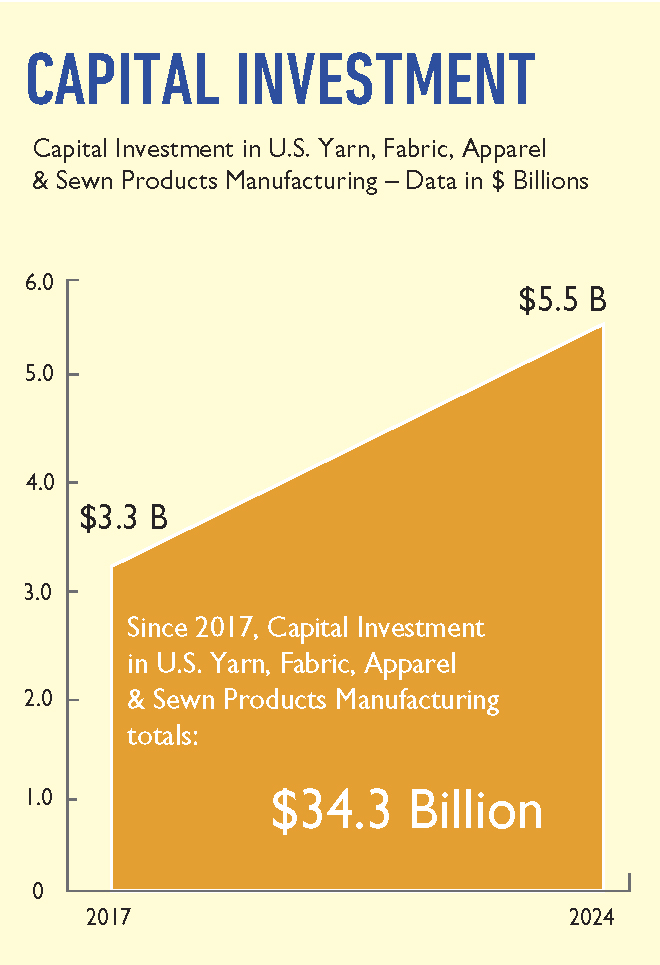
Source: Bureau of Economic Analysis, Investment in Private Fixed Assets, Textile Mills and Textile Product Mills/Apparel and Leather and Allied Products
The work never ends and the challenges are ever evolving.

In 2026, global competition remains fierce. Policy uncertainty remains real. Enforcement gaps remain persistent. But so does our resolve.

The positives are that the administration is focused on a strategy to support domestic manufacturing, and our industry, while showing some cracks, remains incredibly resilient.

The de minimis loophole has been closed, we gained exemptions for qualifying CAFTA-DR and USMCA trade, and we increased our presence in the minds of policy makers.

And we did it together.

These things give us hope that 2026 will see our industry moving forward and becoming healthier.

NCTO’s top advocacy priorities this year include:

  • Preserving duty-free treatment for USMCA and CAFTA-DR qualified textile and apparel goods;
  • Heighening advocacy aimed at the administration and Congress to secure tariff exemptions for textile manufacturing inputs and machinery not available in the United States;
  • Intensifying engagement to protect and expand the Berry Amendment through the National Defense Authorization Act and the House Berry Amendment Caucus;
  • Expanding government procurement of American-made textiles and uniforms across all federal agencies; and
  • Robust engagement with the administration on customs enforcement to combat rampant fraud.

NCTO and our industry will continue advancing policies that strengthen domestic manufacturing and ensure that the United States remains the global leader in high-performance textiles and advanced manufacturing.

Thank you. This concludes my formal remarks.


References:

  1. U.S. Census Bureau, Manufacturers’ Shipments, Inventories, and Orders (M3) Survey, and Annual Survey of Manufacturers (ASM), value of shipments for NAICS 313, 314, 315 & 32522. 2021 data used to estimate 2025 NAICS 32522 figure.
  2. U.S. Department of Commerce data for Export Group 0: Textiles and Apparel.
  3. Bureau of Economic Analysis, Investment in Private Fixed Assets, Textile Mills and Textile Product Mills/Apparel and Leather and Allied Products.
  4. Bureau of Economic Analysis, Investment in Private Fixed Assets, Textile Mills and Textile Product Mills/Apparel and Leather and Allied Products.


Editor’s Notes: Information contained in the speech was current as of NCTO’s annual meeting. Chuck Hall is president and CEO of Spartanburg, S.C.-based Barnet. He served as the 2025 NCTO chairman. At the 2026 annual NCTO meeting in Washington, Amy Bircher Bruyn, CEO and founder of Brooklyn, Ohio-based MMI Textiles, succeeded Hall as NCTO chair; and Jay Todd, CEO and managing partner of Laurinburg, N.C.-based Service Thread, was elected vice chairman.

The North American Industry Classification System (NAICS) is the standard used by Federal statistical agencies in classifying business establishments for the purpose of collecting, analyzing, and publishing statistical data related to the U.S. business economy. NAICS Subsector 313 covers Textile Mills, sub-sector 314 covers Textile Product Mills and subsector 315 covers Apparel.


2026 Quarterly Issue II
Building A Smarter Textile Enterprise With AI And Automation

AI, automation and robotics help textile manufacturers boost quality, cut waste and deliver customer value.

By Marcio Manique

The textile industry is one of the oldest in the world, dating back to the late 1700s. It has survived centuries of transformation with each new wave of technology and now stands at another inflection point. As AI, automation and robotics reshape production, legacy manufacturers that want to remain competitive must be willing to rethink how they operate.

As customer expectations for quality, performance and lead times continue to evolve, digitalization and AI can no longer be viewed as optional or experimental. Companies that treat data as a core business need — rather than a passing trend — will be the ones best positioned for long-term success.

One of the most common misconceptions about automation is that it exists solely to replace jobs. In reality, the goal of digitalization in the textile industry is to empower teams and deliver enhanced value to customers. By embedding data analytics into operations, manufacturers can accelerate operational feedback loops, make better decisions and deliver better products with significantly less scrap.

In the end, this new era in the textile industry is about unlocking real business value. By strategically integrating AI models, robotics and sensors, manufacturers can elevate product quality, increase asset reliability, enhance workplace safety and empower the next generation of industrial workers.

Elevating Quality And Precision In Production

Maintaining consistent textile product quality has historically been a subjective task. Key processes like fabric inspection, color matching and dye development have relied almost entirely on the human eye. However, relying on the human eye adds some variables, like differences in color perception or visual acuity, which can make an already complicated process even more so. While human judgment is still needed, relying only on manual visual inspection for high-volume production is tiring and can lead to mistakes that waste materials.

To solve this, leading manufacturers are turning to AI to enhance human oversight. During a typical shift, a team member may visually inspect three to five miles of fabric. Today, camera systems paired with AI software can support this work by monitoring fabric in real time. Trained to detect specific defects, AI-supported systems can flag issues automatically and consistently. Unlike the human eye, these systems apply the same level of detection every time, regardless of fatigue or differences in vision. Because the software builds a comprehensive catalogue of defects, it can also help determine the most efficient way to parse out flaws and piece the fabric back together.

Similar technologies can also enhance decision making in color matching and the dye development processes. By digitizing visual inspection and color analysis, facilities can ensure greater specificity and significantly reduce scrap material. Automating these tedious tasks allows manufacturers to move workers to more satisfying roles, which makes the experience better for everyone involved and results in a better product.

Shifting From Reactive To Prescriptive Maintenance

While AI transforms finished goods inspection, it is equally beneficial for maintaining the complex machinery that produces textiles. Asset reliability is critical, especially since unplanned equipment breakdowns can typically cost about three times as much as planned maintenance. Adding to this challenge is the ongoing labor shortage of specialized trades like electricians and maintenance technicians.

Prescriptive maintenance programs help address these risks. By equipping machinery with sensors that monitor critical operating data like temperature, pressure and vibration, data can be fed into AI models around the clock. Once a baseline for normal operation is established, the system can quickly detect unusual behavior and flag potential issues well before they escalate into failures.

Instead of reacting to costly breakdowns, plant managers can use AI insights to proactively plan repairs and schedule downtime around limited technical resources. This reduces unplanned disruptions and supports consistent output and overall efficiency.

Redefining Workplace Safety And Ergonomics

As experienced workers retire, the manufacturing sector is undergoing rapid change. By 2033, up to 3.8 million manufacturing jobs are expected to be needed, with as many as 1.9 million potentially going unfilled. As new hires who have never worked in manufacturing enter the industry and learn how to navigate complex, fast-moving environments, safety training and monitoring become increasingly important.

To support this transition, many facilities are using AI to enhance workplace safety. By layering AI software onto existing security camera systems, AI models can be trained to recognize established safety protocols. These tools can identify situations where personnel get too close to moving equipment or are missing required personal protective equipment (PPE), like high-visibility vests.

The goal is not surveillance, but insight. For example, if an AI system detects a spike in missing high-visibility vests in a specific warehouse zone, team leaders may discover that outside delivery drivers are overlooking protocols. Plant leadership can then address the root cause without placing blame on the factory floor.

Beyond AI-supported safety monitoring, introducing robotics into material-handling operations reduces ergonomic risks associated with tasks like moving heavy rolls, loading equipment and transporting materials, helping prevent injuries while improving efficiency.

Empowering The Workforce And Weaving The Path Forward

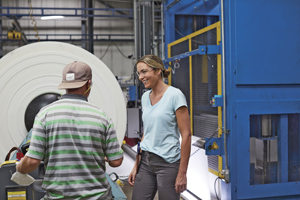
Discussions about robotics in manufacturing often come with underlying assumptions and “automation anxiety.” However, employees who work alongside these technologies quickly see the benefits, including reduced physical strain, improved safety, and more efficient workflows.

By automating repetitive tasks like manual fabric inspections and heavy lifting, textile manufacturers can better address persistent recruiting challenges and redeploy talent to dynamic roles. AI can also help preserve institutional knowledge. Digitizing decades of operational data can help teams quickly search and reference past insights, bridging the gap between retiring experts and the next generation of workers.

As data costs decrease and technologies continue to advance, textile manufacturers must adopt a practical test-and-learn approach to assessing new technologies. Evaluating tools on a small scale to prove their business value before broad rollouts allows teams to validate business impact and embrace adoption with confidence. Ultimately, investing in digitalization is about building more efficient operations that empower the next generation of industrial workers to do their best work and deliver increased value to customers.


Editor’s Note: Marcio Manique is executive vice president and managing director, apparel, at Milliken & Company.


2026 Quarterly Issue II

Apparel Brands Expand CiCLO Technology To Address Microplastics

Gastonia, N.C.-based Intrinsic Advanced Materials announced expanded adoption of CiCLO technology across performance apparel, outdoor and protective workwear as brands address microplastic fiber pollution.

CiCLO technology is embedded in polyester and nylon fibers during production, enabling the material to biodegrade at rates comparable to wool when exposed to seawater, soil or wastewater. According to the company, third-party lab studies show CiCLO fibers fully biodegrade in under four years compared to conventional fibers that remain intact.

New product launches include Fruit of the Loom’s Iconic Premium and Iconic 250 Sweats collections in Europe, ROFA’s MOVE EASY Workwear line and Black Diamond Equipment’s Rift Fleece collection in the United States.

“Integrating CiCLO technology into these collections allows us to introduce an ingredient innovation directly into core apparel categories,” said Christian Lanvermann, senior marketing manager for Fruit of the Loom Europe.

CiCLO fibers are available from certified manufacturers globally.


2026 Quarterly Issue II

Polartec Introduces Pre-Dyed Standard To Simplify Color Production

Spartanburg, S.C.-based Polartec, a Milliken & Company brand, introduced Standard Issue, a unified pre-dyed option available in black on its fleece fabric platform. The technology will be rolled out across the Polartec portfolio and expanded based on market demand.

According to the company, brands independently order thousands of rolls of fleece in nearly identical black shades annually. Each variation requires its own dye batch, minimum order quantity and production setup, adding time and complexity without meaningful differentiation.

“Standard Issue invites the industry to consider a shared alternative to producing countless variations of a visually identical color like black,” said Ramesh Kesh, senior vice president at Milliken & Company and business leader for Polartec.

“By providing brands with a consistent, ready-to-use color option, we are helping design teams move from concept to production more efficiently,” added Karen Beattie, director of product management at Polartec.


2026 Quarterly Issue II

Penn Emblem Receives NAUMD Innovation Award For Glow-In-The-Dark Silicone Emblem

Trevose, Pa.-based Penn Emblem Company received the 2026 Network Association of Uniform Manufacturers and Distributors (NAUMD) Innovation Award for its glow-in-the-dark silicone emblem technology.

The award-winning design, the Centurion FR Silicone on Glow-in-the-Dark, combined advanced silicone molding, intricate detail and functional low-light visibility. According to NAUMD, the emblem “pushes the frontier of emblem design” by combining “detailed FR logo artistry with a functional glow-in-the-dark silicone backing.”

“Silicone has been dominating the emblem market for the past few years, so our goal was to take it to the next level,” said Rich Hirsh while accepting the award on behalf of Penn Emblem. “Seeing it go from concept to a finished product and now to this stage is incredibly rewarding for our whole team.”

The company’s silicone emblems feature embossed 3D dimension, waterproof flexibility and wear resistance for uniforms, promotional products and branded apparel.


2026 Quarterly Issue II

LYCRA Introduces VintageFX Fiber For Heritage-Style Denim

LYCRA® VintageFX delivers the authentic look of heritage denim with the comfort and fit that customers expect from stretch denim.
Wilmington, Del.-based LYCRA Company announced the global launch of LYCRA VintageFX fiber at Kingpins Amsterdam, April 15-16. The fiber delivers the look of vintage denim in modern silhouettes while providing comfort, fit and shape retention.

Designed for denim and woven fabrics, LYCRA VintageFX fiber enables brands and mills to recreate rigid, heritage-inspired looks without sacrificing recovery, durability or comfort. The fiber addresses challenges in wide-leg, flares, boyfriend and mom jeans, particularly in the waist, hips and crotch.

“For brands and garment makers, its dual-core yarn construction, low growth and high recovery open new design possibilities,” said Ebru Ozaydin, product category director for denim and ready-to-wear at LYCRA Company.

Engineered with a proprietary fabric application, LYCRA VintageFX fiber works with LYCRA fiber in a dual-core structure. During finishing, the fiber shrinks under heat, controlling elastic extension and delivering enhanced shape retention.


2026 Quarterly Issue II

Teijin Frontier Develops Stretch Polyester Yarn

Tokyo-based Teijin Frontier Co. Ltd. announced it has developed a stretch polyester yarn offering compatibility with high-performance polyester materials for sports and outdoor wear.

According to the company, its proprietary polymer design and spinning technology impart elasticity to the yarn, adding stretchability and recovery to high-performance polyester materials. The yarn’s elasticity derives from polymer design and spinning control technology rather than yarn structure, providing soft stretchability and shape stability with recovery comparable to polyurethane-based elastic fibers.

The yarn enables development of 100% polyester textiles that maintain advanced functions including moisture absorption, quick drying and durable water repellency. The all-polyester composition also simplifies recycling.

Teijin Frontier plans to combine the yarn with high-performance polyester materials in textiles for sportswear, casual wear and innerwear. The company will begin selling to domestic and overseas markets in 2027, targeting annual sales of 100,000 meters in fiscal 2027 and 500,000 meters in fiscal 2029.


2026 Quarterly Issue II

Americhem Launches PFAS-Free Technology For Functional Fibers

Cuyahoga Falls, Ohio-based Americhem Inc. announced the launch of nDryve, a PFAS-free, in-melt surface-modifying technology platform designed to deliver durable multi-fluid repellency against alcohol and other low-surface-energy fluids in fiber systems.

As global regulations accelerate the phase-out of per- and polyfluoroalkyl substances (PFAS), manufacturers face pressure to maintain barrier performance without fluorinated chemistries. nDryve integrates directly into the polymer during melt processing, embedding surface-modifying functionality within the fiber matrix rather than relying on removable finishes.

“Evolving global PFAS regulations are reshaping how manufacturers evaluate barrier and surface performance technologies,” said Matt Miklos, vice president of corporate strategy and marketing at Americhem. “nDryve provides a PFAS-free pathway that aligns performance with emerging regulatory expectations.”

The technology is optimized for polyolefin and engineering fiber systems including PP, PET and PA6 for applications such as medical fibers, apparel, hygiene materials and industrial protective fabrics.


2026 Quarterly Issue II

Barmag Huitong Makes PA6 Direct Spinning Economically Viable

Remscheid, Germany/ Yangzhou, China-based Barmag Huitong (Yangzhou) Engineering Co. Ltd., a subsidiary of Barmag, commissioned the first continuous polymerization plant for polyamide 6 in China’s Zhejiang province.

Following a construction and commissioning phase, the plant began production at the end of 2025. According to the company, 20 metric tons of high-quality polyamide 6 are produced daily with significantly reduced energy consumption. The material is processed into filament yarn for textile applications via a direct spinning facility.

The joint venture between German chemical fiber plant manufacturer Barmag and Chinese chemical plant specialist Huitong has further developed the classic two-reactor technology, making it competitive and establishing the concept as an option for future PA6 direct spinning. Barmag Huitong Engineering is working on process and equipment innovations to increase plant efficiency while promoting sustainable development of the nylon industry chain.


2026 Quarterly Issue II

UNIFI Introduces Luxel™ Linen-Inspired Performance Yarn

UNIFI®, Makers of REPREVE®, introduces Luxel™: a linen-inspired, easy-care performance yarn
Greensboro, N.C.-based Unifi Inc., maker of REPREVE recycled yarn, announced the launch of Luxel, a yarn technology that combines the look and feel of linen with performance features and recycled materials.

Luxel captures the natural look and feel of linen while offering moisture-wicking, wrinkle resistance and odor control. The technology is built into the yarn and is suited for apparel, footwear, home furnishings, workwear and accessories.

Luxel is made with REPREVE recycled polyester yarn, including 30% REPREVE Takeback, which incorporates textile waste.

“We developed this yarn to provide designers and manufacturers with a product that delivers the premium look and tactile appeal of linen but delivering on enhanced benefits of easy care, durability and sustainability,” said Eddie Ingle, CEO of UNIFI.


2026 Quarterly Issue II

Sponsors