Open-End Yarn Prices Increasing


W
ell, here we go again! Cotton prices are up, and rayon fiber producers have announced an
increase in their prices due to increasing costs of caustic. Acrylic producers have warned spinners
to expect a price increase due to increased prices of natural gas. Now, finally, open-end (OE)
spinners have begun to ask for increased prices for their products. One such spinner commented that
the OE markets were changing rapidly. He added, “ This price increase has been somewhat of a shock
to our customers, but they seem to understand. However, only time will tell if the retailers will
accept it. One thing is certain — we can’t continue to run our mills and lose money. Our OE
customers are quite optimistic for the first quarter and some have booked well into the second
quarter.” So, everything is not doom and gloom.

Concerning the comment above about customers understanding the price increase, several
respondents have said something to the effect, “Yeah, I understand, but when it comes to the bottom
line will I accept it (the price increase)?”


Ring-Spun Markets Slow


Ring-spun (RS) markets have hit a slowdown, according to some spinners, although the demand
for yarns for the denim trade remains good. Apparel markets for those products are reported as
spotty. Spinners and their customers, however, remain optimistic for the immediate future mainly
because of the last-minute surge of retail customers during the holiday season and the continued
strength of the denim market. Future business for RS yarns depends in part on the ability of the
retailer to move his inventories. The slowdown of RS markets did not effect all spinners because,
as one spinner said, “Ring-spun markets are up moderately, open-end yarn markets are up
considerably, prices are firming up daily, and our customers’ yarn supplies are down. Raw material
costs are up, but overall things are looking up.” Isn’t it good to hear a positive report once in
awhile?

Synthetic spinners are definitely less than happy with their market conditions. When asked
about market conditions, one commented, “Market conditions are lousy! However, we are optimistic
for the first quarter — traditionally the first half is better in our business. Children’s
sleepwear business is improving, but right now automotive sales are way off and home furnishings
are pretty soft. Recently, we have noticed some shrinkage in business for cotton yarns, which
should help those of us in synthetics, but 2001 is going to be a tough year for synthetic yarn
sales.” He went on to say that his company had things in place before the end of the year to assure
a better first quarter. However, he didn’t say what those things were, but he anticipated a solid
five-day work week for all of his plants.

Weavers report that the first quarter “looks promising.” There was some curtailment during
December, but weavers are planning a full five-day operation for the start of 2001. Like spinners,
weavers also report that long-term business has shrunk, making it very difficult to plan their
operations. They also have similar pricing concerns. One weaver said, “Frankly, our customers are
not interested in a price increase and they will definitely resist such a move.” As one spinner
said, “Time will tell.”


Texturizers Concerned


Texturizers report that prices may actually drop because of imports. Interestingly enough,
the imports they refer to are not fibers but garments. Currently, markets for textured yarns are
quite soft and projected to stay that way through most of the first quarter. First quarters are
traditionally slow for texturizers, but improvement will depend on how retailers move their
inventories.

As one texturizer observed, “If retailers move their inventory, business for us will
improve. Domestic capacity is nearly balanced with demand, but the imports from Asia upset that
balance.” Asian production of textured yarn and garments made from those products greatly exceeds
the demand there, according to reports from texturizers. That over-capacity is exported. It doesn’t
seem fair, does it?

It may not seem fair to those affected, but one respondent to the Yarn Market this month
reported that domestic fiber producers are running full. They can do that only because they are
exporting fiber. What’s the expression? What’s good for the goose is good for the gander.

One thing you have to say about people in the textile trades, especially sales — they are
always optimistic!

February 2001
Cone Mills Announces Initiatives

Cone Mills Announces Initiatives Cone Mills Corp., Greensboro, N.C., announced two initiatives
aimed at improving its earnings. The first initiative is the expansion of the Parras Cone
joint-venture denim plant in Mexico. Cone Mills and Compania Industrial de Parras, S.A., have
agreed to expand Parras Cones production capacity by 11 million yards, or 35 percent, for a capital
investment of approximately $18 million. John L. Bakane, CEO, Cone Mills, said, Over the past five
years, sourcing of denim jeans for U.S. markets from Mexico has more than doubled. The Parras Cone
expansion should allow us to keep up with this substantial growth in demand. In addition, since
Parras Cone was originally constructed with the infrastructure in place for this expansion, this
move should further improve the versatility and cost effectiveness of the plant.The second
initiative involves the shutdown of Cones Marion, S.C.-based Raytex top-of-bed fabrics plant.
Bakane commented on the closing of the plant by saying, Raytex did not fit our vision for the
future Cone Mills because it did not have a leadership position in a market dominated by large
vertical bedding manufacturers. In addition, the closure of Raytex will eliminate significant
operating losses, which for the first three quarters of 2000 have totaled $4.3 million, or $0.11
per share, on sales of $14.1 million.According to Bakane, these two initiatives are the result of
continued progress toward the strategy we have been implementing over the past two years.
February 2001

Armstrong Enters Into Talks Regarding Sale Of Commerical Carpet Unit

BIETIGHEIM, Germany, Feb. 20 /PRNewswire/ — Armstrong DLW AG, a subsidiary of U.S.-based Armstrong
Holdings, Inc. (NYSE: ACK) said today thatit had entered into talks with CVC Capital Partners on
the possible sale ofthe European components of its Textiles and Sports Flooring division, which
operates under the brand name Desso. The talks are expected to last several months. Desso, with
approximately 1,300 employees, manufactures commercial carpet and artificial sports flooring in The
Netherlands, Germany and Belgium. Basedin Oss, The Netherlands, the division had annual sales of
approximately$313 million in 1999. “An acquisition by CVC would enable Desso to receive the
investment it needs to grow and better serve its customers and employees,” said ArmstrongDLW AG
President and CEO Gerard Glenn. “Armstrong’s European flooring business is focused on resilient
products, and indeed we would use theproceeds from a sale to grow this core business for us in
Europe.” Although the Company is currently assessing the accounting for the potential transaction,
it is expected that there could be a net loss on disposal of approximately $30-35 million before
any tax benefit. CVC Capital Partners, based in London, is a leading European private equity firm
that has interests in more than 200 companies throughout Europe with a total value of $30 billion.
Additionally, Armstrong Holdings, whose operating unit, Armstrong World Industries, Inc., filed for
Chapter 11 protection in December to resolve its asbestos liability, reported that it would
disclose its financial results for2000 in its 10-K report to the SEC in late March. Although the
financial reports are not yet available, Chairman and CEO Michael D. Lockhart said that fourth
quarter 2000 performance was negatively impacted by a decline in sales and profits as a result of
the continued slowdown in the economy, and higher raw material and energy costs. For 2001, Lockhart
said he expected economic conditions not to improve and that Armstrong plans on revenues relatively
flat versus 2000 and operating income, excluding the effects of asbestos and reorganization
charges, to decline from 2000 levels. These materials contain forward-looking statements within the
meaning ofthe Private Securities Litigation Reform Act of 1995. These statements provide the
company’s expectations or forecasts of future events. Actual results could differ materially as a
result of known and unknown risks and uncertainties and other factors, including: the outcome of
Armstrong World Industries Inc.’s (“AWI”) Chapter 11 case; the company’s ability to maintain
financial liquidity; AWI’s asbestos-related and any other litigation;variations in raw material and
energy costs and the company’s success inachieving manufacturing efficiencies and price increases;
the company’s success in introducing new products; product and price competition caused by factors
such as worldwide excess industry capacity; interest, foreign exchange and effective tax rates;
success in achieving integration of and synergies from the company’s acquisitions; greater than
expected working capital requirements; business combinations among competitors and suppliers; the
strength of domestic and foreign end-use markets and improved efficiencies inthe European flooring
market; effects on international operations from changes in intellectual property protection and
trade regulations; and other risks,uncertainties and factors disclosed in the company’s and AWI’s
most recent reports on Forms10-K, 10-Q and 8-K filed with the SEC. The company undertakes no
obligationto update any forward-looking statement. Armstrong Holdings, Inc. is a global leader in
the design, innovation and manufacture of floors and ceilings. Based in Lancaster, PA, Armstrong
has approximately 15,000 employees worldwide. In 1999, Armstrong’s net sale stotaled more than $3.4
billion. SOURCE Armstrong Holdings, Inc.Web Site: http://www.armstrong.com Copyright 2001 PR
Newswire

Vamatex And Somet Merge

The Radici Group weaving machine manufacturing companies of Vamatex of America and Somet of America
have announced their operational merger in the North American Market. These two companies with U.S.
weaving machines installed surpassing over 3500 is also being merged with American Savio Corp. who
is also located in Spartanburg, S.C. These three market leaders now operating as one company will
further insure future financial stability.Mr. Nikolaos Perackis has already been named one of the
two commercial directors over the newly formed company. Promatech is responsible for both Vamatex
S.p.A. and Somet Weave Tech in the Americas. Mr. Perackis resides in Italy. Further details of the
merger will follow soon.Vamatex and their employees have physically relocated to the offices of
Somet of America and American Savio located at 100 Martin Road, Spartanburg, S.C.

Tradition And Technology

ATI Special Report Tradition And Technology
Frotanna-Textil revitalizes terry production with Sulzer installation. The
Oberlausitz region in the German state of Saxony has a long history of textile production. The
first terry loom in Germany was put into operation there in 1856, in the small town of Grochonau.
Around 1900, there were some 2,250 looms in Grochonau, including 700 terry looms, producing a wide
range of fabrics. Today, the towns Damask and Terry Museum bears witness to the skills and quality
standards that evolved over the course of time.Frottana-Textil GmbHandCo. KG, founded in Grochonau
in 1856, grew with that tradition. Today, the 180-strong workforce produces terry products marketed
under the brand names Frottana and Move. The Move brand is noted for top-quality terry goods in
exquisite designs. Frottana-Textil supplies its products terry fabrics, finished terry towels in a
wide range of sizes and bathrobes mainly to European clients, including all leading vendors of this
type of textile, and the products are becoming ever more popular among end-users. In the past few
years, turnover has increased by over 10 percent per year. 

To keep pace with increasing demand, production facilities have been modernized to reflect
the state of the art. The weaving room has been completely renewed in order to create a highly
flexible weaving facility for high-end quality and exclusive patterning. The main effort in the
modernization was focused on the replacement of older looms with modern Sulzer Textil G6200 F-model
rapier weaving machines, whose short set-up times allow cost-effective production, even of small
orders. All of these machines are equipped with electronically controlled jacquard heads
manufactured by Stli.With the assistance of specialists from Switzerland-based Sulzer Textil,
commissioning of the new weaving facility at the end of May 2000 went off without a hitch. The
anticipated plant efficiency level was achieved within just a few weeks. Ludwig Marschner,
Frottanas weaving manager, said: We have achieved the flexibility we wanted. Setting up the
machines is easy and 100-percent reproducible. The error rate is minimal, thanks to the machines
far-reaching self-checking capability (by microprocessors). The G6200s dynamic pile control allows
special patterning effects to be produced. Changing from three-pick to seven-pick terry is possible
at any time. Each pick can be programmed on the microprocessor and beaten up separately. No special
tools are needed. With these machines, we can surpass present standards regarding patterning
options and quality.Managing Director Matthias Kretzschmer added: Apart from substantial cost
savings, our company will be able to fulfill customers wishes in the future with even higher levels
of flexibility and quality. This is especially true when you consider that the use of modern
weaving technology, backed up by a universal CAD-CAM system, opens up new and fascinating
perspectives in patterning for future collections. Loop Formation TechnologyTerry fabrics are
produced by simultaneous processing of two warps: the ground warp, with tautly tensioned ends; and
the pile warp, with lightly tensioned ends. A special weaving method enables loops to be formed
with the lightly tensioned warp ends on the fabric surface. With the basic method, known as
three-pick terry, three picks form a pick group. Using a special device on the weaving machine, two
picks are inserted at a variable distance the loose-pick distance from the cloth fell, according to
the desired loop height. When the third pick is beaten up, the reed pushes the pick group on the
tautly tensioned ground warps towards the fell, and the loose-pile warp ends woven into the pick
group are uprighted to form loops. Depending on the weave, loops are created on one or both sides
of the fabric.For complex patterns, the G6200 series is equipped with a jacquard machine. For less
demanding patterns, a dobby is sufficient, and simple, non-patterned fabrics can be woven using a
tappet motion. Terry fabrics are often very complex, combining differently colored warp ends with
loop patterns.Terry fabrics are subject to changing fashions and demands for new qualities and
designs. Completely new patterns can be designed, thanks to the rapid development of electronics,
with microprocessor controls and highly dynamic stepping motors combined with modern mechanisms.
One such mechanism is the special terry sley gear with dynamic pile control, as used by Sulzer in
the G6200 F. Via a servo motor, the beat-up position for each pick, and thus the type of terry and
pile height, can be freely programmed for each pick group. In this way, 200 different loose-pick
distances, and hence the same number of pile heights, can be programmed in any order desired. Thus,
the fabric designer has a broad range of patterning options, and the weaving engineer a technology
for improving the fabric structure, because the transition from one pattern element to the next can
be woven with greater precision. Sculptured TerryWith these elements, Sulzer specialists have
developed a new patterning method referred to as sculptured terry. At each full beat-up, two pile
loops of different heights are formed in weft direction. The secret of this method lies in the fact
that two loose-pick groups formed at distances corresponding to the pile heights are beaten up to
the cloth fell together.For two short loops, the pile threads are woven into both loose-pick
groups, and for one large loop, into the second loose-pick group only. It was difficult to develop
a basic weave that results in neat loops without excessive friction between warp and weft at full
beat-up. The solution was found in a special seven-pick weave combined with full beat-up at the
sixth and seventh pick. In this way, a second pile height is also formed in weft direction, making
sculptured patterning possible by the difference in pile height in warp and weft direction.For this
kind of pattern formation, freely programmable sley travel, as is found on the G6200 series, is
necessary. Microprocessor control allows the loose-pick distance to be programmed easily and
individually for each pick. The G6200 F can be equipped with a control system for a maximum of
eight different weft colors or yarns, and a jacquard machine, thus giving fabric designers
practically unlimited scope for the design of terry fabrics. 
For additional information on Sulzer weaving technology, contact Verner Huber or Rudolf Vogel,
Sulzer Textil, at +41 (0)52-262 65 54 or
www.sulzer.com/str_home.html.
This story was published with permission of Sulzer Textil.

February 2001

West Point Foundry And Machine Offers Pre-Wet Sizing

West Point Foundry and Machine Co., West Point, Ga., has developed the new model SAS-PW Pre-Wet
System, which uses patent-pending technology to apply atomized water to warp yarns prior to
sizing.The system maintains consistent water wet pick-up by precisely controlling the volume of
water applied to the warp yarns. Dwell time between the pre-wet chamber and the size box is
increased to allow maximum penetration of water into the yarns. Due to the penetration of water
into the center of the yarn, the amount of sizing chemicals required for efficient weaving is
reduced by 20 to 50 percent.The SAS-PW is the lowest-cost pre-wet system available, said Scott
Warren, general sales manager. It has a self-contained control system and a narrow footprint that
will allow it to run on any slasher, regardless of space limitations or equipment manufacturer.

February 2001

Federal Reserve Lowers Interest Rates


T
he latest economic reports show a weak U.S. economy in December. The Federal Reserve,
concerned that the weakness could develop into a full-fledged recession, reduced short-term rates
by one half a point well ahead of its scheduled meeting at the end of January. With inflation at
bay, further rate cuts are likely to follow.

The nation created 105,000 new jobs in December, after adding only 59,000 jobs in November.
The goods-producing sector lost 78,000 jobs, including 62,000 factory jobs and 13,000 construction
jobs. Total non-farm payrolls in 2000 grew by 1.91 million jobs, or 1.5 percent, down from 2.2
percent in 1999.

The unemployment rate held steady at 4.0 percent in December. In 2000, the jobless rate
averaged 4.0 percent, down from 4.2 percent in 1999 — the lowest in more than three decades.

The price index for finished goods was unchanged in December. The core index, which excludes
energy and food, jumped 0.3 precent in December.

Consumer prices rose 0.2 percent in December. Energy prices were also up 0.2 percent. In
2000, energy prices shot up 14.2 percent, following a double-digit gain in 1999. The surge in
energy prices sent the cost of living up 3.4 percent from December 1999. For all of 2000, consumer
prices rose 3.4 percent, up sharply from 2.2 percent in 1999. The core inflation edged up 0.1
percent in December and increased 2.6 percent from a year ago.

 
BF_Feb_343


Industrial Output Up Despite Recent Declines

Industrial output in December declined for the third month in a row, falling 0.6 percent in
December and 0.3 percent in each of the previous two months.

Output contracted at an annual rate of 1.1 percent in the fourth quarter of 2000, the first
decline since 1991.

Production of motor vehicles and parts plunged 4.1 percent in December, after taking a
6.7-percent dive in November. Nevertheless, for all of 2000, industrial output grew 5.6 percent,
the highest increase since 1997.

The operating rate fell to 80.6 percent of capacity, down from 81.4 percent in November. This
rate was 1.5 percentage points below its 1967-1999 average.

Housing starts, at an annual rate of 1.575 million units in December, were virtually flat
from 1.570 million in November. Higher mortgage rates in 2000 forced housing activity down 4.4
percent to 1.59 million units.

Business sales fell 0.3 percent in November following a 0.5 percent loss in October.
Meanwhile, business inventories grew 0.5 percent.

The inventory-to-sales ratio inched up to 1.36 in November from 1.35 the previous month, the
highest ratio since April 1999.


Textiles Operating Rate Holds Steady; Producer Prices Show Mixed
Results

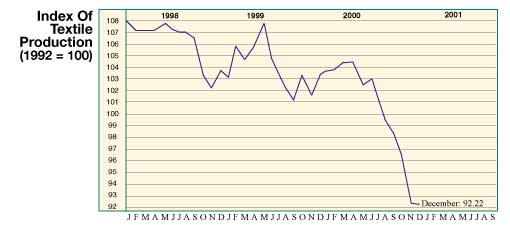
In 2000, the textiles and apparel industries did not fare well despite an overall robust U.S.
economy. Textile output was down 0.1 percent in December, after plunging 4.5 percent in November.
For all of 2000, the industry’s output declined 3.7 percent.

The operating rate for textiles held steady at 75.2 percent of capacity in December. In 2000,
the industry operated at 81.0 percent of capacity, down sharply from 83.1 percent in 1999.

Shipments by textile manufacturers fell 1.1 percent in November, and inventories were down by
0.3 percent, resulting in an inventory-to-sales ratio of 1.69.

The industry’s payrolls were slashed 1.2 percent in December. In 2000, textile employment
averaged 541.2 thousand jobs, down 3.4 percent from 1999. The unemployment rate for textile mill
workers jumped to 4.8 percent in December.

December retail sales were up 0.1 percent, and automotive sales rose 0.3 percent, while
general merchandise sales declined 0.8 percent. Total retail sales in 2000 grew 7.9 percent.
Apparel and accessory sales rebounded 0.9 percent in December. Total sales in 2000 grew 5.2
percent, after a 6.4 percent gain in 1999.

Textile and apparel producer prices edged down 0.1 percent in December. Prices rose 2.3
percent for carpets, 0.2 percent for greige fabrics and 0.1 percent for finished fabrics. Prices
were unchanged for home furnishings and synthetic fibers, but declined 0.3 percent for processed
yarns and threads.

February 2001


Shell Still Excited About PTT

HOUSTON, Jan. 30 /PRNewswire/ — An industry publication recently ran a story saying that Shell
Chemical Company* was not proceeding with a polytrimethylene terephthalate (PTT) project planned
for Altamira, Mexico.This is not accurate. The company is currently looking at various sites,
including Altamira tobuild a plant that would demonstrate Shell and Zimmer AG’s all-melt,continuous
PTT process. Shell’s PTT business development and investment in anew PTT plant remain an integral
part of our strategy to grow the1,3-Propanediol (PDO) business. “We are excited about the long-term
prospects for the PTT business and ourPTT proprietary continuous process technology. We see
positive signs in the industry that PTT is on its way to becoming a viable product in the
marketplace as new textile and carpet products, made from our CORTERRA**Polymers, continue to be
launched,” said Stan Park, Vice President-PDO/CORTERRA Polymers. Shell is actively discussing
various project options with others interested in PTT. * The expression ‘Shell Chemicals’ refers to
the companies of the RoyalDutch/Shell Group which are engaged in the chemical businesses. Each of
the companies which make up the Royal Dutch/Shell Group of companies is an independent entity and
has its own separate identity. ** CORTERRA is a trademark of the Royal Dutch/Shell Group of
companies.The trade designation for CORTERRA is not registered for fibers per se, but is registered
for the polymer used to make the fibers.SOURCE Shell Chemical Company Copyright 2001 PR Newswire

Ciba Launches Range Of Soft Pigment Inks

Switzerland-based Ciba Specialty Chemicals has launched a new range of soft pigment inks for
digital printing. The Ciba® Irgaphor TBI 150-850 HC highly concentrated pigment inks are designed
for piezo ink-jet printing of all textile fibers, especially polyester, cotton, and blends of
these, as well as leather. The pigments can be printed directly on all fibers without pretreatment
or aftertreatment. Following application, the inks must be fixed with dry heat for 3 to 5 minutes
at between 160 and 180°C. The printed fabric can also be treated by all hot-press and cylinder
methods for 1 minute at 210°C. The new inks are compatible with the original Ciba Irgaphor TBI
100-800 range.Ciba claims that the new dyes offer environmental advantages. One advantage is that
the inks have high fixation and need no washing off, therefore reducing water consumption and
waste-water treatment. The inks are formaldehyde-free and are also free of pigments and chemicals
that can, on reduction, release amines banned under MAK III regulations.

February 2001

Higgins Industries Introduces UV Protective Clothing

NEW YORK, Jan. 31 /PRNewswire/ — Higgins Industries Inc., announces the development of an UV Sun
Protective clothing process called “BFX.” Certified and tested by International UV Testing
Laboratories at Auburn University, this BFX process has received a50+UPF rating, the highest
International rating level available. A spokesperson for Higgins Industries has said that “before
there was fashion, clothing had a utilitarian purpose. In this new millennium the protective
quality of our clothing has become increasingly more important,particularly with the dramatic
increase of skin cancer.” It is estimated this year that in the United States, Melanoma cases will
reach 47,700 with deaths of 7,700. It is the fastest growing of all cancers,and among all
accidental deaths it has experienced the largest percentage of increase from 1986 – 1996, 22%.
Textiles treated with the BFX protection block 98%-99% of the sun’s harmful UVA and UVB rays. Tom
Higgins, of Higgins Industries, has expressed his concern about the depletion of the ozone layer
and has said, “it is a small price to pay for such an important protection. If you consider that
80% of the harmful exposure occurs during our childhood, it is really important we get an
educational message out to our youth of the importance of protecting themselves with sunscreens and
the correct clothing.”SOURCE Higgins Industries, Inc.Web Site: http://www.bfxtextiles.comCopyright
2001 PR Newswire

Sponsors