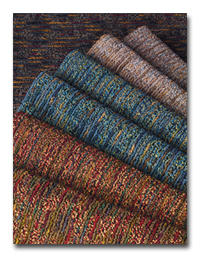
Datacolor Opens New Office To Assist Wal-Mart

Datacolor, Lawrenceville, N.J., recently opened a Color Resource Center in Bentonville, Ark.,
dedicated to providing Wal-Mart and its suppliers and vendors with service, training and support.
The center will offer: educational classes on the fundamentals of color science and technology;
digital imaging resources for virtual fabric and garment development; training on Datacolor
products adopted by Wal-Mart; and the ability for local vendors to evaluate the latest color
technology as it becomes available.

July 2005

Sorona-Based Fabrics Now Available On-Line

FAST, an on-line catalog created by technology company Freeborders, San Francisco, enables users to
search for and request samples and costs of DuPont Sorona®-based fabrics 24 hours a day.

Catalog users may register at
www.fastextile.com to search mill databases by fiber brand,
fabric type, construction and geography, among other parameters; and request swatches at no cost.

“Buyers and designers at key apparel brands expedite sourcing using FAST because for the
first time they’re able to communicate in real-time with mills that manufacture fabrics such as
those made with Sorona,” said Mike Keating, partner, Freeborders, and general manager, FAST. “This
marks a significant improvement for the entire apparel industry supply chain.

July/August 2005

Trade Officials Seeking Progress On Doha Round


U
S and European trade officials are attempting to jump-start negotiations on the Doha
Round of trade liberalization. Progress has slowed as a result of the elimination last January of
textile and apparel import quotas.

Trade officials here and in Europe have been focusing their attention on what they can do to
stem the flood of Chinese exports following the removal of quotas. In the short run, they have been
using the safeguard mechanism in China’s World Trade Organization accession agreement to place new
quotas on imports, but that authority ends in 2008, and that could spell more trouble for them.

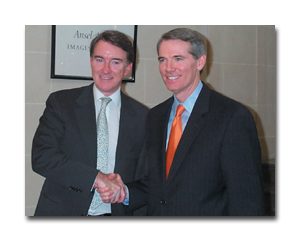
At a recent meeting in Paris, US Trade Representative Rob Portman and European Union
Commissioner Peter Mandelson underscored the importance of getting the Doha Round preliminary work
completed by the end of the year in order to get formal negotiations started.

At the conclusion of his meeting with Portman, Mandelson said the EU is redoubling its
efforts in the coming weeks to get the preliminary work out of the way, which will hopefully lead
to successful completion of the round after that. They both underscored the importance of the round
not only to their own countries but to the developing countries where, according to Portman, “we
will be able to pull millions of people out of poverty and improve economic prosperity.”

The basic goal of the Doha Round is to remove barriers to trade throughout the world by
lowering tariffs, eliminating non- tariff barriers and taking other measures that open more
markets.

US textile manufacturers are concerned about the tariff reduction efforts as they see another
flood of imports from China once the ability to use the safeguard mechanism expires. Since the
ability to use safeguards expires in 2008, US textile manufacturers will seek a permanent extension
of the Chinese safeguard mechanism as part of the Doha Round. In addition, they say US tariffs on
textiles and apparel, at an average of around 14 percent, are the lowest in the world and they
should not be cut any further. In the event tariff reductions are considered, the position of US
manufacturers is the tariffs of other countries first should be brought down to US levels before
any further reductions are considered.

How the round deals with cotton could be a major source of problems in the agriculture
segment, which has been one of the most contentious areas throughout the preliminary discussions.
US cotton growers have had disagreements with the EU with respect to whether cotton should be
handled separately from other agriculture commodities. Obviously, much more needs to be done in a
number of sectors before the formal negotiations can get underway.

wo
European Union Commissioner Peter Mandelson (left)

and US Trade Representative Rob Portman


Safety Agency Looks At Chinese Imports


The Consumer Product Safety Commission (CPSC) is taking a hard look at Chinese imports that
may not be in compliance with US safety standards.

At a recent meeting with a number of manufacturing industry representatives, including
textiles, the agency staff and commissioners heard accusations that Chinese imports do not meet the
voluntary and mandatory standards regulating US-made products.

Following the briefing, Karl Spilhaus, president of the National Textile Association, Boston,
wrote CPSC Chairman Hal Stratton outlining concerns of US textile manufacturers. Citing a
186-percent increase in Chinese imports of wearing apparel over the last eight years, Spilhaus
added, “While this is high, it is overshadowed by the 102-percent (first quarter 2004 versus same
period, 2005) increase in Chinese imports of wearing apparel over just a three-month period that
occurred since Jan. 1, 2005, when textile quotas were eliminated.”

Spilhaus said compliance with US flammability regulations and voluntary standards is
essential if Chinese products are to provide the same safety as products made in the United States
and other countries. Not to comply, he said, would give China a competitive advantage and not be in
the best interests of US consumers. He urged the commission to step up its compliance activities
until China establishes a “solid record” of consistently meeting the rules under the Flammable
Fabrics Act. He also pointed out that retailers, as the ultimate distribution source, have an
important role in ensuring that imports comply with US safety standards.


Textile And Apparel Tracking System Shows Promise


A textile and apparel component identification system that can help government trade
officials combat illegal transshipments of clothing and textiles is showing considerable promise.
The process being developed by the Oak Ridge National Laboratory (ORNL), Oak Ridge, Tenn., encodes
information invisible to the naked eye that can be used to determine the country of origin of
imports. Products from regions that have special trade agreements with the United States such as
Mexico, Canada, Africa and the Caribbean Basin enjoy special tariff concessions if their finished
products are made of US yarn and fabric, or yarn and fabric produced in the participating
countries.

The US government and domestic textile manufacturers have long contended some producers in
the special trade agreement countries illegally use inputs from nonparticipating countries and
falsify entry and shipping documents.

ORNL has developed an invisible marker that can be read only by special scanners that
identify the source, type, production conditions and composition of textile material.

“Our goal is to have a system using a fluorescent dye or other taggant that could cost just
tenths of a cent per taggant and would survive the harsh manufacturing process but not affect the
quality of the garment,” said Glenn Allgood, head of the team developing the process. He added the
new experimental process would be far less expensive than other information-encoding systems. The
next step is to determine for certain whether the taggant will affect the quality of the product
being identified and then to work with an industry partner to conduct field tests.

Hardy Poole, an industry representative on the research team, said the process will be
invaluable in connection with the US government’s efforts to eliminate the illegal importation of
millions of dollars of non-US textiles that enter the country annually. He says the process could
provide a simple but reliable way to detect illegal shipments and lead to crackdowns on illegal
trade.


African Free Trade Agreement Extended


The US government’s extension of the African Growth and Opportunity Act (AGOA) for another 10
years is not likely to have much of an impact on the US textile market.

When the pact was first negotiated in 2001, it provided 37 nations in Sub-Saharan Africa with
quota- and duty-free access to the US market. The agreement had a rule of origin requiring apparel
eligible for the special treatment to be made up of fabric and yarn from participating countries.

At the time, US textile manufacturers feared the African nations would become a source for
illegal transshipments of apparel, because there was so little textile manufacturing capability in
the area. That simply has not happened, and that is not likely to change in the near future.

Imports from the AGOA nations currently account for less than 1 percent of US textile and
apparel imports from all sources.

The overall effect of the agreement is perhaps more important. In signing legislation
extending the agreement, President Bush said trade with the AGOA nations has increased by 80
percent.

“People are now making goods that the US consumers want to buy, and that’s helpful,” he said.
“That’s how you spread wealth.”

July/August 2005

Material World NY Nets NTA Support To Show Home Furnishings

The National Textile Association (NTA), Boston, has joined the American Apparel & Footwear
Association, Arlington, Va.; the American Apparel Producers’ Network, Atlanta; and the Textile
Distributors Association, New York City, in supporting Material World New York. The inaugural New
York City edition of the global fabric and sourcing show will be held Sept. 28-30, 2005, at the
Jacob K. Javits Convention Center.

“As a supporter of the Material World New York event, we look forward to the new business
opportunities that will arise for our members to strengthen their positions both nationally and
internationally,” said Karl Spilhaus, president, NTA.

materialworld_Copy_1
The Material World Home Furnishings Showcase debuted last March at Material World in Miami
Beach.

In addition to fabric, trim, yarn, components, manufacturers, technology, full-package
providers, and other services and suppliers geared to apparel, Material World New York will present
suppliers to the home furnishings sector of the textile industry. The Home Furnishings Showcase
will feature converters, mills, and leather and trimming manufacturers; and will target upholstery
manufacturers, jobbers, interior designers, retailers and over-the-counter businesses.

Event plans also include trend pavilions, color and trend presentations from major trend
leaders, and educational programming resources for Fall/Winter 2006.

A marketing alliance between show organizer Urban Expositions, Marietta, Ga., and the ASAP
Global Sourcing Show – a Material World global marketing partner – is expected to expand the show’s
international exhibitor base. Each participating country will form a pavilion within the Material
World New York Global Pavilion to show products, services and other capabilities available within
that country.


July/August 2005

Sophisticated Fibers


D
efining high-tech fibers is no easy task. One person’s high-tech material may be
another’s chopped liver. Is moisture absorbency high-tech? What about extra strength, heat
resistance or even conductivity?

You get the drill. High-tech defies the laws of uniformity.

Textile World
has decided to establish its own parameters and focus discussion of high-tech fibers on those
it believes target new textiles and/or new textile processes. This allows an investigation of
materials based upon a judgement of market positions (including level of development) and their
ability to energize the innovative juices that flow liberally through textiles. This discussion of
high-tech fibers is organized into classes by raw materials, and compares the relative advantages
and characteristics of each vis-à-vis direct and indirect competition.  While high-tech fiber
markets overlap, in most cases they can be segmented based upon processing technology and
materials. 

This article will focus on the majority materials of glass, carbon and ceramics. A follow-up
piece in a later issue of

TW
will look at the advances in aramid, quartz, boron, polyethylene and hybrid items designed to
build performance characteristics for a particular market niche.

skier
Advanced Cerametrics Inc. and Head NV are developing active fiber composite skis and tennis
rackets that supply more functional edge on a ski and more power to a ball hit.


Understanding Materials And Composites


Discussion of high-tech fibers almost necessarily involves examination of growth
opportunities for fibrous materials and structures in building composites. Composites are defined
as structures containing one or more separate components selected to compensate for or eliminate
weaknesses in other material components. Composites generally are composed of a matrix material
(polymeric, ceramic or metallic, among others) combined with strength-adding fibrous-like materials
whose role is to increase the in-use structural performance of a lighter-weight combined structure.
The two (or more) components maintain their separate identities, but in combination work
interactively to the performance advantage of both.

The combination of high strength and light weight is the carrot on the string that drives
new markets. Rising oil prices and environmental constraints combine to demand greater efficiency
and effectiveness from the structures; possibly, composites are the answer. Users may select from a
myriad of materials to obtain vibration damping, resistance to expansion under varying heat
conditions, fatigue resistance, corrosion and wear. The major fiber types used in advanced
composites include carbon, glass, ceramic, polycarbons and metals.

Composite materials appeared headed for significant growth in the late 1980s, and most of
the ’90s. Unfortunately, three macro-economic events slowed and confused this advance. First, in
the late ’90s, public policy demanded reductions in military expenditures, and advanced composite
development funding fell victim to the cost cutter’s axe. Second, the tragedy of 9/11 subsumed
advanced development in a national malaise, the effects of which were further highlighted by a
nagging business recession in 2002 and 2003. The literature of the last two decades is rife with
enthusiastic forecasts in the ’90s followed by a determined silence in the current period. Further
evidence is provided by the larger number of merger/acquisition/de-merger/shutdown activities.
Frankly, it is not easy to trace the family trees of some market participants. Significantly, many
US developments were purchased/absorbed by foreign owners, particularly those based in Asia.

Industry estimates project that high-performance materials incorporating matrix resin
composite technologies in 2007 will consume more than 4 billion pounds of materials, split
approximately into two-thirds  resin and one-third reinforcing materials, including fibers.
Based upon the history of forecast accuracy in composites, it is unlikely the industry will meet
the underlying 7-percent to 8-percent annual growth rate implicit in this projection.
owenscorning
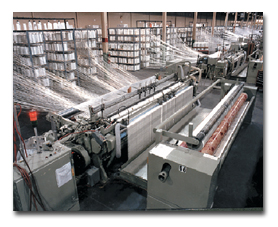
The Owens Corning Fabrics facility in New Braunfels, Texas, produces fiberglass material.
The company operates a second fabrics facility in San Vicente, Spain.


Glass Fibers


According to a recent report in High Performance Composites (HPC) magazine, glass fibers
represent the largest share of reinforcing materials in the composites industry.  Generally,
glass materials are used in three major areas – insulation, filtration and composite
reinforcement.  Reinforcement in both aerospace and industrial end-uses replaces heavier metal
parts in many markets. Glass fibers are found in boats (once again a growth market after repeal of
the car and boat luxury tax); tubs and showers; wind-turbine blades; small industrial-turbine
blades; reinforced pipe; automobile and appliance components; printed circuit boards; insect
screens; industrial scrims (including house wrap and roofing shingles); gaskets and wicks;
filtration; and insulation.

The US glass fiber market is dominated by Pittsburgh-based PPG Industries and Toledo,
Ohio-based Owens Corning. A number of smaller producers cover the markets that are too small for
the big two.

Glass fibers are supplied in continuous, roving, yarn and chopped form – with the
ingredients and coatings determining the ultimate fiber characteristics. In production, raw
materials – more than 50-percent silica sand – are “melted” and reformed into individual filaments
ranging in diameter from less than 3 microns to more than 35 microns. Other ingredients are added
to design performance characteristics into the final fiber. 

Electrical glass, or e-glass, is an excellent electrical insulator, making it a natural
component in radio-signal applications, radomes, antennae and circuit boards. It also turns out to
be the most economical glass fiber for composites offering sufficient strength at a low cost,
morphing into today’s standard form of glass fiber. 

According to HPC magazine, e-glass is at least 50-percent silica oxide with the remainder
composed of metal oxides of aluminum, boron and calcium plus clay, limestone, boric acid and
fluorspar. The ultimate end-use determines what properties are required from additives.

When further strength is required, high-strength s-glass is available.  Known as
r-glass in Europe and t-glass in Japan, the product achieves orders-of-magnitude increases in
strength by incorporating higher proportions of the oxides of silica, aluminum and magnesium.
Unfortunately, for competition with ceramic fibers – where temperature stability is vital – s-glass
erodes at higher temperatures. Fiber coatings provide partial relief, but the coating often adds
its own problematic characteristics to the composite.
hexcelfiber
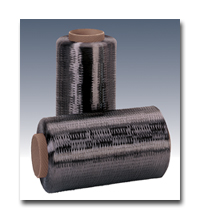
Carbon fiber is available from several global fiber and composite manufacturers.

Photograph courtesy of Hexcel Corp.


Carbon Fibers


Carbon fibers are the most widely used fibers in high-performance applications. They are
produced from rayon, petroleum or coal tar pitches and – the most popular – polyacrylonitrile
(PAN). While all meet the definition of carbon fibers, each brings different characteristics to the
end-use.

Early carbon fibers were produced from rayon precursors, and the fiber’s dogbone cross
section made it an optimal material for the carbon/carbon materials and the ablative structures of
the space shuttle program. PAN-based fibers show good-to-excellent strength and high stiffness,
while pitch-based materials show PAN-like strength, extremely high stiffness and a negative axial
coefficient of thermal expansion,  meaning an extremely stable structure under varying heat
loads. 

Current market interest in carbon fibers traces its roots to the 1960s and 1970s excitement
surrounding the US space program. In truth, carbon fibers trace their even older roots to Thomas
Edison and the famous 19th century incandescent lightbulb filament experiment. 

The market is supplied by several major manufacturers: Zoltek Cos. Inc., St. Louis, which
provides fibers and composites from sites in the United States and Hungary; Mitsubishi Rayon Co.
Ltd., Tokyo, with facilities in Japan and the United States; Toray Industries Inc., Tokyo, with
facilities in Japan, Europe and the United States; Toho Tenax Co. Ltd., Tokyo, which established a
US beachhead recently by purchasing Knoxville, Tenn.-based PAN producer Fortafil Fibers Inc.; and
Hexcel Corp., Stamford, Conn., with facilities in the United States, Europe and the Pacific Rim.
Hexcel provides both fibers and finished honeycomb patented carbon-based composites.

According to HPC magazine, much “debate exists over industry statistics for carbon fibers.
Estimates of world-wide demand for continuous, PAN-based carbon fiber (sic) range from … 30
million lb to 50 million lb.”

The magazine’s latest estimate puts industry capacity at 70 million pounds for conventional
and large tows. Despite an up-and-down consumption history, hope continues to spring eternal that
true commercialization of carbon materials is just around the corner. To this end, market reports
suggest major suppliers are planning capacity expansions, although against an estimated
double-supplied market the judgement is questionable.

Carbon fibers probably have the widest distribution of all specialty/ high-tech fibers, if
for no other reason than that, excepting glass, they have been worked into advanced structures for
a longer time than competitive materials. End-uses include the obvious aerospace structural and
ablative applications; low-cost asbestos replacement in automotive (including trucking and off-road
vehicles) brakes and clutches; chemically resistant packing and gasket materials; sporting goods;
additions to plastics, ceramics and adhesives to provide conductivity and shielding characteristics
in electrical applications; and an expressed probability of future use in fuel cells.


Ceramic Fibers


The attractiveness of material synergies achieved by combining fibers and matrices has not
escaped the ceramics industry. Ceramics’ intrinsic characteristics make them ideal building blocks
in markets requiring strength, stiffness, thermal expansion and thermal conductivity. Sadly,
however, ceramics are extremely brittle and, therefore, are rarely available in large-sized
structures. The answer is fiber reinforcement to deflect the energy of a forming crack; and for the
past several decades, much work has focused on this development.

Ceramic fibers can be engineered to the specific characteristics required by the reinforcing
activity. The ability to “spin” ceramic fibers to “match” the matrix could be an important
development, but potential volumes and physical difficulties, mostly focused on heating regimens,
have delayed the work. Most recent development work, therefore, has focused on two readily
available materials – silicon carbide (SiC) and aluminum oxide (Al2O3) and combinations of the two.

Current producers of ceramic fibers include: Mitsui Mining Co. Ltd., Tokyo, with its Almax
fiber; Sumitomo Corp., Japan, (Altex); 3M Corp., St. Paul, Minn. (Nextel™); Nippon Carbon Co. Ltd.,
Tokyo (NICALON®); and Ube Industries, Japan (Tyranno®).

Ceramic fibers are produced in several forms, mostly continuous filaments and “whiskers” –
short fibers added to a slurry of the matrix for non-dimensional strength support.  Continuous
fibers are particularly desirable in producing continuous-fiber-reinforced ceramic-matrix
composites, the holy grail of the composite manufacturer.

Currently, ceramic fibers are used to strengthen matrices in heat shields, high-temperature
gasket materials, electric thermocouple coverings utilizing both the heat and (lack of)
conductivity characteristics of the ceramic, pipe wrap, furnace insulation, high-temperature
structural applications in aerospace in heat-exchangers, gas turbines, and space shuttle engine
components.

Ceramics also are ideal in non-strength applications. One of the more interesting is
produced by Lambertville, N.J.-based Advanced Cerametrics Inc. (ACI). Using a proprietary process,
the company produces a line of piezoelectric ceramic fibers. (Author’s note: the piezoelectric
effect develops a current from mechanical work and produces mechanical work from an electric
current. The glittering lights on the heels of a child’s sneakers are lit by piezoelectric material
in the heel, actuated by the child’s leg/foot movement).

ACI is working with sports equipment manufacturer Head NV, Amsterdam, in development of
Intellifiber and Intellichip active fiber composite tennis rackets and skis. ACI supplies actuators
that actively dampen the vibration created during a ball strike or edge chatter from a ski turn,
using the energy to create an electrical force to counteract the mechanical forces and control the
shape of the ski or racket. ACI claims the piezoelectric structure adds up to 15-percent more power
to a ball hit and about 6-percent more functional edge on a ski.

The Head sports project is but one use of ACI’s materials. Long-term, the company sees
piezoelectric fiber materials becoming integral parts of ultrasound testing equipment, actively
controlled automobile suspensions and a myriad of acoustic applications.

Expanding on the success of piezoelectric fiber, ACI is working to develop conductive
titania fibers for use as conductors in stressful or destructive environments.


Looking Ahead


Some of these examples of smart fibers are not “new smart,” but extensions of existing
technology. However, the developments achieved by these fiber manufacturers provide high-tech
components for the textile industry to adapt to its going-forward product lines. Rare is the need
for a primary sophisticated structure – tri- or multiaxial weaving or knitting, for example.
Examination of the ingredients suggests simple fabric constructions using high-tech materials can
provide a basic component for a smart structure.

Polymeric materials, increasingly  being developed to supplant or replace the natural
materials used in glass, carbon and ceramics, will be covered in part two of this feature.

July/August 2005

July/August 2005


bbcartMeese Orbitron Dunne Co.

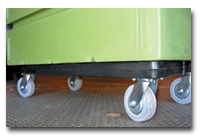
, Saddle Brook, N.J., offers the 72PL bulk laundry cart. The molded plastic cart features
a plastic base and can carry up to 600 pounds in 48 cubic feet of capacity. It is water-, rust- and
corrosion-resistant; and is able to withstand collisions and bumps without crumpling, scratching or
denting, according to the company.


The American Association of Textile Chemists and Colorists (AATCC)
, Research Triangle Park, N.C., has developed the AATCC Standard Reference Fibers quality
control product to aid customers in precisely identifying cashmere and wool fibers and fiber
blends. The product set includes the statistical results of an interlaboratory fiber analysis
study, and 5-gram samples of pure cashmere and wool.

The

European Committee of Textile Machinery Manufacturers (CEMATEX)
, organizer of the Asian International Exhibition of Textile Machinery (ITMA Asia 2005),
has launched an on-line ITMA Asia 2005 exhibitor directory at www.itmalive.com.

The New York City-based

Fragrance Foundation
recently awarded New York City-based

International Flavors & Fragrances Inc. (IFF)
the 2005 FiFi® Award for IFF’s Sensory Perception™ technology — a micro-encapsulation
delivery system for textiles that enables fragrance or active ingredients to be released over time
from a variety of textiles.

Northampton, Mass.-based

Commercial News USA
— the official export magazine of the US Department of Commerce — is now being translated
into Chinese for distribution in China.

Effective July 1,

Albemarle Corp.
, Richmond, Va., has increased in the Americas the price of its Antiblaze® line of flame
retardant products by 12 cents per pound. The company also has increased globally the price of its
Saytex® RB-79 products by 12 cents per pound, and its Saytex HP 900 and Saytex BCL 462 flame
retardant products by 5 percent.


Habif, Arogeti & Wynne LLP
, Atlanta, in cooperation with

Kennesaw State University
, Kennesaw, Ga., the

Georgia Industry Association
, Smyrna, Ga., and

Georgia Quick Start
, Atlanta, have published a survey titled the “Performance and Practices of Georgia’s
Manufacturing Firms.”

Aston, Pa.-based

Amacoil Inc.
has made available a CD-ROM that details Uhing rolling ring linear drives. The CD
includes downloadable technical files and video clips that explain the ring’s operating
principle.


Premier Pneumatics Inc.
, Salina, Kan., now offers customized system manuals in easy-to-use and -store digital
formats.

premierscreen


The

International Wool Textile Organisation
, Brussels, is accepting entries through Oct. 31, 2005, for the 2006 World Wool Award.
For more information, contact Marzena Oscilowska 32 2 505 40 10; fax 32 2 503 47 85;
project@iwto.org;
www.iwto.org.

At the recent NeoCon 2005 World’s Trade Fair for Interior Design in Chicago,

Designtex
, a Steelcase company based in New York City, received a Best Of NeoCon Silver award for
its 100-percent Ingeo™ PLA Terratex® panel textiles.

Evansville, Wis.-based

Haight Pumps
now offers its Universal Design PD pump in stainless steel models capable of handling
10-, 15- and 20-gallon capacities.

The

Association of the Nonwoven Fabrics Industry (INDA)
, Cary, N.C., is accepting product nominations through Sept. 1, 2005, for the annual
Visionary Award, which will be presented at the Vision 2006 Consumer Products Conference next
January in New Orleans. For more details, contact Michael Jacobsen (201) 612-6601; mjacobsen@
inda.org;
www.inda.org. In other news, INDA has made available an academic
research facilities database at www.inda.org/about/research/index.html. INDA also now offers a
consultants network that includes 20 firms from the United States, Canada and India at
www.inda.org/about/research/consultants/index.html. In addition, the association has upgraded and
expanded its job mart and classified advertising listings, also found at
www.inda.org.


July/August 2005

Finlane Introduces New Cognetex Draw Frame Machine Upgrade Program

The Finlane Group – comprised of the Italy-based SantAndrea Novara and Cognetex Divisions, and
Germany-based Seydel Maschinenfabrik GmbH – recently unveiled the Cognetex SC600 intersecting draw
frame for acrylic fiber processing. According to the company, the new frame features easy operation
and settings using the new Finlane Dialoguer touch screen machine interface, a simple mechanical
structure that leads to low and easy maintenance, a high working speed, excellent technological
head characteristics for exact sliver control, optimal quality/price ratio and fast return on
investment, and high electrical and mechanical reliability.

Finlane also has initiated a new machine upgrade program to encourage the use of a
performance-improving retrofit kit that can be used with existing machines. Visitors to
www.finlane.com may visit the Machine Upgrade Program section
of the website to browse through the continually updated list of retrofit kits available for
SantAndrea Novara, Cognetex and Seydel machines.

 
July 2005

INVISTA™ Spins Off Textronics™ Venture

Textronics Inc., Wilmington, Del., an electro textile materials and system integration venture
formed by Wichita, Kan.-based INVISTA Inc., has spun off from Invista to become an independent
company.

The convergence of electronics and textile science is opening up exciting new markets for
fabrics that conduct, illuminate, sense and warm, said Stacey Burr, CEO, Textronics. Our goal is to
integrate electronics in ways that make textiles the provider rather than the container of new
functionality.

Using investment funding from Invista; NGEN Partners and Unilever Technology Ventures, both
based in Santa Barbara, Calif.; and New York City-based SAS Investors, Textronics will expand its
employee base; ramp up development of patented technologies; and commercialize promising apparel,
home, industrial and transportation textile applications. The company also will continue to have
access to Invistas textile development facilities.

July/August 2005

Watch Your Step


I
n typical ambulatory style, the general population walks across a variety of floor
covering products each day without giving a passing thought to what’s underfoot  – a finely
burnished hardwood floor in a neighbor’s dining room. A rather shaggy rug left over from the 70s at
Grandmother’s house. How bout the rather nondescript carpet that covers every inch of the typical
office floor? Several floor covering companies in recent months have introduced new product lines
that promise to put some color and pattern back under your feet, as well as add stain-lifting,
antimicrobial and environmentally friendly properties.

millikenremix


Creating A Vibe


Interior designers looking for a way to jazz up certain carpet designs need look no further
than the new Color Vibe process from LaGrange, Ga.-based Milliken Carpet. The process offers what
the company calls high-energy accent colors such as raspberry, sunshine, ruby, sky, mango, emerald,
violet, aqua and indigo that can be added to existing Milliken carpet patterns for that certain
spark – sure to get the attention of any walker-by.

“Color Vibe allows designers to further customize the floor without spending time and money
on a customs process,” said Alison Kitchingman, director of marketing, Milliken Carpet.

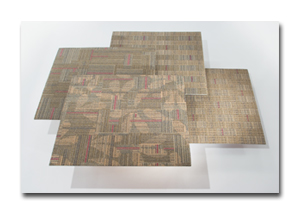
Milliken Carpet’s Remix collection features the company’s color vibe process by which an
accent color of choice may be added to carpets found in the Remix of Step Out collections.

The Remix and Step Out carpet collections from Milliken feature the Color Vibe customization
process. Their base color treatments include neutral grays, beiges and olives, and blues and
greens.

Step Out includes patterns that give a contemporary feel to elliptical loops and Pop Art
dots, as well as bubbles and fizz designs, all overlaid on a funky grid work, according to the
company. The group features five patterns, each in five colors.

Remix patterns display basket weaves, organic botanical and sisal-inspired pinstripes. The
group features four patterns, each in 16 colors.

Colors in the two collections can be specified as is or remixed to include the Color Vibe
accent color of choice.


Taking Upholstery

Fabrics In A New Direction

Quaker Fabric Corp., Fall River, Mass., reports its new sueded velvet collection of
furniture upholstery fabrics offers customers a smart, environmentally friendly alternative to
microdenier faux suede, while also delivering enhanced color and pattern design, softer hand, and
superior performance.

The collection features plaids, contemporary geometrics and coordinated plain and jacquard
stripes all manufactured without releasing toxic effluent into the environment.

“We decided sueded velvet was the best way of capturing the velvety soft hand and the rich
sumptuous look of these fabrics, and that’s how they got their name,” said Larry A. Liebenow,
president and CEO. “These products come with the service and quality advantages only a US-based
fabric manufacturer can offer the color consistency that flows from the use of pigmented yarns the
performance characteristics inherent in all of Quakers Ultra fabrics – stain resistance, durability
and cleanability.”

mohawkcarpet


Think Luxury


The Kennesaw, Ga.-based Mohawk Group recently introduced a number of new carpet collections
across a range of brands all devoted to luxury in the contract design market.

“Luxury increasingly is emerging as a trend in contract design, and all of our brands –
Karastan Contract, Durkan Commercial, Mohawk Commercial and Bigelow Commercial – are responding to
it,” said Tom Lape, president. “Our newest designs reflect the upscale qualities and
characteristics that help to define luxury, yet they still are practical and purposeful for
commercial applications.”

Karastan Contract brought in architect Shashi Caan to design a line of woven carpets that
combine the 3D elements of traditional hard-surface architectural elements such as concrete, rebar,
steel girders and undulating glass with soft floor coverings. The resultant Translations line
contains four patterns Glass Lines, Gridded Steel, Molten Weave and Ribbed Concrete created with a
new yarn system and a re-engineering of the company’s looms. Yarns are made from Invista Antron®
enhanced polymer nylon 6,6 skein-dyeable metallic fibers, which impart a high-luster effect. Pile
heights on existing looms were reset to unconventional measures in order to create the 3D effects.

The color palette includes flat neutral tones, sea glass blues and greens, and steely grays
all reflective of the architectural surfaces they are based upon.

Probable end-uses for the Translations line include retail, public and corporate spaces.

Karastan Contract continues its theme of luxury with Chenille Concepts, a woven floor
covering product that takes the look of chenille textiles found in upholstery and applies it to
floor surfaces. The cut pile of space-dyed yarns imparts linear patterns and multicolor tonal
effects. Shown in 13 colors, the new line is able to effectively conceal wear, stains and soil,
according to the company. The collection is a suitable coordinate with Mohawk’s Brocatelle
collection – a classic loop cut small-scale grid pattern available in 21 color options.

Durkan Commercial echoes this same theme of all things luxurious, with two new commercial
carpet collections – The Moroccan Series and Etchings.The Moroccan Series features a tufted
construction with a grid-like arrangement of patterned cut and loop texture. The group’s four
designs available in 17 colors include: Morocco II, a staggered stripe effect; Agadir, a textured
coordinate; Kenitra, large-scale blocks; and Marrakesh, small-scale blocks.

Mohawk’s Ultra Performance System (UPS) – a patented technology that enhances tufted carpet
performance and enables installation flexibility – is incorporated into the carpet construction.
The Etchings collection features a traditional boucltyle enriched with a dimensional, decorative
pattern with subtle tone-on-tone coloring elements. Four patterns – Pin Scribed, Chiseled Edge,
Laser Cut and Etched Weave – are available in 28 colors. The carpet is a precision cut and loop
with a higher percentage of loop to ensure exceptional performance, according to Durkan Commercial.
Bigelow Commercial has put a touch of luxury into its Renaissance collection for the institutional,
retail and corporate environments, among others, that call for a high-end look and feel.Inspired by
chiaroscuro a Renaissance painting technique based on light and shadow interaction the three
patterns in the collection are made of a patterned and loop tufted construction that features a new
proprietary yarn that imparts a shiny effect and the suggestion of shadowy contrasts.

The Fab and Wow paired collection, just as its name implies, delivers a high level of visual
interest and textural effect just what a pair of feet might want to experience as they traverse a
carpeted space. Available in 12 colorways, the collection combines yarns in a range of sizes in
weaves that appear to be overlaid with color fields. Pebbled color and accent tones enhance the
geometric motif.

Mohawk Commercial now offers three new patterns with its Initiative carpet tile collection,
in which very long strands of color repeat and reverse throughout the length and the width of the
tiles, which can be arranged in any configuration.

Pattern choices include Too Fresh, with the look of an abstract non-directional grid; A2Z,
inspired by the look of Art Deco fabrics; and Brain Box, featuring unique swirls with geometric
suggestions. Each pattern is available in nine colorways, each containing seven colors. The new
designs also are offered with companion broadlooms, also available in nine colorways, each with
seven individual colors.

The Initiative collection also features UPS technology, as well as UltraSet Modular system
backing a hard tile back structuring that features a high level of resiliency and performance to
ensure against cupping, dishing and doming.Sisal weaves can be seen underfoot in the Rhythm in
Weave woven carpet collection. Inspired Sisal and Fresh Tapestry patterns impart warm, natural
textures through balanced patterns and natural hues. Thirteen colorways are available.

Mohawk Carpet’s commercial contract brands feature the theme of luxury in their latest
collections.


Think Environmentally Friendly


While luxury seems to be a predominant theme at Mohawk, the company never veers from its
goal of producing commercial carpet that is at once attractive and environmentally sound.

“While performance issues are at the forefront of our decisions, our challenge is to
understand the ecological impact of every process, to question our assumptions as we search for a
better way, and to ensure that ultimately we are making the right decision for the right reason,”
said Lape.

UPS re is the latest generation of Mohawks UPS technology. According to Mohawk, the new
technology, which is scheduled to be available by the beginning of next year, provides carpets with
the highest level of post-consumer recycled content of any widely available commercial carpeting in
the industry. Recycled materials are integrated directly into the UPS foundation, producing carpet
that has at least 15 percent post-consumer content based on total product weight. The new
technology: increases the lifespan of tufted carpet, reducing the environmental footprint left by
additional cycles of replacement; reduces the need to use natural resources, substituting them with
materials diverted from landfills; can potentially divert more than 8 million pounds of such
materials from landfills just in the first year; and can be recycled and converted into more useful
products for several generations.


European Associations Agree To Standardized Floor Covering
Symbols


In an effort to effectively communicate floor covering product attributes and
classifications in an organized and standardized manner, three European associations representing
resilient, textile and laminate floor coverings have agreed on a list of standardized symbols
related to European testing standards.

The European Resilient Flooring Manufacturers Institute and the European Carpet and Rug
Association, both based in Brussels, and the Germany-based European Producers of Laminate Flooring
in cooperation with the European Committee for Standardization, also based in Brussels, have issued
a report that establishes a system of graphic symbols and specifies their use in the marking of the
following: floor panels for loose laying; laminate floor coverings; textile floor coverings
excluding loose-laid mats; and resilient plastic, linoleum, cork or rubber floor coverings
excluding loose-laid mats.More information can be found at
www.floorsymbols.com


July 2005

Saurer To Acquire Fehrer

Subject to European Union Monopolies Commission approval, Saurer Group, Switzerland, will acquire
Austria-based Dr. Ernst Fehrer AG. Saurer plans to add Fehrer’s operations including its
needlepunching technology and machinery to produce carded nonwovens from long-staple fiber to its
Germany-based Neumag nonwovens machinery business unit, providing Saurer with an entree into
automotive, carpet and geotextile markets. Monica Fehrer will continue as president of Fehrer,
which will maintain its Linz, Austria, location.

July/August 2005

Sponsors