Celebrating A Milestone


I
n 1930, Saul Rosen formed United Yarn Products Inc. and began selling natural fiber
yarns, including silk yarn waste, in Paterson, N.J. the United States first planned industrial
city, which became known as Silk City because of its dominant silk production industry. That
business decision has evolved into a thriving Wayne, N.J.-based business that supplies a variety of
man-made yarns for the industrial and domestic textile markets that celebrates its 75th anniversary
this year. It is a company that encompasses a number of businesses, and is still owned and operated
by the Rosen family.  Saul’s son Martin is president, and his son Arthur is vice president.
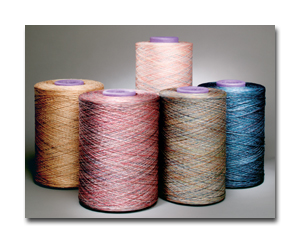
spools


Building A Business


Rosen was an ambitious businessman, creating Fiberspun in 1960 – a yarn-processing operation
in Staunton, Va., that included texturing, beaming, rewinding and twisting operations. That
facility was sold to Greensboro, N.C.-based Unifi Inc. in 1988.

In addition, Rosen built a strong relationship with DuPont, processing packaged filament
nylon and Dacron® polyester. This relationship enabled United Yarn to expand its distribution
business and extend its range of products and target markets.

United Yarn transitioned its relationship from DuPont to INVISTA Inc., Wichita, Kan., when
Invista was spun off from DuPont Textiles and Interiors. The company now supplies Invista branded
products containing Lycra® elastane, Tactel® and Supplex® nylon, and CoolMax® polyester to the
narrow- and warp-knit fabric markets.

United Yarn entered into a joint venture in 1992 to establish American Drawtech Co., a
business that produces fully drawn flat polyester yarns for apparel, industrial and home
furnishings markets. Two years later, company principals purchased affiliate business Kennetex
Inc., a manufacturer of texturized and space-dyed polyester fully oriented and partially oriented
yarns.In 2001, United Yarn created the Industrial Filaments Group to aid it in providing higher
efficiency and service for its customers in the industrial textiles market. The group manufactures
custom-designed high-tenacity polyester and high-quality nylon 6 and 6,6.


Continuing Success


With past successes comes the knowledge that future gains are possible if the company
remains focused keeping a pulse on industry trends and customer needs, upgrading operations and
improving products and capabilities.Throughout our history we have been dedicated to the success of
our customers, meeting their needs for quality products, delivered on time and at a competitive
price, said Martin N. Rosen, president. By continuing to invest in the best people and the latest
technologies, we will be able to handle any changes in the marketplace and to empower the success
of our customers.

July 2005

Jones Apparel Obtains 750M Bank Credit Facility

Jones Apparel Group Inc., Bristol, Pa., has completed a $750 million five-year revolving bank
credit facility that extends to May 2010. The facility is an amendment and restatement of the
company’s existing $500 million three-year credit facility that was to mature in June 2006.
Approximately 29 banks and financial institutions participated in the credit facility.

“Combined with an existing revolving credit facility, which extends to June 15, 2009, Jones
Apparel Group now has $1.75 billion of committed bank credit that provides us with substantial
financial flexibility as we continue to pursue our multibrand, multichannel diversification
strategy,” said Wesley R. Card, chief operating officer and chief financial officer.

July/August 2005

NSC Nonwoven Debuts Excelle Card

France-based
NSC Nonwoven reports its new Excelle® card offers consistent web quality, high production and
productivity rates, ease of maintenance and minimum downtime, and user-friendly and safe operation.

Suitable for direct or crosslapped textile routes, Excelle can be customized and offers
individual variable drive speeds. The card features total visual access to facilitate adjustments
of parameter settings, as well as touch screen control and AC motors with flux vector control. Air
options include filtered, temperature-controlled and humidified. Another option is the new C1
condensing rollers system for high-efficiency web removal and control.

July/August 2005

Schoeller, Ciba Partner To Expand 3XDRY® Technology

Schoeller Technologies, a Switzerland-based subsidiary of Schoeller Textil AG, and Ciba Specialty
Chemicals AG, Switzerland, have announced they will partner to promote and expand the 3XDRY®
moisture-management finishing technology developed by Schoeller Textil. Ciba will manage
consultancy, sales and quality control, while Schoeller Technologies will manage branding,
marketing and patents.

July/August 2005

Freudenberg To Install PET Spunbond Line In Taiwan

Freudenberg Nonwovens, Germany, will add 12,000 tons of polyethylene terephthalate (PET) spunbond
capacity in Taiwan with the installation of a second PET spunbond line in that country. The company
reports the additional capacity, expected to come on-line by the end of 2007, will support its
growing Asian customer base.

“We aim to increase our production capacity for tuft backing substrates as well as enhance
our global supply flexibility to our customers as they continue to grow,” said Bill Casey, general
manager, Tuft Division. “Our total PET spunbond capacity in Asia should cover the demand for our
unique PET spunbond products for the next eight to 10 years.”

July 2005

Fashionishare-i Web Solution Streamlines Apparel Operations

Fashionware Solutions Inc., New York City, has launched Fashion
share, a scalable, Web-based solution that brings merchandisers, designers, sourcing
managers, vendors, suppliers and retailers together to share product, trim and fabric information.

The software, based on Microsoft.NET technology, does not require on-site installation, and
runs on almost any computer capable of Internet access. It is delivered in an on-demand, hosted
environment, and can be used as a stand-alone front-end solution, or in conjunction with
traditional enterprise resource planning systems.

Fashionware provides setup, personalization and ongoing support for the technology.

July 2005

Senate Approves Central American Free Trade Agreement

The US Senate on June 30 approved the Dominican Republic-Central American Free Trade Agreement
(DR-CAFTA), setting the stage for a major battle in the House of Representatives when Congress
returns from its July 4 recess. The 54-45 vote showed considerable support for the agreement among
Southern textile state senators, with Sen. Lindsey Graham (R-SC) being the only senator to vote
against the measure. In the New York-New England area, where both textiles and apparel are major
employers, the vote was just the opposite with the New York, Massachusetts and Rhode Island
senators opposing the measure, except for Sen. Lincoln Chafee (R-RI), who voted for it.

Concurrent with the Senate action, the House Ways and Means Committee voted 25-16 to send the
measure to the full House for a vote soon after the recess.

Both supporters and opponents of the pact, which will lower or eliminate trade barriers to
imports to the United States from Honduras, Nicaragua, Costa Rica, Guatemala, El Salvador and the
Dominican Republic, said the Senate vote showed momentum for their positions. The textile-related
American Manufacturing Trade Action Coalition said DR-CAFTA is losing momentum and is in serious
trouble. A statement noted that the 54-52 vote was the closest vote on any of the recently
negotiated free trade agreements, including the North American Free Trade Agreement, which DR-CAFTA
is modeled after, that passed the Senate by 61-38.

On the other hand, Kevin Burke, president of the American Apparel and Footwear Association,
which supports DR-CAFTA, said the House and Senate votes show clearly that there is growing
momentum toward full passage and implementation of this very import agreement. Noting the support
from textile state senators, Burke said there is strong recognition that this agreement is vitally
important to the US textile and apparel industry and its Dominican Republic and Central American
partners.

The National Council of Textile Organizations, which also supports DR-CAFTA, said the textile
region votes were the strongest show of support of any region.

US Trade Representative Rob Portman said momentum is on the side of the administration.
“Every day we’re making more and more progress. The House Ways and Means Committee gave DR-CAFTA a
good shot in the arm by approving the implementing legislation 25-16,” Portman said. “While the
momentum for DR-CAFTA is building, and we’re drawing more and more support from all sides, the
debate will continue when the House returns after the July 4 recess. I look forward to working to
build towards successful passage in July.”

While there is pretty general agreement that the pact will not open many opportunities for US
exports to the Central American countries because of their size and poor economies, DR-CAFTA has
become a linchpin in the Bush administrations trade policies as the president believes free trade
agreements can be mutually beneficial by providing economic stability in some of the less-developed
countries. At the present time, imports from the DR-CAFTA countries account for about 6 percent of
total US imports of textiles and apparel.

July 2005

Picanol Introduces OMNIplus 800


W
eavers from across the country were treated to a glimpse of the latest technology at a
recent open house hosted by Belgium-based Picanol NV and Global Textile Partner (GTP) Greenville
Inc. – the US headquarters of Picanol’s Belgium-based GTP operation that produces weaving machinery
accessories, and which provides service and sales of spare parts for Picanol weaving machines in
the United States.

loommen
A recent Picanol/GTP event offered attendees a look at new Picanol technology and a tour of
Steel Heddle’s facilities.

GTP Greenville President James C. Thomas welcomed attendees to the event, which included
presentations, tours of GTP company Steel Heddle Inc.’s manufacturing facilities and demonstrations
of Picano’ls latest offerings.

Patrick Steverlynck, chairman and CEO, Picanol Group, set the tone for the day by stressing
his family’s commitment and involvement as the majority stakeholder of the company. Steverlynck
spoke of business conditions that include weavers delayed investment plans related to World Trade
Organization issues and US dollar-versus-euro exchange rate challenges; but he also focused on a
customer orientation by Picanol that features innovation, cost control and collaboration.

Jan Laga, vice president, Weaving Machines and Services, Picanol, presented a history of the
company leading up to the latest-generation GamMax rapier and OMNIplus air-jet weaving machines.

Philip Gilliland, quality manager of GTP worldwide accessories, spoke of the proud heritage
of Steel Heddle acquired by Picanol in 2001 dating back to 1898 and a history of innovation
featuring some 200 patents. He also mentioned that GTP Greenville underwent a multimillion dollar
investment campaign in 2004 that allowed it to improve the quality of a number of products while
increasing capacity at the same time.

omniplus800
omniplusinset
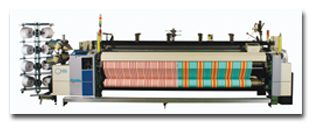
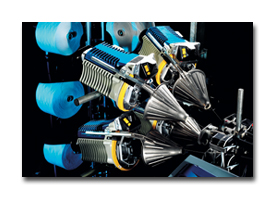
The new OMNIplus 800 (top) from Picanol features optimized insertion preparation for up to
eight colors or yarn types (bottom).


New Features


At center stage, Jan Maes, international sales manager, Picanol NV, presented the new
OMNIplus 800 air-jet weaving machine with the ease of a man who has spent years with the evolving
technology of the company. Picanol launched the first OMNIplus in 2000, but the air-jet legacy goes
back 25 years. Speed, quality and flexibility, according to Maes, are achieved by the air-jet’s
performance, electronic controls and fully modular design. Maes pointed out a number of features.
The real draw of this machine is the flexibility of its new modular design. He noted fast, simple
width changes; warp and cloth roll changes without the need to use additional tools; and the
patented Quick Style Change system, which enables style changes in less than 30 minutes by one
person. The modularity allows for cam, dobby and jacquard motions to be interchanged. Insertion
requires 10- to 15-percent less air consumption, and main nozzle controls run at 4 milliseconds
rather than 14 milliseconds. There also is an updated design of relay nozzles and valves.

The oil-cooled main drive of Picanol’s Sumo motor functions without the standard belt or
clutch and brake, using a short transmission chain. More than 60,000 Sumo motors are currently in
the market on weaving machines.

Maes also reviewed several pilot placements of the machine, which demonstrate the OMNIplus
800’s versatility and efficiency.

Weavers are sure to see many presentations of the new design in the coming months.


Additional Activities


Steve Brown, regional sales manager, United States, Picanol NV, provided an update on the
GamMax rapier and its optimized rapier motion. The GamMax is capable of accommodating 190- to
380-centimeter (cm) widths (with the exception of the free flight version, which is available in
all widths except 380 cm). Showroom demonstrations of the OMNIplus 800 weaving denim and sheeting,
as well as a GamMax throwing a wide variety of fillings with Maes providing a play-by-play
explanation illustrated just how far weaving technology has evolved through the years
high-technology performance that delivers quality and provides flexibility for changing market
demands.

Tours of the Steel Heddle manufacturing facility gave visitors an up-close view of the care
that is necessary to make and deliver the quality for which the company is known.

July/August 2005

Pharr Yarns To Expand Operations

With partial support from a $200,000 grant from the One North Carolina Fund – a state incentive
grant program that promotes economic growth in North Carolina – Pharr Yarns Inc., McAdenville,
N.C., has begun construction on a new plant that will house fiber manufacturing lines within the
company’s carpet yarn manufacturing division.

“Pharr Yarns chose to build this facility in McAdenville because of the performance of its
current highly skilled manufacturing workforce and its proximity to our existing operations,” said
J. M. Carstarphen, chairman and CEO. “Our company greatly appreciates the support of the state and
county in providing training support and economic incentives to assist in the launch of this
important project.”

Over the next three years, Pharr plans to invest $30 million and create 75 jobs, which will
include manufacturing and supervisory positions in the new plant.

Operations are expected to begin by the end of this year.

July 2005

Fiber Innovation Technology Offers PPS Staple Fiber Line

Fiber Innovation Technology Inc., Johnson City, Tenn., now offers a full line of polyphenylene
sulfide (PPS) monocomponent staple fibers for applications that require heat and chemical
resistance.

The fibers are made with Fortron® PPS from Florence, Ky.-based Ticona, the technical polymers
business of Dallas-based Celanese Corp. Fiber Innovation Technology offers the fibers in standard
2- to 3-denier round cross sections, with cut lengths ranging from 0.25 to 6 inches and crimp
levels from uncrimped to 12 crimps per inch. The fibers feature a tenacity of 4 grams per denier,
50-percent elongation and less than 2-percent shrinkage at 170°C. They also can be manufactured in
almost any other shape, size and cut length, according to Brad Willingham, president.

“We began producing these fibers because of the growing demand for advanced filtration
materials that perform well in industrial pollution control applications involving hot gases and
liquids,” Willingham said. “We’re also seeing a call for such fibers in a range of new composite
materials, as well as in aerospace and other markets.”

According to Ticona, Fortron linear PPS is inherently flame-retardant, withstands
temperatures of up to 200°C, tolerates a pH range from 2 to 12, and is stable in the presence of
bleaches and organic solvents. The fiber can be processed using most extrusion methods.

July/August 2005

Sponsors