Tullahoma Develops Fabric Using AF&Y’s Innova® Yarns

Tullahoma Industries LLC, Tullahoma, Tenn., has introduced Outerbounds, a line of high-performance,
double-sided terry fleece fabrics made with Innova® performance yarns from Chapel Hill, N.C.-based
American Fibers & Yarns Co.

The fabrics are stain- and fade-resistant, bleach-cleanable, moisture-wicking, quick-drying,
lightweight, breathable and antimicrobial.

According to Tullahoma, the new fabrics weigh 22-percent less, provide better durability and
feature more thermal retention when compared to branded polyester fleece products.

“This application of Innova technology is the most significant advancement for the fleece
market in recent years,” said Mike Williams, manager, product development, Tullahoma. “The test
results are tremendously impressive and we are eager to see the reaction when consumers get their
first opportunity to see these products.”

Targeted to apparel and home textiles, the new fabrics come in three weights temperate,
alpine and arctic to provide consumers with a range of comfort and warmth levels.

October 2005

Wilbur L Ross Purchases Stake In Safety Components International

Zapata Corp. Chairman, Avie Glazer, announced the sale of 4,162,394 shares, 77.3%, of Safety
Components International to private equity investor Wilbur L. Ross, Jr. for $51.2 million. Safety
Components, the leading independent manufacturer of air bag fabrics and cushions, had sales of
$230.4 million and income of $7.4 million in the twelve months ended June 30, 2005. The company’s
value-added fabrics are mainly used in automobile safety air bags and in a variety of applications
such as fire service apparel, ballistics material for luggage, filtration and military tents.
Safety Components is headquartered in Greenville, South Carolina and has plants located in North
America, Europe, China and South Africa.

Mr. Ross said, “We have confidence in the long-term outlook for the business even though
industry conditions are challenging at present. Management has great technical expertise in
manufacturing its niche textiles globally, and we hope to help them acquire complementary product
lines.”

Mr. Glazer added, “Safety Components is an excellent company and we have enjoyed our
relationship with it. We look forward to continuing to enhance value at Zapata.”The transaction is
subject to a number of closing conditions, including approval by the shareholders of Zapata. Glazer
interests, owning 51% of Zapata stock have committed to vote in favor of the deal.

Press Release Courtesy of Wilbur L. Ross

October 2005

IRO To Acquire Te Strake Textile Weft Feeder Assets

The Sweden-based IRO Group has reached an agreement with the Belgium-based Picanol Group whereby
IRO will acquire the assets and activities related to Picanol subsidiary Te Strake Textile BV’s
weft feeder business. The acquisition will enable IRO to consolidate its yarn-feeding expertise and
expand its market to include glass weaving and technical textile areas, among others.

While IRO henceforth will supply feeders, spare parts and service to Te Strake’s customers,
Te Strake will continue to offer weft-insertion-related products including main and relay nozzles.

October 2005

CRI Awards Approval Seals

The Carpet and Rug Institute (CRI),
Dalton, has awarded Seals of Approval to several carpet cleaning extractors that use National
Aeronautics and Space Administration-enhanced X-ray fluorescence technology developed by KeyMaster
Technologies, Kennewick, Wash., to measure amounts of soil removed.

Truck-mounted extractors from Sears Carpet & Upholstery Care, Lewis Center, Ohio; Mohawk
FloorCare Essentials, Fayetteville, Ga.; Prochem, Englewood, Colo.; ZeroRez, Lindon, Utah; and
CleanMaster, Mulkilteo, Wash., received gold Seals of Approval. Bronze seals were awarded to nine
portable extractors from US Products, Coeur d’Alene, Idaho; and a self-contained extractor from
Plano, Texas-based Rug Doctor.

October 2005

Current Industry Performance


D
omestic mill activity is holding up well despite the flood of imports from China and
other countries. Based on results for the first three quarters, overall 2005 production and
shipment totals for US mills won’t be down all that much vis-à-vis year-earlier levels. Part, of
course, reflects continuing economic growth.

Even with Hurricane Katrina’s negative effects, the nation’s overall 2005 gross domestic
product advance is estimated at around 3 percent. This, accompanied by still-growing employment and
incomes, is helping keep consumer spending on apparel and other textile products strong enough to
keep the domestic textile industry afloat.

Analysts at economic forecasting firm Global Insight see only a 4.8-percent decline in basic
textile mill revenues for 2005. And when it comes to the textile product sector, the forecasting
group anticipates a fractional 0.6-percent gain.

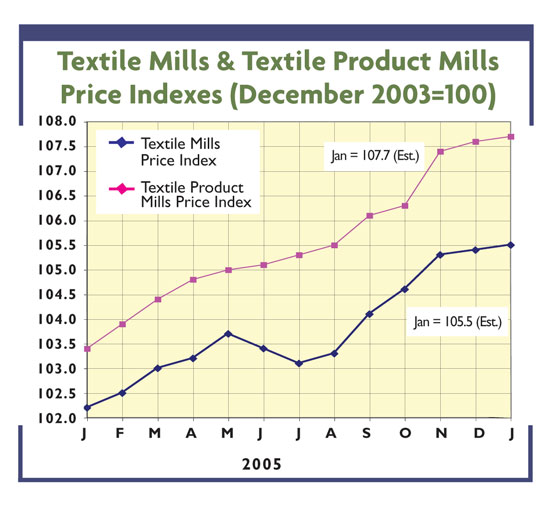
Prices, too, haven’t been faring badly and clearly haven’t experienced the catastrophic
tumble that many predicted following the junking of quotas this past January. Indeed, using Global
Insight’s latest projections, 2005 textile mill, mill product and apparel quotes are all seen
ending up within 1 percent or so of their 2004 averages.

bfchart_Copy


Productivity Factor

Nor are current demand and price trends the only factors behind our continuing viable textile
industry. Much of the domestic mills’ ability to stay afloat in today’s highly competitive global
markets stems from continuing productivity gains – as firms continue to modernize and take
advantage of new technological breakthroughs. A recently released government report covering the
16-year period from 1987 to 2003 finds average output per textile worker rose 3.9 percent
annually – with fiber/yarn/thread and fabric mills racking up even more impressive 5.2-percent
and 4.4-percent increases, respectively. Efficiency gains in the domestic apparel sector over this
same period aren’t all that bad either – averaging out near 3.1 percent a year.

Combine this with very modest wage gains, and there actually are some fractional declines in
both textile mill and apparel unit labor costs over this same 16-year time span. Productivity and
unit labor cost performance in these two areas has been as good as or even a bit better than those
noted in many other domestic manufacturing sectors.


More Efficiency Gains Ahead

Productivity gains show every sign of continuing. This can best be seen by looking at employment
and output trends over the last 12 months. Domestic mill production over this period declined by
only about 2.3 percent. On the other hand, employment in the combined basic textile mill and mill
product sectors was off about 4.5 percent. Implication: Output per worker over the past year has
again risen – probably somewhere in the order of 2 percent. This trend is expected to continue
into 2006 as domestic mills continue to invest in new, increasingly efficient equipment and
processes. This willingness to spend on new world-class equipment also is confirmed by the fact
that overall textile mill capacity – despite the spate of recent mill closures – hasn’t
really declined all that much when compared to the levels prevailing just one year ago.


Lingering Trade Uncertainties

There’s still no final answer on how the US-China dispute over textile and apparel imports will
be resolved, but a compromise – limiting future Chinese shipments – is virtually certain.
On the other hand, putting specific import numbers on any such agreement isn’t easy. Odds would
seem to favor a final pact along the lines of the recent deal with the European Union – one
that limits future Beijing-to-EU shipment gains to specified category-by-category percentages. Any
such agreement would clearly rule out any repeat of our huge import gains of recent months. Another
plus: A US-China deal would also assure our continuing exports of cotton, other textile raw
materials and textile/apparel manufacturing equipment to Chinese manufacturers.

Finally, an agreement would return some stability and predictability to an industry that has
been in a constant state of turmoil for nearly a year now.


October 2005

Fenner Dunlop Worldwide Orders SMIT Weaving Machines

Fenner Dunlop Worldwide, England, recently placed an order for 12 GS900 rapier weaving machines
from Italy-based SMIT Textile. With twelve facilities in eight countries, Fenner Dunlop
manufactures a range of conveyor belting for many different industries and applications from coal
mining and power plants to package handling and process automation. The company’s facilities in the
United States Georgia Duck Conveyor Belting, Scottdale, Ga.; and Scandura Conveyor Belting,
Charlotte already use 21 SMIT looms for their operations.

fennersmit

The new machines are destined for Georgia Duck Conveyor Belting’s facilities. Delivery has
commenced and will be completed by the end of November. The GS900 representing the evolution of
SMITs G6300 rapier weaving machine has gained wide acceptance and a strong foothold in the
technical fabrics market, according to SMIT. The machines mechatronic solutions offer enhanced
versatility and efficiency. The company reports it also offers excellent insertion rates, and its
compact construction gives it a sturdy frame that guarantees vibration-free running, even at high
speeds.

October 2005

Spotlight On Turkey


Hightex 2005 attracted visitors from Eastern Europe, the Middle and Near East, and North
Africa.


T
he

premiere edition of the Istanbul
International Technical Textiles and Nonwoven Trade Fair (Hightex 2005) recently was held at the
new Istanbul World Trade Center. Organized by Turkey-based Teknik Ltd., the show attracted 250
exhibitors — 130 of them from abroad — and almost 9,000 visitors from 50 countries — including
7,507 from Turkey and 1,413 from such regions as Eastern Europe, the Middle and Near East, and
North Africa, among others. The large number of Turkish visitors from 59 different cities was
evidence of the local demand for information about these growing sectors.

Many attendees said this event was the right place for people who are participating in the
conventional textiles sector but are seeking alternative ways to invest.


A Growing Sector

Nonwovens and technical textiles used
globally in diverse applications such as health care, construction, automotive, apparel,
agriculture and packaging — many of which have impressive growth rates — drew the interest of
visitors.

According to organizers, when increasing competition in the nonwovens and technical textiles
sectors is considered, the quality of exhibitors and visitors at Hightex clearly proved Turkey can
become an important producer and market for these sectors.

Regarded as an indication of movement in Turkey from traditional textiles towards technical
textiles — production in which high technology is utilized — the exhibition was perceived by both
exhibitors and visitors as a good opportunity to increase awareness of the nonwovens sector, share
information, improve trade in world nonwovens markets and increase profitability.


Advanced Technology

“There are entrepreneurs in Turkey
who participate in industry with this technology,” said Necip Güney, sales and marketing director,
Teknik Ltd. “They recycle the waste bottles and garment waste and, after processing, they provide
them to the textile and garment industry. We have gathered these native industrialists with the
leading foreign technology and industry giants in our exhibition.

“Our aim was to join the nonwoven and technical textiles sectors, which are developing
rapidly and becoming the focus of investment, with the technology developers in America, Europe and
other centers all over the world. We believe that new opportunities and new customers will emerge
in this, the world’s fastest-developing market,” Güney added.

Ümit Vural, director of operations, Teknik Ltd., said Teknik is very proud of organizing
Hightex 2005 following the International Textile Machinery Exhibition (ITM), held last year in
Istanbul, which he said is among the most important and largest international exhibitions in the
world. He added that having exhibitors at this global level makes Hightex even more essential.


Hightex Activities

The 2nd International Technical
Textiles Congress, held concurrently with Hightex with the cooperation of the Dokuz Eylül
University Textile Engineering Department, brought together foreign and local researchers and
companies working in the field.

The congress aimed to guide textile industrialists currently producing or planning to
produce in this field. “Smart” clothes; high-performance fibers; packaging, industrial, protective
and automotive textiles; as well as filtration, were discussed.

The Innovation Relay Center-Ege held a series of Cooperation and Technology Relay meetings
during the show in an effort to bring together machinery manufacturers, customers and partners in
the European Union.

The Hightex 2005 opening ceremony featured Turkish government officials and leading textile
representatives.


Future Events

Turkey is of growing interest as an
exhibition site, as it links Europe and Asia, providing access to strong markets in Turkey, Iran,
Syria and surrounding regions.

Hightex organizers continue to make a diligent effort to promote Istanbul as an attractive
location for textile exhibitions — one that offers good value to exhibitors and visitors alike and
an opportunity to participate in a growing market.

Hightex will be held every other year, with the next show scheduled for 2007. The next
edition of ITM will take place June 27 through July 2, 2006, at the CNR Expo Fair and Congress
Centre in Istanbul.


October 2005

Farm Trade Proposals Concern Cotton Growers

A pledge by US Trade Representative
Rob Portman to make “deep cuts” in US farm tariffs and other subsidies has the US cotton industry
on edge. At a recent meeting in Geneva with trade ministers from some of the world’s largest
countries, Portman promised major concessions in order to get the Doha Round of trade
liberalization talks back on track. While urging other developed countries to match the US
proposals, Portman said developing countries also must be prepared to offer concessions
commensurate with their ability to contribute to the cause of free trade

Woods Eastland, president of the National Cotton Council, said Portman’s proposals represent
a “very aggressive stance” and would require significant cuts in US farm programs if agreed to by
members of the World Trade Organization (WTO) and Congress. Warning that there must be “
corresponding gains in market access,” Eastland said, “The troubling aspect for the US cotton
industry is that China – the world’s largest cotton market – continues to seek special treatment in
the WTO so it can avoid market access concessions.” In addition, he said, the US cotton industry
cannot allow countries with highly competitive agricultural products to avoid making concessions “
simply based on their self-declaration as a developing country.”

Regardless of what happens, he said, it is imperative Congress provides programs that result
in “an effective safety net” for US cotton producers.


October 2005


Chilewich Adds To Plynyl Line

Chilewich LLC, New York City, has
added 18-inch modular tile to its line of Plynyl woven vinyl floor coverings.

Plynyl Tiles feature the company’s Basketweave style woven vinyl fabric face, which has been
re-engineered to have sharp, clean tile edges; and a backing comprising a two-layered vinyl cushion
and an intermediary nonwoven stabilizing layer. Available in eight colorways, the tiles may be
installed in either a uniform or a random configuration. They have 20-percent recycled content and
are themselves recyclable as well.


tiles


Chilewich also now offers Solid Shag tufted vinyl floor covering in three colors — black,
gunmetal and lime — that may be used independently or in coordination with striped combinations in
the Plynyl Shag collection launched last year.

October 2005

Researchers Develop Anti-Counterfeiting Nanofiber

Researchers at North Carolina State University (NCSU), Raleigh, and the University of Puerto Rico,
Mayaguez, have created a nanoscale fiber that can be incorporated into a textile or a paper
document to verify its authenticity. The alien nanofiber could be used by branded textile
manufacturers to protect against piracy by unlicensed competitors. Using an electrospinning
process, Juan Hinestroza, Ph.D., assistant professor of textile engineering, chemistry and science,
NCSU; and Carlos Rinaldi, Ph.D., assistant professor of chemical engineering, University of Puerto
Rico, have developed the nanofiber, which has a diameter of approximately 150 nanometers. The fiber
contains smaller nanoparticles with a magnetic, electrical or optical signature that can be
identified by a scanning device.

“These fibers can be easily incorporated [using] existing textile manufacturing facilities,”
Hinestroza said. Hinestroza and Rinaldi have been assisted in their work by graduate student Carola
Barrera and high school student Aldo Briano. The research is supported by a National Science
Foundation Nanoscale Exploratory Research grant and by the NC State Nanotechnology Steering
Committee.

October 2005

Sponsors