Trade Liberalization Talks Get New Life


W
ith the trade ministers from the 148-member World Trade Organization (WTO) scheduled to
meet in Hong Kong in December in an effort to jumpstart the Doha Round of trade liberalization
talks, textile and apparel manufacturers, importers, farmers and their governments throughout the
world are staking out their positions. Everyone involved admits it’s going to be a rough road to
success.

The United States has been playing a leading role in promoting the Doha Round, which started
back in 2001. Government officials believe the talks must be concluded in 2006 if they are to
succeed.

In a recent speech, President George W. Bush said, “The United States is ready to eliminate
tariffs, subsidies and other barriers to free flow of goods and services as other nations do the
same.” The difficulties surrounding the “do the same” and Bush’s ability to sell the US commitment
to Congress will bring global trade issues to the forefront throughout next year.

A recent analysis by the US Trade Representative (USTR) found US agriculture tariffs average
12 percent, while the global level is 62 percent. Ninety percent of imports from developing
countries enter the United States duty-free.

In the manufacturing sector, US tariffs average 3 percent, while tariffs for other WTO
members average 30 percent. In the area of non-tariff barriers, the USTR reported the United States
will seek to eliminate “market-distorting practices such as subsidies and make trade remedy
proceedings open and transparent.”


Agricultural Issues


The biggest obstacles standing in the way of success are agricultural issues where rich and
poor nations are at odds, and the US cotton industry is right in the middle of it all. The WTO
already has ruled the subsidies paid to textile mills and cotton merchants under Step 2 of the
Cotton Competitiveness Program are illegal, and they likely will be phased out at the end of the
current marketing year.

As USTR Rob Portman has promised sharp cuts in US farm subsidies to inject new life into the
Doha Round, the National Cotton Council (NCC), Memphis, Tenn., is insisting the United States
shouldn’t agree to dramatic cuts in domestic supports unless there are assurances the United States
will achieve “significant market access” for farm products in return.

The NCC also said US textile and apparel exports should enjoy the same market access
textile-exporting countries enjoy in the US market.


Textile And Apparel Issues


Textile and apparel manufacturers have a vital stake in the outcome of the Doha Round. Major
issues are reciprocal tariff reductions, reduction or elimination of non-tariff barriers, and how
to address market disruption stemming from what developed countries contend are illegal trade
practices. The emergence of China as a dominant exporter following the abolition of import quotas
at the beginning of this year has sent shock waves throughout the world’s textile manufacturing
nations. As the Doha Round negotiations move forward, US textile manufacturers are seeking
reciprocity in tariff reductions. They point out that while US textile and apparel tariffs average
14 percent, many countries have higher tariffs and more restrictive non-tariff barriers. Domestic
manufacturers want tariffs in other countries brought down before the United States makes further
concessions.

The three-year bilateral agreement with China imposing quotas on 34 “sensitive” product
categories will likely have a significant restraining effect on the growth of Chinese imports in
those categories, and while importers do not like quotas, they say in this case the bilateral is
preferable to the uncertainty resulting from the extensive use of safeguard quotas. However, the
door is left open for using the safeguard procedure to impose additional quotas on Chinese imports,
and US textile and apparel manufacturers will continue to pursue a permanent safeguard mechanism in
the Doha Round that could be used against any country’s imports when it can be demonstrated that
they are disrupting or threatening to disrupt markets.

With the current safeguard authority that has been used extensively by the US government due
to expire in 2008, domestic textile manufacturers want something else in place, because proposed
tariff cuts would make the US market more vulnerable than ever.

The US industry says the WTO needs to look at non-tariff barriers as well, identifying the
worst offenders and taking measures to open their markets to imports. In addition, US textile
manufacturers are strongly opposed to anything that would weaken its ability to use antidumping and
countervailing duty laws to remedy the impact of imports.

As negotiations move forward, a coalition of US and more than 90 textile and apparel trade
groups from 55 countries is pressing for sectoral negotiations that would have textile issues
addressed apart from other products. They fear that without sectoral negotiations, textiles and
apparel could become a bargaining chit traded for concessions in other areas.

At a recent meeting, the 97 members of the Global Alliance for Fair Textile Trade (GAFTT)
called on governments around the world to insist that textile issues be addressed in what it called
a Special Textile Sectoral (STS). The GAFTT members said a STS would allow WTO members to deal with
tariffs, non-tariff barriers and other concerns in a “comprehensive manner” in order to achieve
what they called “an orderly and fair long-term development of trade in this critical sector.” They
also said the elimination of quotas earlier this year caused a “shock to the world trading system
that must not be ignored at a time when new textile trade rules are being negotiated in the Doha
Round.”


Textile Importers


The National Retail Federation (NRF), Washington, has a broad agenda for the Doha Round that
calls for liberalization with regard to farm products, services and manufactured consumer goods.
With respect to textiles and apparel, the federation wants to see “substantial cuts” in duties and
elimination of non-tariff barriers here and abroad.

Retailers are opposed to any effort by US textile manufacturers to reimpose quotas, and they
believe there is little WTO membership support for quotas.

Eric Autor, NRF’s vice president and international trade counsel, said quotas would roll
back the very trade liberalization that the Doha negotiations are all about. NRF sees a need for
harmonizing customs rules in order to create freer market access, and it wants more freedom to open
establishments overseas. The federation also would like to see changes in antidumping and
countervailing procedures that would permit retailers and other consumers to have standing in the
procedures, something that is denied to them at present.

The US Association of Importers of Textiles and Apparel (USAITA), New York City, supports
tariff reductions – to zero for the lower tariffs, and meaningful reductions in the higher ones –
and is strongly opposed to any effort to reinstate quotas. USAITA’s International Trade Vice
President Julia Hughes said she cannot see any consensus in favor of any continuation of quotas.
With respect to tariffs, she pointed out that while some tariffs need to be reduced across the
board, elimination of tariffs would negate the advantages enjoyed by countries that currently have
free trade agreements with the United States. She said her members are interested in
“trade-facilitation efforts” under consideration in the Doha Round. These efforts are designed to
harmonize customs regulations in overseas countries that today restrict and complicate market
access.

In addition, USAITA members are opposed to sectoral negotiations. They say that in the past,
these negotiations resulted in special treatment for textile trade that can no longer be justified.

Pointing out that US-branded textiles, apparel and footwear are often kept out of markets by
high tariffs and persistent non-tariff barriers, Kevin Burke, president of the Arlington, Va.-based
American Apparel and Footwear Association, sees the Doha Round as “the best shot to get harmful
trade practices reduced and eliminated.”

burke_Copy
Kevin Burke, president, AAFA


Congress’s Role


A final complicating factor is where Congress will eventually come down on whatever is
negotiated. Until 2007, the president has Trade Promotion Authority, whereby Congress can only
approve or reject trade agreements without amending them.

The highly sensitive agricultural issues, the recent close call on the passage of the
Dominican Republic-Central American Free Trade Agreement and China’s emergence as a dominant trade
force in a number of industrial and consumer areas make the outlook for final approval of any Doha
Round agreements cloudy at best.

November/December 2005

Dow Offers First Chlorine Proof Fiber

Dow Fiber Solutions, Midland, Mich.,
has introduced DOW XLA CP™, the first-ever inherently Chlorine Proof™ stretch fiber.

It is the first olefin-based elastic fiber that is naturally resistant to harsh chemicals,
high heat and ultraviolet light — properties that make it suitable for competitive and recreational
swimwear.


fw


The fiber survived chlorine exposure after 1,000-plus hours of testing at 3.5 parts per
million of chlorine at room temperature.

“[W]ith the large and expanding number of recreational and competitive swimmers in the
United States and Europe, there is a growing demand for superior performance in swimwear fiber,”
said Brad Miller, commercial director, Dow Fiber Solutions. “The performance benefits of Dow XLA CP
fiber far exceed those of its competitors, which is why Dow XLA CP fiber’s role in the swimwear
category is so important.”

November/December 2005

CRI, MTS Promote Sustainable Carpet Assessment Standard

The Carpet and Rug Institute (CRI)
and The Institute for Market Transformation to Sustainability (MTS) have reached an agreement to
promote their jointly developed Sustainable Carpet Assessment Standard as the preferred consensus
environmental standard for purchasers, specifiers, and users of carpet. The standard will be
administered by the not-for-profit NSF International and published as an American National
Standards Institute (ANSI) draft standard for trial use following registration. This will move the
standard into a well-established, transparent ANSI process that will refine and finalize the draft
through a consensus–based task force within the next three years. The task force will include many
of the MTS and CRI members that developed the standard.

“This new carpet standard is the direct result of the commitment and leadership by MTS to
assemble a broad consensus stakeholder group to create sustainable building product standards,”
said Russell Grizzle, Chairman of the CRI Board of Directors. The carpet standard began as part of
an overall sustainable textile standard and grew into a larger effort with active participation of
carpet manufacturers due to the well-developed environmental stewardship in the carpet industry and
the desire of several state governments to enact sustainable purchasing policies for carpet. MTS
and CRI recognized the need to move the Sustainable Carpet Assessment Standard into the market
quickly to meet the demand.

CRI and MTS cooperated in determining that NSF administration and ANSI designation was the
best solution to build stakeholder trust in this comprehensive global supply chain standard
underpinned by life cycle analysis (LCA). Both CRI and MTS believe the carpet standard will drive
progress toward sustainable product development and pave the way for future MTS product standards
and administration including product certification by Ernst & Young’s Global Sustainability
Audit Group.

“We are very proud to stand with CRI as both organizations donate all rights to the carpet
standard to a marketplace that is looking for ways to understand and evaluate products making
claims of sustainability,” said Denny Darragh, Chairman of the MTS Board of Directors. “This
important agreement with the carpet industry and the launching of the world’s first consensus
sustainable product Standard, provide great benefits for global sustainability consistent with MTS’
mission and activities, and further cements our joint dedication to environmental stewardship.”
These statements were reiterated by Russell Grizzle of CRI adding, “We expect to register the draft
carpet standard under ANSI requirements and get it published by NSF well before year-end. Carpet
manufacturers will begin to certify products under the draft standard very quickly.”

The certification arm of NSF and Scientific Certification Systems (SCS) are two highly
reputable certification firms prepared to begin the detailed data verification required by the
Sustainable Carpet Assessment Standard. Carpet companies previously certified under the SCS
Environmentally Preferable Carpet Standard will recertify under the new standard as their annual
SCS renewal date is reached. SCS was instrumental in developing the new carpet standard.

Press Release Courtesy of CRI

November 2005

Quality Fabric Of The Month: Tough As Turtleskin

Warwick Mills, New Ipswich, N.H. – manufacturer of puncture-resistant TurtleSkin® products – has introduced MultiGuard, a new iteration of its TurtleSkin protective glove that delivers enhanced dexterity and comfort, and is targeted particularly to full-force jobs such as waste-handling.

Warwick is a fully vertical manufacturer, from yarn preparation through finishing, including finished end-products. The operation also includes research and development and engineering activities.

The company developed a precursor of TurtleSkin in the 1990s for use in an air bag system to protect the National Aeronautics and Space Administration’s Mars rovers as they crash-landed on the Red Planet. More recently, Warwick has developed a family of TurtleSkin fabrics for a range of down-to-earth protective applications including safety and law enforcement gloves, body armor, outdoor clothing to protect against snake bites and briars, water armor for industrial water jet operators and bike tire liners.

qfom_Copy_24
Tests conducted by Warwick Mills show TurtleSkin® prevents penetration by objects as small
as a 28-gram hypodermic needle.

The fabrics feature a very tightly woven construction and are made with aramid yarns or a combination of aramid and polyester yarns. According to Warwick, the construction prevents penetration by fine, sharp objects such as needles, glass splinters and metal shards. By comparison, standard knitted cut-resistant gloves may allow such materials to penetrate the knitted construction or even gaps between the aramid fibers.

Describing the newest TurtleSkin glove, Matt Keenan, safety apparel specialist and sales manager, said: “It’s a very exciting development. TurtleSkin MultiGuard has a very thin coating on an equally thin material. The fabric offers enhanced dexterity and comfort in addition to puncture resistance, and the coating helps with the grip. We also are able to achieve different levels of protection without sacrificing dexterity and flexibility.”

Pharr Yarns, McAdenville, N.C., supplies the very fine aramid yarns used in TurtleSkin products. In addition, MultiGuard features a Lycra® shell with a very unique neoprene coating that Keenan said enhances the durability and abrasion resistance of the fabric. He also said Warwick has adapted its machinery to facilitate the patented weaving and coating technologies used in making TurtleSkin.

Keenan said MultiGuard has generated a lot of interest, especially in Europe. “Currently, there are limited offerings for puncture-resistant gloves. Most are so uncomfortable, they can only be worn 10 to 15 minutes at a time because of cramping.”

TurtleSkin products have achieved CE certification based on European mechanical test EN388 using a 4.5-millimeter puncture probe. Going beyond that certification, Warwick has modified EN388 to test even smaller sharp objects in its own lab, which is ISO 9001-certified and also is approved by the US Department of Defense, according to Keenan. He said the company’s tests show TurtleSkin will prevent penetration by objects as small as a 0.05-inch sewing needle or a 28-gram hypodermic needle.


For additional information about TurtleSkin®, contact Matt Keenan (603) 878-1565, Ext. 255; mkeenan@warwickmills.com.


November/December 2005

Concordia’s Regenerative Solution


A
s the traditional textile industry in the United States struggles with the challenges
brought about by relentless competition from lower-cost regions of the world — and even as some
specialty areas are experiencing competition from these regions — the biomedical field offers
unique opportunities to textile manufacturers that have the determination to transform their
commodity-driven and/or traditional businesses. Such a company is Concordia Manufacturing LLC, a
Coventry, R.I.-based family-owned business that started out in 1920 manufacturing silk yarns,
transitioned into man-made yarns used in traditional textile applications, and in the late 1980s
moved into specialty engineered yarns and other fiber products for various technical uses. Over the
last four years, the company has added a biomedical focus to its operations.

Concordia found itself on a road fraught with obstacles that threatened its very existence as
its customers turned increasingly to cheaper foreign sources for the yarns they used in their
products, or as these customers themselves were forced out of business because of foreign
competition. However, with funding from state agencies and other sources, the company has been able
to push ahead in a very specialized niche within the biomedical arena, increasing the size of its
workforce and reversing a negative trend that began as Asian textile manufacturers started to claim
an ever-larger share of the global textile marketplace.


biofeltopen

biofeltinset
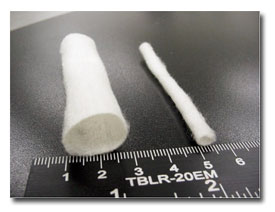
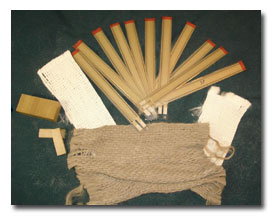
Concordia’s BIOFELT™ (top) comprises a range of bioabsorbable felt tissue-engineering
scaffolds that are highly porous, soft and flexible.

Tubular scaffolds (bottom) are used to build new blood vessels.


Finding A New Niche

“Because of where we started,
twisting silk, we’ve developed our core competency in fiber handling, particularly continuous
filament fiber handling,” said Randal W. Spencer, president and CEO. “We’ve just been trying to
push the envelope on that area as hard as we can for our whole existence. We were probably the
first company to install the two-for-one twister, and we were the largest two-for-one installation
in the country for a number of years. We were doing most of the yarns that went into Velcro®
fabrics worldwide. With the advent of Asian manufacturing, all that is going away. What once was
quite special is not special at all anymore, and the Chinese are buying the latest and best
machines as well. So it’s up to us to be even more innovative, and that’s the driver that’s really
pushing us into the medical arena.”

Concordia began heading down the biomedical path after it was approached by a major medical
device manufacturer to develop a solution to process a brand-new bioabsorbable fiber for in-body
tissue-engineering scaffolding applications.

“The difficulty was that the fiber was extraordinarily fine — 10 denier — with a tensile
strength measured in fractions of a gram, and if you held it in the palm of your hand for too long,
it would disappear — it’s a fast-resorbing fiber; but they were desperate to get it into a fabric,”
Spencer explained. He added that the device manufacturer, which had not been able to find a
machinery manufacturer that could provide a processing solution, was referred to Concordia by
Italy-based Michele Ratti S.p.A. Concordia had bought twisting machinery from Ratti, and the two
companies had at one time collaborated to develop a Ratti upgrade for some older machinery.

“We have always designed and developed our own machinery whenever it was appropriate, and so
we understood the problem right away, and we designed and built a machine that would handle this
material,” Spencer continued. “That got us started, because once we proved we could make a yarn out
of this single 10-denier filament, they knew they could get it into fabrics. So we designed a yarn.
The device manufacturer had its own fairly large knitting facility, and we helped them produce the
first fabric, all within a period of about four months. Then, subsequent to that, their people were
having a hard time knitting it, so we took over that part of it.” He added that Concordia adapted
some of its machinery to knit the fabric.

cleanroom
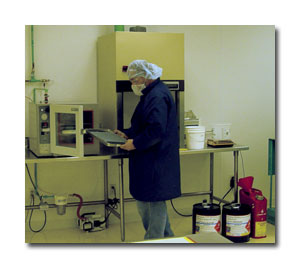
Technician Todd McKerracher processes a piece of BIOFELT™ in Concordia’s ISO
13485:2003-certified cleanroom.


Changing Focus

And Building A New Business


In 2003, Concordia underwent a
restructuring to focus on biomedical textiles, particularly on tissue-engineering scaffolds. The
transformation was helped along by equity seed funding from the Slater Center for Biomedical
Technology, now consolidated into Rhode Island’s Slater Technology Fund Inc. — fittingly named, in
this case, for 18th-century US textile industry pioneer Samuel Slater. The fund is supported by a
legislative grant and administered by the Rhode Island Economic Policy Council.

“The whole idea is to help promote new technologies in the state,” Spencer explained. “The
funding they provided made it possible to bring in capital to help finance this transition.”

Concordia’s first foray into biomedical textiles led to its building a cleanroom to minimize
both nonviable particulate and viable microbial matter in the air, and provide a controlled
manufacturing environment. The cleanroom, built in 2003, has been crucial to the company’s
transition, as is a very sophisticated quality management system.

“To work with these materials, you need a highly controlled environment,” Spencer said. “You
just can’t produce this material out on the typical textile manufacturing floor.

“We have a very good quality system,” he added. “We’ve been working with technical fibers
for a long time, but because we’re actually getting into human-use applications, obviously the bar
has been raised. There’s a lot of retraining that has to be done.” In addition to ISO 9001:2000
certification for general quality management systems, the company has received certification for
ISO 13485:2003, which specifies quality management system requirements for the manufacture of
medical devices.

Concordia’s fiber-handling knowhow provides a foundation for its thrust into this special
niche within the biomedical fiber field. “We’re not polymer chemists here, and we don’t try to be,
but we are dealing with biomaterials — polymers or fibers that are resorbable in the human body,”
Spencer noted. “There are a lot of medical textile fabrics that go into the body — hernia meshes
made out of polypropylene, vascular grafts made of textured polyester. We’re not dealing in those
areas — those are well-understood. We’re focused primarily on bioabsorbable fibers for
tissue-engineering applications. The Holy Grail is to be able to model and get yourself to grow
your own replacement organs — bones, arteries and even larger organs.”


redbuilding


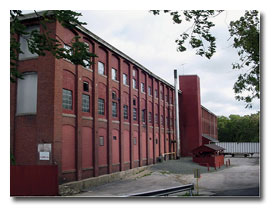
Concordia Manufacturing LLC, established in 1920 as a silk yarn manufacturer, today
produces man-made filament materials for biomedical and other specialty applications.


The company’s mechanical and engineering expertise also provides an advantage. “We have our
own machine shop and will develop machinery that’s required for different applications that we’re
presented with,” Spencer said. “We have a lot of textile machinery here in the plant, so where we
can modify something we already have, we will. But often it’s necessary to build something unique
simply because of the delicate nature of these fibers.”

Another ingredient in the mix is Concordia’s employees, some of whom already have undergone
retraining to work in the biomedical area. “We have some very loyal employees with really strong
finger smarts,” Spencer said. “They just have a sense in their hands of how to handle fibers, and
once they’ve been retrained into the particular characteristics of resorbable fibers, we can do
pretty unusual things.”

In his effort to develop Concordia’s biomedical business, Spencer recently brought Art
Burghouwt into the company as executive vice president, Medical Group. A veteran of more than 20
years in the medical device business — most recently with Cambridge, Mass.-based Genzyme, he has
watched the evolution of the market for biomedical products.

“Ten years ago, the whole tissue-engineering and biomaterial market was more of a
conversation about possibilities, but now quite a few products are starting to hit the market, and
the whole concept of biomaterials and hybrid devices that go from mechanical products into a more
biological healing aspect is really starting to come into its own,” Burghouwt observed.

“There’s a tremendous need for responsive, small-scale prototyping, and a lot of these
things start in development stages,” he said, drawing on a perspective gained from his years on the
end-product side of the business. “There just aren’t very many companies out there that can convert
raw materials into device components or intermediate products. Certainly, those textile companies
that may have done some of this kind of work have no experience with resorbable polymers at all, so
it was really useful to bring the knowledge of how to produce resorbable sutures, and how to
package and sterilize them — to add that whole experience to Concordia’s base of textile
manufacturing and make that into a useful entity for our medical device customers.”

mtone
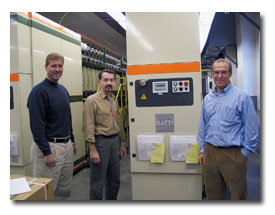
Left to right: Art Burghouwt, Plant Manager Lucien Desrosiers and Randal Spencer show
Concordia’s Ratti twisting machinery.


BIOFELT

“We make BIOFELT in a wide range of
different densities depending on what types of tissue you’re trying to duplicate. It could be a
very open structure depending on what type of cells the researcher wants to use, or a more dense
structure. That’s our foundation product, but it’s led to other types of structures as well. We
understand a whole range of fabric-formation systems. It’s just a matter of applying the right
system to the particular application,” Spencer said.

“There are many different iterations of BIOFELT, but our base material is pretty much yarns
that have been approved for suture applications — materials the Food and Drug Administration has
already cleared for human use,” he added. “Resorbable sutures really started becoming popular in
the early to mid-‘80s, maybe a little before. As those materials have evolved, they’ve opened up a
whole range of products now in fiber form that can be converted into fabric form, and that’s where
the tissue engineers are really getting excited.”

Spencer described two ways in which
scaffolds are used: “Because the scaffolds get resorbed by the cells as they grow, they help
vascularize wound areas, so in some cases — such as in orthopedics — they might be planted in the
body directly without any cell-seeding at all, and they will help protect and regenerate damaged
tissue in and of themselves. The other model is to take the patient’s own cells and seed them onto
the scaffold in a bioreactor, which gets these cells differentiated to the proper kind of cell for
whatever kind of tissue is being manufactured. A lot of work is being done on arteries, for
instance. We actually make a tubular BIOFELT scaffold that can be put in a bioreactor, which takes
blood cells from the patient’s body and gets them to differentiate and turn into vascular
structures.”

Commenting on the efficacy of scaffolds for tissue engineering, Burghouwt noted: “Cells tend
to grow much better with the scaffolds, where you have some base material to populate with these
cells. You get much better results than if you were just to implant the cells after you multiply
them in the lab without the base material.”

randykevin
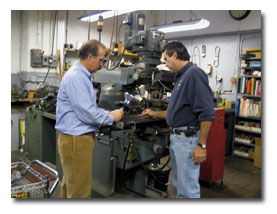
Spencer (left) discusses a two-for-one spindle modification with Kevin Leandro, engineering
manager, in the ccompany’s machine shop.

Photographs courtesy of Cutler Communications LLC


From Research To Reality

“Tissue-engineering development has
been going on for more than 10 years in terms of companies that have had some false starts or
thought they had a product and didn’t quite make it, but it’s really starting to change now, based
on their experiences,” Burghouwt said. “A lot of lessons have been learned, and I think we’re
seeing a much more realistic attempt now that some of the questions have been answered over time,
and the products are working. Some of the early examples of what’s possible are in the market
today.

“It’s very exciting to think that it’s starting to become reality rather than just a
research lab activity,” he added. “Certainly to be part of that is going to be a tremendous
opportunity for Concordia.”

November/December 2005

Devanlay Establishes Subsidiary In El Salvador

France-based Devanlay — global
licensee and part owner of the Lacoste apparel brand — recently set up manufacturing operations in
El Salvador. The company attributed the country’s excellent business environment, easy access to
the United States, support provided by the government and productivity of its workers as
contributing factors to the decision.

Devanlay, which also has operations in China and Peru, will establish Trans America Textil
El Salvador S.A. de C.V. in the Miramar Free Zone, and will work with local subcontractors. The
Argus Group will provide cut-and-sew processing, while Industrias Duraflex will manufacture and dye
cotton fabrics.

kanews_Copy_13
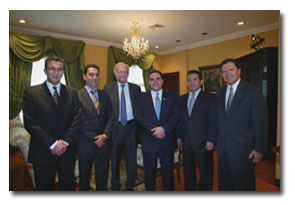
El Salvador and Devanlay representatives celebrate Devanlays decision to establish a
subsidiary in El Salvador. From left to right: Badis Kouidrat, managing director, Devanlay Peru;
Bruno Luppens, board member, Devanlay; Guy Latourrette, president of the Board of Directors,
Devanlay; Elias Antonio Saca, president, El Salvador; Roberto Bonila, president, Miramar Free Zone;
and Ricardo Avila, vice president and managing director, Miramar Free Zone.

Trans America first will produce men’s
polo shirts and expects to export nearly 200,000 units to the United States in 2005. The company
hopes to expand with the production of striped polo shirts for men, ladies’ polo shirts and
dresses, and children’s sportswear, among other items.

November/December 2005

Johns Manville To Boost Richmond Plant Capacity

Johns Manville (JM), Denver, will
increase its Formaldehyde-free™ fiberglass insulation capacity by almost 20 percent when it
constructs a new loose-fill line at its Richmond, Ind.-based manufacturing plant. The company
expects to complete the new line by mid-2006.

The expansion is the next phase of JM’s capacity-increase efforts, which will add up to 200
million pounds of insulation and will be complete by the end of 2006. Loose-fill production will be
boosted by almost 50 percent.

November/December 2005

Reinventing Advanced Cerametrics


agassi
Andre Agassi uses a Head Intelligence series tennis racket powered by Advanced Cerametric
Inc.’s self-powered piezoelectric ceramic fiber composites.


A
dvanced
Cerametrics Inc. (ACI), Lambertville,
N.J., has developed a technology to produce ceramic fiber from nearly any ceramic material. These
fibers possess the desirable properties of ceramics — such as thermal, chemical, electrical and
mechanical properties — but mitigate the detrimental characteristics —such as brittleness and
weight. ACI’s ceramic fiber technology has many novel applications including the ability to
scavenge functional amounts of electric power directly from wasted mechanical energy, eliminating
the need for batteries or power cabling in many systems.


Corporate Overview

ACI has supplied ceramic and metal thread guides to the domestic and
international textile industry for more than 58 years. ACI’s origins trace back to 1947 when Dick
Cass founded Lambertville Ceramic and Manufacturing Co. (LCMC). LCMC grew steadily through the
early 1970s as Cass’ son, Richard “Bud” Cass, joined his father in the business. The crash of the
US textile industry began in earnest in the late 1970s, and many of LCMC’s customers closed their
doors. Those textile businesses that remained open began purchasing foreign textile machines,
forcing LCMC to suffer a double blow to its customer base. As a result, the company searched for
new ways to use resident core technologies to find a way to survive.


The company adopted the name Advanced Cerametrics in 1991 to reflect its plan to enter into
high-tech markets. ACI capitalized on its technical strengths and developed a range of new products
starting with Conduxite, its patented, highly electrically conductive ceramic for use in
electrochemistry. This led to the formation of HiTc Superconco, a wholly owned subsidiary, whose
business model used ACI’s ceramic expertise to manufacture new ceramic high-temperature
superconductor materials. The superconductor venture led ACI into the realm of high-tech research,
and the company became an expert at winning Small Business Innovation Research grants and others
from the US departments of Defense and Energy and the National Aeronautics and Space
Administration. These grants permitted the company to develop a Viscous Suspension Spinning Process
(VSSP) to form fibers from nearly any ceramic material. This patented process is the basis for many
innovative fiber products, ranging from energy harvesting in sporting goods to reinforcement of
bone scaffolds to solid oxide fuel cell separators.


VSSP

This process loads a rayon precursor viscose with a high-volume percentage of
ceramic powder. This mix is spun through platinum spinnerets into mild sulfuric acid with a high
percentage of an added salt. The resulting acid/base reaction coagulates the cellulose with the
ceramic in it, and the salt pulls the water out, dehydrating the fiber and reducing its diameter
without stretching, which normally would pull the ceramic particles apart. This cellulose/ceramic
fiber then is washed and handled like a textile. Once formed into desired shapes, it is placed in
the furnace and processed as if it were ceramic.

Ceramic materials that have successfully been made into fiber form using ACI’s process
include: lead zirconate titanate for PZT-piezoelectric; titanium dioxide for batteries and water
purification; yttrium-stabilized zirconium oxide for biomedical uses, fuel cells and ceramic and
metal matrix composites; aluminum oxide for ceramic matrix composites; iron silicide for stealth
applications; and calcium carbonate for paper applications; among many others.


History Of the Process

In the late 1980s, LCMC’s management recognized that developing new technologies
was critical to saving the business. Building on core competencies, the company expanded its
superconductor and conductive ceramic businesses to conceive an entirely new technology. LCMC’s new
president, Bud Cass, was looking for ways to make superconducting fiber. Media reports had
speculated that 90 percent of all high-temperature superconductors would be in the form of wire.
Knowing ceramic wire was not a realistic possibility, Cass sought a way to make superconductors
from ceramic fiber.


Ceramic superconductors require extremely pure processing conditions. The first thought was
to coat an organic fiber with a superconductor and then burn the organic fiber away. Carbon fiber
was selected because it burns away as carbon dioxide and water, leaving no residuals in the crystal
grain boundaries.

Superconducting tubes were produced, thus proving the concept. However, the tubes were too
weak to be practical. Cass looked farther back into the fiber process to see how carbon fiber was
made, with the idea of loading the carbon fiber precursor with the superconductor powder and then
burning the precursor away.

Through pure serendipity, LCMC’s largest customer was Avtex Fibers Inc., Front Royal, Va. —
the largest manufacturer at the time of carbon fiber precursor rayon fiber. LCMC convinced Avtex to
load viscose with LCMC’s superconductor powder using LCMC’s new methods, and spin it as if it were
rayon.

The concept worked. Once Avtex recognized the value of its rayon as a fugitive carrier for
LCMC’s product, the idea of using the same machines and people to make $300-per-pound ceramic fiber
versus 50 cents-per-pound rayon made sense.

After Avtex shut its doors in the late ‘80s, LCMC — soon to become ACI — worked with
Germany-based BASF AG and then with Elizabethton, Tenn.-based North American Rayon Corp. as its
viscose supplier.

ACI acquired Avtex’s pilot spinning line, made significant modifications to the rayon
process and began spinning fiber in Lambertville. Using its modified process, ACI has been able to
make ceramic fiber from rayon viscose, cellophane viscose, sausage casing viscose and sponge
viscose.

ceramicfibers
ACI manufactures ceramic fibers of various compositions in the form of sensors, actuators
and woven mats for composite reinforcement and fuel cell separators.


Applications And Products

The first commercial products
emerging from this process are high-performance ultrasound transducers that can signal over
multiple frequencies and solve the lateral wave interference of dice and fill solutions, providing
a significantly cleaner image trace than current state-of-the-art transducers. The most successful
products have been Amsterdam-based Head NV’s family of Intelligence™ “smart” tennis rackets and
skis. JossWest, Ruidoso Downs, N.M., sells smart pool cues that use ACI’s ceramic fiber composites
to dampen up to 50 percent of the vibration of a break or shot, providing more comfortable playing
and straighter shots.

ACI currently is investing significant monies to develop energy-harvesting technologies that
will eliminate batteries in applications ranging from heart pacemakers that use pulse as the source
of power to wireless sensor networks that use the activity being sensed as the source of power.

The company’s fibers are able to generate and store enough power to run small electronic
systems from a few seconds of moderate-type vibrations. One example is the ability to power a
soldier’s global positioning system from the vibrations of his steps while walking.

ACI also has developed a new generation of products that can produce light from mechanical
energy directly without using any intervening electronics. An example is self-powered lights on
navigation buoys that use rocking as the source of power, eliminating the use of batteries.

Self-diagnostic systems also are being realized. One example is a self-diagnostic bearing
that uses ambient vibration to charge a radio frequency transmitter that relays information to a
central data collection site, informing maintenance of the bearing’s health.

ACI’s Variable Diameter Fiber (VDF) technology has been shown to increase the absolute
strength of reconstructive bone cement by a few percentage points. This is a good thing because one
wouldn’t want new bone area to be significantly stronger than surrounding bone.


The Future Of ACI

ACI has taken its core technology and
combined it with the oldest synthetic fiber technology to become a textile company, resulting in
many new uses and textile processes that were unheard of just five years ago.

The company currently is focusing on producing piezoelectric fiber composites for energy
harvesting, where it can harness ambient mechanical energy such as vibration to power electronic
systems without the need for external power systems such as batteries. Self-powered sports
computers using ACI’s piezo fiber composite power sources will be in stores in the summer of
2006.


Editors Note: Richard Cass is president; Farhad Mohammadi, Ph.D., is director, research; and
Stephen Leschin is manager, business development, at Advanced Cerametrics Inc.

November/December 2005

Fordham Changes Name To United Apparel

Fairfield, N.J.-based apparel company
Fordham Inc. has rebranded itself as United Sport Apparel.

“This change builds upon our acquisitions this year of Hewitt Manufacturing and Gorga
Athletic Wear, bringing 65-plus years of handcrafted, quality apparel to this new name,” said James
Lombard, president, Fordham. “Rebranding as United Sport Apparel recognizes the scope of our
product offerings, as well as our united approach to servicing our customers’ needs as we move
forward.”

In other company news, United Sport Apparel’s customers now may order products on-line at
www.unitedsportapparel.com.


November/December 2005

Polymer Group Inc. Announces New $455 Million Senior Secured Bank Facility

Polymer Group, Inc. announced it has
successfully closed and received proceeds from its new $455 million syndicated credit facility
arranged by Citigroup Global Markets, Inc.

“This refinancing is expected to have a positive impact on our cash flow due to the
significantly lower interest rate. Additionally, we view this as an affirmation from the financial
markets of the improvements we have made in our business and confirmation of our sound strategies
for future growth,” said Polymer Group’s chief executive officer, James L. Schaeffer.

The new senior bank facility consists of a $45 million revolving credit facility maturing in
2010 and a $410 million senior secured term loan that matures in 2012. The proceeds were used to
fully repay indebtedness outstanding under the company’s previous senior credit facility. The
interest rate on the new facility is based on a spread over the London Interbank Offered Rate
(LIBOR) of 2.25% – or 1.25% over a defined Alternate Base Rate (ABR) – for both the revolving
credit facility and the term loan. The company’s previous senior facility included a $280 million
Term Loan B with an interest rate of LIBOR plus 3.25% (or ABR plus 2.25%), a $125 million Term Loan
C with an interest rate of LIBOR plus 6.25% (or ABR plus 5.25%) and a $50 million revolving credit
facility with an interest rate of LIBOR plus 2.50% (or ABR plus 1.50%). The credit facility is
secured by certain assets of the company.

Press Release Courtesy of PR Newswire

November 2005

Sponsors