Mansco Delivers 200th TOV Sensor In China

Ivyland, Pa.-based Mansco Products Inc. has shipped its 200th Torsional Oscillatory Viscometer
(TOV) system for the Chinese market. The TOV is used for continuous measurement of the viscosity of
polymer resin, fiber and filament processes. Viscosity uniformity affects the quality and
downstream performance of a product, and the TOV’s design – based on a torsional measurement
principle – enables the sensor to perform sensitively and reliably in a polymer installation.

The TOV initially was sold exclusively to DuPont and DuPont Engineered plants, but it 1999,
Mansco signed a new agreement enabling it to sell the sensor to the general world market. The
company now offers the TOV in China’s polymer market through direct sales and a number of original
equipment manufacturing companies. Mansco reports it recently received several large orders for
large projects in China, and the company also has installed TOVs in several recent projects in
India.

June 9, 2009

Darlington Fabrics Launches UBL, FR Warp-Knit Stretch Fabrics

Darlington Fabrics Corp. – a manufacturer of warp-knit elastic fabrics, textiles and stretch goods
for the apparel and medical industries, and a division of The Moore Co. Textile Group, Westerly,
R.I. – has introduced its unbroken loop (UBL) line of warp-knit loop fabrics that combines stretch
with hook receptive durability and offers benefits such as stability without raveling, strength,
colorfastness, washability, softness and value.

Darlington also has launched a line of fire retardant (FR) warp-knit stretch fabrics that do
not require post treatments such as flame coating. The polyester/spandex fabrics are available in a
variety of weights and widths, and are suitable for applications including military, flags,
industrial protection and safety.

June 9, 2009

Victor Group Earns SFC Silver Recognition

Canada-based interior fabrics manufacturer Victor Group Inc. has become a Silver Corporate
Exemplary Member of the Sustainable Furnishings Council (SFC), a Chapel Hill, N.C.-based non-profit
organization that promotes sustainable practices among manufacturers, retailers and consumers.
Victor Group is the first textile manufacturer to join at the silver level.

To meet SFC’s standards, a company must manufacture at least 25 percent of products using
sustainable materials; implement a Social Equity Code of Conduct for employees; submit a Carbon
Footprint Report; show the improvements have had an impact on its supply chain; comply with certain
additional sustainability measures; and achieve an objective, third-party certification, which
Victor has received from Charlottesville, Va.-based McDonough Braungart Design Chemistry LLC.

June 9, 2009

Avery Dennison Introduces 3002T Tape

Pasadena, Calif.-based Avery Dennison Corp. has introduced 3002T polyester woven-edge satin tape
made from 100-percent post-consumer waste derived from recycled plastic bottles. According to Avery
Dennison, 3002T is the first recycled woven-edge tape to receive third-party accreditation, attain
Oeko-Tex® Standard 100 certification and feature thermal transfer and wet ink print capabilities.
The tape can be printed on both sides and complements sustainable apparel solutions.

Avery Dennison developed 3002T to relate to England-based retailer Marks and Spencer’s Plan
A, a corporate sustainability strategy. Avery Dennison also will supply up to 9 million tags and
woven labels this year to the Cotton Made in Africa (CmiA) project, which promotes environmentally
and socially responsible cotton production. Avery Dennison is the sole supplier of CmiA’s
standardized tags and woven labels.

June 9, 2009

Binsfeld Unveils TempTrak® RT406-2C Temperature Transmitter

Maple City, Mich.-based Binsfeld Engineering Inc. – a manufacturer of rotary data transmission
systems including temperature transmitters for heated godet rolls – has released the TempTrak®
RT406-2C six-zone temperature transmitter for use on Germany-based Oerlikon Neumag’s S5 and NPT
bulk continuous filament spinning machines.

According to Binsfeld, the TempTrak RT406-2C – a drop-in replacement for Neumag’s original
transmitter – offers improved temperature stability and reliability while eliminating complications
common with comparable transmitter systems such as alignment problems, high ambient temperature and
debris. The TempTrak transmitter features 16-millimeter rotor-stator spacing and fully
encapsulated, high-grade electronics; and comes with a standard two-year warranty.

June 9, 2009

June 2009

Israel-based
OptiTex Ltd. now offers expanded online access to features of its computer-aided
design and manufacturing solutions. For more information, visit
www.optitex.com.

The
American Apparel & Footwear Association (AAFA), Arlington, Va., has released
the fourth edition of the global AAFA Restricted Substances List covering home textiles, apparel
and footwear. The list is available free of charge at AAFA’s website, located at
www.apparelandfootwear.org.

Supercritical Fluid Technologies Inc. (SFT), Newark, Del., has introduced the
SFT-250 Supercritical Fluid Extractor (SFE) for performing extractions in supercritical fluid or
for small-scale pilot processing. SFT also now offers the Data Acquisition Package (DAP) as an
option for its SFT Phase Monitor II instrument. The DAP produces real-time image and data capture
directly to a personal computer.

SFT

Supercritial Fluid Technologies Inc.’s

SFT-250 Supercritical Fluid Extractor


Pinpoint Laser Systems Inc., Peabody, Mass., has released the Microgage Roll
Alignment kit for use in paper and textile mills; converting, coating, and plastic bag lines;
printing presses; and other roller and web-related applications.

Cognex Corp., Natick, Mass., has released VisionPro™ 5.2 software, featuring
SearchMax™ and Color Extractor™ color tools; a simpler version of PatMax® technology; and muticore
support for PatMax PatInspect™ and image filtering tools. Cognex also has released three new color
vision systems for the In-Sight® Micro product line of compact color vision systems: the
entry-level Micro 1100C, with 640 x 480 resolution; the 1400C, with doubled processor performance
for more demanding applications; and the 1403Cm with two-mexapixel (1600 x 1200) resolution. Cognex
also has introduced In-Sight Explorer version 4.3 software with Color Match and Color Extract
tools.

The
Association of the Nonwoven Fabrics Industry (INDA), Cary, N.C., is accepting
nominations through September 1 for the 2010 Visionary Award, to be presented at the Vision 2010
Consumer Products Conference in New Orleans in January. To nominate a product, e-mail a product
explanation to Visionary Awards Coordinator Michael Jacobsen at
mjacobsen@inda.org. INDA has published a special online
issue of the Journal of Engineered Fibers and Fabrics that focuses on nonwovens and engineered
fabrics modeling. The journal can be accessed free of charge at
www.jeffjournal.org. INDA also has released “Wipes,
Nonwovens Industry Outlook Trends & Forecasts, North America 2008-2013,” a report about the
wipes market including all sales of wipes by major retailers and distributors in North America.

Alexandria, Va.-based
Color Marketing Group will offer its annual Color Direction® forecast in a digital
format using Grand Rapids, Mich.-based
X-Rite Inc.’s ColorMunki Design spectrophotometer.

Salt Lake City-based
Silver State Inc. now offers the Sunbrella® Horizons collection of fabrics
including 71 SKUs and 17 patterns.

horizonsretrometro

Silver State Inc.’s Sumbrella® Horizons

Metro Retro fabric collection


ASTM International, West Conshohocken, Pa., now offers the sixth edition of “ASTM
Standards on Precision and Bias for Various Applications.” To order the online-only publication,
contact (610) 832-9585 or
service@astm.org.

Dalton, Ga.-based
J J/Invision has launched its new website, located at
www.jj-invision.com, combining the J&J Commercial and
Invision Carpet Systems site into one user-friendly, easy-to-use-and-navigate site with information
on all J J/Invision products, processes and services.

Berkeley Heights, N.J.-based
Eldib Engineering & Research Inc. has released a market survey reporting new
and expanded demand for Wilmington, Del.-based
DuPont‘s Nomex® brand products, including Dupont™ Sontara® spunlaced fabrics,
available commercially using Nomex.

Pendergrass, Ga.-based
TenCate Geosynthetics North America has introduced a brochure dedicated to
high-performance geotextiles for haul roads, including its Mirafi® HP-Series of woven geotextiles,
made with high-tenacity polypropylene yarns. The brochure, a supplement piece to TenCate’s
PowerPoint presentation on aggregate road systems, is available at
www.mirafi.com.

York, Pa.-based
Glatfelter has launched a section of its website focusing on sustainability,
located at
www.glatfelter.com/sustainability.

GLFsustainability

The new sustainability section of Glatfelter’s website

Red Bank, N.J.-based
Concept III Textiles has added a “New Fabrics” page to its website, located at
www.conceptiii.com. The new page offers updates on the
company’s latest textiles.

Pasadena, Calif.-based
Avery Dennison Corp. now offers “Custom Packaging with Avery Dennison,” an online
guide to packaging for apparel and accessories merchandisers. The 44-page resource is available at
www.ibmd.averydennison.com/pkgguide.

averydennison

Avery Dennison now offers an

online guide to packaging for apparel

and accessories merchandisers.


Germany-based
KSL Keilmann Sondermaschinen Lorsch GmbH,
KSA GmbH & Co. KG,
KSE GmbH and
Advanced Composites are now united under the umbrella brand
Keilmann Group. The company structure remains the same.

Dallas-based
Celanese Emersion Polymers has updated its website, located at
www.celanese-emulsions.com. The new site includes
an “Ask a Chemist” feature, allowing customers to send emulsion- and formula-related questions
directly to the technical department.

The Dalton, Ga.-based
Carpet & Rug Institute now has a blog, located at
http://carpet-and-rug-institute-blog.com.
Subscription options include e-mail updates or an RSS feed.

Naples, Fla.-based
Industrial Nanotech Inc. has launched an ongoing program to educate heavy
industries about the company’s Nansulate® energy-saving projects in process. “Nansulate – Around
the Globe and Around the Clock” can be seen at
www.nansulate.com/nanoblog.

The Brussels-based
International Rayon and Synthetic Fibres Committee has been renamed CIRFS:
European Man-made Fibres Association.

The Boston-based
National Textile Association (NTA) is requesting comments on its Voluntary Product
Environmental Profile (VPEP), available at
www.nationaltextile.org/vpep. Comments and
suggestions should be sent to David Trumbull,
dtrumbull@nationaltextile.org, by July 15, 2009.

England-based
Technical Absorbents Ltd. has redesigned its website, located at
www.techabsorbents.com.

The
Outdoor Retailer 2009 Summer Market – to be held July 21-24, 2009, in Salt Lake
City – presents two new opportunities this year for designers: Project OR, a 48-hour design blitz
contest for student designers; and Design Center, which features swatches and samples of designers’
materials. For more information, visit
www.outdoorretailer.com.

June 2009

June 2009

Seattle-based
Schoeller Textil and Technologies USA’s
Shannon Walton has resumed her position as public relations and marketing manager,
North America.

The
University of Tennessee Nonwovens Research Laboratory, Knoxville, Tenn., has named
Dr. Rohit Uppal research associate.

Germany-based
DyStar Textilfarben GmbH & Co. KG has named
Viktor Leendertz CFO and chief transformation officer.

The Textile Museum, Washington, D.C., has elected
Paul N. Schwartz to the Board of Trustees.

Fort Myers, Fla.-based
Chico’s FAS Inc. has named
Rochelle Udell senior vice president, creative director for the Chico’s brand.

The
Carpet America Recovery Effort, Dalton, Ga., has named
Georgina Sikorski executive director.

Wilmington, Del.-based
DuPont has elected
Samuel Bodman to its Board of Directors.

Cary, N.C.-based
[TC]
2
has elected the following to its Board of Directors:
Carmen Covelli, Invista;
John Crisco, Asheboro Elastics Corp.;
Chris DeSoiza, Milliken & Company;
Steven A. Jesseph, Worldwide Responsible Accredited Program; and
Janet Rivett-Carnac, Gap Inc. The board has appointed
Chuck Nesbit, Chico’s FAS Inc., vice chairman of [TC]
2.

Los Angeles-based
Talon International Inc. has promoted
Larry Dyne to president.

Dr. Stefan Mecheels, Hohenstein Institute, has been named vice president of the
Executive Committee of the
RAL German Institute for Quality Assurance and Certification.

Mecheels

Dr. Stefan Mecheels


The Hohenstein Textile Testing Institute, Germany, has given
Robert C. Steiner, ALSCO USA, the Hohenstein Award for Entrepreneurial Excellence
in Global Textile Services.

robertsteiner


Robert C. Steiner received the Hohenstein Award for

Entrepreneurial Excellence in Global Textile Services.


Pasadena, Calif.-based
Avery Dennison Corp. has named
R. Shawn Neville group vice president, Retail Information Services.

The Washington-based
National Council of Textile Organizations (NCTO) has elected
Wally Darneille, Plans Cotton Cooperative Association, chairman; and
David Hastings, Mount Vernon Mills Inc., vice chairman. NCTO also has appointed
Cass Johnson, NCTO, president and CEO;
Mike
Hubbard, NCTO, vice president and secretary; and
Werner Bieri, Buhler Quality Yarns Corp., treasurer.

Youngsville, N.C.-based
Xerium Technologies Inc. has appointed
David G. Maffucci executive vice president and CFO.

The
Association of Italian Textile Machinery Manufacturers (ACIMIT), Milan, has named
Sandro Salmoiraghi, Salmoiraghi S.p.A., president.

The
American Association of Textile Chemists & Colorists (AATCC), Research
Triangle Park, N.C., has named
Ashley E. Bradham, North Carolina State University (NCSU), its 2009 Outstanding
College Graduate of the Year. AATCC also has announced the 2009 Materials Design Competition
Winners: First Place to
Elizabeth Hathaway,
Amanda Shearin,
Ashley Amick and
Ivy Bunn, NCSU, for Temp-A-Tote: Solving the Dilemma of Storing Portable
Electronics in Automobiles; Second Place to
Jinmei Du, NCSU, for Design and Preparation of Super-hydrophobic and
Anti-microbial Fabric.

Paris-based
Lectra has appointed
Hervé Claverie director of projects and strategic accounts worldwide.

Claverie

Hervé Claverie

The Boston-based
National Textile Association (NTA) has awarded
Matthew R. Lamoureux the NTA Bronze Medal.

The
European Association for Textile Polyolefins, Brussels, has appointed
Selim Akdoğan chairman.

selimakdogan

Selim Akdoğan

June 2009

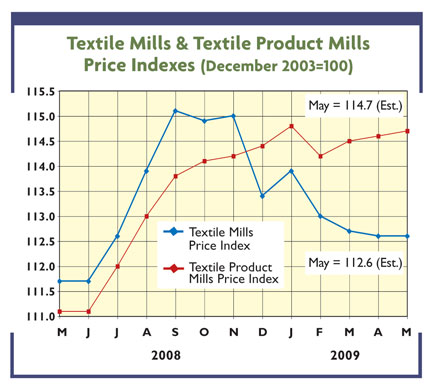
Raw Material Costs Drop


T
here’s a modicum of good news to help offset still-falling textile and apparel demand —
namely the fact that basic materials going into these products are actually going down in price.
And these new declines are pretty much across the board. In man-made fibers, for example, excess
global capacity and declining petrochemical feedstock costs have helped push the average tab — as
measured by the US Bureau of Statistics — down by a significant 4.5 percent over the past year,
with most of the slippage noted over the past few months. And there’s little to suggest any
meaningful near-term turnaround.

There is also some good news on the cotton front, where prices for the raw fiber, when
compared to early last year, are off by more than 30 percent. Moreover, given the latest
supply-demand projections of both Cotton Incorporated and the US Department of Agriculture, tags
here are likely to remain soft through the foreseeable future as world stocks hold near current
high levels.

Quotes on the other major natural fiber, wool, have also been trending sharply lower as of
late. At press time, for example, both domestic and overseas wool prices trailed year-ago levels by
anywhere from 30 to 40 percent.

Bottom line: All these declines can’t help but have some positive impact on the textile
industry health, especially given the fact that raw material costs in the basic textile sector,
including yarns and fabrics, account for close to two-thirds of every sales dollar. The
raw-material role for more highly fabricated textile products also is quite significant, with
fibers and other material imputs representing about 55 percent of the finished product’s value.

BFChart


Other Costs Also Under Control


Labor isn’t presenting any cost problems either. Over the past 12 months, for example,
hourly rates for basic textile products advanced only about 2.5 percent — a number more than
balanced out by a nearly 3.5-percent decline in the more highly fabricated textile products sector.
Indeed, average those numbers out and adjust for continuing productivity gains, and the industry’s
overall unit labor costs have probably inched a bit lower.

Similar situations also seem to be shaping up in other cost areas. Take transportation:
True, no individual textile numbers are available, but the fact that the nation’s aggregate
trucking rate actually declined suggests mill freight costs are under control.

Finally, there are inventory carrying charges — another big industry cost drain. Here, too,
problems seem to be minimal, thanks to the combination of today’s low interest rates and the
industry’s continuing ability to keep inventories at relatively low levels.

To sum up then: Overall mill production and distribution costs are now probably at, or even
a bit under, where they were last year. And this could well by why, despite continuing production
declines, most US firms are still able to show some profit. Textile World will report more about
the earning pressure in a month or so when first-quarter 2009 figures become available.


The Improving Business Picture


The prognosis for a bottoming out in overall economic activity also has to be regarded as an
industry plus. To be sure, any actual upturn in gross domestic product (GDP) is still a few
quarters away. But clearly the worst is over. Federal Reserve Bank Chairman Ben Bernanke, for
example, notes a wide array of encouraging signs. These include the better-than-2-percent jump in
consumer spending over the first quarter, steadying sales of new and existing homes, the modest
revival in credit markets, and the recent huge drop in business inventories.

On the latter score, the industry stockpiles have been dropping 2.5 times as fast as sales
since the beginning of the year. A decline of this magnitude can’t help but clear the way for at
least a modest resumption in GDP growth toward year’s end as companies boost production to levels
that are in better balance with sales. Still, other positive trends would have to include the
bottoming out of basic material prices, a sign that there’s still demand for commodities used in
industrial output; the stock market gains of recent months; and the turnaround in consumer
sentiment — with people now a bit more upbeat about the economy and the job market.

Bottom line: All of the above can’t help but have a positive spending impact — on textiles
and apparel as well as all other major consumer sectors. Zeroing in on domestic mill activity, for
example, TW editors now see decelerating production and shipment declines over the remainder of the
year, with perhaps even the possibility of some scattered small gains by early or mid-2010.

June 2009

Life-Saving Fabrics


R
ecent ballistic textile developments have been geared toward reducing product weight
while increasing performance to provide warfighters and police officers with better-than-ever
protection that also is more comfortable and manageable than ever. The National Institute of
Justice (NIJ) standards used to certify ballistic armor products also have been updated recently to
require compliance with more stringent parameters, particularly with regard to durability of the
antiballistic function.

Well-established premium ballistic fibers, including aramid and high-modulus polyethylene
(HMPE), are available in increasingly effective, lighter-weight, more cost-effective versions for
both soft armor such as bullet-resistant vests; and hard armor such as helmets, shields, body armor
plates and vehicle armor.

There also are several interesting innovations using recently developed materials or
involving new applications for established high-performance fibers that may provide alternatives to
the traditional materials and/or may be used in conjunction with them to enhance armor products in
various ways.

kevlargal
Soft body armor incorporating new high-performance materials such as DuPont™ Kevlar™, among
others, provides enhanced bullet resistance and reduced backface deformation.


Established Materials


Wilmington, Del.-based DuPont’s Kevlar® aramid materials are offered in several versions to
protect against bullets, sharp objects, shrapnel, or a combination of threats. The newest is Kevlar
XP™, a woven/laminated construction that offers attributes of both woven and unidirectional
technologies.

“Kevlar XP stops a 44 Magnum bullet within the second or third layer of an 11-layer design,”
said Jeff G. Fackler, global marketing manager, DuPont Personal Protection. “Its patented woven
structure stops the bullet, and up to 15-percent backface deformation reduction comes from the
energy-absorbing capability of the remaining layers of material.” Fewer layers of fabric are needed
to provide the performance, resulting in up to a 10-percent weight reduction and potentially
reduced costs to construct a vest.

Kevlar XP is being used in soft bullet-resistant vests. Future applications include hard
armor such as platform armor, helmets and personal shields. “Though XP technology was developed
initially for bullets, it is being developed to address fragments and other threats,” Fackler
added.

Morris Township, N.J.-based Honeywell International Inc. reports its latest-generation
Spectra Shield® II ballistic composite material using HMPE fibers, available in several soft and
hard armor versions, provides up to 20-percent greater ballistic performance than the original
Spectra Shield technology. When a greater level of protection is not needed, using the newer
technology in place of the older can help reduce armor weight by 10 to 20 percent. According to
Jeff Emery, Honeywell’s global strategic marketing manager, armor products, the US military and the
company’s law enforcement customers are specifying the newer technology to replace previous
materials in their armor programs.

Honeywell’s Gold Shield® armor materials use less costly aramid fiber incorporated in the
Shield technology’s unidirectional construction. “We are seeing significant demand for vehicular
armor with our Gold Shield GV-2016 composite,” Emery said. That solution can significantly lower
the vehicle’s weight at a cost comparable to older, bulkier armor solutions, and provide a high
level of protection against bullets, shrapnel and explosions, according to Emery. Vehicles also may
be equipped with explosively formed projectile (EFP) kits made with a Spectra Shield II material to
protect against the highest-velocity threats.

DSM Dyneema, the Netherlands, maker of Dyneema® ultra-high-molecular-weight polyethylene
(UHMWPE) fibers and yarns, has considerably expanded production capacity at its Greenville, N.C.,
facility, largely to supply ballistic materials to the US military and law enforcement agencies.
Among the company’s unidirectional hard and soft armor materials are Berry Amendment-compliant
HB51, produced specifically for the US hard body armor market; and HB26 hard ballistic composite,
used for vehicles and helmets and having potential uses in body armor inserts.

HB51 is a hybrid construction used as a protective backing behind  the armor’s strike
face. According to DSM Dyneema, it offers 20-percent improved ballistic performance over a previous
version used by the US military, without adding weight.

HB26 has seen its first commercial use in helmets supplied by Pittsfield, Mass.-based
Protech® Armored Products to the Denver Police Dept. DSM Dyneema reports the helmets are 15-percent
lighter in weight and exhibit less backface deformation than comparable aramid helmets. In
addition, HB26 requires less handling time and enables increased production speeds.

The company also is developing a tape system for use in vehicle armor to provide
lightweight, superior protection against emerging battlefield threats. The first prototype, X32, is
currently under evaluation for its effectiveness against such threats.
bulletimpact
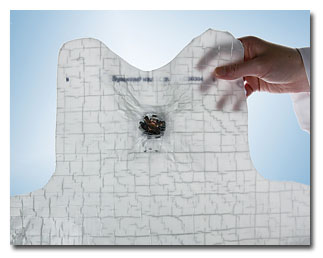
Warwick Mills, New Ipswich, N.H., a developer of ballistic packages from fiber processing
through to finished body armor and testing, uses Dyneema® and other high-performance fibers to
provide bullet resistance and blunt trauma protection  in soft armor incorporating its
TurtleSkin® SoftPlate technology.


Some Newer Materials


Milliken & Company, Spartanburg, contributes Tegris™ polypropylene (PP) thermoplastic
composite to the arsenal of ballistic textile technologies. Tegris technology is based on a
coextruded PP tape yarn with a highly drawn core sandwiched between layers of lower-melt polymer.

“For ballistics applications, layers of fabric are stacked, and using only heat and
pressure, the outer layers melt and fuse the stack together into flat panels and molded parts that
have very good impact properties,” said Todd Kleman, profitable growth strategist, Milliken
Performance Fabrics. The composite, used in combination with metals, ceramics and other composites
for hard armor, enables considerably reduced weight compared with glass-filled composites at a
lower cost than the premium composites.

Simpsonville, S.C.-based Innegrity LLC offers Innegra™ S PP-based ballistic materials for
both hard and soft armor applications. Dr. Brian G. Morin, CEO, said the company has developed
economical, effective hybrid solutions combining Innegra S with aramids and is in the process of
testing Innegra S with UHMWPE fibers. He noted that in testing, soft armor panels containing a
50/50 blend of Innegra S and aramid provide practically the same level of protection as aramid
alone. In hard armor — especially heavy, inches-thick armor — the performance of  blends
containing from 25- to 75-percent Innegra S equals or exceeds that of aramid alone for a lower
cost, in addition to lowering the fabric weight by 10 to 20 percent.

jeep
Honeywell’s latest-generation Spectra Shield® II and Gold Shield® materials have ballistic
uses in vehicular and personal armor systems.


Developing Technologies


A lot of ballistic textile research and development is conducted at the US Army Natick
Soldier Resaarch, Development and Extension Center, Natick, Mass., in collaboration with fiber and
ceramics companies, academic institutions and other entities, with a goal of developing ever
lighter-weight, higher-performance materials that can improve soldiers’ mobility, performance and
comfort.

“There are mechanical fiber properties that we can use to predict the performance of a fiber
in an armor system before the fiber exists, and this is done in part knowing some fiber
manufacturers have a processing envelope for treating the fibers,” said Research Mechanical
Engineer Philip M. Cuniff. “We tell the fiber makers the fiber we would prefer them to make for us,
and we’re still working on ways to gain insight into what would make a better fiber using that
model.”

In one project, Natick is working  with the University of Cambridge, England, and
Concord, N.H.-based Nanocomp Technologies Inc., producer of long carbon nanotubes — in the
millimeter length range — in yarn and nonwoven sheet form. According to Nanocomp, the materials are
100 times stronger than steel, extremely lightweight, and easier and safer to handle than
commercially available powdery carbon nanotubes.

Nanocomp currently is producing small amounts of carbon nanotube yarn and nonwoven sheet
materials in its research-scale facility. CEO Peter L. Antoinette said the materials  will
have applications in composite systems for use in strike and spall layers, plate, and compressed
materials such as helmets; or in layered hybrid systems. “You could expand the area you are
protecting without increasing the weight and compromising mobility,” Antoinette said. He added that
the materials have demonstrated a higher level of fracture toughness than traditional ballistic
textile materials; and are also highly ultraviolet-resistant, immune to moisture and
flame-resistant.

 Nanocomp is preparing to open a 40,000-square-foot (ft2) pilot facility, and within
the next three years plans to open a 100,000-ft2 production facility that would produce more than 1
million kilometers of yarn and 50 acres of 3-by-6- and 4-by-8-foot nonwoven sheets annually.

At North Carolina State University, Raleigh, N.C., high-tenacity polyethylene naphthalate
(PEN) fibers in development under the direction of Drs. John A. Cuculo and Richard Kotek show
potential for both soft and hard ballistic applications. The fibers are melt-spun using a newly
developed process and at 12.5 grams per denier are reported to be the strongest polyester fibers
ever made. According to Dr. Mehdi Afshari, a research assistant professor working on the project, a
hybrid sample made with high-tenacity PEN woven and hydroentangled nonwoven fabrics is
lighter-weight and shows higher ballistic performance than a PEN woven fabric.

Fort Mill, S.C.-based Kuraray America Inc.’s Vectran® liquid crystal polyarylate fiber is
not traditionally used in ballistic applications. However, a new version of the high-strength,
high-cut- and impact-resistant fiber is in development for uses in military hard armor, according
to Bob Knudsen, manager, sales and marketing, Vectran Division.


May/June 2009

RST Introduces Demron™-W Bomb Shield For Nuclear/Ballistic Protection

Miami-based Radiation Shield Technologies (RST) reports its Demron™-W High Energy Nuclear/Ballistic
IED RDD RED Shield offers complete protection against ballistics, improvised explosive devices
(IEDs), radiological dispersive devices (RDDs), radiological emission devices (REDs), fragmentation
bombs and nuclear spills.

“RST’s new Demron-W Nuclear/Ballistic Shield is the only device that enables our first
responders and military to combat all threats faced today, including traditional ballistics and
bombs as well as IEDs, RDDs, REDs and the ever-increasing nuclear and radiological threats,
roadside bombs that are triggered by cell phones,” said Dr. Ronald F. DeMeo, president, RST. “No
other ballistic blanket currently provides significant protection against nuclear or radiological
threats. Demron Shield provides unsurpassed nuclear suppression and outperforms all current
soft-body armor in anti-frangment and ballistic protection.”

Demron comprises a radiopaque nanopolymeric compound fused between layers of fabric and is
offered in two product lines including Demron-W into full-body suits, vests and blankets for
first-responder and military applications; and Demron-M X-ray vests, aprons and other products for
medical applications
(See ”
Quality
Fabric Of The Month: Shielded By Fabric

,” www.
TextileWorld.com, March 20, 2009)
. Its effectiveness in blocking gamma rays,
X-rays and nuclear emissions has been proven by the Lawrence Livermore National Laboratory, Georgia
Institute of Technology and Columbia University College of Physicians and Surgeons. Demron-W
fabrics are flame- and acid-resistant and have received National Fire Protection Association Class
2 Certification for the 1994-2007 Standard on Protective Ensembles for First Responders to CBRN
(chemical, biological, radiological and nuclear) Terrorism Incidents. In tests conducted by H.P.
White Laboratory Inc., the Demron-W Nuclear/Ballistic Shield also has been proven to provide
National Institute of Justice Level IIIA ballistic protection and unmatched protection against
fragmentation.

June 2, 2009

Sponsors