E-Textiles For Wearability: Review Of Integration Technologies


Abstract

This paper provides the latest insights into emerging technology to enhance wearability of
e-textiles and smart clothing by reviewing the cutting-edge researches and development.
Misconception of wearability in smart wearable systems is pointed out, and attachable technological
components are suggested as one of the best known solutions. Such components allow the most fragile
technologies to be protected or removed depending on the environmental changes or users’
preferences.

Based on the concept of attachable electronics, the textile transmission system is introduced
in which transmission lines and connectors are integrated to the fabric. The textile transmission
system is designed to connect attachable electronic devices by supplying power and transferring
data signals. Relevant fabrication issues — such as design of conductive yarns, integration or
interconnection methods, and connectors — are studied.


Introduction

Although electro-textiles attract a great deal of interest in relevant industries and
academia, they do not have any official definition. Electro-textiles, known as e-textiles, refer to
fabrics that can electrically function as electronics and physically behave as textiles. The
prominent application of e-textiles is smart clothing. Generally, “smart clothing system” refers to
a new garment feature that can provide interactive reactions by sensing signals, processing
information and actuating the responses.

Poorly matched to the name of clothing, however, current smart clothing systems are not
practically wearable. The clothing is wired with cables crisscrossing all over and batteries or
hard electronic devices sticking out. The problem of wearability is related to a misconception of
the word “wearable”. Initiated in the concept of a wearable computer, a wearable system was
originally understood as the use of the human body or the piece of clothing to support
technological devices. It was much later on that the concept of wearability became more practical,
addressing issues of comfort, light weight, breathability, and care and maintenance.

Having considered the true wearability, the most feasible way to wear complicated electronics
or computers at this point is to use attachable electronic components
(See Figure 1). The clothing itself carries only transmission lines and connectors so that
clothing can be flexible and washable enough to be wearable. The attachable electronic system
consists of textile transmission lines and connectors. Structures and technologies for textile
transmission lines, interconnection methods, and connectors would be explored from a textile
perspective.
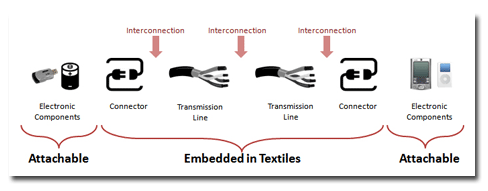
figure1
Figure 1:

Concept Of Attachable Electronics


Textile Transmission Line

A textile transmission line consists of conductive yarns integrated into a flexible textile
base. Conductive yarns are either pure metal yarns or composites of metals and non-conductive
textile materials that help improve mechanical properties. In order to produce a successful textile
transmission line, the best mix of conductive — metal — and non-conductive — textile —
components is critical. As a thread becomes more conductive and takes a bigger portion of the
conductive component, it loses the typical textile properties such as flexibility or drapability.

The structures of conductive yarn could be categorized into three classes:

  • Metal-wrapped yarn is a composite of metal and yarn. A conductive yarn mainly consists of a
    strand of non-conductive yarn wrapped with one or more metal wires
    (See Figure 2a).
  • For metal-filled yarns, a fine metal wire serves as a core covered by non-conductive fibers
    (See Figure 2b). Textile coverings can protect a core metal wire, helping it withstand
    physical stresses and providing electrical insulation.
  • Metal yarn does not take a core-sheath structure. Metal fibers that are very finely drawn
    replace one strand or entire strands of the yarn
    (See Figure 2c). Metal fibers are prepared in forms of either filaments or staple fibers
    and processed as a conventional yarn.

One or more strands of these conductive yarns are integrated into the fabric substrate to form
a textile transmission line. Successful integration creates reliable conductive traces on the
fabric while protecting the traces against repeated dimensional changes or abrasions in order to
maintain long-term conductivity. Integration methods found in the literature are divided into five
groups: woven; knitted; sewn; couched, or e-broidery; and printed structures.

The simplest way to embed conductive yarn in fabric is to weave it as one of the warp or weft
yarns. Empirically, plain weave has been preferred because its construction represents the most
elementary and simple textile structure, in which no lateral yarn movement is possible and a very
stable fabric structure is created. Consisting of interconnected loops, knitted structure is known
for its stretchability. No other textile materials can be incorporated except the conductive yarn
itself because only one continuous yarn is interlaced. Knitting requires more flexible yarns than
do any other structures because the yarn is highly curved to form a loop.

A conductive yarn can be stitched on the fabric surface to create a conductive trace. A sewn
trace forms a similar structure to the plain fabric woven with conductive yarns. It is beneficial
that a sewing line can cross over seams in apparel composition. Embroidery was previously
understood as being just for decorative purposes, but it opens much potential for smart textiles.
Conductive threads can be either embroidered or couched by traditional embroidery threads.
Embroidery using conductive threads is referred to as electronic embroidery or e-broidery. The
fabric becomes more or less rigid and offers poor flexibility.
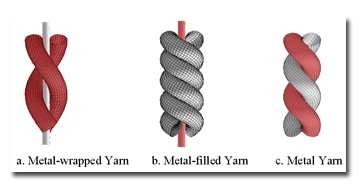
figure2
Figure 2:

Structures Of Conductive Yarns

  *Conductive material is shown in red.


Interconnection

Electrical interconnection is required when a conductive path reaches to connectors (or other
conductive paths). The contact area at a junction point is critical for making a good connection.
Improper interconnection causes incomplete contact and varying contact areas that result in
non-uniform electrical resistance at the connecting points. Electrical connections are made
possible by soldering or welding, stapling, and bonding.

Soldering or welding is a process for joining two or more metals together by melting and
cooling them at the junction point
(See Figure 3a). Soldering is distinguished from welding in that the base metal is not
melted, but solder is melted and filled into the joint. Being a reliable electrical connection, the
junction point has adequate strength and electrical conductivity, which is desirable for a
permanent connection, but the hardened solder provides a bending point at which the wire can break
after repetitive bending.

Lack of flexibility can be overcome by stapling, which can be made by conductive stitches
(See Figure 3b). Stapling is highly recommended in terms of increasing flexibility at the
junction points, but increased dimensional rigidity may restrict the freedom of motion, which can
accelerate fabric tearing. With the possibility of the stitches coming loose, the stability of the
connection can be uncertain. Interconnection can be made by using conductive adhesives
(See Figure 3c). Conductive adhesives can be envisioned that are nontoxic, highly
conductive, highly durable, and moderately flexible. Bonding remains an open possibility and is the
subject of further study.
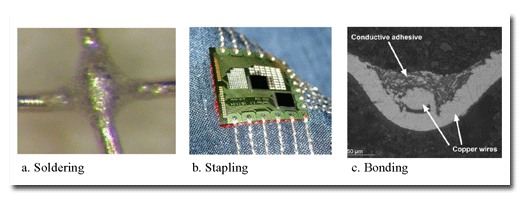
figure3
Figure 3:

Examples Of Interconnection


Connectors

Connectors between electronics and e-textiles need to be specially designed. The fastening
should be strong enough to hold the electronics and, at the same time, it should allow them to be
easily detached. Traditional forms of apparel fasteners can provide a good connection.

A two-piece gripper snap can be a good connector. One side of the snap is attached to the
e-textile and the other side to the electronic device. The major advantage of the snap is ease of
attachment and removal, but frequent connections and disconnections may weaken the strength of
interconnection between connectors and e-textiles. The size and number of snaps can limit the
connection interface and weight of electronics. Snaps are known to allow only primitive levels of
electrical connection.

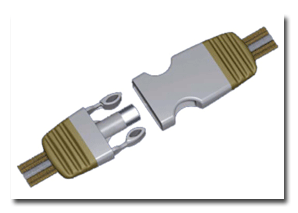
For a higher-profile connector, the textile USB cable was developed
(See Figure 4). The socket has a rigid pre-mold for durability covered with a soft
over-mold for comfort. The mold system will protect the interconnection. Even more robust
connectors are proposed in a buckle shape
(See Figure 5). Physical suspension of each buckle piece will provide a more secure
connection, while it also is easily unfastened.
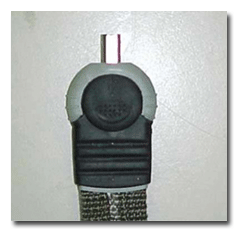
 
newfigure4

Figure 4: USB Connector


newfigure5
Figure 5:
Concept Of Buckle-Type Connector


Conclusion

Over the past decade, electronics have been shrinking in size and increasing in
functionality. The idea for the most wearable system is to attach technological components to the
textile in which transmission lines and connectors are embedded. Because the electronics are
attached and detached freely, they can be protected from the physical stresses of laundering. As
many different electrics can be connected to any clothing, a wearable system becomes more
versatile, and the user can change its look depending on environmental and situational changes and
individual preference.

Standardization is the biggest challenge for the industry as it commercializes the wearable
systems. It is especially critical for compatibility and connection problems. Standardization
should be done in a way that covers the multidisciplinary characteristics of an e-textile as a
textile, as an electronic, and as a computer. Another challenge is to ensure personal safety
against potential offenses from the wearable system itself or from abusive users. For example,
concerns regarding harmful effects of the electromagnetic field or leaks of confidential
information must be cleared before the clothing reaches the users.

Current advances in new materials, textile technologies, and miniaturized electronics make
wearable systems more feasible. It has been anticipated that batteries or memory storages could be
woven directly into textiles. In the future, it might be possible that people can enjoy the freedom
not to carry any electronic device, but, instead, to wear it.

Editor’s Note: Minyoung Suh is a doctoral student in the Department of Textile & Apparel
Technology & Management at North Carolina State University’s College of Textiles, Raleigh, N.C.

April 2010
April 2010

The
RFID Research Center at the
University of Arkansas, Fayetteville, Ark., has appointed Pasadena, Calif.-based
Avery Dennison Corp. to its advisory board.

Northbrook, Ill.-based
Protect-A-Bed® has acquired its United Kingdom-based distributor
Shine Capital Europe Ltd.

Textile Media Services Ltd., United Kingdom, has released “Automotive Textiles:
The Changing Landscape for Tier 1 and Tier 2 Suppliers.”

Avery Weigh-Tronix, Fairmont, Minn., has introduced the Model 1080 weight
indicator/controller, a data management and process control solution.

Banner Engineering Corp., Minneapolis, has debuted the iVu Bar Code Reader, which
it reports is the first industrial touch-screen bar code reader.

New Way® Air Bearings Inc., Aston, Pa., has achieved ISO 9001:2008 certification.

The
Association of the Nonwoven Fabrics Industry (INDA), Cary, N.C., has released Air
Filtration Industry of North America, its first nonwovens statistical report on air filtration; and
China Nonwoven Industry Outlook Trends and Forecast, a report combining a history of China’s
nonwovens market since 2003 with projections of its growth through 2013. INDA also is accepting
nominations until June 1 for the Lifetime Technical Achievement Award and the Lifetime Service
Award. Nomination forms are available at
www.inda.org/HallofFame/nominate.html.

Erie, Pa.-based
Eriez Manufacturing Co. has released a 14-page brochure titled “How to Choose and
Use Magnetic Separators.”

New Rochelle, N.Y.-based
London Luxury LLC has been named the exclusive home textiles licensee for the
Elizabeth Arden brand.

Greenville, S.C.-based
Safety Components has named
Innovative Industrial Solutions Inc., based in Boynton, Beach, Fla., a WeatherMax
distributor.

Montreal-based
AHF Ltd., the Canadian subsidiary of Louisville, Ky.-based
Louisville Bedding Co., has formed a joint venture with India-based
Welspun Global Brands to distribute home textiles to the Canadian market.

Ireland-based
Research and Markets Ltd. has published a report titled “Product Lifecycle
Management in the Textile and Apparel Industry.”

Jackson, N.J.-based
Newson Gale Inc. has released a white paper titled “Controlling Static Hazards is
Key to Preventing Combustible Cloud Explosions.”

The
American Apparel and Footwear Association, Arlington, Va., has published the sixth
edition of the AAFA Restricted Substances List covering apparel, footwear and home textiles.

Finland-based
Ahlstrom Corp. has signed the United Nations Global Compact initiative and now is
registered as a participant.

Mira Loma, Calif.-based
Enduratex (China General Plastics Corp. Of America) has released Gran Reserva, a
new faux leather product that features a soft hand, subtle grain and microfiber backing, according
to the company.

Raynham, Mass.-based
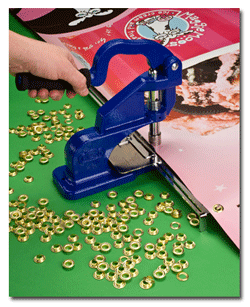
METALgrommets.com has introduced the ClipShop™ CSTEP-2 Grommet Hand Press, an
inexpensive hand press for inserting solid brass grommets onto banners and posters.

14492bb
METALgrommets.com’s ClipShop™ CSTEP-2 Grommet Hand Press

Carlstadt, N.J.-based
Pantone LLC has decreased the prices of PANTONE® Goe™ System specification
products. The new prices are available at
www.pantone.com.

Winston-Salem, N.C.-based
Hanesbrands Inc. has been named an Energy Star® 2010 Partner of the Year by the
U.S. Environmental Protection Agency. In other company news, Hanesbrands has
launched a national environmental advertising campaign titled “For Future Generations,” along with
a new consumer website,
www.hanesgreen.com.

England-based
Mudpie Ltd. has released the trendbook “Denimhead West.”

mudpie
Mudpie’s “Denimhead West” trendbook

Fall River, Mass.-based
Engineered Yarns Co. has changed its name to
EY Technologies.

West Conshohocken, Pa.-based
ASTM International now offers its catalogs in interactive digital format.

Natick, Mass.-based
Cognex Corp. has released VisionPro® 6.1 machine vision software with expanded
operating system coverage including support for Microsoft® Windows 7, line scan distortion
correction and ToolBlock, which simplifies vision tool management and allows faster integration.

Bunting® Magnetics Co., Newton, Kan., has debuted the Pro-Series™ Protection Plan,
a three-stage comprehensive warranty program for its Metal Detection product line.

The Netherlands-based
Control Union Certifications will formally transfer the
Global Recycle Standard to O’Donnell, Texas-based
Organic Exchange on Jan. 1, 2011.

The
Global Organic Textile Standard (GOTS) has launched a redesigned website, located
at
www.global-standard.org, which details licensing and
labeling requirements and includes a public database of GOTS-certified companies.

In recognition of Earth Day on April 22, 2010, the Fairfax, Va.-based
Specialty Graphic Imaging Association (SGIA) has launched a new website and online
sustainability workshops, located at
www.sgia.org/govt/sustainability/earthday2010/index.cfm.

Fairlawn, Ohio-based
Omnova Solutions Inc. has increased the price of styrene butadiene latex for
carpet and related markets by 4 cents per dry pound.

Martinsville, Va.-based
Nilit America will implement a 7- to 8-percent price increase effective May 3 for
all nylon filament products including yarn for intimate apparel, activewear, sportswear, legwear
and bodywear.

Charlotte-based
Polymer Group Inc. will begin implementing price increases on its products
globally, with amounts varying based on product composition.

Dallas-based
Celanese Corp. has increased the price of all 100-percent acrylic and styrene
acrylic emulsions sold to Europe, North Africa and the Middle East by 150 euros per ton.

Florham Park, N.J.-based
BASF Corp. has increased prices of its Sytrofan® carboxylated styrene-butadiene
polymers sold to the carpet industry in the United States and Canada by 4 cents per dry pound.

Mayer & Cie S4-3 2 R Circular Knitting Machine Allows Three- To Six-Color Striping

Germany-based circular knitting machine manufacturer Mayer & Cie. GmbH & Co. KG reports its
S4-3.2 R machine with 108 feeders and a 34-inch cylinder diameter can handle up to three colors per
feeder over all 108 feeders or up to six colors over 54 feeders, enabling knitters to produce
fashionable striped single-jersey fabrics with maximum productivity.

The machine features 3.2 feeders per inch for striping up to three colors or 1.6 feeders per
inch for up to six colors. The user can replace striping non-knit feeders with knitting feeders,
allowing 3.2 feeders per inch for structures having up to four needle tracks, with or without
elastomer plating. Flexibility is enhanced thanks to a quick-change gauge conversion, and there is
no need to remove the stripers. The machine operates at a rotational speed of up to 20 revolutions
per minute (rpm) when stripes are being produced, and up to 31 rpm when there are no stripes.

Mayer & Cie also offers the S4-3.2 II model with an E44 gauge for production of a knitted
silk effect. This machine can be equipped with special unfolding frames that eliminate squeeze
edges, and can knit two- and four-needle structures and single-jersey plating. Up to four needle
types can be used for each of three needle positions, and all apparel weights can be produced. This
model also features quick-change gauge conversion.

The company will present both machines at ITMA Asia + CITME 2010.

April 13, 2010

Herrmann Ultrasonics Introduces Ultraspin Ultrasonic Bonding System

Bartlett, Ill.-based Herrmann Ultrasonics Inc. — a manufacturer of ultrasonic welding equipment
and a Germany-based Herrmann Group company — has introduced the Ultraspin ultrasonic bonding
system for applications including cuff welding, front and back ear attachment, acquisition layer,
tape construction and side seam, among other textile and bonding applications.

Ultraspin’s newly designed rigid bearing sleeve technology withstands high bonding forces,
according to the company, enabling high-speed continuous and intermittent application, and
providing precise parallel adjustment with no vibration of the sleeve/bearing assembly. The bonding
module comprises a rotary sonotrode, in addition to the double bearing sleeve, bearings and a
specially designed 35-kilohertz converter. The system may be combined with the close-loop Microgap
control system.

Benefits of the Ultraspin bonding system include: a small design for simple retrofitting of
existing production lines; improved visual quality and 3-D texture of the bonded product; increased
overall equipment efficiency; increased line speed compared to conventional ultrasonic system
outputs; smooth web handling; bonding of material less than 12 grams per square meter; and a 9- to
40-millimeter bonding width with speeds greater than 500 meters per minute.

April 13, 2010

Schenk Vision Launches EasyMeasure Web Monitoring Option

Woodbury, Minn.-based Schenk Vision LLC, a provider of automated surface inspection systems and
industrial measurement technology, now offers EasyMeasure. Developed for nonwovens applications,
the solution, a new method of monitoring web process parameters, provides an alternative to
mechanical scanning of gauges. According to the company, EasyMeasure provides data points at a very
high spatial measurement density with 100-percent monitoring coverage, compared to mechanical
scanning systems that only monitor the typical “Z” pattern. The system uses a light source and
charge-coupled device (CCD) line scan cameras to provide a purely optical measurement.

EasyMeasure can be used in conjunction with Schenk’s EasyInspect 100-percent automated defect
inspection system to provide a single solution for both gauging and defect detection. According to
Schenk, the modules can be smoothly integrated into each other and can share hardware including CCD
cameras. The company also reports the systems reduce raw material usage and costs for
manufacturers.

April 13, 2010

Hyde Debuts Wilson™ Brand Textile And Cloth Blades

Hyde Industrial Blade Solutions — a division of Southbridge, Mass.-based Hyde Tools Inc., a
manufacturer of industrial blades and surface preparation hand tools — has introduced Wilson™
brand textile and cloth blades for cutting a range of materials from natural or man-made fiber
fabrics or leather for apparel to carpet and upholstery in commercial cutting applications.

Wilson blades feature a hollow-ground, knife-edge design that prevents binding and allows a
better, cleaner cut than is achieved using other knives. According to the company, these durable
and highly corrosion-resistant blades last up to 72 percent longer than competitive blades in
long-term cost-per-cut comparisons, and also have been proven in ISO 8442-5-2004 standardized
testing to be 20 percent sharper. Hyde also reports the blades don’t require as many replacements,
so production downtime is reduced.

The blades are manufactured in ISO 9001:2008-certified facilities and are available as
slitter, shear, guillotine, ledger and mill blades; bias slitters; die knives; and hand knives for
manual or automated use on all major manufacturers’ textile cutting equipment.

April 13, 2010

Karl Mayer Launches Revamped HKS MSU S With Parallel Weft Insertion

Germany-based warp-knitting machinery manufacturer Karl Mayer Textilmaschinenfabrik GmbH has
introduced a revamped version of its HKS MSU S high-speed tricot machine with parallel weft
insertion. The new version of the machine, which is used to produce textiles used in semi-technical
and technical applications, offers optimized features such as the ability to process an increased
range of yarns including extremely fine yarns such as 17-decitex polyester filament yarns and
improved versatility in incorporating reinforced yarns. According to the company, the machine can
easily process long underlaps, and through use of the weft repeat option, can incorporate
reinforced yarns only at the points at which they’re needed. The HKS MSU S also can alternate zones
with different densities and configure the segments produced to specific widths, transitioning
smoothly from open to dense knitted constructions using the Multi Speed function.

April 13, 2010

BASF To Open PU System Houses In Colombia, China

Germany-based chemical company BASF SE has announced it will establish a new Polyurethane (PU)
Systems Solution House in Cartagena, Columbia to fulfill the demand of its growing markets in
Colombia, Venezuela and Ecuador, as well as one in Chongqing, China to serve its growing market in
West China. Both sites will include local production along with sales and development staff and are
expected to be operational in 2011.

“We expect the market for PU systems in the Andean region to grow in the coming decade by 6
percent,” said Anton Traunfellner, managing director, BASF Polyurethanes in South America.”

In Chongqing, BASF also will build a state-of-the-art methylene diphenyl diisocyanate (MDI)
plant with an annual production capacity of 400,000 kilotonnes. “The new PU System House will be
fully backward integrated into the planned MDI plant — a significant advantage our customers can
benefit from,” said Jacques Delmoitiez, president, BASF Polyurethanes. The PU house in Chongqing
will work with BASF’s existing systems houses and development centers in Shanghai and Nansha,
China.

BASF anticipates business opportunities in industries such as appliances, transportation,
construction and footwear in both the Andean and West China regions. Applications for the material
also include mattresses and other household goods.

April 13, 2010

Pulcra Chemicals To Begin Production In May At DyStar’s Geretsried Site

Germany-based Pulcra Chemicals GmbH — a former subsidiary of Cognis GmbH, and supplier of
specialty chemicals — has completed its acquisition of Germany-based DyStar’s production site in
Geretsried, Germany.

DyStar filed for bankruptcy last year, and during the reorganization, a buyer was found for
all of DyStar’s assets except for the Geretsried site
(See ”
DyStar
Finds Buyer
,” Dec. 15, 2009)
. The Geretsried facility became part of the DyStar family in
2006, when the company acquired the Dr. Th. Böhme group. DyStar continued to search for a favorable
outcome for the operation, and on April 1, Pulcra completed its acquisition of the textile, leather
and auxiliaries site including land, buildings, equipment and inventory. Pulcra is expected to
resume production at the idled facility in May, and will maintain the plant as its primary leather
and textile business production site within Europe.

“The production site at Geretsried is perfectly tailored to the needs of Pulcra Chemicals,”
said Yusuf Aktalay, CEO, Pulcra Chemicals. “As a supplier of process chemicals, we serve similar
types of customers that DyStar and Dr. Th. Böhme used to. We will greatly benefit from the
technological knowledge and expertise of the employees at Geretsried. By acquiring the site, Pulcra
Chemicals has strengthened its position in the market, and can further enhance the services and
products it provides to customers in Europe and all over the world.”

April 13, 2010

NanoHorizons Appoints SmartSilver™ Agent In Turkey

Bellefonte, Pa.-based NanoHorizons Inc. has appointed Istanbul, Turkey-based Uniteks as an
authorized distributor in Turkey for its SmartSilver™ nanoscale antimicrobial additive for textile,
healthcare and industrial applications. Uniteks immediately will begin marketing SmartSilver and
will target the apparel, carpet and home furnishings sectors.

“Through our strategic alliance with Uniteks, we will continue SmartSilver’s international
growth into a critical textile market,” said Timothy Skedzuhn, vice president, Textile Business
Unit, NanoHorizons. “Uniteks is a well respected, highly successful textile company and is
committed to establishing SmartSilver as the antimicrobial technology of choice in Turkey.”

April 13, 2010

Sponsors