The Rupp Report: New Global Yarn And Fabric Production Highs

According to the latest information from the Switzerland-based International Textile Manufacturers
Federation (ITMF), global recovery in yarn and fabric production continued in the fourth quarter of
2009 to recover from their lows in the year-earlier quarter. Yarn and fabric production rose in
Asia and Europe, whereas South and North America recorded reduced output levels compared to the
previous quarter.


Low-level Production In North America


Production in North America reached its lowest levels on record for both yarn and fabric
production. Global yarn stocks dropped somewhat mainly due to lower inventories in Asia, while
those in the other regions remained almost unaffected. Global fabric stocks increased owing to a
considerable jump in South American inventories and a slight increase in Asia and despite decreased
North American and European inventories. Yarn and fabric orders increased in Europe and dropped
significantly in Brazil.

Increased World Yarn Production

World yarn output rose by 6.1 percent in the fourth quarter of 2009 in comparison to the
previous quarter. This is underlining the upward trend that could be observed since the first
quarter of 2009. While Europe and Asia recorded respective increases of 12.8 percent and 5.5
percent, yarn production in North and South America dropped by 2.6 percent and 10.2 percent,
respectively. In comparison the year-earlier quarter, Asia and Europe saw output levels
significantly higher, by 13.7 percent and 8.8 percent, respectively, whereas South America remained
unchanged and North America recorded a 9.5-percent drop.

World Fabric Production Rose

Fabric production grew worldwide by 4.0 percent in the fourth quarter of 2009. Again, Europe
and Asia recorded higher output levels, respectively, by 18.8 percent and 5.0 percent, while South
and North America reported significantly lower output levels, by 17.2 percent and 7.3 percent,
respectively. Year-on-year global fabric production increased by 9.3 percent as a result of
11.9-percent higher output in Asia. Europe and South America, on the other hand, recorded
production levels slightly below those of the previous year with respective decreases of 1.9
percent and  2.8 percent, while North America’s output dropped by 16.8 percent.

World Yarn Stocks Dropped

World yarn inventories fell slightly, by 0.9 percent. Asian stocks were reduced by 1.4
percent and Europe’s by only 0.1 percent. On the other hand, South American stocks rose by 0.4
percent. On an annual basis, world yarn stocks were down by 5.4 percent, with levels falling in
South America by 21.6 percent, in Asia by 5.5 percent and in Europe by 3.8 percent.


World Fabric Stocks At Their Lowest Levels On Record


Fabric stocks rose globally by 5.6 percent, with South America recording a big jump of 35.9
percent; and Asia, a small 1.5-percent increase. In Europe, inventories fell slightly by 0.2
percent; and in North America, by 2.6 percent — the lowest levels ever recorded in both regions.
Compared to the fourth quarter of 2008, global fabric inventories increased by 7.4 percent. South
American stocks soared by 30.8 percent and Asian inventories were up by 9.3 percent. On the other
hand, inventories dropped by 16.9 percent in North America and by 2.85 percent in Europe.

Recovery In European Yarn And Fabric Orders

In Europe, yarn and fabric orders continued to recover a bit, rising by 2.6 percent and 1.7
percent, respectively; whereas Brazil recorded significantly lower orders, with a drop of 12.4
percent for yarns and 27.0 percent for fabrics. On an annual basis, yarn orders in Europe and
Brazil were up by 4.3 percent and 16.8 percent, respectively, while fabric orders were down by 7.8
percent and -20.3 percent, respectively.

In the third quarter of 2009, both yarn and fabric orders experienced a strong increase.
Orders in Europe grew by 5.5 percent for yarns and 5.1 percent for fabrics, and those in Brazil by
19.1 percent and 10.0 percent, respectively. On an annual basis, European yarn and fabric orders
were down by 2.4 percent for yarns and 12.1 percent for fabrics, while orders in Brazil rose by 6.6
percent for yarns and 4.0 percent for fabrics.


April 20, 2010

What A Difference A Year Makes


I
t doesn’t seem so long ago that spinners were looking anywhere and everywhere for any
business they could find. As second quarter 2010 begins, some spinners are finding they now have
more business than capacity. Demand for both ring and open-end (OE) is currently the strongest it’s
been in some time, spinners say. Prices are up, approaching levels that haven’t been seen for five
years or more.

Why such a turnaround — especially when things looked so bleak just 12 months ago?

“A lot of spinning has returned to this hemisphere,” said one rep who sells both domestic and
imported yarn. “And, due to the weak dollar and the need for quick turnaround, it looks like it is
going to stay around for quite some time.”

Said another: “Ring-spun yarns have been strong for quite some time. But now, we’re seeing a
big jump in OE orders. It looks like a lot of the T-shirt manufacturers may have let their product
pipelines run almost dry. The question is, when they get restocked, will OE continue its momentum,
or will it fall off to previous levels?”

Despite the healthy state of business at the moment, one thing is steadily shrinking, and
that’s the number of companies that are still in business. In January, banks seized Wellstone
Mills. With the demise of R.L. Stowe last year, that leaves Parkdale Mills Inc. as the sole
surviving large, diverse spinner. Overall domestic capacity, however, wasn’t significantly
impacted, as Parkdale acquired four of Wellstone’s plants.


Limited Retail Inventory Drives Business

Not only is OE seeing at least a short-term boom because of inventory replenishment, so are
other industry segments. Said one specialty spinner, “The apparent limited inventory positions
throughout the supply chain are a driving force behind the increased business opportunities within
this hemisphere.”

Business has been very good so far, and he is optimistic for continued success: “We are
confident that the encouraging business activity we are experiencing will continue throughout
second quarter.”

Products in high demand at the moment, especially in the specialty segment, are those that
offer some form of value add. “The markets that we serve are continually seeking to differentiate
themselves, which is extremely valuable for our R&D initiatives,” he said.  “Products that
offer either a sustainability or a performance attribute are in demand. Texture is also very a
desirable characteristic.”

Another spinner agreed: “We’re not running lots of the same things these days.  It seems
everybody wants something different.”


Raw Material Prices Escalate;

Demand Enables Pass-through

One element of the increased demand that has some spinners smiling is the ability to pass
through increased costs to customers. One spinner noted, “For a long time, we had to absorb a lot
of the increases in our cost of production. We, like a number of other spinners, were selling for
very low margin — and sometimes even at a loss — just to keep the order. Now, demand is high,
everyone is running flat out, and there is substantial business in the pipeline. We’ve seen prices
go up 25 percent or more, in some instances over the past few months.

For example, mid-last year, 30-count cotton ring-spun was going for about $1.45 to $1.50. Now
it is going for $2.05 to $2.10. The last time we saw those prices was 1999. I got up to $1.90 in
2005, but it didn’t stay there long.”

Even with prices going up, margins still are not where a lot of spinners would like, because
raw material prices are still escalating. “Raw material cost escalation has been a concern. We have
tried to work cooperatively with our customers to minimize the negative impact of higher yarn
prices,” said a Carolinas spinner.

The bottom line,” said an independent sales representative, “is that it is a spinners’ market
for now, and we haven’t had one of those in a long time. I hope it lasts awhile.”


April 2010

Albaad USA Announces Expansion Plans

Reidsville, N.C.-based Albaad USA Inc. — a producer of nonwoven wet wipes for markets such as
personal, home and automotive care; and a subsidiary of Israel-based Albaad Massuot Yitzhak
Ltd.  — has announced it will invest more than $9 million to expand its facility, creating 95
jobs in the process. The expansion coincides with Albaad winning a contract for a new infant wet
wipe product. The Office of the Governor of North Carolina reports the company will pay an average
annual wage of $21,820 plus benefits to each new hire.

“North Carolina was chosen for this project because of a wealth of talented and skilled
labor, good shipping lanes to the East and Midwestern parts of the U.S., accessibility to ports to
bring in raw materials, and a well-established new aero transportation hub at Piedmont Triad
International Airport,” said Dan Mesika, CEO, Albaad USA.

The expansion expenses are partially defrayed by a One North Carolina Fund grant of $350,000.
The fund offers financial assistance to businesses through local governments to draw business
projects to the state to boost economic activity and create jobs.

“I was proud to work with Albaad USA as they decided to come to Reidsville,” said State
Representative E. Nelson Cole. “Our investments have paid off with the expansion and new jobs
announced today.”

April 20, 2010

NCSU’s College Of Textiles, ITT Create CESTAB

Raleigh, N.C.-based North Carolina State University’s (NCSU’s) College of Textiles and The
Institute of Textile Technology (ITT) have founded the Council for Economically Sustainable Textile
and Apparel Business (CESTAB) to provide validated information, analyses and resources to foster
sustainable social, economic and environmental practices within the global textile supply chain.

“Sustainability has become one of the most pressing issues facing the textile industry,” said
Allen E. Gant Jr., president and CEO, Glen Raven Inc., and chairman of ITT’s Board of Trustees.
“The institute, in collaboration with the College of Textiles, is endeavoring to provide much
needed leadership for the textile industry in addressing sustainability issues in a scientific and
consistent manner.” 

According to the organizations, the council intends to offer resources to textile supply
chain participants with the aim of providing a uniform approach to addressing sustainability
issues; to conduct objective and verifiable scientific research to fill in gaps in the textile
sustainability knowledge base; and to offer and foster undergraduate, graduate and continuing
education programs for textile supply chain participants and the public.

April 20, 2010

NTA Offers Voluntary Product Environmental Profile

The National Textile Association (NTA), Boston, now offers its Voluntary Product Environmental
Profile (VPEP) reporting format that textile companies and their suppliers can use to record and
share information about chemical products. Developed by a group comprising dyestuff and chemical
suppliers, textile manufacturers, and professional staff of academic institutions and trade
associations representing the chemical, dyestuff and textile industries, VPEP can be used by
textile companies and chemical suppliers to facilitate the efficient exchange of information
necessary to make decisions regarding the environmental impact of textile products and processes,
NTA reports.

NTA offers VPEP as a downloadable paper form free of charge via its website,
www.nationaltextile.org. The organization currently is
designing a software version, which it expects to release soon.

NTA’s Vice President of International Trade David Trumball will make a presentation on VPEP
at the American Association of Textile Chemists and Colorists’ New England Section Technical
Meeting, to be held Thursday, April 29, at Buskers Pub in Newport, R.I. For more information
contact
hwoodacre@cmal.com.

April 20, 2010

Birdair To Supply Tensile Fabric Roofing For La Plata Stadium

BUFFALO, NY – April 15, 2010 – Birdair, Inc., the leading specialty contractor of lightweight
long-span roofing systems and tensile structures throughout the world, has been awarded the
design-build contract to provide the cable structure and fabric roofing system for the La Plata
Stadium in La Plata, Argentina.

A world known specialty roofing subcontractor, Birdair has been hired to engineer, construct
and install a 312,545 square-foot tensile roof featuring Birdair’s steel cable systems and PTFE, a
Teflon®-coated woven fiberglass membrane.

“The addition of the PTFE fiberglass membrane will cover the seating area, providing the
stadium’s patrons with shade and protection during soccer and cultural events,” explains Kevin
Mayer, vice president of business development for Birdair. “PTFE fiberglass also provides
sustainable benefits with a long lifecycle and needs minimal maintenance as the fabric is highly
resistant to dirt and pollution.”

The 53,000-seat capacity La Plata Stadium, which originally opened in 2003, was designed by
architect Roberto Ferreira.

In addition to Birdair, the project team also consists of engineer Weidlinger and Associates
and general contractor Astillero Rio Santiago.

To date, Birdair has completed work on 65 sports facilities globally, incorporating tensile
architecture into a variety of single-sport and multi-purpose stadiums and arenas.  Birdair
combines breakthrough technologies with unparalleled experience to create structures that meet both
facility and patron requirements. Learn more at
www.birdair.com.

About Birdair: 

Birdair, Inc. is the leading specialty contractor of lightweight long-span roofing systems
and tensile structures throughout the world, providing design-build solutions for architects and
clients in all aspects of project design, engineering, installation and maintenance. 
Lightweight long-span roofing systems and cable structures can be attached to any building envelope
and offer aesthetic and functional options to complement any exterior design.  Birdair, based
in Buffalo, NY, is a member of the Taiyo Kogyo Group, with operations serving North and South
America and other international locations.  For more information about Birdair, call
1-800-622-2246 or visit
www.birdair.com.

Posted on April 20, 2010

Press Release Courtesy of Birdair Inc.

Premium NILIT® Yarns Boost Performance And Environmental Friendliness Of Thoni Mara® Running Wear

MIGDAL HAEMEK, Israel and THUM, Germany – April 14th , 2010 – NILIT Ltd., a leading manufacturer of
nylon 6.6 fibers and engineering thermoplastics compounds, and thoni mara, a brand of leading
sportswear maker Nautilus, today announced that thoni mara®’s GREEN FEE® runners’ shirts collection
contains the premium NILIT yarn EcoCare and the premium collection the NILIT yarn Aquarius.

NILIT® EcoCare and yarns are key components of the fabric created especially for the Green
Fee shirts, which are designed for superior performance and comfort while being kind to the
environment. NILIT EcoCare is a high-quality yarn made of recycled polymer that provides excellent
color depth and uniform dye-ability. NILIT Aquarius is a high-performance yarn engineered to wick
away moisture.

The unique properties of these NILIT yarns, combined with thoni mara environmentally friendly
and fair Green Fee manufacturing processes, create outstanding runners’ shirts that are highly
functional and fashionable as well as fair and sustainable.

“NILIT EcoCare  has proven to be ideal yarns for thoni mara Green Fee runners’ shirts,”
said Christian Schwab (CEO). “We have exacting standards for every aspect of our products and these
NILIT yarns fully meet our requirements for color, durability, moisture management and
environmental friendliness.”

The premium collection with NILIT Aquarius  was recently named as a finalist in the
prestigious Brand New Awards at the ISPO sports show, held in February. The collection garnered a
great deal of attention at the show with visitors interested in its unique combination of
high-performance and sustainable production.

Mr.Gilad Frenkel, Marketing and Sales Manager at NILIT commented: “We are proud to have
contributed to thoni mara’s success at the ISPO show, in the Brand New Awards and, most
importantly, in the market place.”

About NILIT Ltd.

NILIT customizes nylon 6.6 fibers and engineering thermoplastic compounds to solve customer
challenges. A global company established in 1969, NILIT operates in more than 70 countries
worldwide. The company’s headquarters is located in Israel and it has manufacturing facilities in
Israel, Germany, Italy, USA and China. For more information:
www.nilit.com.

About thoni mara

Who or what is behind this new brand which has recently been making a name for itself with
runners? The shirts have been grabbing attention not only because of their unique design but also
because they function extraordinarily well. An ambitious marathon runner knows how to appreciate
these benefits just as well as a leisurely jogger does. Probably the most amazing fact though is
that these shirts are manufactured in Germany. A real high-tech product: Made in Germany! For more
information:
www.thonimara.de

Posted on April 20, 2010

Press Release Courtesy of Nilit Ltd. and thoni mara

Quality Fabric Of The Month: Litrax Natural Bamboo: The Real Deal

For those seeking to manufacture and market certifiable, sustainable bamboo-based apparel and home-fashion textiles, a natural bamboo fiber developed by Switzerland-based Litrax AG offers an alternative to bamboo-based manufactured viscose fiber, which has come under fire because of inaccurate claims of eco-friendly and other claims made by its marketers. Litrax-1®, extracted
directly from the stalk of the bamboo plant, is processed mechanically using environmentally friendly enzymes into a soft, luxurious fiber — similar to linen in its processing and comparable to cashmere in its feel — that retains the essential properties of the bast fiber that is its basis.

bamboofiber
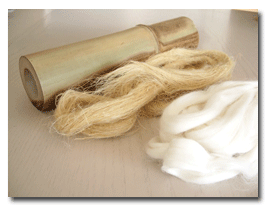
Litrax-1® natural bamboo fiber is extracted from the stalk of the bamboo plant by lateral
crushing and decortication. The raw fiber is then processed using fine-tuned enzymatic cocktails
and made into fine, silky-soft sliver for spinning.
 

When bamboo first was promoted for textile uses in the early years of this decade, the viscose fiber typically produced from it was hailed as an environmentally friendly, biodegradable material because it is derived from the bamboo plant — which in itself is quite environmentally
friendly, as it is very fast-growing and renewable; needs no pesticides, fertilizers nor irrigation in its cultivation; causes no soil erosion; and absorbs considerably more carbon dioxide than an
equivalent planting of trees. However, the typical rayon production process used for most manufactured fiber derived from bamboo uses caustic chemicals whose emissions can harm not only factory workers but also the environment when not properly controlled within the factory. And the resulting fiber — whether processed using the rayon process or a closed-loop, eco-friendly, modified lyocell process — does not resemble bamboo at all in its original form. In addition,
widespread claims that the fiber offers antimicrobial properties cannot be substantiated, and its biodegradability has been questioned because it does not break down within a reasonably short time after disposal in a landfill or in a recycling scenario.

Concerns over truthful marketing of the viscose fiber have led the Federal Trade Commission to require that marketers of products made from these fibers state that their products contain rayon made from bamboo, and also that they refrain from making claims that their products provide benefits such as inherent antimicrobial properties or biodegradability.

Litrax was formed in 2005 to develop materials using environmentally friendly, renewable sources. It took several years to refine the process the company is using to make Litrax-1 natural bamboo fiber, said Felix Stutz, Litrax’s president and one of its founders.

crosssection
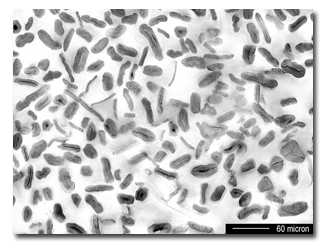
A micrograph showing  cross sections of natural bamboo fibers shows the inherent
variations of thickness in the fiber walls.

“The first two years were very discouraging — at first, we were making large-decitex [dtex] fibers, but we refined the process and got them down to about 5.8 dtex,” Stutz said. “In order to process bamboo — it’s very hard, more stubborn than flax or hemp — you need a lot of steps from the initial decortication to extraction to the enzymatic process. You can’t field-ret it like linen because it mildews,” he said, noting that instead, it undergoes various processing steps using “fine-tuned enzymatic cocktails.”

After four years, Litrax presented its natural bamboo to several interested spinners, “and from there, we were successful within about six months,” he said. “Schoeller [GmbH &Co. KG,
Austria] has spun worsted from natural length fiber, and later we developed a clean sliver for ring spinning from fiber cut to about 52 millimeters (mm), which allows us to make very nice yarns.”

The fiber, which is processed in France, has a natural staple length between 70 and 150 mm, and is cut to shorter lengths for processing. Litrax’s ring-spinning partners include Italy-based Filati Maclodio S.p.A. and Slovenia-based Predilnica Litija.

The mechanical process used to make Litrax-1 makes the fibers stronger than viscose made from bamboo. “This is a fundamental difference,” Stutz explained, noting that the viscose, processed
using harsh alkaline chemicals, is extruded and has a cell structure that is nothing like the original cell structure. “They are two entirely different products. Natural bamboo is a very irregular fiber, with thin- and thick-walled fibers. and is stubborn to spin. Thus far, we have only about six spinners that can spin it.”

Litrax describes its natural bamboo fiber as “hypersoft like cashmere.” It also offers good breathability and moisture management; is highly absorbent of water and also absorbs odors, though no antimicrobial claims are made; feels cool in warm weather, but when blended with merino wool or certain other fibers is warming in a cold climate; and has a silky sheen. The fiber has received Oeko-Tex® Standard 100 certification for compliance with regulations and criteria related to the
presence of harmful substances. The yarns produced by Schoeller also are certified to the bluesign® standard for optimization regarding environmental, health and safety criteria throughout the supply chain and in all manufacturing processes.

towels
Litrax-1 can be blended with Tencel® or cotton for terry towels and robes.

Litrax-1 can be used alone as a worsted yarn for woven fabrics, but Stutz said its real appeal is as a component in a blend, in which the natural bamboo provides complementary properties to or reinforces properties of the partner fiber. One fabric that recently made a splash in Europe is a silk/bamboo denim for jeans that soon will be available at retail. Other possible blends include bamboo with Tencel® or cotton for terry towels and robes; bamboo with merino wool, silk or cotton for shirts and suits; and bamboo with Tencel or cotton for knits.

With regard to Tencel, Litrax is cooperating with Austria-based Lenzing Group to offer Litrax-1/Tencel blends, which Stutz said will have a highly sustainable and well-regarded ecological profile. The fiber products will be spun into worsted and ring-spun yarns by four spinning partners. The Litrax-1 fibers will feature special DNA coding for authentication purposes. Describing the blend as “amazing,” Stutz said Litrax-1 adds unprecedented stability to the blend and enhances the soft feel of the resulting material.

“We started working with Lenzing about a year ago,” he said. “All the tests were very successful, and we are very pleased and actually surprised about the results. Knits from the combined product are very homogeneous compared with linen/Tencel blends. It won on all points —
mechanical, strength, fineness, touch and the dyeing process. We didn’t expect all of this, but we did a good job in the final cleaning steps and the way we do the sliver — for that, we have a partner in France, who is also doing sliver for the U.S. and Turkish spinning industries.”

“We see Lenzing as an ideal partner due to their world leadership in man-made cellulose fibers such as Tencel, Lenzing Modal® and Lenzing Viscose®,” Stutz said. Lenzing’s Botanic Concept stresses the botanic origins of these fibers and their optimized and closed-loop production processes. Even the waste and by-products from viscose production are recycled or sold, and the company has received the European Environmental Award for its environmental protection efforts.

Litrax is targeting higher-end fashion markets with its natural bamboo products, which are more expensive to produce than is viscose made from bamboo. “I believe this is going to be the start of a very interesting market niche. I doubt that this will compete with cotton, and it will probably cover at most 5 percent of the industry, but it will be a very pleasant contribution and will add a bit of sustainability in terms of material resources. Blends are the secret of success, with Tencel for summer, wool for winter and silk for high-end,” Stutz said, adding that denim also will be offered.

Litrax also is working to develop bioplastics, and stranded fibers for the furnishing industry. “We’re also grinding bamboo into nanopowders for very extraordinary effects in performance wear,’ Stutz added. The powder would be incorporated into polyester, nylon and other extruded fibers.

For more information about Litrax-1®, contact Jack Ganis +1-508-876-1070, jack.ganis@litrax.com; or Valerie Cooper +1-479-442-7284,
info@hearthuntersconsulting.com; or visit www.litrax.com.

April 2010

April 2010

Australian Wool Innovation Ltd., Australia, has appointed
Stuart McCullough acting CEO.

The Norcross, Ga.-based
Technical Association of the Pulp, Paper, Packaging and Converting Industries
(TAPPI)
has named
Frank J. Sutman, Ashland Hercules Water Technologies; and
Ronald Van Gilder, Sappi Fine Paper NA, as 2010 TAPPI Fellows. 

Miami-based
Empire Investment Holdings has appointed
Shannon C. Marshall CEO and
Scott M. Sannes CFO of Polyester Fibers LLC, Conover, N.C.

Switzerland-based
Vortex Valves GmbH has appointed
Oliver Küng sales manager.

oliver
Oliver Küng

New York City-based
24 Seven Inc. has named
Bob Nahas vice president.

The
American Apparel and Footwear Association, Arlington, Va., has named
Killick Datta, International Brand Partners LLC, chairman of the Board of
Directors.

Stylesight, New York City, has awarded the top three prizes in the international
Stylesight Student Print Competition for the spring/summer 2011 season to the following textile
design students from Philadelphia University:
Soo Kyung Joung, first place;
Arpita Kohli, second place; and
Jullanar Abdul-Zahir, third place.

Wichita, Kan.-based
Invista has appointed
Derek Young global sustainability manager, Invista Performance Surfaces and
Materials.

Germany-based
Invista European Polymer & Resins GmbH has named
Ottmar Schmidt general manager.

ottmar
Ottmar Schmidt

Duluth, Ga.-based
Nordson Corp.‘s Adhesive Dispensing Systems Group has promoted
George Porter to vice president, North American Adhesives sales and service;
John Schnarr to director, strategic marketing; and
Alan Ramspeck to manager, product management. Nordson also has named
David Titone director, business development and sales operations.

The
Hohenstein Institute, Germany, has presented the 2009 textil+mode Innovation Award
to
Gregor Hohn,
Elisabeth Holzer and
Michael Sontag.

Agriculture Secretary
Tom Vilsack has appointed the following new members to the Memphis, Tenn.-based
Cotton Board for a three-year term:
Jeff Posey, producer, Texas;
Teel Warbington, producer, Georgia;
Kimberly Pettit, importer, North Carolina; and
Monica Gorman, importer, Pennsylvania. Vilsack also has appointed the following
new alternate members for three years:
Adam Hatley, producer, Arizona;
Mark Wright, producer, Texas;
Craig Brown, producer, Mississippi;
Jonathan Brewer, importer, California; and
Chris Fisher, importer, Wisconsin.

The Research Triangle Park, N.C.-based
American Association of Textile Chemists and Colorists (AATCC) has announced the
winners of the 2010 AATCC Concept 2 Consumer® (C2C) Student Design Competition. In the Fabric
Design Challenge, first place went to
Sarah Buck Mueller, Drexel University, for “Shamanism-Spirit of the Summer”; and
second place to
Laura Jefferson, University of Wisconsin, Madison, for “Seaside Serenity.” For the
Product Design Challenge,
Courtney Fitzpatrick, Cornell University, won first place for “Hot Hot Hot”; and
Emily B. Parks, Illinois State University, won second place for “Tide Me Over.”

Waxman Fibres Ltd., England, has promoted
Peter Seward to technical director.

Saddle Brook, N.J.-based
Unilux Inc. has named
Matthew Runo senior engineer.

Germany-based
assyst GmbH has added
Dr. Jürgen Rudolph to its PLM team.

jurgen
Jürgen Rudolph

Montreal-based
Visual 200 International Inc. has named
Eric Dahan director of sales for Retail PLM. The company also has established a
strategic partnership with
Joe Facenda, under which he will market, implement and support the company’s
solutions in the Western United States.

Elon, N.C.-based
Elon University has awarded the Frank S. Holt Jr. Business Leadership Award to
Allen E. Gant Jr., Glen Raven Inc.

Peabody, Mass.-based
TÜV SÜD America Inc. has named
Scott Griggs general manager, consumer goods and retail services; and
Dan Pacheco account manager, consumer goods and retail services.

Lawrenceville, N.J.-based
Datacolor has appointed
Tae Park chief technology officer and vice president, product engineering.

Dalton, Ga.-based
Shaw Industries Group Inc. has named
Bob Burton divisional vice president, Tuftex product management and marketing.

The
National Textile Association (NTA), Boston, has elected the following officers for
2010-2011:
Roger Berkley, Weave Textiles LLC, chairman;
George Shuster, Cranston Print Works Co., vice chairman;
Karl Spilhaus, NTA, president and secretary;
Hank Truslow Jr., Sunbury Textile Mills, vice president; and
Henry Truslow, Sunbury Textile Mills, treasurer. NTA also elected the following
directors for 2010-2011:
Charles Adams, Victor Group Inc;
Justin Barnett, Highland Industries Inc.;
John Bishop, Pendleton Woolen Mills;
Kathi Dutilh, Milliken & Company;
Rick Osborne, Woolrich Inc.;
Steve Perry, Darlington Fabrics; and
Ed Ricci, Duro Textiles LLC. The association also has awarded
Alyssa Medeiros, a student at UMass Dartmouth, the NTA Bronze Medal for 2010.

Switzerland-based
Sanitized AG has named
Dr. Heinz Katzenmeier head of Innovation and Product Development and
Dr. Roland Harbig research and development manager, Textiles.

Dallas-based
Market Center Management Company has named
DeDe Anderson West Coast sales manager, GlobalTex: L.A. International Textile
& Sourcing Fair®.

STA’s Winter Technical Conference Attracts Plenty Of ‘Survivors’

Editor’s Note: Following is a review of the Southern Textile Association’s (STA’s) Winter
Technical Conference — held January 13 at the Textile Technology Center, Gaston College East
Campus, Belmont, N.C., provided to
Textile World courtesy of STA
.


BELMONT, NC — As Ken Leahy of Duke Energy stood at the podium and gazed at more than 100
sets of eyes that have witnessed much of the textile industry’s modern-day metamorphosis, he began
his presentation with a profundity.

“I feel like I’m speaking to the survivors of the Titanic, in a way,” said Leahy, managing
director of Climate Change Policy for the Charlotte, N.C.-based energy provider. “I mean, you guys
are the ones left of an industry that I know is extremely important and really the driver of this
region.

“So my presumption is you are the most nimble and the smartest and the ones who have found a
way to survive in this economy,” he added. “And I have a lot of respect for that.”

Indeed, those on hand for the Southern Textile Association’s Winter Technical Seminar can
tell you what it feels like to hit a virtual iceberg — more than one, actually — and live to tell
about it.

And coming together, all hands on deck, for an event such as this provided a tremendous
opportunity to learn better, smarter ways to navigate rough waters in a new decade that promises
further obstructions.

The seminar offered something for everyone — those seeking business opportunities with the
military, those looking for ways to improve their supply chains, those in need of information to
help them wade through coming climate change regulations, those pursuing potential partnerships
with high-tech performance fiber producers and those trying to gain expert insights on the economy.

They came to learn, commiserate, strategize, network — and persevere.

And they couldn’t ask for a better organizer than the STA, which has played a huge role in
helping its members and this industry weather many a storm during the past 102 years.

Also, it was only fitting that the half-day meeting was introduced by a member of another
time-tested textile industry institution, 121-year-old Greenwood Mills of Greenwood, S.C. STA
President Jay Self III, the company’s president and COO, promised an informative program, and
presenters did not disappoint.


Eyes On The Military

One of the domestic textile industry’s better opportunities for partnerships is with the U.S.
military, but pursuing, pinpointing, persuading and procuring a contract is more often than not an
onerous process. That’s why Greensboro, N.C.-based TNC Inc., in conjunction with the North Carolina
Department of Commerce, hosted a military conference for performance textile producers and
suppliers in November.

That event was such a success — with 180 attendees and many more turned away — that STA
Winter Technical Seminar Chairman Brad Burnett and his planning committee asked representatives of
TNC to provide a recap of the conference at this meeting. Jorman Fields, president of TNC and
managing director of International Market Solutions (IMS), gave Jim Leonard III the honors and
introduced him.

Leonard, an IMS consultant specializing in international trade issues, is a former deputy
assistant secretary of textiles, apparel and consumer goods industry in the U.S. Department of
Commerce.

“About two years ago I was invited to a meeting at NC State’s College of Textiles, where the
focus was on dealing with the military,” said Leonard, a former long-time executive with Burlington
Industries. “A number of folks there said, ‘I have a product that I think will have military
applications, but I don’t know who to talk to. I don’t know anyone in government or the Department
of Defense.”

Thus was born the idea for such a conference, so Leonard and Fields’ group decided to host a
focused event that would connect the industry with military contacts. With the first military
conference attracting more than 100 people, they organized another in November, which Leonard
rehashed to STA members.

Leonard mentioned the wide-ranging roster of speakers before calling the event “overly
successful.”

“Actually, we had too many speakers,” he said. “We had to cut down some speakers’ talks.
Afterward, we had a critique sheet and the only negative comments we received were things like we
ran out of coffee or the room was too cold. If those are the negative comments you get, then you’re
pretty pleased.”

He added that some companies informed him that they were likely to earn military contracts
based on contacts made and insights gained at the session.

Respondents unanimously said they would be interested in a follow-up event, so Leonard said
another is in the works.

“It may take the form of a workshop or it may be a half-day workshop and half-day ‘35,000
feet’ program,” he said.

He asked attendees at the STA conference for any ideas they would have for the program or
format.

Contact information and presentations are available at
www.internationalmarketsolutions.com,
Leonard said in conclusion.


Supply Chain Optimization

The next speaker was deemed a “supply chain wizard” by STA Chairman Jim Booterbaugh of
National Spinning Co., Washington, N.C., as he introduced him. And Dr. Bill Kernodle lived up to
that billing during his presentation, “Lean Tracking and Scheduling Software.”

Kernodle, former site director of Clemson Apparel Research (CAR) at Clemson University, in
2007 formed a spinoff supply chain company based on developments made over 15 years at the
university. He remains part-time with Clemson and is full-time with Balance Flow SC Solutions LLC.

“When we started working on this project 15 years ago at Clemson, we were challenged to go
find what is missing in the areas of manufacturing and the areas of supply chain,” he said. “Don’t
go improve something that’s already available and just tweak it, but go find what’s missing — and
we believe we did. And we are convinced of this as we implement it in companies today.”

Kernodle went in-depth on his company’s techniques for mapping a supply chain with software
that was originally developed for the military. It is now used by a number of companies to track
internal raw material systems.

“Over 75 percent of all U.S. manufacturers say they are doing something in the area of Lean
(Manufacturing),” he said. “But there’s an absolute void in synchronizing what moves. We want to
synchronize and release what’s needed right now and move it quickly to get to the consumer.”

How does the software achieve this? First, by mapping the supply chain, Kernodle said.

“For example, a supply chain section might be the dyer and finisher, and we have learned that
when we approach a supply chain in this manner, the same common sense replenishment practices and
the algorithms that support them work for any supply chain, for any product and anywhere in the
supply chain,” he said. “So these are the building blocks we’ve designed to manage a supply chain.”

Kernodle and his team have determined that the critical operational metrics in mapping the
supply chain are to maintain balance in days of supply in products across the entire chain, he
said. Simultaneously, the fastest throughput is a goal, with throughput defined as the rate at
which money invested in raw materials is turned into revenue.

“Our vision is to make, move and order supply-chain wide one day of supply every day,” he
said. “And, in doing this, take care of the items in shortest supply first, from where we stand in
the supply chain to the end of the supply chain while maintaining balance in days of supply.

“Will we get there? No, but that’s the vision. We want to get as close as we can. What’s
going to limit this? Change overcosts in manufacturing and shipping. There may be other limitations
when we start, but eventually we’ll get there.”

Kernodle spent the next few minutes delving into the details of the process of optimizing
supply chains.

“We have found in analyzing over 150 supply chains in the last 10 or 12 years that they all
look alike, it doesn’t matter if you’re weaving it, sewing it, welding it, bolting it or cooking it
— doesn’t matter,” he said while peeling back the onion of the synchronization steps. “When we
work on moving product through, the physics are exactly the same. And we have found that where
there’s a little bit of complexity in the number of stock-keeping units (SKUs) and number of
players, all supply chains perform miserably and to the same degree.”

He later noted that while plenty of companies have implemented Lean Manufacturing techniques,
though expensive, very few Lean efforts — less than 10 percent — are deemed successful after
three years, Kernodle said. But SC Solutions’ system is a “common-sense solution,” he added.

Technically, he continued, root cause problems exist in all supply chains — local
optimization; large-order, make and move batches; bottlenecks and constraints; forecast error;
SKU-level optimization; and bad product and data quality.”

There may be others in a particular supply chain, but these are common in all supply chains,”
he said. “And we have built in the solution to take on all of these through our software.”

But the real problem, the core problem, is leadership, Kernodle said.

“It’s the lack of knowledge of what can be different and then it’s the change management
determination and skills to make it happen,” he said.

In conclusion, Kernodle admitted that he “dumped a lot of technical information on you very
quickly.”

“But it’s grounded in common sense at the top to do something that is very, very different
from the way people are doing it today to get very, very different results,” he said. “It’s a lot
of fun and it’s exciting.”


A Look At Pending

Climate Change Legislation

In opening his presentation on climate change legislation and its potential impacts, Duke
Energy’s Leahy informed the group that his company is a founding member of United States Climate
Action Partnership (USCAP), which consists of a group of business and environmental organizations
that have come together to call on the federal government to quickly enact strong national
legislation to require significant reductions of greenhouse gas emissions.

Which may seem contradictory to a company that counts among its customers manufacturing
companies already burdened by strict regulation.

Leahy explained Duke’s involvement with the organization in colorful terms.

“We’ve been accused of being in an alliance between bootleggers and Baptists,” he said. “We
have some folks in this group who really are threatened by this thing called climate change and
they got involved because they wanted to make sure that it didn’t mess things up too badly.

“And we’ve been working together with some of these organizations for about three-and-a-half
years now to try to figure out how, if this is going to happen, we do it in a way that this economy
will still work.”

As a USCAP member, Duke’s objectives are vast, he said, and include such bullet points as
resolving regulatory risks, preventing intrusive command and control policies, containing costs,
advancing technology and minimizing the competitive threat to domestic manufacturers.

Before delving into the meat of his presentation, Leahy offered a disclaimer because “anytime
I talk to an audience, our lawyers get really nervous. They say ‘tell them you’re not speaking for
Duke Energy, you’re talking for yourself.’ ”

So with that condition understood, Leahy was off.

“Climate regulation is coming at us, and it’s not going to be good, in my opinion,” he said.

He explained the Environmental Protection Agency (EPA) is moving fast to get climate change
legislation passed, particularly after the Supreme Court ruled in 2007 (Massachusetts v. EPA) that
greenhouse gases fit within the Clean Air Act (CAA) definition of air pollutants. Leahy called the
CAA a “very blunt, inefficient instrument that doesn’t work for climate.”

With the ruling, the EPA must assume legislative power to amend the act — or
createadministrative chaos. A federal judge warned the EPA against such action last summer, he
added.

The EPA solution calls for legislation to be phased in over time and tailored so it covers
only large sources such as brick makers, pulp and paper mills, small coal mines, Leahy said. That
would leave a lot of smaller and medium-sized sources out of the picture — for now. But he pointed
out that those would be covered and regulated in the future.

The risk with the Clean Air Act is, if you pass the threshold for allowable greenhouse
gasemissions, you must apply for a Prevention of Significant Deterioration (PSD) Air Quality
Permit, Leahy said.

“So what happens if you happen to see this threshold now or if you anticipate it?” he asked.
“Before you make any change to your facility you have to apply for an air permit before you put the
first shovel on the ground. You have to show that you’re using the best control technology
available. Nobody knows what that is for carbon right now.

“It could take months or years sometimes to get the permit. As part of the permit application
they have to open this up for public comment. So this is when every Tom, Dick and Harry can come
out and say why you should or should not get your permit. And sometimes they’ve decided they’re
going to have open hearings. So this is not fun stuff.”

Leahy described the scenario as “welcome back, Carter,” referring to the 1970s when
austerity, conservation, mandates, subsidies and CAFÉ standards were typical during the energy
crisis.

“It’s old-style command and control,” he said. “We’re punishing the guilty and, incidentally,
you’re all guilty. [They’re saying] ‘we don’t trust the market and we’d rather have government
mandates.’

“Now, the clock is ticking on this,” he added. We’ve got the Clean Air Act and it’s going to
hit in June, at which point Duke Energy is under it immediately. We’re past that 25,000-ton
threshold by running a gas turbine for just a few days. But the risk window for everybody else
opens up wide at that point.”

Leahy pointed out that he advocates for solutions such as those made by President Reagan. Cap
and trade-type legislation — which was opposed by environmentalists at the time, he said — was
developed during the Reagan Administration and was applied to phase out ozone-depleting chemicals
such as lead in gasoline.

Because businesses know their operations better than bureaucrats and are allowed to make
reductions where they can get them the easiest and cheapest, measures like these work with the
market, not against it, he added. And it unleashes innovation and continuous incentive, he noted.

Current legislative proposals are beset with problems, and climate change policies must
incorporate a number of attributes to be successful, Leahy said. Among them: they must protect
consumers, be economy-wide in scope, include effective cost-containment measures, provide a fair
allocation of allowances, advance technological development, advance nuclear production, wall off
the EPA and litigation, and accelerate energy independence.”

The objective of this whole game is to keep the energy crisis within the normal volatility
range and grow slowly over time,” Leahy said.

A problem with the legislation now is that it’s being driven by only one side of the aisle
and it should not advance further in that direction, he said. As such, a bipartisan bill is needed,
he added.

“Anytime you have a contentious bill, something that’s not going to pass very easily, at
least in this Congress, that means you’re going to have a thick bill,” he said. “Every vote they
get equals another 50 or 100 pages.

“So we need to have a bipartisan approach,” he continued. “And I’m not kidding myself. I
don’t think either side is going to sing Kum Ba Ya and step across and work with the other side.
But we need some folks from the other side of the aisle who are willing to go in there and say ‘we
are going to fix this and we are not going to have this, this and this.'”

Leahy went on to discuss various alternative energy options and the potential economic impact
of climate legislation — then closed with an apology for “annoying you tremendously today.”


Repreve® — The Recycled Brand

Other presentations were made by representatives of high-performance fiber producers,
starting with Terry Turner, product development manager for Unifi, Inc., Greensboro. He discussed
the company’s Repreve® brand of recycled fiber.

Two issues surrounding recycled fiber are transparency and global availability, he said.

Transparency means basically that the fiber indeed matches its claim. Throughout the entire
supply chain and with independent certification, Unifi and outside certifiers monitor the fiber
from raw material to end product to verify its recycled assertions, Turner said.

“The Federal Trade Commission (FTC) does have some things to say about recycled claims and
we’re trying to follow the FTC rules to the letter,” he said. “To say that it has recycled content
means that it has to be made from materials recovered or separated from the trash.”

In addition, Unifi does fabric certifications downstream to make sure those claiming to have
products containing Repreve indeed do, he said.

“And you’d be surprised how often that happens,” Turner said. “Recently, we were looking at
some samples bought by someone with the Repreve claim. It was supposed to be recycled nylon. It was
not only not Repreve, it wasn’t even nylon. It was polyester.”

He said that he sees two approaches to recycling fiber: turning chicken stuff into chicken
salad; and making a silk purse from a sow’s ear. The former, he said, involves cases where claims
are made that aren’t true. Unifi falls in the latter category, he contended.

“That means make it as good as you can,” Turner said. “In this case, you have much higher
content — 100-percent recycled content. And that comes with higher expectations. People processing
these fibers and yarns expect them to run well. You have greater accountability. You’ve got to have
a clean story. You know what you started with, and you know where it went.”

Recycled products, he went on to say, are made from materials that have been melted down or
ground up and made into new products.

“So it’s not a reuse or repurposing,” Turner said. “You’re almost destroying one to make the
other, and it has to be trash. And according to the FTC, if the label says ‘recycled,’ it has to
reveal the recycled content unless it’s 100 percent.”

What does it mean for design? It means that everything that goes in the fiber has to be
recycled, meaning even the use of processing aids and other chemicals is restricted. For instance,
additives such as titanium dioxide or dyes generally don’t come from recycled sources. If used, the
product can’t be called recycled, he added.

“So if you make a black product, unless you get your carbon black from a recycled carbon
black source, the product would not be 100-percent recycled,” Turner said.

For labeling, the verbiage runs the gamut, from “Contains recycled,” which doesn’t tell you a
lot; to “5-percent recycled,” which is the “chicken salad,” Turner said; to “100-percent recycled.”

Finally, Turner said he doesn’t know where the recycled market is headed, but he hopes toward
greater transparency and third-party certification.

“We live and die by these FTC rules, and we’re not sure that everybody plays the same game,”
he said. “More verification methods, better ways for you to tell what you bought, higher-quality
fibers — that’s certainly where we’re pushing things. I also think you will see more lifecycle
analysis of the benefits coming. Obviously, there are lots of other aesthetics to consider such as
closed-loop recycling. There’s a small amount of that happening right now.

“Or the other approach — chicken salad,” he concluded.


Ultem® — One Hot Fiber

Ed Homonoff, sales manager for Johnson City-Tenn.-based Fiber Innovation Technology, LLC
(F.I.T.), followed Turner with an insightful presentation on Ultem* performance fiber. F.I.T. is a
privately held bicomponent and specialty fiber manufacturer with 30 million pounds of specialty
fiber capacity, he informed the audience.

F.I.T. has partnered with SABIC Innovative Plastics to produce Ultem, a new fiber with
inherent flame resistance, low smoke, low smoke flame toxicity, weight savings, excellent
dyeability, uultraviolet lightfastness and outstanding processability, Homonoff said.

SABIC, based in Saudi Arabia, is a $33 billion industry leader and is one of the leading
producers of polypropylene, polyethylene, glycols, methanol, methyl tertiary butyl ether (MTBE),
fertilizers and steel. SABIC’s Ultem injection molded plastic has been used in aircraft materials
for two decades, notably in tray tables, seating elements and overhead storage units.

Now, through its partnership with F.I.T., Ultem is being converted into fiber — a concept
that may have seemed far-fetched a few years ago, he said. Ultem fiber is initially being targeted
for the regulated transportation and safety apparel industries, although a few commercial products
from Ultem fiber already exist in the marketplace, notably in nonwovens.

F.I.T. is the first company in the world to spin polylactic acid (PLA) into fiber, under the
NatureWorks® brand.

“So we have a lot of experience with taking crazy ideas and converting them into reality,”
Homonoff said.

He added that, for the aircraft industry, potential end uses could be in wall tapestries,
carpeting, upholstery and composites. Homonoff went into detail about Ultem’s inherent fire, smoke
and toxicity properties, which he said is why it is attractive to that industry.

“The polymer has an inherent flame resistance,” he said. “When you hold it against a flame,
it burns, but when you take it away it doesn’t. The second thing is, when it burns it generates
almost no smoke. In the environment inside an aircraft, you don’t want a lot of smoke if you’re in
an emergency situation. And that smoke doesn’t have a lot of massive chemicals in it that can hurt
us. So we can breathe and get out of that aircraft.”

But one of the things that’s interesting about it is it’s a highly amorphous material, so it
has outstanding dyeability,” he added.

Homonoff said he did not prepare a summary for his presentation “because it’s just getting
started, so there’s nothing to summarize. It’s really up to you folks to say ‘here’s a new product,
here’s something that has properties I’ve never seen before or has some advantages in issues I’ve
been trying to address’ and for you to decide what that summary is going to be.”

Dr. Darrell Parker, dean of the USC Upstate School of Business, Spartanburg, SC, rounded out
the program with his economic overview.


April 2010

Sponsors