Karl Mayer Revamps HKS MSU S Tricot Machine

Karl Mayer Textilmaschinenfabrik GmbH, Germany, offers a revamped version of its HKS MSU S
high-speed tricot machine with parallel weft insertion to produce textiles for semi-technical and
technical uses. Optimized features include the ability to process an increased range of yarns
including extremely fine yarns, and improved versatility in incorporating reinforced yarns. The
company says the machine can easily process long underlaps; and, in using the weft repeat option,
can incorporate reinforced yarns only at the points at which they’re needed. It also can alternate
zones with different densities and configure them to specific widths, transitioning smoothly from
open to dense constructions using the Multi Speed function.

May/June 2010

Lenzing Announces Further Investment In Austria, China

Lenzing Group, Austria, will invest  55 million euros to more than double production capacity
at its Nanjing, China, plant to 140,000 tons per year; and 23 million euros to convert production
in Lenzing, Austria, from standard viscose to modal fibers. The China expansion is expected to take
18 months to two years to complete, and the changeover in Austria should take 15 months. The
investment is in addition to one announced previously

(See “Lenzing To Expand European, Asian Sites,”  Fiber World News, Textile World,
January/February 2010)

.

“Modal has very much turned out to be a global export success over the past years,
particularly in Asia,” said Friedrich Weninger, Lenzing Board member responsible for the fiber
business. “Integrated pulp production [at the Lenzing site] enables optimized and decisive control
of the production quality parameters from beech to fiber required for special fibers, and the
site’s expertise in modal production spans decades.”

May/June 2010

Biocor To Handle Post-Consumer PLA

Biocor LLC, Concord, Calif., has been established to buy and process post-consumer polylactic acid
(PLA) packaging to convert it using a closed-loop process back into lactic acid feedstock for
various end-use markets.

Biocor, headed by Executive Director Mike Centers, will acquire the packaging from recyclers.
The company also plans to collaborate on pilot PLA recycling projects; and work with government
agencies as well as non-government, consumer and recycling groups.

May/June 2010

Hyosung Opens Plant In Brazil

Hyosung Corp., South Korea, will invest more than $100 million to open a plant in Brazil’s Santa
Catarina region that will produce 10,000 metric tons of creora® spandex  per year.

“We are investing in Brazil because we recognize the growth potential of the South American
continent and in particular Brazil’s importance in the future of the global textile business,” said
Yun-Eun Whang, president, Spandex Performance Unit.

Whang said upon startup of the facility, scheduled for 2011, Hyosung is expected to be the
largest spandex producer in South America. The company also plans further investment to double
capacity to 20,000 metric tons.

May/June 2010

Suessen Celebrates 90th Anniversary

Spindelfabrik Suessen GmbH, Germany, marks its 90th year in business this year. Founded in December
1920 as Wuerttembergische Spindelfabrik Suessen GmbH by Johannes Schurr, Hans Grill and their six
employees, the small engineering workshop manufactured spindles and components for the
modernization of spindle drives in ring-spinning frames.

At ITMA ’75 in Milan, Suessen debuted CleanCat and SpinCat robots — the first automated rotor
spinning machine components — for the cleaning and piecing-up of rotor spinning machines; and in
1978, the company introduced the Autocoro with Suessen SE 7 SpinBox, the first fully automatic
open-end spinning machine. At ITMA ’99 in Paris, Suessen launched its EliTe®Compact spinning system
for short- and long-staple fibers, and has since installed more than 3.5 million EliTeCompact
spindles globally. In 2001, Switzerland-based Rieter Group acquired Suessen’s textile machinery
business.

May/June 2010

Karl Mayer, Primon Develop Robotic Rotary Creel Loading

Karl Mayer Textilmaschinenfabrik GmbH, Germany, and Primon Automazioni, Italy, have jointly
developed robotic rotary creel loading technology to improve the doffing/donning process on Karl
Mayer’s Gir-O-Matic sample warping machine. Karl Mayer reports the technology offers benefits when
yarns must be changed frequently or when working with short warp lengths.

A robot station allows bobbin changing during total or partial yarn creeling and subsequent
automatic knotting of yarn ends. Tools include: pick and place tool to take bobbins from the
loading trolley and for bobbin doffing/donning; yarn-sucking tool; yarn-cutting/positioning tool;
mobile knotting tool; rotary creel bobbin holder release tool; loading trolley; and Karl Mayer
laser monitoring system to measure bobbin diameters as they run out. A modification to the
Gir-O-Matic allows bobbin mounting onto the loading trolley at the robot station rather than
directly onto the rotary creel. Karl Mayer reports the robot station enables a production increase
of 15 percent or more and maximizes the machine’s flexibility.

May/June 2010

Quality Fabric Of The Month: The Auxetic Effect

Typically, if a flexible material is stretched in one direction, it thins out in the other; and if compressed in one direction, it thickens in the other. However, in the case of auxetic materials, the converse is true. For example, if a thin, inelastic fiber is wrapped around an elastic core and then pulled lengthwise, the elastic component bulges outwards. This simple, elegant auxetic effect can be the basis of some revolutionary solutions for all sorts of textile applications.

Zetix™ helical-auxetic fiber technology – developed in the United Kingdom by Dr. Patrick Hook, managing director, Auxetix Ltd., in collaboration with researchers at the University of Exeter and Dow Corning Ltd. – has won several awards, including the Techtextil 2007 Innovation Prize. Hook, an engineer who had been involved in the motor racing arena prior to pursuing a doctorate in engineering with a focus on auxetic materials, established Auxetix to commercialize
the patented technology. Auxetix now has granted an exclusive license to Houston-based Advanced Fabric Technologies LLC (AFT) to develop and market Zetix fabrics for use in blast-mitigation and ballistic-protection fabrics in North America, as well as first right of refusal to market and manufacture the fabrics elsewhere in the world.

QFOM1

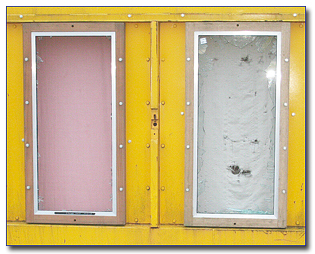
A test conducted by the UK Ministry of Defence compares the performance of a Zetix™ blast
curtain (left) with that of a conventional blast curtain.

“This is a completely new approach to material science, particularly for blast and ballistic mitigation, and we think it’s going to be a game-changing, breakthrough technology,” said Tony Lentini, AFT’s vice president of marketing.

Zetix comprises a series of auxetic yarns, each yarn wrapped using S or Z twist with a high-strength cord — or “power thread,” as Lentini described it — and woven by weft insertion across the warp. Off the loom, the weft becomes the tensile element in the fabric. “When force is
applied,” Hook explained, “the auxetic yarns deform, opening thousands of small pores in the fabric’s surface. In so doing, they absorb the peak pressures from the blast wave and yet allow the
rest to pass through. At the same time, they catch any airborne debris such as glass shards, shrapnel or secondary fragmentation.” In simulated car bomb testing and grenade testing, Zetix has shown “remarkable resilience,” sustaining negligible damage after eight nearby grenade blasts, he added.

“It is the only material on the market that automatically adjusts its strength and thickness in response to explosive forces,” said AFT CEO David O’Keefe. “Because it has memory, it returns to its neutral state when the stress is dissipated.”

The basic Zetix fabric is made with a Spectra®-wrapped polyester monofilament and ballistic nylon; but materials such as Kevlar®, Vectran™, Hytrel®, Nomex®, fiber optics or telemetric materials may be used for specialized applications.

“That gives you the capability to have many generations of Zetix,” O’Keefe said. “We can immediately increase the strength by probably 80 to 85 percent just by substituting Vectran for ballistic nylon.”

QFOM2

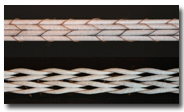
Bungee cords wrapped with inelastic cords and then stretched demonstrate the principles of
helical-auxetic technology.

Potential blast- and ballistic-protection applications include spall liners for armored vehicles, allowing a reduction in armor thickness and a consequent reduction in vehicle weight. Incorporating Zetix in body armor worn by soldiers in the field also could lighten the load they
must bear.

O’Keefe said Zetix will be cost-competitive weight-for-weight with other blast-mitigation fabrics, and its performance advantage will provide added value. “Because it’s not a single-event fabric, the cost of development or installation would be recouped pretty easily,” he said.

Although Zetix has successfully undergone official testing in the United Kingdom, the performance data from those tests is not easily accessible, so AFT is conducting testing in the United States so it can provide specific results to potential users. “We want to provide hard data to support Zetix’s claims, and we’re working with other companies and independent testing labs to generate it,” Lentini said.

AFT is working with US and Canadian manufacturers including Greensboro, N.C.-based BGF Industries Inc. and Quebec-based JB Martin Co. to produce Zetix fabric and is seeking additional
partners along the supply chain for various aspects of production.

“We’re looking for materials that would work well and be low-cost, and we’re looking for a variety of sources,” Lentini said. “For example, a critical component is the wrapping of the power thread because it’s key to the whole auxetic effect. We’re looking for people with capabilities to
do that efficiently and who can supply that thread to the weavers.”

Virtually Unlimited Potential

While the immediate focus for Auxetix and AFT is to provide blast-mitigation and ballistic-protection solutions for military and first-responder applications, there are many other areas in which Zetix technology can play a role. Even those initial solutions have relevance for non-defense applications, such as mine safety, hurricane protection, satellite testing, jet engine shielding — the list goes on. Nomex or a Hytrel flame-retardant yarn could be incorporated to add protection from high-heat or a fireball. With the addition of fiber optics, a Zetix apparel fabric could change color to help camouflage the wearer; or the addition of telemetric materials could allow remote monitoring of a person’s heartbeat or other vital signs. In the medical field, potential applications include adjustable bandages, sutures and medication delivery. There is good potential for filtration, as the behavior of the yarns can allow a filter to self-adjust in response to applied force; and the self-adjusting capability in a seat belt could help minimize
injury from an accident.

“Down the road, your imagination is the only limit to what this might do,” Lentini said. “Way down the road, imagine a military battle uniform that is blast- and shrapnel-resistant, can change color because of fiber optics, has telemetry that will measure a soldier’s vital signs and
could send a signal to adjust a built-in tourniquet. This may be pie in the sky now, but the auxetic effect is so important here, you can let your imagination run wild.”


For more information about Zetix™, contact David O’Keefe 1-281-872-7272; dokeefe@advancedfabrictechnologies.comwww.advancedfabrictechnologies.com


May/June 2010

Steel Heddle® Offers Wide-Width Frame

Belgium-based GTP Global Textile Partner’s Steel Heddle® subsidiary now offers a
5,475-millimeter-wide heddle frame that requires no center support. GTP reports it is the longest
frame ever produced without center support, and is suitable for weaving machines operating at high
speeds, especially those used to produce technical fabrics.

The frame is a modified version of Steel Heddle’s HybridPower 158 aluminum frame with carbon
strips to provide stability for high-speed operation.

May/June 2010

May/June 2010

The
California Fashion Association, Los Angeles, has elected
Won Kim, Fineman West & Co. LLP, to its Advisory Board.

Loves Park, Ill.-based
Zenith Cutter Co. has appointed
Paul Nissen Midwest sales engineer.

PeopleNissen

Nissen

Paris-based
Messe Frankfurt France S.A.S. will award
Manix Wong the Dinard 2010 Grand Prix Homme at Texworld, to be held September
13-16 in Paris.

Texas Tech University, Lubbock, Texas, has named
Stephanie Hartwig, men’s jeans division, and
Becca Pierce, women’s jeans division, winners of the first Denim Runway
competition.

The
American Apparel and Footwear Association, Arlington, Va., has named
Killick Datta, International Brand Partners LLC, chairman of the Board of
Directors.

The
Carpet America Recovery Effort (CARE), Dalton, Ga., has named
Georgina Sikorski CARE Person of the Year.

The
American Association of Textile Chemists and Colorists (AATCC), Research Triangle
Park, N.C., has awarded
Dr. S. Kay Obendorf, Cornell University, the Olney Medal for outstanding
achievements in textile chemistry;
Dr. Martin John Bide, University of Rhode Island, the Harold C. Chapin Award for
outstanding service to the association; and
Nestor Beyer Knoepfler (deceased) the Henry E. Millson Award for Invention for his
work developing a flame-retardant treatment for cotton batting.


PeopleObendorfPeopleBide

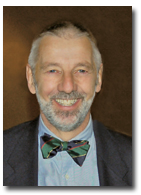
Obendorf (left) and Bide

New York City-based
Kaltex America has named
Keith Hull president and CEO.

Shaw Industries Group Inc., Dalton, Ga., has named
Bob Burton divisional vice president, Tuftex product management and marketing.

Energy Savings In Thermal Nonwovens Processes


I
n thermal nonwovens processes, most medium- and long-term costs are not caused by
machinery purchases, but by the thermal energy generated. The most important measures are initial
moisture reduction, exhaust-air flow optimization and heat utilization, and a highly efficient
dryer. The Eco-Heat heat-recovery and Eco-Air exhaust-air cleaning systems from Brückner
Trockentechnik GmbH & Co. KG, Germany, allow considerable cost cutting and are compatible with
all dryer makes.

Production line operating costs have a decisive influence on the total costs of articles
produced. Even nonwovens and technical textiles producers face ever more decreasing profits. One
reason is tough competition due to globalization. Another is that more and more producers want to
share in these segments by diversifying their existing portfolios. In parallel, operating costs
have increased rapidly in recent years, caused mainly by rising energy costs. If nonwovens
producers want to save these costs, they must consider measures resulting directly in lower
specific energy consumption and measures indirectly but positively affecting energy consumption.


Three Production Steps


The nonwovens process comprises mainly three steps: First, a web is formed from individual
fibers. This web, still sensitive to pressure and traction, eventually is treated using bonding
processes to get the required dimensional stability. In the last step, the nonwovens are finished
using different methods to give the requested end-product characteristics.

The complete process requires a corresponding amount of energy, mainly electrical or
thermal. Depending on the process step and the applied methods, the portion of required electric
and thermal power and the relevant energy carrier’s absolute consumption differ very much.

While nonwovens formation requires electric power almost exclusively, the portion of thermal
energy increases significantly for bonding and finishing. Particularly energy-demanding are all
bonding methods, such as spray bonding, hydroentanglement, full bath or foam impregnation. And
nonwovens finishing technologies such as coating, printing, dyeing and others require the
evaporation of water or solvent.
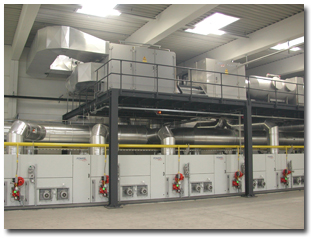
EnergyBruck

Brückner’s Eco-Heat heat-recovery and Eco-Air exhaust-air cleaning systems are shown
installed on a nonwovens finishing line.


Electrokinetic Energy


Apart from thermal energy, it also is possible to save electrokinetic energy. Electrical
energy needs are determined by motor size and efficiency, a drive system that is optimally designed
and fine-tuned for the complete line, and the consequent use of highly efficient gears and motors,
which offers a big savings potential.

Brückner has calculated possible annual savings in a five-digit-euro range for production
lines. In addition, the use of suitable raw materials and high-capacity materials and thus
achievable weight savings also contributes to cost savings.


Thermal Energy


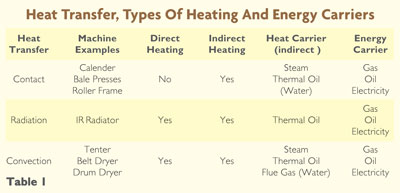
In nonwovens production, thermal energy is required almost solely for bonding and finishing.
Heat transfer from machine components onto the nonwovens is made by heated roller contact, infrared
radiation or convection. However, there is a difference between direct and indirect heating: With
direct heating, the heat generated by the energy carrier comes directly in contact with the
substrate. Indirect systems generate the primary heat basically in the same way, but the thermal
energy is first transferred to a carrier medium and then by means of a heat exchanger onto the
nonwoven
(See Table 1).
BrucknerTable1

In this connection, two aspects are of particular importance regarding thermal energy cost.
Direct heating systems are approximately 92- to 96-percent efficient, while indirect systems
provide only 60 to 85 percent of the primary energy. Also, basic prices for the elementary energy
carriers’ power can differ considerably and thus directly affect the cost per generated kilowatt of
thermal energy.


Surprising Results


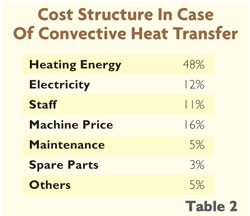
Some years ago, Brückner completed a study regarding life cycle costs, focusing on how a
machine’s operating and energy consumption costs are distributed over time for a convective heat
transfer process. The expenses for heating energy and power represent more than 50 percent of the
total costs
(See Table 2). However, most of the customers participating in the study overestimated
heavily the share of the machinery price, with an average estimate at 40 to 50 percent, whereas
energy costs were predicted only at 30 to 40 percent.

BrucknerTable2

To reduce thermal energy costs in nonwovens bonding and finishing, it is a prerequisite to
know the parameters involved in the process and the corresponding energy inflow and outflow.
Thermal energy is required to heat the web to the desired temperature, evaporate moisture adhering
to the textile, and heat the exhaust air and/or the corresponding quantity of fresh air to remove
the evaporated water.

The evaporation of water and the heat removed with the exhaust air and the heating of fresh
air require most of the consumed thermal energy. The portions for fabric heating and heat losses
due to the transport system and machinery components are rather low in comparison. Heat losses in
modern convection machines are not more than 3 percent of the total heat required. Therefore,
machinery producers focus optimizing efforts mainly on cost drivers where possible savings are
higher. In practice, heat losses are often discussed, and it is correct to strive for improvements
here, too. However, as the use of high-capacity materials leads also to considerable cost increases
for the complete machine, the achievable benefit must be critically analyzed.


Energy Savings


The decisive saving potential is in the energy required for water evaporation, exhaust air
flow and fresh air heating. The first step is to provide for the best mechanical dewatering of the
web, as lower initial moisture leads to lower energy consumption.

The second step is to reduce exhaust-air volume. Drying requires air that is able to absorb
moisture. Lower exhaust-air flow means higher saturation of the circulating air with steam, but
absorptive capacity decreases with increasing humidity, and the dew point sets a physical limit.
The moisture in the dryer interior or in the exhaust-air ducts condenses when maximum saturation of
the circulating air is exceeded. Exhaust-air-flow reduction is always connected to dryer
performance and is thus a problem for optimization. According to Brückner, the optimization is
between 80 and 140 grams of moisture in the exhaust air per kilogram of exhaust air. A control
system allows setting this optimum for each drying process by automatically adapting exhaust-air
volume flow independent of exhaust-air moisture.

Control of exhaust-air volume flow and recovery of exhaust-air heat make up the third step.
It is possible to recover efficiently most of the heat discharged with the exhaust air by means of
heat-recovery systems. A possibility is to heat fresh air, which is then supplied to the convection
machine. In this context, there is a considerable difference in the heat-setting process: The use
of exhaust-air heat is also important because there is no measurand for the exhaust-air flow
control. Also, here, the exhaust-air flow should be as low as possible. However, condensation of
finishing vapors must be avoided. The only possibility for such processes is manually controlled
exhaustion.


Heat Recovery


Brückner provides two systems for exhaust-heat recovery: air-to-air; and air-to-water. Both
can be combined and varied and adapted to any convection machine or to customer specifications.
Also, when combined with an electrostatic precipitator, this efficient method of economic energy
utilization can be enlarged to be used as a high-capacity exhaust-air purification system. This
heat-recovery system can be used with a range of dryers, ovens and heat-treatment chambers.

Using an air-to-air system, process heat can be reduced by 12 to 15 percent; and using
heat-setting processes, by 33 to 36 percent. Another possibility is to use the hot fresh air to
air-condition the factory. With an air-to-water system, water can be heated to 90°C. These are
excellent savings possibilities regarding the overall energy balance of a plant for nonwovens
producers that use hot water for their wet-finishing.


Editor’s Note: Stefan Müller is sales director, Nonwovens, at Brückner Trockentechnik GmbH
& Co. KG.


May/June 2010

Sponsors