Engineered Floors Has Reached A Letter Of Intent To Acquire Beaulieu Group LLC

DALTON, Ga. — September 20, 2017 — Engineered Floors LLC. has reached a letter of intent agreement in principle to purchase substantially all of the operating assets of Beaulieu Group LLC. The transaction will be contingent upon approvals through the bankruptcy court and due diligence processes. Pending governmental approvals, the transaction is expected to close in the fourth quarter of 2017.

Posted September 21, 2017

Source: Engineered Floors

U.S. Textiles Stays On Track

BornemanBy James M. Borneman, Editor In Chief

The good news continues in U.S. manufacturing, and the recent Institute for Supply Management (ISM®) Manufacturing ISM Report On Business®, provides some great data that supports the trend. Prepared by the Tempe, Arizona-based organization, the report states, “Economic activity in the manufacturing sector expanded in August, and the overall economy grew for the 99th consecutive month.”

Timothy R. Fiore, CPSM, C.P.M., chair of the ISM Manufacturing Business Survey Committee said: “The August PMI® registered 58.8 percent, an increase of 2.5 percentage points from the July reading of 56.3 percent. A reading above 50 percent indicates that the manufacturing economy is generally expanding; below 50 percent indicates that it is generally contracting.”

That expansion is evident in the many news reports of plant openings in the United States. And it is good news for the economy in general.

Fiore said:“The past relationship between the PMI and the overall economy indicates that the average PMI for January through August (56.7 percent) corresponds to a 4.2 percent increase in real gross domestic product (GDP) on an annualized basis. In addition, if the PMI for August (58.8 percent) is annualized, it corresponds to a 4.9 percent increase in real GDP annually.”

Those are the headline numbers that represent total U.S. manufacturing and are a composite of the 18 manufacturing industries tracked by ISM.

Fourteen of the 18 manufacturing industries reported growth in August including Textile mills and General Machinery. Unfortunately, apparel contracted compared to the July report.

Looking at the elements of each industry, Textile mills and General Machinery fared well in the New Orders, Production, Employment and Increase in Backlog of Orders sections of the report.

There is also increasing interest in the U.S. textile industry — possibly spurred on by new plant and equipment trends.

The Germany-based Mechanical Engineering Industry Association (VDMA) for Textile Machinery will be hosting a one-day technology B2B Forum & Conference title “German Technology meets U.S. Textile” in Charlotte, November 6, 2017. Please see the preview in this issue for details on the program. Registered attendees will be admitted free of charge. The VDMA also will host a similar event in Mexico City, November 7-8.

The flow of news to TW’s inbox has been on the increase and generally positive. Not an exact science, but in looking at textile activity on a daily basis through TW’s daily posting, it is fairly easy to sense an optimistic trend.

Business is difficult at times and keeping up with dramatic changes in technology is challenging. But it is great to see this sense supported by the ISM data.

It is very rewarding to see the level of technology driving the industry and allowing for competition on a global scale. Today, the U.S. textile industry is safer, with better paying jobs, increased productivity and better quality products than ever before, and automation plays a significant role in the industry’s technical revolution and continuing good news.

September/October 2017

Robert H. Chapman, III, Longtime Industry Leader

ChapmanRobert “Rob” H. Chapman, III, recently passed away unexpectedly. The Chairman, CEO and treasurer of Inman Mills, Inman, S.C., was 66 years old. He was the fourth generation family member to run Inman Mills joining the company in 1976.

During his lifetime, Chapman served in many leadership roles within the textile industry as well as within his community. Last year, he was recognized for his contributions and inducted into the South Carolina Business Hall of Fame.

Chapman also was the immediate past chairman of the Washington-based National Council of Textile Organizations (NCTO).

“On behalf of the U.S. textile industry, NCTO extends its deepest sympathies to the Chapman family and everyone at Inman Mills,” said NCTO President and CEO Auggie Tantillo.

“Rob’s legacy is immense. In the last two decades, globalization, particularly the entry of China into the World Trade Organization, triggered the most disruptive change ever experienced by the U.S. textile industry. When other companies were going out of business, Inman Mills responded with a strategy of innovation, reinvestment and a willingness to adapt. Today, thanks to Rob’s dedication and foresight, Inman Mills is one of the shining lights in the renaissance of the U.S. textile industry,” Tantillo continued.

“Rob was also leader in crafting the U.S. textile industry’s Washington, D.C.-based policy response to globalization.  It speaks volumes that Rob’s peers chose him to lead NCTO in 2016-2017 when debate on the now failed Trans-Pacific Partnership (TPP), the biggest challenge to the U.S. textile industry since China’s 2001 entry into the WTO, was coming to a climax,” Tantillo added.

“Finally, on a personal note, Rob was a close friend. He was a true gentleman, unfailingly courteous, loyal and generous. Soft spoken and quick to deflect credit to others, Rob was a fierce competitor, driven by the desire to help his community and industry. Most of all, Rob loved his family and his many associates at Inman Mills. He dedicated his life to their well-being.

If there ever was any doubt that builders can build faster than destroyers can destroy, Rob was living proof. He will be greatly missed, but his legacy will long endure,” Tantillo finished.

September/October 2017

Fibertex To Establish Plant In Asheboro

Denmark-based Fibertex Personal Care has announced plans to establish its first U.S. manufacturing facility in Asheboro, N.C. The company will invest $60 million by the end of 2021 and anticipates creating jobs for 145 people.

Fibertex focuses on materials for personal care items including diapers, feminine hygiene and incontinence care products. Fibertex also offers printed nonwovens and the Innowo Print band. The new state-of-the-art U.S. facility will focus on printing on nonwovens.

“The coming factory in Asheboro will cover the markets of North and South America, which are very important for our expansion,” said Mikael Staal Axelsen, Group CEO, Fibertex Personal Care. “We expect fine growth rates within our niche, and therefore, the factory will need to be operational by the end of 2018. We are very pleased with the cooperation with North Carolina and Randolph County about this project, and look forward to being a part the community in Asheboro.”

September/October 2017

Glen Raven Inks Agreement To Acquire Sunbury Textile Mills

Glen Raven Inc., Glen Raven, N.C., recently signed a letter of intent to purchase Sunbury, Pa.-based Sunbury Textile Mills Inc. Sunbury, a designer and producer of decorative jacquard fabrics, will become a wholly owned subsidiary of Glen Raven and will operate as a part of Glen Raven Custom Fabrics LLC.

“Sunbury has been a close strategic business partner for more than 20 years,” said Allen E. Gant, Jr., chairman and CEO of Glen Raven, Inc. “Sunbury’s leadership in serving the designer, decorative jobber and furniture manufacturers with premium jacquard fabrics is unparalleled. Every Sunbury customer is important to us and represents an opportunity to combine resources and be better suppliers and business partners.”

“We have long considered Sunbury to be part of the extended Glen Raven family, and we are excited about working with them to further service all of their markets and customers,” Gant added.

September/October 2017

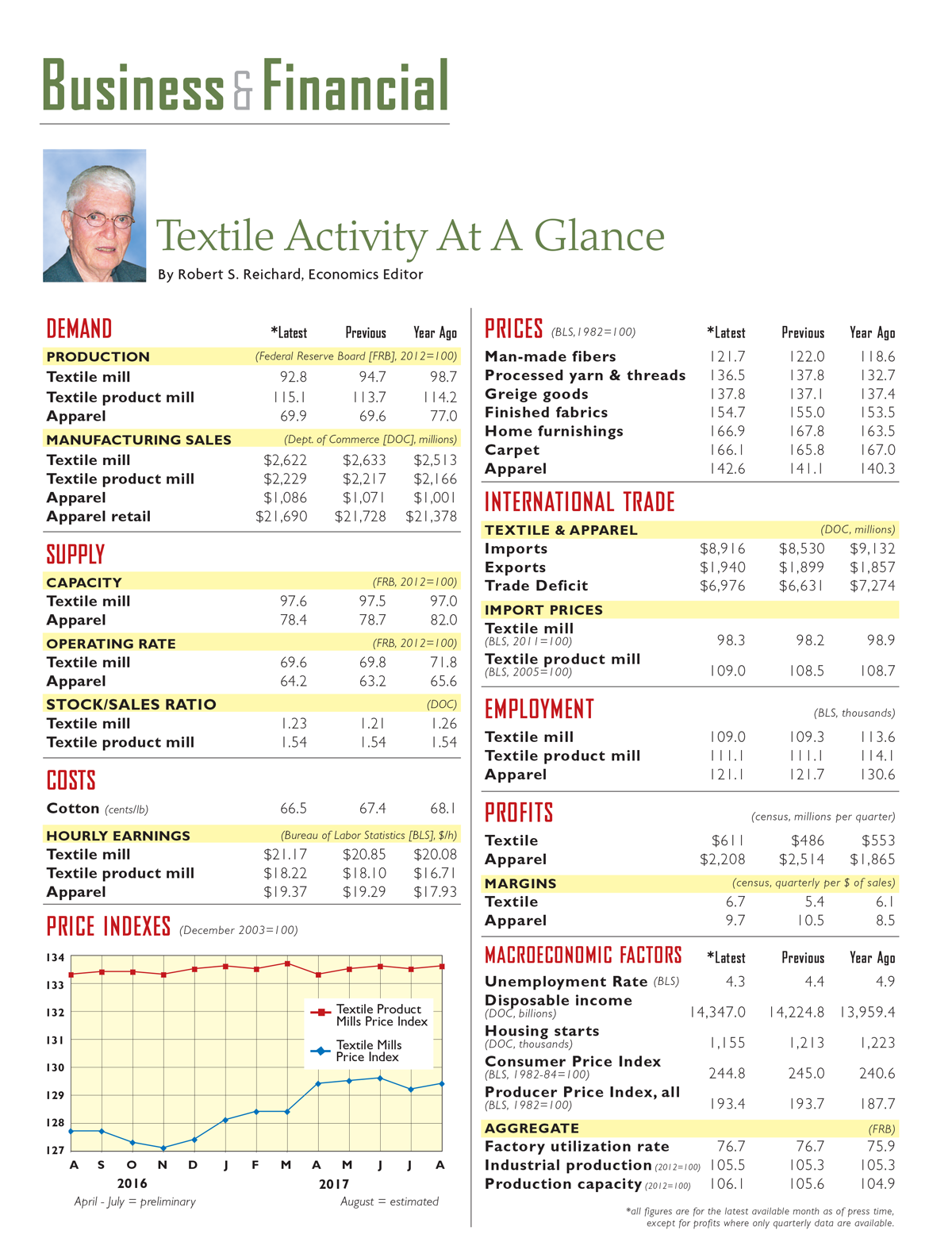
September/October 2017: Textile Activity At A Glance

BFBarometersSO17

September/October 2017

Third-Quarter Orders Stay Steady

Jim-Phillips-colorBy Jim Phillips, Yarn Market Editor

A number of spinners reported stable business conditions throughout the third quarter and expect orders to continue to be relatively strong until the typical end-of-the-year slowdown.

“Our business has been solid,” said one spinner. “You couldn’t say it’s been great, but it’s been relatively steady throughout the third quarter.” Added another spinner: “This is just a funny business. You never really know what to expect. Overall, our orders have been fine. We don’t have a huge backlog, but that has been the case for most of the year. But just when we expect business to fall off some, it picks up. And just the opposite happens. We see the signs that say expect big things and then nothing happens. As I said, it is just a funny business.”

Some spinners noted that orders for cotton yarns picked up significantly in early September. “Over the course of the summer, we had a lot of orders for blends,” said one spinner. “In fact, that has been the bulk of our business for a few months. But now, heading into the end of the year, we are seeing a lot more orders for cotton yarns.” Another spinner commented: “We’ve seen definite increase in orders for cotton yarns in the last few weeks. We’ve got a steady stream of orders coming in that we hope will keep us busy until everyone starts shutting down and cleaning up for the holidays.”

A multi-national spinner said: “Orders across the board have been strong. We are moving a lot of specialty yarns and a lot of cotton. In fact, at the moment, it seems the only things that aren’t moving very well are OE yarns and some commodity products. And that’s because the market is already flooded with inventory of these products.”

Hurricanes Top The News In Early September

Weather dominated much of the discussion among yarn spinners in late August and early September. Hurricane Harvey ripped through the Texas coast, accounting for numerous personal tragedies and record amounts of property destruction. Yarn spinners were affected as well, as spot market cotton prices temporarily spiked to a season high of more than 70 cents per pound on August 31.

As of this writing, Hurricane Irma is poised to hit the Florida coast. Its track is uncertain and could affect a significant portion of the southeast and south central United States. Irma has a number of spinners concerned about its impact on the U.S. cotton crop. Note: By the time of publication, a lot will be known about how Irma affected the U.S. industry. A review of Irma’s impact on the U.S. yarn business will be published in the next “Yarn Market.”

“It is not likely to destroy a lot of the cotton crop in the southeast,” said one spinner, “but it could have a significant impact on the overall quality of the crop.” Said another spinner in early September: “With a storm so powerful, it is just going to be wait and see. We still don’t even know where it is going — how much of the country it is going to affect. The bad news is that it is very strong. The good news is that it is moving rapidly, so it is unlikely that we will see the devastating flooding associated with Harvey.”

Cotton Prices Inch Up As Yarn Demand Improves

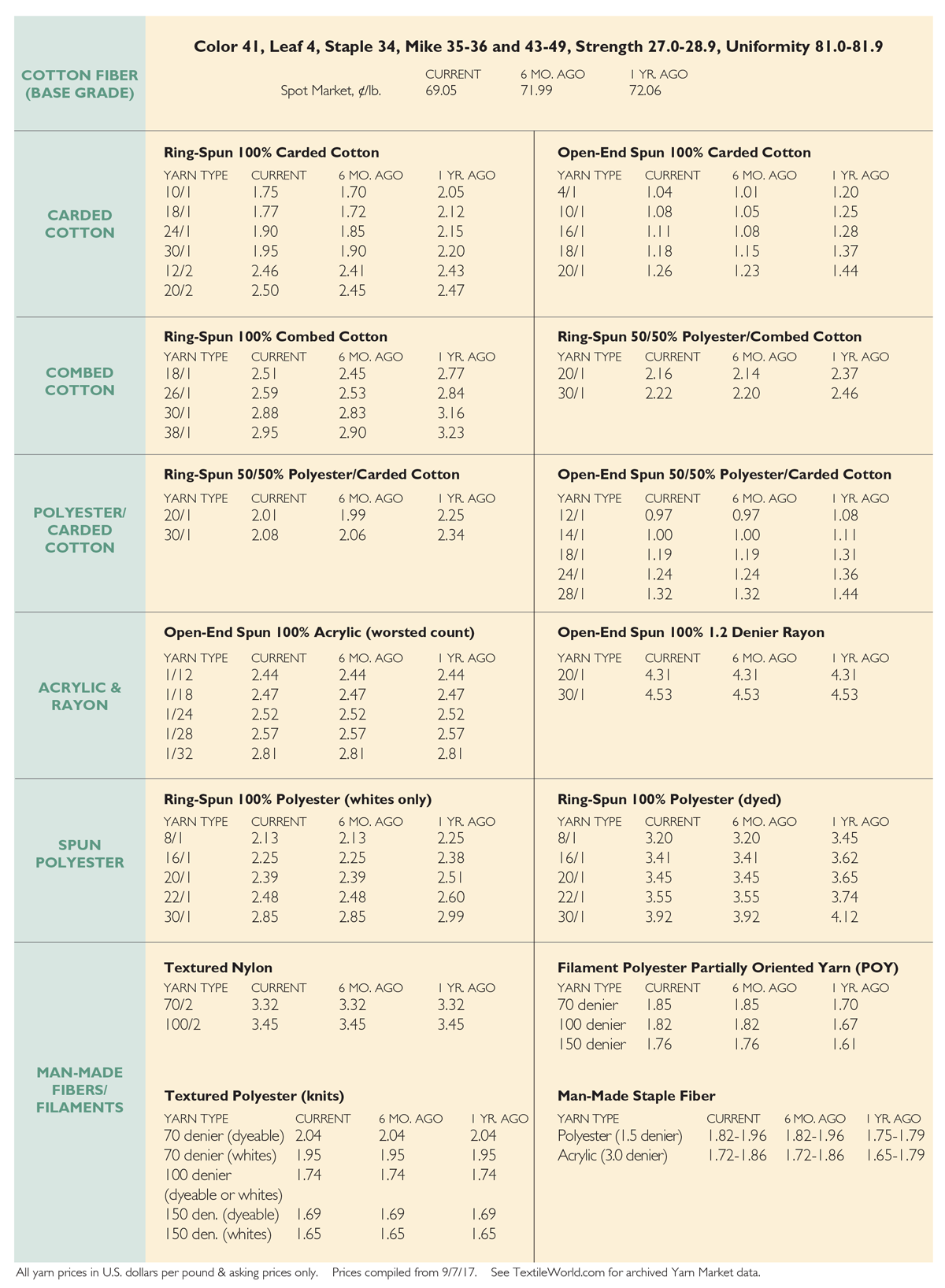
Average quotations for the base quality of cotton (color 41, leaf 4, staple 34, mike 35-36 and 43-49, strength 27.0-28.9, uniformity 81.0-81.9) in the seven designated markets measured by the U.S. Department of Agriculture (USDA) averaged 69.05 cents per pound for the week ending August 31, 2017. The weekly average was up from 67.01 the
previous week, and 65.30 cents reported the corresponding period a year ago. Daily average quotations ranged from a low of 67.15 cents Friday, August 25 to a season high of 70.06 cents Thursday, August 31. Spot transactions reported in the Daily Spot Cotton Quotations for the week ended August 31 totaled 2,566 bales.

The USDA also reported that demand was good for color 41, leaf 4, and staple 34 and longer for second and third quarter 2018 delivery. Some mills anticipated increased cotton consumption during the fourth quarter of 2017 as yarn demand improved. Most mills were operating on five-to-seven day schedules.

YarnChartSO17

September/October 2017

What Do We Do When All The Old Guys And Girls Are Gone?

KaufmannHeadshotBy Jim Kaufmann, Contributing Editor

There’s an old adage suggesting that “Inside every old person is a young person wondering what happened?” I mention this, because when I first started in the textile industry circa 1983, there always were older guys and gals around for the young ‘uns to learn from. Many of you know whom I’m referring to. There was the wizened fixer who not only named but talked to his machines, yet knew just how to coax them into running smoothly no matter what we did to them; guys like Bubba, Harold and Big Jim who told fantastic stories that constantly made you laugh until you cried; Ms. Sue in purchasing, all four feet ten and 105 pounds soaking wet who would stand toe to toe with literally anyone, even Mr. Milliken himself, to get you the best pricing; or the crazy mad scientist with his little black book who could create the most vibrant of colors from a bunch of pixie dust. Everyone knows folks like this, and went to them for help and guidance. They’re the real-world teachers and mentors that drive the textile industry. Fortunately, I still know and am proud to call many of these now “older folks” friends.

Unfortunately, looking at all the folks in the textile industry today, the old ones regrettably are getting older, and there appears to be significantly fewer and fewer young ones hoping to take their place. “Textiles are growing worldwide and expanding into new and fascinating areas, but the talent pool is shrinking and continues to shrink,” lamented James Wang, CEO of Pailung Machinery Co. “The impression of textiles is that the industry is in the sunset, but that couldn’t be further from the truth.”

Many others in the textile industry are sounding alarms with similar concerns about the lack of young people showing an interest in textiles. Dan St. Louis, director of the Manufacturing Solutions Center established to assist and grow industry in North Carolina, proclaimed: “Man it’s tough! Everyone thinks textiles are dead. Do a Google search for textiles and you still see pictures of the old dirty, nasty factory mills from days gone by. Those old images couldn’t be further from the truth given the advanced factories of today or the unbelievable breadth of applications where textiles are used. But how do we get kids interested in textiles? They think stuff like robotics and artificial intelligence are the cool jobs, not textiles. How do we manufacture anything if they’re all playing on their smart phones and immersed in virtual reality? We’re at less than 4-percent unemployment in this area now. We already can’t find people, so where’s the future hands-on work going to come from? Where do we find the fixers? Where do we find the craftsmen? That’s really the huge concern!”

“The textile industry was never sexy,” said Lee Berry, sales manager at SAERTEX USA. “It’s always had an image problem. The media consistently portrays the textile industry as old school, not the highly technical growth industry which it really is. There truly needs to be an effort to change that image and get young people interested again.”

Wang is equally concerned. “The new generation doesn’t see textiles as interesting globally,” Wang said. “They don’t realize that today’s textile industry is as advanced or even more advanced than many other industries. We have to change the global image of textiles and get more young people involved and we have to do it soon. How can we continue to realize growth and find new opportunities without the talent pool to drive it?”

“It seems like the textile industry created its own self-fulfilling prophecy when many of the traditional textile schools started dropping or greatly reducing their textile programs,” said Berry. “Georgia Tech maybe has some classes. Philadelphia Textile is now Jefferson University. It still has textile programs, I think? Does Clemson or Texas Tech still offer textile courses? I don’t know,” Berry opined. “People imply that textiles aren’t around anymore and all the jobs are going to Asia, yet the textile industry in the United States keeps evolving into new and interesting directions that most don’t realize. Somehow we need to change that.”

On the bright side, there is a lot of good going on in textiles and several efforts are increasing the textile industry’s visibility to bright young people. Raleigh, N.C.-based North Carolina State University (NC State) still maintains an active textiles program. The Nonwoven’s Institute at NC State, led by Behnam Pourdeyhimi, is a world-class organization benefitting the nonwovens industry. There are a growing number of composites programs using textiles for reinforcements at universities around the country expanding the understanding and use of composite technologies in a variety of industries.

And speaking of technologies, while most people still think of textiles as only being the stuff that clothing and bed sheets are made from, it is a progressive industry filled with technology and literally untold numbers of applications. Some fun facts:

  • The global textile industry, when categorized properly, remains one of the largest, if not the largest, in terms of manufacturing dollars and number of employees.
  • Machine manufacturers like Pailung continue to push the limits of machinery and resulting fabric technologies. It’s estimated that more than 20 percent of the human body can now be replaced or improved using some form of textiles.
  • Performance and high-tech fabrics are everywhere. Several new running shoe uppers are actually complex one-piece knit fabrics while near net-shape 3-D woven preforms are being used in ultra-high performance composite applications.
  • The Advanced Functional Fabrics of America (AFFOA) organization — initially funded with a Department of Defense grant and based at the Massachusetts Institute of Technology — is investigating truly advanced uses for textiles in the military, electronics and beyond.

No, it’s definitely not my father’s textile industry any longer, and we need to inspire more young people from all education levels and disciplines to get immersed in the textile industry in order to keep

it advancing. “We have to engage youth early in order to service industry needs of the future,” St. Louis suggested. “We have to help them understand that knowing how to make stuff is a worthy and valuable skill. Textiles are a large part of our history in this area and they are still a significant part of our future.”

Personally, I remain bullish about the future of the textile industry, but share all the concerns that textiles needs to improve its image. It’s one of the oldest industries known to man and has continually progressed through the cumulative efforts of young and old guys and gals alike.

Textiles are used virtually everywhere in applications that amaze and inspire, but regrettably many people harbor that old, dirty image of a dying industry. And that’s the image that needs to change in order to get young people excited about textiles. Otherwise, the concern is that when all the old guys are gone, the textile industry is going to look back and wonder what happened?

September/October 2017

German Technology Meets U.S. And Mexican Textiles

VDMAlogoThe VDMA Textile Machinery will hold two events — one in Charlotte and one in Mexico City — to showcase German technology to industry decision-makers.

TW Special Report

Interested in developing and manufacturing new products; or enhancing competitiveness by increasing efficiency and quality? The Germany-based Mechanical Engineering Industry Association’s (VDMA’s) Textile Machinery Association hopes to help textile manufacturers find answers to these questions, as well as tackle topics such as saving energy and material resources, digitization, and smart factories during two upcoming B2B Forum & Conference events this November.

The first event will be held in Charlotte at the Sheraton Charlotte Hotel November 6, 2017. The second conference will be held November 8-9, 2017, at the Hilton Mexico City Santa Fe in Mexico City. Each event will feature approximately 25 VDMA member companies that will present practice-oriented technology topics along the entire textile chain from spinning to finishing and dyeing, in addition to cross topics including energy and material efficiency, life cycle costs, and Industry 4.0. Conference presentations, some held in parallel, will be supplemented by B2B meetings and a table-top exhibition area.

The free event is targeted to decision-makers in the textile manufacturing industry. Interested parties can register at each event’s website, as well as use tools on the site to schedule meetings with participating VDMA member companies, subsidiaries and agents.

Healthy Markets

According to the VDMA, traditionally the United States is one of the top five destinations for German textile machinery. Strong sectors in the United States include technical textiles and nonwovens, but also home textiles like carpets. In the first half of 2017, German exports of textile machinery and accessories to the United States reached more than $130 million. “So, for the whole year 2017, we can expect business on a quite good level with exports worth well above $200 million,” said Thomas Waldmann, managing director, VDMA Textile Machinery.

The VDMA reports the market in Mexico was quiet for a couple of years, but picked up in 2015 and 2016. In the first six months of 2017, German deliveries of textile machinery to Mexico reached more than $20 million. “Continuing like this, the result for the whole year will be a good one,” Waldmann said.

“We expect decision-makers of textile manufacturers from the United States and Mexico who are interested in developing and manufacturing new textile products to attend the event,” Waldmann said. “For textile producers that wish to enhance competitiveness by increasing production efficiency and quality of their textile products, the VDMA events are a place to be. The practice-oriented technology topics will place high value on saving energy and material resources in the production process. Textile producers looking for content behind the sometimes loosely used buzzwords ‘digitization’ and ‘smart factory’ will benefit from attending the conferences in Charlotte and Mexico City.”

Participants

VDMA companies taking part in the Charlotte event includes:

  • A. Monforts Textilmaschinen;
  • Andritz Küsters, a Division of Andritz Inc.;
  • Autefa Solutions Germany;
  • Brückner Textile Technologies;
  • DILO Systems;
  • Erhardt+Leimer;
  • Georg Sahm;
  • Groz-Beckert;
  • Interspare;
  • Karl Mayer Textilmaschinenfabrik;
  • Körting Hannover;
  • Lindauer Dornier;
  • Mahlo;
  • Neuenhauser Maschinenbau;
  • Oerlikon Textile;
  • PLEVA;
  • Reseda Binder;
  • Saurer Components;
  • Sedo Treepoint;
  • Temafa;
  • Textechno Herbert Stein;
  • Thies Corp.;
  • Trützschler; and
  • Welker Vakuum.

VDMA member companies participating in the Mexico City event includes:

  • A. Monforts Textilmaschinen;
  • Allma Volkmann Zweigniederlassung der Saurer Germany;
  • Andritz Asselin-Thibeau;
  • Autefa Solutions Germany;
  • Brückner Textile Technologies;
  • DILO Systems;
  • Erhardt+Leimer;
  • Georg Sahm;
  • Groz-Beckert de México;
  • Interspare;
  • Jakob Muller Trading de Mexico;
  • Karl Mayer Textilmaschinenfabrik;
  • Körting Hannover;
  • Mahlo;
  • Mayer & Cie;
  • Neuenhauser Maschinenbau;
  • Oerlikon Textile;
  • PLEVA;
  • Reseda Binder;
  • Saurer Components;
  • Schlafhorst Zweigniederlassung der Saurer Germany;
  • Sedo Treepoint;
  • SETEX Schermuly textile computer;
  • Temafa;
  • Textechno Herbert Stein;
  • Thies;
  • Trützschler;
  • Welker Vakuum; and
  • Xetma Vollenweider.

To Participate

First, attendees must register at the event website; then, individual business meetings with other participants may be requested. Once both parties confirm the request, the meeting will be scheduled. Prior to the event, each registrant will receive a personalized meeting schedule. The event website offers registered participants access to a calendar; a to do list; activities; and a summary of accepted, declined or pending meetings. The comprehensive website also offers a searchable catalog of profiles for each participating company.

Technology Highlights

Following is a brief preview of what to expect from just a small slice of the participating companies.

Andritz’s “Innovative Needlepunch Solutions For The Automotive Industry” presentation will focus on its aXess and eXelle lines designed for market entry and medium capacities versus high capacities and premium products respectively. The company reports there is a focus on needlepunch technologies for automotive applications in the presentation, and it is ready to share its experience and knowledge in this growing application area.

Autefa Solutions considers the forums a great opportunity for easy networking and information exchange, and reports many of its new developments are driven by customer demands. According to Autefa, energy efficiency in addition to reliability and economy play a big part in its product portfolio. “The unique design of our Square Drum Dryer SQ-V combines the small footprint of a drum dryer with the better performance of a belt dryer,” said Alexander Stampfer, regional sales director.

At the Charlotte conference, Brückner’s presentation will provide a definition of the meaning of the Internet of Things and will identify the possibilities that digitalization can offer to end-users and suppliers, as well as explain how these possibilities can be used in a state of the art control system, how they affect machine operation and maintenance and how data collected will increase the production efficiency. In Mexico, Brückner will focus on an up-to-date machinery control system with Remote Maintenance Control and Styles Administration data base for a new system that allows the user to ecologically optimize the finishing processes under and reduce production costs.

DiloGroup will present information on its VectorQuadroCard from DiloSpinnbau, which combines different types of carding within one card using a simple and fast changeover of the intermediate section; the horizontal crosslayer DLSC 200 from DiloMachines, which features an electro-mechanical web infeed speed of 200 m/min depending on the fiber used; and the DILO HyperTex and Hyperpunch needlelooms, among other products.

For carding customers, Groz-Beckert offers a wide range of products available in a variety of options including micro-alloyed and high-end steel grades. The company continuously develops new technologies including the SiroLock® and EvoStep® wires for long staple spinning and nonwovens production. Groz-Beckert’s strong technical support also helps companies address challenges in today’s increasingly competitive environment.

Interspare, a producer of textile finishing systems, will highlight its horizontal chain for high-tension fabric transportation without using lubricants. The company reports the chain is usable in high impact and extreme cross tension situations, making it suitable for carpet and coating applications. Interspare also will share information on new innovations such as its patented Econ-Air guiding system.

Mahlo offers on-line measurement and quality control technologies. During the event, the company will highlight its systems for textiles, nonwovens, coating, converting, film and paper applications. The company develops customizable, modular technologies with the aim of improving quality, reducing manufacturing costs and optimizing processes.

High-tech coating solutions for advanced filtration materials and automotive textile applications will be the focus of A. Monforts Textilmaschinen. At the conference, Monforts will highlight its texCoat coating range, which incorporates a knife over roller/air system, magnetic roller system and printing head systems. “Our new texCoat coating system is the most versatile coating system on the market,” said Jürgen Hanel. “With texCoat, it’s simply a question of changing a position on the machine and we can move from coating to printing. In addition, we can either retrofit the system to an old machine, or add it to a new frame for a totally integrated solution.”

Georg Sahm and American Starlinger-Sahm will introduce the new YarnStar3+ — coating, cooling, winding + automation — single-end extrusion coating line. The line allows polyester yarns to be coated with poly vinyl chloride at speeds of up to 1,500 meters per minute (m/min). The mono- and bicolored coated yarns are suitable for sunshades, home textiles, upholstery fabrics, and wall and floor coverings.

Saurer’s divisions have implemented an E3 concept, which aims to optimize the company’s spinning, winding and twisting systems in terms of energy, economics and ergonomics. The Volkmann twisting division has developed specific solutions to reach these goals including a range of efficient motors and bearings in conjunction with low friction drive systems and a wide range of spindle and rotor combinations to minimize the energy required to produce 1 kilogram of yarn. Its systems are modular and can be tailor-made to meet customer’s requirements.

Sedo Treepoint reports the company has focused on a deeper integration of all systems in dyeing and finishing to offer higher productivity and machine efficiency; more sustainable production; and substantial water, chemical and energy savings. Presentations given at the two events will offer insight on connecting the shop floor with management decisions using a fully integrated system and dynamic production environment.

The Thies iMaster H2O short liquor fabric dyeing jet for cotton and cotton blends operates at liquor ratios as low as 1:3.5 and at 1:2.5 for polyester. Thies reports the machine is flexible and simple to operate with its new software. The company also offers a full line of dye and chemical dispensing equipment.

Trützschler will promote its Integrated Draw Frame (IDF) — a compact auto leveler draw box — during the event. The company reports it is possible to realize improved efficiencies and improve yarn quality when using IDF because the process substitutes one or two passes on the draw frame, thus reducing the number of cans, can transports, power consumption and building space. The improved yarn quality in turn results in fewer imperfections and yarn count variations for better appearance in knit and woven fabrics.

Programs

VDMACharlotteSchedule

VDMAMexicoProgram


For more information about the Charlotte event and to register, please visit germantech-ustextile.de. Details about the Mexico City event and the form to register can be found at germantech-mextextile.de.


September/October 2017

ShanghaiTex: Sparking New Opportunities

ShanghaiTexShanghaiTex 2017 will highlight Industry 4.0 ideas and promote “Textile for Smarter Future.”

TW Special Report

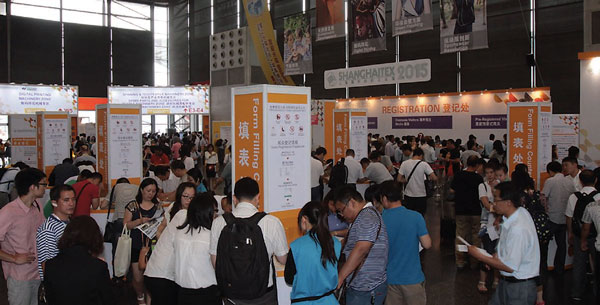
ShanghaiTex 2017, the 18th International Exhibition on Textile Industry, returns to the Shanghai New International Expo Center (SNIEC) November 27-30, 2017. This year, show organizers — Adsale Exhibition Services Ltd., Shanghai Textile Technology Service & Exhibition Co. Ltd. and Shanghai International Exhibition Co. Ltd. — are embracing the theme of Industry 4.0 and promoting “Textile for Smarter Future.” The show will focus on the ideas of advancing production, digitalization, sustainability and servitization.

Organizers anticipate more than 1,200 exhibitors will show their technologies on a trade show floor covering at least 103,000 square meters over nine halls. More than 60,000 visitors from more than 80 countries are expected. The last edition held in 2015 attracted 1,200 exhibitors and 55,049 visitors from 67 countries and regions.

Show sponsors include ShangTex Holding Co. Ltd., China Council for the Promotion of International Trade Shanghai Sub-council, and China Chamber of International Commerce Shanghai Chamber of Commerce.

Themed Zones, Hot Topics

ShanghaiTex 2017 will feature nine themed zones:

  • Sports Textiles Technology;
  • Technology for Automotive Textiles;
  • Knitting & Hosiery Machinery;
  • New Materials, Technology & Designs for Textile Products;
  • Printing, Dyeing & Finishing Machinery & Textile Chemicals;
  • Digital Printing Machinery;
  • Spinning & Techtextile Machinery;
  • Spare Parts and Accessories for Textile Machinery; and
  • Weaving Machinery.

According to organizers, “from innovation of product, service to production process, ShanghaiTex will demonstrate the integration of information, internet, IoT and mobile electronics technology, assisting enterprises to find their own pace to Industry 4.0.”

In addition to the exhibit halls, ShanghaiTex will host seminars, networking events and new product and technology launches. Highlights include a denim mastermind, Evolution of Sports Shoe Tech and Sports Bra-ology seminars; a Smart Textile Innovation Forum; Wearable Technology X Textile Design Competition; Smart Textiles Showcase; Sports 3-D Printing Technology Showcase; a Buyer’s Forum and Business Matching; and Smart Factory & C2M [customer-to-manufactory] Experience Zone featuring a Textile Industry 4.0 Forum and Smart Manufacturing Technology Showcase.

The new C2M Smart Factory Experience Zone will highlight 3-D scanning, 3-D printing, textile automation, management systems and e-commerce platforms to demonstrate the workings of a smart factory. ShanghaiTex visitors will gain hands-on experience using the equipment and technologies found in the zone and will have access to a professional team who can answer questions about Industry 4.0 and help industry players improve productivity and remain competitive in the fast-changing marketplace.

ShanghaiTex admission is free, and visitors may preregister online or register on-site during the show.


For more information about ShanghaiTex 2017, please visit shanghaitex.cn.


September/October 2017

Sponsors