WEINHEIM, Germany — March 6, 2019 — Freudenberg & Vilene Nonwovens brought a new production line for car headliners into operation at its Suzhou site in Eastern China. This enables the company to meet the increasing demand for high-quality car headliners in China and South-East Asia. Freudenberg Performance Materials is the specialist for technical textiles of the Freudenberg Group. In China, Freudenberg & Vilene Nonwovens, a joint venture with Japan Vilene Co., Tokyo, represents the group.
With the new production line, Freudenberg will increase its annual production of technical textiles in Suzhou by around 8 million square meters. Customers will particularly benefit from higher quality of the next generation headliner products. “This investment underscores our long-term commitment to Asia. We want to continue to support our customers in the automotive market with innovative and sustainable solutions that will help them grow,” commented Dr. Frank Heislitz, CEO of Freudenberg Performance Materials.
Freudenberg & Vilene headliners are based on nonwovens and can be finished in various ways to provide additional functionality. Apart from excellent surface appearance with good abrasion resistance, outstanding acoustic properties and improved stain resistance, these products contribute to higher comfort in the car interior as well as marked reduction in vehicle weight when combined with other vehicle components. In addition, the company also uses a proportion of recycled products in the manufacture of its products. In this way, Freudenberg helps its customers to reduce their environmental footprint.
“Freudenberg & Vilene Company offers its customers innovative products ensuring consistently high quality,” explained Heislitz. Freudenberg & Vilene first introduced printed headliners to the market in 2010, thus capturing a special customer need. Already in 2016, the company investment in an additional production line.
Freudenberg Performance Materials is an established and reliable partner to the automotive industry worldwide. In Asia and China, Freudenberg & Vilene enjoys long-standing relationships with Asian OEMs, where it holds a leading position in the market. A cornerstone of this success has been the ability to create numerous headliner innovations.
Alongside the production of products for car interiors, Freudenberg & Vilene’s product portfolio includes industrial nonwovens for the apparel industry, industrial ventilation and other technical applications.
Winston-Salem, N.C.-based HanesBrands is one of three companies in Forsyth County and one of 33 in North Carolina honored with the United Way Spirit of North Carolina Award. It is the 12th time the company has received the award. Hanes was recognized for “exceeding their $1.8 million goal and demonstrating outstanding community support through United Way involvement.” Money pledged to Hanes’ 2018 campaign exceed $2 million, and employee participation in the program increased by 73 percent over the previous year’s campaign. The funds will help United Way of Forsyth County and surrounding counties.
Portsmouth, R.I.-based Oppenheimer Co. Inc. — a garment lining supplier founded in 1913 under the name Brand & Oppenheimer (B&O) — has announced a name change to Ocean State Innovations (OSI).
“In consideration of our corporate strategy and our deep roots in Rhode Island, we feel our identity is best associated with the Ocean State,” said CEO Edward Ricci. “The Brand and Oppenheimer brand represented stability and quality within a very specific segment of the textile space. Today we offer a broader scope of innovative textile expertise and needed a moniker to represent who we are.”
OSI has added the “Textile Solutions” marketing message to its corporate identity to reflect “the current and future direction of our growing company,” Ricci said.
The company has changed over the years through various acquisitions, and currently is owned by 1947 LLC, and Praesidian Capital and StoneCreek Capital LLC. OSI comprises:
B&O Legacy Division, Portsmouth, R.I. — a provider of textiles for the military tactical, commercial, apparel and industrial markets;
Performance Textiles, Greensboro, N.C. — a supplier of high- performance fabrics for parachutes, medical and high-visibility applications, among other end-uses;
1947 LLC, Portsmouth — a company that specializes in military, tactical and industrial products;
Cutting Edge TexStyles, Bedford, Mass. — a textile converter, and producer of bias binding and trims; and
P&B, Pawtucket, R.I. — an international specialist in fabric for quilters.
Tracing materials is complex and complicated, but pressure for transparency and sustainability within the fashion industry is increasing. The Organic Cotton Traceability Pilot program reports it has reached a milestone in its efforts to improve the traceability of organic raw materials in the textile supply chain.
The pilot program, the first of its kind employed in the fashion industry, combines several technologies to trace and identify the origin, purity and distribution of organic cotton. Testing is currently underway to trace organic cotton from farm to gin. The next stage is to trace the cotton from gin to consumer, then prove the process works at scale.
The multi-stakeholder effort has Bext360 as lead technical partner. Haelixa, Tailorlux and IN-Code Technologies contribute logistics, planning and technology; while Pratibha Syntex farm groups in India are conducting field trials. Other partners in the program are Fashion for Good, C&A Foundation, Organic Cotton Accelerator, Kering, Zalando, PVH Corp. and C&A.
“With the work we have done to trace organic cotton from farm to gin, we are confident that in the next phase we will be able to make the leap from gin to consumer, eventually making it possible to swiftly and efficiently trace organic cotton straight from the farm to the consumer,” said Daniel Jones, founder and CEO, Bext360.
“These technologies will improve how companies can map, audit, certify, and monitor their value chains, allowing them to tackle issues head on and build transparent processes,” explained Katrin Ley, managing director, Fashion for Good.
Glen Raven, N.C.-based Glen Raven Inc. reports production has begun at a new state-of-the-art Strata Geosystems production facility located in Daheli, Gujarat, India. Strata is a joint venture (JV) company that was established in 2004 as a producer of geogrids, and is now known as India’s largest producer of reinforced soil structures, according to Glen Raven. Production from the facility will fulfill growing demand for geosynthetics in India as well as globally.
“The opening of the Daheli facility is yet another milestone in Strata’s remarkable story,” said Harold Hill, president of Glen Raven Technical Fabrics LLC. “Strata’s products are being used to build critical infrastructure all around the world.”
“The growth and evolution of our Strata team in India has been nothing short of extraordinary,” said Leib Oehmig, CEO of Glen Raven Inc.
One can’t throw a rock in the next several months without hitting a textile meeting or event. The industry is approaching that part of the event cycle when annual, biannual and triennial events collide.
It’s not a bad thing, particularly with the U.S. economy performing well and continuing to grow. As mentioned in the investment feature (See “Textile Investments In The Headlines,” TW, this issue), according to the latest Manufacturing ISM® Report On Business® published by the Tempe, Ariz.-based Institute for Supply Management® (ISM®): “Economic activity in the manufacturing sector expanded in February, and the overall economy grew for the 118th consecutive month, said the nation’s supply executives.”
Not only that, but the textile mill sector is performing well, coming in third out of 16 growing manufacturing sectors.
On the world stage, the U.S. economy is a stand-out. But lack of growth in export markets are a challenge.
China is a double-edged sword. Its slowing economy can cause a global swoon. But if fair and free trade can be achieved, or if trade policy can move in that direction, positive global economic effects could result. If China’s growth is based on a strengthened internal economy rather than a sharp focus on export driven growth, a hallmark of mercantilism, the net effects globally could be tremendous.
If trade went back to the general tenets of free trade based on countries specializing in trade based on their comparative advantage rather than competitive advantage, a win-win would occur. China/U.S. trade hasn’t been based on free trade, and neither are long term tariff barriers or restrictive trade barriers.
Comparative advantage can be a challenge to understand, but it is fundamental to real free trade.
If you have two trading partners that produce goods for domestic and trade consumption, each partner needs to look at what they can produce most efficiently. If these goods are then traded, in economic terms goods and services were traded at their lowest opportunity cost, and that is why free trade is a win-win.
You can build a motorcycle for $5,000 and sell it $7,500 in the open market. A potential trading partner has higher opportunity cost, but insists on making motorcycles at $10,000 and selling at $12,500 rather than trading something with lower opportunity cost. He insists on protecting his industry, and applies a 100-percent tariff on imported motorcycles.
The end result is your $7,500 motorcycles sells for $15,000 in your partner’s country — more expensive than his $12,500 bike. The partner’s consumer is paying a high price for whichever bike they buy, the partner’s government is pocketing $7,500 for each bike of yours that sell in that country and your business volume isn’t maximized. Everybody loses.
But this unfair trade can be fixed. It turns out your partner makes roller skates much more efficiently than he makes motorcycles. Just maybe, if he lets in motorcycles tariff free and you accept roller skates tariff free, both partners can maximize efficiencies and consumers and companies are all winners.
At least that’s what supposed to happen, keep your fingers crossed on China trade — it is important on a global scale.
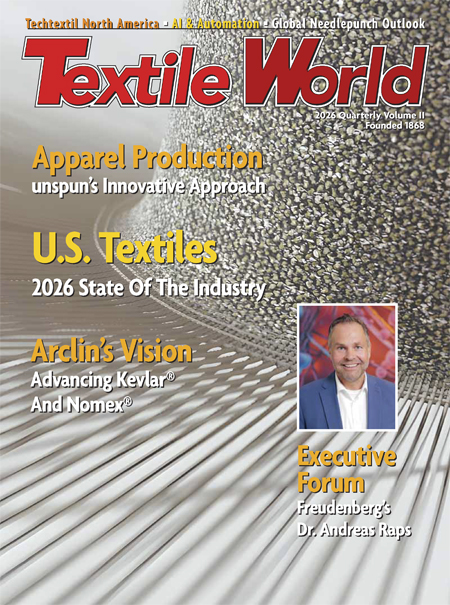
Kevin Young, Web Industries’ vice president of corporate development, shares his views on textiles and nonwovens from the perspective of a converter serving the aerospace, medical, personal/homecare and industrial markets.
TW Special Report
In 1969, with $10,000 and the support of family and friends, Bob Fulton founded Web Industries Inc. as a slitting company. At the heart of Fulton’s firm was the strong belief that a good business is built on sincere, solid relationships with clients. This belief still drives Web Industries today. In 2000, Web became an employee-owned company (an ESOP), providing the associates with an ownership interest in the company and focusing their dedication to the success of Web.
After building the client base to 800 customers in a wide range of industries, the company reimagined itself and its business. In 2008, under the leadership of then COO Mark Pihl, who today is president and CEO, Web refined its business strategy to focus on four key markets: aerospace, medical, personal/homecare and industrial. Today, the Marlborough, Mass.-based company applies its problem-solving mentality to serving a core client base of approximately 200 customers across these industries. In each market, Web has developed a longstanding reputation for precision, quality and problem solving.
A Link Between Textiles And Technical Applications
For the traditional textile manufacturer, the activities Web undertakes to supply products in to the manufacturing supply chain may not be common knowledge. Within the traditional textile industry, converters are known for buying fabrics from mills to sell to garment manufacturers or clients in apparel sourcing. This is not the case at Web.
The company has a very sophisticated focus on precision converting and outsource manufacturing. Web specializes in slitting flexible materials, leveraging more than 50 slitting lines. Other services include:
spooling and traverse winding;
ply cutting and kitting — where kitting is the process of gathering the various layers of formatted materials into one package to supply the composite manufacturer with the precise package of materials necessary to manufacture a part;
composite formatting — using various cutting and slitting techniques to convert roll goods into precise forms or shapes that will be used by the fabricator to manufacture a composite part;
material management; and
material testing/qualification.
Each service is performed to exacting customer specifications. In the company’s own words, “…utilizing the widest array of slitting, spooling, winding, and ply formatting configurations, Web formats composites, nonwovens, specialty films, papers, foils, laminates, and foams and delivers converted materials on custom-designed spools, planetary rolls, planetary pads, and ply kits for efficient, cost-effective downstream manufacturing.”
Textile World recently had the opportunity to speak with Web Industries’ Kevin Young, who was appointed vice president of corporate development in August 2016. He has been a member of Web’s board of directors since 2014 and retains his board seat as a management representative. Young reports directly to Pihl.
TW: Thank you for your time, particularly given the significant recent acquisition. But before we get to that, please give the readers a sense of the size and scope of Web today.
Kevin Young: Since our humble beginnings, we’ve expanded dramatically. Today we have nine operating plants — six in the United States and three in Europe including our recent acquisition of OMEGA Systèmes, in France. Web has more than 700 employees, with 500 in the United States and 200 in Europe.
TW: How significant was refocusing on four key vertical markets to the success Web is realizing today?
Young: It was probably the single most significant activity that Web has undertaken. Our employees are exceptionally clear on the type of work that we do, the customers we serve and where our research and development efforts are channeled. By focusing on our four vertical market segments, we’ve grown the business significantly while streamlining the number of customers we work with.
TW: Please explain Web’s activities in the aerospace, medical, personal/homecare and industrial markets.
Young: In aerospace, we are the world’s largest independent converter/formatter of composite materials. We enable our customers, the major OEMs and Tier 1 suppliers/aerostructure fabricators, to concentrate on their core competencies while we provide vendor-managed inventory services and deliver products in the exact format that they need it — when they need it. We’re not limited to supplying materials to the commercial aerospace market. We also are very active in defense and space markets, formatting materials that go into missiles, satellites, rockets, helicopters and fighter jets.
In the medical market, our focus is on outsourced manufacturing, specifically for the lateral flow immunology market. We play a key role in producing over 1 billion diagnostic test strips annually for some of the largest OEMs involved in diabetes testing devices and medical lab testing kits. Additionally, we’ve developed a process for invitro diagnostics that uses a continuous web of laminated flexible materials as opposed to the industry norm of discrete manufacturing. This provides cost advantages for our customers by leveraging manufacturing efficiencies.
In personal and home care — which encompasses diapers, adult incontinence and feminine hygiene products — we provide comprehensive material-converting services under one roof, from multicolor printing to precision slitting and large-format spooling. To our knowledge, we’re the only company that can do so. This approach is necessary to meet the needs of fast-moving consumer goods companies. They are always looking for new efficiencies that enable them to respond quickly to their customers’ demands and deliver their product to market faster.
With respect to the industrial market, we leverage our core competencies of slitting and spooling in a number of sectors. Within the wire and cable market, for example, we have developed unique shielding products that cut down on alien crosstalk and dissipate heat as information flows through today’s high-speed cables. We also provide multi-layer insulation to customers involved in making satellites, MRI machines, liquefied natural gas tanks and other products. It insulates their components from severe elements, such as freezing conditions or extreme heat. For example, on a satellite, the insulation keeps the inside of the satellite warm in space, but also protects it from heat when it passes through the atmosphere.
TW: It is fairly apparent that Web’s market selections are no accident. Please discuss the growth and trajectories of these markets.
Young: Fortunately for us, we’ve picked well, but that doesn’t mean the markets all grow at the same rate or at the same time. In general, we work in markets that have demonstrated strong growth over recent years. We see positive growth in all of our market segments because of some megatrends that are happening in the world today. For example, one of the factors driving growth in aerospace is the demand for low-cost travel worldwide. The number of new, more efficient passenger planes coming online is significant, and the light-weighting of this latest generation of aircraft plays exceptionally well into our composite formatting strategy.
Within the personal and home care division, our customers are responding to consumers’ busy, on-the-go lifestyles and finding innovative ways to help consumers simplify and make life easier. Products such as disposable diapers help people do this. The aging population also contributes to growth in adult incontinence products.
When it comes to the wire and cable business, as we like to say: In the wireless world, there’s more wire being used in data centers than ever before. As global wireless coverage continues to be built out at a rapid pace, our products help enable the transmission of that data. Each industrial market has its own drivers. We benefit from being able to leverage our technologies from our core markets into our industrial market segments.
In the medical market, we see a real opportunity as a contract manufacturing organization (CMO). We hear daily on the news that healthcare costs are skyrocketing, and there is a clear demand to reduce those costs. Web offers medical and life science companies a level of precision, quality and scale that no other non-competing CMO can offer. By specializing in high-tech commercialization and manufacturing solutions for lateral flow immunoassay (LFI) devices and medical diagnostics, we offer cost-effective solutions for our customers and their end users. By the time a medical product has been designed, about 10 percent of the total product budget has been spent. At that point, the design has already determined 80 percent of the product’s final cost. Those economics make it crucial to partner with the right CMO early in the process to control costs downstream and deliver a cost-effective, but cost-conscious product.
TW: Please provide some insight into the processes used by Web. What refinement, investment and even invention over the years have set Web apart?
Young: Web’s focus has always been on the precision formatting of flexible materials. Our customers need specific flexible materials to be formatted to suit their production process, and we have numerous converting capabilities to do that. If we don’t have the right capability already, we will use our ingenuity to create a solution to meet our customer’s needs. Ingenuity is one of our greatest differentiating qualities, and when we develop a new machine or process, we protect that intellectual property fiercely.
Web Industries offers customized formatting services, such as for thermoplastic slit tape pads, that are customized for the end user’s manufacturing processes.
TW: You must attract many talented employees. How do Web employees impact your strategy going forward?
Young: One of the principal reasons that our founder, the late Bob Fulton, sold the company to the employees was that he realized they were the reason for his success. We still believe that today. We’re an employee-owned company, and our success is a function of the quality of the people we attract. To provide the ingenuity and solutions our customers expect, we have focused greatly on expanding our engineering and technical talent. More than 15 percent of our workforce has a technical background, allowing us to provide exceptional service to our customers and solve the complex problems that they bring to us.
TW: Can you speak about recent investments and how they fit into the future of Web industries?
Young: We continue to look at our four vertical market segments for growth and to invest in each of them. Our most recent acquisition of OMEGA Systèmes in France is a great example of our commitment to aerospace. Our customers asked if we could provide the same level of independent capabilities and quality in Europe that we provide to our North American customers. We realized we needed a physical presence in Europe, and now OMEGA Systèmes allows us to provide consistent products on a global basis. At the same time, we have gained some new capabilities that we will be able to bring back to the North American market. In recent years we also have made significant investments in our personal and home care division to meet the needs of fast-moving consumer goods companies. For example, we expanded our Fort Wayne, Ind., operation by 50,000 square feet in the past year, including the addition of two eight-color flexographic presses and what we believe to be the most advanced large-format spooler in the industry. And in our medical division, we created a new center of excellence for medical contract manufacturing to develop and implement high-tech commercialization and manufacturing solutions for LFI devices and other medical diagnostics.
TW: In pursuing new business, building strong client relationships and meeting demanding product performance, what do you see as key to Web’s success?
Young: Our customers bring us their most difficult problems. We may not always have the answers, but we love a challenge. We’ll sit down with those customers and help them think through the problems, the constraints and possible solutions. Very often, and we know this from the surveys we’ve conducted, they tell us that we come up with ingenious answers. That’s the key to our success.
March/April 2019
Editor’s note: Alien crosstalk is a problem that can occur when there are multiple wires bundled within a single cable. Without shielding tapes on the wire, information flowing from one wire could jump across to another, causing noise or interference in the data communication.
Barcelona, the sophisticated capital of Spain’s Catalonia region known for its art and architecture, forms the backdrop for the 18th edition of ITMA.
TW Special Report
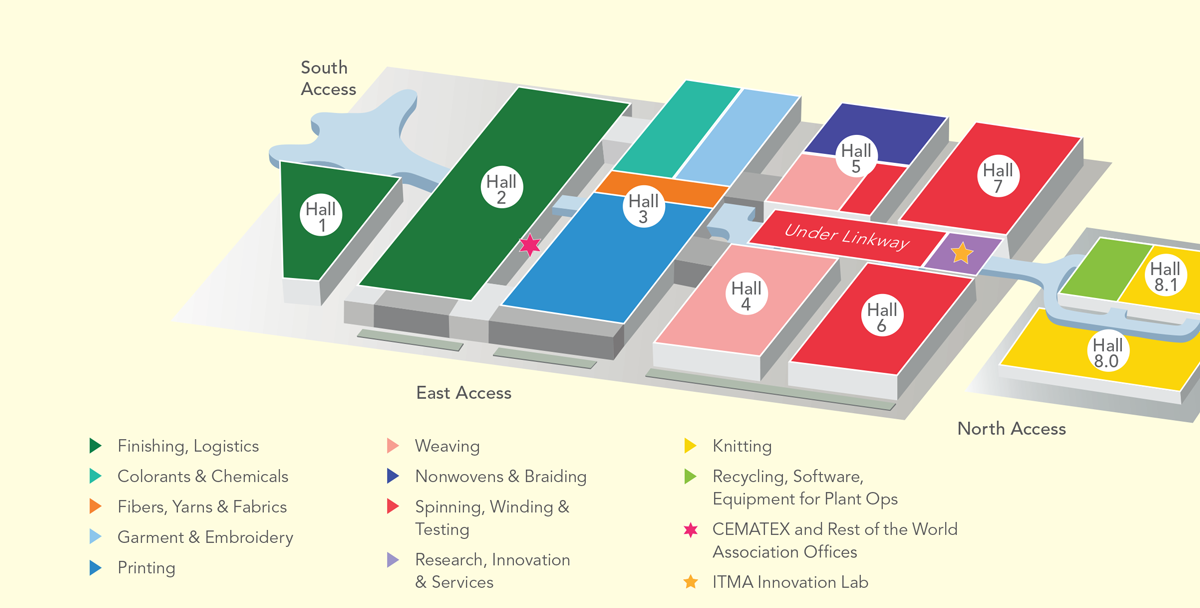
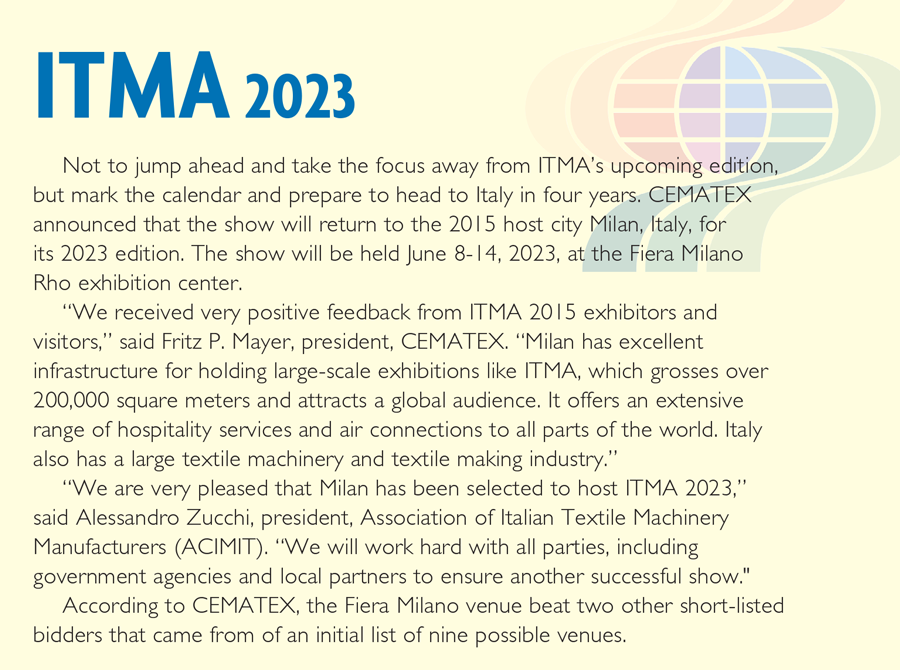
To be held June 20-26, at the Fira de Barcelona Gran Via, Barcelona, Spain, ITMA 2019 is now just a few short months away! The quadrennial textile trade show, owned by the European Committee of Textile Machinery Manufacturers (CEMATEX) and organized by Brussels-based ITMA Services, is always a highlight on the textile trade show calendar. ITMA rules for exhibitors state that companies may show only “newly manufactured products” guaranteeing the latest-generation machinery and innovative technologies will be on display to visitors.
As of Textile World’s press time, more than 1,600 companies from 46 countries have registered to participate in ITMA 2019. The show will occupy all halls of the Fira de Barcelona Gran Via venue filling the gross exhibition area of 240,000 square meters. Organizers also predict some 120,000 visitors from 147 countries.
As is usual with the show, the largest number of exhibitors come from European countries, with CEMATEX countries accounting for approximately 65 percent of all exhibiting companies. Italy represents the largest contingent, followed by Germany and Spain. Outside of Europe, companies from Turkey, India and China occupy the top spots in terms of total floor space reserved.
Viewed by sector, finishing exhibitors account for 25 percent of all exhibits in terms of space, followed by spinning with 14 percent, printing and weaving with 12 percent each, and knitting exhibitors with 11 percent.
“ITMA has been a very important international exhibition for us, especially as a platform to launch our brand-new machines with unique technologies,” said Daisuke Murata, president and CEO, Murata Machinery, a company that will exhibit in the spinning sector. “A bigger showcase with more exhibitors, including new companies at ITMA, will attract higher interest and appeal to a wider audience. There will also be greater opportunities for collaborations within the industry.”
Exhibitor categories showing the largest growth include the garment making, and printing and inks sectors. Garment making counts a number of first-time exhibitors eager to demonstrate their robotic, vision system and artificial intelligence solutions; and the number of exhibitors showcasing their technologies in the printing and inks sector has grown 30 percent since ITMA 2015.
“Innovation is vital for the industry’s success as Industry 4.0 gains momentum in the manufacturing world,” said Fritz Mayer, CEMATEX president. “The shift towards open innovation has resulted in increased exchange of knowledge and new types of cooperation among education institutions, research organizations and business. ITMA has been a catalyst and showcase of ground-breaking innovation since 1951. We hope participants will be able to share new developments, discuss industry trends and spur creative efforts, thus ensuring a vibrant innovation culture in a global context.”
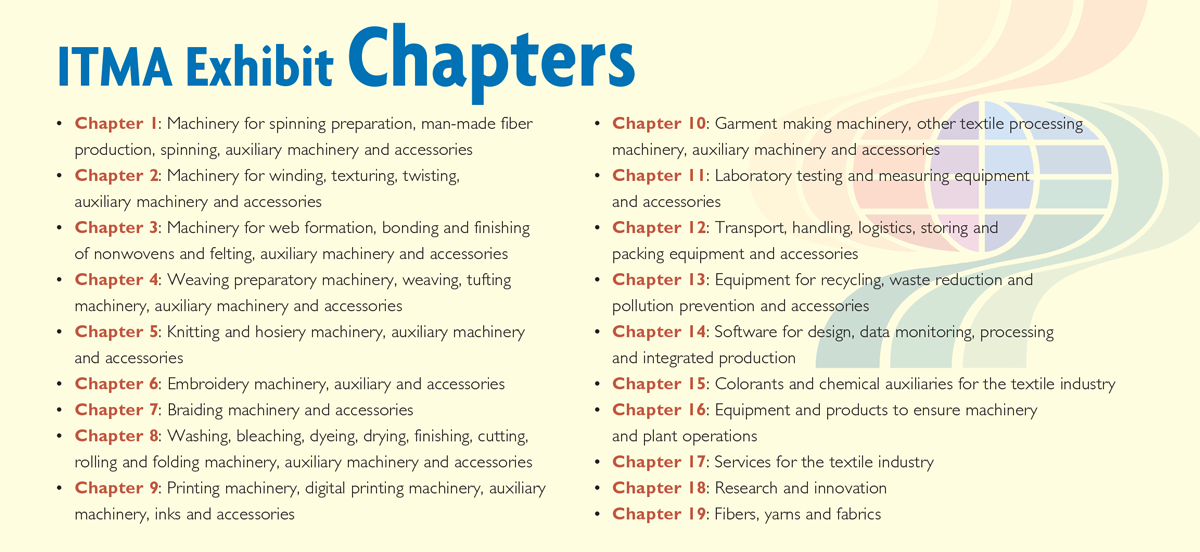
All exhibits at ITMA 2019 will be indexed into 19 categories called chapters (see Table 1).
What’s New?
The Innovation Lab recently was launched for the 2019 edition of ITMA to emphasize the innovation theme. The Innovation Lab concept features:
A Research and Innovation (R&I) Pavilion showcasing the research and development work of 27 participating organizations to encourage collaboration between industry and academia;
ITMA Speakers Platform where participating R&I institutes can present research projects and developments;
Innovation Video Showcase featuring selected videos about the exhibits to be shown at the Speakers Platform;
ITMA Sustainable Innovation Award, which was created in 2015 to “recognize the collaborative efforts by the global textile industry to advance business sustainability through innovative solutions, and promote outstanding industry related research” in two categories — Industry Excellence and Research & Innovation Excellence.
“By launching the ITMA Innovation Lab feature, we hope to better drive industry focus on the important message of technological innovation and cultivate an inventive spirit,” said Charles Beauduin, chairman of ITMA Services. “We hope to encourage greater participation by introducing new components, such as the video showcase to highlight our exhibitors’ innovation.”
The official ITMA 2019 app also is new for 2019. The app, which may be downloaded free of charge from the Apple App Store or Google Play, offers key information on the exhibition to help attendees plan their visit. Maps and searchable exhibitor lists, as well as general show information are all available in the app.
“As ITMA is a huge exhibition, the app will be a useful tool to help exhibitors and visitors maximize their time and resources on site,” said Sylvia Phua, managing director of ITMA Services “An appointment scheduler will allow visitors to request meetings with exhibitors before they arrive at the show. The scheduler and online floorplan will be available from late April 2019.”
Knowledge-Sharing, Learning Events
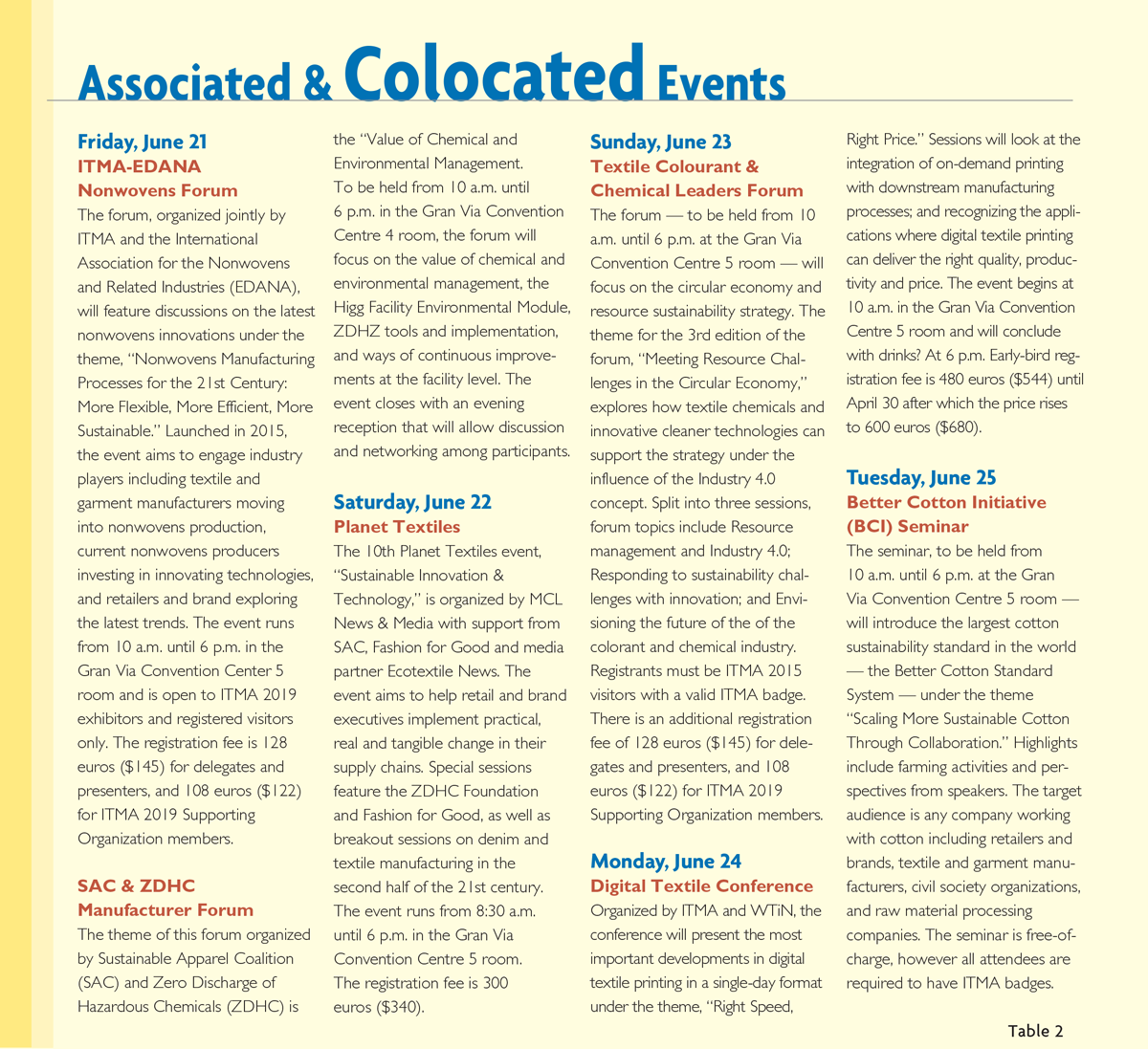
ITMA will again complement the exhibition show floor with collocated seminars and conferences (See Table 2 for a full list of events). “As technological developments are happening at breakneck speed, and collaboration is becoming increasingly necessary in a globalized economy, the industry has to stay abreast of the latest developments and trends,” said Fritz P. Mayer, president, CEMATEX. “Hence, ITMA will be staging several forums to help participants be ahead of the competition curve. The forums also offer a valuable platform for various associations and professionals to connect and network with the right players. This is especially important as collaboration and partnerships from research institutions to technology, chemical and raw material providers and users are increasingly more critical to business success.”
The educational program features two main conferences — the ITMA-EDANA Nonwovens Forum, and the Textile Colourant and Chemical Leaders Forum.
Nonwovens are an ever-increasingly important part of the global textile industry. The ITMA-EDANA Nonwovens Forum — jointly organized by ITMA and EDANA, the international association serving the nonwoven and related industries — was introduced at ITMA 2015. The theme for this year’s forum, held all day on June 21, is “Nonwovens Manufacturing Processes for the 21st Century: More Flexible, More Efficient, More Sustainable.”
“The nonwovens industry is a bright spark in the textile world,” said Pierre Wiertz, EDANA’s general manager. “We are glad to be able to collaborate with ITMA to bring these exciting opportunities to visitors who are involved in or have the intention to move into nonwovens manufacturing.”
The forum will be broken into three sessions:
Circular economy/challenges and opportunities for processing biobased and recycled materials on nonwovens machinery;
Latest trends and innovation in nonwoven processes — including hybrids and composites; and
Innovations in nonwovens technology.
The event also will host a panel discussion featuring experts from the nonwovens sector on their views of nonwovens processes in the 2030s.
The third Textile Colourant and Chemical Leaders Forum on June 23 is geared to dyestuff, color and chemical professionals. The event, titled “Meeting Resource Challenges in the Circular Economy,” will explore “how textile chemicals and innovative and cleaner technologies can help create a more sustainable future for the textile and garment industry,” according to the organizers.
The event is organized into three sessions:
Resource management and Industry 4.0;
Responding to sustainability challenges with innovation; and
Envisioning the future of the colorant and chemical industry.
“The forum has been an eagerly-awaited event at each ITMA edition as it is an inclusive industry platform that takes in perspectives from all stakeholders of the textile and garment supply chain,” said Andrew Filarowski, technical director, Society of Dyers and Colourists, and forum chair. “Organized by the industry, it allows like-minded industry players to exchange knowledge on the latest innovations and solutions, understand current issues and trends in a global context.”
Show Details
Organizers are offering an early-bird registration discount. Anyone who registers online before May 15, 2019, may purchase a one-day pass for 40 euros ($45) or a seven-day badge for 80 euros ($90). The online rate then rises to 55 euros ($62) and 95 euros ($107) respectively. Onsite, registration will cost 85 euros ($96) for a one-day pass, and 125 euros ($140) for the seven-day badge. Attendees may also purchase conference and forum passes online, as well as request an invitation letter for a visa while ordering a badge.
Show hours are from 10 a.m. until 6 p.m. June 20-25, and from 10 a.m. until 4 p.m. on June 26.
Book a hotel, buy a badge, download the official ITMA 2019 app, and join the large gathering of textile industry personnel in Barcelona this summer.
The Textile Industries Media Group will be at ITMA, and attendees are invited to stop by Hall UL, Booth B208 to pick up complimentary copies of Textile World and Textiles Panamericanos.
For more information about ITMA 2019, please visit itma.com. For more information about the city of Barcelona, please visit barcelonaturisme.com.
About Barcelona
Located on Spain’s northeast Mediterranean coast, Barcelona is capital of the autonomous community of Catalonia, and — with a population of more than 1.7 million people in the city proper and a metropolitan area population of more than 5 million — Spain’s second-most populous city after Madrid and Europe’s largest Mediterranean coastal metropolitan area.
Textile production was an important component of industrialization in the late 18th century, and it continues to be important today — indeed, the vast majority of members of the Spanish Association of Manufacturers of Textile and Garment Machinery (AMEC AMTEX) are located in Barcelona province, and AMEC AMTEX has its headquarters in the city of Barcelona a couple of miles up the road from Fira de Barcelona. In addition, the city has attempted more recently to become a major fashion center.
The Catalan region has long fostered a strong separatist identity and today still values its regional language and culture. Although Spanish is spoken by virtually everyone in Barcelona, Catalan is understood by about 95 percent of the population and spoken by about 75 percent.
Barcelona’s Roman origins are evident in several locations within the Barri Gòtic, the historical center of the city. The Museu d’Història de la Ciutat de Barcelona provides access to excavated remains of
Barcino underneath the center of present-day Barcelona, and parts of the old Roman wall are visible in newer structures including the Gothic-era Catedral de la Seu.
The strange, fanciful buildings and structures designed by turn-of-the-century architect Antoni Gaudí, found in numerous locations around Barcelona, are major attractions for visitors to the city. Several of them together comprise a UNESCO World Heritage Site under the designation “Works of Antoni Gaudí” — including the Façade of the Nativity and the Crypt at the Basílica de la Sagrada Família, Parque Güell, Palacio Güell, Casa Milà, Casa Batlló and Casa Vicens. The site also includes the Crypt at the
Colònia Güell, an industrial estate established in nearby Santa Coloma de Cervelló by Eusebi Güell, a textile business owner who moved his manufacturing business there from the Barcelona area in 1890, setting up a state-of-the-art vertical textile operation and providing living quarters and cultural and religious amenities for the workers. The mill closed in 1973.
Barcelona’s Museu del Disseny comprises four museums: Museu de les Arts Decoratives; Museu Tèxtil i d’Indumentària; Gabinet de les Arts Grafiques; and Casa Bloc Apartment Museum. Photo courtesy of Kippelboy/es.wikipedia.org
Barcelona was also home at one time or another to 20th-century artists Joan Miró, a lifelong resident, as well as Pablo Picasso and Salvador Dalí. There are museums devoted to the works of Miró and Picasso, and the Reial Cercle Artístic de Barcelona houses a private collection of works by Dalí.
The Museu Nacional d’Art de Catalunya, located in the Parc de Montjuïc near Fira de Barcelona, has a major collection of Romanesque art and other collections of Catalan art spanning the ages.
Barcelona also has a textile museum, the Museu Tèxtil i d’Indumentària, which offers a collection of garments dating from the 16th century to the present; Coptic, Hispano-Arab, Gothic and Renaissance fabrics; and collections of embroidery, lacework and printed fabrics.
Those wanting to get a taste of life in Barcelona may want to join the locals in the evening for a stroll through the streets of the city, and sample the local cuisine and nightlife. Just remember that dinner is served late — restaurants generally serve between 9 and 11 p.m. — and partying goes on very late into the night.
There are several options for getting around Barcelona. Public transportation services include a metro with nine lines, buses, both modern and historic tram lines, funiculars and aerial cable cars.
Things To Do In Barcelona In June
Barcelona is known for its summer time street parties and district festivals, and June 2019 has a lot to offer visitors.
One of Spain’s largest outdoor parties takes place June 23. Known by many names including the Sant Joan’s Night, Revetlla de Sant Joan and Night of Fire, the event roughly coincides with the Summer Solstice and celebrates the start of summer. The event likely has pagan origins with fire and renewal playing an important role. At midnight on June 22, a flame — which is kept burning all year round at a museum in Perpignan — is carried to the top of Mount Canigó to start a fire. This fire is shared with torches that are carried in relay to towns throughout the area. On June 23, the flame arrives in Barcelona’s Placa de Sant Jaume, where it is met by traditional festival figures before it is shared and taken to neighborhoods and boroughs around the city to light bonfires.
The celebrations are embraced all over the city throughout the day with community dinners, concerts, fire-running processions and dances. Cava and a specialty flatbread called coca de Sant Joan are enjoyed during the festivities. However, many people head to La Barceloneta Beach to celebrate in the evening— with picnics, fireworks, bonfires and music — for an event that often lasts until dawn. Not surprisingly, the following day is a public holiday in Barcelona.
A series of free, outdoor concerts runs through the summer months in Barcelona at a variety of parks. The Música als Parcs features Jazz music in June on Wednesdays and Fridays.
Gaudí’s church of the Colònia Güell, which was never completed, was declared a UNESCO World Heritage Site in July 2005. Photo courtesy of Maria Rosa Ferre/flickr.com
Gaudí’s Casa Batlló hosts open-air concerts on the roof terrace in its “Magic Nights” event at the infamous Barcelona landmark. Tickets must be purchased in advance for this special one-hour event. Admission includes two drinks; live music from a variety of genres including pop, rock, jazz and flamenco; and a SmartGuide augmented reality video guide to learn more about Gaudí. Visit casabatllo.es/en/online-tickets/visit-magic-nights/ to learn more.
Now in its seventh year, the Jardins Pedralbes Festival is a series of outdoor concerts held in the gardens of the Pedralbes Palace June 5 through July 15. Concert goers are invited to arrive early to wander the gardens, which features two works by Gaudí — a parabolic pergola and Hercules fountain. The auditorium, which seats 2,000, is set up opposite the façade of the palace. The diverse 2019 concert series is packed with stars including Mariah Carey, The Gypsy Kings, Kraftwerk and Il Divo. For more information, visit festivalpedralbes.com/en/.
The Festa Major del Casc Antic — or festival of the Old Town — begins June 21. During this celebration, some of Barcelona’s oldest neighborhoods — Sant Pere, Santa Caterina and La Ribera — host communal activities for people of all ages including traditional dances and street performances, and huge meals featuring botifarra sausage barbecues and vermouth sessions.
And for the motor sports enthusiast, the Monster Energy Catalonia Grand Prix motorcycle race is not to be missed June 14-16. This MotoGP World Championship race covers 25 laps, and it is a popular event because of the level of local success in the sport.
Pack for warm weather and sun in Barcelona. The average high temperature for June is 77°F.
For more information on things to do in Barcelona this summer and to learn more about the city, visit barcelonaturisme.com.
COLOMBES, France — March 25, 2019 — Arkema has successfully started up a Kepstan® polyetherketoneketone (PEKK)plant at its site near Mobile (Alabama – United States). Inaugurated today, this investment is a new step in Arkema’s ambitious growth strategy in high-performance polymers and advanced materials, the development of which is supported by the Group’s cutting-edge technologies in search of solutions for sustainable development.
This investment, which complements the doubling of Kepstan PEKK resin capacities in France in 2017, supports the strong demand for carbon fiber reinforced composites and 3D printing.
It confirms Arkema’s wish to strengthen its offering of advanced materials in the most demanding markets such as aeronautics, oil and gas, electronics and automotive, and the Group’s commitment to lightweight materials, which is one of its six innovation platforms for sustainable development.
The Kepstan PEKK resins range features excellent mechanical, chemical, fire and abrasion resistance. These resins also accommodate a wide range of processing technologies, particularly in the field of 3D printing where they are uniquely suited for powder sintering and filament extrusion processes.
Parts made of Kepstan reinforced carbon fiber PEKK, replacing metal for structural parts of future generations of aircraft, will provide lightweight materials including faster production cycles in the aeronautics and defense sectors.
“This new capacity, which has been brought on line on schedule, will enable our customers and their customers to better meet the future demand for ever more efficient materials. We thank our customers, our partners and the users who have trusted us and very early on selected Kepstan PEKK in their respective markets” said Christophe André, executive vice president, Advanced Materials for Arkema.
Located in Axis, Ala., the Mobile site, which will produce PEKK Kepstan resins, also manufactures plastics additives.