Brooks Sports Protecting Its Brand And Trademarks

SEATTLE — February 11, 2020 — Brooks Sports Inc. — a footwear, apparel and accessories company headquartered in Seattle — filed a lawsuit against Brooks Brothers Group Inc. in federal court for breach of contract, unfair competition and trademark infringement.

The lawsuit seeks to stop Brooks Brothers from using Brooks’ famous BROOKS trademark on its stores and products and prevent public confusion and dilution of the BROOKS mark by Brooks Brothers. Brooks also seeks damages for Brooks Brothers’ unfair competition and breach of contract.

The two companies have coexisted for more than 100 years without consumer confusion due to their distinct product lines and trademarks. Brooks is known for athletic-inspired innovative footwear, apparel and accessories under its famous BROOKS mark while Brooks Brothers makes ready-to-wear fashion apparel and tailored business and formal wear under its BROOKS BROTHERS mark. To support this distinction, there is a coexistence trademark agreement between Brooks and Brooks Brothers dating back to 1980.

Brooks Brothers recently attempted to block Brooks from obtaining registrations for its BROOKS trademark in the United States and other countries, despite decades of unopposed use. Additionally, on December 30, 2019, Brooks Brothers filed new trademark applications to use BROOKS alone, without the word BROTHERS, on eight categories of goods, including clothing, sporting goods and accessories for athletics. Brooks Brothers is also marketing “athletic” footwear and “sneakers,” which are among the items on which Brooks Brothers seeks to use the BROOKS trademarks.

“For more than 100 years we’ve built a brand that consumers worldwide recognize and trust,” said Jim Weber, Brooks CEO. “We will aggressively protect our intellectual property and defend the investment that’s created our valuable brand.”

In a time when more than 150 million people worldwide are running, Brooks has become a household name to consumers interested in an active lifestyle. Brooks’ customers range from novice to elite runners as well as consumers who may not run but choose Brooks product for quality, support and brand affinity.

Posted February 11, 2020

Source: Brooks Sports Inc.

Commercial Flooring Company Interface Introduces NY+LON Streets

ATLANTA — February 11, 2020 — Interface®, a worldwide commercial flooring company and global leader in sustainability, today unveils its latest carpet tile collection, NY+LON Streets™. The playful carpet collection uses fresh textures and patterns to encourage a new perspective on urban exploration.

The collection takes inspiration from two of the world’s most iconic cities, New York City and London, as well as one of the carpet tile’s core materials — nylon. The playful designs strive to create spaces that become their own community hubs – cities within cities. NY+LON Streets explores the effects of aging architecture, technological advancement, and sustainable design — through pattern, texture, and aesthetic — and brings these qualities to commercial interiors, specifically corporate offices.

To create the collection, David Oakey, founder of David Oakey Designs and product designer exclusive to Interface, focused on the trend of old becoming new again, a design approach that involves renovating older structures and adapting them for use as office or hospitality spaces. These repurposed buildings frequently showcase rustic aesthetics juxtaposed with contemporary elements and can have a lower carbon impact than new construction projects.

“The inspiration for this collection came to me while standing on the street in London when I noticed the anti-slip surface on the sidewalk. The diversity and randomness of the repeating squares within the pattern lend themselves well to flooring design, especially carpet tile, and became the basis of the entire collection,” explained Oakey. “To round out the collection, we shifted our focus to New York City with the beautiful, iridescent colors found in glass vault lights as well as the distressed metal plates peppered throughout the city’s streets and sidewalks.”

The Intersection of Contemporary and Industrial
In today’s increasingly tech-connected world, people crave human connection in spaces that feel both comfortable and flexible. With a variety of patterns and textures, NY+LON Streets takes inspiration from details found in busy cities, such as subway grates, to create the collection’s six carpet tile products in eight colorways.

Wheler Street™, Old Street™, Dover Street™ and Reade Street™ interpret familiar urban textures, such as asphalt, worn metal, and distressed pavement, in a variety of scales. Mercer Street™ embraces an unconventional grid pattern that Broome Street™ punches up with contemporary color. Altogether the collection brings new meaning to the phrase, “take to the streets.”

“NY+LON Streets features designs that are simple to start but can build on one another to create unique patterns that mimic a space within a space, mixing textures and colors together,” notes Oakey. “The collection offers many different combinations, from an organic, transitional feel that brings together the colorful and the neutral, to bold looks that use contrasting colors and unique designs.”

As part of Interface’s flooring system, architects, designers and other specifiers can easily and efficiently pair the collection’s 50cm x 50cm carpet tiles with Interface luxury vinyl tile (LVT) and nora® rubber flooring to achieve integrated flooring. And, like all Interface flooring products, each style in NY+LON Streets is carbon neutral through the Carbon Neutral Floors™ program.

Posted February 11, 2020

Source: Interface Inc.

Performance BioFilaments Reaches New Milestone In Nanofibrillated Cellulose Commercial Production

VANCOUVER — February 10, 2020 — Performance BioFilaments Inc. is pleased to announce the availability of high performance nanofibrillated cellulose (NFC) starting in 2021.

The construction of a 21 metric tons per day plant, located at Resolute’s Kénogami paper mill in Quebec, will ensure a reliable commercial supply of NFC. This wood-derived biomaterial can significantly enhance the strength and durability of a wide range of products, as well as lower an end product’s overall carbon footprint through weight reduction and substitution of non-renewable components.

The input material for NFC is market pulp, which is made from sustainably harvested wood fiber, a completely renewable resource. The market pulp is third-party certified to one or more of three internationally recognized chain of custody (CoC) standards. NFC is produced mechanically using a proprietary processing technology, without the use of chemicals or enzymes.

Performance BioFilaments, a joint venture established in 2014 between Resolute Forest Products and Mercer International, is dedicated to the technical and market development of new and novel applications for nanofibrillated cellulose.

“We are pleased to have reached this exciting phase of the commercial process for NFC,” said Gurminder Minhas, managing director of Performance BioFilaments. “NFC and cellulose filaments (CF) have a host of possible applications. The chemical-free refining process results in fibrils of exceptional strength and purity, with an extraordinarily high aspect ratio and surface area not obtainable through currently applied processes.  We look forward to working with Resolute on bringing this high-potential biomaterial to global markets.”

Performance BioFilaments will continue to maintain adequate supply of pilot scale quantities until the new plant is fully operational. This material is currently available for development purposes and initial field trials.

Performance BioFilaments recently launched a new website, www.performancebiofilaments.com. The site details the features and benefits of NFC in four key areas of application: strengthening concretes, mortars and cements; enhancing rheology of coatings and industrial fluids; strengthening nonwovens, filter media and construction materials; and reinforcing polymers, composites and foams.

Posted February 10, 2020

Source: Performance BioFilaments Inc.

Aurora Specialty Textiles Group’s President Marcia Ayala To Speak At IFAI’s Women In Textiles Summit

Ayala

YORKVILLE, Ill. — February 10, 2020 — Marcia Ayala, president of Aurora Specialty Textiles Group Inc., has been selected as a panelist to speak at the International Fabrics Association International (IFAI) Women in Textiles Summit 2020, February 19-21, 2020, in Nashville, Tenn .

IFAI’s Women in Textiles Summit is a networking and educational forum for both men and women in the textile industry and explores how women are contributing to the success of their organizations and the evolution of the industry at large.

Ayala is an engineer and textile manufacturing executive with experience in fields as diverse as nuclear energy, carbon materials, coatings and textiles. She was originally hired by Aurora Specialty Textiles Group as Director of R&D and in the 14 years since has been promoted several times — most recently to company president. In that role she now leads one of North America’s major textile coaters and finishers.

She will speak Friday, Feb. 21 on a panel titled “The Next Generation: Attract, Mentor and Develop Future Leaders.” The panel discussion will focus on recruiting future leaders, navigating career paths and mentoring to build the next generation of leaders in the textile industry.

Through her various roles at Aurora, Ayala has supported several programs that encourage today’s college students to pursue manufacturing careers. She also sits on the Board of Directors of the Valley Industrial Association, the industry association that supports the manufacturing industry in Northern Illinois, including greater Chicago.

“I am very excited to be included on a panel with so many talented women in our field and to have the opportunity to share my own experiences with others,” said Ayala. “I’m also looking forward to the networking opportunities at the Summit and the chance to learn from others.”

Additional information on the Summit and the speakers is available on the IFAI Women in Textiles website.

Posted February 10, 2020

Source: Aurora Specialty Textiles Group Inc.

BSN SPORTS Acquires Strategic Assets From Riddell’s Kollege Town Division

DALLAS — February 10, 2020 — BSN SPORTS — a direct marketer and distributor of sporting goods to the school and league markets, and a division of Varsity Brands — today announced that it has acquired certain assets from Riddell’s Kollege Town division, including approximately 50 sales representatives, sales management and customer service professionals, and Kollege Town’s fanaKTive graphic capabilities.

Terry Babilla, BSN SPORTS’ president, said: “We have admired the Kollege Town team for many years, and share their commitment to providing customers with the broadest array of high-quality products paired with innovative programs that maximize team budgets.  The combination of our two organizations also adds to BSN SPORTS’ presence in key Midwest markets — including the addition of more than 50 committed and passionate sales professionals to our platform. We look forward to their contributions and to ensuring that Kollege Town’s customers recognize tangible and positive impacts from the combination of our two great companies.”

Babilla concluded: “With the addition of Kollege Town, BSN SPORTS continues to build upon our successful growth trajectory with more than 380 sales professionals added in the last twelve months, including valuable teammates in Florida, Utah, Missouri, South Carolina, New York, Washington, Illinois, Michigan, Wisconsin, Colorado, Iowa, Texas, Alabama, Georgia, and Pennsylvania. We will continue to seek out partners that share our mission and have a passion for building lifelong customer relationships.”

Posted February 10, 2020

Source: BSN SPORTS

TMAS Members ACG Kinna And ACG Nyström Have Teamed Up With Sewing Machine Juki Corporation In The Development Of A New Automated Concept For The Production Of Finished Filter Bags

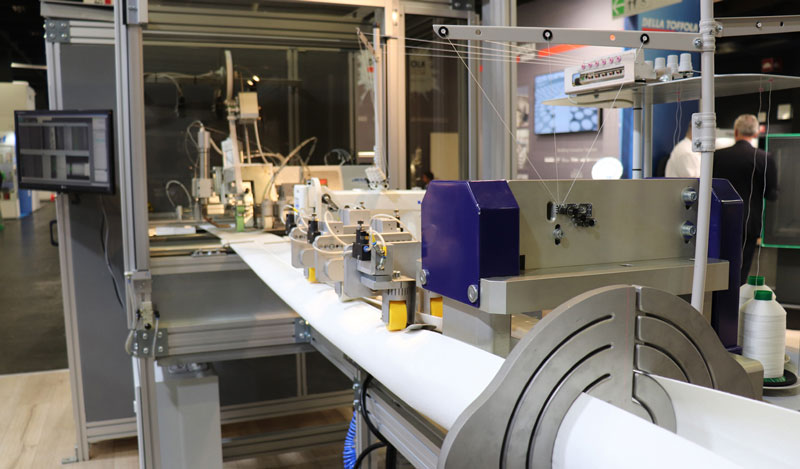
STOCKHOLM — February 10, 2020 — In the latest technology innovation from members of the Swedish textile machinery association, TMAS, ACG Kinna and ACG Nyström have teamed up with sewing machine manufacturer Juki Corp. in the development of a new automated line concept that can considerably speed up the production of finished filter bags.

Woven or nonwoven filter bags employed in a wide range of industrial processes may be under the radar as products, but they represent a pretty significant percentage of technical textiles production.

According to a recent report from BCC research, a leading US analyst covering this sector, industrial filtration represented a $555 million market in 2019 and some of the key areas where such filter bags are employed include:

Metal fabrication, with effective filtration required for manual and automated welding, thermal cutting, blasting and machining, especially for coolant filtration.

The process and energy industries, including foundries, smelters, incinerators, asphalt works and energy production plants.

Other key manufacturing fields — often where dust is generated — including the production of timber, textiles, composites, waste handling and minerals, in addition to chemicals, food production, pharmaceuticals, electronics and agriculture.

As an example of the scale of this industry and the high volumes of fabrics involved, one supplier recently received a single order for 30,000 filter bags to be used for flue gas cleaning at the Estonian Eesti Power Plant — the biggest oil shale fired power plant in the world. The bags can be anywhere up to eight meters in length and frequently have to be replaced.

Line integration

The new SFL-2000 line is the result of a four-year development project between Juki Central Europe, headquartered in Poland, and the two ACG companies.

It is capable of handling a wide range of different filter media, and as an all-in-one solution, can produce high quality and accurate seams to predefined parameters, with optional modules allowing for customized constructions.

“The line can achieve sewing speeds of ten meters a minute with all kinds of fold, overlap and stitched seam, and up to 20 meters per minute with welded bags in widths of up to a meter,” says Christian Moore, CEO at ACG Kinna. “The unique selling point is that it builds all sewing, welding and taping options into one flexible line to ensure less stops, and more importantly, quicker stops between changes of material, dimensions or joining options. This puts more money into the pockets of our customers.”

“This type of automation is the way forward, not just for filtration, but for all industries,” adds Masanori Awasaki, president of Juki Central Europe. “At Juki, our main technologies are for garment manufacturing, but we are also widely involved in the technical textiles field and this line integration concept is moving production on to the next level of efficiency.”

Joining options

The line is available in three versions — the SFL-2000S for sewn seams, the SFL-2000-W for welded alternatives and the SFL-2000WS employing both joining technologies.

The standard version of these lines has a single media roll feeder as standard, but as an option, a second can be added, with a Juki MO-6903G overlock head joining two separate materials together in continuous production, without any slow-down of the machine.

A custom prefolding system creates the tubular form of the filter bag and the overlap just prior to the Juki sewing and welding units.

“The quality control system at this point employs three cameras inspecting and steering every parameter — the bag width and the width of the overlap, as well as seam accuracy — right down to the length of each stitch,” explains Christian Moore. “Three-axis positioning of the Juki modules ensures the seams are perfectly centered for precision consistency.”

The bag is then conveyed to the cutting and printing unit.

“An inkjet printer is a further option at this stage, for the addition of QR and bar codes, and/or logos, and a buffer system of up to 1.5 metres prevents any stoppages as this is taking place, prior to cutting,” added ACG Nyström Vice-President Thomas Arvidsson.

“I continue to be surprised by the many fields of industry our TMAS members serve,” said TMAS Secretary General Therese Premler-Andersson. “The innovations from our companies during 2019 were far-ranging and characterized by an advanced grasp of Industry 4.0 automation techniques and the need for more sustainable processing methods that is being demanded by their customers. There will be much more of this to come in 2020 and beyond.”

Posted February 10, 2020

Source: TMAS (The Swedish Textile Machinery Association)

National Retail Federation: February Retail Imports to See Larger Drop Amid Coronavirus

WASHINGTON — February 10, 2020 — With coronavirus causing longer Lunar New Year shutdowns of factories in China, imports at major U.S. retail container ports are expected to see a sharper-than-usual drop this month, according to the Global Port Tracker report released today by the National Retail Federation and Hackett Associates.

“February is historically a slow month for imports because of Lunar New Year and the lull between retailers’ holiday season and summer, but this is an unusual situation,” NRF Vice President for Supply Chain and Customs Policy Jonathan Gold said. “Many Chinese factories have already stayed closed longer than usual, and we don’t know how soon they will reopen. U.S. retailers were already beginning to shift some sourcing to other countries because of the trade war, but if shutdowns continue, we could see an impact on supply chains.”

“Projecting container volume for the next year has become even more challenging with the outbreak of the coronavirus in China and its spread,” Hackett Associates Founder Ben Hackett said. “It’s questionable how soon manufacturing will return to normal, and following the extension of the Lunar New Year break all eyes are on what further decisions China will make to control the outbreak.”

U.S. ports covered by Global Port Tracker handled 1.72 million Twenty-Foot Equivalent Units in December, the latest month for which after-the-fact numbers are available. That was up 1.8 percent from November but down 12.4 percent from unusually high numbers at the end of 2018 ahead of a scheduled tariff increase that was ultimately postponed. A TEU is one 20-foot-long cargo container or its equivalent.

December’s numbers brought 2019 to a total of 21.6 million TEU, a 0.8 percent decrease from 2018 amid the ongoing trade war but still the second-highest year on record. Imports during 2018 hit a record of 21.8 million TEU, partly due to frontloading ahead of anticipated 2019 tariffs.

January was estimated at 1.82 million TEU, down 3.8 percent from January 2019. February is forecast to be down 12.9 percent year-over-year at 1.41 million TEU and March is expected to down 9.5 percent year-over-year at 1.46 million TEU. Before the coronavirus outbreak, Global Port Tracker had forecast February at 1.54 million TEU and March at 1.7 million TEU.

While the duration of the coronavirus impact remains unknown, April is currently forecast at 1.82 million TEU, up 4.5 percent year-over-year; May at 2 million TEU, up 8.3 percent, and June at 1.95 million TEU, up 8.5 percent. Those numbers would bring the first half of 2020 to 10.47 million TEU, down 0.4 percent year-over-year.

Global Port Tracker, which is produced for NRF by the consulting firm Hackett Associates, provides historical data and forecasts for the U.S. ports of Los Angeles/Long Beach, Oakland, Seattle and Tacoma on the West Coast; New York/New Jersey, Port of Virginia, Charleston, Savannah, Port Everglades, Miami and Jacksonville on the East Coast, and Houston on the Gulf Coast. The report is free to NRF retail members, and subscription information is available at NRF.com/PortTracker

Posted February 10, 2020

Source: National Retail Federation (NRF)

Pharr Closes On Sale Of High Performance Yarns Unit To Coats

MCADENVILLE, N.C. — February 10, 2020 — Pharr, a diversified provider of differentiated textile products and assorted real estate businesses, today closed the sale of Pharr High Performance to Coats Group plc (Coats) under an agreement announced in November 2019.

Last week, Pharr announced completion of the sale of its Pharr Fibers & Yarns and Phenix Flooring business units to Mannington Mills of Salem, N.J., which was also announced last November.

Coats is an industrial thread company with operations in 50 countries. With the addition of Pharr High Performance, the company will have six North Carolina manufacturing sites located in McAdenville, Kings Mountain, Marion and Hendersonville along with a corporate office in Charlotte. The company currently employs more than 18,000 and will retain Pharr’s workforce.

“We are very pleased to have reached this juncture with Coats as a partner,” said Bill Carstarphen, Pharr president and CEO. “Coats is a respected industry leader and we know the High Performance business will flourish as a part of its global operation.”

Pharr, founded in 1939, is a closely held, privately-owned company based in McAdenville. With the completion of these two transactions, Pharr will be comprised of two companies: Belmont Land & Investment Company, developer of residential and commercial real estate and hotels, and Strand Hospitality Services, which manages a portfolio of hotel properties throughout the Southeast. Pharr intends to seek investment opportunities in other businesses in the future.

“We look forward to growing our remaining businesses, maintaining a strong presence in Gaston County and continuing to invest in our community,” Carstarphen said.

Posted February 10, 2020

Source: Pharr

K-Bro Linen Systems Renews Hygienically Clean Certifications

ALEXANDRIA, Va. — February 7, 2020 — K-Bro Linen Systems Inc.’s Calgary, Alberta, laundry recently achieved recertification for Hygienically Clean Hospitality, and this location along with its Vancouver (Burnaby), British Columbia location has also passed recertification for Hygienically Clean Healthcare certification renewal. These results reflect K-Bro’s commitment to best-management practices (BMPs) in laundering as verified by on-site inspection and capability to produce hygienically clean textiles as quantified by ongoing microbial testing. Hygienically Clean is the quantified, validated standard and measure for hygienically clean textiles in North America since 2011.

The certifications confirm K-Bro’s dedication to compliance and processing textiles using BMPs as described in its quality-assurance documentation, the focal point for Hygienically Clean inspectors’ evaluation of critical control points that minimize risk. The independent, third-party inspection confirms essential evidence that:

  • Employees are properly trained and protected;
  • Managers understand legal requirements;
  • The facility is OSHA compliant; and
  • Physical plant operates effectively.

To achieve certification initially, laundries pass three rounds of outcome-based microbial testing, indicating that their processes are producing Hygienically Clean Healthcare and Hospitality textiles and diminished presence of yeast, mold and harmful bacteria. They also must pass a facility inspection. To maintain their certification, they must pass quarterly testing to ensure that as laundry conditions change, such as water quality, textile fabric composition and wash chemistry, laundered product quality is consistently maintained. Re-inspection occurs every two to three years.

This process eliminates subjectivity by focusing on outcomes and results that verify textiles cleaned in these facilities meet appropriate hygienically clean standards and BMPs for hospitals, surgery centers, medical offices, nursing homes and other medical facilities (for Hygienically Clean Healthcare) and  for hotels, bed and breakfasts and other lodging industry segments (for Hygienically Clean Hospitality). Hygienically Clean certifications acknowledge laundries’ effectiveness in protecting healthcare operations by verifying quality control procedures in linen, uniform and facility services operations related to the handling of textiles containing blood and other potentially infectious materials.

Certified laundries use processes, chemicals and BMPs acknowledged by the federal Centers for Disease Control and Prevention (CDC), Centers for Medicare and Medicaid Services, Association for the Advancement of Medical Instrumentation, American National Standards Institute and others. Introduced in 2012 and 2017, respectively, Hygienically Clean Healthcare and Hygienically Clean Hospitality brought to North America the international cleanliness standards for healthcare and hospitality linens and garments used worldwide by the Certification Association for Professional Textile Services and the European Committee for Standardization.

Objective experts in epidemiology, infection control, nursing and other healthcare professions work with Hygienically Clean launderers to ensure the certification continues to enforce the highest standards for producing clean textiles.

Based in Edmonton, Alberta, K-Bro is recognized as Canada’s largest owner-operator of laundry and linen processing facilities, with nine across the country from Victoria, British Columbia to Quebec City, Quebec. K-Bro also holds the TRSA Clean Green Certification for its practices with regard to environmental stewardship.

“Congratulations to K-Bro on their certifications,” said Joseph Ricci, TRSA president and CEO. “This achievement proves their continued commitment to infection prevention and that their laundry takes every step possible to prevent human illness.”

Posted February 7, 2020

Source: TRSA

VF Corp. Provides Update On Business Impact Of Coronavirus In China

DENVER — February 7, 2020 — In light of the coronavirus outbreak, VF Corp. is working in accordance with local government guidelines to ensure the health, safety and overall well-being of the company’s associates and partners in the communities where they live and work.

“The safety and well-being of our associates and partners in China is our highest priority. Our thoughts are with those people affected by the coronavirus,” said Steve Rendle, VF’s chairman, president and CEO. “While the coronavirus will impact our financial results in the Asia Pacific region in the near term, VF’s growth opportunity in China and across the Asia Pacific region is significant and the fundamentals of our business are strong. VF is well positioned to navigate the impact of the coronavirus situation given the diversity of our business and operating model in other key geographies.”

At this time, about 60 percent of VF’s owned and partner stores in China have been temporarily closed due to coronavirus mitigation efforts. Stores currently open have experienced significant declines in retail traffic.

In Fiscal 2019, the Asia Pacific region and mainland China represented 12 percent and 6 percent, respectively, of total VF revenue. And, while it is not possible to gauge the impact to our supply chain at this point, approximately 16 percent of VF’s total cost of goods sold is sourced directly from mainland China, of which 7 percent is bound for the US market.

The coronavirus situation in China was not contemplated at the time VF provided its adjusted fiscal 2020 outlook on January 23, 2020. We will provide an update as to the operational and financial impacts of the coronavirus during VF’s fourth quarter fiscal 2020 conference call in May 2020.

Posted February 7, 2020

Source: VF Corp.

Sponsors