
McDonald’s Restaurants In Brazil Are Serving Up A New Sustainable Food Tray 

SÃO PAULO — January 25, 2021 — Arcos Dorados, the largest independent McDonald’s franchise in the world which operates restaurants in Latin America and the Caribbean, advances in its commitment to drive a positive impact on the environment, announcing the substitution of the plastic trays used by clients in its outlets with a more sustainable version.

The measure is part of a plastics reduction program that began in 2018. Since then, over 1,300 tons of single-use plastic have been removed from the restaurants. The plan is to continue on this path, minimizing the use of virgin materials throughout logistics, supply chain, and manufacturing to measurably offset the chain’s carbon footprint.

The new trays represent the first step in the partnership between Arcos Dorados and UBQ Materials, an Israel-based company that has patented a technology which converts household waste into a climate positive, biobased, thermoplastic. Not to be confused with standard recycling that requires highly developed sorting, UBQ’s technology receives landfill-destined waste that includes everything; food leftovers, paper, cardboard, and mixed plastics and can convert it all into a single composite thermoplastic material compatible with industry machinery and manufacturing standards.

In this first phase, 7,200 serving trays made with UBQ™ were introduced in 30 McDonald’s restaurants in 20 Brazilian state capitals, replacing old plastic tray models. The initiative will be gradually extended to all McDonald’s restaurants throughout the country, with 11,000 additional trays already in production. Outside the presence of a UBQ logo, McDonald’s patrons will see and feel no difference in the iconic serving tray as the impact of this collaboration is in the intangible offset of carbon emissions. Using UBQ in the production of the new trays has already diverted over 1,200 kilograms (kg) of waste from being sent to landfills.

By converting waste and giving it new life as a raw material in manufacturing, UBQ prevents the pollution and harmful greenhouse gas emissions related to landfill decomposition. Every ton of UBQ produced prevents nearly 12 tons of carbon dioxide equivalent into the environment. According to Quantis, global leader of environmental impact assessments, this metric qualifies UBQ™ as the most climate positive thermoplastic on the market. The production of the first 18,000 trays represents an estimated reduction of 3,713 kg of carbon dioxide equivalent.

“We as a company are fully committed to the environment and are doing everything possible to reduce the impact of our operation by means of our Recipe for the Future platform,” states Gabriel Serber, director of Sustainable Development and Social Impact at Arcos Dorados. “The partnership with UBQ is yet another step towards introducing more and more innovative solutions to improve the world around us, and we are proud to take this first step, supporting a technology that will transform the way society recycles its organic waste.”

The new trays are produced by the Brazilian company Semaza, whose plant is in Santana de Parnaíba, in the Greater São Paulo region. The introduction of trays made with UBQ will be gradually extended to the other units in the chain, while old tray models withdrawn from the restaurants will be used in the circular economy projects promoted by Arcos Dorados.

“UBQ has the potential to revolutionize the way we view waste, transforming it from a liability into a valuable resource for manufacturing,” says Albert Douer, Executive Chairman of UBQ Materials. “The market at large is demanding sustainable solutions and the fast-food industry is no exception. UBQ enables manufacturers to create products that positively impact our world, without compromising on profitability – the solution is as simple as implementation.”

Commitment to Sustainable Development

The implementation of the trays produced with the UBQ material complements a series of Arcos Dorados initiatives focused on the reduction and the conscious use of plastic, including the substitution of the packaging of some products and the suspension of the proactive distribution of straws in its restaurants, which has already avoided the consumption of around 200 tons of disposable plastic in one year. To learn about Arcos Dorados’ initiatives and socio-environmental commitments, access the website www.receitadofuturo.com.br.

In addition to its regional actions, the company is committed to achieving McDonald’s global targets of a 36-percent reduction in greenhouse gas emissions by 2030 from its restaurants and corporate offices and a 31-percent reduction throughout its supply chain in the same period. This means the elimination of a total of 11 million tons of CO2 emissions, which is equivalent to planting 3 billion trees or removing 25 million cars from the streets.

Posted January 25, 2021

Source: UBQ Materials Ltd.
Senator Brown, Representative Manning Call On Biden Administration To Prioritize American Manufacturers, Help Bolster Domestic PPE Production

WASHINGTON, D.C. — January 24, 2021 — Today, U.S. Senator Sherrod Brown (D-OH) and U.S. Representative Kathy Manning (D-NC) wrote to President Biden calling on the Administration to prioritize purchasing fully made in America Personal Protective Equipment (PPE). The lawmakers outline four steps the Administration can take now to ensure our frontline workers have products needed to effectively carryout their critical responsibilities and to support domestic manufacturers who are ready to scale up production and help keep workers healthy and safe.

“This industry retooled production chains in the spring to respond to the crisis as international supply chains broke down. Domestic production capabilities for essential products like isolation gowns, N95 masks, testing swabs and other critical products have grown exponentially since the beginning of the crisis.  However, regrettably, we have too many manufacturers in our states and across the nation that have capacity but no orders to supply. With so many capable domestic manufacturers making quality product, the U.S. textile and nonwovens industries are eager to work to ensure you are getting the quality product you need when you need it,” the lawmakers wrote.

In their letter, Brown and Manning call on President Biden, through Executive Order and legislative efforts, to:

  1. Prioritize the purchase of fully made in America PPE “Berry compliant” to help continue bolstering the U.S. supply chain regardless of purchasing agency;
  2. Issue long-term contracts directly to domestic manufacturers when possible to help bolster the domestic supply chains;
  3. Adopt a contracting purchase methodology that uses “Best Value” criteria versus “Lowest Price Technically Acceptable” criteria; and
  4. Designate a point person in charge of coordinating the government’s efforts to procure PPE and other medical equipment who is responsible for meeting regularly with key domestic manufacturing stakeholders.

Taken together, these measures would help ensure frontline workers have the critical PPE they need while also supporting American manufacturers and their workers. Scaled up production of domestic PPE would help keep American workers safe while also bolstering the economy in states like Ohio and North Carolina with a rich history of manufacturing.

Brown has introduced legislation, the Protecting American Heroes Act, to help increase the U.S. stockpile of personal protective equipment (PPE) and allow for a quick ramp up of American production of PPE in any future emergency. Brown also wrote to President Trump outlining several steps the Administration should take immediately to address the shortage and ramp up manufacturing of these critical medical supplies.

Manning, the newly elected Representative from North Carolina’s Sixth Congressional District, represents several PPE manufacturers located in central North Carolina. The Sixth District and the state of North Carolina are home to a robust textile industry with deep roots in local economies across the state.

A full copy of Brown and Manning’s letter can be found below:

Dear Mr. President:

As your Administration carries out the Build Back Better Plan and the National Strategy for the COVID-19 Response and Pandemic Preparedness to turn around the nation’s effort to defeat COVID-19, we write regarding federal contracts for the purchase of personal protective equipment (PPE) and the need for strong domestic supply chains. We urge you to prioritize purchasing fully made in America PPE to ensure our frontline workers have products that meet the strong performance requirements needed to effectively carryout their critical responsibilities.

We have four immediate priority requests for your consideration for both Executive Order implementation and legislative efforts:

  1. prioritize purchase of fully made in America PPE “Berry compliant” to help continue bolstering the U.S. supply chain regardless of purchasing agency;
  2. issue long-term contracts directly to domestic manufacturers when possible to help bolster the domestic supply chains;
  3. adopt a contracting purchase methodology that uses “Best Value” criteria versus “Lowest Price Technically Acceptable” criteria; and
  4. designate a point person in charge of coordinating the government’s efforts to procure PPE and other medical equipment who is responsible for meeting regularly with key domestic manufacturing stakeholders.

The U.S. textile industry employs nearly 600,000 workers who form the backbone of our domestic supply chains. North Carolina, with a rich history of textile manufacturing, is home to manufacturers who have long experience in providing medical-grade materials and stand ready to produce and supply high-quality PPE to meet America’s ongoing fight against COVID-19.  Likewise, Ohio manufacturers, supported by the state’s research and medical institutions, have joined together to form the Ohio Manufacturing Alliance to Fight COVID-19 and stepped up to drive innovation to develop advanced PPE solutions for our frontline workers, first responders, and the general public.

This industry retooled production chains in the spring to respond to the crisis as international supply chains broke down. Domestic production capabilities for essential products like isolation gowns, N95 masks, testing swabs and other critical products have grown exponentially since the beginning of the crisis.  However, regrettably, we have too many manufacturers in our states and across the nation that have capacity but no orders to supply. With so many capable domestic manufacturers making quality product, the U.S. textile and nonwovens industries are eager to work to ensure you are getting the quality product you need when you need it.

We strongly support Berry amendment domestic procurement language that prioritizes the use of federal taxpayer dollars for the purchase of domestically made PPE that meets high quality standards from established, proven, and vetted suppliers. We also encourage the government to purchase both reusable and disposable products in order to bolster sustainable supply chains. Without a strong demand signal by the government for domestic manufacturing, we fear these supply chains will continue to be susceptible to offshoring.  Further, we strongly support issuing long-term contracts to manufacturers when possible, grants to further support this essential manufacturing production chain and its workforce, and other incentives to help the purchase of these products in the private marketplace.

To ensure the reliability of supplies, quality and durability of products, and compliance with reasonable domestic procurement requirements, we strongly urge all future federal contracts purchase Berry-compliant, USA-made product and use contracting criteria based on “Best Value” vs “Lowest Price Technically Acceptable”.  “Best Value” contracting criteria must take into account quality and price, past performance and financial capabilities of awardees, and other critical criteria to ensure our health care workers are getting quality PPE that will perform on the job. These combined factors are more important than just price alone. A shift to “Best Value” that has this type of criteria around quality, safety, and durability standards, along with criteria about awardees capabilities and relevant past performance coupled with strong pre-award vetting procedures is necessary to protect essential workers, whereas the “Lowest Price Technically Acceptable” standard uses price as the predominant factor in making awards. Regrettably, a key reason this part of the industry was offshored pre-COVID was because price was the predominant factor in purchasing.  We must not compromise the health of our frontline medical workers by making purchases based mainly on lowest cost. Instead, procurement of critical PPE should be based on a variety of criteria to ensure that price and quality and performance are an inherent part of contracting standards.  We also encourage you to make awards directly to quality manufacturers so that there is a seamless communication between the government and those manufacturing these essential products.

Finally, we request the White House designate a point person in charge of coordinating the government’s efforts among all relevant federal agencies to procure PPE and other essential equipment and to secure the necessary domestic supply chains to meet this critical task. Knowledge of current supply chain capabilities, including the specifications of the goods to be procured and existing American producers, is essential. This individual should serve as a liaison to the U.S. textile industry and work closely with manufacturers to ensure the collective industry has proper guidance and cooperation in order to provide the necessary products to help in this COVID-19 effort, and communicate anticipated needs for the Strategic National Stockpile regularly with stakeholders.

Thank you for your commitment to investing in critical domestic supply chains that balance the urgent demands of the pandemic while encouraging a robust domestic PPE industry.  We also congratulate you on your inauguration and thank you for your attention to this critical matter.

Sincerely,

Posted January 24, 2021

Source: United States Congress: Offices of U.S. Senator Sherrod Brown (D-OH) and U.S. Representative Kathy Manning (D-NC)

United Legwear & Apparel Co. Acquires The TicTacToe Brand

NEW YORK CITY — January 22, 2021 — United Legwear & Apparel Co. (ULAC) has acquired TicTacToe, a brand of infant, toddler, and children’s legwear, accessories and apparel that has been a trusted staple in childrenswear for more than 30 years.

The acquisition of TicTacToe allows ULAC to offer a wholly-owned brand to retailers who want to give their customers top-quality children’s apparel and accessories at a good value. Additionally, ULAC is developing a global licensing program across all categories in the kids’ market, from layette, infant, and toddler sets to baby blankets, underwear, toys, and more.

In the three decades that TicTacToe has served the children’s market, it’s been a go-to brand for infant socks, booties, grip-bottom socks, knee-socks, tights, school uniform legwear, and athletic legwear. In recent years, ULAC has also designed and manufactured two and three-piece toddler apparel sets and has plans to continue this program under a licensed model.

Posted January 22, 2021

Source: United Legwear & Apparel Co.

Ascend Performance Materials’ Acteev Technology Takes Prize At Outdoor Retailer Innovation Awards

HOUSTON — January 22, 2021 — Ascend Performance Materials’ Acteev Protect™ antimicrobial odor-resisting fabric technology has been named a winner at the 2021 Outdoor Retailer Innovation Awards. The awards recognize new and groundbreaking technologies used in winter apparel, outdoor and sports products and materials.

Acteev Protect was chosen out of a record number of submissions for its performance across four criteria — Spark, Desire, Function and Impact.

Nikki Huffman, principal business development leader for Acteev, accepted the award at a virtual ceremony held during the Outdoor Retailer Winter Online tradeshow.

“We are honored to be in the company of so many talented innovators,” Huffman said. “We envision an Acteev world with Ascend working together with other manufacturers and innovators to create products ranging from sheets and pillowcases to scrubs and hospital gowns, athleisure wear and socks, swimwear and intimate apparel.”

Acteev technology embeds zinc ions in a polymer to create long-lasting antimicrobial properties. The result is a fabric that destroys odor-causing bacteria and fungi. Acteev yarns and fabrics are abrasion-resistant, soft and durable. And because the zinc ions are embedded during the polymerization process, knit and woven articles made with Acteev retain their antimicrobial efficacy for up to 50 washes.

Testing on knit fabric completed at the University of Cambridge demonstrated that Acteev technology deactivates SARS-CoV-2, the virus that causes COVID-19, with 99.9-percent efficacy on contact. Ascend is working with governmental agencies to obtain appropriate regulatory clearances to make specific claims in the U.S.

Posted January 22, 2021

Source: Ascend Performance Materials

TRSA 2020 Healthcare Sector Benchmarking Report Available

ALEXANDRIA, Va. — January 22, 2021 — The TRSA Healthcare Committee has released the results of the 2020 Healthcare Laundry Survey, now available at www.trsa.org/store. The TRSA 2020 Healthcare Laundry Survey, co-sponsored by the American Reusable Textile Association (ARTA), was compiled and distributed to a large cross section of TRSA and ARTA member linen, uniform and facility services companies serving the acute and non-acute healthcare sector in the United States and Canada.

The report provides these laundries an opportunity to benchmark various aspects of their operations, trends and market opportunities. The survey also included a section on the 2020 COVID-19 pandemic, its effects in 2020 and its anticipated impact in 2021.

Nearly 50 participants representing the acute (hospital), non-acute (specialty medical/outpatient surgical, etc.) and long-term care/nursing home sectors completed the 50-question survey, covering topics such as:

  • Return-on-Investment (ROI) impacts: labor, utilities and sustainability;
  • Market growth opportunities;
  • Bottom-line threats (including the COVID-19 pandemic);
  • Consumer habits and changing priorities; and
  • Healthcare hygienically clean standards and certifications.

The 2020 benchmarking study tracked regional geographic location, sector and demographics, as well as volume:

  • Plants that process more than 25 million lbs. per year;
  • Plants that process less than five million lbs. per year; and
  • Location by geographic quadrant of the continental U.S. and Canada.

The TRSA 2020 Healthcare Laundry Survey is a valuable business improvement and planning resource for the evolving healthcare sector, regardless of company size. Key findings include:

  • While higher volume laundry customers are requiring more robust pandemic plans (38%); these laundries also created 34-35% more business opportunities;
  • Sustainability continues to be in the forefront, with nearly half of the companies surveyed participating in water recycling, especially in the southwest part of the U.S. (70%); and
  • Pandemic-specific inquiries revealed smaller companies were more likely to flex and be more diverse in market offerings; that nearly 100% of those surveyed have seen an increase in customer request for reusable PPE (due to both the increase in use and the increase in the number of employees now required to wear them), and that 75% of the respondents expect to continue diversification of products and services specifically for disaster preparedness.

TRSA thanks the healthcare survey respondents who shared their experiences and expectations for what lies ahead for the healthcare market. Each participant received a complimentary copy of the report. Obtain the full report at www.trsa.org/store, at a cost of $75 for members and $150 for nonmembers.

Posted January 22, 2021

Source: TRSA

Freudenberg Performance Materials Apparel Plans Competence Centers In Europe

WEINHEIM, Germany — January 22, 2021 — Freudenberg Performance Materials Apparel produces interlinings for all segments of the apparel industry. At present, the company manufactures interlinings for the European mass market at its site in Weinheim, Germany, while high-quality canvas interlinings for the European luxury market are made at the site in Sant´Omero, southern Italy. As a result of massive market changes, the company is planning to concentrate on manufacturing base materials for interlinings in Weinheim. Base material finishing and coating is to be bundled at Sant´Omero. For this purpose, two lines are to be relocated from Weinheim to Sant´Omero. It is planned to conclude this measure by the end of 2022.

Massive market changes

The middle price segment of the mass market has been particularly hard hit in recent years. More and more consumers are following the trend towards casual wear in many areas of life. Generally speaking, casual garments only require very few interlinings, or none at all. The global pandemic has dramatically accelerated this trend. Suits are worn to work in the office, but loose clothing is the favorite for working from home. Moreover, the apparel industry in general has seen a sharp fall in demand as a result of the pandemic, and recovery is likely to take quite a few years.

Even though the apparel industry has been moving out of Germany and Europe for many years, Freudenberg Performance Materials Apparel has always sought to strengthen the production location in Weinheim – out of a sense of loyalty to the birthplace of Freudenberg’s nonwoven. Time and again, the company has launched initiatives designed to successfully run the core business in interlinings for the mass market middle and lower price segments from Weinheim. However, it has not been possible to completely offset the massive market changes.

European competence centers for base materials as well as finishing and coating

Freudenberg Performance Materials Apparel is planning to bundle its technologies in competence centers in order to enable its European interlining business to thrive in future and to better fulfill the needs of European customers. Existing base material know-how is to be developed further in Weinheim. The Sant´Omero site is to be expanded to become a competence center for finishing and coating. Customers would enjoy many advantages such as more flexible solutions, faster lead times and swifter delivery. At the same time, they could continue to benefit from the “product originating in Europe” designation.

To accomplish this forward-looking ambition, Freudenberg Performance Materials Apparel is planning to relocate two lines for finishing and coating from Weinheim to Sant´Omero, along with one line from the site in San Martín, Argentina. This line was decommissioned and disassembled in 2017. Sant´Omero has a long tradition and extensive expertise in processing textile base materials for the manufacture of interlinings. The lines to be relocated are designed for all types of interlinings. The existing modern facility for base nonwoven production in Weinheim provides the ideal foundation for a competence center. Furthermore, weft production will continue in Weinheim. The groundwork for this was laid with the acquisition of the woven and weft specialist Hänsel in 2015. It is planned to relocate the lines to Sant´Omero in the course of 2022. Until relocation commences, production in Weinheim would continue unchanged — at least for the full twelve months of 2021.

Posted January 22, 2021

Source: Freudenberg Performance Materials

Polygiene’s Subsidiary Addmaster Contributes To The CAT® Launch Of The First Fully Antimicrobial Mobile Phone

MALMÖ, Sweden — January 22, 2021 — British Addmaster Holdings Ltd. is since January 8, 2021, a wholly-owned subsidiary of Polygiene with specialist skills within antimicrobial technology and hard surfaces. The company has a range of products for this kind of applications, found in consumer products, public spaces as well as in hospital environments and more.

According to a press release published by Addmaster January 21:

The UK-based Bullitt Group, makers of military-grade smartphones and the global licensee for CAT® phones, has launched the first fully antimicrobial mobile phone — the CAT S42. The entry-level Android smartphone with antimicrobial protection is designed for military use but is now also available to the public. Every exterior component of the product including the screen made from Corning Gorilla Glass 5s has been treated with Addmaster Biomaster antimicrobial technology and tested to ISO 22196.

The technology inhibits the growth of microbes on the phone surface offering protection for the lifetime of the unit. Research shows that mobile phones harbor thousands of germs, with one University of Michigan study finding in excess of 17,000 bacteria on handsets. According to research from Deloitte, on average we interact with our mobile devices around 47 times daily. Bacteria or other microorganisms can easily transfer from the hard surfaces of your phone to your hands and face.

Biomaster technology combines with the existing CAT phone rugged credentials that ensure the device can be thoroughly and regularly washed with soaps and water, sanitizers and even bleach.

“The acquisition of Addmaster makes the company a comprehensive supplier of antimicrobial solutions for both soft and hard surfaces, and we clearly see synergies where existing and new partners can take advantage of our complete range of stays fresh solutions for any surface or product. And the partnership with Bullitt Group and CAT® phones is just the beginning”, says Andreas Holm, CCO of Polygiene.

Peter Cunningham, vice president, Product Portfolio at Bullitt Group said: “Throughout 2020 we have consistently been driving awareness of the importance of mobile hygiene for us all, but this is vital for those among our customers working within a health or social care setting and those visiting multiple sites for their job.”

“Using a CAT phone already allows them to have confidence that they can wash and sanitize their CAT phone regularly or between visits. The addition of antimicrobial product protection into the CAT S42 is another first for CAT phones and will make the CAT S42 more hygienic for users – such an important feature in the current climate.”

The Biomaster-treated CAT S42 is the first of a series of devices in the Bullitt Group phones range with antimicrobial technology, with others coming later in the year.

Posted January 22, 2021

Source: Polygiene AB

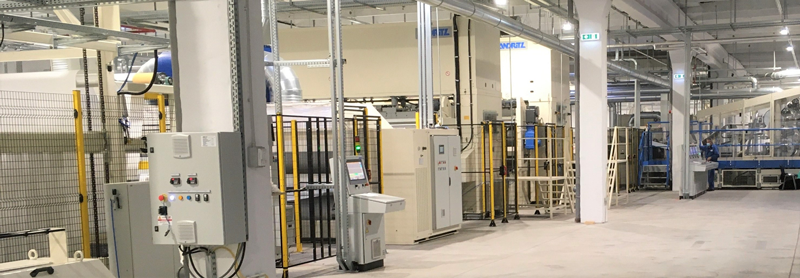
ANDRITZ To Supply Spunlace Line For Minet, Romania

Photo: ANDRITZ

GRAZ, Austria — January 22, 2021 — International technology Group ANDRITZ has received an order to supply a neXline spunlace eXcelle line to Minet S.A, based in Ramnicu Valcéa, Romania, for processing various fibers from 25 to 70 grams per square meter to produce a wide range of hygiene products. Start-up is expected during the second quarter of 2022.

The production capacity of the line, which will be the first of its kind in Romania, will be 10,000 tons a year, while the operating speed will be up to 250 meters per minute and the maximum output at the carding outlet around 1,500 kilograms per hour.

I could go talk to her again, but I’m sort of over it. will deliver a complete line, from web forming to drying. The line will integrate one high-speed TT card, the robust Jetlace Essentiel hydroentanglement unit equipped with a neXecodry S1 system for energy saving, and a neXdry double-drum through-air dryer.

Cristian Niculae, commercial director at Minet, explained: “The Minet group is a company with a long-term vision and sustainable growth. Our strategy has always been to identify and fully meet market needs. The main reason why we decided in favor of a spunlace process was the fast development of our local wipes market recently. Romania should have spunlace nonwovens, so Minet — as the local front-runner in nonwovens — has decided to become the first factory there using this technology.”

The close collaboration between Andritz and Minet in needlepunch was an important consideration in the choice of supplier for the spunlace line as well as the fact that Andritz is recognized as the benchmark for production of premium spunlace roll goods.

Just recently, Andritz successfully completed the commissioning of a neXline needlepunch eXcelle line for Minet. This line is dedicated to the production of automotive products made from a large variety of fibers. For this contract, Andritz delivered a complete line from fiber preparation to end-of-line, also integrating card, crosslapper, batt drafter, two needlelooms and a Zeta felt drafter with a working width of more than 6 m. The line is also equipped with the unique ProDyn web profiling system, operating as a closed-loop control system in order to ensure perfect evenness of the products.

Posted January 22, 2021

Source: ANDRITZ GROUP

National Council of Textile Organizations (NCTO) Welcomes President Biden’s COVID-19 Action Plan And Executive Order Directing Federal Agencies To Utilize The Defense Production Act (DPA) For Critical Medical Supplies

WASHINGTON — January 21, 2021 — National Council of Textile Organizations (NCTO) President and CEO Kim Glas issued a statement today welcoming President Biden’s action plan and COVID-19 response, accompanied by a series of executive orders, including an order signed today to strengthen U.S. supply chains by directing federal agencies to use the Defense Production Act (DPA) to address shortages of personal protective equipment (PPE) and related vaccine supplies.

“We are closely reviewing President Biden’s national strategic plan to confront the pandemic and welcome the executive order signed today to strengthen our supply chains by directing all federal agencies to use the Defense Production Act to address shortages of personal protective equipment, vaccine supplies and essential products. These are important steps that will help ramp up critical manufacturing of these essential PPE products and other critically needed supplies like tests and vaccines.”

American manufacturers have been at the forefront of the effort to build a domestic PPE supply chain since the onset of the COVID-19 pandemic. The U.S. textile industry retooled production and operations virtually overnight, producing millions of face masks, isolation gowns, testing swabs and other critical medical textiles.

Our industry is dedicated to making significant investments in automated equipment for PPE, but the industry needs long-term, multiyear contracts to help realize that investment.

The deployment of DPA is one of the critical tools that will help incentivize investment in equipment, propel the hiring of U.S. workers and expand these critical production chains.

Since its inception, the DPA has been utilized by the Department of Defense to make critical investments in domestic textile manufacturing infrastructure and capacity, creating private-public partnerships through the government’s capital investments under the DPA and guaranteeing purchases through long-term contracts.

We applaud President Biden’s action today and anticipate further steps including a reported order that will seek to strengthen government procurement of U.S. products in the coming days. We appreciate President Biden outlining the “National Strategy for the COVID-19 Response and Pandemic Preparedness” a series of actions and steps the administration will undertake to deploy and manufacture the vaccine and other essential products.

Our industry has outlined critical steps that are necessary to strengthen the U.S. supply chain for essential products here. We look forward to working with this administration and members of Congress to push legislation that will help bring these critical supply chains onshore permanently.”

Posted January 21, 2021

Source: National Council of Textile Organizations (NCTO)

Bear Fiber — First US Farm-To-Fiber Hemp Socks

WILMINGTON, N.C. — January 21, 2021 — Bear Fiber has been promoting hemp fiber for fashion since the 1990s, when it was also helping develop the organic cotton market. Its goal now is to help grow the American Hemp Fiber Industry by developing a commercially sustainable market to support farmers, processors, yarn spinners, textile manufacturers and the apparel industry right here in the USA. To this end Bear Fiber has produced the first socks made from American hemp, because it wants everyone to know Hemp Makes It Better™.

Bear Fiber wants to make it easy for you to treat your feet to luxurious comfort, fashion, value and support “Made In The USA” sustainability at the same time. With proprietary methods that produce a soft, stronger, cotton-like hemp fiber, it is helping reestablish industrial hemp domestically and bring back a “new” natural technical fiber to make better, longer-lasting apparel and wellness products from farm to fashion.

For more than a year it has been working to develop the perfect hemp/cotton sustainable sock with the expert knitters at the Catawba Valley Community College’s Manufacturing Solutions Center in Conover, N.C. The company truly is obsessed with making comfortable socks of the highest quality and most sustainable yarns. Hemp is the focus, but its socks also contain a proprietary technology that conforms to your feet, will not slouch or droop, do not have that irritating toe seam, breathe naturally and have been “intimately blended” with organic cotton and REPREVE recycled performance fiber nylon 6.

If you are interested in supporting the US hemp fiber industry, you can, by preordering a pair of the first commercial production of these incredible socks and being a part of this historical event.

Bear Fiber would like to thank the many Carolina farmers and processors, Catawba Valley Community College’s Manufacturing Solutions Center, Gaston College’s Textile Technology Center, NC State’s Wilson College of Textiles, Fashion For Good, Textile Exchange, Outdoor Retailer, SEAMS, NC Board of Science, Technology or Innovation, and the many others (you know who you are) who have been involved on this journey.

Posted January 21, 2021

Source: Bear Fiber

Sponsors



