In March 2020, the world changed — people were forced to drop everything, shelter in place and rise to the challenges of the then unknown realities brought about by the COVID-19 virus.
Prior to the pandemic, marketing in the textile industry had grown to be very tradeshow-, seminar- and meeting-focused. Those events largely drove the editorial focus of Textile World, Textiles Panamericanos and Textile World Asia’s editorial planning.
Many advertisers used print and electronic media offerings to announce their participation in events, drive traffic to their booths and promote their investment in the personal selling event experience.
As of fall 2020, planning for 2021 is proving challenging for editors, publishers and advertisers alike. Textile Industries Media Group will continue its focus on each of the manufacturing sectors of textiles — from fiber through finished products — as well as business, trade and executive profiles of interest to subscribers.
Each issue will contain a sector focus —spinning; knitting; weaving; dyeing, printing and finishing; nonwovens; and man-made fiber — with the remaining content balanced by such topics as sustainability, composites, automation and smart fabric technology.
TextileWorld.com will continue to focus on capturing relevant daily textile industry breaking news, which will be distributed to subscribers of the TW weekly e-newsletter.
There currently are 16,690 posts of news and articles on TextileWorld.com; and on an average workday, 10 new posts are added. The website draws close to 70,000 pageviews per month, and the TW e-newsletter circulation exceeds 18,000 subscribers each week.
In a way, the textile group is very lucky to have built and fortified robust textile media offerings at a time when selling and marketing within the global textile industry has grown challenging.
As people and companies experiment with virtual offerings, deal with the frustrations brought by a lack of human contact, and wait for face-to-face events to reemerge, TW, TPA and TW Asia continue to provide high-value print and electronic media offerings for advertisers of all means.
Whether a low-cost, electronic media-only campaign or a fully-integrated multi-title print and electronic plan, the Media Group’s sales staff has a full tool bag to make best use of your marketing budget for maximum reach to textile readers.
On the editorial side, please keep the editors aware of your activities — such as staff changes, new products, new plant and equipment, and investments — news relevant to the global textile industry. Your participation helps editors bring significant information in a timely manner to a very engaged and loyal readership.
Thank you for taking the time to investigate the Textile Industries Media Group print and electronic media marketing solutions. As the textile industry tries to make the best of a new COVID-19 sales and marketing environment, please let our sales staff assist you to get your message to the industry in an efficient and cost-effective way.
Frank Fett (left) with TW’s Contributing Editor Jim Kaufmann at ITMA 2019.
Textile World and Textiles Panamericanos sales representative Frank Fett announced he will retire at the end of 2020.
Based in Frankfurt, Germany, Fett worked for several public relations and advertising agencies prior to joining McGraw Hill in 1980 where he first represented TW among other publications. Fett moved to a Switzerland-based company in 1988 representing Americas Textiles International (ATI) and TPA. He continued to represent those publications when he became an independent rep in 1994, and later representing TW again when ATI publisher, Billian Publishing Inc., acquired the publication.
“I first met Frank when I became the new Editor in Chief of ATI magazine,” said Jim Borneman, TW’s owner and publisher. “Frank has always been extremely helpful and supportive, particularly at trade shows. He always had a list of companies to visit and was eager to make introductions.”
“With more than 40 years in two industries — textiles and publishing — that have changed dramatically over the years, his career certainly was one with twists and turns,” Borneman added. “His industry knowledge and professionalism will be sorely missed.”
“I enjoyed getting to know Frank on work trips to Europe,” said TW’s Executive Editor Rachael Davis. “I will miss our travels together very much. Frank was always an asset at a trade show, helping me meet people and cultivating relationships with people in the European textile industry. He also has an adventurous spirit and was always up for exploring and trying new foods. He most certainly will be sorely missed.”
HomTex Inc., a Cullman, Ala.-based manufacturer of bed linens among other products, announced it will establish an operation in Selma, Ala., to produce personal protective equipment (PPE) — including general purpose and Food and Drug Administration approved Level 1, 2 and 3 surgical masks and N95 masks — under the new brand Sovereign America. The company, a family- and minority-owned business, reports the expansion will create between 300 and 325 new jobs.
When the pandemic hit, HomTex pivoted production at its Cullman facility from bed linens to disposable medical-grade masks and reusable cotton masks.
HomTex received just over $10 million in Coronavirus Aid, Relief and Economic Security
Act (CARES) funds for the expansion.
“HomTex has made Alabama proud by stepping up during the COVID-19 pandemic to shift their production to create critical PPE supplies,” Alabama Governor Kay Ivey said. “Their ability to be flexible in order to remain operational is the exact intent of the CARES Act funds. I appreciate their commitment to the economy and Alabama workers by providing needed jobs in Dallas County and thank HomTex for being a great corporate partner with the state of Alabama.”
“We are very honored to be the recipient of COVID-19 Relief Funds from the state of Alabama,” HomTex President and CFO Jeremy Wootten said. “This second operation will make HomTex one of the largest face mask manufacturers in the USA, and we are proud to be manufacturing these products in Cullman and Selma. We very much appreciate the support from Governor Ivey, the State Senators and everyone who made the factory in Selma a reality.”
Miami-based Maskco Technologies Inc. has partnered with Los Angeles-based Gredale LLC to open a facility in Los Angeles to produce approximately 160 million N95 protective face masks each month. Gredale will oversee production at the new plant — which is located in a former Van Heusen factory — as well as provide investment and credit facilities of $100 million. The investment will cover working capital in addition to raw material and machinery expenses.
The facility, expected to open in March 2021, is one of three new Maskco facilities in the United States.
Gredale CEO Greg Lorber has been appointed to the Maskco Technologies board of directors. “Having spent 20 years of my life operating the largest domestic textile manufacturing facility west of the Mississippi, I take great pride in assisting Maskco to develop and produce the MTech N95 here in downtown Los Angeles,” Lorber said. “Our team at Gredale has the technical experience with nonwoven meltblown materials to make sure that our customers and healthcare professional’s needs are met with a precise attention to performance and detail.”
U.S. manufacturing has rebounded strongly from the record 31.4 percent contraction seen during the second quarter of 2020.
New orders jumped to their highest level in nearly 17 years, according to The Institute for Supply Management (ISM). As a result, manufacturing employment expanded in October for the first time since July 2019. Overall, ISM reports that about 11.5 million of the 22.2 million jobs lost during the pandemic have been recovered.
While many yarn spinners, weavers and knitters retooled to manufacture protective gear for frontline COVID-19 personnel, they also began to see business-as-usual orders increase. “Once the economy began to reopen, we noticed an uptick in inquiries,” noted one industry professional. “Orders began to strengthen throughout the third quarter. In the last month or so, they have fallen off a bit. I think a lot of can be attributed to a wait-and-see approach by wholesalers and retailers in regard to holiday sales.”
On that front, the National Retail Federation (NRF) reported December 1 that an estimated 186.4 million consumers took advantage of the Thanksgiving holiday weekend and shopped in-store and online. NRF also predicted an increase in holiday sales for 2020 of between 3.6 percent and 5.2 percent over 2019.
“If consumer spending continues as expected, you can anticipate that business at the start of 2021 will be much better,” said one analyst. “Coupled with a hopefully quick and wide distribution of COVID-19 vaccines, we may expect a return to some semblance of a new normal — whatever that may be — by mid-year or so.”
Regardless of how the new year begins, 2020 provided lessons that cannot be ignored.
Crisis In 2020: Uninformed And Unprepared
“We got caught out,” said a life sciences specialist about the unprecedented chain of events and miscues that resulted in the greatest national crisis of the millennium. “We can’t ever let that happen again. We had insufficient information — even when top government officials were aware of the danger — and insufficient resources to deal with the COVID-19 pandemic.”
As Americans became infected and hospitals became crowded, there was, initially, a woeful shortage of life-saving ventilators and life-protecting personal protective equipment (PPE). While U.S. yarn spinners and fabricators quickly retooled in a heroic attempt to combat the PPE shortfall, it became painfully obvious that the industry simply did not have the capacity to meet critical needs.
Industry leaders are dedicated to make sure such an issue does not continue in 2021. The National Council of Textile Organizations (NCTO) spearheads an effort to return substantial PPE manufacturing capacity to the United States.
“It is impossible to understand America’s PPE predicament without acknowledging China’s overwhelming and destructive dominance of global PPE markets,” NCTO President Kim Glas told the U.S. International Trade Commission in September. “China dominated global PPE production before the pandemic began — exporting more surgical masks, medical goggles,
and protective garments than the rest of the world combined. And they have ramped up production substantially since.”
The return of PPE manufacturing to the United States will only occur if proper government policies are implemented to incentivize the long-term investment needed to sustain PPE production, Glas said.
As a result, the coalition of which NCTO is a part has recommended the following to Congress:
Create strong domestic procurement rules for federal PPE purchases substantially similar to the Berry Amendment and the Kissell Amendment;
Implement forward-looking policies to shore up the Strategic National Stockpile and to identify, incentivize, and maintain a robust domestic supply chain for PPE and medical supplies;
Create federal incentives for private sector purchases of domestically produced PPE;
Provide funding assistance for companies to reconstitute domestic PPE supply chains; and
Strengthen the Berry Amendment.
“Without a comprehensive set of procurement, trade and enforcement policies designed to foster domestic PPE production, U.S. manufacturers will continue to be undercut by state-sponsored and exploitive offshore competitors, namely China,” Glas said.
Harrie Schoots is based in Waco, Texas, and is the chair and cofounder of AATCC’s Texas Section. The bridge in the background is the Waco Suspension Bridge crossing the Brazos River in Waco, which is on the U.S. National Register of Historic Places.
Ascend Performance Materials’ Harrie Schoots shares his thoughts on AATCC, its 100th anniversary and vision of AATCC’s future as he begins his term as AATCC president.
By Rachael S. Davis, Executive Editor
The Research Triangle Park, N.C.-based American Association of Textile Chemists and Colorists (AATCC) was founded in November 1921 by a small group of U.S.-based dye manufacturers at a meeting held at the Engineer’s Club in Boston. Louis A. Olney, a professor at the Lowell Textile School and editor of the Technical Section of the American Dyestuff Reporter, is considered to be AATCC’s founder.
According to AATCC: “The need for American textile test methods became apparent during the First World War, when the blockade in the Atlantic prevented European dyes from coming to America, and the fledgling American dye manufacturers struggled with providing consistent products.” This realization led AATCC to form its first subcommittee in 1922, to study the colorfastness of printed and dyed cottons, formulate testing procedures, and develop standards for fastness.
This original, small, U.S.-based group has become a global association that will celebrate its 100th anniversary in 2021. Test methods remain a large part of AATCC’s focus. Committees, comprised of AATCC members, are responsible for developing and maintaining the test methods, and the association offers test method training and courses for interested parties. The association also offers networking opportunities through meetings and conferences.
Harrie Schoots recently received his Presidential AATCC lapel pin, which marks the beginning of his term. Schoots, senior business development leader at Houston-based Ascend Performance Materials, has long been involved with AATCC during his career, most recently as president elect.
According to AATCC, the president: “is an active, long-term senior member of the Association. S/he has a general knowledge and understanding of the mission and history of the Association, acquired from prior service on numerous administrative, publications or technical committees within his/her respective local section(s) and at the national level. This individual has also held office at the section or interest group levels.”
Schoots will serve as AATCC president for the next two years, presiding over meetings of the board of directors and the awards banquet at the international conference; attending sectional and interest group meetings, as well as symposia and association programs; promoting the mission and goals of the organization, as well as mentoring and assisting the next generation of textile students, among other duties.
He replaces Kerry King who moved into the role of immediate past president, a title she will hold for the next two years.
Textile World recently had the chance to speak with Schoots to learn more about AATCC and his goals for the organization during his tenure, among other topics.
TW: What led you to the textile industry?
Harrie Schoots: I graduated in 1996 from NC State with a B.S. in textile chemistry with a concentration in dyeing and finishing. I transferred from a school in Boston to NC State when my father went to work at the university.
He was in nonwovens his whole life and is one of the inventors of the blue and white reusable Handi Wipes®. I’m a first-generation American. My family emigrated from Holland, and as a Dutch-American, one way to really rebel, was to not do my homework and not do what my father did. Seeing how things turned out, I guess I’m not much of a rebel after all.
Anyway, chemical engineering at NC State is a big deal and I didn’t know that. I didn’t have the grades and was rejected from the program. When I met with my dad at his office on the new centennial campus at NC State, he said “go down the hall and there is a guy there that will talk to you about textile chemistry.” I got the sales pitch of my life from Tim Clapp. I thought it sounded great and couldn’t believe you could study that sort of thing in college. I transferred into the college of textiles and loved it. My GPA increased because I was so interested in the subject matter and I took two years of back-to-back textile chemistry courses. I believe I came out of school ready to go!
TW: When did you first become aware of AATCC?
Schoots: I learned of AATCC while at NC State. I thought the meeting I attended was just to have pizza. I did not know what AATCC meant when I was a student. The name is long and out of the five words in the name, only one of them is actually true — it’s an association. It’s not justfor textiles, it’s not just for chemists and it’s not just for colorists. And it’s definitely not just American. It’s an international association!
Before AATCC’s 2019 International Conference & Exhibition, which was held in Fort Worth, Texas, attendees had chance to participate in a day trip to Waco, Texas, where they visited the Magnolia Silos, among other venues.
TW: How has AATCC standardized testing been helpful in your work?
Schoots: Unless you can prove something, nobody is going to believe you. AATCC test methods are an absolutely essential thing needed to sell products. It’s the only way to prove that what you say is actually true, and that means the consumer will recognize it.
Without standardized testing, you have only wear testing, which is inconvenient and difficult to quantify. Test methods are not just helpful, they are essential. They are the reason people can sell stuff. Us textile nerds never get credit for any of that, but we all know nothing gets sold unless our tests are taken seriously.
TW: The year 2021 is AATCC’s 100th anniversary? What do you see for your term as president, and does the anniversary impact your role?
Schoots: I didn’t realize I was going to be the 100th anniversary president. When I did the math and realized the timing, I thought, oh, that’s neat. But then I had that I’m
not worthy moment!
I’ve seen the people in this position before me and seen the wonderful job that they have done. I’d also like to honor Kerry King as our most recent past president. She helped bring us into the COVID era very well — seamlessly in my opinion. I truly hope I can do the position honor.
There are three things I told Diana Wyman [AATCC’s executive vice president], whom I look forward to working with, that I’d like to focus on.
One is I that want to make AATCC’s online presence stronger. We need to not ignore pandemic-related shutdowns, and let’s say it’s two years where we are all doing this stay at home thing. We need to upgrade our online presence, how we advertise meetings and when we have meetings. We also don’t have to hold virtual meetings at 7 p.m.
The second thing I told Diana, is I want more interaction with other textile and color organizations when it’s appropriate and when it’s synergistic. When you add in people meeting online today, we have less and less of an excuse not to interact. We need to work with kindred groups and non-profits in our industry that are too valuable to ignore. Why should we not meet with the fabric people if we are yarn people. Do we ignore cotton growers? Why are the buyers not involved with the fabric people? I don’t believe these entities are competitors, but rather full of synergistic opportunity.
The third goal is to make engagement with the student sections a little bit more enjoyable especially in the online meetings.
I’d like to have an online meeting with every student chapter during my time as president.
TW: Can you reveal any plans related to the 100th anniversary?
Schoots: I would say the most important note is that we still hope to have our international conference next year, but we are probably going to delay it — and that’s a scoop by the way. We’re going to delay to maybe November, and if we do that, we believe it’s possible to have the conference next year. We’ll also host the event in a place where AATCC members who work in corporate jobs won’t have to travel so far to attend, so probably in the Raleigh/Durham area.
TW: What do you think is the true value of AATCC membership?
Attendees at AATCC’s first annual social event in New York City.
Schoots: Part of my answer to what I think AATCC’s value is, is this — If you read the book “Dyeing for a Living: A History of the American Association of Textile Chemists and Colorists,” you’ll notice there are two different viewpoints within AATCC going all the way back to the 1920s. One is that it is a technical organization meant to do technical work, fundamental research and development, this type of thing, which leads to the test methods. That purpose of course continues today, and AATCC is focused on managing test methods and growing new methods, as well as correcting and improving old ones. But the other side, is that AATCC is a networking group. It is an organization that is relatively rare in that it allows anyone from a student to an entry-level textile individual to a leader or owner of a company to gather in the same place at relatively low cost to no cost. There was a battle within AATCC for decades between these two groups — the people who wanted to network and share products to develop new business, and the people who were looking to engage in that fundamental research that needed to be done. Of course, both facets are important, but my work and focus has been to help other people connect with this network.
TW: What is the benefit of AATCC membership for students?
Schoots: Getting a degree in textiles means learning a trade. You’re not just getting a degree, you are gaining skills and people pay for those skills. Every time I talk to a group of students, I offer to take their call, schedule a meeting, get to know them a little, and then help them write their resume. The reason I can offer that — even though I’m busy — is because only 2 percent of students ever take me up on that offer. So, spread out over time, it’s doable. That one-on-one time, this mentorship, that’s what AATCC, I believe, is about for students.
When I graduated, I personally had more than 40 interviews on campus with dyehouses. They came to me. Now, these kids at NC State are scouring the boards looking for jobs.
Do they have any companies come to campus for interviews? I’m not sure, but if there are any, it’s not 40 companies.
The students are shy. You really do have to reach out, and I’m going to continue to work on that. How can we be useful to the next generation? How can we help them learn the things the industry wants? It’s not always just about jobs.
I helped to start a student chapter of AATCC at the University of Texas (UT) at Austin in May 2017. This a school that requires you are in the top 10 percent of your high school class to get in and most students are interested in medicine, engineering and business. These kids at UT Austin in the textile program at some point had to tell their families, I’m going there to learn how to make better textile products. These kids did not grow up with family members working in the industry. They have chosen to do this, and they have passion for it.
The first class, founding class, graduated last year. They held meetings, hosted speakers and learned how to use the things AATCC can offer them. I was just so proud of them. And at graduation, the students chose to make a cord to wear that identified them as AATCC student chapter members in good standing. The thing they wanted to wear at graduation, was this AATCC cord. If you can create that sense of pride just spending time once or twice a semester talking to the students, that’s what AATCC means to me. It’s a place you can impact someone’s entire career just by talking to them.
I also started hosting socials in New York City during the summers because I learned that many students spend summers there working for brands. We held one, then a second, then COVID killed the social we had planned this summer. We look forward to hosting a third sometime in the future!
Ascend fully supports this work. Without them and their support, I wouldn’t be able to do this. It’s me paying it forward.
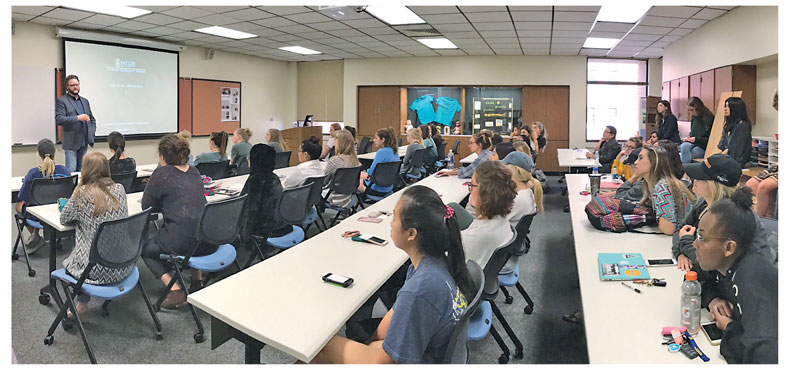
High attendance at Schoots’ first student chapter meeting at Baylor University meant it was standing room only.
TW: What do you see for AATCC in the future, beyond your tenure as president?
Schoots: We’re going to learn it’s not a male-dominated business anymore. The industry is going to have to learn to understand the new demographics. This industry in particular also was heavily focused in the southeast, but that’s changing. We have active sections on the west coast. AATCC has a very active California section and we’re going to be led by the brands’ participation in my opinion. I believe the brands, retailers and apparel dealers and wholesalers will become more involved in AATCC in the future because of the answer to an earlier question — are tests helpful? They’re required, and people are going to be selling functionality more and more and more. And so AATCC will become more and more a place to share products, but also a place to measure them and explain their value. Because there aren’t as many production facilities outside of the southeast, it’s only natural that the brands are going to come to AATCC for help. I think the brands also should come to the international conference and committee meetings because they can get help that way.
Also, the people who will be retiring … see, I’m the youngest of the old people. Before I retire, all the people coming up behind me need to get this information out of my head and my colleagues’ heads. I believe that mentorship will play a big role in sharing that information and educating. There are not a lot of people running mills anymore, but everyone still needs clothes so I guarantee the industry is going to be here!
So, demographics are changing, functionality is getting to be more and more part of the sale, and this is the other piece — I think AATCC will be seen as more of an international entity. It should be noted that these test methods are international test methods. You’ll see the new technical manual will have a slight change in its name next year to state that it isinternational.
TW: In an earlier answer, you mentioned Kerry King and AATCC’s COVID response. How did Ascend respond to the pandemic?
Schoots: I was hired by Ascend to find new applications in textiles, and after creating Endur by Ascend™ (See “Static Free? — Ascend’s Nylon 6,6 Answer Is ENDUR,” TW, May/June 2019), we were challenged to make a no odor nylon 6,6 yarn that is dyeable and not silver-based. There were some challenges spinning yarns using metals, but Ascend did develop this resin and it’s called Acteev™.
In February, shutdowns began and Ascend decided to test Acteev for viral protection. Tests showed a 99.9-percent reduction of SARS-CoV-2, the virus that causes COVID-19. This led Ascend to create a business division called Acteev. It was interesting how the project morphed from a more narrow “no odor” solution to an antiviral technology with its own division.
AATCC has a committee called AR31 and that’s going to be important over the next couple of years for me. Everyone needs to be educated on how to supply antimicrobials, how to talk about them, how to buy them. I look forward to helping in any way that I can to produce that education because I’m so closely involved with Acteev. We’ll have to see how things go with the Environmental Protection Agency (EPA) and the Food and Drug Administration. The EPA sees an antiviral callout as a public health message.
A company cannot claim a public health message unless the EPA approves it, and full registration takes two years. Ascend is currently involved in that process now.
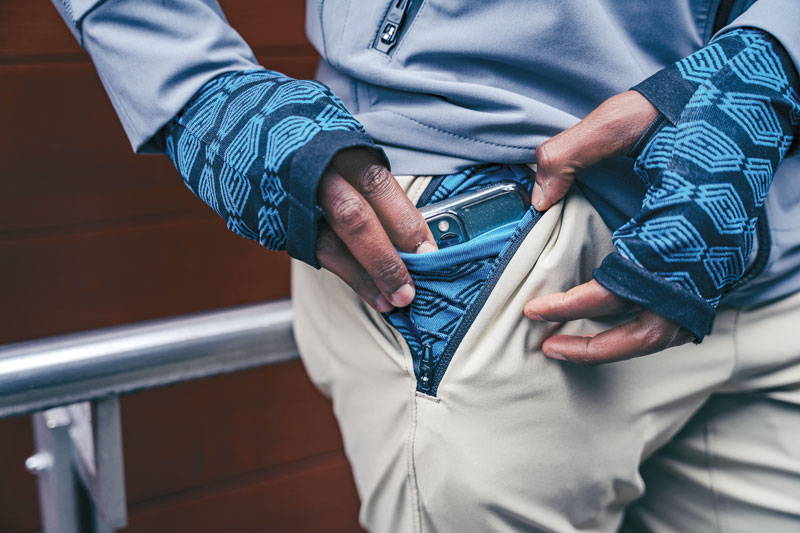
Hemp Black’s pocket sleeve concept for cleaning and sanitizing a mobile phone.
Hemp Black is a new company researching and commercializing applications for hemp in textile and industrial products.
By Jim Kaufmann, Contributing Editor
While the advent of legalized hemp in the United States has brought much attention to the use of cannabinoids in medicinal and homeopathic applications (see “Hemp: A Reintroduction To One Of the Original Textile Inputs”, TW, this issue), Greensboro, N.C.-based Hemp Black Inc. is exploring alternative routes for hemp including products featuring hemp derivatives targeted towards performance-driven technical and industrial applications. A business unit of Ecofibre — an Australia-based industrial hemp company with U.S. headquarters in Georgetown, Ky. — Hemp Black is the offspring of Ecofibre’s initial research collaborations with Thomas Jefferson University (see “A Study in Collaboration,” TW, September/October 2020), which was strengthened by the recent acquisition of TexInnovate, a portfolio of high-performance textile businesses led by founder Jeff Bruner. Collective efforts to date have resulted in an array of technologies and concepts on the cusp of being introduced to, or already found in, consumer and industrial products.
TexInnovate, previously Hemp Black’s preferred manufacturing partner, brings not only technical and manufacturing capabilities, but an established customer base that they will continue to service and support. In addition, the company brings a rather large, diverse list of industry contacts.
“This acquisition was a very strategic move for us,” stated Eric Wang, Ecofibre’s CEO. “Over the last few years, we have worked with TexInnovate to develop intellectual property and product concepts, while capitalizing on their development, and technical and manufacturing capabilities. Not only has this allowed us to accelerate and expand the introduction of Hemp Black’s initial product offerings, but especially given today’s COVID-influenced climate, we were able to quickly pivot to develop and produce the Hemp Black face mask and gaiter line of personal protective equipment, with more items coming soon.”
An industrial hemp plant
Bruner — a textile industry veteran known for his innovative, forward thinking and constant eye towards the future — now serves as Hemp Black’s president and is excited about advancing its technologies. “I was first introduced to Hemp Black’s concepts, research and patent efforts in 2018, and was so intrigued that I quickly inquired about becoming a shareholder in Ecofibre in 2018,” Bruner said. “There is strong commercial potential for these technologies, not only to solve existing customer issues, but more importantly to initiate a step function shift in textile performance across a wide range of industries and applications. I believed it was like getting in on the ground floor of plastics in the first half of the 1900s, and my excitement and enthusiasm continues to grow.”
Spend any amount of time speaking with Bruner, Wang or Mark Sunderland, Hemp Black’s chief innovation and sustainability officer who also serves as vice president of Innovation and Technology at Thomas Jefferson University where he was intimately involved in the Ecofibre sponsored collaborations with Jefferson, and you quickly realize that Bruner’s initial assessment of the technologies in development at Hemp Black is spot on, if not possibly a bit reserved. “It’s really become a great example of university research meets industry investors, marketing exercises, creating product and culminating in market opportunities, the result being Hemp Black,” said Sunderland who also coined the company’s name. “Three-and-a-half years from our first introductions to transpire into the opportunities we now have has been an amazing ride.”
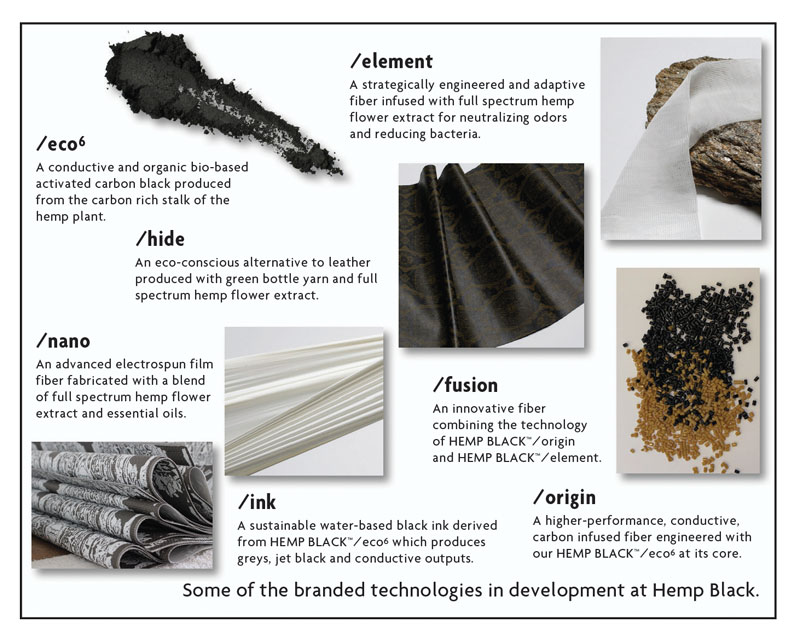
Hemp Black’s unique stable of technologies, with the hemp plant as a primary constituent, were developed with two specific areas of input focus: full spectrum hemp flower extract (FSHE) and activated carbon black. In addition to working with local hemp farmers to develop new plant strains with a higher level of consistency and aligned with their technical goals, Hemp Black has developed proprietary in-house processes for incorporating the extract and then from the remaining hemp biomass — basically whatever unused portion of the plant is left over — producing a carbon black that is purely sustainable.
Some of the branded technologies in development at Hemp Black.
Full Spectrum Hemp Flower Extract
Full spectrum hemp flower extract — or the “golden oil” as some may refer to it — as the name implies is the pure extract from the hemp flower, which in this state contains all of the cannabinoids — 113 different ones identified to date — including cannabidiol (CBD), and other compounds found in the plant. Ananda Hemp, a separate Ecofibre business unit, produces a variety of nutraceutical products aimed at promoting health and wellness from the extract, CBD and its derivatives, but Hemp Black has taken a different approach. With the acquisition of TexInnovate whose broad capabilities, all of which were included in the acquisition, comprise of polymer compounding and masterbatch production, polymer extrusion into filament yarns for industrial and bio-medical applications, innovative knit fabric manufacturing, man-made turf yarn manufacturing, and custom textile machinery solutions, a variety of industrial and technical possibilities emerge.
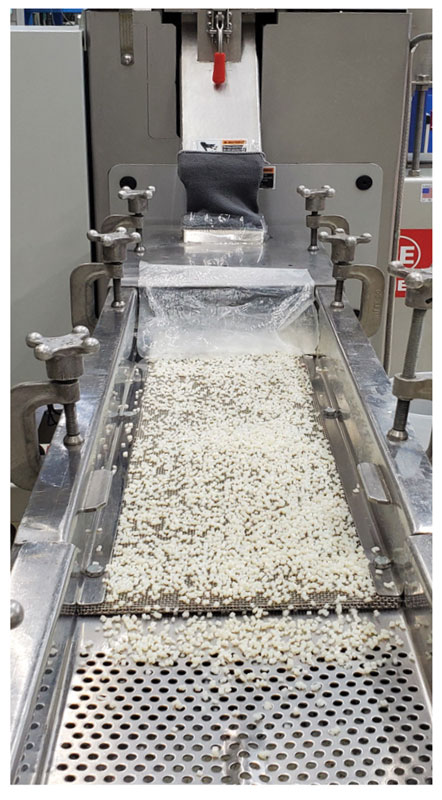
Compounding masterbatch line with extruded polymer chips.
Given TexInnovate’s processing capabilities, the usual questions naturally arose: “Can we make a polymer and masterbatches incorporating the extract and extrude it into a yarn?” followed closely by, “If we can create a yarn incorporating the extract, what type of properties and characteristics might it have?” Shortly thereafter, the questions became, “What else can we incorporate into the polymer compound to either enhance the resultant attributes or generate unique new attributes?” This is where Bruner and his colleagues from TexInnovate excel and it turns out the answers were “yes,” “yes” and “a lot,” with still much more to explore!
Hemp Black is able to successfully incorporate the extract into several different polymers resulting in a textile yarn exhibiting unique properties. According to Bruner: “The full spectrum hemp extract works better than just CBD oil for us. Think of it as a multivitamin compared to a specific single vitamin. The extract blends well with no indication of chemical interference so far. Inclusion of the FSHE during the compounding process where it can be evenly dispersed, is homogeneous, literally becoming part of the DNA of the polymer being used. We’ve also seen that it actually helps to make the yarn spin better. We’ve had positive results with nylon, polyester, polypropylene, polylactic acid and urethanes so far, but the higher processing temperature polymers are yet to be tested.” They’ve also had success extruding polymer and extract combinations in trials with bi- and trilobal filament structures and various cross section configurations.
A portion of the carbon black processing line developed by Hemp Black.
The resulting yarn variants have demonstrated natural odor-neutralizing properties, and initial testing has shown them to also exhibit antimicrobial and antibacterial characteristics, where testing and evaluations are ongoing, allowing for the distinct possibility of being able to solve multiple problems with a single yarn. “With the various other additives available to us, we believe new yarns can be developed with diverse properties and characteristics that could be really interesting,” Bruner stated. “Imagine outdoor or hunting clothing that is naturally bug or tick resistant; floor coverings, wallpaper and possibly furniture that is naturally antimicrobial and antibacterial; masks and other PPE, even yoga or workout clothing that are anti-odor as well and don’t have to be washed every time they’re worn. These properties would be ideal for military apparel, especially in socks and other next-to-the-skin applications.”
“Another positive is that the active ingredients do not appear to dissipate,” Sunderland added. “We’ve tested items after 50 washings and the properties do not change. Hemp is a highly effective natural anti-microbial and biopesticide, so we are preparing the documentation and testing for submission to the EPA hopefully in 2021 in order to register, certify and approve our technologies.”
Hemp Black is currently selling 3D-knitted protective masks and gaiters produced in-house that incorporate a version of this yarn. According to Wang, “We are working with CVS and many independent pharmacies to sell the masks through their locations.”
“We had the yarn already built for athletic apparel, so when COVID hit we were able to go from concept to a fully integrated mask product in less than four weeks,” Sunderland noted “In addition to the masks and gaiters, our next generation of branded ‘advanced performance wear’ incorporating this technology and designed in-house was recently introduced and is now available to purchase on the Hemp Black website, with other new clothing options and a fashion line coming out soon.”
(left to right): Eric Wang, Jeff Bruner and Mark Sunderland in front of Hemp Black’s custom-designed, in-house-built multifilament yarn extrusion line
According to Sunderland, Hemp Black has developed several other technologies that employ the extract in order to benefit from its attributes. “We now have Hemp Black™/nano, which combines the extract with specific essential oils and other ingredients through an electro-spinning type process to produce an advanced film fiber construction that can be bonded to different fabric types providing wind and water protection, as well as odor-neutralizing and insect-repellent properties,” Sunderland said. “We’ve also introduced Hemp Black/hide as a sustainable, vegan replacement for eco-friendly man-made leather. We create a polyurethane coating using the extract, which is then backed by fabric made with REPREVE®, a performance fiber produced from recycled bottles. This allows Hemp Black/hide to be produced using 90-percent less energy and 80-percent less solvent than conventional man-made leather while maintaining its enhanced performance characteristics. It’s currently going through California Certification studies and is targeted for use in automotive, truck and bus seating; office furnishings; and high-traffic area public seating applications.”
Carbon Black
Carbon black, historically used for reinforcing rubber products and as a colorant in inks, paints and plastics, is generally produced by burning petroleum products. Hemp Black, after two years of research, has developed a proprietary process that exposes the hemp biomass to extremely high heat, resulting in a sustainable methodology for fully carbonizing the plant remnants, allowing the company to produce a naturally sourced, activated carbon black. The process has been awarded a Platinum Level Material Health Certification by McDonough Braungart Design Chemistry as well as meeting the Cradle to Cradle Certified™ Products Program requirements, which represents the highest level of Material Health Certification. According to Hemp Black, its carbon black is the first carbon black to be certified in this manner.
“As a company, we’re very cognizant of sustainability and being environmentally friendly,” Wang said. “It’s important to our future, especially with millennials being the workforce of the future and being rather mindful of their workplace environment.” Wang oversaw the recent completion of Ecofibre’s new Leadership in Energy and Environmental Design (LEED) Platinum-certified 50,000 square foot U.S. headquarters facility, the first such facility in the United States.
Using its proprietary process, Hemp Black has been able to reduce the carbon black particle size to the micron level, making it ideal for multiple applications. The resultant carbon black product, now branded as Hemp Black/eco6, is not only finding use as a colorant for inks, dyes and pigments for various polymers, but also exhibits the ability to conduct electricity.
“Creating a micron-level particle size, which is also lightweight and low density, was really important,” Sunderland stated. “It allows for a more even and consistent dispersion in inks and colorants and also makes it ideal for incorporation into polymers allowing the potential creation of electrically conductive yarns, which is planned for 2021.” And this conductivity property creates additional product opportunities for Hemp Black. With compounding and extrusion capabilities — not to mention the assortment of additional additives available including luminescent and magnetic variants that can be combined with the conductive carbon black — and the possibilities are bordering on limitless for integration in high-performance textile, industrial and fashion products. According to Bruner: “Hemp Black/eco6 will first be incorporated into yarns branded as Hemp Black/origin. We know Hemp Black/eco6 conducts current, now it’s about engineering the micron powder and the yarn types and geometries necessary to create new textile product realities. The year 2021 largely will be devoted to the electrically conductive development for textile yarns when our new equipment is started up in the second quarter.”
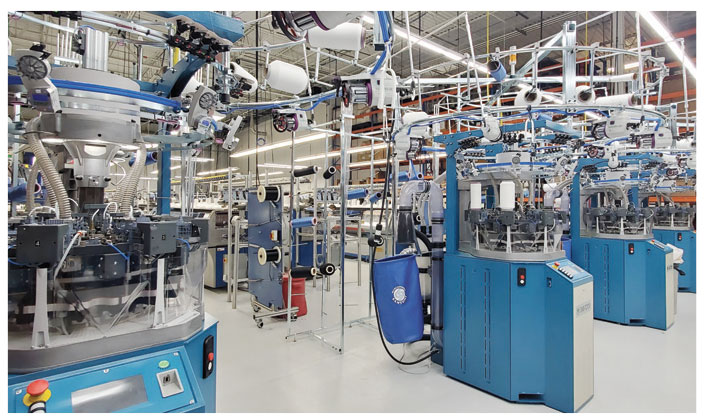
Hemp Black’s in-house seamless 3D circular and flatbed knitting technologies
An Eye Towards The Future Of Textiles
Several additional proposed applications based on Hemp Black’s evolving yarn technologies are in development that may become rather interesting realities. The first application, according to Bruner, involves creating a pocket liner for clothing made from the antimicrobial and antibacterial elements of the yarn technology. “Imagine if you could put your cell phone into your pocket, or you had a sleeve in your backpack or briefcase, where after a few minutes when you next took it out, the pocket/sleeve fabric had effectively cleaned and essentially sanitized your phone,” Bruner mused. Another application, based on the conductivity of the carbon black inclusion involves creating a textile-based phone charger that could be plugged into a car, home outlet, or maybe a backpack or briefcase where the fabric configuration could not only charge the phone using the yarn’s conductivity, but also clean the device.
Other possibilities for the technology include activewear and other clothing with electronics incorporated into the fabric construction; radio-frequency identification technology embedded in the yarn or fabric structure; or as a pigment additive in dyes, paints or resin systems including injection molded parts or components. Not to mention the possibilities for smart clothing, active camouflage, or fabrics with luminescence or glow-in-the-dark attributes that could be turned on and off with the touch of a sleeve. All of these ideas may be developed with realistically no recognizable changes to the current textile or product supply side.
“You need to think about the real world and commercial world as the research is being done,” Sunderland said. “We’re doing our own science and making our own products. We’ve filed several patent applications to date, five have been issued so far, with more in process. It’s exciting to be part of something that is wholly crafted in the U.S.A., but in today’s business climate, you really need to keep the ball moving in different directions and keep inventing your own products to keep others at bay. It makes it harder for competitors to extract what’s really going on.”
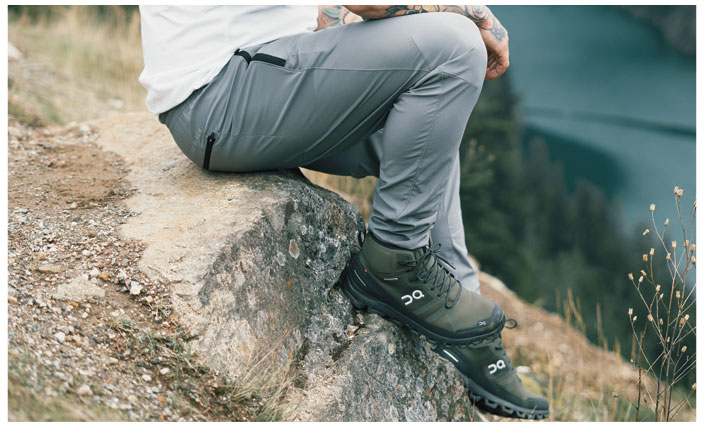
the recently introduced SUNN PANT incorporating Hemp Black’s technologies.
It is refreshing and exhilarating to see the numerous real and saleable possibilities ahead for Hemp Black as it continues to develop and explore the technologies provided by hemp-based extract and carbon black. Aside from launching its own branded line of products, Hemp Black’s biggest challenges essentially come down to where do you start and who do you partner with? “We don’t really know what all the end uses should or could be yet,” Bruner said. “Where do we start? Do we make something novel, something that wasn’t previously possible and see where it goes? We want to focus on value added applications based on performance opportunities, but given these technologies, the opportunities are virtually limitless.”
Hemp Black’s desire is to identify a partner or partners in many industries and end-use applications where all parties benefit. “An interesting set of potential partners comes from the west coast, the tech folks — someone who wants to change the game,” Wang offered. “Blending textiles with the next level of high tech would be really interesting for us. A commodity producer selling on price is not for us, but others looking for a differentiator that might be a game changer? We have the capabilities to support that. Connect the problem solvers with creative solution providers, that’s where we are. We just need people to tell us what the problems are that they need solved.”
Bruner added: “It’s about opening minds to the possibilities. Start with the future, totally reimagined. Here’s the answer first. Now go backwards to figure out how to tell the story that gets us there. Right now, we’re just scratching the surface.”
One thing does in fact lead to another, and for Hemp Black, given all of the different opportunistic paths in front of them, one can only wonder where its next development will lead. Parent company Ecofibre’s website states the company’s vision is “to become the global leader in hemp technologies by providing innovative solutions that address emerging health and resource sustainability issues.” Judging from the list of innovations and product offerings that Hemp Black is generating, one can easily say they’re off to a pretty good start in fulfilling that vision!
St. Louis-based Baldwin Technology Co. Inc. reports Sezginler Tekstil, a Turkey-based printing and dyeing company, recently completed the installation of four Baldwin TexCoat G4 non-contact spray systems. The company has integrated the technology into its softening finishing process replacing the conventional pad/foulard application method. It uses the four spray systems in both wet-on-wet and wet-on-dry processes. According to Sezginler Tekstil, the TexCoat G4 offers increased uptime, consistent finishing quality and reduced chemistry and energy consumption.
“By using the TexCoat G4 in the wet-on-wet process with reactive dyed fabric, we get a uniformity of the fabric that we have never experienced before,” said Ali Küçükerenköy, finishing manager at Sezginler Tekstil. “Adding the non-contact spray technology to the pad/foulard, is a decision we will never regret.”
“With TexCoat G4, we can totally rely on a continuous and even application from the first meter of the fabric to the last,” explained Küçükerenköy.“The same amount of chemical concentration is applied throughout the production, which was never the case with the old finishing method, where every meter of the fabric could have variations as the pad/foulard also being dirtier each meter.”
Germany-based A. Monforts Textilmaschinen GmbH & Co. KG reports its customer Kipas, Turkey, was chosen as the sole denim manufacturing partner in the New Cotton Project — a 6.7 million euro ($8.1 million) European Union project aiming to show that circular, sustainable fashion is achievable.
The brands adidas and H&M both are involved in the New Cotton Project along with a consortium of suppliers, innovators and research institutes. Over the next three years in relation to the project, Kipas will produce denim fabrics made using cellulose- based fibers from Finland-based Infinited Fiber Co., consortium’s leader.
Currently, Kipas is installing its third Monforts Montex tenter and third Monfortex compressive shrinking system in a configuration designed for denim production. The tenter is a 12-chamber unit; while the Monfortex unit features a double rubber configuration with two compressive shrinkage units and two felt calenders for simultaneous elastane heat setting and residual denim shrinkage. Both units have a working width of 2 meters.
“Around 90 to 95 percent of denim fabric production now contains elastane fibers and the Monforts system has allowed us to simultaneously increase our production and quality in this respect,” said Ahmet Öksüz, vice chairman of the board, Kipas.

 By Jim Borneman, Owner & Publisher