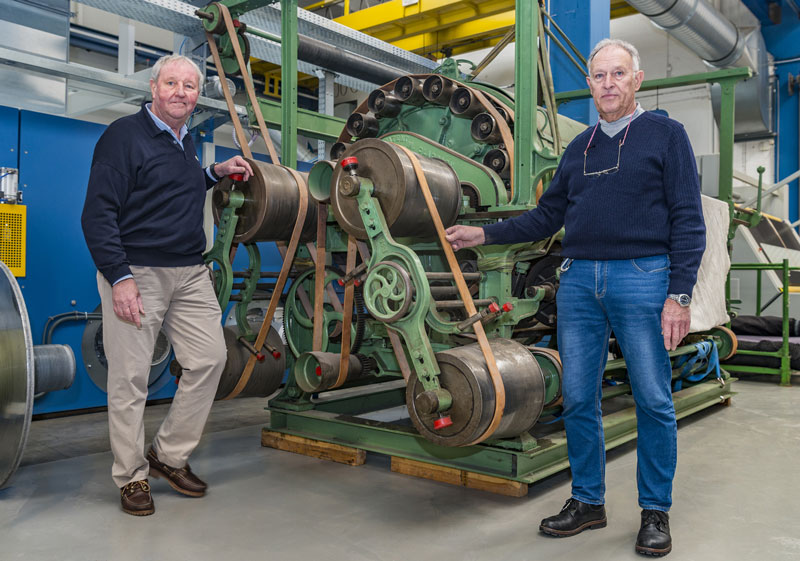
Fred Vohsdahl (left) and Walter Dresen with the103-year-old Monforts machine.
MÖNCHENGLADBACH, Germany — February 15, 2021 — A 36-roller raising machine manufactured in the year 1918 has recently been delivered to its final retirement home — as a historic showpiece at the Monforts Advanced Technology Centre (ATC) in Mönchengladbach, Germany.
The machine remained in operation at a plant in Poland up until early 2000 and has now been handed back in full working condition to its manufacturer.
Monforts veterans Walter Dresen and Fred Vohdahl — both of whom each worked for the company for more than 50 years and are themselves now retired — ensured the smooth landing of the machine as it was unloaded from its delivery truck.
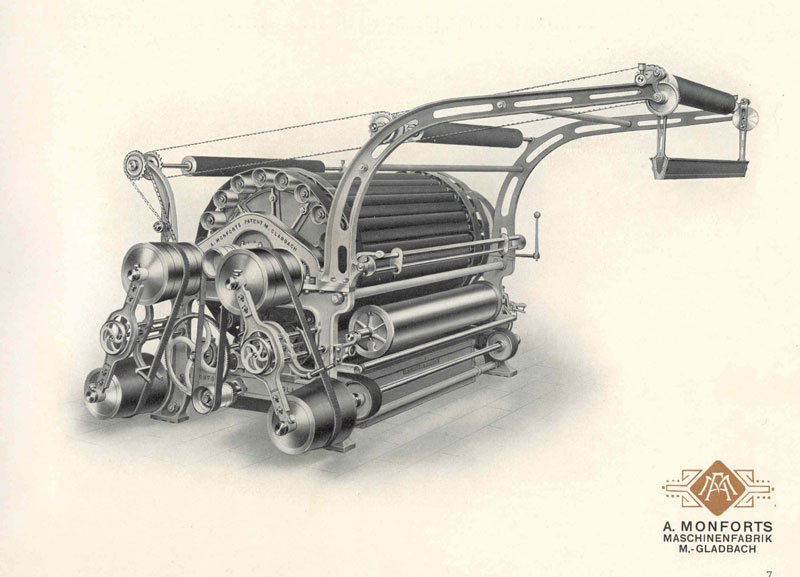
The raising machine was introduced by Monforts at the end of the 19th century and represented a game-changer at that time, due to the use of low friction ball bearings for its raising rollers. This greatly reduced the wear and maintenance of the raising rollers and was a first for the market.
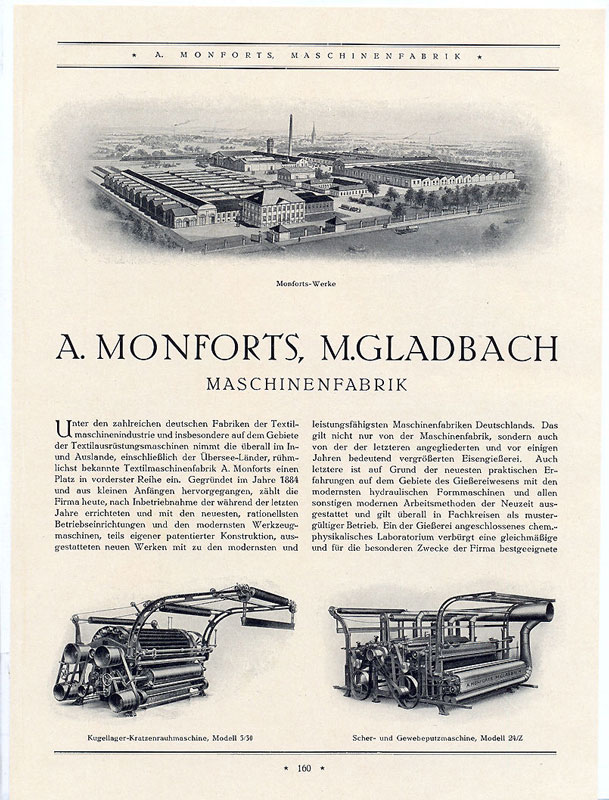
An 1927 advertisement for Monforts with the raising machine depicted bottom left.
Spirit of innovation
“We are proud to have such an old-timer now on display at our ATC,” said Monforts Marketing Manager Nicole Croonenbroek. “It demonstrates the spirit of innovation that has been a part of Monforts since the company was founded in 1884 and is now in our genes.
“Our two former collleagues, Walter Dresen, our head of Service for many years, and Fred Vohsdahl, who was the manager of the ATC until his recent retirement, took charge of the rebuild and restoration work. They have been able to find and replace the leather transmission belts which were the crucial drive element between what would originally have been a steam engine and the raising machine in the textile mill.
“Visitors will be interested to see this example of Monforts Industry 1.0 engineering and can compare it to the latest Industry 4.0 features of our latest finishing lines at the ATC.”
Illustration of the raising machine from the 1920s.
Despite any current travel restrictions, the Monforts Advanced Technology Centre (ATC) is fully operational for industrial-scale trials which go beyond lab or pilot plant testing, to be run by highly experienced staff on behalf of customers.
Since its opening in 2013, more than 3 million euros have been invested in equipment at the ATC, which over an area of 1,200 square meters, houses two full finishing lines, engineered to accommodate an extremely diverse range of processes based around the industry-leading Montex tenter, in addition to a Thermex range for continuous fabric dyeing and the newly developed CYD process for yarn dyeing.
ALEXANDRIA, Va. — February 12, 2021 — Reino Linen Service, a second generation, family-owned and operated company serving the textile needs of hospitals and healthcare facilities throughout Ohio and Michigan, recently qualified for renewal of the Hygienically Clean Healthcare certification for their locations in Brownstown, Mich., and Gibsonburg, Ohio. The renewals of this certification reflects its continued commitment to best management practices (BMPs) in laundering as verified by on-site inspection and its capability to produce hygienically clean textiles as quantified by ongoing microbial testing. The Hygienically Clean Healthcare certification confirms the organization’s continuing dedication to infection prevention, compliance with recognized industry standards and processing healthcare textiles using BMPs as described in its quality assurance documentation, a focal point for Hygienically Clean inspectors’ evaluation. The independent, third-party inspection must also confirm essential evidence that:
Employees are properly trained and protected;
Managers understand regulatory requirements;
OSHA-compliant; and
Physical plant operates effectively.
To achieve certification initially, laundries pass three rounds of outcome-based microbial testing, indicating that their processes are producing Hygienically Clean Healthcare textiles and diminished presence of yeast, mold and harmful bacteria. They also must pass a facility inspection. To maintain their certification, they must pass quarterly testing to ensure that as laundry conditions change, such as water quality, textile fabric composition and wash chemistry, laundered product quality is consistently maintained. Re-inspection occurs every two to three years.
This process eliminates subjectivity by focusing on outcomes and results that verify textiles cleaned in these facilities meet appropriate hygienically clean standards and BMPs for hospitals, surgery centers, medical offices, nursing homes and other medical facilities.
Hygienically Clean Healthcare certification acknowledges laundries’ effectiveness in protecting healthcare operations by verifying quality control procedures in linen, uniform and facility services operations related to the handling of textiles containing blood and other potentially infectious materials.
Certified laundries use processes, chemicals and BMPs acknowledged by the federal Centers for Disease Control and Prevention (CDC), Centers for Medicare and Medicaid Services, Association for the Advancement of Medical Instrumentation, American National Standards Institute and others. Introduced in 2012, Hygienically Clean Healthcare brought to North America the international cleanliness standards for healthcare linens and garments used worldwide by the Certification Association for Professional Textile Services and the European Committee for Standardization.
Objective experts in epidemiology, infection control, nursing and other healthcare professions work with Hygienically Clean launderers to ensure the certification continues to enforce the highest standards for producing clean healthcare textiles.
“Congratulations to Reino Linen Service on their recertifications,” said Joseph Ricci, TRSA president and CEO. “This achievement proves their commitment to infection prevention and that their laundry takes every step possible to prevent human illness.” The company has also earned TRSA’s Clean Green certification, which recognizes their efforts in environmental stewardship.
AUBURN HILLS, Mich. — February 11, 2021 — Continental Structural Plastics (CSP), a Teijin Group company, today announced that Steve Rooney, CEO, has been promoted to general manager of the Composites Business Unit of Teijin Ltd.
In this expanded role, Rooney will report directly to Akimoto Uchikawa, who has been named president of the Materials Business. Rooney will continue to be a Teijin Group corporate officer, while Uchikawa becomes a Teijin Group executive officer.
As general manager of the Composites Business Unit, Rooney will now be responsible for all composites operations in North America, Europe and Asia Pacific. This will include Japanese composites operations in Matsuyama and Ibigawa; and the operations of Inapal Plásticos, Benet Automotive and Teijin Automotive Center Europe, in addition to CSP’s existing operations in Pouancé, France. It also includes the operations of CSP Victall. In January, CSP Victall, originally a 50/50 joint venture with Victall Qingdao Railway Ltd., became a wholly owned subsidiary of Teijin via a share transfer. This transfer took place to allow Victall to focus on its core rail business, while CSP Victall continues to expand the use of advanced composites among Chinese automotive OEMs.
“This organizational change is an important step in allowing us to unify Teijin’s composites operations around the world,” Rooney said. “We will be able to standardize operations and systems across all facilities globally, enabling us to provide our customers with seamless service and access to leading-edge composite technologies, regardless of where they are located.”
“I am convinced Steve will strengthen our capabilities across our composites operations. The composites footprint we now have further enables us to meet our customers’ needs for lightweight but strong automotive components,” Uchikawa said. “As we integrate these global operations, we are committed to embarking on a robust life cycle assessment process, including a complete analysis of the total amount of carbon dioxide we emit during our production process.”
Specifically, Teijin’s Composites Business Unit is comprised of manufacturing operations in the United States (CSP); Mexico (CSP); Czech Republic (Benet Automotive); France (CSP); Portugal (Inapal Plásticos); China (CSP Victall); and Japan (Teijin). It also includes research and development facilities located in Auburn Hills, Michigan; Pouancé, France; Wuppertal, Germany; Mladá Boleslav, Czech Republic; Tangshan, China; and Matsuyama, Japan. Today, these advanced glass and carbon fiber composites operations provide lightweight, high-strength automotive components ranging from electric vehicle battery covers and enclosures to pickup boxes, roof systems and Class A body panels. CSP is among the largest compounders of composite materials in world, while Teijin is the world’s third largest producer of carbon fiber.
These management changes will become effective April 1, 2021.
Posted February 12, 2021
Source: Continental Structural Plastics, a Teijin Group company
ROSEMONT, Ill. — February 12, 2021 — The 2021 Kappa Delta Elizabeth Winston Lanier Award was presented to Dr. Farshid Guilak and his co-authors Dr. Bradley T. Estes and Dr. Franklin T. Moutos for their research and development of technology to grow bioartificial cartilage using a patient’s own donor cells and seeding them on a novel scaffold that can be molded to match the shape of a patient’s joint. Following a successful preclinical trial on canines with hip osteoarthritis (OA), the research is soon expected to begin a Phase I clinical trial. Additionally, Dr. Guilak’s work in gene therapy to protect against joint inflammation has the potential to advance the treatment of patients with arthritis and some orthopaedic conditions. The Kappa Delta Awards recognize research in musculoskeletal disease or injury with great potential to advance patient care.
OA is a debilitating and costly disease affecting more than 32 million Americans and totaling approximately $65 billion in direct medical fees annually in the United States.i It occurs when the articular cartilage (smooth white tissue that covers the end of bones where they meet to form joints) gradually degenerates, contributing to the degeneration of the joint. Approximately 2.8 million patients with OA are between the ages of 40-65 and seek medical treatment for hip OA.ii iii Of these, 840,000 (about 30%) suffer from activity limiting hip OA, and these patients are typically recommended for hip replacement surgery.
“Due to injuries sustained from increased athletic activity and, conversely, a high prevalence of obese patients, we’re seeing more hip osteoarthritis in younger patients,” said Dr. Guilak, lead author, Mildred Simon Professor of Orthopaedic Surgery at Washington University and director of Research at Shriners Hospitals in St. Louis.
A hip replacement is an ideal surgery for patients in their 70s and 80s to relieve pain and restore function. However, a younger patient who receives a hip replacement will likely need a revision surgery since the life span of the prosthesis is typically 15-20 years.
“This is not ideal,” Dr. Guilak said. “It is traumatic to tear out an old prosthesis and the risk of infection and complications increase tremendously. We wanted to find a way to restore hip joint function in the short term (5-10 years) until the time was right for a hip replacement.”
Drs. Guilak, Estes, and Moutos, along with numerous collaborators and colleagues, spent more than 15 years developing a scientific approach for extracting cells from the patient’s fat or bone marrow, combining them with a biomaterial scaffold and establishing an optimal environment for the cells to multiply and form a living joint replacement. “Our goal from the beginning has been to help patients afflicted with debilitating arthritic disease. We have progressed to the point that we are now on the verge of bringing a product into the clinic. We are excited about that,” said Dr. Estes, who is currently the president and COO at Cytex Inc.
While there had been progress in tissue engineering to repair focal defects, there was nothing available to biologically replace an entire joint surface. The challenge, however, was developing an anatomically sized and functional cartilage, and ensuring that the inflammatory environment within an arthritic joint didn’t stymie the continued growth of the cartilage once implanted.
“It is easier to fill a pothole rather than repave an entire road,” Dr. Guilak said. “With a background in bioengineering, we knew success was contingent upon a biomaterial scaffold that could not only hold cells but have the strength and durability to withstand joint loading after covering the entire joint surface.”
Over the years, the team tried hydrogels and nonwoven fabrics (mesh of fine materials) as the base for the scaffold. However, the weak mechanical properties of these substances didn’t withstand the joint loading, which can often be 10 times a person’s body weight.
“At this point, we theorized that if we wove our own fabric using individual fibers of a material that was safe and resorbable, such as a dissolvable suture, we could create a scaffold that was porous enough to seed the stem cells directly into the fabric, but strong enough to withstand loading compression.”
After initial studies demonstrated the exciting potential of this new approach, Drs. Guilak, Estes, and Moutos formed a startup company, Cytex Therapeutics so that this promising technology could ultimately be translated to the clinic to treat young patients with joint disease.
Dr. Moutos, who is now the vice president of Technology Development at Cytex Therapeutics Inc. in Durham, N.C., previously worked in the textile industry and understood the intricacies of textile construction. His expertise was instrumental in developing a loom that could weave 600 sutures into a 3-D pattern, entwining multiple fiber layers in three orthogonal directions to form a one-piece scaffold structure with regular, interconnected pores that could be molded into the shape of a patient’s joint. Tuning and perfecting this process took nearly two years.
To develop the cartilage, Dr. Estes worked to create optimal conditions to isolate the stem cells from either fat or bone marrow and then treat them with a cocktail of growth factors and supplements that allowed them to form into bone or cartilage-forming cells on the scaffold.
The result is a living joint replacement that can restore the function of an osteoarthritic hip joint. By implanting regrown cartilage started in a laboratory into the body to resurface a damaged joint, the stem cells continue to grow on a tough yet flexible scaffold which will eventually disintegrate once the cartilage is fully developed.
This approach was tested in dogs with hip OA and the implants showed success in all measured outcomes. The dogs who received the engineered implant returned to normal gait, activity levels and behavior by six months, whereas the control cohort did not return to these levels by the end of the study. The study demonstrated that the engineered implant restored the contour and functional properties of the femoral head to its native condition, providing the needed large animal data to advance this technology to the clinic. As a result, the team expects to begin a Phase I clinical trial for use in humans in the near future.
Dr. Guilak and his team continue to study the complexities of optimal cellular growth to advance the next generation of tissue engineering. They are currently conducting laboratory research utilizing gene editing and gene therapy to change the genetic makeup of the cell and program them to fight off inflammation that can inhibit cartilage growth. This includes:
The development of a virus to create an anti-inflammatory drug that will rewrite a cell’s DNA by inserting a gene into the stem cells. This virus is coated on the scaffold, so it doesn’t go anywhere else in the body. When the stem cells are added to the scaffold, they take on that viral construct. In inflamed joints, inflammatory cytokines (signaling molecules) such as TNF and Interleukin-1 cause inflammation and arthritis. The virus was developed to make biologic inhibitors (similar to those used in rheumatoid arthritis drugs) and the gene can be turned on and off simply by adding or removing a harmless compound to the cells in the laboratory or to the diet of the animals undergoing testing.
Utilizing the same genetic program that will turn on an anti-inflammatory drug, the team created self-regulating SMART cells (Stem Cells Modified for Autonomous Regenerative Therapy) by using CRISPR-Cas9 (removing, editing or altering sections of the DNA sequence). They edited the cells to cut out the signaling pathway in the cytokine that breaks down the cartilage, and in its place, inserted the biologic drug to shut off inflammation. Instead of remotely adding or removing inhibitors, these cells can turn on the drug when it senses inflammation and turn on and turn off when the inflammation stops. This approach is currently being tested in mouse models with rheumatoid arthritis.
“We’re hopeful that as we work through this next chapter in our research, we can increase the efficacy of the joint replacement, so eventually it has a longer life span and one day could provide permanent regeneration and replacement option,” said Dr. Guilak.
Dr. Guilak previously received the Kappa Delta Young Investigator Award in 1998 for “The Biomechanics of the Chondrocyte in Articular Cartilage” and was part of the team who received the 2015 Kappa Delta Ann Doner Vaughn Award for “Early Inhibition of Proinflammatory Cytokines Prevents Post-Traumatic Arthritis: Insights from the Natural History of Arthritis Developing after Intra-Articular Fracture.”
iUnited States Bone and Joint Initiative. The Burden of Musculoskeletal Diseases in the United States (BMUS). In: In. Fourth ed. Rosemont, IL. 2018: Available at https://www.boneandjointburden.org/fourth-edition. Accessed June 12, 2019.
ii Gunther KP, Puhl W, Brenner H, et al. 2002. [Clinical epidemiology of hip and knee joint arthroses: an overview of the results of the “Ulm Osteoarthrosis Study”]. Z Rheumatol 61:244-249.
iii Gunther KP, Sturmer T, Sauerland S, et al. 1998. Prevalence of generalised osteoarthritis in patients with advanced hip and knee osteoarthritis: the Ulm Osteoarthritis Study. Ann Rheum Dis 57:717-723.
ALEXANDRIA, Va. — February 12, 2021 — TRSA’s Production Manager Job Analysis report, which helps define the role of production managers (outlining the tasks, skills and knowledge required to successfully serve in that position) is now available in the TRSA store located at www.trsa.org/store.
Created with consulting firm PSI (an industry leader that helps organizations identify competencies, knowledge, skills, abilities and other characteristics required for jobs), the analysis was the result of peer-directed focus groups of TRSA operator members who compiled surveys from more than 100 operators.
The analysis aided in the development of TRSA’s Certified Professional Laundry Manager (CPLM) certification self-study program, which is also available for purchase in the store.
The analysis addresses competency covering 38 task statements and 47 knowledge statements sorted by frequency and order of importance:
Laundry Processing
Soil Sort, Wash Aisle, Drying, Finishing
Management
Workflow, Business, Inventory Control and Safety
Further analysis of these tasks and knowledge statements has been added in the form of a matrix showing their critical value in helping to attain the CPLM certification. “The laundry industry is constantly evolving,” said TRSA President & CEO Joseph Ricci. “TRSA’s commitment to the protection of the integrity and the advancement of professionalism in the areas of plant and production management is vital. The need for ongoing professional development provides the opportunity for managers and trainees to continuously improve their skills and credibility as the industry’s technology and associated productivity requirements become more complex.”
W. CONSHOHOCKEN, Pa. — February 12, 2021 — ASTM International’s geosynthetics committee (D35) is developing a proposed standard that covers vinyl sheet piling used in marine and geotechnical fields for seawalls, retaining walls, flood walls, erosion control, and pollution cut-off.
According to ASTM member Steve Hargrave, the proposed standard (WK75165) will fill the need for a specification for vinyl sheet piling used for structural walls to hold back soil, separate land from water, mitigate flooding and erosion, and control water flow. Structural, civil, and design engineers will be the primary users of the standard.
“Vinyl sheet piling is also used for barriers to seepage through dams or levees and barriers to underground pollutant flow,” says Hargrave, innovation and engineering director, CMI Limited. “These products are often made with recycled materials, have a lower carbon footprint than traditional materials, are inert in the environment, and can be recycled at the end of lifespan.”
This effort directly relates to the United Nations Sustainable Development Goal #6 on clean water and sanitation because the standard contributes to pollution mitigation and erosion control.
ASTM welcomes participation in the development of its standards. Become a member at www.astm.org/JOIN.
CUYAHOGA FALLS, Ohio— February 11, 2021 — Americhem — a designer and manufacturer of custom color masterbatch, functional additives, engineered compounds, and performance technologies — has been awarded the Bronze EcoVadis Medal. This result places Americhem among the top 50 percent of companies assessed by EcoVadis.
This prestigious award is presented to companies who achieve a high level of global sustainability. EcoVadis is a company that provides holistic sustainability ratings of companies. The EcoVadis Rating covers a broad range of non-financial management systems including Environmental, Labor & Human Rights, Ethics and Sustainable Procurement impacts.
Americhem’s CEO Matthew Hellstern stated: “I am so proud of what Americhem has been able to achieve on a global level in terms of sustainability. We won’t be stopping here though; all of our teams across the globe continue striving to take these efforts even further this year.”
Americhem has made a major step forward in its sustainability efforts not just with the recent Bronze EcoVadis Medal, but in September of 2020 with its acquisition of Controlled Polymers in Ribe, Denmark. Controlled Polymers is on their way to the greenest compounds in the world as they strive for sustainability in everything they do through responsible sourcing, customer workshops for greener solutions, extensive R&D and sustainable know-how, and responsible production. Controlled Polymers’ production is based on 100-percent wind energy and the use of biofuel as well as performing waste management in order to recycle as much as possible.
EMIGSVILLE, Pa. — February 11, 2021 — Herculite Products Inc., a manufacturer of high performance and custom fabrics, is pleased to announce it has acquired the Laminated Fabrics Division of Burlan Manufacturing LLC. This acquisition strengthens Herculite’s position as a global leader in high performance reinforced textile composites.
Herculite’s President and CEO Peter McKernan said, “The acquisition advances our mission to help our customers grow their business through innovative products, advanced materials and engineered solutions.”
This acquisition builds on Herculite’s long history of delivering exceptional brands through operational excellence and creates opportunities to serve our customers an expanded range of high-performance reinforced composite textiles.
Herculite® Inc. has been an innovative fabric company specializing in high performance laminated and coated fabrics for more than 62 years. As one of the founders of the synthetic fabrics industry, Herculite pioneered the use of laminated fabrics in many different industries. Today, Herculite Products Inc. provides a vast array of brands, products, marketing, design, manufacturing, consulting, and technical expertise for the benefit of its customers.
PETAH TIKVA, Israel — February 11, 2021 — Twine Solutions today announced that it has appointed Alon Bar-Shany as active chairman of the board.
Alon was the general manager of HP-Indigo for last 16 years. HP-Indigo is known as a pioneer of digital printing technology and during his tenure as CEO, HP Indigo has maintained a global market leadership in the digital printing sector through continued innovation and customer focus, resulting in unprecedented customer growth.
Prior to the general manager role Bar-Shany served as indigo’s CFO and since joining in 1995 was involved in a 10-fold growth of the company.
Bar-Shany said: “Twine has all the ingredients to become another Indigo in the textile industry based on a unique technology and the rapidly changing industry needs and potential for digital disruption. I am especially excited at the ability to help the company scale by helping its customers to grow and at the sustainability impact Twine brings to the market.”
Alon Moshe, Twine CEO and co-founder, said: “I am pleased and honored to welcome Alon to our board of directors and chairman. There are incredible similarities to the digital printing industry transformation and with Alon’s insights of more than 30 years across so many disciplines, he will help propel Twine forward.
The pandemic has only fueled and accelerated the market’s needs towards the ‘sell then manufacture’ paradigm enabled through Twine; Speed and sustainability are pertinent keys, and we intend to keep delivering on the promise of our revolutionary technology.”
Twine was established in 2015 by twin brothers, Alon and Erez Moshe, both veterans in the digital print industry, and is headquartered in Israel.
Twine’s technology is the first of its kind, by digitally dyeing raw or off-the-shelf white polyester thread in any color and length needed, for immediate use in sewing, knitting or embroidery. Twine’s process is sustainable with its waterless process, while reducing huge amounts of thread waste.
MIDLAND, Mich. — February 11, 2021 — Dow, a materials science company, today introduced DOWSIL™ IE-8749 Emulsion, a new generation of durable water repellent finishes for fabrics based on silicone chemistry.
“As the global textile industry quickly adopts new production practices and materials with reduced environmental impacts, it’s important to examine the water repellent treatments being used as many conventional options come with a number of disadvantages,” said Shawn Mealey, technical service and development scientist at Dow. “At the same time, fashion designers are being tasked with finding fabric solutions that meet consumer and societal expectations for style, ease of care and durability. With DOWSIL IE-8749 Emulsion, we can help meet those needs and provide designers with a water repellent treatment that aligns with the industry’s overall push for greater sustainability.”
Studies conducted on a variety of textiles substrates based on DOWSIL IE-8749 Emulsion treatment demonstrate improved fabric retention compared to standard silicone finishes — thereby providing continued water repellency after multiple washes. Unlike many conventional finishes, DOWSIL IE-8749 Emulsion finish does not need to be regularly heat treated to restore the water repellency performance, which is a key advantage for the durability of the final product.
By incorporating a DOWSIL IE-8749 Emulsion treatment into their finishing processes, textile finishers receive greater control over the hand feel of the fabric — an important parameter driving consumer choices today. Depending on specific need, this can range, from a very soft hand feel that is characteristic of silicone when used alone, to a firmer hand with the addition of cross linkers.
Mealey will present the specifics of this new durable water repellent solution for textile finishing during a dedicated webinar on March 2nd at 8 a.m. Eastern Time. Participants are invited to register online: https://us02web.zoom.us/webinar/register/WN_Otv0hqOvRkCm58Fay-WWWw
The technology powering DOWSIL IE-8749 Emulsion was developed through a collaboration between Dow and Nicca Chemical, and was recently recognized by a 2020 R&D 100 Award. It does not contain fluoroalkyl or fluorocarbon.
This product comes in addition to several recently announced technologies by Dow in the textile space, focused on combining high performance, cost-effectiveness, and improved sustainability profiles. For more information about Dow’s broad chemistry panel for textile formulation, please visit www.dow.com/textiles.