Hilco Global And Gordon Brothers Launch New Retail Store Called Shopper’s Find In Former Lord & Taylor Locations

NORTHBROOK, Ill. — June15, 2021— Hilco Global, the world’s preeminent financial services organization, announced today that its Hilco Retail Solutions platform, in a joint venture with Gordon Brothers, has been working with HBC to launch Shopper’s Find, a new retailer that is opening in former Lord & Taylor locations. Shopper’s Find is the department store for every shopper, offering savings of up to 60-percent off apparel for women, men, and children, fine jewelry, cosmetics, fragrances, handbags, footwear, designer furs and accessories, home décor, rugs, furniture, small appliances, mattresses, and much more.

The Shopper’s Find team works directly with manufacturers and wholesalers to find the best possible price and bring in new merchandise virtually every week, so shoppers will find fresh selections each visit. Shopper’s Find has something for every shopper seeking great buys and bargains. Shopper’s Find carries high quality, stylish, on trend, brand name, and famous name designer merchandise, all up to 60-percent off. The products are sourced from excess inventory, out of season merchandise, overstock goods, clearance merchandise, and more. Shopper’s Find will be open for a limited time, so consumers should plan to stop by often to take advantage of these amazing savings and discover new finds before they are gone. Since merchandise offered is a one-time opportunity, it is available only while supplies last.

Posted June 16, 2021

Source: Hilco Global

Integrated Polymer Solutions Acquires Swift Textile Metalizing

BLOOMFIELD, Conn. — June16, 2021— Integrated Polymer Solutions Inc. (IPS), a portfolio company of Arcline Investment Management, today announced the acquisition of Swift Textile Metalizing LLC (STM).

STM is a designer and manufacturer of highly engineered metalized fabrics used in electromagnetic and radio frequency interference shielding applications. The company maintains key positions on long-lived aerospace, naval, and ground defense platforms critical to the next generation of national defense. Located in Bloomfield, Conn,, STM was founded in 1955 and throughout its history has remained at the forefront of conductive and reflective fabric materials science. Since 2015, the Company has been owned by Steve Sigmon, who has guided the business into new end markets and impressive growth.

Sigmon, owner and President of STM, said: “STM has found an ideal partner in IPS that will continue STM’s legacy of innovation, problem-solving, and collaboration while diligently supporting our customers to solve their most difficult challenges. It was clear from my time with the IPS team that we share similar visions for the future, and I couldn’t be more excited for the future of the business.”

Rich McManus, president and CEO of IPS, commented: “Since we first met Steve and were introduced to STM, we have continued to be impressed by not only the quality of his company, but also the experience, depth, and dedication of his team. It is truly an exceptional organization, and we take the responsibility of partnering with Steve and his team for STM’s next chapter very seriously and with great humility. Together we are excited to continue building a world-class materials science business.”

Posted June 16, 2021

Source: Arcline Investment Management

Heimtextil 2022: Good Prospects For The Restart

FRANKFURT, Germany— June16, 2021— The plans for the coming Heimtextil are being drawn up against the background of an optimistic perspective for 2022. A promising number of registrations and a positive echo from the sector are encouraging signals for the restart in seven months.

The sector is raring to go and yearning for a return to the international stage. Personal discussions, physical product presentations and valuable inspiration — the call for an international and multifaceted meeting place for the sector is loud and clear seven months before the next scheduled edition of the trade fair. At present, the falling corona infection rates, as well as the associated moves to relax restrictions and open up businesses, offer good reason for optimism at home and abroad. “At last, we can see light at the end of the tunnel. And, although this is no reason for euphoria, it gives us a solid ground for taking a positive approach. We have excellent contacts to our international customers who have expressed a great need for personal encounters, a direct exchange of information and new impressions”, says Olaf Schmidt, vice president,Textiles & Textile Technologies, Messe Frankfurt. This is also reflected by the reassuringly high number of registrations already received after more than a year of pandemic and with seven months still to go before the leading trade fair for home and contract textiles opens its doors again. Thus, around 80 percent of exhibitors at Heimtextil 2020 are interested in taking part in the coming edition of the fair.

Trend Space: tomorrow’s furnishing trends

For visitors interested in design, the highlight of the programme of events in 2022 will once again be the Trend Space inspiration area in Hall 4.0. The coming edition will show how the pandemic has changed our lives and, therefore, the way we furnish our homes. In this connection, particular attention will be given to the mega subject of ‘new work’, which will be viewed with new facets. As in the past, the director of the Trend Space is Anja Bisgaard Gaede and her team from SPOTT Trends & Business.

Digital service to supplement the trade fair

Digital services will supplement the spectrum of products to be seen at Heimtextil 2022 in Frankfurt. In planning are live streams and online contributions from the program of lectures. They will cover a variety of topics, such as ‘sleep’, the Heimtextil Trends and Interior.Architecture .Hospitality, the service for (interior) architects and hospitality experts. Lectures will illuminate the sustainability theme and the Future Materials Library. Nextrade, the order and data-management portal, is another digital service offered by Messe Frankfurt and provides an around-the-clock business relationship between dealers and suppliers. As the first digital B2B marketplace for home and living, Nextrade brings together demand and supply from the entire sector and thus creates significant value added for both sides: www.nextrade.market

Posted June 16, 2021

Source: Messe Frankfurt Exhibition GmbH

Indorama Ventures Adds New Production To Its Naphthalates Business To Become The World’s Largest Merchant Producer Of PNDA

BANGKOK, Thailand — June16, 2021— Indorama Ventures Xylenes & PTA LLC (IVXP), a subsidiary of global chemical producer Indorama Ventures Public Co. Ltd. (IVL), announced new purified 2,6-naphthalene dicarboxylic Acid (PNDA) production unit, making IVXP the world’s largest PNDA producer. The unit is located at IVXP’s integrated manufacturing site in Decatur, Ala.

The company used in-house technology to design and develop the new unit, which was built with equipment mostly made in the Unietd States. IVXP’s PNDA maintains the highest 99.8 percent purity level, with extremely low levels of metals and other organics. The unit can produce enough PNDA to fulfil current and forecast global demand for the next 10 years.

IVL is the only large-scale commercial producer of dimethyl 2,6-naphthalene dicarboxylate (NDC) monomers. In addition to PNDA and NDC production, it offers a wide range of naphthalate polymers such as (polyethylene naphthalate (PEN), PEN-Copolymers, polybutylene naphthalate (PBN), and other specialty naphthalates.

D. K. Agarwal, CEO of Combined PET, IOD and Fibers Business at Indorama Ventures, said: “The additional PNDA production extends IVL’s specialty chemical portfolio. Along with NDC, the new unit will serve high-end polyester markets. This is part of our continuous commitment to providing our customers with a reliable and integrated source of important monomers for their specialty polymer production. This helps our customers to capture the growth in 5G and related end-use markets.”

PNDA is the carboxylic acid counterpart to NDC, which is also produced at IVXP’s Decatur facility. The product is produced as a white solid powder and is used to make specialty polyester polymers for electronic and electrical parts, packaging, high-temperature performance polymers, chemical intermediates as well as liquid crystal chemicals and polymers. Samples are available for testing, qualification, and product development in metric ton quantities.

Posted June 16, 2021

Source: Indorama Ventures

Advanced Pricing Ends This Week for Techtextil North America 2021

ATLANTA — June 16, 2021— Early bird registration for Techtextil North America 2021, being held August 23-25, 2021, in Raleigh, N.C., ends this Friday.

Techtextil North America’s tired pricing structure provides significant savings to those who register in advance. All Symposium registrations include three days of exhibit hall access. Advanced Pricing ends this week, so new registrants or those looking to upgrade their badge to include symposium sessions are encouraged to take advantage of the savings before prices increase.

Advanced Pricing (through June 18th, 2021):

  • $800 for Full Symposium* pass, offering the best value for education;
  • $500 for One Day Symposium*, Monday, August 23 or Tuesday, August 24;
  • $165 for One Day Symposium*, Wednesday August 25; or
  • $90 for Exhibit Hall only.

The highly-acclaimed Symposium will give attendees the opportunity to listen and learn from industry leaders and subject matter experts as they discuss some of the most pivotal advancements in research and technology within the last year and explore the future of textiles. This year’s lineup features sessions led by the biggest names in industry and academia, covering today’s hot topics.

To explore the full session schedule, visit: https://techtextil-north-america.us.messefrankfurt.com/us/en/themesandevents/SymposiumSchedule.html.

The Standard Pricing tier will remain active from June 19th through the last day of the show. Full pricing details can be found on the show’s website. Additional discounts are available for students and military, for discount inquiries, contact: Ali.rosenberger@usa.messefrankfurt.com.

Registration can be accessed here: https://www.xpressreg.net/register/TTNA0821/start.asp?sc=PR2

For more information on the upcoming edition of Techtextil North America, August 23-25, 2021 in Raleigh, North Carolina, please visit: www.techtextilna.com.

Posted June 16, 2021

Source: Messe Frankfurt North America

Texo Trade Services Introduces Sustainable Textile Line: GREEN Textiles

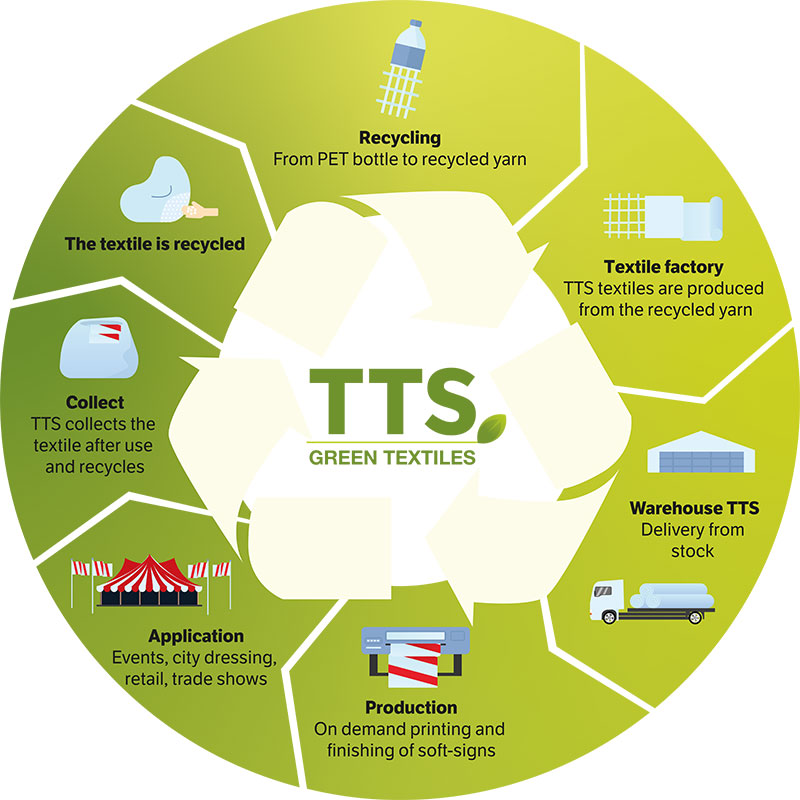
MOORDRECHT, the Netherlands — June16, 2021 — Texo Trade Services (TTS) is helping its customers run their businesses in a socially and environmentally responsible way by launching a sustainable textile line: GREEN Textiles. These products are made from recycled PET yarn, and will allow businesses to meet market demand for eco-friendly print products and make a direct contribution to a sustainable future.

Leading the way in environmentally aware business practices

This launch marks a new era for TTS as it aims to lead the way in corporate social responsibility and environmental awareness. TTS had previously invested in energy-neutral business premises, taken steps to recycle all its waste flows and minimise its use of product packaging. The company set up a Textile Recycling Service to facilitate logistics and offer its customers in the Benelux (and later in Northern France too) the possibility of collecting and recycling used sublimation printed textiles. This gives its soft signage customers the chance to offer circular signage to their own customers.

TTS GREEN Textiles

The whole textile range offered by TTS is already 100-percent PVC-free. This means a huge reduction in waste because products made of polyester are often half the weight of comparable PVC ones. Additionally, polyester textile can be made from recycled PET bottles. However, this still doesn’t always happen, even though demand for sustainable print products is increasing. TTS is set to change all this though with its GREEN textile line: it is offering a green variant of every type of textile, made from 100-percent recycled polyester. The yarn used for this purpose is produced in a sustainable way from recycled PET bottles, without affecting the properties of the original textile.

A high quality, sustainable alternative

TTS has a recycled alternative to almost every form of soft signage that uses both sublimation and UV inks. For example, nonwoven outdoor banners, flag cloth, display cloth and lightbox textile. Not only are festival organizers looking for this kind of product, so are large retail companies, and garments made from recycled yarns are increasingly filling the racks of fashion chains. It would be even better if the chains could follow this trend when decorating their stores. Opting for a green textile variant means choosing quality as well as sustainability.

Posted June 16, 2021

Source: Texo Trade Services (TTS)

Allied Home Launches RENU:700 Bedding Made With Performance Recycled Down

MONTEBELLO, Calif. — June16, 2021— Furthering its commitment to sustainability by helping reduce the massive textile waste that ends up in landfills, Allied Home, manufacturer of quality crafted bedding products designed to give you a better sleep experience, has launched its new RENU:700 Performance Recycled Down bedding, the first of its kind on the market.

By working with a global recycling supply chain, Allied is able to collect post-consumer bedding from Germany, Italy, Russia and North America and reuse the down inside these products for its RENU:700 Performance Recycled Down bedding.

The collected down undergoes an intensive sanitation process at Allied’s facility. It is cleaned using a proprietary DuraWash Method using environmentally safe, bluesign-approved detergents to meet the strictest levels of cleanliness and high-quality standards. The result are down clusters and feathers that are resilient and strong — creating a down quality that is unmatched.

Allied’s RENU:700 Performance Recycled Down bedding, and its supply chain, is certified to the GRS (Global Recycling Standard), an independent certification auditor considered the most comprehensive and stringent Recycling Standard. This certification ensures all material has been collected from post-consumer goods and processed within strict chemical regulations and social compliance guidelines.

“With the future of our planet top of mind, more and more consumers are choosing eco-friendly products from brands that are in line with their values,” said Jonathan Uretsky, COO, Allied Home. “We’ve seen acceptance of post-consumer products increasing and we are very excited to launch an exceptional quality recycled bedding collection that’s been years in the making. Consumers can sleep deeply knowing they made a sustainable impact by choosing to rest on RENU:700.”

The down inside RENU:700 bedding is a lofty 700FP white recycled down, providing you with pillows and comforters that provide the perfect combination of fluffy and soft with ultimate comfort and support. The pillow and comforter shells are made with a 233TC 100% certified organic cotton. Grown free of pesticides, herbicides, and chemical fertilizers, this luxurious, breathable natural-color cotton shell is more sustainable than conventional cotton.

Posted June 16, 2021

Source: Allied Home

Combining Expertise For More Sustainable Fashion

TW Special Report

Ever wonder how much water was used to make your favorite cotton T-shirt? About 2,700 liters, or roughly three years of drinking water. What first comes to mind is probably the water that was essential to growing the cotton crop. Surprisingly, cotton is a drought-tolerant plant, and often less recognized is the strain that can be put on water resources to dye cotton textiles.

Progress is being made across the industry to lessen the strain on our precious water resources. Over the past several years, Dow has collaborated with Cotton Incorporated to research and validate Dow’s product — ECOFAST™ Pure Sustainable Textile Treatment — that can help drastically reduce water and chemical use during the dyeing process. Major fashion brands like Ralph Lauren are integrating it into their supply chain to dye more sustainably, without sacrificing color or quality.

Problem

Cotton dyeing is very resource-intensive and puts strain on local waterways. A large amount of water is used in the dyeing process — up to 5 trillion liters a year, or nearly enough to supply all of humanity with drinking water. Significant amounts of chemicals and dye are needed to get the desired colors consumers expect too. This is part of the reason textile mills account for 20 percent of industrial water pollution globally. Wastewater from the dyeing process can be polluting and require costly treatment and these challenges are found in regions that already face water scarcity.

Solution

Reforming processes in an industry as established as textiles is no easy feat. Collaboration across the sector is needed to bring about sustainable change. With that in mind, Cotton Incorporated approached Dow. They wanted help scaling a cotton technology to support more sustainable textile dyeing. It turned out we were developing a similar technology that had improved performance, and we were looking for help too. Leveraging Cotton Incorporated’s industry expertise and Dow’s material science knowledge, we worked together to understand and validate the benefits of our patented ECOFAST Pure Sustainable Textile Treatment.

How Can Colors Be More Responsible? 

ECOFAST Pure is a pretreatment applied before the dyeing process to produce cationic cotton. This means the charge of cotton is permanently changed from negative to positive, so it acts like a magnet to attract negatively charged dye to the material. How does that benefit the textile mill? It significantly decreases the amount of water, chemicals, dye and energy needed to color cotton. A third party reviewed and validated life cycle assessment, available by request, helped further prove the benefits.

Click to watch the LCA video

Why Is Collaborating Across The Value Chain Essential?

Collaboration is critical for change to be meaningful and sustainable. As a not-for-profit focused on conducting research to benefit every link in the cotton supply chain, Cotton Incorporated has a unique expertise that complements our own. Working with Cotton Incorporated gave important insights about our product in application. Insights that would have taken much longer to discover without the industry expertise they offered.

Together we were able to evaluate the benefits of ECOFAST Pure compared to existing cationic chemistries. This was critical, because cationic cotton isn’t a new concept and this research helped prove our new product was advantaged over others — including no odor in application. We were also able to test compatibility across a variety of popular dyes, connect with expert consultants and more through this collaboration.

Still, Cotton Incorporated and Dow are only two players at two distinct points in the textile value chain. Like we’ve seen in our work with Ralph Lauren, we have to reach further — collaborating with brands, mills and others — to color cotton with integrity. Will you join us?

June 16, 2021


Inkjet Printing Shows Promise As New Strategy For Making E-Textiles

By Laura Oleniacz

In a new study, North Carolina State University researchers demonstrated they could print layers of electrically conductive ink on polyester fabric to make an e-textile that could be used in the design of future wearable devices.

Since the printing method can be completed at room temperature and in normal atmospheric conditions, researchers believe inkjet printing could offer a simpler and more effective method of manufacturing electronic textiles, also known as e-textiles. In addition, researchers said the findings suggest they could extend techniques common in the flexible electronic industry to textile manufacturing. They reported their findings in the journal ACS Applied Materials & Interfaces.

“Inkjet printing is a rapidly advancing new technology that’s used in flexible electronics to make films used in cellphone displays and other devices,” said the study’s corresponding author Jesse S. Jur, professor of textile engineering, chemistry and science at NC State. “We think this printing method, which uses materials and processes that are common in both the electronics and textiles industries, also shows promise for making e-textiles for wearable devices.”

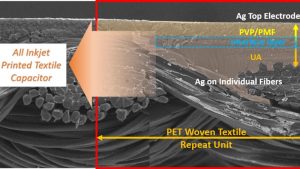
In the study, researchers described how they used a FUJIFILM Dimatix inkjet printer to create a durable and flexible e-textile material, what they did to reliably create the e-textile, and its properties. Part of their challenge was to find the right composition of materials so the liquid ink would not seep through the porous surface of the textile materials and lose its ability to conduct electricity.

“Printing e-textiles has been a very big challenge for the e-textile industry,” said the study’s first author Inhwan Kim, a former graduate student at NC State. “We wanted to build a structure layer by layer, which has not been done on a textile layer with inkjet printing. It was a big struggle for us to find the right material composition.”

They created the e-textile by printing layers of electrically conductive silver ink like a sandwich around layers of two liquid materials, which acted as insulators. They printed those sandwich layers on top of a woven polyester fabric. After they printed the layers of silver ink and insulating materials — made of urethane-acrylate, and poly(4-vinylphenol)  –— they monitored the surface of the material using a microscope. They found that the chemical properties of the insulating materials, as well as of the textile yarns, were important to maintaining the ability of the liquid silver ink to conduct electricity, and prevent it from penetrating through the porous fabric.

“We wanted a robust insulation layer in the middle, but we wanted to keep it as thin as possible to have the entire structure thin, and have the electric performance as high as possible,” Kim said. “Also, if they are too bulky, people will not want to wear them.”

The researchers evaluated the electrical performance of the e-textile after they bent the material multiple times. They tested more than 100 cycles of bending, finding the e-textile didn’t lose its electrical performance. In future work, they want to improve the materials’ electrical performance compared to e-textiles created using methods that require special facilities and atmospheric conditions, as well as increase the material’s breathability.

Eventually, they want to use the printing method to create an e-textile that could be used in wearable electronics such as biomedical devices that could track heart rate, or used as a battery to store power for electronic devices.

“We were able to coat the ink on the fabric in a multi-layer material that’s both durable and flexible,” Kim said. “The beauty of this is, we did everything with an inkjet printer – we didn’t use any lamination or other methodologies.”

The study, “Microstructures in All-Inkjet Printed Textile Capacitors with Bilayer Interfaces of Polymer Dielectrics and Metal-Organic Decomposition Silver Electrodes” was published online in ACS Applied Materials & Interfaces. In addition to Jur and Kim, the other authors were Beomjun Ju, Ying Zhou and Braden Li. It was funded by VF Corp. The authors also acknowledge Liquid X Printed Metals for the preparation of the reactive silver inks used in this study. The authors acknowledge the U.S. Department of Defense and the Air Force Research Laboratory for provision of the Science Mathematics and Research for Transformation (SMART) scholarship to Li. This work was supported by the National Science Foundation through Nanosystems Engineering Research Center for Advanced Self Powered Systems for Integrated Sensors and Technologies under Grant EEC 1160483.


Editor’s Note: Laura Oleniacz is Public Communications Specialist at NC State News Services.


June 16, 2021

Beaver Paper Group Appoints Allen Wheeler TexSewn® Product Manager

ATLANTA — June15, 2021— Beaver Paper Group, a manufacturer of sublimation media and TexSewn® cut & sew papers is pleased to announce the promotion of Allen Wheeler to the new position of TexSewn® product manager.

As the new TexSewn Product Manager, Wheeler will play a pivotal role in generating new sales and market opportunities for Beaver Paper’s TexSewn product portfolio.  Wheeler is responsible for developing new products and initiatives that will increase sales and awareness for the brand.

“We are thrilled to have Allen move into this leadership position. He is extremely knowledgeable about the Sewn Products industry and will be key in developing new markets for TexSewn,” explained Tobias Sternbeck, CEO of Beaver Paper. “Allen’s deep industry knowledge and experience makes him a perfect fit for his new role.”

“I am honored to be able to use my extensive experience to spearhead and breathe new life into a legacy product line that is still heavily used in the sewn products industry,” Wheeler said.

Wheeler has been with Beaver Paper for more than six years in progressive roles including National TexSewn Sales Representative and Southeast Regional Sales Representative before being promoted to his new management position.

Posted June 15, 2021

Source: Beaver Paper Group

Sponsors