RESEARCH TRIANGLE PARK, N.C. — June 14, 2021 — AATCC is happy to announce the winners of the 2021 Pitch It to Win It Student Competition.
The Herman and Myrtle Goldstein Undergraduate Student Competition is intended to highlight projects conducted by students from all areas of the textile/apparel supply chain. Projects submitted may include academic research, technology and/or process investigations, and literature reviews. This competition is designed to enhance the textile education experience for student members of AATCC. The intent is to encourage independent student projects both within the USA and internationally.
First Place ($1,000 prize): Sophia Luu
Project: Optimizing 3D Fashion Design Software for Physically Disabled Populations
Major: Apparel, Merchandising, and Design: Creative and Technical Design
School: Iowa State University
Luu said: “The Pitch It to Win It competition has helped me learn how to communicate very discipline-specific research endeavors into accessible presentations that anyone can understand and glean significance from. Additionally, this competition has further broadened my understanding of 3D fashion CAD systems and aspects that can be improved for inclusive apparel design purposes.”
Trippiedi said, “Participating in the AATCC Pitch It to Win It competition gave me the freedom to ignite my passions and challenged me to explore the limits of endless possibilities.”
Major: Fashion Merchandising & Apparel Product Development
McKee said: “This competition taught me to be thorough in my work and to always back up my claims. As the process went on, I learned more and more about sustainability, humbling me on the amount of information I thought I already knew.”
JÖNKÖPING, Sweden — June 14, 2021 — Coloreel, with its unique patented technology for digital dyeing of textile thread on-demand, is entering the next phase in the efforts to scale up the company globally. Sven Öquist, with a background from Polestar, has recently been recruited as the new vice president of Sales.
Coloreel, a Sweden-based textile innovation brand, has developed a pioneering technology that enables high-quality digital dyeing of textile thread on-demand, creating sustainable and vivid fashion details. Coloreel began efforts to scale up the global presence last year, targeting a market valued over 25 billion Swedish Krona ($3 billion).
At the beginning of 2021, it was clear that Robur Ny Teknik would invest 100 million Swedish Krona (12 million) to support Coloreel’s market expansion and future growth. As a result, recruitment has been done to strengthen the sales organization with a new vice president of sales. Öquist, who previously was responsible for driving the sales expansion at Polestar, has recently taken on the role.
Mattias Nordin, CEO Coloreel, commented: “We are now seeing how the markets are starting to reopen after a period that has been marked by the effects of the pandemic. We operate in the textile and fashion industry and notice clear signs from our customers that production is picking up to a more normal pace again, not least when leading fashion fairs plan to be carried out according to plan during the late summer. This means that we are now scaling up to reach the global market with our innovative product. We have already come a long way, but the time is now right to increase our efforts as our goal is to reach a billion SEK in turnover within five years. Sven Öquist is perfect for the role of Vice President Sales with his previous experience of driving up sales volumes and developing sales organizations both in Sweden and internationally.”
Öquist commented: “Getting the opportunity to enter such a news-thirsty market is very exciting. Coloreel’s product will fundamentally change the industry. My job now will be to build on, strengthen and develop the sales organization with the goal of scaling up the company. The product has a unique patent foundation that gives me the opportunity to do this in the right way. To be able to participate and work with such an innovation, which has an enormous ‘tech height’ and development potential, is extremely motivating for me. The fact that it also provides significant sustainability benefits makes me extra proud to take on my new role.”
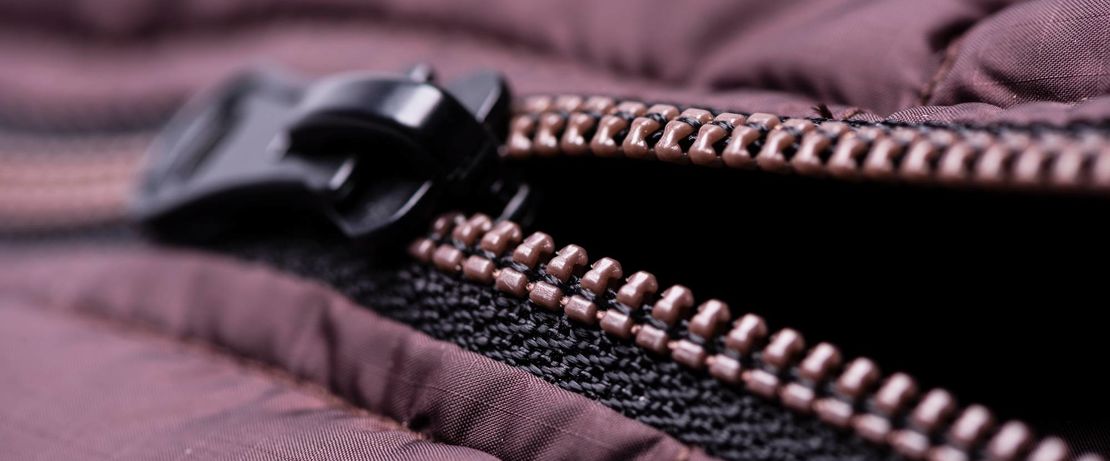
More and more customers are also paying attention to sustainability when it comes to fashion and clothing. But garments are more than fabric — after all, there are also yarns, fibers and applications such as zippers. All the better if they are also made from the same biobased solutions: from biobased VESTAMID® Terra.
“The zipper is a rather complicated product,” said Gabriele Mosso, suspecting that his comments will probably surprise some people. This everyday object, that’s so familiar to us all, which we have relied upon for so long to close jackets, bags or bed linen — undoubtedly an ingenious concept, but: complicated, really?
“It’s a fascinating object,” Mosso affirmed. As head of the Italy-based zipper manufacturer Nyguard for 15 years, he calls himself a “zipper maniac” with a wink and knows what he’s talking about. For a zipper to function smoothly a lot of detailed work is required, the right material, the exact shape. The teeth must mesh smoothly, must not get stuck, must not falter. And the fastener must literally integrate seamlessly into the tape. The idea for the zipper was born 125 years ago, at that time using sliding metal clasps. But the first versions all failed because they were cumbersome or quickly snagged. “In recent decades not much has changed about the basic idea for zips,” Mosso said. But the details have. Today, the clasp is mostly made of plastic and the strap is also synthetic.
Circulation Is The Target
This is where material development meets sustainability. More and more consumers feel a lot more comfortable when they feel that their consumption is not contributing to growing mountains of waste. So what could sustainable fashion look like? Recycling garments would be one variant: “Recycling materials is generally difficult when different materials are firmly bonded together,” Mosso said. That’s as true for composite packaging as it is in this case for pants with zippers. Different types of synthetic textiles and accessories are difficult to properly separate.
The same applies for certificates of origin for these various individual parts. The apparel industry is well-known for sourcing numerous components from completely different countries and production locations — from yarn, to buttons and zippers. “The latest challenge in textile is to achieve a complete traceability and circularity in value-chain. A process in which all the synthetic textiles and accessories could be recycled together” said Alan Garosi, head of Marketing at Fulgar, the Italy-based manufacturer from which Nyguard obtains the yarn for its zipper tapes.
Aware of that, Mosso added: “Why not make the zipper out of the same material as the tape it’s attached to? From plastic, sure, but why not from a more sustainable, biobased plastic. And even better: from a material that would also be suitable for use to make the complete garment?” This would at least bring us a decisive step closer to the possibility of recycling clothing. Even if there is still a long way to go before this vision is realized, because some details of clothing recycling still have to be invented — the prerequisites on the part of the manufacturers would be created.
It is precisely for orders like these, for outdoor and luxury clothing, that Fulgar also sees the close cooperation with Nyguard’s zipper manufacturers as a real benefit: “After all, we also have to think about the end of life of our products,” Garosi said. “If it becomes easier to recycle a garment, then that’s a meaningful thing for all sides.” That, in turn, pays into the larger issue of sustainability.
“A few years ago, companies were interested in sustainable zippers but not yet willing to pay for them,” Mosso added — an experience that matches that of Fulgar. But now, that has changed, and in 2020 in particular, demand has increased significantly. For Mosso, this is proof that his decision to fully focus on biobased plastics was the right one.
In the meantime, he is increasingly approaching customers with custom-made model designs of combinations of zipper and yarn, both of which are made using VESTAMID Terra. “We’re sort of doubling our sales strength there,” Mosso said. “It’s true co-marketing. And it’s highly successful because it hits just the right nerve.” Especially since, to his knowledge, he remains the only supplier currently offering zippers made from biobased materials. “That’s because we were early adopters of it, and our production process is already very well set up for it.” He winks. The zipper — that is, after all, a thoroughly complicated product in some details.
Create A Targeted Niche
After some market research, Gabriele Mosso found what he was looking for at Evonik. The specialty chemical company’s VESTAMID Terra is a nylon made entirely from biobased material, castor oil to be precise. This is a raw material that is inedible for many animals so is not used as a food source, or as animal feed. Additionally, since the plant known as the “miracle tree,” tolerates dry soils and drought, cultivation of the renewable raw material does not compete with land used to grow food. This makes it an ideal plant for use in biobased solutions. At Nyguard, the decision was made about four years ago to move consistently in this direction. “We can’t compete with really big companies anyway — so we purposefully created a niche for ourselves,” Mosso said. Nyguard still occasionally produces zippers from plastic that is not biobased: “But the proportion of renewable raw materials is moving strongly toward 100 percent.”
Cooperation With Yarn Producer Fulgar
Another special idea of Mosso’s, also contributes to this successful conversion: He has sought cooperation with textile manufacturers in order to help convince his customers of using only products that are made of just one material. In this case, with Fulgar.
“The plastic from Evonik was an extremely good match for the polyamide we had been using,” Alan Garosi said. That’s because spinning a yarn from plastic requires detailed knowledge and expert experience. “Especially for high-quality textiles, plastic yarns need a high level of quality and purity,” he adds. Fulgar entered into a close exchange with Evonik, and both sides learned from each other as he describes: ”After a whole series of trials, we had found the formulation that worked best for us.” As a marketing executive with twelve years of experience at Fulgar and a long-term commitment to sustainability in textiles, he adds, “I’m watching the market and noticing a significant shift toward sustainability in the fashion and apparel industry in recent years.”
Textiles Made Using Bio-Based Fibers: Is It Possible?
Initially, it was just a curious interest from Fulgar’s customers: Textiles made from biobased solutions — would such a thing be possible and what would it look like? “But for about three years now, the topic has been picking up enormously,” Garosi noted. This is especially the case in the premium segment. Fulgar produces 36 million kilos of yarn per year, and here it has made a name for itself in the high-tech yarn sector, as well as with sustainable materials — even if these still make up a comparatively small share. The yarn that Fulgar produces from VESTAMID Terra is marketed under the brand name “EVO® by Fulgar”, an elegant, artistic nod to Evonik.
“Fulgar was the first company to recognize the opportunities for textiles made from VESTAMID Terra,” said Johannes Krampe, manager, Filaments, at Evonik’s High Performance Polymers business line. Evonik, in turn, was the first company on the market to think more broadly about the possible areas of application for a biobased plastic such as VESTAMID Terra: “We are really noticing how much the sustainability topic is now present in the industry,” Krampe said. More and more companies are responding to this desire on the part of their customers “not to be part of the throwaway society,” as Krampe puts it.
Plant Products From The Factory
“Particularly among customers, the term polyamide is still anchored in their minds as something artificial,” Garosi noted. After all, the term “plastic” already expresses that. “For many, it’s not very easy to understand that something made in a factory is actually a thoroughly plant-based thing.” In this regard, Fulgar was particularly excited about the fact that VESTAMID Terra is a 100 percent biobased material — and that its cultivation is not in competition with food production. “Many other fibers are made from sugar cane or similar materials that do place demands on the land. That’s one of the really central strengths and advantages of VESTAMID Terra,” Garosi said.
But for a yarn producer, VESTAMID Terra offers even more advantages. “The synthetic fiber is also extremely good in moisture management and also in coverage,” Garosi elaborates. With a comparatively lightweight fabric made from it, the wearer feels better protected from the wind and cold. In addition, moisture evaporates better with VESTAMID Terra than with comparable petrochemical-based nylons. This makes VESTAMID Terra an interesting alternative for sports and outdoor clothing, among other things, as well as for underwear. “But we also now have enquiries from producers of evening wear and luxury fashion,” Garosi said. In this segment, Fulgar is also well connected due to its high-quality production. Two years ago, Fulgar even supplied its EVO yarn to a shoe manufacturer.
MIGDAL HAEMK, Israel — June 15, 2021 — NILIT has announced that the company will sponsor a pioneering German-Israeli partnership to advance textile circularity. The initiative will officially launch with the Circular Textiles Business Matchmaking Showroom, organized by Re-Fresh Global, opening on 17 June at Expo Tel Aviv. The showroom kicks off a year-long exchange program between German and Israeli experts in sustainability, circularity, and textile waste management. The project is supported by the German[1]Israeli Future Forum Foundation.
“This innovative partnership aligns perfectly with NILIT’s goal to positively influence the textile and apparel industry to use more sustainable products in more responsible ways,” said Ilan Melamed, NILIT general manager. “NILIT has been recognized for improving our manufacturing footprint by increasing our use of clean energy, reducing emissions and waste, and introducing responsible new products that target specific ecological challenges. We look forward to connecting with other sustainability-minded companies to further advance our environmental initiatives.”
“Israel’s image as the Startup Nation has been key to creating tremendous impact on various industries,” said Viktoria Kanar for Re-Fresh. “It’s about time to show our excellence in sustainability and circular economy innovation. This showroom, and the German-Israeli expert exchange program it’s based on, is a first step toward developing new solutions and technologies that will create a new cleaner and circular global fashion and textile industry to benefit all humankind and the environment.”
Under its Total Product Sustainability program, NILIT manufactures the largest portfolio of sustainable premium nylon 6,6 performance and fashion fibers and yarns in the industry. The company recently launched several new products in its Sensil® consumer brand portfolio that are specifically targeted to the industry’s most pressing environmental challenges. Sensil®WaterCare eliminates 100-percent of the water used in the typical wet dyeing process and Sensil® BioCare contains technology that reduces any impact on oceans caused by microfiber shedding.
“The breakthrough ideas in sustainability and circularity require collaboration across the entire textile value chain,” continued Melamed. “At NILIT, we leverage the creativity of our employees and our vendor and customer partnerships. We are confident that this special German-Israeli exchange program will further expand our scope and help achieve dramatic improvements in our industry’s environmental footprint.”
NEW YORK — June 15, 2021 — Ralph Lauren Corp. today announced its goal to achieve net zero global greenhouse gas (GHG) emissions from its operations and its value chain by 2040. The company also published a detailed Net Zero Commitment Statement, its strategy for achieving net zero and advancing established sustainability targets. This new strategy builds on the company’s existing GHG reduction commitment to lower absolute GHG emissions across its operations and supply chain by 30 percent by 2030 compared to Fiscal 2020 levels. It includes scaling investments in credible, nature-based carbon removals, starting with an initial partnership with Indigo Ag, the first scalable, registry-approved carbon credits for agriculture.
“Climate change is one of the most complex and challenging issues of our time — one that will require innovation, collaboration, technology and a fundamental shift in behavior to solve,” said Patrice Louvet, president and CEO, Ralph Lauren Corp. “Our net zero goal and roadmap are anchored in our belief that through deliberate action we can deliver the change required to reduce our climate impact and help create a more sustainable future for generations to come.”
The Company’s net zero approach entails reducing scope 1 and 2 emissions by using 100% renewable power in its stores, offices and distribution centers by 2025. To reduce emissions from scope 3 sources resulting from making its products, Ralph Lauren will collaborate with suppliers through collective actions and strategic programs to drive down GHG emissions in manufacturing facilities. Moreover, it plans to reduce GHG emissions from its raw materials by switching to preferred fibers with lower emissions impact than conventionally-grown fibers.
In the coming years, Ralph Lauren expects to expand its emissions reduction tactics to include collaboration with suppliers through collective action programs that accelerate the standardized approach to setting carbon targets and low-carbon action plans at the factory level, further empowering those partners to establish and implement climate strategies aligned with Ralph Lauren’s net zero objectives. Ralph Lauren’s net zero plan extends beyond reducing GHG emissions from its operations and suppliers in its value chain. For emissions that cannot be reduced through Ralph Lauren’s direct actions and collective initiatives, the company will purchase high-quality, verifiable carbon removals equivalent to its residual GHG emissions by 2040. To that end, beginning in Fiscal 2022, Ralph Lauren will commit to carbon removal projects in partnership with Indigo Ag, an ag-tech company dedicated to improving the profitability, sustainability and social responsibility of the agriculture system. Through the Indigo Carbon program, Indigo Ag supports farmers in adopting new beneficial farming practices; measures and validates the resulting carbon sequestration and emissions abatement; and allows companies to directly support farmers’ transition through the purchase of verified agricultural carbon credits.
Aligned with its commitment to the climate goals identified in the Paris Agreement, Ralph Lauren’s new net zero pledge is its latest significant move to aid in mitigating the impact caused by its global operations and a key component of Design the Change, the company’s Global Citizenship & Sustainability strategy. The company’s net zero progress will be reported yearly in its annual Global Citizenship & Sustainability Report, a fully detailed corporate environmental and social status update on its sustainability approach.
EBENE, Mauritius — May 15, 2021 — One hundred percent digital, CIEL Textile is pleased to present its first sustainability report developed in accordance with GRI standards. The report entitled “Winning Well” provides a transparent overview of the current state of the Group’s sustainability achievements and progress. It demonstrates CIEL Textile’s objective to be a “Sustainable Global Fashion Partner” for leading international fashion brands.
Eric Dorchies
“After a year marked by the COVID-19 pandemic, the publication of this report demonstrates our commitment to sustainable development, which is at the heart of our corporate strategy and vision” said Eric Dorchies, CEO of CIEL Textile.
“We are merely in the starting blocks, yet we are determined to contribute at our level to this global issue, by accelerating our efforts in terms of Sustainable Fashion, by working together with our customers and partners to be more respectful towards our planet and our communities. The stakes are high, whether in terms of reducing our carbon emissions, improving working conditions or product traceability, but we are convinced that this is the only way forward for the future of our Group”, adds Pami Kular, Head of Sustainability for CIEL Textile.
Pami Kular
The report covers the period July 2017 to June 2020 and shares the data for the environmental, social and corporate governance (ESG) of CIEL Textile operations which includes 18 production sites and nearly 18 000 employees. The report introduces the group’s approach and actions implemented to improve its ESG performance.
Activate climate response
Commitments:
Zero Coal as boiler fuel by 2030
Achieve 35% renewable energy by 2030
50% reduction in waste to landfill by 2030
Under this section, it is worth noting that:
CIEL Textile joined the Sustainable Apparel Coalition (SAC) in 2017, becoming the first Sub-Saharan African member of this global alliance.
In 2019, Aquarelle’s factory in Samudra, India, was awarded the LEED Platinum Certification—the highest distinction for green buildings—making it one of the first apparel eco-factories in India.
Around 50,000 trees were planted in 2019 as part of carbon offsetting activities.
100% of the effluents are treated before discharge using effluent treatment plants (ETP).
Foster a vibrant workforce
Commitments:
35% Women at Management level by 2030
100% employees trained on Ethics and Sustainability by 2023
Under this scope, CIEL Textile indicates that:
98% of the workers are permanently employed.
Regular audits of all production sites are carried in accordance with the IFC performance Standards for human rights.
Through its Leadership and Management Academy 361°, CIEL Textile trained 2,500 employees in best practices for operational excellence and managements techniques.
Champion inclusive growth
Commitments:
·Advocate for 30% Certified & Recycled raw material usage by 2025 & 50% by 2030
Advocate for Higg Index tools adoption in our value chain representing 80% of business volume, of which 50% verified by 2030
Under this heading, it is interesting to note that:
91% of the product mix is made out of 100% natural raw materials
18,000 employees spanned in 4 countries participated in the annual group initiative “Act For Our Community” and voluntarily devoted their time to support community driven events.
CIEL Textile provided rigorous control and monitoring over its 1 150 suppliers and partners
CIEL Textile has taken initial steps to develop circular economy solutions, having created a 100% recycled shirt, as well as a 100% “waste-to-wear” sweater
“Save the date for the release of our 2nd report in 2023 which, we hope, will show many positive advances in all our initiatives” said Pami Kular.
“I firmly believe that our future lies in our ability to transform our industry through smart design, innovation and sustainable supply chains while offering products at competitive prices,” concluded Eric Dorchies.
Read the full report and discover the group’s performance and sustainable development initiatives online on: https://www.cieltextile.com/sustainability-report-2020.pdf
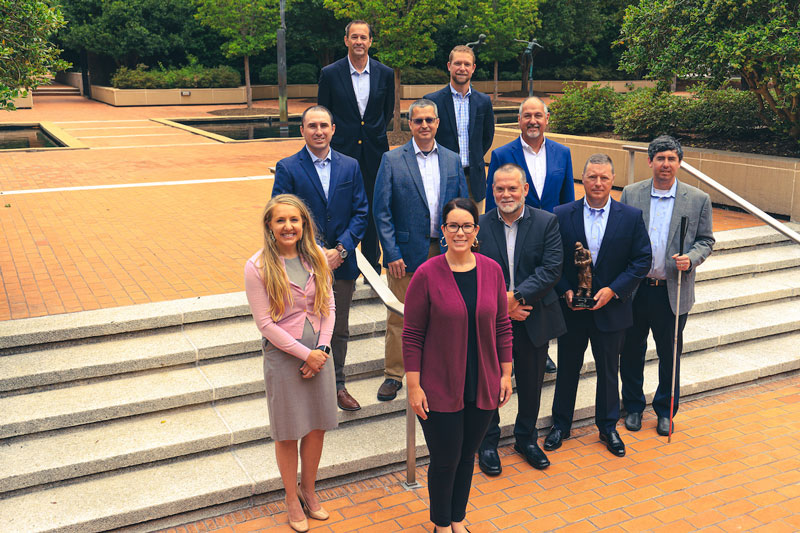
Front row (left to right): Meg Patel, marketing manager, Government and Defense, Milliken; Nicole Ducouer, senior director communications, IFB; David Horton, president and CEO, IFB; Erik Cobham, director Business Development, Government and Defense, Milliken; and Danny Kelly, executive vice president, IFB. Middle row (left to right): Sean Murphy, Senior Account Manager, Government and Defense, Milliken; Silas Martin, COO, IFB; and Randy Buckner, vice president, Asheville Manufacturing, IFB. Back row (left to right): Bruce LaFlam, vice president, sales and marketing, Government and Defense, Milliken; and Matt Gilreath, CFO, Textile Division, Milliken
SPARTANBURG, S.C. — June 15, 2021 — Milliken & Company has been named Partner of the Year by IFB Solutions. In its 15th year, the prestigious award is given to the partner who has stood out as an organization that has gone beyond the board room to support opportunities for people who are blind. Milliken was selected from more than 400 IFB vendors.
“It’s an honor to receive an award of this caliber from a partner like IFB,” said Chad McAllister, executive vice president of Milliken & Company and president of the Textile Division. “IFB has shined a light on how to do business for good, going above and beyond to positively impact their community. We are honored to call them a partner and look forward to continuing to support their mission for years to come,” he adds.
Milliken has been working with IFB, a US-based manufacturer who provides employment to people who are blind or visually impaired, since 2008 as a U.S. military fabric supplier. Since then, the partnership has provided more than 245,000 hours of work for people who are blind or visually impaired. In addition to the business relationship, Milliken has donated more than $30,000 to IFB over the years to support jobs, training and services for the blind.
“All of us at IFB Solutions are incredibly grateful to the Milliken & Company team for their contributions to our mission. As a non-profit, our mission is to provide opportunities for people who are blind or visually impaired in need of training, employment and services. For more than a decade, our partnership with Milliken has provided countless opportunities for adults and children who are blind all over the country resulting in thousands of lives changed for the better,” said David Horton, president and CEO of IFB Solutions.
WINSTON-SALEM, N.C. — June14, 2021— HanesBrands, a global supplier of iconic apparel brands, today announced that William S. Simon has been appointed to the company’s board of directors.
With the appointment of Simon, whose term runs until the 2022 annual meeting of stockholders, the company’s board has 10 members. Simon will serve on the board’s audit committee.
“Bill brings extensive experience leading complex organizations and building global brands,” said Steve Bratspies, CEO, HanesBrands. “His knowledge of retail and consumer goods will be extremely valuable as we unlock growth by delivering innovative products and creating a seamless consumer experience.”
Simon is a senior advisor to the investment firm KKR & Co. and president of WSS Venture Holdings LLC, a consulting and investment company. From 2010 to 2014, Simon served as president and CEO of Walmart U.S. Before that, he was COO of Walmart U.S. He joined the company in 2006 as executive vice president of professional services and new business development.
Simon has also held senior executive positions at Brinker International Inc., Diageo North America Inc. and Cadbury Schweppes plc. Simon also served as secretary of the Florida Department of Management Services and served 25 years in the U.S. Navy and Naval Reserves. He currently serves on the board of Darden Restaurants Inc.
Simon holds a bachelor’s degree in economics and a master’s degree in business administration from the University of Connecticut.
“We’re thrilled to have a leader with Bill’s outstanding experience join our board,” said HanesBrands Board Chairman Ronald L. Nelson. “We welcome Bill and look forward to working with him as we execute our Full Potential plan.”
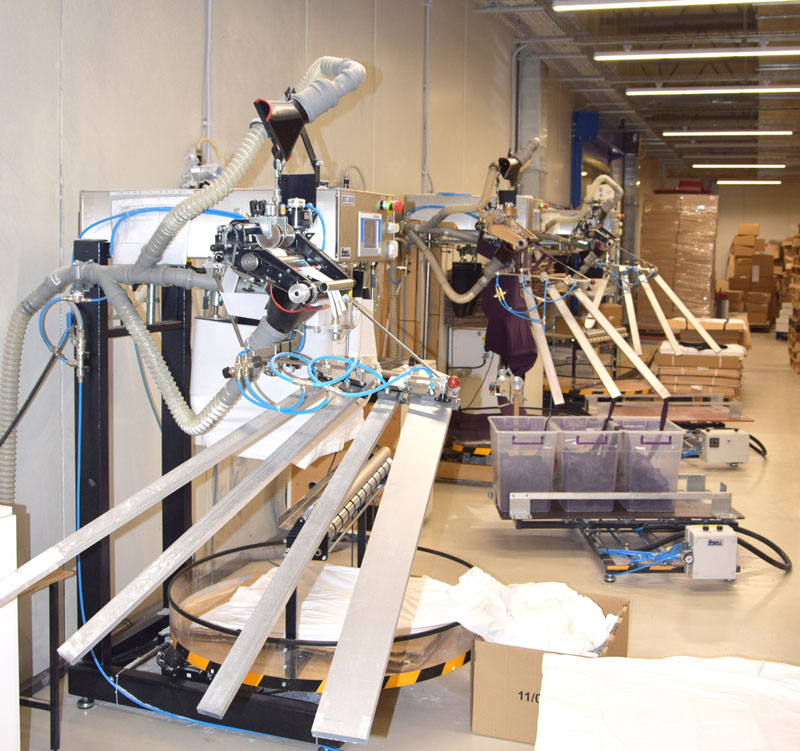
The latest Svegea collarette band cutting machines in operation at Triteks Trejd in Prilep, North Macedonia.
TW Special Report
Founded in 1952, Svegea of Sweden — a member of TMAS, the Swedish textile machinery association — has more than 60 years of experience in exclusively designing, manufacturing and installing the highest quality collarette band cutting machines worldwide.
These are used by garment manufacturers around the world for the production of tubular apparel components such as waistbands, cuff and neck tapes and other seam reinforcements.
Much has changed, of course, since the company’s formation, when its earliest technologies had operational speeds of around 360 meters per hour.
Today, Svegea’s most productive collarette machine has an output of 20,000 meters per hour.
Garment manufacturing was also still a dominant industry across Europe in the first decades of Svegea’s existence, largely enabled by such automatic machine production. Inevitably, however, labor costs, especially for sewing machinists, became too high in many countries in Europe.
As a result, companies began moving their operations, first to nearby lower-wage countries and then inevitably to Asia and the Far East, which is the main destination for Svegea’s collarette machines for knitwear today. At the same time, the company’s expertise has been increasingly turned to the development of bespoke machines for the production of special technical textiles and tailor-made units for specific niche applications.
Resilience
The recent Covid-19 situation is now leading to the reshoring of certain niche textile production operations in Europe — most notably in face masks and medical gowns, but also fast fashion items — following the realization that total dependence on overseas suppliers with long lead times is unwise.
From the early 1990s until just recently, however, only the most resilient garment manufacturing companies with highly-automated processes and strong brands retained production in Europe.
This makes Svegea customer Triteks Trejd somewhat unique.
Founded in 1994, this family-owned business employs over 280 people at its plant in Prilep, North Macedonia, where high quality cotton fabrics are expertly converted into the products of the Tritex Underwear brand.
The Prilep operation encompasses the processing of fabrics, design, cutting, sewing, quality control and packing in a fully integrated workflow.
“We constantly monitor market and fashion trends, and our team of designers creates collections that meet the needs of the most demanding consumers,” says Plant Manager Dejan Naumoski. “Our high quality cotton fabrics are chosen through a stringent selection process and we work to the relevant ISO 9001 standards.”
With around 200 sewing machinists, the Tritex product range encompasses briefs, boxers, slips, t-shirts, pyjamas and body slips which are primarily sold to countries within the European Union, as well as the domestic market.
The company has also just completed the digitalisation of its full production via the in-house DPC-SYS system, installing around 200 industrial PCs linking each of its workstations and departments.
Triteks Trejd employs 200 sewing machinists at its Prilep plant.
E-commerce
“This was a nice challenge, and we now have all data in real time across all of our operations,” says Dejan. “Of course, we also make the most of the benefits that our country has to offer,” “The business climate here is relatively stable, there are qualified and productive workers, the textile industry is highly flexible to the market’s needs, and the country’s proximity to EU countries, as well as well-developed transport and logistics, are certainly a big plus. We also have a very efficient e-commerce operation which is essential in today’s marketplace.”
Triteks Trejd currently operates three of the latest Svegea collarette cutting machines and is highly satisfied with their performance, as well as the service provided by the Swedish company.
“In recent years, Triteks Trejd has replaced its original Svegea collarette machines with our latest highly-automatic units with True-Drive control systems,” says Svegea Managing Director Hakan Steene. “They are also equipped with Dust Phantom units to ensure an optimum working environment through the efficient removal of dust and lint. Festooning of the trim from the machines directly into boxes, rather than winding them onto rolls, also ensures less breaks in production for the sewing machinists, with less stretch from the endless material produced.”
“The latest machines are simple to operate, and we are very impressed with their precision, as well as with the waste reduction that is achieved through their use,” adds Dejan. “Any problems that may occur are rare and easily solvable and so far, service has been online via viber or mail, and it’s always fast and helpful.”
For TMAS Secretary General Therese Premler-Andersson, the relationship between Triteks Trejd and Svegea is a good example of how Swedish textile machinery manufacturers are contributing to production in Europe.
“With a high level of automation and expertise in many areas of technology, TMAS members support the competitive edge of the European textile industry,” she says. “Today, business is about much more than just supplying machines or technologies. As suppliers our members understand and are prepared to integrate with the procurement, administration and production and stock handling operations in order to create complete, intelligent systems. This means working closely with customers and supplying a constant flow of ideas on efficiency, quality improvements, reduced waste and adapting for automation.”
BANGKOK, Thailand — June14, 2021— Indorama Ventures (IVL), a global chemicals producer, has completed its acquisition of CarbonLite Holdings’ facility in Texas as part of the company’s commitment to increasing PET recycling capacity.
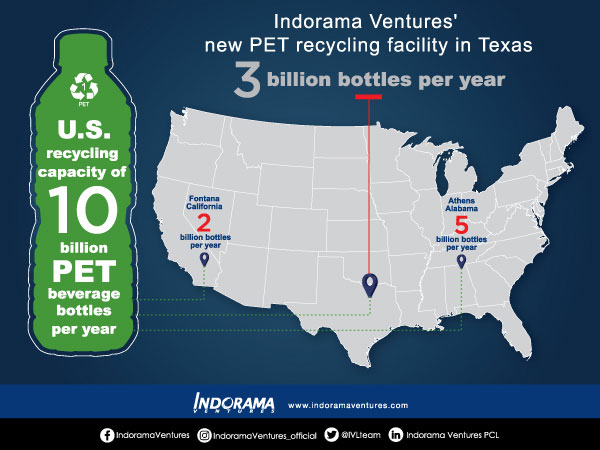
Now known as Indorama Ventures Sustainable Recycling (IVSR), the Dallas site is one of the largest producers of food-grade recycled pellets (Recycled Polyethylene Terephthalate or rPET) in the United States, with a combined capacity of 92,000 tons annually. The facility will recycle more than 3 billion PET plastic beverage bottles per year and support more than 130 jobs directly. IVL is the world’s largest producer of recycled PET for beverage bottles. With this acquisition, IVL expands its U.S. recycling capacity to 10 billion beverage bottles a year, towards its global target of recycling 50 billion bottles (750,000 metric tons) annually by 2025.
Thailand-based Indorama Ventures entered the U.S. PET market in 2003. In 2019, the company acquired recycling facilities in Alabama and California, bringing a circular business model to its U.S. operations. The new acquisition in Texas allows IVL to better serve customers’ increasing need for recycled PET for beverages. America’s leading beverage companies have launched the ‘Every Bottle Back’ project to support the circular plastics economy by reinforcing the value of their fully recyclable PET bottles among consumers.
D. K. Agarwal, CEO of Combined PET, IOD and Fibers Business at Indorama Ventures, said, “We are excited to have completed this acquisition and welcome new employees to the Indorama Ventures family. Dallas now joins Indorama Ventures recycling sites around the globe, dedicated to giving new life to post-consumer beverage bottles. We are also pleased to support more than 130 green jobs for the Dallas community. Indorama Ventures Sustainable Recycling, as it will now be known, will complement our existing PET and fibre businesses in the US. By providing an expanded global recycling presence, we will meet the growing needs of our customers.”
Yashovardhan Lohia, chief sustainability officer at Indorama Ventures, said: “Plastic waste has no place in our environment. By recycling 10 billion beverage bottles in the U.S, we are diverting waste away from the environment and back into the economy. The unique PET plastic used in beverage bottles is fully recyclable. Consumers want sustainable packaging and global brands are using more and more recycled content in their bottles. This recycling facility supports customer needs and consumer wants. We are delivering the infrastructure America needs to close the loop, enhancing our approach to sustainability with the Deja™ brand platform to build a circular economy for PET plastic beverage bottles”.