Improved Technologies Offers New Textile Printers

Improved Technologies, Tilton, N.H., has introduced two wide-format, ink-jet printers for textile
and apparel use. I-Jet is a six-color, piezo ink-jet printer available in 46- and 62-inch-wide
formats.IXIA (pronounced zia) is based on the IRIS 3047 platform but incorporates a new print
engine using hertz technology.Both printers are compatible with major CAD programs such as U4ia
from Lectra Systems, Vision from NedGraphics and Pointcarrrom PointcarrSA.

September 2001

William Tatham Offers Advanced Auto Doffing System

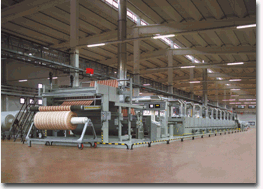
William Tatham Ltd, United Kingdom, has developed an auto doffing system that removes full spools
operating at speeds of up to 60 meters per minute (m/min). The unit has been applied to an existing
free-standing creel on a 2.5-meter-wide Tatham carpet yarn set. The new system can be fitted to all
similar creels.The system operates with three synchronized drives that automatically transfer the
rovings to the new spools and deliver the compact, high-density packages to the front creel, ready
to be unloaded.The design enhances conditions with bobbins 1,500 millimeters long, weighing up to
17 kilograms. Because the system eliminates the lifting of heavy condenser spools in awkward
conditions in mills, it complies with European legislation on manual handling and safe working
practices.William Tatham has partnered with Westwood Yarns, United Kingdom, for development of the
new design.

September 2001

Duro Buys Balson Hercules Apparel Lining Business

Duro Industries, Fall River, Mass., has purchased the apparel lining business from The Balson
Hercules Group Ltd., a wholly owned subsidiary of New York City-based Consoltex (USA). The purchase
includes the Balson Hercules name.The company, now run as a wholly owned subsidiary of Duro, is
called Balson Hercules/Duro Inc. William Milowitz, former senior vice president of apparel and
textile operations, Consoltex, has joined Duro as president of the new subsidiary. John Iason,
former vice president of apparel linings, Consoltex, has also joined Duro.Duro has been greatly
strengthened in recent months with new financing and new business, and we saw this as a very
desirable opportunity to protect and expand our market position, said Andre Laus, president and
CEO, Duro. Its a big win for us. We gain the knowledge and experience of excellent industry people
like William Milowitz and John Iason, as well as business from some of the countrys best names in
apparel.

September 2001

September 2001


Jim Beard
has joined
828 International Trading Co., Greenville, S.C., as vice president of broadloom
operations.

Scholl America Inc., Charlotte, N.C., has announced

Erik Johnson
, owner of KMT Textile Machines, Montreal, has joined the company as its Canada agent.

Cary, N.C.-based
Cotton Incorporated has appointed

Dr. Beatrice Le Pechoux
manager, international, global product marketing. Also joining the company are

Dennis Horstman
, manager, global product marketing; and

Vikki Martin
, research chemist, textile chemistry research.


Johnston Industries, Columbus, Ga., has appointed

L. Gene Cone
CEO and president.


cone_890


Cone


Foss Manufacturing Co., Hampton, N.H., has named

Joel Schaefer
marketing manager for Fosshield Antimicrobial Technologies.

Ronile Inc., Rocky Mount, Va., has promoted

Ron Martin
to president of Ronile and its wholly-owned subsidiary, Ronile of Georgia. Martin
continues to head sales and marketing efforts and also assumes operational responsibilities.

Portland, Ore.-based
Pendleton Woolen Mills announced

R.K. (Peter) Johnson
has joined its Blanket & Home Division. Johnson will lead the company’s expansion
into catalog, specialty home retailers, and regional and national department store chains.

Woolrich, Pa.-based
Woolrich® has appointed

Dennis Marxen
director of domestic licensing. Marxen’s responsibilities include ensuring consistency in
the firm’s licensing program, maintaining the company’s stategies and strengthening brand image.

Hoover Materials Handling Group Inc., Alpharetta, Ga., has named

Douglas Silverman
marketing manager for its asset product line and rental business.

Westlake, Ohio-based
Nordson Corp. announced

John M. Raterman
has received the 2001 Nord Innovation Award for his patents on the Nordson Saturn®
nozzle. During his 21-year career with Nordson, Raterman has garnered 25 patents.

Germany-based
Mayer ReCond GmbH, a subsidiary of Mayer & Cie. GmbH & Co., has named

Uwe Bührer
CEO. Former CEO

Rolf Betrand
is taking up responsibilities for the German-speaking circular knitting machine markets
within the Mayer group.


Buhrer_891


Buhrer


Astrup Co., Cleveland, has appointed

James (Jim) Wilson
and

James (Barry) Morton
sales representatives for the company’s Atlanta branch. In addition,

Manuel (Manny) Ricker
and

Steve Martinez
have joined the company as sales representatives working out of the Santa Fe Springs,
Calif., branch; and

Ryan Broadhurst
as sales representative in Cleveland.

France-based
Lectra Systèmes has appointed

Ginny Perrine
as North American marketing communications manager for its Atlanta office.

The
Screenprinting & Graphic Imaging Association International (SGIA), Fairfax,
Va., has named its 2001 Pioneer Award Recipients for Lifetime Achievement:

William Boyd
, W.W. Boyd & Associates, Columbus, Ohio;

Rolan Johnson
, Rolan A. Johnson Co. Inc., Peoria, Ill.;

James McRea
, Jay Products, Cincinnati; and

Harry Rosenthal
, Rosenthal Manufacturing Co. Inc., Northbrook, Ill. The Pioneer Award recognizes
prominent industry members, now deceased, nominated by their peers and affirmed by SGIA’s Board of
Directors.

Clariant International Ltd., Switzerland, announced

Philipp Hammel
, head of investor relations, will take over corporate communications responsibilities.

Iris Welton
has joined the company’s investor relations department.


Spindelfabrik Suessen GmbH, Germany, has appointed

Erik Hartmann
joint managing director.


hartmann_889


Hartmann


The Covina, Calif-based
Society for the Advancement of Material and Process Engineering (SAMPE), has
inducted three new fellows:

Dr. Louis A. Pilato
, Pilato Consulting, Bound Brook, N.J.;

Gary W. Valentine
, Raytheon Systems, El Segundo, Calif.; and

Dr. Harry Katz
, Utility Development, Livingston, N.J.


September 2001

Quick-Installation GAM Couplings Reduce Costs

GAM Enterprises Inc., Chicago, has developed a new KLC metal bellows coupling series, available
finished bored, pre-bored or bored with bore sizes for additional bushings. The couplings modular
concept reduces cost because of a design that features only one radial clamping screw for each hub
and clamping hubs on both sides. Installation is quick, reducing downtime.The couplings offer high
torsional stiffness and axial, lateral and angular misalignment compensation. The couplings also
feature backlash-free torque transmission and are available in sizes of 20, 40, 90, 180 and 300
nanometers (nm).

September 2001

Omnova Daikin Sign Fluorocarbon Alliance Agreement

Omnova Solutions, Fairlawn, Ohio, and Japan-based Daikin Industries have signed an agreement
whereby the two companies will jointly develop and commercialize surface-modification and
surfactant application fluorochemical products. Initially, developments will be based on Omnovas
PolyFox fluoropolymer technology.Through this alliance, we intend to develop a wide range of highly
effective, environmentally friendly fluorosurfactants and coatings modifiers to provide the
performance that the market is seeking, said Kevin McMullen, chairman and CEO, Omnova.PolyFox
fluoropolymers utilize a fluorinated oxetane platform technology. The technology provides
structures that enhance properties such as stain resistance, surface flow, leveling and wetting.

September 2001

ATME-I Decision Reached

After two years of deliberation, the co-sponsors of the American Textile Machinery
Exhibition-International (ATME-I), the American Textile Machinery Association (ATMA), Falls Church,
Va., and Textile Hall Corp., Greenville, S.C., have resolved the issues of show frequency, format
and venue.ATME-I 2004 will be a consolidated show, held in the fall in Greenville. The following
installment of the show will take place in Atlanta in 2006. There will be no more two-part or split
shows, and the number of shows between now and 2009 has been reduced from four to two.ATMA and
Textile Hall hope this approach will blend tradition with a broader base to maintain pace with the
rapidly shifting profile of global exhibitors and Western Hemisphere fiber, textile and apparel
producers, and their many sub-sectors.

Quick Turns

Finishing TrendsBy Peter Hauser, Ph.D. Quick Turns
Latest finishing equipment improves productivity and quality, reduces costs and environmental
impact.
  As the U.S. textile industry moves toward smaller production lots, the
importance of quicker turn-around times and easier machinery setups becomes increasingly
critical.Additionally, quality and economic issues cannot be ignored, as textile manufacturers must
now compete in a worldwide marketplace for evermore discriminating customers. A look at wet
processing equipment reveals a trend toward higher operating speeds, more automation, increased
versatility and greater reliability. Equipment addressing these trends can be grouped into four
main areas: increased productivity, quality improvements, cost reductions and environmental
impact. Increased Productivity

Tenter frame manufacturers have met the need for higher production speeds by providing
equipment capable of operating at speeds of up to 300 yards per minute. Charlotte, N.C.-based
American Monforts Montex Tenter 5000 and the X-300 chain from Marshall and Williams Products Inc.,
Greenville, S.C., are examples of this technology.Reduction of dye-cycle times are also evident in
the latest machinery. The Multiflow by MCS Officina Meccanica S.p.A., Italy, can produce excellent
quality dyeings in as little as half the usual production time. Germany-based Thies GmbHandCo.s
Luft-Roto Plus, developed in cooperation with Germany-based Dystar, gives the dyer a machine that
takes advantage of short cycle times and low liquor ratios to increase dyehouse
productivity.Italy-based Brazollis Saturno Lux dyeing machine, the latest evolution of the Saturno,
seeks to reduce treatment-cycle time to an absolute minimum, using 100-percent cotton, dyeing with
a reactive dye as a base. The company has accomplished this reduction through the use of
high-frequency contact between the treatment bath and the fabric during the drying cycle, achieved
by increasing the speed of the fabric without causing elongation, twisting or pilling. As well, the
Saturno Lux features a higher mixing ratio of the treatment bath and the fabric. Quality
ImprovementsThe importance of rapid scale-up of laboratory dyeings has led to equipment designed to
allow error-free transitions from lab to full production. An example is the Autolabo package-dyeing
machine from Italy-based Bellini. The computerized controls and machine design lead to excellent
correlation of laboratory dyeings with production runs.Accurate fabric width and length data are
crucial to a well-run quality program. The True-Matic inspection frame offered by Joseph Pernick
Manufacturing Corp., Glendale, N.Y., combines excellent tension controls with computerized data
storage and report generation. 

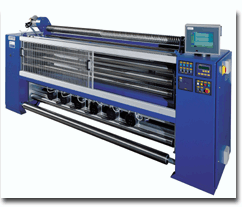
Italy-based Bianco S.p.A. offers the Digitex six-roller weftstraightener. The system includes
Biancos DSP 10R reading system, as well as the VDTEX terminal for easy machine operation. The VDTEX
terminal features a new algorithm that automatically estimates the maximum correction speed for
different fabrics, assuring bow and skew are controlled and fabric is straightened within required
tolerances.Spartanburg, S.C.-based American Santexs Santa Spread TS compactor is designed for
producing extremely uniform, compacted, tubular knitted fabrics. The high degree of reproducibility
in the processing of the fabric produces a final product that meets strict customer standards for
consistent shrinkage throughout the entire fabric length.From a controls standpoint, Italy-based
Obem S.p.A.s VisualDye, now with more than 100 units installed, represents a further step forward
in conformity and consistency in dyeing operations. An active color screen enables activation of
all machine functions. The system can handle up to 400 different dyeing programs and obtain
real-time information relating to the dyeing equipment. Cost ReductionsThe importance of
maintaining cost competitiveness in todays global textile marketplace cannot be overestimated. To
that end, machinery developments that provide quality goods at lower costs are welcomed.Biancalani,
Italy, has improved the Petra machine since its introduction at ITMA 99. This unit produces surface
effects on open-width goods by using abrasive rollers in a continuous process. By treating denim
fabrics on the Petra prior to garment manufacture, subsequent garment wet processing can be carried
out in one third the time, at half the cost.Even the continuous washing process can be improved
upon to yield lower production costs. Kusters Textile Machinery, Spartanburg, S.C., presents a wash
box with vacuum extraction to improve the efficiency of the washing process after preparation. This
vacuum-assisted wash box can reduce the total number of wash boxes needed, as well as produce
cleaner fabrics.Addressing the growing trend toward smaller lot sizes, as well as rapid pattern
changes, Worcester, Mass.-based Gessners Transcolorizer was developed to provide an economical
approach for producing samples and short production runs of transfer-printed fabrics.
 Environmental IssuesDoing business in developed nations, particularly in the United States
and Europe, requires companies to meet increasingly stringent environmental regulations. As an aid
in meeting these requirements, Morrison Textile Machinery Co., Fort Lawn, S.C., offers its patented
Thermal Oxidizer as an option on the companys FS-21 Finishing Range.During thermal oxidation, the
dryer exhaust temperature and dwell time are set so that volatile organic compounds odors and haze
are reduced to products of combustion.The Morrison Thermal Oxidizer can properly size the chamber
to provide the dwell time to meet specific requirements. The enclosure is insulated with several
layers of high-temperature ceramic fiber, which keeps the outside of the enclosure cool enough to
touch during operation. The open, flow-through design requires no catalyst.The resulting heated
clean air is exhausted. Due to an integrated design, a portion of the air is returned to the dryer.
An accurate temperature profile is maintained in the dryer system through the use of modulating
dampers.The ultimate result, according to Morrison, is that the Thermal Oxidizer eliminates 98
percent or more of objectionable compounds generated during fabric processing.
Editor’s Note: Peter Hauser, Ph.D., is an associate professor of textile chemistry at North
Carolina State University College of Textiles, Raleigh, N.C. His research focuses on reducing
costs, energy use and pollution associated with wet processing. High-performance chemical finishes
for enhanced value textiles, indigo dyeing and denim garment wet processing and new textile
processes are included in this research.

September 2001

Crystal Textile Group Launches Spacer-Lite Line

New York City-based Crystal Textile Group has introduced Spacer-Lite, a line of spacer fabrics for
various apparel, medical, industrial and technical end-uses.Spacer fabrics comprise two outer
textile substrates joined together and also separated by a ventilated inner layer of spacer yarns,
to allow heat and moisture to escape. Various properties can be added to the fabrics, including
anti-microbial, anti-mildew, anti-static, flame-retardant, absorptive, water-repellent and
abrasion-resistant attributes. Spacer-Lite is far softer than laminated fabrics used for the same
purposes and retains its qualities after repeated launderings, said Richard Crystal, CEO. By virtue
of such qualities, this extremely versatile fabric is perfectly suited for such end-uses as
lingerie, bras, swimwear and activewear.Crystal Textile Group, formerly The Tricot Man, was
originally a textile converter specializing in warp knits for niche markets. The company recently
expanded to become a vertically integrated organization that includes knitting and dyeing, as well
as full research and product development capabilities.

September 2001

Reinventing ATMA

ATMA Chairman InterviewBy Jim Phillips, Executive Editor Reinventing ATMA
ATMA Chairman, Kurt Scholler, talks about the current and future state of ATME-I and the
textile industry.
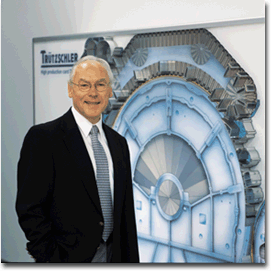
 Kurt Scholler is a dapper, well-dressed gentleman who projects an air
of quiet confidence. He looks as if he would be as comfortably at home as a diplomat in Washington
as in his office at American Truetzschler in Charlotte, N.C. The silver-haired German is quiet and
well-spoken, and has a finely developed sense of humor. His easy smile puts those around him at
ease.

Kurt Scholler, ATMA chairman andCEO of American Truetzschler But flowing beneath the
gentle exterior is a current of steel and determination, qualities Scholler will need if he is to
realize his goals as chairman of the American Textile Machinery Association (ATMA). Scholler,
midway through the first year of a two-year term in office, inherited the helm of ATMA at a time
when it was embroiled in deep controversy over its flagship event, the American Textile Machinery
Exhibition-International (ATME-I).As well, he seeks to significantly expand the membership of the
association and bring ATMA into active participation in the Textile Alliance, the 13-member
confederation of associations and institutions that is seeking to protect and promote, as well as
unify, the voice of the U.S. textile industry. Revitalizing ATME-IOf all the things on
Schollers plate, however, nothing supercedes the importance of revitalizing ATME-I, once a thriving
show that attracted visitors from all over the world to the Palmetto Expo Center in Greenville,
S.C., and provided a conduit for the worlds textile machinery manufacturers to show off and sell
their latest offerings.Declining attendance during the past few shows has cast a pall of
uncertainty over the shows future, and has created a rift between ATMA and Textile Hall Corp., the
former parent of the Expo Center and an ATME-I co-sponsor.The issue, as reported previously in
Textile Industries, is relatively simple. ATMA seeks to combine the two segments of the
show one dedicated to yarn preparation, the other to fabric formation and finishing into a single
large show. Textile Hall wants the show to remain in Greenville, regardless of whether it is a
single show or has a split-segment format. But it is not certain the facilities at the aging center
will be able to accommodate a combined format, so ATMA has been looking elsewhere, with the most
likely candidate being Atlanta.Add to the mix the recent financial difficulties of the Expo Center
its default on a bank loan and ensuing purchase by the City of Greenville and the ultimate
resolution of the issue may still be some time in coming.ATMA has asked Textile Hall to continue as
a co-sponsor, even if the show leaves Greenville. As well, ATMA is contractually obligated to hold
the next edition of the show, which would most likely be in 2004, in Greenville. A major issue at
this point is whether Textile Hall will release ATMA from this arrangement. ATMA has offered to buy
out the contract on at least one occasion, but that offer has been refused.We need to redefine and
reorganize the ATME-I exhibition, which for many years has been in Greenville, Scholler said. The
market demands a consolidated show. That is something weve been working on. The relationship with
Textile Hall Corp. has been a long-standing one, and I think that there will be some
accommodation. Partnerships Establish NeedsAnother goal is to create partnerships with other
associations and industries both foreign and domestic in order to establish common interests and
needs. Maybe we can find ways to help each other, to create some synergies, particularly with
regard to the textile show, he said. 

Maybe, for example, it would make sense to have a bigger show, like a machinery show that is
also taking place at the same time as other shows in the textile industry perhaps the Bobbin Show
or the knitters show or other important shows in our industry. Also, perhaps we should get together
with associations in other countries, particularly Latin America. We have talked about the
possibility of creating a show for all of the Americas that could alternate between a South
American city and a U.S. city. All of these things have been discussed and will, hopefully, help
the industry. These are all, of course, long-range thoughts. Our immediate priority is to work out
exactly what is going to happen with the next edition of ATME-I, Scholler continued.The real
question, of course, has been whether Greenville can host a combined show. The overwhelming
majority of the machine manufacturers and textile customers all seem to agree on at least one thing
and that is, we need to have a consolidated show. Thats a rare thing for there to be so much
agreement, and we must listen. My personal position has always been that if Greenville can host a
combined show, then it should stay in Greenville. But if not, we should look at alternate locations
in the Southeast. Atlanta, because of location and facilities, would be a particularly good
candidate. Whatever the ultimate resolution, it must occur relatively soon, because suitable
facilities are booked-up well in advance. Trade InequitiesBut ATME-I aside, other issues of
significance must be addressed, including the steadily declining market share of U.S. textile
manufacturers, due in large part to escalating foreign imports, nebulous trade agreements and
inefficient U.S. enforcement of trade arrangements.Other industries have been hit hard in the past
with a drastic increase in subsidized, unfair foreign competition the U.S. automobile and steel
industries come to mind but have rallied to compel the U.S. government to strengthen its backbone
in forcing international trade to be conducted on a more equitable basis. The textile industry
however, is a collection of diverse, fragmented and fiercely independent entities, many of which
have conflicting agendas in governmental relations. Importance Of Unity Within IndustryIn
March of this year, Chuck Hayes, chairman of Guilford Mills and president of the American Textile
Manufacturers Institute (ATMI), told TI in a very frank interview that the hopes of the American
industry rest on the willingness of its individual components to come together and work with an
unwavering commitment toward unity
(See ATME Evolution, ATI
, March 2001). 

Since then, ATMI and the American Yarn Spinners Association (AYSA) have apparently mended a
rift that began during the final stages of lobbying for the Caribbean Basin Initiative (CBI), in
which the organizations took opposing stances about certain country-of-origin rules. As a result,
the Textile Alliance is again alive and well and is, ostensibly, working to provide the industry
with considerable clout and influence on Capitol Hill and in the White House.Scholler sees ATMAs
participation in this alliance as a vital tactic in the organizations overall strategy. Everything
that works to strengthen the U.S. textile industry is something ATMA should work very actively to
support. Unfortunately, a lot of times, it is all about money, said the CEO of American
Truetzschler. The textile industry has never had its money concentrated in the right places. It has
been too scattered, with not enough people saying the same things to the same people. Working
together, perhaps we can change that. Perhaps we can stand as one and be a loud, strong and
effective voice for the interests of the U.S. textile industry. ATMA Goals Include Increasing
Membership

Another item on Schollers agenda during his term as ATMA chairman includes seeking to change
the by-laws of the organization in order to increase membership.Currently, a company must actually
manufacture machinery in the United States to qualify for ATMA membership. But a number of
companies that maintain manufacturing facilities in Europe Sulzer and Promatech for example also
commit considerable resources to providing technical support, training and sales offices in the
United States. These companies, Scholler says, should be eligible for membership in ATMA.Schollers
own company, American Truetzschler, manufactures in Charlotte much of the yarn-preparation
machinery the company sells in the American marketplace.American Truetzschler was founded in 1969
to serve the U.S. and Canadian customers of Truetzschler GmbHandCo. of Germany. The company
maintains manufacturing, sales, spare parts, technical support and training facilities. The company
manufactures and distributes equipment ranging from bale openers to high-performance draw-frames,
as well as equipment for the nonwovens industry. The German parent company is more than 110 years
old and is owned by the Truetzschler family. Heinrich Truetzschler and Dr. Michael Schuerenkraemer
are the fourth generation of the family to be actively involved in the management of the
company.Scholler said Truetzschler, like many of its customers, is seeking to offer more
value-added services to ensure its competitive position in years to come. Weve added a few more
functions that go beyond manufacturing in order to better meet the needs of our customers, he said.
We have added repair and maintenance to our product and service offerings. Historically, many of
our customers have done their own repairs. But with many mills downsizing maintenance departments,
this is a service we feel we can offer that will be of considerable benefit.Like so many others, we
find it necessary to make the transition from being exclusively a manufacturer to being both a
manufacturer and a service company.That is a transition that many American companies know very
well. And make no mistake, Scholler considers American Truetzschler to be a U.S. company, with its
fate indelibly tied to that of the U.S. industry.Are things difficult right now for the entire
industry he asks. Of course they are. But that doesnt mean the industry is going away. It is
changing, transitioning. And when it does reinvent itself, the U.S. textile industry will once
again assume a position of global competitiveness and profitability.Scholler intends for both ATMA
and American Truetzschler to share in that regeneration. The American Textile AllianceAmerican
Fiber Manufacturers AssociationContact Paul ODay (202) 296-6508 American Cotton Shippers
AssociationContact Neal Gillen (202) 296-7116America Sheep Industry AssociationContact Peter Orwick
(303) 771-3500American Textile Machinery AssociationContact Harry Buzzerd, Jr. (703)
538-1789Alabama Textile Manufacturers AssociationContact Rebecca Camerio (334) 279-1250American
Textile Manufacturers InstituteContact Carlos Moore (202) 862-0555The Association of Georgias
Textile, CarpetandConsumer Products ManufacturersContact G.L. Bowen (404) 688-0555Knitted Textile
AssociationContact Peter Adelman (212) 689-3807National Cotton Council of AmericaContact Gaylon
Booker (901) 274-9030North Carolina Manufacturers AssociationContact Dennis Julian (919)
782-8416Northern Textile AssociationContact Karl Spilhaus (617) 542 8220South Carolina
Manufacturers AllianceContact Jim Morris, Jr. (803) 799-9695Textile Distributors AssociationContact
Bruce Roberts (212) 869 6300

September 2001

Sponsors