Cationic Fiber Modification In Development At NCSU

Dr. Peter Hauser, associate professor, North Carolina State University (NCSU), College of Textiles,
Raleigh, N.C., is developing a greener process, cationic fiber modification, for cotton
dyeing.Sponsored, in part, by Dow Chemical Co., Midland, Mich., Hausers research involves treating
the cotton with the Dow chemical, N-(3-chloro-2-hydroxypropyl) trimethylammonium chloride. The
permanent positive charge on this cationic chemical provides a permanent site to attract
negatively-charged cotton dyes. Because of the small molecular size, however, the chemical cannot
be exhausted from a batch process prior to dyeing.The new process is much more efficient and saves
about half of the time normally required to dye cotton, said Hauser. It uses one-third of the
energy and only 20 percent of the water used in traditional methods, and no salt. In addition, less
dye is needed as a result of the strong attraction of the dye to the surface of the fiber.The next
phase of Hausers research involves developing ways to streamline the new process to make it a
continuous process that does not slow down production in dyeing and finishing.

October 2001

ADMTronics

ADMtrONICSAdhesive, 73F, is a water-based primer/adhesive for extrusion, laminating and printing. Product is water- and moisture-resistant on most substrates. Minute applications give high bond strengths. One gallon of product covers up to 90,000 sq. ft of substrate. Substrate may be primed and rewound for use up to 90 days later with no blocking or reduction in bond strengths. ADMTronics sales@admtronics.com.October 2001

Cotton Test Center Gets New Equipment

COTTON TEST CENTER GETS NEW EQUIPMENTAustralias textile research body, CSIRO TFT, has announced investments worth more than U.S. $500,000 in cotton processing equipment, targeted at helping the countrys cotton growers.The research organization will install a full-scale yarn production line, with bale-to-spinning equipment from leading European technology suppliers Trutzschler, Zinser and Schlafhorst. Both ring and rotor spinning routes will be used.The aim is to test various raw cottons to see how harvesting and ginning procedures affect yarn characteristics. The line also will test fiber properties and research possible new yarn production techniques.CSIROs Gary Robinson said the project would directly benefit Australian cotton growers: “Using the new equipment, well be able to process different batches of cotton under a variety of conditions whether the batches are small from breeding programs, or large from individual growers and ginning groups. In this way, we can build up a comprehensive picture of fiber performance.”October 2001

Italian Rapier Loom Targets Quality Fabrics

ITALIAN RAPIER LOOM TARGETS QUALITY FAbrICSPromatech, the Italian textile machinery group that comprises the Somet and Vamatex weaving machine brands, has launched a new flexible rapier loom. The Somet Alpha will be targeted initially at high-quality fabric producers in Europe and Asia, with its commercial debut in the U.S. scheduled for early next year. The machine is claimed to offer an “incomparable relation between flexibility and speed,” with its development brief having focused on versatility, reliability, ergonomics, the use of advanced technology, and lower running costs.Fuller details of the machine, and an update on the Promatech group recent purchaser of Sulzer Textil — will be published in our next issue.October 2001

Federal Reserve, Consumers Key To Future


Eighth Rate Cut Not Likely To Be Last

Evidence from the latest set of economic reports shows the U.S. economy weakened further in
August, and in the aftermath of the terrorists’ attacks, a recession is likely to be already in
progress. On the bright side, consumers keep spending, and the Federal Reserve stepped in with a
one-half-point cut in short-term interest rates. Further rate reductions are likely to follow to
prevent the economy from going into a deep recession.

The jobless rate increased to 4.9 percent in August from 4.5 percent in July. This climb was
the sharpest monthly increase since early in 1995. Nonfarm payrolls declined by 113,000, despite a
gain of 72,000 jobs in the service sector. Since March, total nonfarm employment is down by 323,000
jobs. With factory output down and a declining business investment, manufacturers slashed 141,000
jobs in August, bringing the total losses from a year ago to more than one million jobs.
Manufacturing employment is at its lowest level since 1964 — a sign that the weakness in U.S.
economic activity has turned into a recession.

The Producer Price Index for finished goods rose 0.4 percent in August, after dropping 0.9
percent in July. The increase was due to a 1.1-percent rebound in energy prices following a 5.8
percent drop in July. Excluding food and energy, the price index slipped 0.1 percent in August,
after rising 0.1 percent in July.
OctBFgraph_1068


Consumer Energy Prices Continue Decline

Consumer prices edged up 0.1 percent in August, after falling 0.3 percent in August. Energy
prices fell 1.9 percent in August on top of a 5.6 percent drop in July. Core inflation was up 0.2
percent for the second month in a row.

Industrial production dropped by 0.8 percent in August, after edging down 0.1 percent in
July. July’s figures had raised hopes that manufacturing was on the verge of a rebound. The monthly
decline was the 11th in a row, matching the longest stretch of industrial output weakness, which
occurred in 1960. The operating rate of industrial capacity fell to 76.2 percent from 76.9 percent
in July, the lowest level since July 1983.

With consumer confidence down, new housing construction fell 6.9 percent in August to 1.527
million starts.

The U.S. trade deficit of goods and services narrowed in July to $28.83 billion from $29.07
billion

in June. Both exports and imports declined, reflecting economic conditions in the U.S. and
abroad. Exports fell 2.5 percent to $83.73 billion, while imports came down 2.1 percent to $112.56
billion.

Business sales bounced 0.4 percent in July, after falling 1.5 percent in June. Meanwhile,
business inventories eased 0.4 percent. As a result, the July inventory-to-sales ratio edged down
to 1.42 in July from 1.43 the previous month.


Mixed Results Show Textile Output, Utilization Rate Rebound

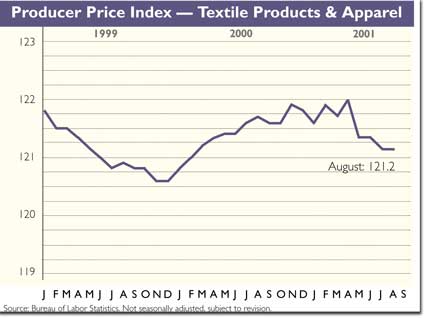
Producer prices of textiles and apparel were unchanged in August after edging down 0.1 percent
in July. Prices jumped 1.9 percent for greige fabrics and rose 0.2 percent for home furnishings.
However, prices came down 0.4 percent for processed yarns and threads, fell 0.9 percent for
finished fabrics, declined 1.0 percent for synthetic fibers and dropped 1.3 percent for carpets.

Results for textiles and apparel were mixed. The industry’s payrolls declined 0.2 percent in
August, after falling 1.1 percent in July. The volatile jobless rate for textile mill workers came
down to 8.3 percent from a high of 9.1 percent in July.

Textile output increased 0.8 percent in August, after falling 2.4 percent in July. Output was
13.8 percent below the year ago level. The utilization rate for textiles moved up to 71.6 percent
of capacity from 70.8 percent in July.

Shipments by textile producers declined 0.8 percent in July after rising 1.7 percent in June.
Inventories were pared down by 1.3 percent. As a result, the inventory-to-sales ratio edged down to
1.66 from 1.67.

U.S. retail sales rose 0.3 percent in August, paced by sales gains of 1.2 percent at gasoline
stations, 0.9 percent at building materials and supplies stores and 0.6 percent at department
stores. Sales eased 0.2 percent for motor vehicles and parts and edged down 0.1 percent at
furniture and home furnishings stores. At apparel and accessory stores, sales declined 0.8 percent
in August after rising 1.0 percent in July.


October 2001

Lantech Designs Automated Turntable Wrapping System

Lantech, Louisville, Ky., has designed the Q-1000 Automated Turntable Wrapping System with added
protection for operators.The system features an in-feed and exit conveyor separated by a turntable
that rotates while stretch film is attached to the load. Film loading of the roll carriage is from
the side, providing unobstructed access and ergonomically sound operation.The roll carriage is
safety-guarded to prevent hand injuries. Transition photocells are mounted on either side of the
turntable for easy access. If a photocell beam is broken during wrapping, the machine will shut
down immediately.The E-Z Thread® roll carriage provides loading with no threading required. All
controls are adjustable from the color-coded control panel without the use of a plug-in external
computer.

October 2001

Steel Heddle Files Chapter 11 Sells Textile Business

Steel Heddle Files Chapter 11,Sells Textile BusinessSteel Heddle Group Inc. and its U.S. subsidiaries, including its primary operating entity, Steel Heddle Manufacturing Co. Group Inc., Greenville, S.C., has voluntarily filed a reorganization case under Chapter 11 of the U.S. Bankruptcy Code in the Delaware Bankruptcy Court. The petition was filed, in part, to consummate the sale of the textile business, which includes the textile loom accessories manufacturing and design operations.Steel Heddle is also completing negotiations for a Debtor-in-Possession (DIP) financing facility.Robert W. Dillon, president and CEO, said that with the DIP financing in place, Steel Heddle should be able to consummate its going-concern sales; meet its going-forward obligations to employees, customer and vendors; and ensure a smooth transition of its operations to the purchasers.October 2001

TYAA Photo Flash Report

Outgoing President Charlie King (left), Unifi Inc., receives a recognition plaque for his
2000-2001 term from TYAA past president John Amirtharaj, Universal Fiber Systems LLC.

Charlie King (left), congratulates the new 2001-2002 TYAA President, Robert Howell, general
manager, Dillon Yarn Corp.

TYAA members stayed busy and exchanged thoughts during the breaks in the conference
room.  held its summer conference July 26-28 in Myrtle Beach, S.C. The general
theme of this year’s meeting was Strategy Beyond Survival. As the title suggests, the
entire U.S. textile industry is presently going through some very trying times, and several
papers covered this topic.Kay Norwood, senior vice president and textile analyst for Wachovia
Securities, explained there is not much hope that the domestic textile industry will return
to the level that was experienced just a few years ago. Norwood pointed out that the
strong dollar value in comparison to other world currencies encourages imports even
more and makes it difficult to export on a competitive price/performance level.Trade
quotas presently in place with Asian countries will be eliminated in 2005, including quotas
for China upon its entry into the World Trade Organization (WTO). Norwood advised that fiber,
yarn and fabric manufacturers must interact through strong partnerships, find niche
markets and manage their inventories efficiently.Alasdair Carmichael, associate
consultant, PCI Group FibresandRaw Materials, Spartanburg, S.C., pointed out that not
everything happening in the U.S. textile industry is negative. Aside from unfortunate plant
closings and layoffs, he presented many positive elements.Deliveries of texturing spindles to the
United States ranked second-highest in the world in 2000. U.S. exports of textured polyester exceed
imports.Several overseas investments have been made in the U.S. textile manufacturing
industry.Domestic investments continue to be made in the industry.Carmichael explained that factors
such as the value of the U.S. dollar, U.S. consumer demand and fashion, as well
as raw-material costs influence the import situation quite significantly. The biggest
concern is that China has been gearing up with capacity increases and continues to
install modern production equipment. Carmichael foresees another significant boost of apparel
exports by China in 2005 due to its entry into the WTO. 

Kay Norwood, senior vice president,Wachovia Securities, talked about thepresent and upcoming
challengesthat are facing the U.S. textile industry.

Alasdair Carmichael, associate consultant,PCI FibresandRaw Materials, talked about
thepositive aspects of the U.S. textile industry.
October 2001

Newly Private Springs Coteminas Form Alliance

Newly Private Springs,Coteminas Form AllianceSprings Industries Inc., Fort Mill, S.C., has entered into a long-term, strategic alliance with Brazil-based Coteminas for bed and bath products.Coteminas will support Springs sales and marketing of home furnishings products in North America with its manufacturing resources.Crandall C. Bowles, Springs chairman and CEO, commented on the alliance: Supplementing Springs manufacturing capabilities with Coteminas world-class textile facilities will allow us to offer a broader array of products on a competitive basis. Springs relationships in the marketplace, well-known brands and distribution capabilities will ensure that our alliance with Coteminas provides more opportunities for all of our customers.In other news, Springs announced the completion of its going-private proposal. As a result of a recapitalization merger between the Close family and an affiliate of Heartland Industrial Partners LP, each outstanding share of Springs common stock held by public shareholders has been converted into the right to receive $46.00 in cash.October 2001

ASTM To Develop Standards For Protective Garments

The American Society for Testing and Materials (ASTM) Committee F23 on Protective Clothing, West
Conshohocken, Pa., is developing new standards to evaluate the effects of protective garments on
humans in hot environments. An ASTM Human Factors Subcommittee will focus on factors associated
with protective clothing worn to prevent heat stress in hot, warm or humid conditions.The
subcommittee has established bench-scale and manikin-based test methods and practices to evaluate
the insulative effects of protective clothing material and garments. It now seeks new members or
input as it develops a methodology related to heat-stress incidence.The subcommittee proposes two
standards: (1) a Standard Guide for Conducting Evaluations of the Heat Stress Effects for
Protective Clothing; and (2) a Standard Practice for Evaluating the Effectiveness of Personal Body
Cooling Garments (or Devices).Those interested in participating should contact Elizabeth A.
McCullough, professor, Institute for Environmental Research, Kansas State University, Manhattan,
Kan.; (785) 532-2284; e-mail: lizm@ksu.edu.

October 2001

Sponsors