Add Value Or Else

 Add Value Or Else
A Caribbean Basin Initiative strategy for U.S. mills Despite all the high hopes and
hoopla surrounding the passage last year of the Caribbean Basin trade legislation, the results,
thus far, have been disappointing for most U.S. mills producing apparel fabrics or yarns. There is
little doubt that imports of apparel products from the region will grow over the next few years.
The real question is whether the Caribbean Basin Initiative (CBI) region can compete in the long
term with other apparel-producing regions especially after the quotas are removed on apparel
imports from other countries in 2005.For producers of apparel fabrics and yarns, this situation is
particularly critical. Like it or not, U.S. apparel production will continue to decline, and
imports of finished garments will continue to increase. Even the most competitive U.S. producer of
apparel fabrics or yarns will find it hard, if not impossible, to prosper without a competitive
downstream customer.The other cold reality is that retailers and wholesalers of apparel products
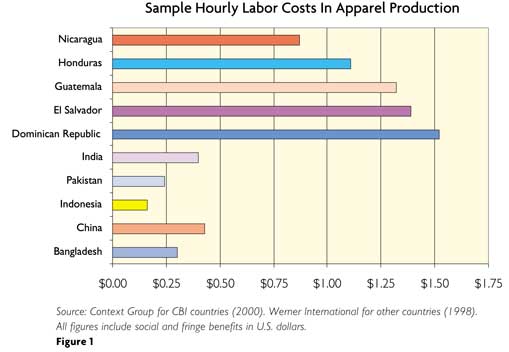
will always be forced to chase the cheap needle. And even though labor costs today are considerably
lower in the CBI region than in the United States they are still considerably higher than in other
less-developed countries in Southeast Asia, the Indian Subcontinent and Africa. 
 Elimination Of Quotas Will Reduce CBI AdvantageBy far, the biggest and most important
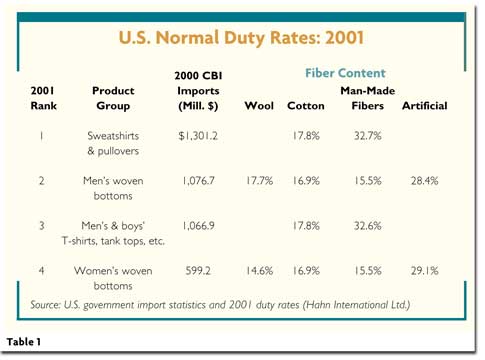
advantage for the CBI region is in the zero-duty rate on qualifying garments, i.e. those made from
U.S. fabrics and yarns. Currently, that advantage is significant in many key product
classifications when compared to the duty rates on imports from Asia and other regions.Figure 1
shows the top imports from the CBI region in 2000 and the duty rates that would apply to the same
garments imported from China, India or most other countries.Unfortunately for the CBI region (and
Mexico), the elimination of import quotas (not duties) on other countries in 2005 will cut deeply
into that competitive advantage.For most imports still covered by U.S. quota restrictions and that
includes most apparel products there is frequently a cost associated with acquiring the export visa
in the supplier country. The quota cost if there is one is usually reflected in the f.o.b. cost of
the garment from the foreign manufacturer. The cost of quota can vary significantly from country to
country, depending on U.S. market demand for the product, the capabilities of manufacturers in a
particular country, and the quantity of quota available in that country for that quota year. Quota
costs also rise and fall during the quota year.In some countries such as Hong Kong and China the
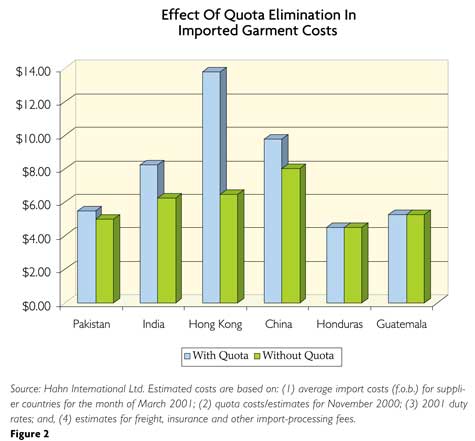
quota charge can be significant.Figure 2 illustrates the before and after impact of the elimination
of import quotas on one important product classification mens cotton polo shirts.Its clear from
this example that factories producing polo-style shirts in the CBI region could easily find
themselves after 2005 at a competitive disadvantage with producers in lower-cost countries such as
Pakistan and for moderate- to better-quality polo shirts from countries such as Hong Kong, China
and India. The same, of course, applies to other products as well.  
CBI Region Lacks Packaging Infrastructure Or FacilitatorsAnother challenge facing the CBI
region is the growing demand for full-package garment production from U.S. wholesalers and
retailers. Unfortunately, few independent garment factories in the region have the capability to
offer full-package services due to financing limitations, lack of knowledge about U.S. fabric and
trim sources, inadequate pattern-making or fabric-cutting capabilities, and other critical elements
of full-package production. Likewise, few independent factories in the region can offer the type of
product development support or quick turnarounds on samples or pricing as can their Asian
competitors.While there are some U.S. companies such as Perry Ellis International, VF Corp.,
Kellwood, Tropical Sportswear and others that can effectively facilitate or manage full-package
production in the region, theres room for more. Although the Asians are well-represented with
factories in the region, most of the fabric and trim purchasing and other coordination/facilitation
is done through their Asian offices which puts U.S. mills at a disadvantage.The situation begs for
more facilitators or aggregators to step in and fill this role. The recent formation of the
Amerisource Group is a step in the right direction. Hopefully, for U.S. mills, others will
follow. 
Long-Term Strategy: Add ValueFor the short term, U.S. producers of apparel fabrics and yarns
have little choice but to focus on those product groups in which North American producers are
currently the most competitive bottom-weight cotton fabrics and basic cotton knits for T-shirts,
sweatshirts and underwear. However, for the longer term, U.S. mills are going to need a different
approach in order to prosper.1.Focus on higher-value fabrics.With CBI labor costs already high in
relation to other lower-cost countries such as Pakistan, India and Bangladesh, its critically
important for the long term to reduce the labor-cost component in garments produced in the region
without lowering the value of the product. The best way to do that is to increase the value of the
fabric in the garment.Finding ways to increase the use of better-quality wool and synthetic fabrics
in mens and womens dress slacks would be one example of a strategy that could work for the
region.2.Forge alliances with best-of-class knitters and finishers.The lack of knitting capacity in
the CBI region is proving to be a real obstacle for U.S. yarn spinners. Yarn spinners should be
forging alliances with top-quality U.S. knitters to do full-package production of better-quality
knit garments in the CBI region, or else looking for an Asian partner that is willing to build a
knitting plant in the region. Likewise, U.S. greige weavers need to partner with best-of-class U.S.
finishers to produce better-quality bottom-weight or shirting fabrics.3.Upgrade the capabilities of
CBI factories.Using the best fabrics alone will not be enough if the CBI region cannot meet the
quality standards or price points of U.S. retailers and wholesalers. Just looking at the list of
top imports from the region, one sees the current focus on basic, relatively low-labor-content
products like T-shirts, jeans and underwear. Unless factories can upgrade their sewing skills and
productivity over time, they will be displaced by new low-cost suppliers in other regions.U.S.
mills need to be identifying and partnering with factories in the region that have the will and the
resources to upgrade their capabilities. In many cases, these will be Asian-owned plants with
headquarters in Asia. Calling on those factory owners should be a top priority. Making the economic
case for the use of U.S. fabrics in CBI production will also be required.4.Find the
aggregators.Likewise, U.S. mills need to be forging alliances with U.S. and Asian aggregators doing
production in the CBI region. These companies can bring the essential sourcing network, logistical
and financing capabilities, product development support, and most importantly the customers to the
table.5. Develop product sourcing infrastructure and outsourcing capability.Last but not least,
U.S. yarn spinners, knitters and weavers should not put all of their eggs in the CBI basket. While
the CBI region and Mexico can provide economical alternatives to U.S. apparel production, the
strict rules of origin requiring the use of U.S. fabrics and yarns can be both a blessing and a
curse. In order to reduce costs, move up the value chain and meet the future needs of U.S.
retailers and wholesalers, U.S. mills are, in some cases, going to have to supplement their use of
local yarns and fabrics with imported products.Using imported yarns, however, does not necessarily
rule out the possibility of lower-cost apparel production in North America. Under NAFTA rules, sewn
product assembled in Mexico can still qualify for full NAFTA benefits zero duties and no quotas as
long as the fabric is formed and cut in the U.S. This rule creates opportunities to use imported
yarns to upgrade a knit or woven fabric and still meet the pricing requirements of a U.S.
wholesaler or retailer. 
Editors Note: Jim Langlois is executive director of Hahn International Ltd., Stamford, Conn, a
company that helps its industry clients develop and execute strategies to stimulate growth and
profitability in the North American market.Hahns team of senior professionals and strategic
alliances with other industry specialists bring strategic planning, market research methodologies
and access to top executives throughout the fiber, textile, apparel and retail supply chains. The
company has extensive hands-on experience in production, marketing, importing and exporting of
textile-related products. For more information visitwww.hahninternational.com.

October 2001
KoSa Introduces New Yarn Products

Charlotte, N.C.-based KoSa has added three new polyester yarns to its product line.Imbue has
antimicrobial properties furnished by an imbedded silver ceramic additive that provides lifetime
resistance to the development of bacterial and fungal growth. Imbue is targeted for use in
performance and fashion apparel, as well as in home furnishings, medical, hospitality and
industrial applications.Stretch-aire®, a single, atmospherically dyeable yarn, has a comfortable,
cotton-like hand and appearance with stretch. Possible applications include sports and thermal
wear, intimate apparel, T-shirts, loungewear and others in which comfort stretch is desired.
Stretch-aire can be combined with other yarns for use in circular-knit and seamless styles.Accepta
yarns accept dye at lower temperatures than standard polyester, yet they still exhibit excellent
colorfastness and fade resistance, according to KoSa. They can be blended with other heat-sensitive
fibers such as spandex, wool and acetate to provide improved fabric performance and hand, styling
benefits and excellent printing and dyeing effects.Sample garments and fabrics made with Imbue,
Stretch-aire and Accepta may be viewed at KoSas fabric library in Charlotte.

October 2001

Welker Presents Condimat Conditioning Machine

Ph Welker GmbH, Germany, has introduced the new Condimat conditioning machine series.The Condimat
is based on a cylindrical autoclave body that can be manufactured with diameters of 1.6 to 3.0
millimeters (mm) and lengths of 1.5 to 14.0 mm.The Welker injector technology system injects cold,
saturated steam into the autoclave after five minutes, shortening the conditioning process to 35 to
45 minutes. According to Welker, the process can reduce energy costs up to 50 percent per kilogram
(kg) of conditioned yarn.Features of the Condimat include a new water-jet device to increase the
net moisture result; fully automatic packaging, wrapping or ticketing solutions; and a 10-year
autoclave guarantee for the autoclave vessels.

October 2001

Center Stage In Music City

IFAI Expo 2001
TI Special Report 

Center StageIn Music City
IFAI Expo 2001 will showcase the latest trends,technologies in technical and industrial
fabrics.
Technical fabrics will take center stage when the Industrial Fabrics Association
International (IFAI), Roseville, Minn., convenes its annual exposition at the Opryland
HotelandConvention Center, Nashville, Tenn. IFAI Expo 2001, to be held October 18-20, will offer
exhibits, conferences, workshops and seminars highlighting the latest trends and technologies in
technical fabrics. More than 8,000 visitors and 500 exhibitors are expected to participate.Among
the products and services to be displayed are: coatings; consulting; converting; equipment; fabric
care and maintenance; fibers/yarns; finishing and dyeing; laminating; nonwovens; rope, cord and
straps; testing labs; weaving and knitting; tools and much more.IFAIs 2001 International
Achievement Awards will be presented on Thursday morning, October 18. The awards recognize the most
recent innovations in technical fabric design and production in 29 categories. Keynote
SpeakersOn Friday, October 19, William McDonough will speak on Material Matters. McDonoughs design
firm, William McDonoughandPartners, Architects and Planners, has won awards for its ecologically,
socially and economically intelligent projects. In 1996, McDonough received the Presidential Award
for Sustainable Development.On Saturday, October 20, Robert Kriegel, Ph.D., will present If It Aint
Broke brEAK IT! Riding the Wave of Change Without Wiping Out. A best-selling author and authority
in the field of change and human performance, Kriegel will offer out of the box strategies for
keeping ahead of changes in the current business environment. Educational ProgramsPrior to the
exposition, the Textile Technology Forum, to take place Wednesday, October 17, will offer
presentations of technical papers covering recent innovations and research findings by an
international roster of academic and research professionals.Technical sessions will include:
fibers, coating and finishing; measurement and testing; performance enhancements; technology and
equipment; and geotextiles. The papers will be published in Proceedings 2001, a booklet to be
provided to forum participants, as well as sold through the IFAI bookstore. The Textile Technology
Forum is organized jointly by IFAI and The Textile Institute, United Kingdom.A full slate of
educational programs is scheduled during IFAI Expo 2001. Topics will be grouped under major tracks
presented either as groups of seminars or as symposia.Thursday, October 18Architecture
TrackConstruction TrackSafetyandProtective SymposiumMedical Textiles SymposiumSignsandGraphics
TrackFriday, October 19Awning TrackSportsandRecreational ProductsSymposiumTransportation
TrackFiltration SymposiumEquipment Technologies TrackSaturday, October 20Marine
TrackBusinessandLeadership Track 
For more information about IFAI Expo 2001, contact (651) 222-2508; (800) 225-4324;
www.ifai.com. For more information about the Textile Technology Forum and the IFAI Educational
Program, contact Jill M. Rutledge (651) 225-6981; jmrutledge@ifai.com. For international
information, contact IFAI Europe (32) 2 774 9600; ifai@eyam.be; or IFAI Japan (81) 727 80 2803;
kikuko_tagawa@nifty.com.
 IFAI Expo 2001 Alphabetical Exhibitor ListAA+ Products Inc.ABC
Industries Inc.ABC Netting Inc.Accent Awning Co. Inc.Achilles USA Inc.ACS ProductionAdhesive Films
Inc.Advanced Tent Technology InternationalAdvanced Testing Instruments Albest Metal Stamping
Corp.Aldan Industries Inc.Allied TubeandConduit Corp.Alom Building Systems Sdn. Bhd.Alpha
Productions Inc.AmericanandEfird Inc.American CordandWebbing American Keder Inc.AmeriCan Netting
Inc.American Mfg. Co.American PlasticsAmerican SantexApex Mills Corp.Articulos de Plastico y Papel
Arquati Co. USAAssociated PrintingandServicesAstechnologies Heat Transfer The Astrup Co.Atlantic
Braids Ltd.Atlas Electric Devices Co.Autex Industrial FabricsAuto TrimandRestyling News Avondale
Mills Inc.S. Axelrod Co.BBainbridge International Inc.Bally Ribbon MillsBarrday Inc.Franz Barta KG
Batz Corp.T.C. BaycorBayeux Cortina Fabrics Inc.BBS Tech Inc.Belgian (Wallonia) Textile
FederationBelton Industries Inc.BemisW.S. Bessett Inc.Bevis Rope Mfg. Inc.BHA Technologies Bill’s
Sewing Machine Co.BioPlasticsBirdair Inc.Bobbin Group/Bill CommunicationsBondCote Corp.John
BoyleandCo. Inc.Brawer Technical Yarns DivisionBrookwood Cos. Inc.Bruin Plastics Co. Inc.Brutsaert
Sun Protection NVBuckles International Inc.Burke Narrow Fabric Corp.Burlan Corp.Wm. T.
BurnettandCo. CCalifornia Combining Corp.Calsak Corp.Camie-Campbell Inc.Can-Do National TapeCanvas
ReplacementsCape Coaters (Pty.) Ltd.Caravan Canopy InternationalCargill Ltd. (Durafibre)Carolina
Specialty FabricsCasco Mfg. SolutionsCatalyst International Inc.Catco Supply Inc.Cavitec AGCentury
ProductsChampion DyeingandFinishingChiquola Fabrics LLCChiquola Industrial Products Group
LLCChiquola Spinners LLCJ.A. Cissel Mfg. Co.Claredon Textiles Inc.CMI EnterprisesCoatema Coating
Machinery GmbHCoats North AmericaCollinscraft Corp.Columbine InternationalConsolidated Sewing
MachineConsoltexCooley GroupCorporacion Corvera TextilCoventry Narrow FabricsCrystal Textile
GroupCustom Metal Crafters Inc.DDaejung Co. LtdDAF Products Inc.C.R. Daniels Inc.Dartex
CoatingsDaya Tarpaulin-Plastic ProductsDeccofelt Corp.Defense Supply Center PhiladelphiaDeitsch
PlasticsandNonwovensDeroyal TextilesJames Dewhurst Ltd.Dickson Industrial Group/Glen Raven Custom
FabricsDienes Corp.Dimension PolyantDirecTex WebbingDiversified Systems Inc.Diversitex Inc.Donovan
Enterprises Inc.DOT FastenersDukane UltrasonicsDunlap Industries Inc.Dunlap Sales Inc.Duracote
Corp.Durasol Awnings Durkopp Adler America Inc.Duro’s Enhanced Fabrics DivisionDynatEEastbank
TextilesEastern Awning Systems Inc.Eastern Metal Supply Inc.Eastman Machine Co.Eddington Thread
Mfg. Co.EFKA of America Inc.EGE System Sun Control Inc.Eide Industries Inc.Elero USA Inc.EMS-CHEMIE
(North America)Emtex Inc.Endutex-Rev. Texteis S.A.Engineered Coated Fabrics GroupJ. Ennis Fabrics
Ltd.J. Ennis Fabrics USA Inc.Enterprise CoatingsErez USA Inc.Eshco LLCEtiflex Corp.ETON Systems
Inc.Excel ThreadandSewing SupplyFFablok Mills Inc.Fabrene Inc.FabriMaxFabrite Laminating
Corp.Fabtac Adhesive StencilFacemate Corp.Fasnap Corp.Fastener Supply Co.Ferdco Corp.Ferrari
S.A.FIAB HF ABFibermill S.A. (Pty.) Ltd.Fibras Plasticas S.A. de C.V.Fil-tec Inc.Filtec Precise
Inc.Firestone Textiles Co.Fiskars IndustrialFiskars Outdoor Leisure ProductsFluoro-SealFly-Bye Bird
Control ProductsForest Group USA Inc.Forsstrom HF ABFoss Manufacturing Co. Inc.The Fox Co. (John E.
Fox Inc.)Firestone FibersandTextiles Co.Franklin Braid Mfg. Co.Frigerio – USAGGale Pacific –
CoolarooGaviotaGC4 Laminating Corp.Gehring Textiles/Militex Inc.General Shoelace Co.General Trading
Co.Gerber TechnologyGlen Raven Custom Fabrics LLCGlobecot Inc.GoldenGuard Technologies Ltd.W.L.
GoreandAssociates Inc.Granat Industries Inc.Louis A. Green Corp.Gretag Professional ImagingGuilford
Mills Inc./Guilford Technical TextilesHHall Dielectric Machinery Co.Hanwha Polymer Co. Ltd.HanYoung
Fabric Co. Ltd. (W.Y. Textile Inc.)Hapco Inc.Haug North AmericaJames H. HealandCo. Ltd.Heely Brown
Co.Herculite Products Inc.Julius Heywinkel GmbHHi-Tech Narrow FabricsHiker Enterprises Ltd.Hoffman
BrothersHoneywell Performance FibersHumantec Systems Inc.Hy-Tech Products Inc.IIbena –
FugafilIndustrial Coatings GroupIFAI Bookstore/MembershipInland Plastics Ltd.Innovative Industrial
SolutionsInterhacoIntertex CarouselsInterWrapIntex Plastics Corp.Iosso ProductsITW Waterbury
BuckleJJandD CarouselJandN Zipper Mfg. Inc.Jado Sewing Machine Inc.Jest Textiles Inc.William Jette
Co.JHRG LLCJopevi Inc.Johnston Industries – J.I. FabricsJTE Machine Systems Inc.Juki Union Special
Inc.Jung Shin Co. Ltd.KKabar Mfg. Corp.S. Kaplan Sewing Machine Co.Keystone Mfg.andSupply Co.Khosla
Profil Pvt. Ltd.King’s Metal Fiber TechnologiesKing Tech IndustriesKorea Tarpaulin Inc.KoSaLLacent
Technologies Inc.Lamcotec Inc.Lancer Textiles Inc.LeaandSachs Inc.Leister/Hapco Inc.LG Chemical
American Inc.Lightning International N.A. Inc.Linal Inc.Lincoln Fabrics Ltd.Littlestown Foundry
Inc.Lowy Enterprises Inc.The Loxcreen Co. Inc.Ludlow Textiles Co. Inc.MMadura Textiles Inc.Maimin
TechnologyMarChem Coated Fabrics Inc.Matai (U.S.A.) Inc.Mauritzon Inc.Megaplast S.A. de C.V.Mehler
Coated FabricsMelanie Machine Co.Meridian Mfg. Corp.Merlin Machine Co.Messe Frankfurt Inc.The Miami
Corp.Mid-South Sewing Machine SalesMiddleburg ThreadsandSewing SupplyMiller
WeldmasterMillikenandCompanyMilliken IndustriesMitjavila Canada Inc.Mitjavila Florida
Inc.Mitsubishi International Corp.Molintex Mills Inc.Montrose Equipment Sales Inc.Morgan
ManufacturingMorse IndustriesMount Vernon Mills Inc.Multi*State Sewing Supply Equipment Corp.Munro
FasteningsandTextiles Inc.NNaizil Coated FabricsNassimi Corp.Nawon USA Inc.Nemeth Engineering
AssociatesNester Software TechnologiesNova*Tech International LLCNovelty Bias Binding Co.Nyacol
Nano Technology Inc.Nylco Division – Worthen IndustriesOOasis 1 Retractable Awnings Inc.Ontario
Sewing Automation Co.Oppermann Webbing Ltd.Ouimet Inc.Ozone ShadeandNet Pty. Ltd.PPandH Metal
ProductsPara-ChemParasol (Comercializadora La Marina) S.A. de C.V.Patio Magic Inc.Pearson
IndustriesPerfectex Plus LLCPerfiles de Plastico FlexiblesPerforating Emerson Corp.Pfaff Industrial
of America Inc.PGI/Difco Performance FabricsPhi Enterprises Inc.Phifer Wire Products Inc.Pieles
Sinteticas S.A. de C.V.Pierret North American DivisionPinnacle Converting EquipmentPlas Tech
Sealing TechnologiesPlaspack U.S.A. Inc.Plastatech EngineeringPolyfabrics Ltd.Polymark
TechnographicsPolyOne Engineered Films GroupPractix Mfg.Premier-TexPrym Fashion Inc.Purity Textile
Pvt. Ltd.QQ-Panel Lab ProductsQuality ThreadandNotions Co.Quality Trim Inc.Quantum Services
Inc./Coyes CanvasandAwningsRRhode Island Textile Co.Ribbon Webbing Corp.Rimoldi of America
Inc.Ripngrip Industries Inc. Riri USARivets Unlimited NY Inc.Roaches InternationalRobeco
Inc.Robeson Sewing Machine Co.Rockland IndustriesRohmandHaas PlasticAdditivesRoll-A-Way
Inc.RollingShield Inc.Ronstan InternationalRosenthal Mfg. Co. Inc.Royal American Co. LLCRubberlite
Inc.SSafer Textile Processing Corp.St. Louis Braid Co.Sans Fibers Inc.Sansuy S/A Industria de
PlasticosSantex-Group.comSarna Xir Sattler AG Sauleda S.A.Saunders Thread Co.Scalar Corp.Schmetz
Needle Corp.Schott International Inc.Schroeder Sewing TechnologiesSeaman Corp.Seamtek International
Inc.Seattle Industrial TextileSeaway Yarns Ltd.SGS-Scanvec Garment SystemsShade Tree Canopy
SystemsShawmut MillsShuford Mills Inc.Shutter Products InternationalSI Corp.Simu U.S. Inc.Sinclair
Equipment Co.Sinteplast S.A. de C.V.Sioen N.V.SIR Webbing Inc.Siska Inc.Sitip S.p.A.Sloan Machinery
Co.Smart DesignSmith Family IndustriesSnyder Mfg. Inc.Solvay Draka Inc.Somerset FabricsSomfy
Systems Inc.Sonco WorldwideSonobond UltrasonicsSoutheast Sewing Corp.Southeastern Sales &
SpecialtiesSouthstar Supply Co.Span Systems Inc.Special Stitching Inc.Specialty NetsSpecialty Sewn
ProductsSpecialized Textile MarketingSperotto RimarSpradling Originals Inc.Spunfab Adhesive
FabricsSSM Industries Inc.Stafford Textiles Ltd.Stamoid AGStanek Netting Co. Inc.Ste-Lar
TextilesStedfast Inc.Steel Stitch Corp.Stephens PipeandSteelSterling Fibers Inc.Stevens
UrethaneStimpson Co. Inc.Sunair AwningsSunbrandSunesta ProductsSunroof Retractable Awning
Co.SuperTex FabricsSurLast LLCSynthetic Thread Co.TTa Ya Canvas Corp.Taiyo Kogyo Corp.Takashima USA
Inc.Tape Craft Corp.TEARepair Inc.Tek-Knit IndustriesTex-Net Inc.Tex-Tenn Corp.Texas Thread Mfg.
Co.TEXTEST InstrumentsTextile Commission Inc.Textile Human Resource CouncilTextile
Industries/Textiles PanamericanosTextiles Omnes S.A.Thermex-Thermatron Inc.Thermopatch Corp.3A
ThreadandSupply Co. of America303 Products Inc.Thwing-Albert Instrument Co.Tier-Rack Corp.Tietex
InternationalTiger Corp.Titex Vertriebs-GmbHTitus Industrial SealantsTMI Inc.TN Webbing
ProductsToff Industries Inc.Top Value Fabrics Inc.TPI IndustriesTreadstone Seventy-One USATrident
Industrial ProductsTucson Rolling Shutters Inc.Turnils Exterior ShadingsTUT (Technical Usage
Textiles)TWs Leather Sales Inc.Twitchell Corp.UUnlimited PartsandSupplies Inc.Uretek Inc.USF
Machine Systems Inc.U.S. ThreadU.S. Wholesale Pipe & Tube Co.VValley Products Co.Value Vinyls
Inc.Velcro USA Inc.Vernon PlasticsVerseidag Indutex GmbHVerseidag Seemee U.S.Vidir Machine
Inc.Vimco Shading SystemsVintex Inc.WWallonia Trade CommissionWalsall Hardware Corp.Wayne Mills Co.
Inc.Weaver Leather Inc.Weblon/Division of Herculite ProductsWeisnerWellington Commercial
ProductsWest Coast Netting Inc.Western Rim Industries Ltd.Western Textile ProductsWing Enterprises
Inc.Wirewright Mfg./DirecTex MarketingWolf Machine Co.Wolff IndustriesWonpoong Corp.Y-ZYKK
Universal Fasteners Inc.YKK (USA) Inc.Z-Tex Inc.

October 2001

Nextec Opens Manufacturing Facility In Singapore

Vista, Calif.-based Nextec Applications Inc. has opened a new manufacturing plant in Singapore. The
high-tech facility is part of Nextecs global strategy, which also includes establishing future
plants in Japan.The Nextec® encapsulation process has many applications in such areas as
performance clothing, medical and protective clothing, industrial composites and electronics. Water
repellency, wind resistance, packability, durability and breathability are all improved by Nextecs
patented process
(See Quality Fabric Of The Month, TI, August 2001).The majority of our fabrics come from
Asia, where our customers are using our patented encapsulation process in their material to
manufacture their end products, said Peter Ellman, president and CEO. Our Singapore facility will
allow us to improve customer service and decrease the time it takes us to deliver our products.Our
new plant will have the initial capacity to produce more than 6.6 million linear yards of fabric
per year, dramatically increasing our ability to grow and serve our customers, he added.

October 2001

Spinning In The New Millennium

The Crisis in U.S. Textiles is, of course, the topic on everyones mind, and some may wonder
why we should be looking at technological advances when all eyes focus on Washington. Yet, in the
past, it was the tinkering of technologists and engineers, the vision of entrepreneurs and the
investments of textile managers in better equipment and processes that guided this industry through
unsteady waters.Textiles is not a dot.com business, but a long-term manufacturing industry.
Spinning does not produce virtual products, but real yarns that are used in many different
applications. And for this, spinners use equipment that is being steadily improved. These steady
improvements ensure the long-term vitality of yarn producers. Following is a look at some of the
improvements, with special consideration given to spinning man-made staple
fibers. CardingGermany-based Truetzschlers chute-feed system to the DK 903 card is produced
entirely from stainless steel to avoid finish build-up. The DK 903 carding system itself can be
adapted to run synthetic fibers through changes in the licker-in and cleaning units, and by
increasing the number of stationary carding segments of the Twin Top System TTS.Of course,
Switzerland-based Rieters reputation for processing 100-percent synthetic materials and blends on
the C-51 card is well-known. John D. Hollingsworth on Wheels, Green-ville, S.C., continues to
demonstrate its dedication to enhancing metallic wire performance through the development of the
Enhanced Point Wire that allows better transfer of fibers at the increased production speeds.
Continuously increasing throughput and production speeds is, of course, found with all equipment
producers. DrawingIncreased production and improved quality and efficiency remain the goals of
any incremental improvements in drafting. The technological level of short-staple drafting is best
seen in machines such as Rieters RSB-D30, or in the integration of carding in drafting, as shown in
Truetzschlers DK 903 and IDF. Such integration of traditionally separate manufacturing steps is
becoming more important with increased demands on quality, zero-error tolerances and, of course,
increasing labor-cost sensitivities.In the long-staple sector, France-based Schlumberger has found
a way to reduce fuzz in carpet yarns through high-speed gilling and spinning, which sounds like a
promising route to regain some of the carpet market share that has gone to
BCF-filament. SpinningWhile in many industries, market share is the primary reason for mergers
and acquisitions, in the spinning-machinery industry, one major focus of mergers is the potential
of the acquired technologies. Rieters purchase of parts of Suessen, Germany, is clearly motivated
by a quest for know-how. Technological leadership in ring spinning is demonstrated by the companys
entry into the Guinness Book of Records with the finest yarn count spun on ring-spinning equipment
(Nm 500 or 300 cc), spun from 100-percent PES on the G-33 ring-spinning frame. Rieters R-20
rotor-spinning machines are making a major impact in the U.S. market.Schlafhorst and Zinser, both
based in Germany, cover the range of rotor and ring spinning for synthetic yarns and blends.
Outside the United States, Zinser has commercial installations of the RM 350 spinning machine with
up to 1,488 spindles running. Increased efficiency and quality is achieved by linking the RO-WE-MAT
670 roving frame directly to spinning through integrated doffer and transfer stations. This direct
link avoids damage of the bobbins, as well as any human errors.Drafting systems in roving, as well
as spinning, show pneumatic loading for consistent pressure over time and for the entire machine.
The PK series from Germany-based TEXParts shows such approaches for new machines, as well as for
after-market improvements. Also state-of-the-art is the servo-drive or multi-motor drive approach
in the drafting system.Delivery speeds in rotor spinning are increasing, especially for blended
yarns with lower twist levels. For example, Schlafhorsts Autocoro 312 can produce at delivery
speeds of up to 250 meters per minute (m/min) with up to 240 spindle units at more than 100,000
revolutions per minute (rpm). Producing 100-percent synthetic yarns is more speed-sensitive, with
rotor speeds typically under 90,000 rpm.Notable improvements are being made in the suction systems,
providing a constant vacuum pressure in the spinbox. The constant pressure results in fewer ends
down and higher efficiencies, while at the same time providing consistent quality. Italy-based
Savios FRS spinning unit produces low-twist yarns at rotor speeds of up to 107,500 rpm and take-up
speeds of up to 200 m/min from a range of synthetic fibers.Charlotte, N.C.-based Murata of America
Inc.s MJS 802HR jet spinner is capable of producing a wide variety of yarns from blends and
100-percent synthetic materials. The new drafting system offers draft ratios of up to 300, allowing
the production of very fine yarn numbers. At the same time, the air-jet process allows the
production of core yarns or special blended yarn structures. Muratas MVS vortex spinner is not yet
used for synthetic yarns.When looking at coarser yarn counts, one must mention Austria-based
Fehrers DREF 2000 friction-spinning machine. As shown at ITMA 99 in Paris, the yarn count now goes
up to Nm 25 (14.5 cc), and the operation of the machine has been simplified for the operator while
its cost efficiency has improved. Last February, Fehrer opened a new demonstration center in Linz,
Austria, and the company indicated that a new DREF 3000 demonstration machine with three heads will
be available for testing at that location.  Winding

Winding is often treated as an afterthought to spinning, yet it is an extremely critical
step. Winding provides the final inspection of a yarn and the presentation of the final product to
a customer or the next processing step. With higher production speeds and increasing quality
requirements, producing a yarn package has more complex technical requirements than before,
especially when processing synthetic yarns. For todays winders, it is (or soon will be)
state-of-the-art to have computers at each position controlling the individual motors and sensors.
Intelligent winders focus on efficient motions rather than speed; fine tuning reduces unnecessary
clearing and improves efficiency; tension is more closely controlled and corrected through
closed-loop approaches, as they are known in autolevelers in carding or drafting. An example of
this approach is the Autotense yarn-tension control in Schlafhorsts Autoconer 338. Uniform tension
and package density is critical for processing downstream.Links between spinning and winding are
also becoming more important. Direct linking can prevent yarn damage during transport and,
especially for mills running many different products, can also prevent mix-ups of yarn due to human
error. The Autoconer 338 comes with up to 60 spindles on each link machine. In most cases, however,
mills link approximately 1,000 to 1,200 ring-spinning spindles with 26 to 36 winding positions.
Times are not easy for spinners these days, nor for anyone in textiles, for that matter.
State-of-the-art technology, sufficient tenacity, and some twist is needed to keep the numbers
right, in the yarn as well as in the books. Good technology is available, and spinners have
tenacity or they would be doing something else. Lets find the necessary twist. 
Editors Note: Helmut H.A. Hergeth, Ph.D., is an associate professor in textile and apparel
technology and management at North Carolina State Universitys College of Textiles, Raleigh,
N.C.

October 2001

IFAI Intends To Go Forward With IFAI Expo 2001 As Planned

IFAI Expo 2001 seminars take on new importance in light of recent eventsThe tragic events of September11 shocked everyone within the technical fabrics industry as well as the world.Naturally, the Industrial Fabrics Association International (IFAI) hasreceived a number of inquiries concerning whether or not theorganization plans to hold IFAI Expo 2001, October 18-20, 2001, inNashville, Tenn.IFAI has confirmed that it intends to go forward with IFAI Expo 2001.”President Bush said that the best thing we can do is get back tobusiness and that’s what we intend to do,”IFAI president Stephen Warner said.Warner said that IFAI has been encouraged by several exhibitors andvisitors to continue with the show. “Only 3 of our 464 exhibitorshave decided not to participate, and two other companies have reserved space since September 11,” he said.Two seminar topics that had already been scheduled for Thursday,October 18, now take on new importance:Richard Healing, Director of the Office of Safety and Survivability,U.S. Department of the Navy, is conducting a program that willidentify applications for textiles. Healing also will provide a forecast of the military’s needs for textiles.Jack London of Defense Supply Center Philadelphia (DSCP) will give areview of DSCP business practices and future business opportunitiesfor professionals involved in the military and safety and protective technical fabric industries.Londonis the head of the supply group that purchases tents, tarps, covers,protective clothing and other items. In emergencies, such as the tragedies in New York and Washington D.C.,the U.S. Federal Emergency Management Agency (FEMA) gets theirsupplies through DSCP.Please contact Stephen Warner, IFAI president, at 651-225-6909 ore-mail smwarner@ifai.com; or Susan Larson, vice president, ConferenceManagement, at 651-225-6956 or e-mail sblarson@ifai.com with questionsor concerns. You may also visit www.ifai.com for the most up-to-dateinformation.IFAI is a not-for-profit trade association whose more than 2,000member companies represent the international technical fabricsmarketplace. IFAI Expo 2001, to be held October 18-20, is NorthAmerica’s largest technical fabrics industry exposition.

Fleissner39 S AquaJet Systems Show Dynamic Growth

During the first half of 2001, Germany-based Fleissner GmbHandCo. sold seven spunlace lines. The
lines will be installed in Western Europe, Eastern Europe, the Middle East, the Far East and South
America. The total number of Fleissner spunlacing systems in operation totals more than 40
lines.Some of the lines are designed for lightweight webs in combination with cards that are
installed in a direct line with the spunlace system. Other lines are combined with cards and
cross-lappers for heavy webs. All lines are supplied with Fleissners high-capacity through-air
dryers.

October 2001

Cognis39 Seclarin Unit Optimizes Bleaching Process

The Netherlands-based Cognis Textile Technology has joined forces with a switching equipment
manufacturer to develop the Seclarin® DOS-CON unit. The instrument uses the principle of cyclic
two-point calibration for continuous, on-line measurement of sodium hydroxide (NaOH) and hydrogen
peroxide (H2O2) concentrations in bleaching baths. The system then automatically corrects any
fluctuations measured by sending out command signals to the dosing equipment.The unit features
selective H2O2 molecule and Na+ ion sensors with a modular design, permitting adaptation to many
existing dosing systems.

October 2001

Asia Causes Major Concern


L
eadership, innovation and creativity are needed more than ever in the U.S. textile
industry. We can’t expect any help from Washington. One spinner said, “It seems that retailers have
flipped the switch and abandoned us right now. They are buying where they can get the best price.
For China and its neighbors, it is easy to have the best price when you don’t have to show a profit
— they have their government support programs. Fair trade is not in their vocabulary. The next few
months are going to be very interesting for the U.S. textile industry.”

Several respondents to the Yarn Market said, “Our biggest concern is the movement of goods
from Asia. They are flooding into the United States in all forms. Not only yarns, but fabrics and
consumer products. Fabrics, wow! There is more coming in fabric form than one would ever imagine.”
And we didn’t think this would happen until 2005.

Looking back just a few years, we started to hear, “We can buy yarn cheaper than we can make
it.” So what happened to spinning in the United States? Spindles were taken out of production, and
the number continues to decrease. Now we are hearing more and more, “We can buy fabric cheaper than
we can

make it.” So weaving capacity in the United States will decrease and continue to decrease.

Where is this going? Is there a winner surviving from the spoils, or are there only losers?
Doesn’t sound like a win/win situation for U.S. spinners, weavers and knitters.

At a recent meeting, the following was given as The Biological Basis of Cooperation: “The
interactions between organisms in nature are often portrayed as conflicts — struggles for existence
— with the spoils going to the victor. Although competition plays an important role in the
evolution of life, the sharing of resources for mutual benefit is another common means by which
organisms succeed and evolve. Such mutualisms, in fact, account for many evolutionary milestones,
including the origin of complex organisms, diverse ecosystems and human civilization.” Can we in
the textile industry learn anything from this?


Business Is About The Same

“Nothing has changed that much in the past few months,” responded a spinner. “We are not
covering total cost, closer to variable cost. We are working six days a week. Every Monday, we come
in and fight each day to give our customers what they want. Let’s face it, the customer base has
shrunk and we are all chasing the same customers. This really makes business more difficult. We are
looking for markets to improve later this year.”

One spinner said, “Our business is pretty good — it is not as bad as some. There is one thing
for certain, our eyes have been opened. We’re thinking, defining opportunities, searching for
something new — the think tanks are out in full force. In the past, when things were good we sat
back, took a snooze, or, in some cases, went sound asleep. But that is not the case now.”

“We have made a lot of yarn for a lot of years,” responded another spinner. “It has been good
for us, and we are still doing okay. But I am not sure that our company can survive on these yarns
in the future. In the future, we may be focusing on different products, such as packaging
materials, composites or automotives. We must think differently. Think out of the box. Put forth
effort on specific priorities.”

“The number of mill closings during the past year and a half has been somewhere around 100,”
stated a speaker at a recent meeting. He went on to say, “We’re not done yet. Scary. We have to get
going to change this.” 


Spinning Capacity

Estimates of spinning capacity in the United States have been given as about 3 million ring
spindles, and in terms of ring-spindle equivalents, there are 6 million spindles for rotor spinning
and 1.5 million spindle equivalents for air-jet spinning. These numbers indicate that there is
twice as much ring spinning capacity compared to air-jet capacity, and rotor spinning has four
times the capacity of air-jet spinning.

Some air-jet yarn spinners seem to be doing very well — specifically, spinners of 100-percent
polyester and blends. One air-jet spinner said, “We are running six days, which is great in this
economic climate, and we are currently booked for several weeks. Maybe this niche area will last a
little longer.” We hope so.


October 2001


Sponsors