BASF Introduces Digital Textile Printing Products At European Show

Germany-based BASF AG will introduce its digital printing offerings at the first Flanders Textile
Valley exhibition in Belgium.BASF has developed an appropriate family of inks for every fabric.
With its pigment, reactive and disperse inks, BASF claims it can cover 96 percent of the textile
printing market.The dispersion dye Bafixan® is suitable for polyester fabrics, while the
pigment-based inks in the Helizarin® line can be used on cotton, viscose or blends.BASF has
conducted research and development work to optimize the inks for the ink-jet process. To prevent
the ink from drying and clogging the ink-jets, water-retentive agents and solvents are added to the
ink. Viscosity and surface tension are also carefully controlled for proper formation of the
droplets.

October 2001

CEMATEX Reconfirms ITMA 2003 Will Be In Birmingham

The France-based European Committee of Textile Machinery Manufacturers (CEMATEX) issued a statement reconfirming that the International Exhibition of Textile Machinery (ITMA) 2003 will be held in the National Exhibition Center (NEC), Birmingham, United Kingdom. The structure of ITMA 2003 organization has been adjusted with the creation of a supervisory committee. Evelyne Cholet, general secretary, CEMATEX, will lead the committee with assistance from: Thomas Waldmann, general secretary, German Engineering Federation (VDMA); Lukas Sigrist, general secretary, Swissmem (textile division); and a technical advisor yet to be named. The supervisory committee will ensure that the CEMATEX rules are observed by the NEC.CEMATEX also announced the addition of the Textile Machinery Association of Sweden (TMAS) as a member of its association.

N Ireland Finishing Plant Gets Boost

N. IRELAND FINISHING PLANT GETS BOOSTBritish textile firm Baird Group is to spend around U.S. $4.3 million on upgrading its linen dyeing and finishing operation, at John Hanna, Northern Ireland. The site will become one of the worlds biggest linen finishing plants, the firm stated.October 2001

SDL Acquires Textile Innovators

United Kingdom-based SDL International Group has acquired Textile Innovators, Windsor, N.C.Textile
Innovators is a major supplier of fabrics and consumable items used in the textile, detergent and
laundry-machine industries.Russell Crompton, president, SDL America, Charlotte, N.C., will oversee
the expansion of Textile Innovators into new products and new markets. Luther Myers, founder of
Textile Innovators, will remain with the company, while the original co-owner, Steve Lane, will
retire, continuing on a consultancy basis for ASTM and AATCC committee work.

October 2001

October 2001

Easthampton, Mass.-based
National Nonwovens has appointed

Ronald Aljoe
technical sales representative, Filtration Division.

Maidenform Inc., Bayonne, N.J., has announced the appointment of

Thomas J. Ward
as president and CEO. Ward also serves on the company’s Board of Directors.


W. Schlafhorst AG & Co., Germany, has named

André Wissenberg
as head of the publicity and public relations department.


wissenberg_994


André Wissenberg


Wools of New Zealand, Atlanta, has elected

Paul Lagemann
, The Carpet Craftsman, Fort Wayne, Ind., as the new chairman of its Retailer Advisory
Council (RAC).

Columbus, Ga.-based
Johnston Industries Inc. has appointed

Douglas A. Bridell
as plant manager, Southern Phenix Textiles, Phenix City, Ala.

Culp Inc., High Point, N.C., has announced the following promotions:

Lawrence W. Bump
, vice president, sales and marketing, Culp Decorative Fabrics Division; and

Robert G. Culp IV
, executive vice president, Culp Home Fashions Division.

Dominick D. Anile, Jr.
, will assume overall sales management for the Culp Velvets/Prints Division.

The
American Society for Testing and Materials (ASTM), West Conshohocken, Pa., has
appointed

Kathleen (Kitty) Kono
vice president, global cooperation. ASTM has given the 2001 William T. Cavanaugh Memorial
Award to

Dr. Steven M. Spivak
. The award recognizes eminence in the voluntary standards system.


Mark Thesken
has joined the sales team at
Hunter Associates Laboratory Inc., Reston, Va. Thesken represents Ohio, Michigan,
and parts of Indiana, Pennsylvania and West Virginia.

The
Carpet and Rug Institute (CRI), Dalton, Ga., has made the following appointments:

Steven J. Phillips, Ph.D.
, director of customer satisfaction;

Frank Hurd
, COO;

Charlott Coker
, director of human resources and electronic advocacy;

Louise Dobbs
, technical advocacy manager;

Barbra Wilson
, manager of technical information in the area of health, environment and technical
services;

Ann Jones
, specialist in indoor air quality and technical information; and

Eugene Underwood
, superintendent of printing and building facilities.

phillips_995

Phillips


North Safety Products, Cranston, R.I., has named

Charles Ellis
president and

John Kime
senior vice president of sales.

The
Society for the Advancement of Material and Process Engineering (SAMPE), Covina,
Calif., has given the 2001 Outstanding Technical Paper Award to the University of Florida team
comprising of

Peter Ifju
,

Scott Ettinger
,

David Jenkins
and

Luis Martinez
.

Russell Corp., Atlanta,has named

Jonathan R. Letzler
president and COO;

Cheryl M. Barre
and

Gilbert J. Roberts
, corporate officers; and

Steven B. Farley
treasurer and corporate officer.


Kenneth Carrick
has joined
Eastern Color & Chemical Co., Providence, R.I., as technical sales
representative for the company’s Southern sales force.

Adairsville, Ga.-based
L. de Poortere, a Wools of New Zealand mill partner, has appointed

Sherrie Anderson
vice president and

Jason Hawkins
new national accounts/store support coordinator.


Sulzer Textil, Switzerland, has named

Paolo Antonietti
president. Former President

Ulrich Bolleter
will resume his position as head of the Technology Division.


antonetti_996


Antonietti


Atlanta-based
Interface Inc. has promoted

Patrick C. Lynch
to vice president and COO.

Kent, Ohio-based
Kent Adhesive Products Co. (Kapco) has appointed

Steve Davis
as sales manager for the Engineered Products Division.

Lectra, Marietta, Ga., has announced appointments to the company’s 3D Visual
Merchant support team:

Meredith Rossi
and

Davin Dong
, senior implementation specialists;

Mendy Cruse
, implementation specialist;

Tammy Wood
, international implementation and marketing specialist for visual merchandising
solutions; and

Liselotte McCloud
and

Marcel Hemingway
, content production/designers.


October 2001

3-D Revolution

3TEX’s 3WEAVE Glass Preform News today is full of plant closings, massive layoffs,
reduced shifts and production decreases. If one formed all impressions of the U.S. textile industry
by the headlines that scream from the pages of newspapers almost daily, it would be difficult to
think that there might be a sunbeam or two ripping through the dark storm clouds that seem to hover
perpetually over this oldest and most basic of industries.But those sunbeams are there and they are
actually growing in number. For every Spartan that closes its doors, for every Mayfair that is
forced to shut down multiple plants, for every corporation that must abandon its roots, there is a
small, specialized company opening somewhere. And these entrepreneurial ventures are not just
holding their own against the massive onslaught of cheap, imported textile products; they are
thriving, generating impressive volumes and margins.Consider, for example, the story of 3TEX, a
weaving company that, while only two years old, is growing at a remarkable pace. And in that
growth, there is a lesson this small company can teach about product innovation, research and
development, and the pursuit of highly specialized markets.You wont find row after row of
high-speed weaving machines churning out commodity fabrics in this companys manufacturing
facilities. That, as the saying goes, would be like making ice at the North Pole. Theres more than
enough product in that arena and far too few buyers. 3TEX, however, has bet the farm on the fact
that it can develop and weave certain specialized fabrics better than anybody else. So far, that
bet is paying off handsomely. 

(left to right): 3TEXs R and D team includes Dr. James Singletary,Dr. Larry Dickinson, Don
Wigent, Dr. Alexander Bogdanovich,Dr. Pu Gu, Dr. Mahmoud Salama and Dr. Dima Mungalov. Getting
StartedThe seeds for the founding of 3TEX were actually planted more than a decade ago, when Dr.
Mansour Mohamed, an Egyptian-born professor at North Carolina State University (NCSU), Raleigh,
N.C., and a
Textile Industries contributing editor, received a grant from the NASA-supported Mars
Mission Research Center to use his research on three-dimensional weaving to develop lightweight
structures for space applications.Ten years later, in May 1998, Dr. Mohamed who had retired from
NCSU two months earlier armed himself with some private financing, licensed his patents from the
university and put on his entrepreneur hat to become the first employee at 3TEX. Twelve months
later, in May 1999, after incubating on NCSUs Centennial Campus, he and 10 employees moved to a
30,000-square-foot facility in Cary, N.C., which now serves as 3TEXs headquarters and technical
center for research and development. In May 2000, 3TEX expanded its operations to include a
30,000-square-foot facility in Rutherfordton, N.C., and officially made the jump from research and
development to commercialization. 
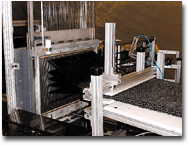
Today, Dr. Mohamed is the chairman and chief scientific officer of 3TEX. Dr. Mohamed and the
company have developed a three-dimensional orthogonal weaving technology that enables the
production of competitively priced composite materials that are stronger than steel and lighter
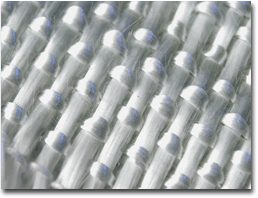
than aluminum. Using its computer-directed looms, 3TEX puts together two sets of fibers such as
Kevlar®, glass, ceramic and carbon or a hybrid of the four piling up to 15 layers.A third set of
yarns, what 3TEX calls the Z-yarn, vertically ties the layers together into a compact shape to
create a preform that resembles the end product. Currently, 3TEX is building a machine that will be
capable of weaving up to 60 layers into a 6-inch-thick fabric. 3TEX has a total of 19
two-dimensional and three-dimensional weaving machines, having widths of up to 72 inches. The
company is in the process of building a 120-inch machine that will be ready next year.  
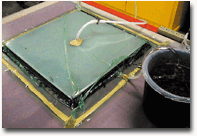
After the preform is inserted into a mold of the end product, the company injects resin into
the vacuum-packed preform to create the finished composite. Developed with 3TEXs automated 3-D
orthogonal weaving process, the resulting composite exhibits improved strength; a high resistance
to corrosion, fatigue and fracture; and an architecture that prevents delaminating. It doesnt
expand and shrink, Dr. Mohamed said. It has tremendous properties because of heat dissipation,
better thermal properties, and very low coefficient of thermal expansion. Vacuum infusion also
means the process isnt hazardous to the environment.Traditional composites are created by a
labor-intensive lamination process, in which multiple layers of fabric and resin are molded
together to build up thickness. Having layers in the composite means its susceptible to
de-lamination in the event of severe stress or impact. With 3TEXs process, manufacturers can save
money because less resin is used and time, because it takes much less manpower to infuse a preform
with resin. For example, it took 3TEX only 30 minutes to inject a 10-foot boat with resin. On
average, we can reduce the weight of conventional composites by 20 percent, while improving their
performance, Dr. Mohamed said. Going Ballistic And Getting DefensiveFrom aerospace parts to
bulletproof vests to kayaks, 3TEX is proving that, using its 3-D technology, it can revolutionize
and grab a slice of the $24-billion-a-year composites industry. 3TEX has received contracts from
the U.S. government to develop armor materials for ground vehicles; carbon rocket nose cones;
pistons; and other high-temperature, high-stress engine parts all using 3-D woven composites.The
government isnt the only one that has caught on to the potential of 3TEXs technology. American
Technology Applications Knowledge (ATAK) Inc., San Jose, Calif., and Second Chance Body Armor Inc.,
Central Lake, Mich., the largest manufacturer of soft, concealable personal body armor in the U.S.,
are teaming up with 3TEXs Ballistic/Defense Development market segment to develop and design a wide
variety of ballistic and defense products. These products include police and military protective
gear, such as shields and barriers, helmets, body armor vests and combat vehicles.These markets are
all turning to composites as alternatives to steel, said 3TEX President and CEO, Brad Lienhart,
because it helps them lighten their loads, and expand their carrying capacity and the speed at
which they can move. Moving The Marine IndustryLightening up is particularly important to the
marine industry, because its always on the lookout for new ways to speed up boats, kayaks and
canoes. Sonic USA, a Hollywood, Fla.-based builder of performance power boats, has signed a
long-term deal to produce annually more than 200 26- to 85-foot-class boats using 3TEXs composite
products. Were very excited about the potential of building lighter, faster boats with 3TEX
preforms and new state-of-the-art vacuum infusion processes, said Richard Hewitt, owner, Sonic USA,
while not reducing boat safety or durability.3TEXs materials and composites have already been used
in the construction of a 45-foot Sonic USA racing boat for award-winning racer Byron Unger. Its
superior performance was proven at the New York State Poker Run 2001 race, when Unger won the
80-plus mile-per-hour class, as well as the Best Looking Boat award.A team of undergraduate and
graduate students at the Savannah College of Art and Design (SCAD), Savannah, Ga., have followed
suit with the design and construction of a 22-foot family sport boat. SCAD Professor Tom Gattiss
goal is to continue to use 3TEXs innovative materials and technology to create attractive,
low-maintenance boats that will outperform current boats. The SCAD boat will be on exhibit at the
Composites Fabricators Association (CFA) show in October.But boats arent the only ones picking up
speed with 3TEX composites. Confluence Watersports, Archdale, N.C., has turned to 3TEX to help it
design lighter, stronger, more durable kayaks and canoes. 3TEXs composite materials allow for the
design of a variety of shapes, which means the composite paddlesport can be suited for a wide range
of paddlers whether its a longer design for speed, or a shorter design for better mobility.
Regardless of length, the end result is a canoe or kayak that is easier to transport and capable of
withstanding harsh water conditions.Resins giant Reichhold, Research Triangle Park, N.C., has
joined forces with 3TEX to get in on the marine action as well. Together, the two companies have
developed a boat in the box program, in which Reichhold brings the resins and 3TEX offers the
preforms, to help marine manufacturers increase productivity and lower their overall manufacturing
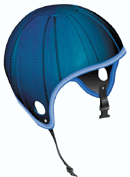
costs per boat. 3TEX composites can be applied to paddles and helmets, as well as being used in
many other applications. Ramping Up
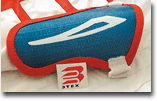
3TEX is already using its patented 3-D weaving technology to develop soccer shin guards for
sporting goods manufacturer Brine Inc., Milford, Mass. And the company is in talks with medical
research centers about using 3TEX composites in prostheses.The applications for 3TEXs technology
appear endless, and thats becoming evident in the companys revenue growth and the amount of
interest its generating with investors. The startup has secured $15 million in venture capital and
private placement. DB Capital Inc., an affiliate of Deutsche Bank AG, led 3TEXs most recent round
of funding. Lienhart expects sales to more than double in 2001, to approximately $10 million, and
in anticipation of increased demand for its composites, the more-than-50-employee company has
leased another 20,000-square-foot building in Rutherfordton. The company also hopes to identify a
location for a manufacturing facility in Europe by next year. 
In May, 2001, 3TEX was featured in Fortune Magazine as one of a handful of textile companies
that are turning to technology and innovation to develop new high-performance products. This
development has turned the company from a dream into a thriving business. In years to come, others
will have to follow in the pioneering footsteps of this upstart if the U.S. textile industry is to
flourish in the new millennium.

October 2001

Cone Announces Credit Facilities Extensions

GREENSBORO, N.C., Sept. 28 /PRNewswire/ — Cone Mills Corp.(NYSE: COE) today announced it has amended agreements with its lendersextending the existing credit facility and senior note obligation throughDecember 7, 2001. While the company and its lenders have a term sheet for anextension of the current agreements to December 31, 2002, the events ofSeptember 11 and its aftermath have delayed the process of final documentationnecessitating the current extension. Chief financial officer, Gary L. Smith, commented, “The company expects tomove forward quickly to finalize agreements extending the credit facility andsenior note obligation through year-end 2002.” Founded in 1891, Cone Mills Corporation, headquartered in Greensboro, NC,is the world’s largest producer of denim fabrics and the largest commissionprinter of home furnishings fabrics in North America. Manufacturingfacilities are located in North Carolina and South Carolina, with a jointventure plant in Coahuila Mexico. The matters disclosed in the foregoing release include forward-lookingstatements. These statements represent Cone’s current judgment on the futureand are subject to risks and uncertainties that could cause actual results todiffer materially. Such factors include, without limitation: (i) the demandfor textile products, including Cone’s products, will vary with the U.S. andworld business cycles, imbalances between consumer demand and inventories ofretailers and manufacturers and changes in fashion trends, (ii) the highlycompetitive nature of the textile industry and the possible effects of reducedimport protection and free-trade initiatives, (iii) the unpredictability ofthe cost and availability of cotton, Cone’s principal raw material, and othermanufacturing costs, (iv) Cone’s relationships with Levi Strauss as its majorcustomer, (v) Cone’s ability to attract and maintain adequate capital to fundoperations and strategic initiatives, (vi) increases in prevailing interestrates, and (vii) Cone’s inability to continue the savings and profitimprovement associated with its Reinvention Plan. For a further description ofthese risks, see Cone’s 2000 Form 10-K, “Item 1. Business -Competition, -RawMaterials and -Customers” and Item 7. “Management’s Discussion and Analysisof Results of Operations and Financial Condition.” Other risks anduncertainties may be described from time to time in Cone’s other reports andfilings with the Securities and Exchange Commission.SOURCE Cone Mills Corp.Web Site: http://www.cone.com Copyright 2001 PR Newswire

Superior Fabrics Introduces Fleecelock Nonwovens

Superior Fabrics Inc., Pompano Beach, Fla., has developed Fleecelock, a new nonwoven
fabric.Fleecelock fabrics, constructed of 100-percent polyester staple fibers using a modified
stitchbond process, have similar properties to those of a traditional stitchbond fabric, but do not
use a separate yarn system.The fabrics are available in weights ranging from 2 to 8 ounces per
square yard and may be dyed using finishing techniques used for other polyester fabrics. To add a
soft back or to create a bulky, soft fabric, Fleecelock is ideal for laminating to other fabric
composites, according to Superior.

October 2001

New Dyestuffs Improve Palettes

Textile manufacturers are constantly looking for more economical ways to run their plants and
produce their products. However, the standards are becoming higher high fixation, good wash-off
properties and lower environmental impact are all becoming increasingly important. Improved light-
and washfastness are the result of customer demands especially from the automotive
industry.Improved communication and globalization of companies require the quality of products to
be the same anywhere in the world. Sourcing is changing at the speed of light. Apparel bottoms
sourced in Kenya must match knit tops sourced around the world. New Dyes: Fiber-ReactiveCiba
Specialty Chemicals, Switzerland, now has three complete dye ranges for fiber-reactive exhaust
dyeing: the Cibacron® FN range for warm dyeing; the Cibacron LS range to reduce the amount of salt
needed in dyeing; and the Cibacron H range for hot dyeing. New products include dyes for black
formulations that offer versatility and a more economical choice:Cibacron Orange ROE; andCibacron
Brown DER.Also new are two greens that offer better shade consistency and quality of dyeing. These
products produce fewer variations within dye lots:Cibacron Green FN-BL; andCibacron Green H-BL.New
products in the Cibacron H range include:Cibacron Yellow H-G;Cibacron Orange H-R; andCibacron Red
H-F. Cationic DyesGermany-based DyStar L.P. has introduced a new physical form of cationic
dyes that are flowable powders. Designated Astrazon® Micro, they are designed for dry dye
dispensers. Conventional powders can cause problems with dusting, bridging and static build-up on
silo sides. Disperse DyesAnother important trend in the market is the need for improved
washfastness, particularly in polyester, polyester/cotton blends and polyester/spandex. To meet
this trend, Ciba has introduced the Terasil® W disperse dye range. New products in this range
include:Terasil Red W-FS;Terasil Black W-NS; and Terasil Navy W-RS.Other products will be
introduced next year to expand the Terasil W range. The products in this range are used in
continuous, package and exhaust dyeing.Ciba has also introduced a new liquid range for automotive
applications. The Ciba Terasil range is made up of stable liquid formulations that give exceptional
lightfastness. Included in this range are:Terasil Blue HL-B, LIQ 75 percent;Terasil Pink 2GLA, LIQ
50 percent;Terasil Blue BGE, LIQ 50 percent;Terasil Yellow GWL, LIQ 50 percent;Terasil Violet
PX-BL, LIQ 75 percent; and Terasil Yellow HL-G, LIQ 40 percent.Also from Ciba are the Terasil C
dyes engineered for continuous and exhaust dyeing for carpets. These products exhibit excellent
leveling and shade repeatability:Terasil Yellow CR;Terasil Blue C3R; andTerasil Red
CB.Switzerland-based Clariant will announce availability of a new line of high wetfastness disperse
dyes: Foron Navy SWF, Black SWF, Rubine SWF and Yellow Brown SWF. A new line of alkaline-clearable
disperse dyes with excellent washfastness includes Foron Navy SAC, Black SAC, Rubine SAC and Yellow
Brown SAC.DyStar has introduced the Optidye series of computer programs in partnership with
selected customers such as Burke Mills, Valdese, N.C., the first polyester-yarn-dye operation in
the country to use Optidye P. There are currently four versions covering polyester, nylon, acrylic
and wool dyeing. The programs use fiber, auxiliary and equipment data to recommend dyeing
procedures for individual shades. The program gives the shortest, safest time/temperature profile
possible. By reducing cycle times without compromising reproducibility, it has been proven to
maximize dyehouse profitability. The program is the product of more than 30 years of continuous
improvement at Bayer and DyStar in the development of such expert systems. PigmentsDyStar has
introduced a line of high-lightfastness pigments under the Imperon® HF label. These pigments offer
in the order of 500 hours in pastel shades. They are also stable to shade changes that can occur
during binder curing. Sulfur DyesClariant has available a new sulfur black Diresul Blue Black
RDT-2B with a blue cast that offers greater versatility in matching black shades on
cellulose. Auxiliary ChemicalsLeveling and migration are important aspects of exhaust dyeing.
Yorkshire Americas, Charlotte, N.C., has a new leveler/migration aid for disperse dyeing of
polyester. PatLev PL has the same migration enhancement and strike rate control as PatLev DDL-LO
for todays low liquor ratio machines.Afterclearing improves the wet-fastness of disperse dyes.
Yorkshire Americas Intratex MSB is intended as a replacement for a caustic/hydro afterclear. It has
also been used to remove spots and deposits from deep shades dyed at low liquor ratio. Often these
goods have a bronzy surface appearance. Intratex MSB cleans the surface to give a deeper, richer
shade. Significant DevelopmentsClariant reports one significant update in the field of dyeing
Fadex ECS: UV-Absorber for polyester fabrics. This product provides very high sublimation fastness
and can be applied by package and beam dyeing. The product is mainly used for automotive fabrics.
Currently available products, which are applied mainly by means of package dyeing, provide
significantly less sublimation and fogging. Dosing SystemsThe VaryFlow system from United
Kingdom-based Kinder International Systems Ltd. offers solutions for dye-dispensing headaches. The
VaryFlow system proportionally controls the pneumatic dispensing valve. The valve can be on, off,
or anywhere in between the on/off state. This allows the dispensing system to determine the optimum
flow rate for the required quantity of dye.The VaryFlow system allows a single valve to dispense
from grams to tens of kilograms of dye because the flow rate can be adjusted from as low as 1 gram
per second (g/s) to more than 1,000 g/s. The system is impervious to fluctuations in the ingredient
supply pressure, and because small orifice valves arent necessary, valve blockages are eliminated.
Kinder claims that a customer can save money and achieve greater reliability by using the VaryFlow
system. Dye Machines

The Millennium by Mount Holly, N.C.-based Gaston County Dyeing Machine Co. continues to offer
great versatility. Fabrics handled include tricot/raschel; spandex (elastane) blends; athletic
wear; wovens; and specialty fabrics.Specialty fabrics processed now include: cotton jersey;
polyester microfiber suede; athletic wear mesh; thermal knit; satin; chenille woven; crepe; poplin;
fleece; high-stretch woven; micro-sanded twill; nonwoven; polyester/rayon twill; polyester/cotton
cuffs and collars; cotton/spandex jersey; nylon flock; and spandex knit.Since the machine was
introduced in 1999, the chamber size has increased, thereby increasing the load per port. Trial
data run over the past two years have shown the capacity to run up to 518 pounds per port.The major
advances continue to be the incorporation of support for the dye machine. The Millennium Dyeing
System consists of an interconnected system from the control center to the dye machines with a
central charge tank, to the automated weighing, dye dissolving and automatic chemical
dispensing.Jet-dyeing technology has taken many directions over the past 10 years, and Sclavos
S.A., Greece, has always looked to the most pressing needs of the customer to bring forth
technology that addresses both the short-term and long-term needs. The TwinSoft Flow, along with
the AquaChron rinsing system, addre-ssed quality and cost issues. Water, steam and energy continue
to represent major costs that impact the profitability of any operation in the United States or
around the world.The Sclavos Venus has several features. The use of a specially designed pump
claims to reduce energy consumption by 30 to 40 percent. The use of the AquaChron allows continuous
rinsing and a reduction in total water consumed. A heat exchanger saves the waste energy and
preheats incoming wash water. Sclavos claims that a customer dyeing 300,000 pounds per week will
save more than $750,000 a year using Sclavos technology when compared to conventional
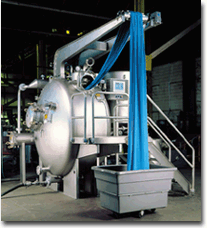
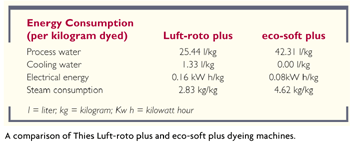
machines.Germany-based Thies GmbHandCo. Luft-roto plus jet-dye machine and DyStar textile dyes have
partnered to introduce a new short cotton dyeing system with very low 3.5:1 liquor ratio. The
previous state-of-the-art process of the Thies eco-soft plus machine required a liquor ratio of 6:1
and a cycle time of 286 minutes. The new procedure runs in 189 minutes. The new process therefore
requires less thermal energy, less electrical energy and no cooling water. The new procedure calls
for a five-minute high-temperature bleach, and a combined cooling rinse and dye cycle, in which dye
and half the salt are added first, followed by alkali and the rest of the salt. The dye solution
enters the venturi and uses a patent-pending technique for positive liquor exchange. 

Research IdeasSee Dyeing, PrintingandFinishing,
TI, this issue, for some of the latest ongoing wet-processing research at North Carolina
State University.

October 2001

Porous Materials Develops Multi-Chamber Porometer

Porous Materials Inc., Ithaca, N.Y., has developed a multi-chamber and multi-mode porometer for use
on such materials as nonwovens, cosmetics, filters, paper and ceramics.The porometer contains five
sample chambers. Four chambers are used for fast sample characterization. The fifth chamber is used
to perform more sophisticated tests.The instrument uses Windows-based software to measure the
pressures and the corresponding flow rates that determine the largest pore diameter, mean flow pore
diameter, pore size distribution, gas permeability and hydrohead of the sample.The porometer can
also measure liquid permeability.

October 2001

Sponsors