Industry Activity

Fiber WorldBy John E. Luke Industry ActivityLast year’s performance demands decisions and action for survival in 2002. In the wake of the moral and economic shocks suffered by the United States since September 11, it appears time to return the focus of Textile Worlds Fiber World feature to the distribution patterns in the fiber and fabric industries and to provide a look at the preliminary results of textile industry activity in 2001. Industry performance last year seems to point to even more survival decisions for 2002 and beyond. A Point Of Comparison
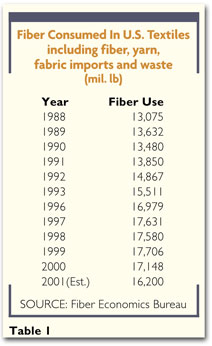
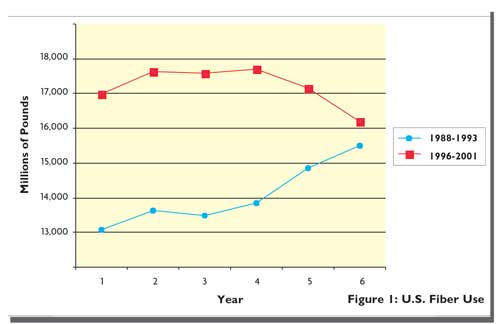
Traditionally, industry activity has been explored as a stand-alone process without detailed comparisons to other periods. The pace and depth of activity in 2001 suggests methodology may be lacking. An interesting correlation of trends appears to exist between the recessions of 1989/1990 and 2000/2001. This report will focus on 2001 as part of a greater cycle 1996 to 2001 comparing industry activities and opportunities to those from 1988 to 1993.The year 2001 was set apart by the horrific September events superimposed upon an economy struggling to stay afloat after a dozen years of prosperity. Granted, textiles did not always share that prosperity, as additional exogenous events forced competing economies into socio/political/economic decisions that changed the world platform for textile and apparel manufacturing and distribution. Given this aggregation of economic forces, the traditional stand-alone methodology will be broken in order to understand 2001 by trying to deal only with those actions induced by events over which the textile industry might have some control.Many textile spokespersons focus on imports in describing the ills of the U.S. textile economy. Imports are a problem that will not go away. Industry leaders, pundits and observers can rail against executive and legislative government as they appear to sacrifice textiles on the altar of trade, but the die is cast: the textile industry has overstayed its welcome at the trough of protectionism. The apparent reluctance of at least part of the industry to employ modern management approaches and its very reliance on entry-level employment encourage government to jump to politically expedient conclusions. Survival now demands decisions and actions through which the industry will find products and distribution channels somewhat less susceptible to foreign incursions.Many events are burned into our memories of textiles in 2001: September 11; the recession; increasing imports of garments and made-up items; mill closings; layoffs; and hundreds of smaller individual hurts. It is sometimes tempting to ask what else can go wrong. The lesson from our countrys history is not to focus on the bad, but to examine events, determine their causes and provide solutions that preempt repetition.There is an interesting correlation between Textiles 2001 and Textiles 1990. Both years are characterized by stagnant/decreasing textile activity in a national economy of the same description. The interesting view comes by examining the paths textiles took into and out of each recession and the structure of the industry in and after recovery. Table 1 outlines total fiber consumed in U.S. production of four major end-use categories: apparel; home textiles; floor coverings; and industrial and other consumer-type items. The data reflect only items manufactured in the United States, but also include raw material fibers and fabrics imported for inclusion in these items.The first notable message in Table 1 is the almost catastrophic usage estimate for 2001. Preliminary Fiber Economics Bureau (FEB) data for domestic consumption, plus traceable imports of fibers, fabrics and waste, paint a grim picture for U.S. textiles. Statistical and anecdotal evidence has been accumulating for years, although the industry has until recently continued to report increased total fiber consumption. It appears that a change, probably one necessitating fundamental revisions in goals and strategies, is about to descend upon American textiles.The important information from Table 1 lies in subtracting domestic shipments from total consumption to note how fiber and fabric imports add to the pressure already caused by imported garments. In 1988, fabric and fiber imports totaled 452 million pounds. As U.S. industry rallied from the 1989/1990 recession, 1993 fiber and fabric imports had risen to almost 1.5 billion pounds. By 1996, fiber and fabric imports had jumped to 2.27 billion pounds and were starting a rise to almost 3.0 billion pounds estimated in 2001. Distribution ChangesAn even more interesting pattern emerges when the data in Table 1 are graphed (See Figure 1). The U.S. textile industry has worked through the 2000/2001 recession in a manner almost identical to that in which it survived the 1989/1990 experience. In each period, fiber use rose approximately 4 percent in the year preceding the recession and declined about 1 percent the next year. In the third year, industry shipments rose again: 1991 exceeded 1990 by 2.7 percent and 1999 beat 1998 by slightly under 1 percent in retrospect, a sign of impending change.Unfortunately, the two graphs now begin to diverge, definitely foretelling a fundamental change in U.S. textiles. Domestic fiber usage stagnated in the 1988/1991 period at approximately 13.5 billion pounds, finally rising above 14 billion pounds in 1992 and above 15 billion in 1993. Recovery was at hand. In the 1996/2001 period, domestic shipments rose from 14.7 billion in 1996 to 15.2 billion in 1998, and then industry began to derail. 1999 industry consumption dropped to 15.1 billion; in 2000, consumption declined to 14.6 billion pounds. Through 1999, total industry consumption rose, with the domestic shortfall satisfied by imports. From 1996 through 2001, imported fibers and fabrics captured 500 million pounds of the U.S. market while from 1998 through 2001, the recession cost U.S. producers 1 billion pounds.
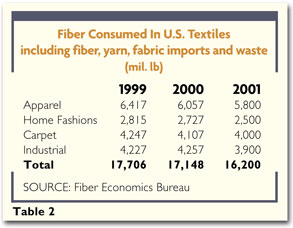
 2001For textiles, 2001 will prove to be a watershed year. The industry must decide how to operate in a national environment likely unsympathetic to pleas for continued protectionism.In the data shown in Table 2, 14 percent of 1999 usage, 15 percent of 2000s and 18 percent of 2001s are estimated to come from imported fibers and fabrics. The losses in home fashions and carpet markets are logical, given changes in housing starts in the recession. One can rationalize the drops in industrial market distribution, although the gross numbers cover some important details, which are partially revealed in labor productivity statistics (See OTEXA Data Reveals Export Opportunities, ATI, November 2000).Fiber use in nonwovens has risen almost 20 percent since 1996. Measuring industrial markets by pounds is not entirely accurate because many traditional knitted or woven structures are being replaced by generally lighter, nonwoven substitutes; the actual loss to traditional weaving mills is larger than poundage comparisons reveal.The real issue comes down to apparel. The labor sensitivity of apparel is driving manufacturers to Southeast Asia, but the U.S. apparel business will not disappear. The question becomes: how far down will fiber usage fall before a much smaller, more nimble base industry begins to emerge And, more importantly, who will remain For various reasons, home fashions, carpet and industrial end-uses are substantially less vulnerable to imports than is apparel, and they have provided cover for lost apparel sales. However, there are limits to the size of home fashions and carpet apparently, current levels. Lacking a serious breakthrough in industrial fabric technology, industrial growth seems limited. The 2001 fiber performance, supported by the plethora of layoff and mill-closing announcements, shows there is scant room for some current apparel fiber and fabric suppliers to crawl into home fashions, carpet and industrial markets.
 How To SucceedIf textiles does nothing to stem the loss of textile and apparel production and jobs, the losses will continue. The World Trade Organization (WTO) takes its final steps onto the stage in less than three years. Quotas will disappear and the full trade weight of economically ambitious developing nations will focus on the United States. Political decisions have displaced economic selection processes in trade. Analysis of exports by U.S. manufacturers must conclude that the playing field is not level now and will become less so with full implementation of the WTO. Certain markets are difficult to enter or are closed to U.S. manufacturers, despite the reverse being open.Market strength built on knowledge is an answer, implemented by joining with more countries in North American Free Trade Agreement (NAFTA)-like trading plans. The European Union (EU) has formed a rigid trading bloc, and Asia appears to speak with a single voice. In contrast, the United States, the object of desire for every exporting nation, sails alone. Arguably, NAFTA has increased trade among the participants. Taking advantage of shorter lead times, Mexico has replaced China as the single largest exporter of apparel to the United States, although shipments from the total Asian region continue to dominate. Mexico probably has gained more from NAFTA than has the United States, but this is a natural consequence of a capital-goods nation trading with a labor-capital nation. The United States ships raw material; trading partners add labor value and return finished product.Can the United States bring Central and South America into the NAFTA model Does the United States gain any advantages by joining with additional Western Hemisphere nations Answers must be viewed with a long-term perspective. Rather than expend political capital defending politico-trade skirmishes in the WTO, should the United States strive toward associations that grant greater voice and strength in trade The United States, as the center of a trade association in the Western Hemisphere, surely carries a larger stick than it would alone. While the political impact of this strategy should be almost immediate, it will take years to identify, train and operate large-volume, labor-sensitive manufacturing in the developing nations of Central and South America. Economic gains can be visible early, though. Once negotiating progress is apparent, companies will act to uncover benefits, customers, trade-encouraging policies, improved infrastructure and other advantages. Time’s A-Wastin’Time is of the essence. If the United States is to expend political capital, there must be a rapid move to enjoy the fruits of its labors. Should the United States not encourage trade in its backyard to add to the regions voice and economic strength Europe and Asia are feverishly trying to negotiate trade pacts with Central and South American nations. It is certain these compacts will not favor the United States and might preclude future U.S. participation. The House of Representatives passed a resolution granting the President trade promotion (fast-track) authority. Similar legislation is inching through the Senate, scheduled for March discussions. If this nation wants to affect change, should pressure not be applied to areas where change is possible and long-term benefits can be offered Railing against the WTO will generate marginal changes; changing the balance of power by endorsing and promoting NAFTA expansion will force more decisions that favor the United States. As well, it is important not to lose sight of what business were in. Just moving a weave shed to Peru doesnt improve competitiveness. Exporting capital and knowledge, the strengths of the U.S. industry, can improve the supply chain between the United States and a Southern Hemisphere trading/manufacturing partner.Product economies gradually evolve to service economies. Using capital creatively, the United States should convert some equities, knowledge particularly, into service activities. U.S. industry can use its expertise in distribution to attack the all-too-long apparel supply chain. Put the weave shed in Peru next to a dye house, export across the land bridge of Central America or through the labor economies of the CBI region, employ and ultimately sell to a new customer. This adds service to the equation, takes the U.S. textile industry beyond a pure manufacturing mentality, and makes it competitive and a survivor.Editors Note: John E. Luke is owner of Five Twenty Six Associates Inc., Bryn Mawr, Pa., a consulting firm specializing in strategic marketing and operations facing textile fiber and fabric manufacturers. He is also a professor of textile marketing at Philadelphia University, Philadelphia.March 2002

Nano-Tex Launches NANO-TOUCH Technology

Nano-Tex LaunchesNano-Touch TechnologyNano-Tex LLC, Greensboro, N.C., a subsidiary of Burlington Industries, has introduced the fourth of its nanotechnology-based textile products. NANO-TOUCH fabric technology enhances fabrics by grafting an outer layer of cotton-like attributes to a man-made fiber core, adding cottons softness, comfort and matte finish to the durability, strength, colorfastness and crease retention inherent in the man-made fibers.Working at the molecular level, the new technology eliminates the need for traditional spinning processes or blended fibers and fabrics, according to Nano-Tex. Our proprietary technology is engineering fabrics that create advanced performance sustainable through the life of the fabric, said George W. Henderson, CEO. Scientists in our research and development center are pioneering new ground with cutting-edge applications of nanotechnology to textiles, creating a pipeline of future innovations.Burlington is producing NANO-TOUCH-enhanced fabrics under exclusive license from Nano-Tex. The fabrics are being shown to customers and are available for immediate sale.March 2002

Conflict Between Cotton Producers And Yarn Spinners


A
t a recent meeting with a group of cotton producers to improve dialogue, the discussion
focused on the importance of fiber quality characteristics. Specifically, fiber characteristics
that contribute to improvements in manufacturing performance and product quality, and at the same
time lower cost for yarn spinners — thus providing a positive influence on company bottom line and
customer satisfaction.

To help those in attendance appreciate the importance of short fiber content and trash
content to yarn spinners, components from the Murata Vortex Spinner (MVS) were passed around. The
spindle, needle and needle holder were carefully observed/discussed. It was emphasized that this
system can’t handle and really doesn’t like short fibers, high micronaire or trashy cotton.

As you might expect, word came from the audience, “We can produce higher-quality cottons
with improved fiber properties, if we are paid for them. Our objective is the same as the textile
mill — to maximize profits. And for us right now, the best way to do that is to increase yield. The
objective is dollars per acre.”

Needless to say, after decades of discussion, the cotton marketing system doesn’t seem to
send the right signals from the spinner to the producer.


Incentives


Producers can produce a higher-quality fiber if the incentive is there. Money provides the
incentive and usually gets attention. Are mills getting what they pay for? Why can’t our leaders
recognize that giving our producers an incentive to produce cottons with improved fiber quality
characteristics contributes to performance improvements? One would expect better input would lead
to bottom-line improvements.

Producers truly believe that mills want better fiber qualities. They also have learned that
mills don’t want to pay for new cotton fibers. And spinners must be willing to pay for fiber that
helps the bottom line. Varieties for these new cottons yield less lint per acre, and with the
current marketing system, producer income would be reduced. Given this loss of income, these
varieties will not be developed/produced.

Spinners know fiber properties influence performance, quality and cost at every process in
the conversion of fibers into consumer products. There isn’t a process where better fiber
properties have a negative impact. If this is the case, why can’t all segments in the pipeline work
together, for the good of all?

It seems reasonable to think that if a supplier developed, created or produced something
that would help make money or improve the bottom line, it would generate a lot of interest.
Management of a company using this raw material would certainly want to explore the opportunities.


Cotton Situations


For the year 2001/02, the United States Department of Agriculture (USDA) reports a sharp
reduction in domestic mill use, higher exports and increased ending stocks of cotton. Domestic mill
consumption was reduced by 400,000 bales last month to 7.3 million — a 1.5 million-bale reduction
compared to the 2000/01 total of 8.8 million. Exports were raised 200,000 bales to 10 million (6.7
million in 2000/01), and ending stocks were increased 200,000 to 8.8 million bales (6 million in
2000/01). Production was 20.08 million versus 17.19 million bales in 2000/01.

With this reduction in U.S. mill consumption, it is worth noting what annual changes have
occurred in other countries. In Europe, there was a reduction of 270,000 bales. In the following
countries, consumption increased: China (250,000 bales); Central Asia (30,000 bales); Turkey
(150,000 bales); South Korea (100,000 bales); and Argentina (30,000 bales). Given these numbers and
trends, what does the future hold?

Cotton prices moved up slightly from those reported last month. Quotation for the base grade
in the seven designated markets averaged 32.73 cents per pound, up from 31.70 cents last month but
down from 61.04 cents a year ago.


Looking Better


All respondents said things seem to be turning around. One responded, “I am more positive
than at any time in the past several months. We have received some orders, so things are better for
the present time. I don’t know what it will be like next month, but it is good to have these orders
now.” Maybe there is a light at the end of the tunnel.


March 2002

Unifi AF And Y Form Polypropylene Agreement

Unifi, AF and Y FormPolypropylene AgreementUnder the terms of an agreement between Unifi Inc., Greensboro, N.C., and American Fibers and Yarns Co. (AF and Y), Cumming, Ga., Unifi is now the commissioned false-twist texturizer of AF and Y polypropylene.Unifi now texturizes polypropylene feeder yarn supplied by AF and Y. Some of the textured yarn is returned to AF and Y for sale and distribution to home furnishings and contract upholstery markets. Unifi sells the remaining yarn into its core markets.This partnership with Unifi combines the technology, knowledge and experience of both companies to allow us to supply high-quality textured polypropylene products to our customers, said Mike Apperson, president, AF and Y.March 2002

Gene Cone President Johnston Industries Addresses The Atlanta Textile Club

Atlanta, 3/12/02 Gene Cone, President and CEO of Johnston Industries in Columbus, Ga., addressed the membership of the Atlanta Textile Club (ATC) at lunch on Monday, March 11. Echoing statistics from the American Textile Manufacturers Institute (ATMI), Mr. Cone said, “The textile industry had lost over 160,000 jobs since 1997, 65,000 of these last year. And over 200 companies have closed since then, 100 of them last year”. But he was also positive about his company.”We cannot compete on cost or price. There is no magic bullet. We have to understand this business, take ownership of our company, work as hard as the immigrants who made this country great.” He outlined five strategies: make Johnston Industries a world-class, global player; focus on solving the customers problem; innovative, new, unique products; excellence in every person in the company; and partnership with customers, suppliers and other textile companies.After the lunch, Mr. Cone met individually with many of the 28 attendees at the lunch including journalists, trade show managers, sales executives, academics, suppliers and even those retired from the industry but lifelong members of the ATC.The April meeting of the ATC is a Golf Outing on April 8 and the May lunch on Monday, May 6 features Mr. Royce McInnis, VP of Sales for Alkahn Labels to tell us important trends in the technology and laws of labeling.About the ATCThe Atlanta Textile Club dates back to its beginnings in 1930 and continues today. The ATC is open to anyone involved in the global textile/apparel/sewngoods supply chain who lives in or near Atlanta. The ATC meets the first Monday of every month for lunch with guests speakers from key positions throughout the industry, and hosts several golf outings. Visit www.usawear.org/atc

Set For Success

Spinning TrendsBy Virginia S. Borland, New York Correspondent Set For Success
Based on demand for quality wool yarns, Amtex opens custom spinning plant serving world
market.
 S ince its inception in January 2001, Amtex (Yarn) Manufacturing Inc.,
Mississauga, Ontario, has been running at near capacity, with an annual production of 1.5 million
pounds of wool yarn. In a world market where global suppliers of innovative products that offer
quality and service to niche markets are the leaders, Amtexs future looks bright.

Zein Dawood, president, built the new facility because of an increasing demand for quality
wool yarns for the sock, sweater and weaving industries. Until he started this new venture, Dawood
worked with his father, Yakub Dawood, at Dawtex Industries, also located in Mississauga. Both
companies are family- owned. Dawtex produces acrylic and cotton/acrylic yarns. We wanted to
separate the wool and acrylic processing because we did not want to run into problems with
contamination due to acrylic fly, Dawood said.Amtex purchases natural, solid- dyed and heathered
wool top from world markets and sells coarse to ultra-fine-spun yarns to knitters and weavers
around the world. Heavy-count wool for socks comes from the United States, extra-superfine merino
from New Zealand and Australia. Most of the wool top is dyed in the United Kingdom. Amtex spins
single- to five-ply yarns.Amtex is a wool licensee for Total Easy Care®. Along with wool, the
company spins blends. Alpaca, cashmere, silk, nylon, polyester and Lycra® are in current
production. Wool/polyester blends are going into thermal underwear, wool/polypropylene is for
socks, and a blend of lambs wool and alpaca is going into upland hunting socks manufactured by the
Columbia Sportswear Co.®Merino wool/silk twisted with Outlast® microthermal fiber is being spun for
ski socks. Amtex has a five-year contract to produce merino wool sock yarns for Smartwool,
Steamboat Springs, Colo. Wool/nylon is being spun for McGregor Hosiery, Toronto.Currently, 80
percent of production is going into socks, 15 percent is for sweaters, and 5 percent is going to
the weaving trade. We have the equipment to weave ultra-fine- count yarns, especially yarns for the
suit market, Dawood said. A small amount of yarn is sold to the home furnishings market.

We think of ourselves as a custom spinner, said Dawood. We run a basic range with 30 colors
in stock. Most of our yarns are dyed and spun exclusively for each customer. We work as their
partner, developing the right yarns and colors for them. We can match a color in two weeks and
deliver a sample yarn two weeks after a color is approved. We are flexible and offer colored yarns
in any grade of yarn or fiber content.The Amtex mill is a ring-spinning operation on the worsted
system, using the latest state-of-the-art equipment. The company has Suessen EliTe® spinning frames
that can make compact yarns. Suessen EliTe-spun yarns are less hairy than conventional yarns,
Dawood explained. They are softer and stronger. We are the only spinner in North America with this
equipment. 

The newest winding and finishing machines are in place as well. Along with conventional
Cognetex equipment, Amtex has purchased Savio Orion and Obem equipment to wind, set and relax
yarns.Touch this sweater, said Dawood. It has the look and feel of a cashmere blend, but it is
100-percent merino spun on our Suessen EliTe equipment. We are able to offer a better product at
the same price. The EliTe equipment originally was developed for spinning cotton. It has been
modified for long-staple fibers. From fiber to yarn, Amtex runs stringent testing. Our plant
manager and quality-control personnel are highly technical and have a long history in the textile
market in regard to the spinning of merino wool, Dawood said.When the fiber first comes into the
mill, we test the fiber for oil content, color and quality. We test throughout the entire process.
We have Uster Tester 3 equipment to analyze the yarn for hairiness, strength, thickness, moisture,
among other factors. We have Uster Classimat equipment to check that the yarn is setting properly
on winders. Our final tests are of the finished cones.Amtex was built to be versatile, flexible and
efficient. We have room for expansion, Dawood explained. We can increase our production to 5
million pounds. It is our intent to constantly update and improve. We are constantly looking at new
technologies and equipment. We want to produce the most innovative and highest-quality yarns in the
market.In the United States, Amtex yarns are available through MS Sales Co. Inc., Commerce, Calif.;
and Pembroke Textile Associates, Greensboro, N.C.
March 2002

National Spinning Acquires Glen Raven Yarn Facility

National Spinning AcquiresGlen Raven Yarn FacilityNational Spinning Co. Inc., Washington, N.C., has purchased the yarn manufacturing facility in Kinston, N.C., from Glen Raven Inc., Glen Raven, N.C. The sale includes the building and land of the Kinston operation, as well as the business associated with the facility.We are delighted to strengthen our relationship with Glen Raven, said Jim Chesnutt, president and CEO, National Spinning. The Kinston facility will be a welcome addition to our company as we continue to aggressively pursue the sales yarn business by offering our customers a wide array of high-quality products.With the sale, Glen Raven has left the sales yarn business. The company will continue to seek to expand its global fabric strategy, concentrating on fabrics for home furnishings and industrial and automotive markets.March 2002

Keeping It Fresh

By Richard G. Mansfield, Technical Editor Keeping It FreshAntimicrobial agents can be used in fibers and textiles to provide long-lasting protection against microbial growth. During World War II, when cotton fabrics were used extensively for tentage, tarpaulins and truck covers, these fabrics needed to be protected from rotting caused by microbial attack. This was particularly a problem in the South Pacific campaigns, where much of the fighting took place under jungle-like conditions. During the early 1940s, the U.S. Army Quartermaster Corps collected and compiled data on fungi, bacteria, yeast and algae isolated from textiles in tropical and subtropical areas throughout the world. Cotton duck, webbing and other military fabrics were treated with mixtures of chlorinated waxes, copper and antimony salts that stiffened the fabrics and gave them a peculiar odor. At that time, potential polluting effects of the application of these materials and toxicity-related issues were not a major consideration.After World War II, and as late as the mid- to late-1950s, fungicides used on cotton fabrics were compounds such as 8-hydroxyquinoline salts, copper naphthenate, copper ammonium fluoride and chlorinated phenols. As the government and industrial firms became more aware of the environmental and workplace hazards these compounds caused, alternative products were sought. A considerable amount of work was done by the Southern Regional Research Laboratory of the U.S. Department of Agriculture, the Institute of Textile Technology (ITT) and some of ITTs member mills to chemically modify cotton to improve its resistance to rotting and improve other properties by acetylation and cyanoethylation of cotton. These treatments had limited industry acceptance because of relatively high cost and loss of fabric strength in processing. In addition, the growing use of man-made fibers such as nylon, acrylics and polyester, which have inherent resistance to microbial decomposition, came into wider use to replace cotton in many industrial fabrics.In recent years, the emphasis has shifted from protecting textiles and textile products from microbial attack to protecting the environment and users of textile products from microbial attacks. Disinfectant materials provide a nearly instant but short-term solution to removing microbes, but antimicrobial agents are designed to provide longer-term solutions to eliminating microbes. Mechanisms And Methods For Protection In TextilesThe three mechanisms that can be applied to textiles in order to confer resistance to bacteria, fungi and mildew-producing fungi are: controlled release (Wakefield, Mass.-based AgION Technologies silver-based product); the regeneration principle (reactivation of antimicrobial by washing using a chlorine bleaching agent); and barrier or blocking action (triclosan products).For hydrophobic fibers like polypropylene, polyester and nylon, only the surface must be protected. Hydrophilic fibers such as cotton, rayon and lyocell require protection whenever moisture is present.

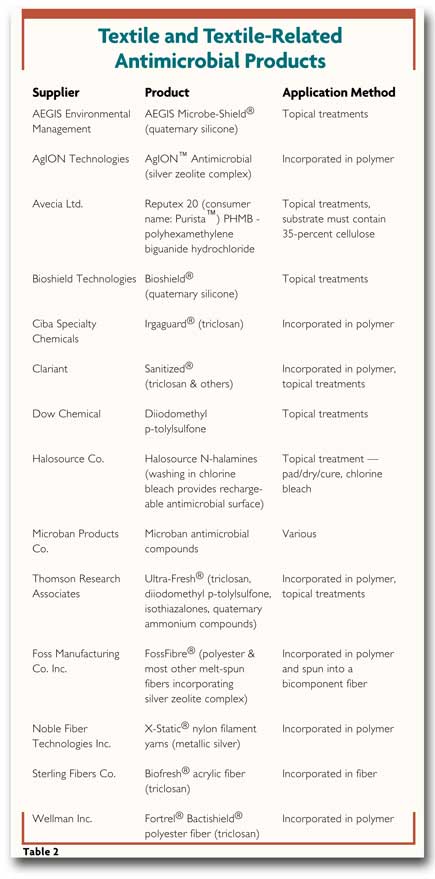
United Kingdom-based Avecia Ltd.s Reputex 20 antimicrobial can control the growth of microorganisms and the generation of odors when topically applied to textile products containing at least 35-percent cellulose (such as the socks pictured above). According to Jainwen Mao and Larry Murphy of Switzerland-based Ciba Specialty Chemicals Inc., an ideal antimicrobial for textiles would have to fulfill the following basic requirements:safety the antimicrobial must demonstrate low toxicity to the consumers and must not cause allergy or irritation to the skin;compatibility the product must present no negative influences to the textile properties or appearance and must be compatible with common textile processing; anddurability the antimicrobial efficacy has to be durable against repeated laundering.Two major classes of antimicrobial products for fibers and textiles include leachable and nonleachable types. Leachable types are not bonded to the fiber or substrate and can be removed by contact with moisture. Nonleachable types are chemically bonded to the fiber or substrate, or are incorporated within the polymer and on the polymer surface. Triclosan-Based ProductsOne of the most durable types of antimicrobial products is based on triclosan, a diphenyl ether (bis-phenyl) derivative, known as either 2,4,4 -trichloro-2-hydroxydiphenyl ether or 5-chloro-2-(2,4-dichlorophenoxy) phenol. Triclosan products have been used for more than 25 years in hospitals and personal care products such as antimicrobial soap, toothpaste and deodorants.Triclosan is manufactured by Ciba® under the trade name Irgaguard® and by several other manufacturers outside of the United States. Ciba makes several versions of its Irgaguard products for incorporation into hydrophobic fiber. These include Irgaguard B 1325 for polypropylene carpet fibers and Irgaguard A 2110 for polyolefin artificial turf fibers because of its ability to inhibit growth of algae. Other Irgaguard antimicrobials for use in polyolefin fibers and nonwovens include Irgaguard B 1000, B 1325, B 5000 and B 7000. Irgaguard products for use with nylon fibers are Irgaguard B 5000 and B 7000. Tinosan AM 100 and Tinosan CEL antimicrobials are also available from Ciba for use on nylon and polyester or blends of the two.Triclosan inhibits growth of microorganisms by using an electrochemical mode of action to penetrate and disrupt their cell walls. When the cell walls are penetrated, leakage of essential metabolites occurs and other cell functions are disabled, thereby preventing the organism from functioning or reproducing. The triclosan, when incorporated within a polymer, migrates to the surface, where it is bound. Because it is not water-soluble, it does not leach out, and it continuously inhibits the growth of bacteria in contact with the surface using barrier or blocking action.Microban® International Ltd., New York City, was formed in 1994 to develop markets for products that can provide antibacterial protection. The Microban organization developed a licensing and certification program, initially based on its expertise with triclosan. These and related products are compounded with colorants and other materials prior to the fiber extrusion or molding processes. Microban has licensed the use of its trademark and certification for bedding products and food service materials. Charlotte, N.C.-based Microban Products Co., a wholly-owned subsidiary of Microban International, is the global headquarters for research and development, manufacturing and distribution of Microban antimicrobial compounds. The company creates custom antimicrobials for specific end-uses.Fibers containing triclosan include polypropylene from Synthetic Industries, Chattanooga, Tenn., and acrylic fibers from Houston-based Sterling Chemicals and Cydsa, Mexico. Silicone-Based ProductsThe AEGIS Microbe-Shield® treatment is based on quaternary silicones like 3-trimethoxy-silylpropyl -dimethyloctadecyl ammonium chloride, which become affixed to the surface of the fibers.The quaternary silicones marketed by AEGIS Environmental Management, Midland, Mich., have been used successfully and safely by the textile industry since the mid-1970s. The products are manufactured by Dow Corning Corp., also based in Midland, and were first sold under the Sylgard® trademark. One of the first successful uses of this product was Dow Cornings 5700 Antimicrobial product for athletic socks produced by Greensboro, N.C.-based Burlington Industries Sock Division. In 1990, Dow Corning spun off its antimicrobial sales and applications as a privately held company now known as AEGIS Environmental Management. Dow Corning still supplies materials to this company. Products are licensed and sold under the AEGIS Microbe-Shield trademark. Its products are used in a number of consumer products including Odor Eaters®, Dr. Scholls® and Russell Fabrics activewear.Application of the silicone-based antimicrobials is usually made from aqueous solutions, and they can be applied by padding, spraying and foam finishing. Upon removal of the water, the nonvolatile silane forms covalent bonds with the fabric, which results in excellent durability.Nonwovens are a growing area for the use of the silicone-based antimicrobials. Applications include baby diapers, incontinence pads and hospital/surgical uses.Bioshield Technologies Inc., Norcross, Ga., supplies silicone-based antimicrobial products for a wide range of uses including textiles, household and institutional maintenance and cleaning. Products for the textile industry, based on Bioshield technology, are sold by Apollo Chemical Co., Burlington, N.C. Bioshield has been granted recent patents on organosilane chemistry.One of the consumer products Bioshield Technologies sells is the Bioshield CarpetandUpholstery Cleaner and Odor Eliminator. This product is claimed to remove tough stains including those from food spills and pet accidents. The company also sells another product, Odor Free®, which is used between cleanings to work on pet and tobacco odors.

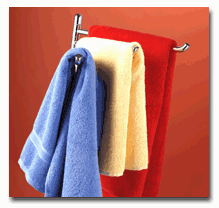
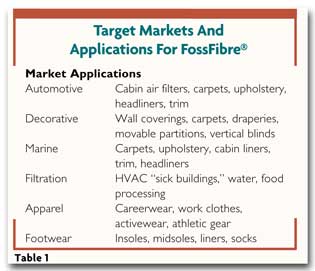
Avecia Purista antimicrobial keeps textile products fresher for longer. Towels treated with Purista are just as soft and absorbent as untreated ones, according to the company. Silver-Based ProductsAgION Technologies, formerly known as HealthShield Technologies, was formed in 1995. The company markets a silver-based antimicrobial with a unique delivery system.This antimicrobial is the result of 15 years of research by BF Technologies Japanese partner, Sinanen Co. Ltd. The AgION antimicrobial system is fully inorganic in nature. A zeolite mineral an aluminosilicate with a three-dimensional structure is used where silver is combined into the mineral structure by means of an ion-exchange reaction. Since the resulting material is ceramic in nature, it is extremely durable and can withstand temperatures as high as 800°C and still retain full antimicrobial effectiveness. This means that the AgION product can be incorporated into fibers made by melt spinning.The silver ions from the ceramic antimicrobial compound are released at a slow and steady, controlled rate. Ambient moisture in the air causes low-level release that effectively maintains an antimicrobial surface. As the humidity increases and the environment becomes ideal for bacterial growth, more silver is released yet there is a maximum release rate. So even under very wet conditions, the silver releases very slowly, ensuring long-term protection. The silver kills microbes by interacting with multiple binding sites on their surfaces.AgIONs antimicrobial is used for biomedical applications, consumer products and industrial applications. It can be used on the surface of a material or embedded directly in the material itself.The antimicrobial effectiveness of the AgION Technologies product has been confirmed against a variety of nosocomial airborne bacteria, yeast, fungi and molds, including escherichia coli (diarrhea), mycobacterium tuberculosis (tuberculosis) and streptococcus pyogenes (pharyngitis). Foss Manufacturings FossFibre® Antimicrobial FibersFoss Manufacturing Co. Inc., Hampton, N.H., is an innovative producer of nonwoven fabrics for automotive, industrial and consumer products (See Quality Fabric of The Month, TI, December 2001). The company has facilities in North America, Europe, Asia and Australia.FossFibre® incorporates AgION Technologies antimicrobials in its structure. Foss, however, has based its products on bicomponent fiber structures, which include a binder fiber as one of the components. To ensure the longevity and slow release of the agent, the active silver component is concentrated on the fiber surface and not in the core. The applications targeted for FossFibre are shown in Table 1.

 X-Static® Fiber From Noble Fiber TechnologiesNoble Fiber Technologies Inc., Clarks Summit, Pa., is a specialty processor of filament nylon yarns. The company has developed a proprietary process for incorporating metallic silver into a filament nylon base. The product has good acceptance for use in industrial products and in some U.S. FoodandDrug Administration (FDA)-approved medical products. It is registered with the U.S. Environmental Protection Agency (EPA) as an antimicrobial product.Some of the properties that Noble Fibers cites for X-Static are as follows:antimicrobial eliminates odor-causing bacteria and athletes foot fungus;all-natural safe and non-toxic, contains no chemicals or pesticides;heat-transferring cooler in the summer, warmer in the winter;anti-static; and therapeutic many health benefits due to conductive properties. Regulatory ConsiderationsU.S. regulatory laws consider any product used to control microbes a pesticide. The active ingredient in any antimicrobial must be registered with the EPA and be approved by the FDA. Whenever an antimicrobial claim is made for a product, it must be registered with the EPA for a specific use. In order to better understand the terminology used for antimicrobials and related products the reader can consult the Online Glossary on Antimicrobial Resistance. This glossary can be found at the website for the National Center for Infectious Diseases, Centers for Disease Control and Prevention: www.cdc.gov.

February 2002

Nordson Relocates Nonwovens Systems Group

Nordson RelocatesNonwovens Systems GroupDuluth, Ga.-based Nordson Corp. has moved its Nonwovens Systems Group from Norcross, Ga., to the manufacturing facility for the companys Fiber Systems and Web Coatings business units in Dawsonville, Ga. The Norcross facility now accommodates Nordsons Packaging and Product Assembly manufacturing.With separate, but related, business units in one location, Nordson hopes to better integrate product development, engineering, marketing and customer support programs.With closer proximity to the 40,000-square-foot Center of Excellence currently under development, well be able to simulate actual production line situations and perform extensive product and application testing before installation at the customer site, said Jim DeVries, vice president, Nonwovens Systems Group.February 2002

DyStar Getzner Partner For Electrochemical Dyeing Trials

DyStar, Getzner Partner ForElectrochemical Dyeing TrialsAustria-based Getzner Textil AG has signed a cooperation agreement with the Technology Team Electrochemistry Textile (TET), headed by DyStar Textilfarben, Germany. Under the agreement, Getzner will be the first company to use DyStars patented electrochemical dyeing process in pilot trials. Getzner will use the technology to vat-dye yarn on a package-dyeing unit. Other members of TET are the Institute for Textile Chemistry and Textile Physics at Austrias Innsbruck University, and Germany-based De Nora Deutschland GmbH.The new electrochemical dyeing process uses an electric current to reduce the dyes with the aid of a regenerable Fe2+/Fe3+ redox system. Conventional application methods use reducing agents that cannot be regenerated.The pilot trials will help TET further refine and develop the dyeing process. Dr. Wolfgang Schrott is in charge of the project for DyStar. He expects electrochemical dyeing to be suitable for a wide range of other applications including vat, indigo and sulfur dyes.In other company news, DyStar now markets all of its disperse dyes under the Dianix® brand. Following the acquisition of Germany-based BASFs textile dyes business, the branding aims to bring together Dianix dyes with the former BASF Dispersol® and Palanil® ranges.February 2002

Sponsors