For The Record:Ramtex uses Trutzschler 803 and 903 cards to prepare sliver at about 120 pounds per
hour for its 70 Rieter SB D10 and RSB D30 drawframes. The company weaves more than 900,000 yards of
fabric per week, 130,000 of which are produced using 14 Sulzer multiphase machines
(See Ramtex, TW, May 2002).
June 2002
For The Record
Easy-Care Cotton Inventor Receives Achievement Award
Easy-Care Cotton InventorReceives Achievement AwardDr. Ruth Rogan Benerito, inventor of easy-care cotton, has received the eighth annual Lemelson-MIT Lifetime Achievement Award for invention and innovation. The $500,000 award was presented during a special ceremony at the San Francisco Museum of Art by the Lemelson-MIT Program at the Massachusetts Institute of Technology (MIT), Cambridge, Mass.Dr. Benerito, who worked for 33 years at the Southern Regional Research Center of the U.S. Department of Agriculture, is credited with saving the cotton industry in the years following World War II, when fabrics made from man-made fibers were gaining popularity over cotton fabrics among American consumers. Her theory of crosslinking cellulose chains in cotton to provide wrinkle, stain and flame resistance received the first of 55 U.S. patents for processes used in cotton production. Dr. Benerito also created an environmentally safe process for the pretreatment of cotton, replacing mercerization using sodium hydroxide with radiofrequency cold plasma cleaning. The process was later adopted by the Japanese textile industry.June 2002
Stork Introduces Sapphire Digital Ink-Jet Printer
Stork Introduces SapphireDigital Ink-Jet PrinterThe Netherlands-based Stork Digital Imaging has introduced the Sapphire digital ink-jet printer. The printer uses piezo drop-on-demand ink-jet technology and can print on a variety of natural and man-made substrates, including silk and polyamide.Print speeds of up to 32 square meters per hour are possible, and the printer is suitable for short runs and roll-to-roll printing. In addition, the PrinterServer software guarantees quality reproduction and high color consistency, according to the company.Stork also offers specially pretreated textiles or, for customers wishing to use their own substrates, the necessary fabric pretreatment chemicals or Storks pretreatment license.June 2002
VBL Installs Bruckner Stenter
VBL InstallsBruckner StenterGermany-based Voss-Biermann, Lawaczeck GmbHandCo. KG (VBL) recently installed a split-flow stenter with process visualization and felt calender supplied by Bruckner Trockentechnik GmbHandCo., also based in Germany. Fabrics up to 2.6 meters wide can be finished using the new frame.As a commission finisher, we have to be able to finish all types of fabric with the most different weights and requirements, efficiently and rapidly, said E. Lingel, production manager, VBL. According to Lingel, VBL selected the Bruckner machine because of its high capacity, flexible automization and easy cleaning.June 2002
BBA Nonwovens Invests In New Spunlace Line
BBA Nonwovens InvestsIn New Spunlace LineBBA Nonwovens, Old Hickory, Tenn., is to invest $36 million in a state-of-the-art spunlace line at its Bethune, S.C., facility. BBA decided to make the investment to support a multi-year, specialty wipes contract awarded to the company by a major global customer. Currently, BBA also has new lines under construction in the United States, Europe and the Asia-Pacific region to support customers needs.June 2002
Biancalani Receives ISO 9001-2000 Certification
Biancalani ReceivesISO 9001-2000 CertificationItaly-based Biancalani S.p.A. is one of the first Italian companies to obtain the new ISO 9001 Ed. 2000 certification. The company obtained the certification earlier than was mandated in order to show its dedication to customer satisfaction and continuous improvement.Biancalani continues to work to fulfill three main goals: to continue introducing innovative machinery to the marketplace; to adopt a price policy that encourages investment in finishing equipment; and to strengthen after-sales service.June 2002
AAFA Proposes Alliance With Material World
As part of its ongoing mission to promote and enhance business opportunities for its members, the
American ApparelandFootwear Association (AAFA) has announced its intention to form an alliance with
Material World, the international full-package and sourcing event for the sewn products industries
held in Miami Beach, FL. As part of the proposed alliance, the AAFA will market Material World,
promoting the exhibition and its extensive exhibitor base, educational programming and full-package
sourcing opportunities, to both its branded apparel members, as well as its supplier members. The
AAFA will also have a prominent booth at the upcoming edition of Material World, October 7-9, 2002,
at the Miami Beach Convention Center. “As the President of the trade association for the apparel
industry, we are delighted to be partnering with the only supplier trade show in the United States
held specifically for the apparel industry. We are encouraging all of our supplier members to
exhibit in this event, and our sourcing managers to give it their full support,” says Kevin Burke,
President and CEO of AAFA. “We’ve been eager to work with the AAFA since we launched Material World
in 2000, and look forward to the partnership with such an important national industry association,”
says Tim von Gal, Executive Vice President, Urban Expositions, producers of Material World. “The
AAFA represents the dominant fabric purchasers and apparel importers in the United States, and
virtually all of these companies are seeking new learning and sourcing opportunities. As the most
important global full-package sourcing event in the Americas, Material World and the AAFA share
common goals and we look forward to working together to enhance the business opportunities for all
members of the industry.” “As chairman of the AAFA, I am delighted to be supporting our proposed
alliance with Material World. Our supplier members – whether they provide materials, equipment or
computer systems – need a place to show their wares to their major customers in the Americas. The
fact that our new International Network of Sourcing Executives has fully endorsed AAFA’s
relationship with Material World means that they will be there, looking for new and better ways to
do business and for new sourcing opportunities,” adds Paul R. Charron AAFA Chairman and Chairman
and CEO of Liz Claiborne, Inc.The American ApparelandFootwear Association (AAFA) is the national
trade association representing apparel, footwear, and other sewn products companies, and their
suppliers, which compete in the global market. AAFA’s mission is to promote and enhance its
members’ competitiveness, productivity and profitability in the global market by minimizing
regulatory, commercial, political, and trade restraints. For more information visit
www.apparelandfootwear.org”There is no doubt that a show of this type must take place in the U.S. –
exposing our members to the latest developments and innovations in materials and systems, and with
the added component of available contractors in the Americas,” says Fawn Evenson, Vice President,
Global Business and Services, AAFA. “This is the show that AAFA’s members have been calling for.”
Material World is the international full-package and sourcing event for the sewn products
industries in the Americas. Material World is strategically located in Miami to take advantage of
its position as an international trading hub and the U.S. gateway to Latin America, and
headquarters of Caribbean, Central American and Mexican commerce. In addition to its attractive
location for exhibitors and attendees from throughout the United States, Miami naturally draws
traffic from all over Mexico, the Caribbean, Central America, South America, and many of the
largest sourcing operations in the United States are located in Miami. Material World is open to
the entire sewn products chain, and participants include fabric, trim, fiber, components, equipment
suppliers, supply chain management systems – from design to delivery — full-package providers,
contractors/manufacturers, publications, services (freight forwarders, financial, color/trend
forecasting), associations and others.The Material World Miami Beach attendee audience will include
key decision-makers from throughout North, Central and South America, and the Caribbean, including:
CEOs, presidents, general managers, manufacturing vice presidents, sourcing executives, product
development executives, designers, purchasing agents, marketing executives, branded apparel
companies and retailers, including mail order, private label and e-business, importers and
others.In addition to a comprehensive roster of educational programs, networking events, product,
packaging and sourcing opportunities, Material World Miami Beach will showcase a number of trend
pavilions highlighting the color, product and technological elements expected to make a splash in
Autumn/Winter 2003/2004.
Jentex Develops JENBond Adhesive Web Products
Jentex Develops JENBondAdhesive Web ProductsJentex Corp., Buford, Ga., has developed JENBond Adhesive Web products to provide increased production efficiencies and reduced environmental impact in laminating processes. Jentex can produce web and composite roll goods in widths up to 64 inches. Matt Pelham, president, said Jentex has worked to produce adhesive web products that are competitive with other products in the marketplace, but also to offer additional products with lower melt points and high bond strengths to cover a wide range of applications. Our product trials have been successful and our customers are satisfied, said Pelham. We are now making the investment to take these products [JENBond] to market.June 2002
Shelton CTI Develop Elastane Relaxation System
Shelton, CTI DevelopElastane Relaxation SystemCollaboration between Shelton Machines Ltd. and CTI, both based in the United Kingdom, has resulted in a new on-line relaxation system for elastane fabrics. The Shelton C-Tex Fabric Relaxation system allows consistent finished length and width measurement of elastic fabrics during processing. The system was developed in response to the desire of Textured Jersey, a British manufacturer of fabrics containing elastane, to supply completely relaxed fabric to its customers. It combines on-line inspection and CTIs C-Tex relaxation® technique of air flotation fabric relaxation in a single machine. Textured Jersey has purchased several of the machines. Shelton and CTI have applied jointly for a worldwide patent for the technology.July 2002
Investments That Work
Investments That Work
Avondale Mills’ ongoing capital investment plan positions the company for low-cost delivery and
high-quality production. With a rich history of investment, acquisition, and focus on
quality, Avondale Mills is no stranger to innovation. A closer look at the companys technical
history reveals a well-honed strategy of plant and equipment upgrades, always positioning the
company for low-cost delivery of high-quality products.Since the acquisition of the Graniteville
Company in 1996, Avondale has invested more than $300 million in capital equipment. In 2000 alone,
more than $115 million was invested by this privately held firm. How does a private firm with
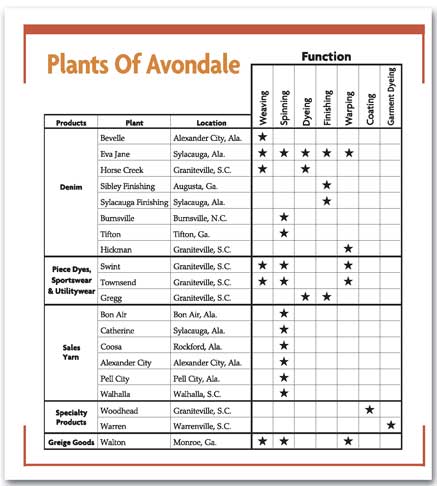
more than 5,600 associates, 20 plants and sales in excess of $600 million stay on course In
Avondale Mills Chairman G. Stephen Felkers words: More than 100 years ago, the visionaries who
formed Monroe Cotton Mills incorporated into their creed some fundamental precepts of doing
business, goals that we adhere to today.

Avondale’s Gregg Finishing Plant uses the latest computer technology to monitor its dye and
resin ranges. According to Felker, these fundamental precepts include:producing a product that
meets the needs of customers;ensuring a safe working environment for associates;taking pride in
manufacturing quality products;delivering on time; andpaying scrupulous attention to costs so that
a reasonable profit can be made.Weve made investments in good times and bad. Our dedication to
keeping Avondale modern and competitive is absolute, Felker continued. By reinvesting in Avondale,
weve equipped ourselves with the tools to fight not only domestic competitors, but imports from
low-wage countries as well.With an ongoing capital investment plan and plants that span spinning,
weaving, dyeing and finishing, Avondale Mills offered
Textile World a peek inside some of its most recent plant modernization
projects. Horse Creek PlantThe Horse Creek Plant, Graniteville, S.C., is a sound example from
Avondales acquisition and modernization history
(See Full Steam Ahead, TI, May 2001). As part of the 1996 Graniteville purchase, the plant
became the focus for consolidating Granitevilles weaving from other facilities, as well as a
platform for continued expansion as a world-class denim operation.With help from Suitt
Construction, additional space was added to make room for 240 Picanol Omni air-jet weaving
machines. These machines are fed by two computer-integrated Morrison indigo warp-dyeing ranges and
18 beaming machines, the most recent purchased from McCoy-Ellison. Hubtex beam-handling equipment
facilitates moving product, while West Point FoundryandMachine Co. provided four
computer-controlled slashers that deliver high-quality warps to the weave room.
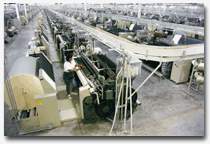
With quality at the heart of the weaving operation, the Picanol Omnis feature Alexander
Machinerys (ALEXCO) off-loom take-ups. As well, four Ingersoll-Rand air compressors were essential
additions to the air-jet installation. Pneumafils filtration systems and Luwa Bahnson/Parks Cramer
traveling cleaner systems ensure the proper weaving environment.Horse Creek was the first new
facility built by Avondale in some time. According to the company, the project was on a tight
timeline, but the efforts of Suitt Construction, Pneumafil, Picanol and the Avondale Engineering
Group kept the project on schedule so that it finished on time and within budget.It was an amazing
process to see the bare ground become a modern weaving mill in a matter of months, said Tim
Stansell, vice president, Manufacturing Services. Coosa’s Linked UpgradesAvondale Mills Coosa
Plant, Rockford, Ala., is the companys first linked spinning operation. Specializing in carded
yarns for its sales yarn business and weaving operations, Coosa features Crosrol bale opening and
cleaning equipment, which leads to eight new Marzoli roving frames and 23 Marzoli ring-spinning
frames. Schlafhorst placed 12 winders, and most recently, seven Savio Orion I winders have been
added. Filtration systems by Roy L. Hartness keep Coosas environment contamination-free.Mark
Tapley, executive vice president, Western Operations, said, The upgrade at Coosa spearheaded our
entry into linked ring yarn production. The improvements we realized in quality and costs
buttressed our effort to be the leader in the yarn markets. They also not only reinforced our
determination to expand in carded yarns, but also convinced us to proceed with a linked yarn
approach in combed cotton sales yarns. Alexander City
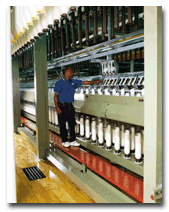
May 2000 brought the announcement that Avondale would invest $32 million in the conversion of
a portion of Bevelle Plant, Alexander City, Ala., to form Alexander City Plant. Bevelle continues
to produce high-quality denim fabrics, and the newly minted Alexander City Plant has been
fine-tuned to produce combed cotton yarns for the knitted apparel industry.Rieter, Marzoli and
Savio are at the center of the investment. There are two Rieter opening lines and 24 Rieter C51
cards with integrated grinding and Advanced Blowroom Control (ABC). Tateishi sliver cans feed eight
Rieter SB-D 10 drawframes for pre-drawing, monitored by Rieters SPIDER web system.Twenty Rieter E72
combers and eight RSB-D 30 finish draw frames with sliver guard utilize the UNIlap E32 transport
system to feed eight Marzoli FT 1-D roving frames with auto doffing. A roving transport system from
U.T.I.T. delivers roving to 25 Marzoli RST 1 ring-spinning frames that have a total of 32,400
spindles. Auto creeling of roving, automatic bobbin doffing and linked winding maximize
efficiencies. Savio winding systems take the form of 12 30-position and 13 38-position Orion I
winders with Uster Quantum Clearers to maximize yarn and package quality. The Orion I winders with
twin splicing produce quality yarn packages with strong splices, said Tapley.The yarn we are able
to produce at Alexander City has defined a new level of quality in the combed-cotton sales yarn
market. The level of technology achieved at Alexander City is the highest that is available with
current machinery, said Wayne Spraggins, corporate vice president and president, Manufacturing
Operations. Swint And TownsendThe Swint and Townsend Plants, both in Graniteville, provide the
spinning and weaving operations for Avondales sportswear and utilitywear fabrics. New machinery
complements and adds value to existing equipment that was kept after recent upgrades at the
plants.Swint, after a two-phase construction project, now weaves sportswear and utilitywear fabrics
using 110 Picanol Omni air-jets and 72 Omni Plus air-jets, in addition to the existing 101 Nissan
weaving machines. Townsends 80 Picanol Omnis round out the plants loom installation, which includes
49 Tsudakomas and 47 Nissans. Todo warp-tying equipment is used in both locations.Townsend houses a
new, modern linked ring spinning department, which includes nine Zinser roving frames, 27 Zinser
ring-spinning frames and 27 Schlafhorst winders. The department makes yarns ranging from 6/1 to
20/1 in size and, according to Avondale, the increased capacity is producing a stronger yarn for
optimum weaving performance.The capital investments at Swint and Townsend have enabled them to make
a better product at a lower cost, said Bo Bonner, executive vice president, Eastern Operations. In
fact, half the spinning production from Townsend is used to supplement the increased weaving
capacity at Swint. From start to finish, these mills are making a better-quality yarn, which, in
turn, makes a higher-quality fabric, Bonner added. Gregg Plant: Reinvestment In FinishingOur
investment in Gregg Plant supports our strategy of building a piece-dye, sportswear and utilitywear
unit in Graniteville. Swint, Townsend and Gregg Plants give us the flexibility and quality we need
to succeed in todays marketplace, explained Keith Hull, corporate vice president and president,
Marketing and Sales.Greggs modernization represents more than $30 million in Avondale reinvestment.
Central to the operation is a new 300-foot-long, high-speed dye range from Kusters that was
installed in 1998. The range features full monitoring and control by ABB, and dyes fabric at the
rate of 150 yards per minute.With a wash range and sanforizers supplied by Morrison Textile
Machinery, the finishing operation is rounded out with six sueders from Lafer. Despite Greggs huge
capacity, a wide array of finishes and surface treatments, and an infinite color spectrum are
available to our customers. Flexibility is a requirement of a full-service company like Avondale,
said Tony Royster, vice president, Dyeing.Krantz inspection tables and 10 EVS fabric-inspection
systems provide the tools necessary to ensure that quality is delivered in every yard. To earn the
large orders necessary to sustain the high volumes demanded by an operation such as Gregg, we must
deliver quality greater than that of our competitors, and deliver it on time, Hull said. The
knowledge of this requirement drives our management approach to machinery selection, plant
staffing, scheduling and quality control. Consider The WholePlant modernization and equipment
selection is just part of the story at Avondale. Talented and motivated associates make our
investments work; without qualification, these people are Avondales greatest asset, said Felker. We
rely on our machinery suppliers to provide us with leading-edge technology. As it evolves, we will
embrace this technology to enhance our competitiveness in terms of quality, cost and customer
service. It is not enough simply to buy new machinery; investment in technology must be justified
by improvements that are realized in the workplace and in our product and service. We will continue
to make every effort to ensure not only that we have the finest technology, but also obtain the
benefit from it.With a successful track record of more than 150 years, it would be easy for
Avondale to become trapped by the weight of its own history. On the contrary, Avondale Mills builds
on the past with a strong sense of its customers needs and its committed associates, seemingly
always ready to invest strategically to remain competitive and stay on course.
June 2002