Supreme Court Narrows Disability Act Coverage


W
hile a U.S. Supreme Court opinion in a repetitive motion case narrows the scope of the
Americans with Disability Act’s (ADA) coverage, textile industry safety officials and labor lawyers
believe the act still leaves the door open to a range of claims.

On January 8, the court ruled that conditions preventing a worker from performing a specific
job are not necessarily legal disabilities as defined by the act. The unanimous ruling authored by
Justice Sandra Day O’Connor said: “To be substantially limited in performing manual tasks, an
individual must have an impairment that prevents activities that are of central importance to most
people’s daily lives. The impairment’s impact must also be permanent and long-term.”

Some of the problems associated with the ADA have been the questions of what injuries are
clearly job-related and when they are severe enough to be defined as disabling. Both labor and
management officials agreed that the ruling narrows the scope of coverage and will make it more
difficult for workers to show they are entitled to accommodations under the ADA.


Cambodian Textile Agreement Extended


The United States and Cambodia have agreed to a three-year extension of their textile and
apparel trade agreement, but the agreement doesn’t seem to satisfy U.S. manufacturers, organized
labor or importers.The sticking points are the size of the quotas and the fact that the agreement
includes provisions granting Cambodia a bonus if it improves worker rights and working conditions.

Charles V. Bremer, international trade director for the Washington-based ATMI, says the
agreement is overly generous for a country that does not qualify for membership in the WTO. Bremer
said the combination of a quota increase of 15 percent, along with a worker-rights bonus could
result in as much as a 33-percent increase in Cambodian imports this year.

The U.S. Association of Importers of Textiles and Apparel (USITA), New York, does not like
the worker-rights provision because there are no measurable criteria or guidelines governing when a
bonus should kick in. This makes trade with Cambodia unpredictable, something that importers don’t
like.


ATMI Makes Major Cuts In Staff


Reflecting the adverse business conditions in the United States textile industry, ATMI has
announced a major downsizing that will result in the elimination of a number of key senior staff
positions. ATMI President Charles A. Hayes said that over the next 60 days, the positions of
director of government relations (chief lobbyist), one assistant director of government relations,
chief economist, and director of membership and administrative services will be eliminated.

woutlook1_1399
ATMI President Charles A. Hayes

Executive Vice President Carlos Moore will go on half-time status until a new executive vice
president is hired. He will focus on international trade and cotton issues.

While some industry observers believe the move could seriously weaken the industry’s ability
to lobby Congress and the administration, Moore said the industry’s lobbying strength comes from
itsmembers and its textile state supporters in Congress. He said the industry has succeeded in
getting strong commitments from Congress and the administration to address critical international
trade and economic issues. “Much of the hard work is done,” he said.

“Those commitments are in place, and our staff, our members and our supporters in Congress
are committed to following through and getting them implemented.” Beyond that, Moore said, ATMI
will continue to have the services of Boyden Gray, a former White House chief of staff, who has
been successfully lobbying the administration.


Importers Don’t See Surge From China And Taiwan


Although U.S. quotas on a variety of textile and apparel imports from China and Taiwan were
removed in January, importers do not expect any surge in exports from those countries in the near
future. A much larger surge is expected in January 2005, when all quotas are due to be removed.

When China and Taiwan were admitted to the World Trade Organization (WTO) on January 1, they
were allowed to catch up with the gradual phase-out of quotas that had been underway for other WTO
members since 1994. U.S. textile manufacturers were strongly opposed to granting the “catch-up” to
China, which had been under a fairly restrictive bilateral quota agreement, but since WTO rules
state that all members must be treated equally, they were permitted to come in under the third
phase of the 10-year phase-out.

While China is a major manufacturer of many products that now are quota-free — including
silk, linen and ramie, coats, jackets, dresses and trousers — importers question whether there are
markets in this country for those products that could result in major increases in imports. In
addition, the U.S. recession led to a decline in apparel sales at the retail level. As a result,
there was no growth in apparel imports last year, and textile imports actually declined by about 3
percent.

Taiwan could become more of a factor in the import markets for knit fabrics, luggage, table
linens, yarns and blankets.The gradual quota phase-out was designed to cushion the U.S. industry
from any major impact on high-volume products, so big hits are not expected to come when all quotas
are removed in 2005. The American Textile Manufacturers Institute (ATMI) estimates that China
accounts for about 9 percent of the import market today, but that share could grow to 31 percent in
a quota-free world.


February 2002
Spring Ahead

Premiere VisionBy Virginia S. Borland, New York Correspondent Spring Ahead
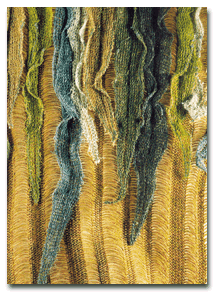
Premiere Vision presents new color and fabric trends for Spring/Summer 2003.

 On the eve of Premiere Vision, which will take place February 20 to 23, fabric lines
for Spring/Summer 2003 are complete. Weaves, weights, colors, patterns and surface treatments were
all determined several months ago.Each season, a committee of leading textile stylists and
forecasters pools their knowledge to create a universal range of colors and trends, which will be
presented at the salon in Paris. Input comes from members of a European consortium who meet first
in their own countries, with a follow-up in Paris to develop unified directions for the season.

Pascaline Wilhelm, Premiere Vision fashion director, has organized the colors and trends into
groups, which she has presented to exhibitors as a guideline for the season. Colors are shown in
four groups with seven shades in each. White is shown with all ranges. Confidential has soft,
slightly grayed pales or tinted neutrals. Champagne, absinthe, putty, pale sky blue, peach tint and
vapor gray are the colors here.The second group, called Experimental, is dominated by yellowed
greens. Citrine, a fluorescent yellow, and taupe are in this range. It is described as having
biological freshness. Sensoriel shades in the third group are warm pink, clay, sandalwood, apricot,
orangeade, shrimp and watermelon. Darks in the Intellectuel range are basic shades of navy and red,
with plum, teak brown, asphalt gray and cognac.The look of natural fibers, real or imitation, is
pointed out for touch and irregularity of weave and surface. Silky or cotton-like crepons, cloques,
seersuckers, and wrinkled or creased looks are light, soft and fluid. Crepe, suede and decorated
lace are described as tactile affinities.Silky fabrics can be fluid or crunch in pure silk,
viscose, acetate, nylon, or blends. Jacquard fabrics with a matte/shine contrast and discreet sheen
are some of the suggestions. Suiting fabrics in cotton include patterns borrowed from wool. There
are yarn dyes, birds-eye weaves and end-and-ends.Neat, compact sporty fabrics mentioned are denim,
diagonal weaves and double cloths. Many contain stretch fibers. They can be woven in cotton, linen
or synthetics. Linen/wool blends are also mentioned.Finishes that suggest a subtle, worn look are
slightly bleached, barely pigmented or aged. Along with discreet shine, there are iridescent
effects, and lacquered and quartz-finished surfaces.Printed patterns can be humorous, exotic,
figurative, geometric or abstract. Ikats, tie-dyes and over-dyes are pointed up. Application
treatments include burn-outs, cut yarns, embroidery, eyelets and hem stitching on lace, tulle and
gauze. The Linen SectorPauline V. Delli-Carpini, North American representative, Masters of
Linen, reports that the linen weavers who will exhibit at Premiere Vision expect Spring/Summer 03
to be a good season. With neutral colors and natural looks in fashion, it bodes well for linen, she
said. Pure linen is in demand because of the aesthetics, and blends offer performance. Today, there
are so many crease-resistant finishes, younger generations dont associate linen with
wrinkling.Delli-Carpini said there will be at least the same number of exhibitors in the linen
sector as in the past, possibly more if space opens up. There is a substantial wait list.Ornella
Bignami, of the Italian firm Elementi Moda and a member of the Premiere Vision Trend Concertation,
is trend forecaster for Masters of Linen. She projects three directions linen will take for the
season: Silence, Charm and Discipline.The Silence trend shows a range of whites and tinted whites,
along with washed neutrals, beige, powder gray and golden washed tones. Voile, crepe and light
knits are supple. Heavier weights include canvas and bleached denim. There will be a variety of
stripes, dr#44; pleats and laser-cut designs.Colors and fabrics in the Charm group are romantic and
sensual. Colors include golden blush, wood rose, hay and leafy greens. Seersucker, sateen, toile
and gauze are some of the fabrics mentioned. Yarn-dyed patterns show handkerchief plaids and
variegated stripes. Embroideries are in this range. Finishes are smooth. Along with pure linen,
there are blends with cotton, viscose and paper.Dark colors and ombres turn up in the Discipline
range. Cobalt, caf44; raisin, graphite, ebony, onyx, majolica blue, garnet and black are the
shades. Rustic weaves are soft to the touch. There are worn, washed aspects, grill patterns,
diagonal stripes, simple geometrics, color blocking, cubist designs and denims.Delli-Carpini will
have a library of seasonal linens at the Masters of Linen New York office. Trend presentations will
be held for both fashion and home furnishings in March. Trends From Expofil

Sylvie Tastemain, fashion director for Expofil, is another member of the Premiere Vision
Trend Concertation. Her Spring/Summer 03 color range for Expofil shows five groups: luminous and
fresh whites, slightly bleached sharp acid tones, grays illuminated by aluminum, deep shades and a
subtle range of faded mid-tones.Tastemain presents fabrics in four directions. A group called
Corrosion features grainy surfaces such as supple, dry-hand crepes. Some have ridges and grooves,
veined and wavy patterns. Fabrics in this group are simple, elegant and sometimes rustic. Natural
fibers predominate; some are blended with synthetics to produce greater fluidity or luminous
effect.There are knitted fabrics with a slightly sandy look, micro-honeycomb patterns, ultra-fine
cotton crepons, seersuckers, silk chiffons and tonal stripes in the Corrosion group.According to
Tastemain, inspiration for the Transformation group comes from crafts and a need to be thrifty with
resources. Cotton is the dominant fiber, although some of the transformations it undergoes change
its look. Fiber blends produce fancy yarns and random effects. There are slubs, nubs, color flecks,
tweeds and coarse-gauge knits. Designs can be random and blurred. There are tussah silks, basket
weaves, torn looks, matte/shine contrasts, appliquand embroideries.The Imitation group, according
to Tastemain, is an effort to mimic nature. Flax is the dominant fiber here. Fabrics can have a
dry, almost brittle look. Fabric treatments include stone-washing, resin-coating, metallic- or
glazed-finishing, discharge- or warp-printing and pearl- or sequin-embellishing.Construction refers
to fabrics that have a strict, modern classicism. Tastemain describes them as sophisticated with
technical refinement. Surfaces can be blurred or hatched with a slightly rustic look. Chines,
moulines, matte/bright contrasts, lightweight compact fabrics, short slubs and nubs and irregular
weaves are mentioned. Fiber SectorSandy MacLennan of East Central Studios is on the United
Kingdoms trend committee and is Tencel®s consultant for fabric and color direction. For Tencel, he
shows colors in five groups. He describes Duo as pale twins and sunny partners. Warm light brown is
paired with creamy white. There are light and lighter blues, yellows, grays and cognacs. Voiles,
batistes and matte shirtings are fabric suggestions.Icy white, cool blues and greens, and violet
and brown are in MacLennans Cooled range. Iridescent fabrics and glossy surfaces are some of the
fabrics shown.Dry-hand fabrics, compact weaves, linen textures and rustic looks are in a group
called Arid. Sun-baked and faded olive, gold and brown are the colors here. Blackened browns and a
bright denim blue are in a range called Sculpture. Tencel/linen blends, textured and fluid fabrics
go in this group. Sunny reds, pinks and yellows are in the Joie de Vivre range. Its an energetic
look, MacLennan said.

At DuPont, New York City-based Fashion Director Roseann Forde handles global color
forecasting. For Spring, she shows a group of sophisticated neutrals that she refers to as tea
stains. There is a range of cool blues that goes from cornflower and chambray to turquoise and a
purple-cast indigo. Black and white are in this group.Serene Greens are inspired by plant life.
They are both yellow- and blue-cast, and are accented with sunshine yellow and raspberry. Reds
encompass true reds, pinks, oranges and grapes, with rust- and green-cast yellow accents. Browns,
garnet, steel and polished silver-gray are in the darkest range.Innovative fabrics shown at DuPont
were developed in Italy. Some contain new fiber variants that were introduced at Premiere Vision in
October. Forde shows a double-faced knitted fabric in a blend of Tactel® prisma/Tencel and a
lightweight, semi-lustered heather knitted of Tactel/Lycra® that has a crisp touch.T-400, a
relaxed-stretch Lycra, is shown blended with cotton and with Tactel in a line of menswear fabrics.
Many of the fabrics are knitted from air-jet-textured yarns. There are rustic weaves, pebble
textures, slubbed and nubbed linen looks, puckers, hand-crocheted looks, lustered sheers, polished
surfaces and metallic patterns.At Cotton Incorporated, New York City, Suzanne Shapiro, senior
director, fashion marketing, said, There is a return to the basics, but with a difference. The new
basics are more refined and have been reworked through unique constructions, use of color and
finishes.Color-wise, Shapiro said brown is the foundation. She shows brown or brown-cast shades in
several ranges. Hide, bronze and rum browns are in a range called Basic Sophistication. The Washed
and Worn category shows faded shades of cowboy coffee, pine, pueblo and light bone.Shapiro notes
that monochromatic color and tone-on-tone are key trends. She shows large groups of pale, tinted
colors and neutrals.Fabric predictions at Cotton Incorporated show smooth, mercerized fabrics with
a silk-like hand in either pure cotton or cotton/nylon. There are open leno weaves, seersuckers,
gauzes, chambrays, twills, cords, slubbed knits, linen looks in cotton/linen blends, canvas, terry
cloth and a lot of denim.Some of the denims Shapiro shows have novelty application treatment such
as wax- or rubber-coated surfaces, splatter prints, metallic touches or embroidery. Others are
washed, bleached, napped, double-faced or screen-printed. There is a lot of stretch denim.There
will be about 750 fabric companies from 14 European countries showing and selling fabrics at
Premiere Vision. Other exhibitors are fiber companies that use the salon as a platform to introduce
new products and dispense trend and resource information.What will be the best sellers for
Spring/Summer 2003 at Premiere Vision Stay tuned.
February 2002

Fi-Tech To Represent Hastem In The United States

Fi-Tech To RepresentHastem In The United StatesFi-Tech Inc., Richmond, Va., was named distributor in the United States and Canada for Germany-based Hastem Transportber GmbH.Hastem holds numerous patents for aprons used in the nonwovens and textile industries. The company has developed plastic slot profiles for efficient transport of nonwoven webs during processing. Individual slats can be replaced as needed with Hastems patented system.February 2002

Xetma Group Installs New Finishing Line In Korea

Xetma Group InstallsNew Finishing Line In KoreaThe Xetma Group, consisting of Germany-based Xetma Gematex GmbH and Switzerland-based Xetma Vollenweider AG, has installed a textile raising, emerizing and shearing production line at the Soodo KnittingandDyeing Co. Ltd., Korea.After several trials, Soodo decided to purchase the complete installation from Xetma Group. Soodo cited the flexibility of the machinery which allows treatment of both knitted and woven fabric on one range as a key factor in its decision. The installation includes Xetmas Optisystem XR, Optisystem XE and Optima XSmachines.February 2002

ProcterandGamble Donates Patents To Clemson University

ProcterandGamble DonatesPatents To Clemson UniversityProcterandGamble (P and G), Cincinnati, has donated its proprietary Capillary Channel Film and Fiber (CCF) technology to Clemson University, Clemson, S.C. By creating grooves in fibers and films, the new micro-capillary technology could make materials feel drier next to the body. The technology may also add benefits to feminine hygiene products, baby diapers, acoustical insulation, air-filtration systems and wound-care dressings.The technology donation includes rights to 10 U.S. patents and 84 foreign and pending patents, as well as all intellectual property from CCF development.According to Clemson, the pairing of the P and G patents with existing Clemson patents to successfully commercialize CCF technology could result in annual sales of fibers and films in excess of half a billion dollars. The university would benefit from royalties on product sales. We are thrilled that Clemson will be able to continue the development of this significant technology, said Al Dierckes, director, Baby Care Technology Division, P and G. It presents a real-life laboratory for Clemson students to further develop and commercialize a promising technology that can lead to a new source of funding for the university.Dierckes said P and G chose Clemson because of its research strength in the field of films and fibers, as well as its excellent track record in taking a technology from the workbench to the workplace.February 2002

U S Cotton Exports Exceed Domestic Consumption

U.S. Cotton ExportsExceed Domestic ConsumptionAt the National Cotton Councils 02 Beltwide Cotton
Production Conference held in Atlanta, William B. Dunavant Jr., chairman and CEO, Dunavant
Enterprises, Memphis, Tenn., had good news to report regarding consumption of U.S. cotton.Dunavant
said that of an estimated 20.05 million bales produced in 2001, 9.8 million were exported, compared
with U.S. consumption of 7.6 million bales. Dunavant projected 2002-03 crop-year production at 18
million bales, including 7.8 million for U.S. consumption and 10 million for export. Anderson D.
Warlick, CEO, Parkdale Mills, Gastonia, N.C., citing the U.S. textile industrys severe decline and
its loss of more than 60,000 workers, as well as the 26- to 30-percent drop in average prices of
Asian yarn and fabric imported into the United States, called on the industry to demand enforcement
of U.S. trade laws. He noted that enforcement of rules governing trans shipments would enable U.S.
mills to consume an additional 1 million bales of cotton.J. Berrye Worsham III, president and CEO,
Cotton Incorporated, Cary, N.C., said the U.S. cotton sector must become more export-oriented due
to the changing distribution of its customer base. His organizations objectives for improving
demand for and profitability of cotton include improving the yield, value and quality of U.S.
cotton production and development of stronger foreign markets for cotton exports, among other
goals.
February 2002

Clariant Launches E-Business Center

Clariant Launches e-Business CenterSwitzerland-based Clariant International Ltd. now offers customers in Europe access to its new on-line business center. Currently available in English and German, the center will be available to clients in North and South America by no later than mid-2002, Clariant hopes.Using the business center, customers can complete on-line transactions, access technical information and use various Web-based project management tools. In addition, Clariants enterprise management system (ERP), SAP, and numerous business-related databases are available. The center is divided into Shop, Products and Service sections. Each section has been designed for simple and intuitive use.February 2002

Acsis Offers Console Pocket PC 2002 For SAP Console

Acsis Offers Console Pocket PC 2002 For SAP ConsoleAcsis Inc., Marlton, N.J., has launched the Console Pocket PC 2002 for SAP R/3 data collection. The new Pocket PC provides an easily navigated graphical user interface (GUI) for SAP Console transactions that are run on Pocket PC-based mobile data collection computers, according to the company. The program includes Windows-familiar navigation buttons, touch screens, menus and more. Users can use the Pocket PC browser to obtain information from their ERP systems via SAP Consoles direct radio frequency (RF) connection or via the Internet.February 2002

Glenro Offers New Catalytic Oxidizer

Glenro Offers New Catalytic OxidizerPaterson, N.J.-based Glenro Inc. now offers a new catalytic oxidation system that removes multiple solvents including aldehydes, ketones, alcohols, esters and non-volatile vegetable oil and odors from a process exhaust stream at a rate of 13.3 pounds per hour. The system reduces fuel consumption by running at a lower temperature than a direct-fired oxidation process, and by using an air-to-air exhaust preheat exchanger subsystem, according to Glenro. The system is designed to maintain catalyst temperature at 750°F to 800°F, ensuring complete destruction of solvents, oils and odors, thereby meeting air quality regulations.February 2002

INDA Announces Winner Of 2002 Visionary Award

INDA AnnouncesWinner Of 2002 Visionary AwardThe Association of the Nonwoven Fabrics Industry (INDA), Cary, N.C., announced that ProcterandGamble has won the inaugural INDA Visionary Award for its Swiffer Wet Jet product. The award recognizes new products utilizing nonwoven fabrics and technologies. Finalists made formal presentations at INDAs Vision 2002 Consumer Products Conference in New Orleans in January. Conference attendees voted to determine the recipient of the 2002 Visionary award.The other finalists were: Abeil-Destex Nomex fire blanket, Destex SA, Switzerland; ComforTemp, Frisby Technologies, Long Island, N.Y.; Cottonelle Rollwipes, Kimberly-Clark, Dallas; and CIF Double Action Wet Wipes, Unilever, The Netherlands.February 2002

Sponsors