Covering Nonwovens

The nonwovens industry is using a greater diversity of processes and materials to meet the demands
of its market segments. This statement is supported by the fact that, at the Nonwovens Technical
Conference (INTC) in September – sponsored by the Association of the Nonwoven Fabrics Industry
(INDA), Cary, N.C., and the Technical Association for the PulpandPaper Industry (TAPPI)
International, Norcross, Ga. – the largest concentration of process technology papers focused on
the meltblowing of polymers. Additionally, there were a number of presentations on hydroentangling
and spunbonding. Virtually every process in nonwovens – with the exception of stitchbonding – was
extensively covered.The abundance of such dissertations on process technologies reveals a number of
trends within the industry, such as the growing use of bicomponent fibers. As well, it seems there
is a tendency to use a wider range of polymers and technology combinations to develop new nonwoven
products. Furthermore, there is much stronger interest in nonwoven research and development by
academia, evidenced by the fact that more than one-third of the papers presented at the Baltimore
conference were from colleges and universities.The lead-off paper at the conference was prepared
and presented by Dr. D.K. Smith, principal, Smith JohnsonandAssociates, Salt Lake City. His review
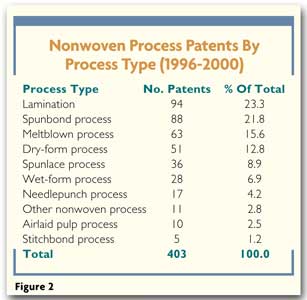
covered U.S. patent activities by company, country and process technology from the years 1996
through 2000. These 403 patents were examined and classified according to the claims and were
assigned to a specific nonwoven technology
(See Figure 2).
 Meltblowing TechnologyMeltblown nonwovens now play a key role in the nonwovens
business, finding use in products ranging from diapers, surgical wraps, protective clothing,
filtration and spill-control procedures.Such products and applications have obviously come a long
way since Van A. Wente of the Naval Research Laboratory, Washington, first produced meltblown
microdenier fibers from organic polymers more than 35 years ago. Meltblowing of polypropylene and
other polymers was further advanced by Dr. Robert Buntin and his associates at Esso Research (now
Exxon) Laboratories in Baytown, Texas, in the mid-1960s and early 1970s.An important development in
the recent history of bicomponent meltblown technology was discussed by John G. McCulloch and John
Hagewood, Ph.D., of Hills Inc., West Melbourne, Fla. Hills installed a 20-inch bicomponent
meltblowing die, which was incorporated in the pack of the Hills spunbond bicomponent pilot line.To
date, Hills has demonstrated the production of the following types of bicomponent meltblown
products:meltblown sheath/core 50/50 polyethylene (PE)/polypropylene (PP);meltblown side/side split
fibers PE/PP;meltblown side/side trilobal poly(butylene terephthalate) (PBT)/PP;meltblown
sheath/core 10/90 PE/PP; andsegmented pie poly(ethylene terephthalate) (PET)/nylon 6.Product
possibilities for bicomponent meltblown nonwovens include:respirators;heat and moisture exchangers
for medical uses;improved filtration media;formation of filter and wicking rods by in-line pellets
to rods process;radiation-resistant medical fabrics;artificial leather starting
materials;cylindrical filter elements; andnanofibers.In further meltblown developments, the
Textiles and Nonwovens Development Center (TANDEC) at the University of Tennessee (UT), Knoxville,
Tenn., is playing an increasingly important role in research and development for meltblowing
processing and the development of meltblown products. In its research, TANDEC took a look at
multi-hole meltblowing lines operating at commercial speeds. According to Randall Bresee, Ph.D., a
UT professor, measurements were obtained on-line at various locations between the die and
collector, as well as off-line from webs. On-line measurements include fiber speed, fiber
acceleration, fiber diameter, fiber temperature and air speed. Off-line measurements include
birefringence, fiber entanglement, fiber orientation and differential scanning calorimetry. These
experimental measurements provide a basis for gaining a greater understanding of the meltblowing
process.Furthermore, TANDEC, in combination with the Ian Carson Shell Coordination Centre S.A. and
Shell Chemical Co., Houston, presented an overview of the development and characterization of
poly(trimethylene terephthalate) (PTT)-based bicomponent meltblown nonwovens. In this study,
PTT-based monocomponent (mono) and bicomponent (bico) webs were produced on Germany-based
Reifenhers Reicofil® bicomponent meltblown line at TANDEC. Thermal and flow properties of PTT were
first examined using differential scanning calorimetry and melt indexer for an effective
experimental design through the Surface Response Methodology (SRM). The processability of meltblown
in a wide range of operating temperatures was investigated.Melt temperature, melt throughput, air
temperature, air-flow rate and distance of collector to die (DCD) were considered as primary
process-control variables. The webs produced, both mono and bico, with polypropylene were
characterized for fiber diameter, bulk density, air permeability, hydrostatic head, tensile
properties and heat shrinkage.Non-round and curly or twisted fibers were observed in the bico
PP/PTT webs by a scanning electron microscope. It was found that the PTT grade studied is quite
suitable for the meltblown process. The PTT/PP-based bico webs showed enhanced barrier properties
and heat resistance.TANDEC also presented, along with the Natick Soldier Center, Natick, Mass., a
study on the process properties of meltblowing polyurethane for military protective apparel
garments. The objective of this work was to develop materials that are stretchable, conformable and
breathable; and have the required barrier protection against biological and chemical agents. The
method chosen to achieve these properties was by meltblowing thermoplastic urethane (Noveon Estane®
58227) on the 6-inch meltblowing line at TANDEC.Three promising processing conditions that were
evaluated produced air and water vapor transport properties that were comparable to those of
Gore-Tex® breathable materials.Spunbound Technology

Spunbond technology is now being practiced throughout the world, thanks to the availability
of turnkey processing units. Polypropylene is still the major polymer used for spunbonded fabrics,
but a wider range of polymers is now being used for the development of specialty products. Bico
fiber technology is now being utilized for both spunbonded and meltblown nonwovens.The focus has
been on spinnable resins, according to Hans GeorgGeus, research and development manager, Reifenher
GmbHandCo. The characteristics of these fiber grades are relatively low viscosity, significantly
high melt stability, excellent purity and homogeneity, as well as a narrow molecular weight
distribution.Use of polyolefins, polyamides and polyesters has become common in the industry.
Within this range of resins, there is the potential to use variations such as copolymers,
terpolymers and blends with materials such as polyolefins and oligomeric materials. Some of the
required properties in combining resinous materials can be found in Figure 3.The shear viscosity
and an elongational viscosity at the given temperature are the most important properties. Other
important items are: the degree of thermal stabilization; the degree of solubility in the second
polymer; crystallization and crystallization speed; and, last but not least, the MFR of the various
polymers.The melt temperature for each polymer can be set differently, until the polymers are fed
into the bico system. Then the two materials are jointly passed through only one temperature. In
practice, this is not a limitation, because the difference between the two set temperatures cannot
continue to be very large, as the temperature of the two polymers will equalize to some degree. The
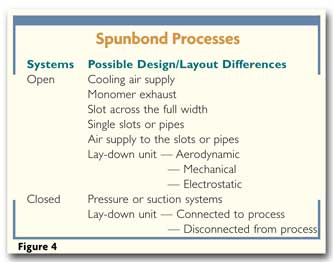
two major types of processes for making spunbonds are the open systems and the closed systems (See
Figure 4). The most commonly used closed system is the Reicofil III System.
 Bico NonwovensBico products from filament lines are usually produced from side/side,
core/sheath or segmented pie filaments. The different cross sections of these filaments determine
fabric properties. In addition to these properties, the filament shape and cross section need to be
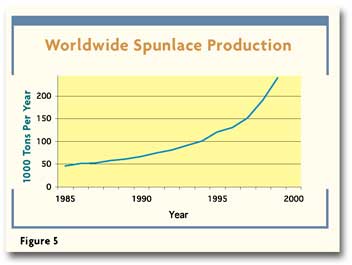
considered. Spunlaced NonwovensThe production of spunlaced nonwovens has practically doubled
between 1995 and 2000, and quadrupled between 1985 and 2000, according to Alfred Watzl of
Germany-based Fleissner GmbHandCo. Spunlace enjoys the highest growth rate of any nonwoven
(See Figure 5).Some spunlaced products can be used directly after they are hydroentangled
and dried, but many fabrics can be enhanced by further processing. Additional processing that can
be applied to spunlaced fabrics includes: impregnation with chemical binders; finishing with
chemicals; dyeing or printing; and thermofusion or heat-setting.An example of a spunlaced line with
fiber opening, blending and two cards is shown in Figure 1. Such a production line can be further
enhanced by adding additional processing lines in-line. Fleissner can supply all of the major
components of a spunlaced line, from hydroentangling through dyeing and finishing.Watzl further
discussed bonding and finishing with chemical binders and chemicals. Chemical binding comprises at
least two steps: first, the binder is applied; then, the bonding process is triggered by a thermal
treatment. Maximum strength in a nonwoven is achieved when all fiber-crossing points are bonded in
a point-shaped form fit. A wide range of additives can be incorporated in the binder systems,
including thickeners, softeners, colorants and flame-retardant (FR) agents.A range of application
methods for applying binders, colorants or other finishing agents includes foaming, spraying and
various wet-application techniques. Special techniques such as print bonding are also employed. In
hot-air bonding, spunlaced nonwovens with increased strength and pilling resistance can be made by
incorporating bico fibers in the blend and thermofusing the lower-melting fiber component by hot
air in single- or multi-drum dryers. This method of bonding nonwovens eliminates the buildup of
binders in the unit, a common occurrence when using chemical binders.Heat-setting can be done in a
hot-air drum dryer when improved fabric dimensional stability is required. Heat-setting is
important when processing polyester fabrics for some applications, such as coating.
 Combining Nonwoven TechnologiesFrance-based Rieter Perfojet is the only nonwoven
machinery producer that makes equipment both for spunlaced and spunbonded nonwovens, according to
Daniel Feroe, area sales manager, and Frederic Noelle, research and development manager. The two
Reiter Perfojet executives discussed how spunlace and spunbond technology can be combined to make
an improved wiping fabric.Rieter Perfojet, in its Jetlace® 3000 machine, has raised the efficiency
of hydroentanglement technology by improved design of the internal chambers within the injector
body. The design of the new 400-bar injector allows for a uniform and turbulence-free flow of water
within the injector body, enabling a more efficient water jet created by the flow of water through
the injector strip. 
Editors Note: The complete set of papers presented at the INTC 2001 conference can be obtained
from INTC 2001, INDA/TAPPI, P.O. Box 1288, Cary, N.C. 27512-1228. Copies of the papers are
available in written form or on CD-ROM.

 
December 2001

November 2001


Cotton Incorporated, Cary, N.C., has named

Dr. Roy G. Cantrell
vice president of agricultural research. Cantrell will succeed

Dr. William Lalor
, who recently retired.

The
Carpet and Rug Institute (CRI), Dalton, Ga., announced

Joan Seelaus
has joined the organization as an electronic advocacy expert.

Seelus_1133

Seelaus

Springs Industries Inc., Fort Mill, S.C., has named

Kenneth E. Kutcher
executive vice president and CFO; and

Ted Matthews
vice president, corporate communications.


Steven Hoffman
has joined
WestPoint Stevens Inc., West Point, Ga., in the newly created position of vice
president, licenses.

The
American Yarn Spinners Association Inc. (AYSA), Gastonia, N.C., has elected the
following officers:

Charles L. Little
, Mount Vernon Mills, president;

Michael S. Hubbard
, executive vice president and secretary;

James W. Chesnutt
, National Spinning Co. Inc., first vice president;

Stephen G. Dobbins
, Carolina Mills Inc., second vice president; and

Fred A. Jackson
, American & Efird Inc., treasurer. Named to AYSA’s Board of Directors were:

Jerry Rowland
, National Textiles LLC;

Howell Newton
, Trio Manufacturing Co.;

Charles J. Buie, Jr.
, Charles Craft Inc.;

W. Ralph Jones III
, Jones Companies Ltd.;

Allen Barwick
, Shuford Mills Inc.; and

Marshall Cooper
, Harriet & Henderson Yarns Inc. Named to the Board of Directors and to the Executive
Committee were:

Mark B. Kent
, The Kent Manufacturing Co.;

Anderson D. Warlick
, Parkdale Mills Inc.; and

Bruce Lanier, Jr.
, Wehadkee Yarn Mills Inc.

Fairlawn, Ohio-based
Omnova Solutions Inc., has given its 2000 Technology Award to

Bernard North
,

Rick Bishop
and

Mark Mussman
from the company’s Chester, S.C., facility. The team developed Sequapel®, a fluoropolymer
repellent system unique to Omnova. The Technology Award recognizes exemplary technology-based
contributions by technical-, product- and market-development associates.


Bayer Corp, Pittsburgh, has announced a reorganization of senior management within
Bayer Dorlastan®, its global spandex business. Appointments include:

Werner W. Nahl
, vice president, global Dorlastan marketing and sales;

Neal Tonks
, vice president, global Dorlastan manufacturing;

Rolf Dietmar-Viehoever
, director, sales and marketing; and

James Heslep
, vice president, Dorlastan sales and marketing.

Dr. Michael Radermacher
will remain head of the global Dorlastan business.

Degussa Corp., Parsippany, N.J., has named

Helio Takahashi
director of manufacturing within the bleaching and water chemicals business unit.

Takahaski_1134

Takahashi

The
Textured Yarn Association of America Inc. (TYAA), Gastonia, N.C., has elected the
following officers for 2001-2002:

Robert Howell
, Dillon Yarn Corp., president;

Tony Dotson
, KoSa, first vice president, technical;

Richard White
, Milliken & Company, second vice president, technical;

Jim McBride
, Cognis Corp., vice president, membership;

Mark Hubbard
, Wellman Inc., vice president, publicity, publications and archives;

Jerry Eskew
, Day International, vice president, conventions.

Jerry King
, Milliken & Company, will continue to serve as executive secretary. Board members for
the new term comprise:

Chas Scott
, Unifi Inc.;

Tommy George
, Spectrum Textured Yarns;

Adam Watson
, BASF; and

Ulrik Frodermann
, American Barmag Corp.

Pittsfield, Mass.-based
Pittsfield Plastics Engineering Inc. & Precision Spools Inc. has promoted

Thomas W. Walker
to president and CEO, and

Stephen McCuin
to vice president, operations. The company has elected

Bruce Lev
to the Board of Directors and appointed

Duncan Cooper
, vice chairman, Board of Directors.

William (Sam) Parris
has been promoted to vice president, sales, and elected to the Board of Directors.

Tappahannock, Va.-based
H. Warshow & Sons Inc. has promoted

Pete McBride
to vice president, manufacturing.

McBride_1132

McBride


The
Screenprinting & Graphic Imaging Association International (SGIA), Fairfax,
Va., has conferred its highest honor — the 2001 Howard Parmele Award — to

Mark Coudray
, Serigraphic Designs Inc., San Luis Obispo, Calif.

November 2001

If It Ain’t Broke, Break It


F
or years we heard “If it ain’t broke, don’t fix it” from managers and, in fact, from most
people working in textile manufacturing. This attitude might seem all right when things are going
well and there is not much to worry about. Costs are in line, revenues are increasing, margins are
good. Not much to worry about, and it’s easy to get comfortable.

But with plants closing and business almost at a standstill, one wonders, “What went wrong?”
or “Why are things like they are?” Could it be that the old “If it ain’t broke, don’t fix it”
mentality contributed to the present state of business in the global marketplace?


Too Comfortable?

Hindsight is always much better than foresight, so one can probably say that it did contribute,
somewhat, to where the industry is today. When comfortable, it is easy to accept the “If it ain’t
broke, don’t fix it” philosophy. Keep trucking along, doing as always, don’t change it. But this
attitude is very dangerous.

Not only is it dangerous for spinners, knitters and weavers, it is dangerous in other
industries as well — steel, automotive, machinery, computers and, more recently, airport security.
It is dangerous because if you are comfortable, operate at the same level or stay where you are for
very long, losing is a near certainty. Competitors are smart. They will catch up. They may get
ahead, and catching up or regaining market share will be difficult.

So, if it ain’t broke, maybe you should break it and work like heck to make it better.


Cotton Prices Move Lower

Demand for U.S. cotton continues to be weak. Quotations for the base grade in the seven
designated markets averaged 32.71 cents per pound. A cotton supplier said, “Cotton prices will
continue to move a little lower. I expect this even though supply might be lower than earlier
estimates. Demand is soft. Many mills are trying to delay shipments of 2000 crop cotton, and a few
mills have cancelled some shipments. This really causes me a problem. On the other hand, a few
mills have fixed some cotton at 33 to 34 cents. So someone thinks that cotton prices are near the
bottom.”


Horizontal Integration Helps Shippers

It seems that many companies are moving from vertical integration (doing everything — yarn
manufacturing through product formation) to a more horizontal organization (doing only certain
things — spinning or weaving or knitting, etc.). During the past several months, the Yarn Market
has observed more and more of this change in company structure.

A weaver responded, “We are doing pretty well, better than most in our business. A couple of
keys are that our inventory is under control and we have very little debt.” When asked about
purchasing yarn, he said, “We look at cost. If it is more cost-effective to buy yarn, we will buy
yarn. We used to be vertically integrated, and today we are buying a lot of yarn and making less
in-house.”

Another weaver recently said, “Our business is going very well. We’re in several markets, and
our customers are doing okay. We recently purchased a plant that complements our business. Plans
are to bring this plant up to ‘state-of-the-art.’ Our investment strategies will determine the most
cost-effective way to do this. We’ll take a look at everything — opening room, card room, spinning
room, weave room, etc.

These areas and all options will be considered — including buying yarn. The goal is to make
money. Thus, the investment strategy directs you to put your money in areas that contribute most to
the bottom line. And that may lead us to buying yarn.”

A spinner said, “I’m glad this is happening.” I would be too. But spinners, beware, you had
better break it and fix it to improve it because your customers are doing and will continue to do
what is necessary to lower costs — including shopping offshore.


Feedback Welcomed

The Yarn Market welcomes your input. Call (864) 656-5962 or e-mail editor@textileindustries.com.
Your input is valued, and it will be addressed.


November 2001

Quality Fabric Of The Month: Natural Function


W
oolrich Inc., Woolrich, Pa., established in 1830, is the nation’s oldest, continuously operating apparel marketer and manufacturer. Specializing in men’s and women’s outerwear and accessories, the company recently developed TechnoWool™, a line of wool fabrics whose protective and comfort properties compare with those of other performance fabrics. The fabrics are woven at the company’s mill in Woolrich.

TechnoWool fabrics build on wool’s natural functions of moisture and vapor management, breathability, shape retention, insulation, air impermeability and water repellency, which result from the fiber’s structural features, including its protein basis, natural crimp, resiliency,
hollow core and scaly surface. Special techniques are employed to produce a tightly woven fabric having improved air impermeability and insulation and creating a comfortable microclimate next to the body, according to Woolrich.
The Products

qfom_1120TechnoWool is currently available in four styles, with other styles in development. TechnoWool X is a 16.3-ounce fabric designed for extreme outdoor activities including mountain climbing and backpacking. The crimped yarn creates loops in the tightly woven, textured fabric, which is sponged
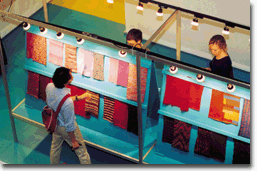
to raise the nap. The fabric is wool blended with a bit of nylon to provide additional abrasion
resistance and durability.

Softness is the defining feature of the TechnoWool S series. Made from a blend of merino and lamb’s wool, the sponged and sheared 9-ounce fabrics are soft and drapeable, making them suitable for sportswear as well as outerwear, “casual, but a little bit more dressed up than fleece,”
according to Paula Kosmatka, product design director for Woolrich.

Other styles include the O series of “quiet,” sponged bouclé wool/nylon/polyester fabrics, which have added water and soil repellency and burr resistance for outdoor activities such as
hunting; and the W series of machine-washable wool/nylon fabrics. A wind-resistant laminate that combines a hydrophilic mesh and a collapsible, breathable cell membrane with TechnoWool X or S fabric will be introduced in early 2002. Also in the works are an X-series stretch wool with Lycra® and a washable wool fleece.

Garments made from TechnoWool appeal to consumers who prefer natural fibers over man-made. “ Wool looks nicer and is more classic,” Kosmatka said. In addition, she said, wool is an eco-friendly, renewable resource that is free of dependence on petroleum resources.


For more information about TechnoWool™, contact Woolrich Inc., (800) 995-1299.


November 2001

Increased Security May Restore Consumer Confidence


Terror Attacks Contribute To Economic Woes

The latest economic reports indicate a faltering U.S. economy that slid into recession in the
third quarter of this year. The unprecedented, vicious terrorist attacks on September 11
accelerated the downfall, as consumer anxiety rose and normal spending patterns were disrupted.
With increased security, consumer confidence is likely to be restored in the near future, and the
economy will rebound. Nonetheless, a recession is now unavoidable as consumer spending weakens
further due to widespread employment losses and the slashing of business capital spending budgets
continues.

In September, the U.S. economy lost 199,000 non-farm jobs, the largest decline since February
1991. The loss included 93,000 factory jobs. September 11 events had minimal impact on employment
counts due to timing and the underlying assumptions. The impact on payrolls will be more evident in
October’s results. The September jobless rate was unchanged at 4.9 percent.

The Producer Price Index for finished goods rose 0.4 percent in September. Energy prices
jumped 0.9 percent, while food prices rose 0.2 percent. Excluding food and energy, the price index
was up 0.3 percent.

Consumer prices increased 0.4 percent in August, largely driven by apparel and energy costs.
Energy costs soared 2.6 percent. The core inflation rose 0.2 percent.

bfgraph_1150


Trade Deficit Narrows

The U.S. trade deficit of goods and services narrowed in August to $27.11 billion from $29.17
billion in July and was the lowest level in 19 months. Exports — led by industrial supplies;
automotive products; and food, feeds and beverages — rose by 1.0 percent to $84.46 billion. Imports
declined 1.1 percent to $111.57 billion. Industrial production fell 1.0 percent in September. This
was the 12th consecutive monthly decline. Factory output fell 1.1 percent.

In the third quarter, industrial output plunged 6.2 percent at an annual rate, on top of
declines of 4.4 percent in the second quarter and 6.8 percent in the first quarter. Output fell
across all industries except for motor vehicles and parts, and lumber and products.

The operating rate of industrial capacity dipped to 75.5 percent in September and was the
lowest since June of 1983.

Housing starts rose 1.7 percent in September to an annual rate of 1.574 million units, but
declined 7.0 percent at an annual rate in the third quarter. Single-family units rose 0.6 percent
to 1.268 million.

Business sales edged up 0.1 percent
in August, while business inventories were drawn down 0.1 percent — the smallest drop in seven
months and a positive sign. As a result, the August inventory-to-sales ratio was left intact at
1.42.


Textile Mill Jobless Rates Decline Despite Job Cuts

Textile and apparel payrolls fell 0.9 percent in September, but the volatile jobless rate for
textile mill workers eased to 7.3 percent from 8.2 percent in August.

Textile output decreased 0.9 percent in September and tumbled 14.4 percent at an annual rate
in the third quarter — off 14.5 percent from a year ago. The utilization rate for textiles dropped
to 71.0 percent of capacity.

Shipments by textile producers declined 1.5 percent in August, while inventories were reduced
by 0.5 percent, causing the inventory-to-sales ratio to move up to 1.68 from 1.66.

Retail and food services sales collapsed 2.4 percent in September, as consumers avoided the
shopping malls after the terrorist attacks, while motor vehicle sales slumped 4.6 percent.
Excluding autos, retail sales were down 2.1 percent. Sales were up 3.0 percent at gasoline
stations, 0.8 percent at health and personal care stores and 0.4 percent at food and beverage
stores. Sales fell 0.4 percent for general merchandise, 1.5 percent for furniture and home
furnishings, 2.2 percent for building materials and hardware, and 5.9 percent for apparel and
accessories.

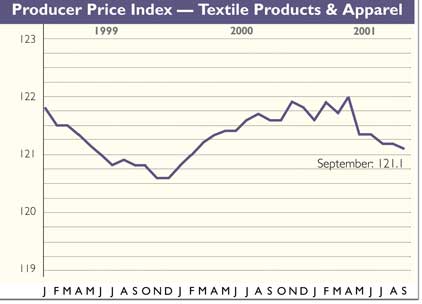
Producer prices of textiles and apparel edged down 0.1 percent in September. Prices rebounded
0.7 percent for synthetic fibers and 0.2 percent for finished fabrics. Prices retreated 0.7 percent
for greige fabrics, 0.4 percent for processed yarns and threads, 0.3 percent for carpets and 0.2
percent for home furnishings.

November 2001

Nano-Tex Expands Technology Internationally

GREENSBORO, N.C., Nov. 5 /PRNewswire/ — Nano-Tex, LLC has expanded theapplication of its technology internationally with the licensing of MartelliLavorazioni Tessili S.p.A, one of the world’s largest laundry and garmentfinishers, and Dominican Knits, a leading producer of knit fabrics andgarments. The company has also entered into its first agreements with agentsto promote licensing arrangements in the European and Japanese markets. Marking the first application of Nano-Tex’s patented technology to sewngarments rather than fabric, Martelli, based in Italy, will utilize the NANO-PEL(TM) technology for use on cotton and cotton blend apparel treated andfinished in Europe for distribution to branded customers worldwide. Denimapparel will be the first product enhanced with the NANO-PEL technology withplans for other products in the future. Dominican Knits, based in the Dominican Republic and part of the Grupo Mcompanies, will utilize the NANO-PEL technology in the first ever applicationto knits, further highlighting the technology’s flexibility to enhance avariety of fabrics. Initial applications will be to 100% cotton circular knitshirting fabrics. The use of NANO-PEL technology adds superior repellency to fabrics thatallow water and oil spills to easily bead and roll off of fabric withoutpenetrating the fibers. The advanced performance is durable through multiplehome laundries and does not alter the fabric’s original hand as experienced bymany traditional coatings. In a further expansion of its international presence, Nano-Tex hasappointed Peter Rohr of Adhoc Consultants AG as agent on an exclusive basis tocoordinate the licensing and use of Nano-Tex’s proprietary technology for usein cotton products produced in Europe and distributed worldwide. International Textile Management Consulting will likewise coordinate on anexclusive basis the licensing and use of a broad range of Nano-Tex’stechnology in Japan with Hiro Okamoto, President, serving as primary agent. “The international expansion of this technology is extremely exciting,”said George Henderson, CEO. “The performance potential of our technology hasbroad market and worldwide appeal and we are pleased to work with theseinternational partners to expand the scope and use of this technology. “The ability to apply our technology in both fabric and garment-form andto both woven and knit fabrics opens additional possibilities for theenhancement of numerous products. Our research and development continues toprogress well with a pipeline of new innovations currently in development.The ability to alter fabrics at the molecular level to enhance performanceopens limitless opportunities.” Gruppo Martelli Lavorazioni Tessili, with over 30 years in business, isone of Europe’s leading denim garment finishing companies operating facilitiesin Bologna, Treviso, Modena and San Benedetto del Tronto in Italy as well asin Buzan, Romania. Grupo M, established in 1986, specializes in the production of textileproducts with full vertical integration including fabric manufacturing,pattern design services, cutting, sewing, finishing, printing and embroidery,labels and plastic bags. Nano-Tex, LLC (http://www.Nano-Tex.com) is an advanced materials company usingproprietary technology to create, change and improve textiles at the molecularlevel. Intelligent fabrics. Better living.(TM) Other Nano-Tex advanced-technology products include those identified by the NANO-CARE(TM) brand, whichenhances cotton fabrics with water and oil repellent and wrinkle resistantproperties and those identified by the NANO-DRY(TM) brand, which enhancessynthetic fabrics with advanced moisture control properties that providequicker drying and better comfort. This press release contains statements that are forward-looking statementswithin the meaning of applicable federal securities laws and are based uponcurrent expectations and assumptions of or relating to Burlington Industries,Inc. (NYSE: BUR) (hereinafter, the “company”), which owns 51% of the equityinterests of Nano-Tex, LLC. The statements herein are subject to a number ofrisks and uncertainties that could cause actual results to differ materiallyfrom those anticipated. Such risks and uncertainties include, among otherthings, global economic activity and the implications thereon of the attack onSeptember 11 and the U.S. government’s response thereto, the success of thecompany’s overall business strategy, the company’s relationships with itsprincipal customers and suppliers, the success of the company’s expansion inother countries, the demand for textile products, the cost and availability ofraw materials and labor, the company’s ability to finance its capitalexpansion and modernization programs, the level of the company’s indebtednessand ability to borrow and refinance, the exposure to interest ratefluctuations, governmental legislation and regulatory changes, and the long-term implications of regional trade blocs and the effect of quota phase-outand lowering of tariffs under the WTO trade regime.SOURCE Nano-Tex, LLCCopyright 2001 PR Newswire

Ciba Launches Synthetic Lubricant-Emulsifier

Cibafluid® SL Conc, is a low-foaming, combination lubricant and emulsifier developed by Ciba
Specialty Chemicals, Switzerland, for elastomeric fiber-blend fabrics. Ciba claims the new
emulsifier prevents rope marks, creases and abrasion during processing; and can reduce uneven
dyeing, fiber damage and wrinkle deformations.

November 2001

Eastex To Represent Schoeller In Northeast

Seattle-based Schoeller Textil USA Inc. has named Eastex Products, Weymouth, Mass., Northeast
territory sales representatives. The territory includes Maine, Connecticut, Massachusetts, Vermont,
New Hampshire, New York, Rhode Island, New Jersey, Ohio and Pennsylvania.Eastex represents
performance fabrics produced by mills both in the United States and abroad. The company has
established relationships with outdoor apparel manufacturers in the Northeast, as well as
throughout North America.We pride ourselves in offering new and unique performance textiles as well
as staple fabrics, said John Kimball, partner, Eastex. Partnering with Schoeller is a perfect fit
for Eastex and allows us to work with the industry leader in the stretch woven and technical
performance markets.

November 2001

New York With A French Accent

The new management organization of Yarn Fair International and CADExpo Plus, T.F.E.A. Inc.
(Textile and Fashion Expo in America), has given the show a new look. Trading on its French fashion
heritage and show organizational skills, T.F.E.A. made dramatic changes in the 2001 show.A Trend
Forum, featuring some 400 swatches of yarns and fabrics provided by exhibitors, was displayed in an
area measuring 3,000 square feet at the entrance to the show. Organized with input from Expofil,
the France-based counterpart to Yarn Fair International, the Trend Forum gave buyers a clear
direction of new colors, textures, yarns and fabrics for 2002/03 and provided yarn resource
information.We are trying to bring to the American market what we do best fashion and service,said
Philippe Pasquet, general director, Expofil. The response has been good from our American and
European exhibitors.Most exhibitors reported an increase in the number and quality of contacts.
French spinner Saint-Lin said sample orders were up 20 percent.There were close to 2,000 visitors
from 32 countries at the show. Twenty-nine percent were from Canada and 20.5 percent from Latin
America.Dan Samuelson, director of menswear, The Forstmann Company, New York City, liked the
representation of exhibitors. To compete globally in todays textile industry, you have to source
yarns from all over the world, he said. I am seeing a return to the classics in wool and worsted
yarns and luxury blends.Howard Silver, president of New York City-based Jasco Fabrics, said, Theyve
brought the flavor of Expofil to New York. Joan Beer, May Merchandising, St. Louis, liked the trend
area and general ambiance of the show. Elizabeth Amoroso, Hathaway Fabrics, Waterville, Maine, was
looking for luster without shine, something elegant, she said. Jules Lavner, Bedford Weaving Mills,
Bedford, Va., was looking for solution-dyed filament yarns for weaving. They all found new yarns to
sample. Unifi Introduces New YarnsUnifi Inc., Greensboro, N.C., introduced two new yarns at
the show, Insulyte and A.M.Y.
(See Fiber World News, TI, this issue).We will have two more polyester yarns before the
end of the year, said Unifis Kim Lewis. Merano, which is disperse-dyeable for heathered looks, and
Reflexx, which is a stretch performance yarn. It has up to 17-percent stretch through processing.
We are also working on a flame-retardant yarn.Meadowbrook Inventions Inc., Bernardsville, N.J.,
producer of Angelina® ultra-soft metallic fibers, showed its newest products 100-percent metal
aluminum, titanium, copper, carbon black and heat-bondable angelina fibers.These specialty fibers
not only have a luminescent appearance, but also have technical features, said Roberta Ruschmann,
vice president. In other words, its not only about how they look, but what they do and how they
perform. For example, Angelina aluminum fibers are thermal-regulating. They can hold body heat from
within and reflect it directly back to the body. They shield against UV radiation.On display were
alpaca/Angelina yarns from Peru Naturtex. Angelina blended with mohair, acrylic, and nylon was
shown from a variety of international resources including Edgarfil, Spain; Lineapiu, Cotonificio
Ferrari, Binicocchi and Emme Filati, Italy; Daniel Houard and Groupe Saint-Lin, France; Canadas
Ormspun; Lanas Merinos, Mexico; and Wayne Trading, China. Domestic mills include Broadnax, Kraemer,
North Carolina Spinning and Yarn Mavens.Two other new Meadowbrook products are Suede Cord, which is
sampling for knitting, weaving, embroidery and edging; and Jelly Cord, which is going into
accessories.At the Masters of Linen stand, there were soft-touch yarns blending linen with wool or
cashmere, iridescent and lustrous yarns in linen/silk or linen/nylon blends, tweedy linens, stretch
linen and chunky knits. Pauline Delli-Carpini, U.S. representative, reported there was unusual
interest in linen velvet and fabrics for the home. We had a lot of visitors from the Carolinas, she
said. Chenille Makes A ComebackJim Laney, executive vice president, marketing, of Valdese,
N.C.-based Meridian Industries Dyed Yarn Group, also noted keen interest in the home furnishings
area. Today, apparel represents only 7 percent of the companys business. Automotive and industrial
end-uses are strong. We are beginning to see a slight recovery in apparel, he said, especially from
weavers and knitters in California. Chenille is one specific yarn Laney mentioned.In April 2001,
Meridian purchased Calhoun, Ga.-based Astro Dye Works, bringing space-dyed, novelty and twisted
yarns to its stable. Today, we are a $300 million company, Laney said, and are totally debt-free.
The Belmont, N.C., and Valdese facilities have a capacity of 650 pounds of yarn per week.Richard
Flaster, SandO Industries Inc., New Hyde Park, N.Y., also mentioned a chenille comeback, especially
in the home furnishings area. Its just beginning to sell in apparel as well, he said. In apparel,
rayon is the fiber of choice. One new yarn, developed for piece-dyeing, is a polyester/rayon blend
using dyed polyester and natural rayon.Gardiner of Selkirk, a Scottish wool spinner represented by
Textron Sales USA, recently merged with Brierley Bros. Ltd., another woolen system spinner. Both
are part of Brook Group, a United Kingdom-based dyer. Gardiner is noted for bulky yarns, while
Brierley spins fine yarns.Stewart Henry, sales director, Gardiner, showed cotton chenille yarns and
Shetland wool twisted with cotton chenille. The twisted yarns are colorful and bulky. They are
selling well to the sweater industry. Lambs wool, melange and silk nep yarns are other heavy
sampling yarns. Luxury WoolsItalian spinner Zegna Baruffa has three distinct lines. The
Baruffa line has innovative, quality yarns. The B-Active line includes high-tech specialty yarns.
B-Exclusive has luxury yarns, featuring super-fine cashmere from baby goats, silk, camel hair and
baby alpaca.For Fall 2002, popular yarns in the Baruffa line include pebble and flat merino yarns
that have a textured look due to shading. Merino is sometimes blended with cashmere, mohair, alpaca
or silk. Baruffa has developed a new technology it calls Spun Air to create bulky yarns that are
ultra-soft and light. It reduces the weight of the yarns by 40 to 50 percent and gives them a rich
hand and brushed look.Spun Air is also going into the B-Active line in blends with merino/nylon.
Superwash 100-percent merino wools, which are completely machine-washable and dryable, are in the
current L.L. Bean catalog. Another new yarn is Travel Wool, which is Teflon®-coated,
crease-resistant and non-pilling.Filarc, another Italian spinner, was a first-time exhibitor at
Yarn Fair. Lorella Massola, export manager, was pleased with the contacts she made at the show.
Filarc has a basic line and a higher-priced line, Manifattura Di Biella. In the basic line, there
is a lot of merino in blends with acrylic and nylon. Twisted yarns and double-dye yarns are
popular.The specialty of Manifattura Di Biella is classic and fancy yarns of precious and natural
fibers for knitwear. Alpaca/merino yarns are selling well for menswear. There are mnge yarns with
cashmere, moulines and nubbed yarns. One new development is top-treated merino. Three yarns can be
combined, knitted and then piece-dyed in fabric or garment form. Each yarn dyes differently, giving
a novel pattern effect. Fine chenilles and bouclare other yarns that are sampling well.French
spinner Saint-Lin, represented by R&M International, also mentioned the comeback of chenille,
as well as mohair bouclarns. Many of its yarns contain Lycra®. There are merino blends, tweed
effects, space-dyed yarns and multi-colored yarns. A lot of the same looks and blends are available
in several weights. Among the most popular yarns are: Cocoon a blend of acrylic/wool/nylon/Lycra;
Forban a blend of acrylic/wool/mohair; and Lolita and Iceberg blends of acrylic/wool/nylon.Himiesa,
a Spanish company represented by Yarn Mavens, has a basic line and a fancy line. The basic line
contains fine-gauge classic yarns in acrylic fibers and blends. There are twisted yarns and a lot
of stretch. The fancy line features novelty bouclin wool/nylon/acrylic that are spun in graduated
colors, brushed merino, smooth yarns and fluffy elastic yarns.Vilarrasa of Spain, represented by
Florence Textiles, is a specialist in cotton/acrylic open-end yarns for circular knitting.
High-bulk acrylic yarns and cotton/acrylic twisted with polyester or nylon metallic yarns are some
of the novelties. One popular yarn is a cotton/linen/viscose blend. Indigo yarns are selling for
flat and circular knitting. Techno Yarns From GermanyThere was a large contingent of German
spinners. Kock Spinnerei opened an office in New York City Spinnkock USA earlier this year. The
company specializes in technical yarns for industrial textiles, advanced clothing, transportation
and home fabrics. High-flame-retardant yarns spun with Trevira CS are selling to specialty apparel
areas such as clothing for fire fighters and race car drivers. Nomex®, Kevlar® and Outlast® are
other high-tech yarns in this line.Schoeller showed cotton staple ring-spun, open-end and core-spun
yarns. Most of its yarns go into woven sportswear, knitted underwear and T-shirts or rugs. Some are
blended with Modal® or elastane. There are core-spun yarns of high-tenacity filament polyester
covered with cotton.Schlafhorst, Germany, a member of the Saurer Group, provided information on
services offered and information about its Belcoro quality standards program. Yarns and fabrics
that have been successfully tested receive the Belcoro certification. Separate tests are conducted
for cotton, synthetic and blended yarns; and for knitting and weaving yarns. Fabric testing is done
according to product category.Schlafhorsts yarn and fabric research and development program is
conducted in cooperation with Lenzing. Generally, it is conducted on an individual basis with each
customer.CNS, a Montreal-based spinner represented by Yarn Mavens, produces cotton and blended
yarns for knitting, hosiery and sweaters. Recently, the company added weaving yarns to its product
mix. Inexpensive novelty yarns are developed on an exclusive basis with each customer. Boucl44;
crepe and fancy twisted yarns are in demand.Ronile, Rocky Mount, Va., an integrated manufacturer of
space-dyed and polypropylene yarns, sells to both knitting and weaving trades. Its yarns go into
fabrics for apparel, crafts and the home. The contract carpet market forms its core business.
Ronile is selling chenille in the United States for both apparel and home fabrics.Novelty yarns in
rayon and blends are the focus at New York City-based Globus Mercantile Co. Inc. Ronald Osborne
noted that Tencel®, Modal and MicroModal® are currently selling very well. Siro core-spun yarns of
rayon/Lycra are another best seller. Siro spun yarns have the look of filament yarns with low pill.
Currently they are selling to Liz Claiborne and Adidas. Silky, fine yarns; high-twist crepe yarns
and heathers were mentioned. Recycled Cotton WasteJimtex Yarns announced that its new plant,
opening this fall in Lincolnton, Ga., will have twice the capacity of the Woodruff, S.C., facility,
which was destroyed by fire last March
(See News, TI, this issue). The company spins coarse-count, open-end singles and plied
yarns from recycled and pre-dyed fiber. Yarns are bleached, solid, tweeded or heathered. Major
apparel end-uses include sweaters and socks. Right now, we are looking for textile waste, said
Stefanie Zeldin. There is an increasing demand for our product.

Jimtex is the only U.S. manufacturer exclusively dedicated to producing recycled, open-end,
cotton-blend yarns for apparel, upholstery and crafts.

Sylvie Tastemain, fashion director for Expofil, presented color, yarn and fabric trends for
Spring/Summer 2003 that will be shown in December at Expofil in Paris. Her overall theme is
NatureandArtifacts. What is natural and what is artificial are becoming blurred, she said. Natural
is taking on a synthetic look, artificial is feeling more natural.Colors with a natural ambiance
warm neutrals, green shades and vegetable tones are mixed or contrasted with intense brights.
Tastemain mentioned fabrics and treatments that have a dry hand or a wet look. There are ribs,
weathered finishes and polished surfaces. Ethnic contrasts with classic, sophisticated with rustic.

November 2001

Carlos Moore Speaks To Atlanta Textile Club

Carlos Moore Speaks To Atlanta Textile ClubThe serious ills afflicting the U.S. textile industry over the past several years can be traced specifically to the Asian financial crisis better known as the Asian Flu that began in 1997, Carlos Moore, executive vice president of the American Textile Manufacturers Institute (ATMI), told a meeting of the Atlanta Textile Club in late September.The U.S. textile industry, after showing signs of increased profits and production into the late 1990s, has suffered mightily since 1998.From 1992 through 1997, textile mill shipments hit new records every year, culminating in a still-record $83.9 billion in 1997. As the industry emerged from the downturn of the early 1990s, textile corporate profits hit a record $2.1 billion in 1992 and remained strong through 1998, Moore said.The devaluation of Asian currencies in 1997-98 and the resulting collapse of demand in Asia have combined to drive prices for Asian textile and apparel products to artificially low levels, Moore continued. This has caused a flood of low-priced Asian imports into the U.S. market. Consequently, textile imports from Asia have increased 80 percent since 1996. A strong U.S. dollar policy has contributed to an unprecedented three-year period of deflationary price cuts for U.S. textile products.Additionally, he said, the terrorist attacks of September 11 and the resulting economic uncertainty have cast a further cloud of apprehension about the immediate future.This is a test of survival for our industry, he said, but there are things we can do.First of all, U.S. textile companies should take advantage of opportunities presented by the North American Free Trade Agreement (NAFTA) and the Caribbean Basin Initiative (CBI), Moore said. In addition, dyeing and finishing of products need to continue in the United States, although CBI legislation is still unclear about that issue.As well, the U.S. government needs to make federal loan guarantees available as has been done with other industries. And, finally, Moore said the industry must do its best to ensure the government does the industry no further harm through its trade negotiations and policy making.By Jim Phillips, Executive EditorNovember 2001

Sponsors