Shawmut Corporation Joins U.S. Department Of Energy’s Better Buildings & Better Plants Program

WEST BRIDGEWATER, MA — February11, 2026 — Shawmut Corporation, a global supplier of advanced materials and sustainable engineered textile solutions, has joined the U.S. Department of Energy’s (DOE) Better Buildings & Better Plants program, committing to ambitious energy and emissions goals that underscore its leadership in sustainable manufacturing.

Shawmut Corporation’s Park Avenue Technical Center helps translate sustainability commitments into measurable manufacturing and energy performance improvements.

As a new partner in the DOE initiative, Shawmut has pledged to improve energy intensity usage by 25% across its U.S. operations within 10 years, using 2023 as the baseline year. These goals align with the company’s long-standing commitment to innovation, sustainability, and responsible manufacturing.

“Joining the Better Buildings, Better Plants program reinforces our commitment to building a lower-carbon future for our customers and our industry,” said James Wyner, CEO of Shawmut Corporation. “Through data-driven insights and continuous innovation, we’re advancing the sustainability of both our processes and the products that power critical markets from automotive to medical and defense.”

A Strategic Path Toward Decarbonization

Shawmut’s strategy for meeting its DOE commitments will focus first on its most energy-intensive operations: textile dyeing and finishing. The company plans to deploy a comprehensive mix of process optimization, equipment modernization, renewable energy sourcing, and heat recovery systems across its manufacturing network.

Five of Shawmut’s facilities in the United States will be enrolled in the program, where teams will benchmark current performance, conduct energy audits, and implement continuous improvement plans to drive measurable reductions in thermal energy use and overall emissions.

Building on a Legacy of Sustainability Innovation

Founded in 1916, Shawmut Corporation has grown into a leading global provider of high-performance textiles and composite materials serving the automotive, medical, filtration, military/tactical, and industrial markets. The company’s commitment to sustainability extends beyond its operations to the materials it engineers.

In 2025, Shawmut launched Shawmut Insights™, a proprietary Life Cycle Assessment (LCA) system that enables cradle-to-grave evaluation of environmental impacts for its products. This system helps customers in the automotive and industrial sectors make more informed, lower-carbon material choices.

Shawmut’s commitment to reducing energy consumption across its plants will also impact LCA results, benefiting customers even further.

“Reducing energy and emissions is not just an operational priority—it’s a core part of how we design our materials and processes for a sustainable future,” added Wyner.

Looking Ahead

As Shawmut advances toward its 2033 sustainability goals, the company will share progress through the DOE’s Better Plants partner network, collaborating with other U.S. manufacturers to accelerate innovation in energy efficiency and carbon reduction.

For more information about Shawmut Corporation’s sustainability initiatives, visit www.shawmutcorporation.com/sustainability.

Posted: February 11, 2026

Source: Shawmut Corporation

NCTO: U.S. Textile Industry Applauds Legislation Aimed At Ending Harmful Customs Rule

WASHINGTON, D.C.— February11, 2026 — The National Council of Textile Organizations (NCTO), which represents the full U.S. textile supply chain from fiber and yarn to fabrics and finished sewn products, lauds a bill introduced today aimed at ending the U.S. Customs & Border Protection’s (CBP) “first sale” rule.

NCTO President and CEO Kim Glas

National Council of Textile Organizations President and CEO Kim Glas stated: “NCTO and the U.S. textile industry strongly support the Last Sale Valuation Act, a bill that would eliminate a harmful CBP rule that significantly lowers duties paid by importers on textile and apparel goods and disadvantages U.S. textile manufacturers in favor of countries that often employ predatory trade practices and fail to provide reciprocal market access.

“We sincerely thank Sens. Bill Cassidy (R-LA) and Sheldon Whitehouse (D-RI) for their leadership on this bill. Closing this loophole will help level the playing field, bolster the U.S. textile industry, and spur more onshoring and investment here and in our Western Hemisphere.”

Posted: February 11, 2026

Source: The National Council of Textile Organizations (NCTO)

Itema America Acquires Palmetto Loom Reed

SPARTANBURG, S.C. — February 10, 2026 — Itema America, the U.S. subsidiary of Colzate (Bergamo), Italy, based Itema Group, has acquired Greenville, S.C.-based Palmetto Loom Reed, one of the nation’s last remaining domestic reed manufacturers. The move expands Itema’s capabilities and signals a long-term commitment to localized service and manufacturing support for North American textile producers.

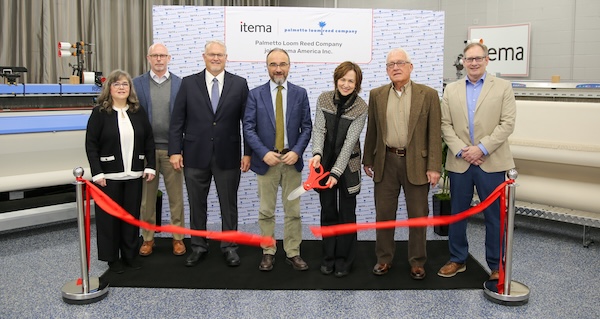
(left to right): Itema America CFO Stephanie Ort, Itema America Area Sales Manager Doug Merritt, Itema America President Scott Malcolm, Itema Group Chief Sales and Service Officer Matteo Mutti, Palmetto Loom Reed President and Owner Gladys Richardson, Palmetto Loom Reed Sales Manager Ron Lemonds, and Palmetto Loom Reed Business Development Phillip Gilliland cut the ribbon celebrating Itema America’s acquisition of Palmetto Loom Reed.
Photo — Devin Steele, eTextileCommunucations.com

Palmetto Loom Reed, founded 113 years ago by William Jefferson Richardson, has remained family-owned for four generations. The company supplies custom reeds — precision components that separate and guide yarns during weaving — to diverse customers across the United States and select export markets.

“This is the best outcome I could imagine,” said Palmetto President Gladys Richardson. “Itema shares our customer-first values and our approach to treating employees like family. They respect their people — and we do that, too.”

Richardson, who has led Palmetto since 1994, will continue with the company to ensure continuity for employees and customers.

Scott Malcolm, president of Itema America, described the acquisition as a strategic move toward becoming a full-service domestic partner for the weaving industry. “We want to take care of our customers from top to bottom any way we can — and we’re going to be doing more of that, not less,” Malcolm said.

The acquisition follows years of discussion between the companies. “We actually started talking five or six years ago,” Richardson said. “I was in my 50s and thinking about the future. My children went on to do other things, so it was always in the back of my mind — but I just wasn’t ready.”

Once she decided to move forward, Malcolm said Itema Group’s board and CEO Ugo Ghilardi “believed in the transaction and supported every phase of the agreement.”

Itema Group Chief Sales and Service Officer Matteo Mutti said the move enhances customer service and responsiveness in the Americas. “What we are providing with this acquisition is further service,” Mutti said. “The idea behind Itema America is to become the company every textile producer in the United States looks for when they are in trouble. You need something — Itema can provide it.”

Palmetto’s domestic base offers logistical and cost advantages, Mutti added. “There are many advantages to producing reeds on American soil — they’re made in dollars, not euros. There are no tariffs, no shipping costs, and we’re much quicker with deliveries.”

Both companies emphasized operational stability. Palmetto’s 18-person team will continue to operate at its existing Greenville facility. “This is a successful, profitable company with a respected brand, and we don’t want to change anything,” Malcolm said. “We love it.”

For Richardson, the decision reflects stewardship rather than sentiment. “My father always said, ‘Keep it in the family,’” she said. “But if it doesn’t make sense anymore, he wouldn’t want me to collapse on top of myself. It’s time to pass it on.”

Mutti called the combination a “good piece of the big puzzle,” adding that integrating Palmetto’s reed, beam-refurbishing and spare-parts capabilities strengthens Itema’s support network across the hemisphere.

“At a time when others are retrenching, this investment shows confidence in U.S. manufacturing,” Malcolm said. “Itema America is stronger because we’re doing this.”

Posted: February 10, 2026

Source: Itema America

Cabot Hosiery Mills Promotes Angelica Taylor To President

NORTHFIELD, VT — February 9, 2026 — Cabot Hosiery Mills, powerhouse American manufacturer of performance outdoor and lifestyle socks, is pleased to announce the promotion of Angelica Taylor to President of Cabot Hosiery Mills.

Angelica Taylor

Hired in 2021 as the Vice President of Finance moving into the role of Chief Operations Officer in 2022, Taylor has shown her prowess and ability to hit targets and aim big for the Cabot Hosiery Mills family of brands including Darn Tough Vermont, Wide Open, and Cabot & Sons.

The promotion of Taylor to President comes as the first non-family member to hold the title. “She has earned it” says Ric Cabot, former President and current CEO of Cabot Hosiery Mills “Angelicas leaderships has been proven time and time again here in Vermont she’s going to do big things in our industry”.

As President, Taylor will manage the overall performance at Cabot Hosiery Mills in this new role.

“Cabot Hosiery Mills and our family of brands continue to grow” explains Angelica Taylor. “With our industry landscape continuously changing and evolving, I am excited for the road ahead and to lead the charge on showcasing rich history while pushing the boundaries for an underdog company nestled in the Green Mountains in of Vermont.”

Taylor holds a degree from Campbell University (BS), as well as obtained certifications in Certified Management Accountant (CMA) and Certified in Strategy and Competitive Analysis (CSCA). She is a wife and mother of two who relocated to Vermont several years ago. From hitting the trails on foot or horseback or attending local sporting events with the kids, Taylor continues to live and breathe the Vermont lifestyle.

Founded in 1978, Cabot Hosiery Mills is an American manufacturer of premium socks with uncompromised comfort, durability, and fit. With a family of brands including Darn Tough Vermont, Wide Open, and Cabot & Sons, our mission is to make the world’s best socks, in Vermont, USA, and back them with our Unconditional Lifetime Guarantee. We are family owned, generations strong, and have yet to produce our best sock.

Posted: February 9, 2026

Source: Cabot Hosiery Mills

Ibex Taps Nuyarn® For Next-Generation 3D Knit Sweaters High-Performance Merino Technology Meets Zero-Waste 3D Construction

New Zealand — February 9, 2026 — In a move that merges advanced textile engineering with domestic 3D knitting, Ibex has integrated Nuyarn® performance yarn into its new Nautilus Fisherman Sweater.

While Nuyarn® is the established technical standard for outdoor baselayers, this product demonstrates the yarn’s versatility in high-end lifestyle applications.

The Nautilus Fisherman sweater merges a classic 8-gauge, 2×2 rib knit aesthetic with the modern precision of bespoke 3D knitting in Brooklyn, NY. The sweater is made with Nuyarn® technology, utilizing a 70% merino wool and 30% nylon blend. Unlike conventional spinning, Nuyarn® drafts fibers onto a high-performance filament without a traditional twist. This proprietary structure allows the wool to perform at its peak, resulting in a resilient, 3D knit garment that offers:

  • Superior Thermal Efficiency: 35% increased thermal retention with higher loft and air permeability for superior temperature regulation.
  • Unrivaled Durability: 8.8x higher durability and significantly higher burst strength and abrasion resistance than conventional ring-spun merino.
  • Enhanced Comfort: 5x faster drying times and 85% more elasticity than standard merino, achieved without the use of spandex.
  • Environmental Benefit of the 3D knitting process: 3D knitting creates garments in their final shape directly on the machine. This dramatically reduces material waste since there are no fabric offcuts, leaving little to no waste.

“This partnership with Ibex is a perfect example of how Nuyarn technology can be applied to redefine classic silhouettes,” said Monica Ebert, Nuyarn VP of Sales. “By integrating our twist-free yarn into a bespoke 3D knitting process, Ibex is demonstrating our technology isn’t just for performance layers.”

“We’re seeing incredible opportunities in outdoor luxury—athleisure, sweaters, and accessories where performance meets everyday style,” said Andy Wynne, CEO of Nuyarn. “The technology we’ve developed doesn’t have to be confined to technical baselayers. Merino, when spun correctly, belongs everywhere—from trail runners, hikers, cyclists, and skiers to staple everyday pieces that are comfortable, breathable, and durable.”

Crafted with precision, the Nautilus Fisherman sweater blends tradition with innovation. Featuring 3D knitted construction and specialized underarm venting for superior breathability and movement, each piece is made to order in men’s or women’s sizes at ibex.com with a fast 6–9 day turnaround.

Posted: February 9, 2026

Source: Nuyarn®

NRF: Import Cargo Volume Expected To See Year-Over-Year Drop During First Half Of 2026

WASHINGTON — February 9, 2026 — Import volume at the nation’s major container ports is expected to see a significant year-over-year decline during the first half of 2026 as the impact of tariffs continues, according to the Global Port Tracker report released today by the National Retail Federation and Hackett Associates.

“With tariffs still a matter of debate in the courts and in Congress, their effect on imports is being clearly seen,” NRF Vice President for Supply Chain and Customs Policy Jonathan Gold said. “The situation underscores the need for clear and predictable trade policies that support supply chain certainty and reliability, business planning and consumer affordability. Tariffs are a tax on U.S. businesses that is ultimately paid by consumers through higher prices.”

A Supreme Court decision could come at any time on the legality of the administration’s use of tariffs under the International Emergency Economic Powers Act. However, if the court strikes down the IEEPA tariffs, there are concerns that the administration could implement tariffs under other trade authorities, creating further challenges and uncertainty.

Hackett Associates Founder Ben Hackett said tariffs have brought “a global change in trade relations” that is affecting import volumes.

“The continuing use of tariffs against friend and foe alike combined with the uncertainty of when or if they will be implemented makes trade forecasting very difficult,” Hackett said, adding that last year’s government shutdown is still making up-to-date government data difficult to come by. “Following essentially flat container import volumes in 2025 compared with 2024, we expect a decline during the first half of 2026 and likely longer.”

U.S. ports covered by Global Port Tracker handled 1.99 million Twenty-Foot Equivalent Units — one 20-foot container or its equivalent — in December, although the Ports of Houston and Charleston have not yet reported their data. That was down 1.7% from November and down 6.6% year over year. Imports for the full year in 2026 totaled 25.4 million TEU, down 0.4% from 25.5 million TEU in 2024.

Ports have not yet reported numbers for January, but Global Port Tracker projected the month at 2.11 million TEU, which would be up from December ahead of Lunar New Year factory shutdowns in Asia but down 5.2% year over year. February is forecast at 1.97 million TEU, down 3.1% year over year; March at 1.89 million TEU, down 12%; April at 2.05 million TEU, down 7.1%; May at 2.13 million TEU, up 9.3%, and June at 2.12 million TEU, up 8%.

Those numbers would bring the first half of 2026 to 12.27 million TEU, down 2% from 12.53 million TEU during the same period in 2025. The May and June results show a year over year increase largely because of the sharp drop-off in imports during those months last year after “Liberation Day” tariffs announced in April 2025.

Global Port Tracker, which is produced for NRF by Hackett Associates, provides historical data and forecasts for the U.S. ports of Los Angeles/Long Beach, Oakland, Seattle and Tacoma on the West Coast; New York/New Jersey, Port of Virginia, Charleston, Savannah, Port Everglades, Miami and Jacksonville on the East Coast, and Houston on the Gulf Coast. The report is free to NRF retail members, and subscription information is available at NRF.com/PortTracker  Subscription information for non-members can be found at www.globalporttracker.com.

As the leading authority and voice for the retail industry, NRF analyzes economic conditions affecting the industry through reports such as Global Port Tracker.

Posted: February 9, 2026

Source: The National Retail Federation (NRF)

Carrington Textiles And Pincroft Unite Defence Expertise At Enforce Tac

ADLINGTON, UK — February 9, 2026 — Carrington Textiles and Pincroft return to Enforce Tac for the third time, presenting a co-branded stand that brings together textile manufacturing and specialist finishing under one roof.

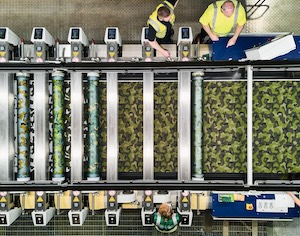
Pincroft’s new Rotascreen TG by Austrian manufacturer Zimmer, with 12 printheads and a magnet system to ensure greater precision, faster reorders and uniform coverage.
Photo — Pincroft Dyeing & Printing

Carrington Textiles will showcase its capability as a global manufacturer of performance and protective fabrics for defence and security markets. The collection spans proven military constructions alongside developments including the Defence Stock Range and the expanded military portfolio featuring ProTact by Haartz?. Together, these fabrics demonstrate a focus on durability, comfort and consistent performance for demanding operational environments.

Pincroft complements this with a service-led offer as a commission dyer, printer and finisher, supporting a wide range of defence, workwear and technical textile programmes. Key capabilities include in-house permethrin application for insect repellent finishes, precision rotary screen engraving and fully managed end to end processing. From artwork development and digital file preparation through screen engraving to final printing, Pincroft controls the entire process, delivering speed, security and repeatable quality.

Paul Farrell, Sales Director, said, “Having Carrington Textiles and Pincroft side by side is incredibly powerful for customers. It allows us to discuss fabric engineering, specialist finishes and print execution in one joined-up conversation, reducing complexity and strengthening confidence in the supply chain.”

Visitors can find both brands in Hall 8, Stand 116.

Posted: February 9, 2026

Source: Carrington Textiles

Alliance for European Flax-Linen & Hemp Expands Bio-Materials Presence at JEC World 2026

PARIS — February 2, 2026 — The Alliance for European Flax-Linen & Hemp is pleased to announce its participation at JEC World 2026, featuring a significantly expanded presence and an enhanced offering for the global composites industry.

Building on previous successes, the Alliance members will be at the core of a newly renamed and enlarged Bio-Materials Village in Hall 5. The village has grown by more than 30%, expanding from 250m² to 333m², and will feature 14 Alliance members and partners representing the full natural fibre composite value chain from fibre cultivation and processing through to semi-finished materials, resins, and industrial applications.

This year’s village welcomes several new members, including Norafin, which brings advanced technical nonwoven expertise using flax and hemp fibres, and innovative start-up Biofibix developing next-generation bio-based composite solutions. Another new participant is GreenPoxy by Sicomin, a leading supplier of bio-based epoxy resins that complement natural fibre reinforcement systems and enable lower-impact composite structures.

Innovations Showcase

The Bio-Materials Village will highlight several award-winning and shortlisted developments, including exhibits from JEC Innovation Award winners and finalists.

Bcomp has received the Automotive & Road Transportation Parts Award for its series-production exterior flax composite components developed for BMW, demonstrating the scalability and performance of flax reinforcements in demanding automotive applications.

Safilin will also present its collaboration with Stratiforme on the Ecotrain project, showcasing the successful integration of natural fibre composites into rail interiors, delivering weight reduction, improved environmental performance, and industrial feasibility.

Biofibix, shortlisted among the 20 finalists of the 2026 JEC Startup Booster, will present its proprietary reinforcement technology designed to overcome one of the key challenges of natural fibre composites : structural consistency. Biofibix develops flax-based reinforcement systems that combine controlled fibre orientation with thermoplastic and thermoset compatibility, enabling improved mechanical performance and process reliability.

Visitors will also discover the Ssuchy-Next project, an initiative focused on wind energy applications. The project explores the use of hemp-based composite solutions for a 12.6m wind turbine blade, combining optimized fibre architecture, bio-sourced materials, and industrial manufacturing processes. Ssuchy-Next demonstrates how natural fibres can contribute to reduced carbon footprint, improved vibration damping, and end-of-life advantages, while meeting the mechanical and durability requirements of the wind energy sector.

Additional cutting-edge innovations on display will be showcased by other Alliance members and partners that include BComp, Circular Structures, DEMGY, Depestele, Ecotechnilin, Emanuel Lang Flax Composites, Flaxco, Libeco, Linificio e Canapificio Nazionale, Norafin, Safilin, Terre de Lin Technique, and many more.

Industry Conference

As part of the JEC Composite Exchange programme, Alliance experts will organize a round-table discussion on Wednesday 11 March at 2:00 pm Agora 5, titled:

“From Data to Applications: How Environmental and Technical Flax-Linen & Hemp Data Help Build Industrial Solutions.” The discussion will highlight how environmental metrics and technical performance data are essential tools for designers, engineers, and manufacturers in accelerating the adoption of natural fibre composites, while exploring the latest technical advances in flax-linen and hemp composites, their environmental performance, and the strategic pathways supporting the industrial deployment of bio-based composites in Europe.

“We are very excited to welcome visitors to our expanded Bio-Materials Village at JEC World 2026, which brings together an extended natural fibre composite value chain under one roof,” said Bruno Pech, Innovation Project Manager at the Alliance for European Flax-Linen & Hemp. “With 14 members and partners from raw materials to finished applications, this showcase demonstrates the maturity, credibility, and innovation capacity of the European flax and hemp composites sector.”

Posted: February 9, 2026

Source: The Alliance for European Flax-Linen & Hemp

BTMA Member Airbond To Receive Recognition For Contributions To The Composites

MANCHESTER, UK — February 9, 2026 — Airbond is the latest member of the British Textile Machinery Association (BTMA) to receive recognition for contributions to the composites industry.

Airbond prototyped and tested a number of structures with different cell sizes and thicknesses before deciding on the optimised structure for its latest range of 3D-printed splicers.

The engineering firm based in Pontypool, South Wales, has just received the Make UK Energy and Sustainability Award for its Lattice 3D Printing project.

The award recognises the company’s use of industrial 3D printing and advanced design methods to reduce material use and waste in the production of its pneumatic splicers, while improving manufacturing efficiency and maintaining the reliability demanded by industrial customers.

“We’ve used 3D printing to do something traditional manufacturing can’t – build strength and performance into the inside of the part, using far less material,” explains Maxim Wright, Airbond’s Head of Design and Development who leads the company’s design engineering and additive manufacturing programme. “Winning a national sustainability award is a big moment for a small team in Pontypool and it shows what modern Welsh engineering can deliver.”

Optimized structure

Pneumatic splicing was invented by Airbond in the 1960s, initially for the textile industry, and has subsequently been widely adopted by companies manufacturing carbon and aramid-based components for the aerospace, automotive and wind power industries.

Using Carbon3D’s Lattice Design Engine, Airbond prototyped and tested a number of structures – Voronoi, Tetrahedral, Kagome –  all with different cell sizes and thicknesses, before deciding on the optimised structure for its latest range of splicers.

Zero mechanical failures and a strong customer response confirmed the design’s robustness and manufacturing viability. The standardised modular design is 33% lighter than previous splicers and has reduced costs in electrical packages, engineering and installation for Airbond, which continues to invest in product development and manufacturing capability in South Wales, applying advanced design to make industrial tools lighter, more efficient to produce and more sustainable.

Interfacing with specialists

Cygnet has just launched a new website for its global audience.

This success follows quickly on the heels of the announcement that fellow BTMA member Cygnet Texkimp has been shortlisted for a 2026 JEC Innovation Award for its collaboration with McLaren Automotive on the ART rapid tape-deposition system. Capable of depositing dry fibre tapes at up to 2.5 metres per second with exceptional precision, ART reduces scrap, shortens cycle times and delivers structural improvements already being realised across McLaren’s composite-intensive vehicle platforms.

As the world’s largest independent manufacturer of prepreg production machinery and handling and converting systems for the composites industry, Cygnet has just launched a new website for its global audience, providing users with easy access to valuable resources and an interface to connect with product specialists.

“The new site gives us a dynamic platform to share our technologies and expertise with our global audience in a way that reflects the ease and professionalism with which we operate,” says CEO Luke Vardy. “We hope it will provide a sense of what it’s like to collaborate with us and a clear view of our commitment to innovation and performance in fibre processing.”

Autoclave advances

Roaches International is marking 15 years of manufacturing autoclaves for composites manufacturers.

A dedicated new LinkedIn page meanwhile celebrates 15 years of growth, development, and engineering innovation in autoclave and thermosetting technologies for a third BTMA member, Roaches International.

Roaches Autoclaves was founded in 2011 and has subsequently become a central part of the West Yorkshire-based business, supporting the development of aerospace components and high-performance automotive structures, as well as the production of components for commercial construction, sporting goods and food production and processing.

The company’s first ever autoclave was installed at Crosby Composites in Brackley, Northamptonshire, with a diameter of 2.5 metres and a length of three metres.

“We started big and the industry instantly wanted more, so happily, we carried on and Crosby went on to order three more autoclaves of the same size, all of which are still in operation today and receive reliable and ongoing service from us,” says Roaches International MD Sean O’Neil. “In addition to the machines themselves, support, service, calibration and collaboration remain the cornerstones of Roaches Autoclaves and our dedicated new LinkedIn platform will allow for more frequent, higher quality communication with the digital composites community.”

Measurable benefits

BTMA CEO Jason Kent

“From additive manufacturing and sustainable product design to high-speed fibre placement and advanced autoclave technologies, our members continue to demonstrate how British machinery and engineering expertise are helping to shape the future of the global composites industry,” says BTMA CEO Jason Kent. “These achievements underline the depth and diversity of engineering excellence across our membership, and what is particularly encouraging is the way they all deliver real, measurable benefits in efficiency, sustainability and performance, while being rooted in long-term investment, collaboration and skills within the UK.”

Posted: February 9, 2026

Source: The British Textile Machinery Association (BTMA)

GenuTrace And Kinset Partner To Help Brands Defend Cotton Claims As Germany Tightens Greenwashing Enforcement And UFLPA Scrutiny Continues

BRIGHTWATERS, N.Y. — February 9, 2026 — As Germany becomes one of the first EU member states to enforce sweeping anti-greenwashing rules and global brands continue to face enforcement under the U.S. Uyghur Forced Labor Prevention Act (UFLPA), GenuTrace and Kinset today announced a collaboration designed to help companies prove cotton origin claims with evidence that can withstand regulatory scrutiny.

The partnership responds to a rapidly changing compliance landscape in which sustainability and origin claims are no longer assessed on intent or documentation alone, but on whether they can be substantiated with verifiable, product-linked proof. Germany’s amended Act Against Unfair Competition—implementing the EU’s Empowering Consumers for the Green Transition Directive—now explicitly prohibits generic or unverifiable environmental claims, while UFLPA enforcement continues to place the burden of proof on importers to demonstrate that cotton is not linked to forced labor.

Against this backdrop, GenuTrace and Kinset are delivering a dual-layer cotton traceability model that connects physical fiber-level verification with Digital Product Passport (DPP)-ready supply-chain data, enabling brands to move from claimed origin to defensible origin.

GenuTrace brings fiber-level isotope testing, a scientific method that assesses geographic origin directly from the cotton itself, independent of documentation. Kinset provides the digital infrastructure to structure, preserve, and connect supplier and location data across the cotton value chain—creating a regulator-legible record aligned with emerging Digital Product Passport requirements.

“Regulation has fundamentally changed the question brands must answer,” said MeiLin Wan, Founder and CEO of GenuTrace. “It’s no longer where did you intend to source from? It’s can you prove that the cotton in this product actually comes from where you say it does? By linking physical origin verification directly to digital records, we help companies respond to enforcement with evidence, not explanations.”

Cotton supply chains are long, fragmented, and prone to aggregation, blending, and loss of origin information—particularly at early transformation stages such as spinning and recycling. This loss of origin integrity directly affects downstream textile mills, apparel manufacturers, footwear brands, and home textile producers, where cotton origin claims are ultimately made to consumers and regulators. While digital traceability systems and certifications remain important, regulators are increasingly testing whether the material reality of the fiber itself aligns with the claims being made downstream. Documentation alone has proven insufficient under both EU consumer-protection law and UFLPA enforcement.

“Digital Product Passports and due-diligence systems only work if the data behind them is credible,” said Katie O’Riordan, CEO and Co-Founder of Kinset. “Our collaboration focuses on connecting existing supply-chain data with independent physical verification, so companies can strengthen compliance without rebuilding their systems from scratch.”

From Sustainability Claims to Enforcement-Ready Evidence

The collaboration is designed to support brands facing increasing scrutiny across multiple jurisdictions. It enables earlier detection of sourcing risk, strengthens audit and investigation readiness, and supports consistent, defensible disclosures across markets as Digital Product Passports become mandatory in the EU.

As Germany’s greenwashing rules take effect and UFLPA enforcement continues to expand, the direction of travel is clear: traceability is no longer about transparency alone—it is about proof. Claims must be limited to what can be substantiated, and systems must be designed with enforcement in mind.

By linking physical evidence to digital traceability, GenuTrace and Kinset offer a practical model for navigating this new compliance reality—one where the most resilient strategies are those that replace promises with proof.

Posted: February 9, 2026

Source GenuTrace, LLC.

Sponsors