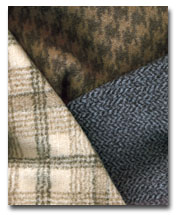
Quality Fabric Of The Month: Easy-Care Luxe

Take some wool for warmth, lighten and soften it by adding a good measure of microfiber acrylic, and make it more durable with a bit of nylon and polyester; blend into sliver and knit, and voilà – you have Casalana, a new low pile fabric developed recently by Glenoit Fabrics (H.G.) Corp. for apparel and accessory applications. The New York City-based knitter is producing the fabric domestically using specialized high-speed computer-driven sliver-knitting machines at its mill in Tarboro, N.C.

p66ap66b

Glenoit Fabrics offers Casalana in a range of solid colors and jacquard patterns and also
according to customer specifications.


Rich Looking But Well-Priced

Fully machine-washable and -dryable, Casalana has the rich look and feel of a high-end boiled wool flannel, but it is very competitively priced when compared with other wool products in the market, according to Joe Zeoli, Glenoit’s national sales manager. “Its applications are numerous,” he said, “but we are looking to place it in products that showcase its richness.” Noting the fabric’s flexibility and styling possibilities due to its knit pile construction, Zeoli mentioned
apparel and accessories as targeted end-uses – from outerwear to middleweight layered fashions – and also potential home fashions applications, such as blankets.

Zeoli said Casalana – having a face-fiber blend of 34-percent wool, 50-percent microfiber acrylic, 11-percent nylon and 5-percent polyester; and a polyester back – is a response to the current strong interest in wool fabrics. The man-made fibers in the blend lend desirable performance attributes of their own. “Glenoit is providing the premiums of each fiber,” he added, noting the fabric is durable and provides good thermal protection, while also exhibiting breathability.

Casalana differs in construction from the traditional pebble-textured sherpa Berber fabric. Zeoli said the low pile construction gears it toward a younger look.Glenoit offers the fabric in a 14-ounce weight in a range of solid colors and jacquard patterns. The company also will work with
its customers to develop patterns according to their specifications. The company is showing Casalana to its customer base and reports it has been very well received. 


For more information about Casalana, contact Joe Zeoli (212) 391-3930, Ext. 8414.


February 2003


US Offers Proposals For Free Trade Area Of The Americas

U.S. Trade Representative Robert B. Zoellick has proposed a bold new initiative designed to jump
start negotiations on a Free Trade Area of the Americas (FTAA) including an offer to eliminate all
US textile and apparel tariffs in five years. Zoellick said removal of textile duties would be
contingent upon other nations doing the same, but that did not satisfy US textile industry
officials and their supporters in Congress.

Rep. John Spratt (D-SC), a key member of the Congressional Textile Caucus, sharply criticized
the proposal, saying removal of tariffs will “open the floodgates to imports.” He said the US has
the largest trade deficit in history and a major portion of it is in textiles and apparel. “This
proposal would deal a stunning blow to the American textile industry and the thousands of Americans
it employs,” Spratt said.

Jock Nash, Milliken & Company’s Washington representative, blasted the proposal, saying
the administration is acting like “a drunken sailor” by giving up all of its leverage even before
negotiations get underway. “Here we are at the beginning of a negotiation and already the
administration is prepared to give up its negotiation leverage on the first day. Everyone knows
that is no way to negotiate,” Nash said.

Although Zoellick said other nations will need to to eliminate their non-tariff barriers to
trade, US textile manufacturers are more concerned about a flood of imports than they are about
market opportunities in what they say are poverty-stricken countries where people are in no
position to buy US textile and apparel imports.

In response to Zoellick’s announcement, the American Textile Manufacturers Institute (ATMI)
said the FTAA must be “fair and beneficial” to US textile manufacturer,s and that it must include a
strict yarn-forward rule of origin without exceptions that benefit non-participating countries.
ATMI also said tariff reductions must be “completely reciprocal” and that non-tariff barriers must
be eliminated.

Zoellick said the textile initiative is in part designed to help offset an anticipated flood
of imports from China once textile and apparel quotas are removed by January 2005. He said a
Western Hemisphere free trade agreement would help the participating countries to be more
competitive and could lead to a “more integrated American market” for textile and apparel imports.

The U.S. Association of Importers of Textiles and Apparel praised the proposal, saying that
elimination of tariffs encourages competition and results in lower consumer prices.

February 2003

Rieter Launches Rotona®, Updates BT 903 And BT 905

Rieter Spun Yarn Systems, Switzerland, reports its BT 904 Rotona® rotor core yarn system combines
rotor yarn benefits with core yarn possibilities. The system wraps rotor yarn around the core to
provide a stable structure and entails fewer steps than ring-spinning systems. Rotona yarns have
low unevenness and reduced hairiness. They can contain elastic or hard-core filaments. Bobbins
weigh up to 3 kilograms and hold longer running lengths without splices or knots.

Rieter also has added new features to its BT 903 and BT 905 rotor-spinning machines,
increasing their length to up to 320 rotors and rotor speed up to 100,000 revolutions per minute
(rpm). The direct rotor bearings contain Rieter’s exclusive state-of-the-art ball bearings, which
have increased durability and require lubrication less often, according to the company. A new spin
box modification permits use of a new type of rotor in conjunction with an enhanced external
suction device and enables spinning of yarns from high-trash-content materials, as well as
specialty yarns. Independently driven machine sides also are available, allowing flexible
production planning.

The BT 903 features the IQclean® yarn clearer and the electronically controlled AMIspin®
piecing device, which works with Rieter’s Qtop® system to eliminate damaged fibers prior to
piecing. The BT 905 now has the option of four robots per machine to provide maximized performance.

February 2003

Joseph Weinkam Takes INDA Helm

The Association of the Nonwoven Fabrics Industry (INDA), Cary, N.C., has named Joseph Weinkam
Jr. to succeed Ted Wirtz as president. Wirtz retired recently after serving seven years as
president of the organization.Weinkam, a former executive with Johnson & Johnson, has worked in
nonwovens, textile and related fields for more than 30 years. Prior to joining INDA, he specialized
in crisis prevention, strategic planning, turnaround planning and financial restructuring at
Baltimore-based Wyndhurst Associates, a management consulting firm.

February 2003

Saurer Expands Suzhou Plant, Focuses Operations

The Saurer Group, Switzerland, has set up a new production facility in Suzhou, China, near
Shanghai. “With [this] factory we want to intensify our production in China, concentrate our
technological presence and thus achieve short distances to customers”, said Heinrich Fischer, CEO,
speaking at the opening ceremony. “Initially,” he added, “the facility will supply machinery and
equipment to the Chinese market, with plans to produce machine sub-assemblies and eventually
complete machines for the global market.”

Saurer also has moved production, sales and service of its covering machines from Hamel AG,
Switzerland, to Volkmann GmbH, Germany, and is concentrating twisting, cabling and covering machine
production at Saurer-Allma GmbH, Germany; Saurer Suzhou; and Volkmann.

February 2003

US Has Plans For More Free Trade Areas

The Bush administration has added Australia, Morocco and five countries in Southern Africa to its
list of proposed free trade agreements. The new proposals, which still must be negotiated and
submitted to Congress, would be in addition to recently announced free trade proposals with Chile,
Singapore and Central America, which are in various stages of negotiation.

Talks with Morocco, at present not a major exporter of textiles and apparel, were initiated
January 21. Currently, Morocco’s leading imports from the US are aircraft, corn and machinery, but
US Trade Representative (USTR) Robert Zoellick said Morocco’s imports of pharmaceuticals and
fabrics recently have increased “significantly.” At present, US products entering Morocco face an
average tariff of over 20 percent, while Moroccan products entering the US are subject to an
average tariff of only 4 percent. Zoellick said the goal of the Moroccan free trade agreement would
be to eliminate tariffs “on the broadest possible basis.”

Meantime, the US and Australia also have initiated talks aimed at reaching a free trade
agreement. Because Australia is a major textile manufacturer and believed by US manufacturers to be
a source for transshipped Chinese goods, the American Textile Manufacturers Institute (ATMI)
immediately announced it will seek a tight rule of origin and tough Customs enforcement,. This
would include a so-called “kick-out” clause that would allow the US to withdraw its tariff
concessions if Australia does not live up to the rule of origin.

In addition, on January 13, the US and five southern African nations agreed to start
negotiations on a free trade zone, in what is known as the Southern African Customs Union (SACU).
The nations involved are Botswana, Lesotho, Namibia, South Africa and Swaziland. Pointing to
assistance and investment opportunities in those areas, Zoellick said Nambia recently received a
multimillion investment in an integrated textile and clothing production complex, and he said
negotiations are underway for two additional factories. This is part of a plan to bolster the
economies of the area and provide growth opportunities; textile manufacturing and trade are
important elements in that effort.

February 2003

Great Lakes Chemical Boosts NDB Production Capacity

Great Lakes Chemical Corp., West Lafayette, Ind., has opened a production and service center in
Arlington, Texas. The new facility doubles the production capacity of Great Lakes no-dust blends
(NDB) line of polymer stabilizers.

“The Arlington facility’s production flexibility and streamlined logistics significantly
expand our ability to service our customers,” said Doug Excell, global business manager, Polymer
Stabilizer Blends. Great Lakes will now offer additional, physical form capabilities on a full
commercial or pilot scale including blending, granulation and extrusion.

February 2003

Tensitron’s TX-125 Measures Tension Of Fine Materials

Tensitron
Inc., Boulder, Colo., reports its TX-125 digital tension meter enables ultra-accurate measurement
of fine materials. The device measures tension on filaments or textiles having a diameter of 0.0001
inch to 0.0060 inch, or on wire measuring 54 to 37 AWG.

np

Tension values can be read in grams, centinewtons (cN) or pounds. Resolution is adjustable
down to 0.1 gram, and full-scale accuracy is 1 percent or better for all calibrations that can be
selected in the menu. The TX-125 uses NIMH rechargeable batteries. It is CE-certified, complying
with heavy industrial immunity standards. Features include automatic shut-off, password-protected
calibration values, speed and length measuring, user-adjustable display update and back-lit LCD.
Options include RS-232 for serial interfacing, analog outputs with user-definable ending sequences,
and magnetic or rigidly mounted mounting brackets.

February 2003

EWarna Launches XDyes

Malaysia-based eWarna has launched XDyes, a Web-based color recipe formulation application. With
XDyes technology, dyestuff manufacturers can add real-time color recipe formulation functionality
to their websites. Website visitors can then, in three steps, formulate recipes for their target
colors from the manufacturers range of dyes. XDyes is currently available in English and simplified
Chinese.

February 2003

James Chesnutt Speaks Out On Fair Trade


I
n December, at a meeting of the World Trade Organization (WTO) in Geneva, US Trade
Representative Robert Zoellick, on behalf of the Bush administration, presented a proposal to
eliminate global tariffs on industrial goods, including textiles and apparel, by 2015. This
proposal is nothing more than a gift to China and puts at risk most of the manufacturing jobs in
the United States.

During the past year, more than 1 million US manufacturing jobs have been exported in search
of cheap and exploited labor. Implementation of this proposal will spell the end of manufacturing
jobs in the United States, especially in textiles and apparel. This “free trade” does not in any
manner take into consideration “fair trade.”

p20_Copy

First of all, for years, our government’s trade policy, whether we agree with it or not, has
encouraged the US textile industry to take advantage of nearby preferential trade arrangements and
free trade areas to develop trading blocs that will be competitive with Asian manufacturers. Our
government has said to us,

“You need to develop partnerships and sell your fabric and yarn to apparel makers in the
Caribbean, Central America, Mexico, and the Andean countries of South America. If you do that, the
apparel will come back tariff-free, and that will give you a competitive advantage over the
low-wage manufacturers in China, India, Pakistan, etc., who would still face tariffs on their
imports after we eliminate all our import quotas in 2005.”

Well, many of us have tried to set up such trading arrangements and develop export markets,
and guess what? This new US proposal to eliminate tariffs will undermine the very trading
partnerships our government told us to establish. By reducing and ultimately eliminating US
tariffs, it will make preferential tariff arrangements meaningless. Our customers in the Caribbean
and Mexico will find their garments – garments containing our yarn – displaced by garments from
China that contain only Chinese yarns. These proposed tariff cuts will wipe out most of the more
than $12 billion worth of US textile exports that currently are shipped to our trading partners to
the south.


Currency Provides Discount

The reason we will lose that business is that it will throw the US market wide open to even
greater numbers of imports from Asian countries that have manipulated their currencies to give
their own products what amounts to a 30- to 40-percent price break. This new tariff proposal does
nothing to address such currency manipulation, which is anything but fair trade.

Further, because the proposal seeks to immediately eliminate duties of 5 percent or less, it
will hurt commodity-type textile producers of yarns and certain fabrics, while making competitive
disparities even wider among many developing countries. Textiles, like the rest of manufacturing,
has been hard hit over the past several years, and profit margins today are between 1 and 2
percent.


Barriers Remain

Finally, the proposal does nothing to force other nations to swiftly eliminate non-tariff
barriers that keep our exports out of their markets. Even if many countries agree to eliminate
their tariffs, the world will be far from the free-trade model. Many developing countries that send
us billions of dollars worth of garments have barriers such as import licenses, hidden import
charges, unnecessary standards and a host of other measures that keep our exports out of their
markets. All non-tariff barriers must be eliminated quickly and not phased out, and no country
should be given a free ride on this. Otherwise, Asian textiles will enjoy yet another competitive
advantage over US producers.

Our textile industry, which has lost hundreds of thousands of jobs over the past decade, has
been repeatedly sacrificed in previous negotiations. This has to stop. It is agreed that nations
should be able to compete fairly; however, the current US tariff proposal will not achieve that for
textiles and apparel.


Achieving Fair Trade

Our representatives and senators should instead push for the United States to adopt a new
proposal that all countries should lower their tariffs first to the current level of US textile and
apparel tariffs, and only then seek to negotiate further liberalization. Also, the United States
should use a separate, sectoral approach to negotiate separately on textiles and apparel. This
would permit the United States to pursue a more equitable approach to tariffs, swift elimination of
non-tariff barriers to US exports, protection of intellectual property rights with respect to
textile designs, copyrights, etc., and more effective customs enforcement measures.

Our elected officials should also remind President Bush of his comments earlier this year
that “minimizing the impact of future trade deals on the domestic textile industry is at the top of
the administration’s agenda.” A different and better tariff proposal for textiles and apparel is
needed if that commitment is to be followed and fair trade achieved.

Editor’s Note: This is an open letter prepared by James W. Chesnutt, president and CEO,
National Spinning Co. Inc., Washington, N.C. Chesnutt also is current president of the American
Yarn Spinners Association (AYSA) and serves as chairman of the Yarn and Thread Committee of the
American Textile Manufacturers Institute (ATMI).
Textile World encourages textile executives to speak out on matters affecting
today’s textile industry. To participate in
TW’s Executive Forum, e-mail:
jborneman@TextileWorld.com.

Sponsors