UGA, CARE Compile Carpet Recovery Report

The Textile Department at the University of Georgia (UGA), Athens, Ga., collaborated with the
Carpet America Recovery Effort (CARE), Dalton, Ga., to compile statistics on the total amount of
carpet waste currently diverted from landfills as part of recycling efforts.

carpetroll

The report covers methods for dealing with recovered carpet such as reuse, recycling or
energy purposes. The report also looks at problems encountered in reuse and recycling efforts, as
well as successes. In addition, market opportunities for products made using recycled carpet
content are discussed.

The report is to be released at CARE’s first annual meeting this month. A copy of the report
can be obtained at CARE’s website,
www.carpetrecovery.com.

April 2003

April 2003

Tom Smith has been appointed chairman of
Amcot, Lubbock, Texas. Smith replaces C.L. Boggs, who is retiring.

Sandra G. Parrillo and
Sheldon Whitehouse have been named to the Board of Directors of
Cranston Print Works Co., Cranston, R.I.

Switzerland-based
Rieter Holding Ltd.’s Board of Directors has elected
Urs Leinhäuser a member of its Group Executive Committee, with responsibility
within the Corporate Center for Group Controlling.

leinhauser
Leinhäuser

Outlast Technologies Inc., Boulder, Colo., has made the following appointments:
Danielle Borden, marketing;
Floyd FitzGerald, inside sales manager;
Christopher Leyes, accountant;
Heather Listoe, marketing and legal assistant; and
Gordon Roe, marketing and business development director.
Duncan Edwards, vice president, corporate counsel, now also serves as vice
president, Asian operations.
Tom Mandula, CFO, now also serves as vice president, European operations. In
addition,
Bernard Perry has been named head of Outlast Ventures. Reporting to Perry are
Monte McGill, technical director; and
Renee Boyda, marketing research assistant.

Eric Hequet, associate director at the
International Textile Center at Texas Tech University, Lubbock, Texas, has been
named chairman of the Cotton Quality Measurement Conference, part of the Beltwide Cotton
Conference.

hequet
Hequet

Jane Dombrosky has joined
Waverly Lifestyle Group, New York City, as design director, home fashions.

Jason Premo has been named executive vice president of
Cernotec LLC, Greenville.

BYK-Gardner USA, Columbia, Md., has appointed
Mike Burns director of sales; and
Elaine Becker product manager, color systems.

St. Louis-based
Kellwood Co. has made the following appointments:
Bea Myerson, president, Halmode; and
John R. Henderson, president, Sag Harbor.

Magnum Systems Inc., Kansas City, Kan., has appointed
Gary Saunders vice president, sales and marketing.

saunders
Saunders

Robert Brooks has joined the sales force of
Louis P. Batson Co., Greenville.

West Conshohocken, Pa.-based
ASTM International’s Committee E02 on Terminology has awarded the 2002 Frank E.
Reinhart Award to
Vincent Diaz, president of the Atlantic Thread and Supply Co.

Larry R. Potvin has joined Poway, Calif.-based
Trespa North America Ltd. as Western regional manager.

Memphis, Tenn.-based
Cotton Council International (CCI) recently elected
Robert A. Carson Jr. president for 2003. Carson succeeds
William B. Dunavant III, who is now CCI board chairman. The following officers
also were elected:
David Stanford, first vice president;
Gary W. Taylor, second vice president;
David L. Burns, treasurer; and Mark D. Lange, secretary. New directors elected for
2003 are
Owen J. “Trey” Hodges III,
Gerald C. Marshall,
Lawrence E. Starrh,
James L. Webb and
Lonnie D. Winters.

Dana Darley has been appointed president of Lawrenceville, Ga.-based
Kreyenborg Industries, the North American subsidiary of Kreyenborg GmbH, Germany.
Darley replaces
Jan-Udo Kreyenborg, who will continue as chairman of Kreyenborg Industries, and
managing director of the Kreyenborg Group.

Switzerland-based
Sanitized AG has appointed
Dominik Zimmermann product manager of its Textiles Division.

zimmermann
Zimmermann

Switzerland-based
Global Textile Partner (GTP) has made the following appointments:
James C. Thomas, president, GTP Greenville;
Thomas A. Korbutt, manager, research and development;
Richard Button, manager, manufacturing, Heddle/ Frame Division; and
Andrew Butenhoff, worldwide manager, business line training and consulting.


April 2003

Wellstone Acquires TNS Assets

Wellstone Investors LLC, Greenville, recently acquired all real estate and operating assets of TNS
Mills Inc., also based in Greenville. The acquisition included 17 TNS plants. Wellstone has sold
off 11 plants that had been shut down and continues under its own name to operate six plants
located in Gaffney, S.C., Lavonia, Ga., and Eufaula, Ala., with the expectation of restoring them
to a full operating schedule as quickly as possible, according to Joshua Hamilton, COO. These six
plants manufacture 100-percent cotton and blended yarns for apparel, home furnishings and
industrial uses, and employ approximately 1,000 people.

“Although it is well known that the textile industry has suffered difficult economic
reversals during the last decade, the new owners and management of these six manufacturing
operations are optimistic that each of them will return to profitability,” Hamilton said. “It is
anticipated that substantially all of the employees of these six plants will be offered the
opportunity to retain similar jobs.

“TNS customers may be assured that all plants will continue operations without interruption,
and pending orders will be delivered on schedule and new orders will be welcome,” he said.
“Wellstone expects to continue to purchase goods and services from its suppliers and make prompt
payment on all Wellstone orders. In spite of the war and an uncertain economy, Wellstone is
confident about its future.”

April 2003

Interface Introduces InterfaceFLOR™

Atlanta-based Interface Inc. has started a new company, InterfaceFLOR Inc., to offer high-style
modular tile carpets to residential customers. Consumers can now purchase tile products from
InterfaceFLOR by catalog or by logging on to
www.interfaceflor.com.

InterfaceFLOR tiles may be installed on most surfaces, allow multiple design solutions with
quick and easy rearrangement, and can be cleaned by washing in the sink if necessary. Pre-packaged
area rug and wall-to-wall solutions also are available to simplify the decision-making process for
customers.

“With the successful launch of InterfaceFLOR, we hope to create not only a new design option
for consumers, but also a new residential floorcovering category,” said Greg Colando, president,
InterfaceFLOR.

April 2003

KoSa’s Shelby Plant Receives Carolina Star Award

The North Carolina Department of Labor’s (NCDL) Division of Occupational Safety and Health (OSH-NC)
presented KoSa’s Shelby, N.C., plant with the Carolina Star Award. The award marks the plants sixth
consecutive year as a Carolina Star site and represents its second recertification. In order to
become a Star site, the Shelby plant had to work with OSH-NC in the voluntary protection program
(VPP) to meet the state’s criteria of excellence.

“According to the latest statistics published by the North Carolina Department of Labor, the
average index rate for on-the-job injuries and illnesses for organic fiber manufacturing plants in
North Carolina, excluding cellulosics, is 5.3 cases per 100 full-time employees,” said Larry
Williams, business director, non-rubber technical filament and sewing thread, KoSa. “During the
certification period, [the Shelby plant] achieved a 0.3 rate.”

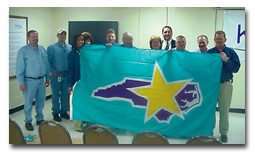
Left to right: Tommy Tessneer, Scott Greer, Lajuana Campbell, Judy Hicks, Joel Gosnell,
Tommy Jones, Nancy Smith, John R. Bogner Jr., Darrell Cole, Jim Graham and Gerald Potter

Lajuana Campbell, a Shelby Star Team member, accepted the award from John R.
Bogner Jr., bureau chief, NCDL. Joel Gosnell, Gerald Potter, Judy Hicks, Nancy Smith, Pat Collins,
Tommy Jones, Rhonda Kennedy, Tommy Tessneer, Scott Greer, Darrell Cole and Jim Graham are the other
Star Team members.


April 2003

NCC Projects Slight Increase In US Cotton Production

At its 2003 annual meeting held in February in Tampa, Fla., the National Cotton Council (NCC)
announced its projections for US cotton production for the 2003/04 crop year, and warned of
continuing challenges for the US raw cotton demand base.

In presenting NCC’s 2003 Economic Outlook, Gary Adams, Ph.D., vice president of economics and
policy analysis for the Memphis, Tenn.-based organization, said shifts in global supply and demand
will have significant effects on the US raw cotton sector. This sector has become increasingly
dependent on export markets, as domestic demand has declined in the face of increased textile
imports. At the same time, Adams said, maintaining US mill use is important to preserving the
demand base for US cotton.

According to a NCC survey, US cotton growers will plant 14.05 million acres of cotton this
spring, up 0.6 percent from 2002. Adams said the projected acreage reflects economic factors.
“While prices have improved over the previous year,” he said, “there is increased competition from
corn because of better corn prices.”

The projected 2003/04 harvest will generate 17.10 million bales, compared with an estimated
17.14 bales in 2002. Of this total, domestic mills will use 7.3 million bales, while exports could
reach as high as 10.7 million bales, depending on Chinese demand. “China remains the wild card in
world markets due to the sheer size of their market and unpredictability of their net trade
position,” Adams said. “Lower production and increased consumption have led to a draw down in their
stocks as well as increased imports during the current marketing year.” He added that these imports
do not reflect changes in Chinas willingness to comply with World Trade Organization (WTO)
accession agreements.

NCC projects 2003/04 world cotton production at 94 million bales, up from 87.4 million in
2002. Most of the increase will come from China and Australia.

April 2003

Shaw Honored With Flag

Army Reservist Jason Bowling, an employee of Shaw Industries Inc., Dalton, recently returned from
active military duty in Afghanistan. Upon his return, Bowling presented to Shaw’s senior management
team a US flag flown in the company’s honor over the US embassy in Kabul. Bowling made the gesture
as an expression of thanks to both the company and his coworkers for the support they gave him
during his time away.

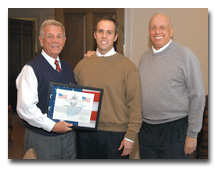
Jason Bowling (center) presents a flag that was flown in Afghanistan in honor of Shaw
Industries to Bob Shaw (left), chairman and CEO, and Julian Saul, president.

April 2003

April 2003

The recently released Tyco Medical Adhesives brochure from
Tyco Adhesives, Norwood, Mass., features specialty medical products — including
coated wovens and nonwovens, coated films and foams, transfer adhesives, and double- and
single-coated products — that use adhesives developed by Tyco.

medicalbrochure
Tyco Adhesives’ new brochure

The
British Textile Machinery Association has relocated to: Mount Pleasant, Glazebrook
Lane, Glazebrook, Warrington, Cheshire, WA3 5BN, England; 0161 775 5740; fax 0161 775 5485.


The
Screenprinting & Graphic Imaging Association (SGIA) International, Fairfax,
Va., is accepting entries for its annual Business Promotion Awards Competition, which recognizes
marketing, advertising and public relations efforts in the screen printing and graphic imaging
industry. Entries are due June 6. For more information, contact Bruce Joffe (703) 385-1335; fax
(703) 273-0456; bruce@pubpartners.com.

West Conshohocken, Pa.-based
ASTM International’s Subcommittee D13.21 on Pile Floor Coverings seeks
stakeholders to participate in the finalization of a Standard Practice for Operation of a Roller
Chair Tester for Secondary Backed Pile Yarn Floor. For more information, contact David Wilkinson
(706) 277-8143; dwilkinson@dow.com. Also, Subcommittee E12.11 on Visual Methods seeks manufacturers
and consumers of high-gloss coatings and paints to participate in the development of a Standard
Practice for the Measurement of Distinctiveness of Image of High Gloss Surfaces with
Visual-Instrumental Devices. To participate, contact Andrew Rutkiewic (505) 281-7820;
rutkieaf@spinn.net.

Downers Grove, Ill.-based
Lovejoy Inc. has released a 400-page catalog, also available as a CD-ROM,
showcasing new shaft-to-shaft power transmission coupling products and accessories. Selection
procedures, dimensional outlines and product photos are included for each of the catalog’s 11
categories.

Akron, Ohio-based
APV Engineered Coatings recently celebrated its 125th anniversary.

DuPont Packaging & Industrial Polymers, Wilmington, Del., has increased the
price of all grades of DuPont™ Elvanol® polyvinyl alcohol by 5 cents per pound for all US market
segments.

Smithfield, R.I.-based
Joraco Inc. now offers a CD-ROM catalog featuring its line of rotary indexing
machines, Toggle-Aire® pneumatic toggle presses and accessories for fabrication and assembly
tooling.

Charlotte-based
DAK Fibers LLC has increased the price of its staple fiber products by 6 cents per
pound.

Moeller FAZ Miniature Circuit Breakers from
Moeller Electric Corp., Franklin, Mass., can be used as alternatives to fuses in
industrial controls, machine tool panels and automation applications. The circuit breakers are IEC-
and UL-compliant, and are available in 0.5- to 63-Amp sizes with a uniform switching capacity of 10
kAmp.

miniatures
Moeller FAZ Miniature Circuit Breakers

Minneapolis-based
Donaldson Co. Inc.’s Downflo® Oval 1™ (DFO) series of cartridge dust collectors
received the Product of the Year Award from Filtration + Separation magazine at the Filtration 2002
conference.

“Labeling Systems & Solutions,” a new eight-page, color brochure from
Weber Marking Systems Inc., Arlington Heights, Ill., details Weber’s line of label
printer-applicators, pressure-sensitive label applicators, stand-alone printers, Legitronic®
Labeling Software, label manufacturing capabilities and custom systems.

Paper titles and abstracts are now being accepted for the England-based
Textile Institute’s 83rd World Conference, to be held May 23-27, 2004, in
Shanghai. Submissions are due May 30. For more information, fax 86 21 62193061;
ti04shanghai@dhu.edu.cn.

“VESTAMELT®: Copolyamides and Copolyesters Hotmelt Adhesives,” a new brochure series from
Degussa AG, Germany, covers products for melt print, powder scattering, powder
dot, paste dot and double dot applications.

April 2003

Changing Ownership


A
standard technique for measuring marketplace maturity is Product Life Cycle Analysis. All
product or service classes progress through four predictable life stages from birth to death –
introduction, growth, maturity and decline. In the introductory phase, products demonstrate great
variety and heavy infusions of innovative thinking. The market is small, and there are few
competitors.

In the growth phase, product success is assured, and prices are declining so as to be
attractive to a wider slice of the population. Despite declining prices, competitors appear to
challenge the leader, because there is now sufficient demand and margin for a few more entrants.
Brand identification becomes important.

In the maturity phase, growth slows or stops; prices drop precipitously; competitors
disappear through failure, merger or absorption under the guise of larger is better; brands drop
away; and innovation evaporates. Industry profits, which peaked early in the growth phase, drop to
zero or negative, and are recognized by frenetic cost cutting in an effort to survive.

Lastly, in the decline phase, few producers remain, prices stabilize and sometimes rise, as
suppliers race to redirect invested capital in new products and markets with greater opportunity
for returns. Additionally, those products that remain become less standardized, as the market
approaches “niche” status, with customers willing to pay premium prices to obtain the now
“obsolete” products.

Sound familiar? Where do fibers and textiles fit in this continuum between introduction and
decline?

While some colleagues in the contemporary textile industry press are ready to write off the
entire industry as incapable of creating satisfactory profits, a careful reading of the business
press seems to indicate otherwise. Some producers are thriving, some are reinvesting, and a few are
emerging from bankruptcy much stronger than when they entered the court’s protection. Admittedly,
while many investors lost significant dollars in the past five to eight years as the industry
swooned, a few hardy folks are reappearing as active investors in what remains of the US textile
industry. Do these people know something others do not? Is there a pattern in their investments
that can lead us to a new definition of the domestic textile market? As Alasdair Carmichael of
United Kingdom-based PCI Fibers & Raw Materials asked rhetorically at the summer 2002 meeting
of the Textured Yarn Association of America (TYAA), “If this were a sunset industry, … would
there be overseas investment? It is clear that some heads think that textiles in the United States
still is an industry worth [investment].”

moneyballs


Methodology

The Securities and Exchange Commission (SEC) Electronic Data Gathering, Analysis and
Retrieval System (EDGAR) website is a jewel for data-mining information about operations, finances
and ownership of public companies.

Several fiber and textile companies were examined to uncover a pattern of outside investment
in the industry.

Textile World
‘s interest comes from trying to balance the historical dominance of private ownership in
textiles against the current need for capital investment to remain world-competitive in the face of
the well-documented import flood. Textile companies, whose futures have been affected by the
investment-numbing problems of stocks with low or no value, and poor markets with low or no
profits, have pushed the industry to the back of the investment capital waiting line. At a time
when directing new investments to new technologies is imperative in global competition, the stars
have aligned to exclude textiles from the party.

Despite this logic, some investors actively are placing significant funds in fiber and
textile companies.
shawbuffet
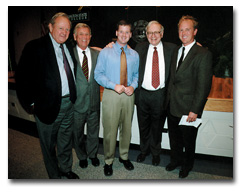
In 2001, Berkshire Hathaway acquired Shaw Industries. From left to right: Former Chairman
J.C. “Bud” Shaw, Chairman and CEO Robert E. “Bob” Shaw, Sales Representative Jason Shaw, Warren E.
Buffet, and Executive Vice President Julius C. Shaw.


Man-Made Fiber Producers

At the risk of generalizing, it is almost fair to say that substantial investment in the US
man-made fiber industry comes from international sources. Except for Kingsport, Tenn.-based Eastman
Chemical Co.’s  acetate, an appendage to the huge volume of cigarette tow, cellulose
production is totally controlled by international firms. Polyester remains US-dominated by DuPont,
KoSa and Wellman, but even these companies are spreading their wings toward outside investment.

In 1998, DuPont, Wilmington, Del., spun off its staple fiber business into DAK Americas,
Charlotte, a joint venture with Mexican petrochemical manufacturer Alfa S.A. de C.V. While
appearing to strengthen DuPont polyester with new investment, the move may in turn have
strengthened other non-fiber DuPont products by passing fiber debt onto DAK.

Two years later, DuPont and Unifi Inc., Greensboro, N.C., announced an alliance to mutually
plan and produce polyester filament yarn. The goals were similar to the DAK transaction (reduce
cost), although the methodology was different. The objective of the alliance was to “reduce
operating costs through collectively planning and operating both companies’ manufacturing
facilities.” Each participant retained ownership of its facilities, but the alliance planned and
operated the facilities in concert. Each participant, through a series of put options, could
purchase the alliance from the other partner. Needless to say, neither DuPont nor Unifi has
exercised the options.

KoSa, Houston, originally was a joint venture of Koch Industries, Wichita, Kan., and IMASAB
S.A. de C.V., a company controlled by Mexican billionaire Isaac Saba, to buy the Hoechst Trevira
polyester operations. The venture was derailed in 2001, when Saba backed out and sold his share to
Koch. KoSa since has taken its total ownership role to heart and remains committed to being “the
‘state-of-the art, lowest-cost producer’ in the markets it serves.”

Wellman Inc., Shrewsbury, N.J., producer of Fortrel® polyester and one of the world’s
largest recyclers of post-consumer polyester materials, has maintained a fierce independence
throughout its history. Committed to expanding its Pearl River, Miss., facility, the company sold
its Fayetteville, N.C., polyester filament plant to Cedar Creek Fibers LLC; converted staple
production in Palmetto, S.C., to bottle resin; converted planned staple fiber production in Pearl
River to bottle resin; agreed to provide amorphous polyester chip to Eastman Chemical for bottle
resins; and accepted a $125 million preferred stock investment from Warburg Pincus LLC, a global
private equity firm. The timing suggests that Warburg is financing the conversions to bottle
resins.

By way of introduction to nylon, the apparent desire of DuPont to spin off its entire fiber
group must not be ignored. In addition to the polyester alliances, DuPont has nylon 6,6 as its
largest poundage volume product and Lycra® (spandex and non-spandex comfort items) as its signature
marketing approach. Carpet fibers, which represent a significant portion of DuPont nylon products,
have done well and are forecast to continue to do so. Nonetheless, nylon is not a new technology
material and is viewed by the investment market as a drag on DuPont’s avowed metamorphosis into a
high-technology company. Market rumors abound about DuPont’s disposition of the remaining fiber
positions. Because nothing is firm, further comment is not necessary.

Last, but not least, in January, Honeywell, Morris Township, N.J., and BASF Corp., Mount
Olive, N.J., announced a business swap whereby Honeywell will acquire most of BASF’s nylon fiber
business plus cash, and BASF will acquire most of Honeywell’s engineering plastics business. Each
of the two businesses’ revenue streams approximate $350 million, which, when added to their new
owners’ portfolios, brings the resulting businesses to the critical mass needed to compete
globally. Honeywell will trade a relatively small plastics business for a nylon carpet, industrial
and apparel fibers business, which will drive its nylon commitment to more than $1 billion in sales
per year. Unstated in the public announcements, but a logical component of the swap, will be
increased usage of Honeywell’s nylon caprolactam capacity. Additionally, BASF will continue its
retrenchment from consumer products to the upstream industrial markets featured in its advertising
slogan: “We don’t make a lot of the products you buy. We make a lot of the products you buy
better.™”


Textile Machinery Producers

Consolidations of textile machinery companies make sense in cases where they eliminate
excessive costs, allow customers to easily view and select from many alternatives, and encourage
elimination of the competitive duplication that accompanied the individual companies.

Two mergers come to mind. The St. Louis-based Harbour Group has assembled, under the
Tube-Tex banner, a family of formerly independent suppliers of finishing equipment for knitted
fabrics. Included in the assembly are: Tube-Tex with compaction/drying and padding machines;
Marshall & Williams with tenter frames; JEMCO with continuous bleaching; RFG with raising and
napping equipment; and Ashby, selling fabric-handling equipment for dyehouses. The advantages of
selling multiple lines include extending venerable brand names and establishing the groundwork for
a global business model.

Similarly, Italy-based Itema Group, a subsidiary of the RadiciGroup, Italy, has assembled a
group of companies that manufacture and sell a complete range of weaving machines appealing to a
broad choice of woven fabric constructions. These include Somet and Vamatex rapier and air-jet
looms; Sultex rapier and projectile looms; and the alliance with Toyota Industries Corp.’s
(formerly Toyoda Automatic Loom Works Ltd.) air-jet technology.


Textile Manufacturers

Until just recently, the most obvious place to examine textile investments involved the
previously announced bid to purchase Greensboro-based Burlington Industries Inc. by Berkshire
Hathaway Inc. Omaha, Neb.-based Berkshire announced it was terminating its offer after losing a
question in bankruptcy court about the court-mandated Burlington auction/sale of assets.
(See ”
Textile
World News
,” March 2003)
. Berkshire’s interest in textiles is not new. Its legacy in
textiles includes Shaw Industries Inc., Fruit of the Loom and Garan Inc.

Two interesting counterpoints to the Burlington scenario involve the latest actions of
Heartland Industrial Partners L.P., Bloomfield Hills, Mich., with moves at Springs Industries Inc.,
Fort Mill, S.C., and Collins & Aikman Corp. (C&A), Troy, Mich. Historically a textile
company, C&A has moved deliberately toward redefining its mission while still maintaining a
foot in the textile marketplace. Several years ago, the Blackstone Group, a New York City-based
private equity investment company, invested in C&A and started transforming it from a textiles
supplier to a “global leader in the design, engineering and manufacturing of automotive interior
components.” C&A divested its apparel fabric operations and, in 2001, added the automotive
fabric operations of Joan Fabrics to its manufacturing base. Joan and C&A long have had major
relationships with the automotive industry as body cloth suppliers, and these connections formed
the basis of company moves to become a broader supplier of automotive products.

Also in 2001, C&A rounded out its product line by adding two other divisions. It
purchased Becker Plastics LLC, a major supplier of plastic components to the automotive industry,
and TAC-Trim, Textron Inc.’s Automotive Trim Division.

These purchases were financed with additional investment. David A. Stockman, director of the
Office of Management and Budget during the Reagan administration, was a senior managing director of
the Blackstone Group when the original C&A investment was made. In 1999, Stockman was a
founding member of Heartland Industrial Partners, with a mission to “purchase and invest in select
industrial companies … [in] the midwest area of the country.”

In 2001, Heartland, to help pay down debt and finance TAC-Trim, purchased a controlling
interest in C&A and acquired the right to a controlling interest on the Board of Directors.
Stockman’s investment participations at Blackstone featured leadership roles in several “old
economy” firms. It does not appear Heartland will do differently.

Similarly, Heartland participated in taking Springs private and refinancing its debt. Before
the private transaction, the Close family (and trusts) owned or controlled approximately 41 percent
of Springs’ common shares, which represented approximately 73 percent of the voting power of the
same stock. Heartland added approximately $225 million of its own equity to around $1 billion from
J.P. Morgan Chase to raise the Close interests to approximately 55 percent and provide Heartland
with a 45-percent position. Most important, the Close family was able to monetarize its stock
position and still retain control of the company, and was also able to provide valuable capital to
allow the company to restructure and reorganize to face the 21st-century market.

It appears that outside investments in textiles display constancy in two areas. First, the
investment community apparently has not soured on textiles per se. It stands to reason that fiber
and fabric manufacturing for apparel in the United States are under pressure from foreign suppliers
and cause concern for investors. Conversely, the same investment community is displaying interest
in textiles focused on home fashions and industrial end-uses. Smaller lots (including prints)
appear to insulate home fashions from imports. The logistics of shipping carpet likely will
continue to close off this product line from imports. And there is a need for specification-driven
product development alliances. All of these factors will help keep high-value-added textile
products “Made in America.”

Editor’s Note: Most of the data cited in this article comes from an accumulation of individual
reports filed with the SEC.

Wastewater Treatment Process Triples Capacity

The Moving Bed Biofilm Reactor (MBbr) wastewater treatment process from Kaldnes North America Inc.,
Providence, R.I., can be retrofitted on existing wastewater treatment tanks to triple capacity, and
can meet updated effluent guidelines concerning ammonia and nitrogen without requiring additional
tankage.The MBbr process reduces biochemical and chemical oxygen demand by utilizing thousands of
small, polyethylene biofilm elements that provide a space for a large, highly active bacteria
culture. These elements are kept in constant motion throughout the volume of the reactor, resulting
in uniform treatment and a reduced plant footprint.

April 2003

Sponsors