AFA Announces FloorTek Awards Nominees

The American Floorcovering Alliance (AFA), Dalton, has announced nominees for the new Best of
FloorTek Awards. The awards will be presented this month at FloorTek Expo during a banquet dinner.

The following people have been nominated for the Individual Leadership Award: Kim Gavin,
Floor Covering Weekly; Norris Little; Jack Godfrey, Wayn-Tex Inc.; Reg Burnett; Ray Anderson,
Interface Inc.; Dan Frierson, The Dixie Group Inc.; Lamar Lyle, Lyle Industries Inc.; and James
Brown, Brown Industries.

Nominated for the Environmental Award are: Mac Bridger, Collins & Aikman Floorcoverings
Inc.; and Ray Anderson.

For the Product/Method innovation award, Rob Beistline, Milliken & Company; Steve Stultz,
Oriental Weavers of America; and Charles Monroe, Card-Monroe Corp., have been nominated.

And, in the Contribution to the Industry category, the following people have been nominated:
Jeff Lorberbaum, Mohawk Industries; Spence Wright, Cobble Machine Co.; Robert Shaw, Shaw Industries
Inc.; and Ed Jorges, Joy Carpets Inc.

April 2003

Premium Products At Commodity Prices


T
he retail sales outlook for this quarter is weak and is likely to remain uncertain,
according to a recent report from Gary Rappaport, chairman, International Council of Shopping
Centers. Rappaport contends consumers are backing away from trendy label fashions that sell in
upscale department stores such as Bloomingdales. It seems many high-end designers have seen their
profits hurt by the ongoing problems within this segment of their businesses. Many are selling a
variation of their labels to mass market chains such as Target, JCPenney and Sears.

The goods news for yarn manufacturers is that this ultimately will lead to additional
business and potential new customers. As one spinning executive said, “We are doing business with
customers we would not have even considered six months ago.” A plant manager indicated his company
was taking spindles off commodity-type yarns to fill these niche orders as fast as possible. The
downside is customer expectations for these yarns do not match the pricing. Although cotton and
polyester prices have increased substantially, spinners are not able to pass these increases on to
their customers. As the vice president of one of the largest spinners said, “We are being asked to
produce a premium product at a commodity price.”


Is Iraq The Only Problem?


Federal Reserve Chairman Alan Greenspan seems to think the major problem with our economy
has been the standoff with Iraq. He argues that oil prices have soared more than 60 percent over
the past year. Based on the Consumer Price Index, prices rose by 0.3 percent in January. However,
virtually all of the price increases occurred in the energy sector, while the cost of clothing and
new cars actually fell.

Iraq currently ships two million barrels of oil a day. Members of the Organization of
Petroleum Exporting Countries (OPEC) recently agreed to stick with their current crude oil
production quotas of 24.5 million barrels a day. OPEC did agree to boost output in the future to
keep supplies flowing in case of any disruption of shipments from Iraq. Many observers feel the
actual impact on supplies and prices could be more severe if fighting spreads beyond Iraq to other
areas in the region.

The weaker dollar has helped to narrow the trade deficit by 8.4 percent to $44.9 billion.
Exports of US goods actually increased by 1.6 percent to $81.9 billion in January. Therefore,
Greenspan feels we are on the road to recovery.

Many economists aren’t buying Greenspan’s prediction that the economy will rebound once the
situation with Iraq is resolved. Many point to the fact that consumer confidence fell to a
nine-year low last month. They contend the decline in imports reflects the more cautious mood of US
consumers. Although factory output is up, US factories are running at 75.7 percent of capacity.
Finally, it is hard to disregard the 308,000 jobs lost in February that pushed the unemployment
rate to 5.8 percent.

Greenspan may be right, but don’t bet on it. As one textile CEO said, “There is still a lot
of overcapacity out there, not only in textiles, but in all segments of manufacturing.” Even a
quick outcome in Iraq will leave a lot of uncertainties. Many analysts predict the Fed will cut
interest rates again to prevent the shaky economy from falling back into recession.


Niche Strategies


Investors are betting that companies with brand names, niche products and new business
strategies are beginning to find ways to turn the corner. As one textile CEO said, “The hard times
have taught us some valuable lessons. We are a stronger company now. We have implemented some
strategies out of necessity that should have been followed years ago.”

Foreign competition has been responsible for closing a vast number of firms over the last
few years. This same competition has forced successful firms to examine the way they do business.
These firms recognize they must justify their existence in a global competitive market. Many are
considering moving some production offshore, or at least partnering with foreign firms. They are
discovering that delicate balance between maintaining a domestic manufacturing base and sourcing
finished goods or raw materials from foreign suppliers. These firms are moving away from
commodity-based textiles towards high-tech, value-added product lines.


April 2003

Schlafhorst Participates In China Jeans Fashion Festival

At the First China Jeans Fashion Festival, held recently in the province of Guangdong, China, W.
Schlafhorst AG & Co., Germany, presented the Schlafhorst Belcoro Boutique, showing denim
articles from Chinese manufacturers made of yarns spun using the Belcoro structured denim system.
The system is used to adapt spinning positions on the company’s Autocoro rotor spinning machine to
produce denim yarns.

spinning

Schlafhorst presented creativity awards following its fashion show at the First China Jeans
Fashion Festival. 

The company also offered fashion shows and a creativity contest during the Schlafhorst Best
Brand Release Conference at the festival. Schlafhorst presented its Belcoro Certificate to Panther
Textiles Co. Ltd., a winner in the creativity contest. Panther operates more than 3,000 Autocoro
spinning positions.

April 2003

Type S Flowmeter Measures Wide Range Of Viscosities

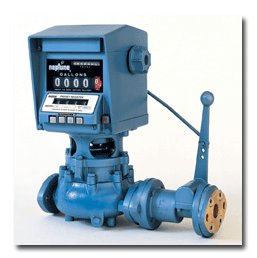
The Neptune® Type S disc flowmeter from the Neptune Liquid Measurement Division of Actaris,
Greenwood, S.C., measures a wide range of liquid viscosities to around 1-percent accuracy.

neptune

Rated for pressures of up to 150 pounds per square inch (10.2 bar) and temperatures of up to
250°F, the Type S is suitable for totalizing and flow monitoring, electronic or mechanical
batching, and inventory control. It is available for flow ranges from 7.6 to 605 liters per minute,
and in line sizes from 16 to 50 millimeters.

April 2003

Adaptive Control To Update Cross Creek Dyehouse

Charlotte-based Adaptive Control recently secured an order to retrofit Cross Creek Apparel LLC’s
dyehouse in Mount Airy, N.C. All older control systems are to be replaced with the most up-to-date
Adaptive APC-12 Web-based, hand-held PC units. Operators will be able to monitor and review
procedures, maintenance and production delays. The project is scheduled for completion in July
2003.

April 2003

Shanghaitex 2003: Postponement Announcement

On April 23, 2003, the Shanghai Municipal Government issued a directive on eight strict measures to
stop the spreading of SARS disease. On April 24, the Foreign Economic Relations & Trade
Commission of Shanghai issued an urgent notice of strict restriction on organizing exhibitions in
the near future. On the same day, we also received a circular from the Shanghai New International
Expo Centre (SNIEC) in Pudong that, consequently, all venues in Shanghai are not permitted to stage
any events until further notice.

We have also learned that governments of some provinces and/or major cities in China have
recently issued notices to discourage travel to other cities and/or provinces.

In view of the above and after consultations, organizers of Shanghaitex 2003 would like to
announce that Shanghaitex 2003 will be postponed to December 10-13, 2003 at the same venue of
SNIEC, Pudong, Shanghai, PRC, taking all the halls.

With the postponement date and venue now confirmed, we will attend to other related matters
and will keep exhibitors informed through further notices. The organizers work closely with related
parties and associations, and will launch new promotion campaigns to inform visitors of the new
December date of Shanghaitex ’03 so as to ensure its success.

For any enquiry, please contact Adsale or our local representative directly.

Adsale Exhibition Services Ltd.

April 2003

Springs Industries Honored – Textile World Magazine 2003 Innovation Award Recipient Announced

Springs Industries, the Fort Mill, S.C. based textile giant, is the recipient of the 2003
Innovation Award from

Textile World
magazine.

“Springs Industries was selected as the recipient of the award because of the companys
long-standing commitment to innovation in the textile industry,” according to James M. Borneman,
publisher of

Textile World
.

“Springs has a rich history, a dynamic presence in today’s textile industry and a vigorous
strategy for the future. Crandall Close Bowles, Springs president and CEO, is recognized as one of
the United States preeminent corporate leaders, regardless of industry segment,” stated Borneman.

The

Textile World
Innovation Award is presented annually by

Textile World
magazine in recognition of outstanding efforts and accomplishments in the textile industry.
The June 2003 issue of

Textile World
will feature the full Springs Industries story.

April 2003

A Lackluster First Quarter


T
here are still precious few signs of any meaningful textile pickup. To be sure, basic
indicators such as new orders, production and shipments have bottomed out. But for the most part,
they still remain well under the peaks of a few years back.

Textile production is a case in point. Latest levels, while basically unchanged from 12
months ago, are running a significant 22 percent under three years ago, when the recent industry
slump first began.

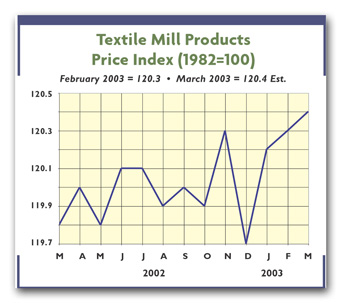
The picture is much the same on the price front, where average textile tags are no higher
than they were three years ago — in sharp contrast to the overall 6- to 7-percent increase in
overall inflation over the same period.

And what’s true of these textile averages also holds for major subgroups. Thus, tags for
such key areas as greige goods, finished fabrics, home furnishings and carpets are all within 1
percent or so of where they were a year ago. Blame it on continuing competition — not only from
imports but also from domestic mills, where excess industry capacity (operating rates are currently
only in the very low 73-percent range) continues to put strong downward pressures on most prices.

p20_Copy_4


A Mixed Cost Picture


Meantime, there’s both good and bad news on the textile cost front. On the plus side, worker
outlays per unit of output are declining. On the other hand, fiber costs are beginning to creep up.

The latest labor data suggest hourly wages of textile workers have risen only a very modest
2.4 percent over the past year. But to get the real impact of this, it is necessary to factor in
worker productivity (as measured by output per employee), which has been advancing by close to 5
percent over the same period.

Conclusion: The industry’s unit labor costs have actually been edging a bit lower — probably
by something in excess of 2 percent. More important, this encouraging trend is likely to persist
over the next few years. In any event, textiles are now more than holding their own with other
industries in the race to remain competitive in today’s hotly contested world markets.


Fiber Costs Head Higher


Somewhat less encouraging is the trend in the industry’s other key cost input — fibers. This
is especially true in the case of man-mades, where hefty increases in petrochemical feedstocks are
starting to translate into fiber price increases. But these advances aren’t likely to hurt the
domestic industry’s global competitive position because overseas producers who make these man-mades
are facing the same upward cost pressures.

In any case, hikes are already beginning to appear — with several firms already announcing
relatively impressive 15-percent or higher boosts for polyester. Acrylic staple is also being
targeted for an increase. And there could be more if oil prices don’t come down significantly. One
thing for sure, it’s unrealistic to expect a repeat of the last 12 months, when man-mades averages
remained fairly stable.

Nor do natural fibers seem exempt from increases. Wool averages are up vis-à-vis a year ago.
And in recent months, cotton has been as high as 55 cents per pound — far above the near 35 cents
per pound levels of a year ago. But no one expects a rerun of the runup a few years back. Instead,
the feeling is that this key fiber will leave off, provided this year’s new crop is anywhere near
normal.


A Few Signs Of Better Days Ahead


Despite all of today’s Middle East problems and uncertainties, the basic long-run prognosis
for the textile industry isn’t all that bad. Textile executives still are willing to spend in the
hopes of future payoffs. How else to explain the fact that industry capacity has remained
relatively unchanged over the past year — as new plants and equipment coming on-stream offset the
rash of recent shutdowns of older, less efficient facilities.

The recent interest in acquiring Burlington Industries also would seem to attest to a viable
textile future. Interestingly, savvy investor Warren Buffett — someone who rarely makes a mistake —
was one of the active bidders for the big textile firm. Still other encouraging signs are suggested
by the continuing introductions and innovations designed to both whet buyer appetites and
differentiate mill offerings. Most of the attention these days seems centered on fabrics with
special surface effects — those that resist wrinkling, stains, perspiration and odors. Then there’s
the appeal of renewable fibers like Cargill Dow’s Ingeo™. Some 85 firms (including mills, fiber
producers and spinners) are already said to be actively engaged in its development.


April 2003

Technology Sets The Pace


T
echnological innovations continue to enhance and streamline the hosiery manufacturing
process. These enhancements come in the form of new machines and in refinements to individual
components and subsystems.

The hosiery segment has seen many recent developments. Advances in automatic toe-closing
units are allowing knitting machines to increase production capability. Seamless machines also are
speeding up. Body-size machines are still in high demand. Electronic yarn control systems can
reduce waste and lower production costs.

“The process of putting electronics on knitting machines has been completed,” said Miroslav
Novy, chairman and general director, Investa International Co. Ltd. “The same applies to other
components, [such as yarn detectors, pneumatic valves and actuators]. The machines are in many
aspects similar because all manufacturers are buying from the same sub-suppliers. And this is what
the customers want.”

Hosiery remains very much a fashion business, so knitters need styling versatility just as
much as they need machine efficiency to stay viable.

“Besides in-machine toe-closing, customers can also use the latest innovations of fully
electronic machines to their benefit when designing product styles,” said Otto Curda, vice
president, Trustfin USA Inc., which represents Uniplet.

“The ability to quickly change styles and switch between reciprocated and pouch heel is very
critical to our customers’ ability to compete in the marketplace. It is this demand for new
high-tech hosiery products and the need to cut costs that is the driving force behind designing
knitting machines with ever higher speeds, efficiency and features, such as in-machine
toe-closing,” said Curda.

The International Hosiery Exposition (IHE) and Conference, to be held May 3-6 in Charlotte,
will give knitters, hosiery and intimate apparel producers, and retailers a chance to see the
latest developments
(See ”
Tight
Connections
,”  April 2003)
.

santoni
L.G.L. Electronic’s Smart Knit Feeder shown on a Santoni SM8 Top 2 knitting
machine


Yarn And Tension Controllers

Italy-based BTSR International (PAF Sales LLC, Greensboro, N.C.) produces electronic yarn
and tension control systems that let knitters fine-tune the knitting process. The company’s latest
technical advances include the Smart 64H electronic production control system and the Smart KTF
feeder system unit.

The Smart 64H can reduce machine waste by 50 to 75 percent on hosiery and seamless knitting
machines. The Smart KTF feeder system utilizes constant tension feeders in conjunction with a smart
controller interface to monitor and control total yarn consumption per garment.

At IHE, BTSR will show for the first time its KTF25MF micro-feeder system for elastic and
critical yarns on hosiery and seamless knitting machines.

The company also will show the Smart 64H; the Smart KTF 2000 feeder system interfacing with
the KTF 100HP yarn feeder; and the IS3N/TS thread-break detection system, as well as accessories
for pantyhose knitting and automatic sewing machines.
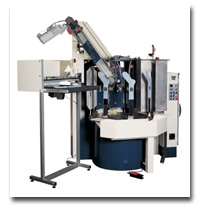
sock8
Heliot’s Sock 8 compact boarding and pressing machine can board socks of all
types.


Loop Control® Reduces Streaks

Germany-based Groz-Beckert’s latest innovations include a line of Loop Control® needles for
seamless and body-size machines to satisfy even the highest quality demands of knitted products,
and various needles with floating hooks for body-size machines, sock machines and seamless machines
to allow for more secure floating. Groz-Beckert also is offering more and more system parts, for
example, components needed for toe-closing machines.

“Our Loop Control needle allows our customers to reduce the risk of panel streaks even when
knitting critical styles,” said Henry Tio, president, Groz-Beckert USA Inc., Fort Mill, S.C. “All
Loop Control needles are manufactured in G 00 execution to minimize the risk of needle streaks due
to spread hooks.”

Hofa-Spec Loop Control needles are made by Groz-Beckert with such precision that the spread
of the production variations – which determine the uniformity of the loop formation – is less than
the thickness of a human hair.
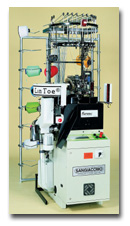
lintoe
Sangiacomo’s Fantasia is a single-cylinder machine capable of producing high-quality
patterned socks in multiple colors.


Sock And Seamless Finishing Solutions

Heliot International S.A., France, reports great success with its Rollset thermosetting
machine. It is designed to thermoset all man-made fabrics, either pure or mixed, in tubular form.
This eliminates the need to slit the fabric so it can be processed through a tenter frame. The
machine also can be used for body-size products.

At IHE, Heliot will show its Sockmodule type 28 T3B and Sock.8 boarding machine. Sockmodule
is a modular system for boarding of socks and half-hose made of natural fibers, man-made fibers or
blends. The automated machine is composed of a drying tunnel or heating press and pressurized
steaming shells. An automatic stripper with conveyor can be added.

Sock.8 is a compact boarding and pressing machine with automatic stripper. It can board
socks of all fiber types and uses Heliot’s standard forms.
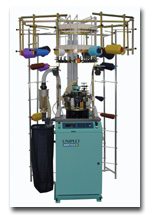
ange
At IHE, Uniplet will introduce the Ange 15, the latest edition to its successful Ange
line.


New Toe-Closing Sock Machine

The big draw at the Czech Republic-based Investa International booth this time around will
be its model NG.plus, a single-cylinder, six-feed, sock-knitting machine. What makes this machine
unique is its ability to close the toe during the knitting process.

Investa describes it as a new and unique patented solution based on an original invention,
which makes the knitting machine very simple, does not require any complicated mechanisms in the
knitting head and achieves a high-quality closed toe. The machine can close the toe either on the
top side of the sock or the opposite bottom side. In addition, the NG.plus can make a reciprocated
heel in two feeds, according to the company.

“Our machine can produce practically any kind of sock – sport, terry, sandwich, plain,
5-color designs, 3-D designs and more,” said Novy.

The NG.plus design is based on an interactive configuration of needles, sliders and cams.
The high-quality reciprocated heel is knitted without pickers and droppers. The unique concept of
the cam system represents a new generation of accident-proof sock-knitting machines featuring
remarkable simplicity, reliability and easy maintenance, according to Investa.


Seamless Tension Control

L.G.L. Electronics S.p.A., Italy (Lang Ligon & Co. Inc., Greenville), entered the
knitting market a few years ago, and started supplying yarn feeders to the leading companies in
seamless machinery.

“Since then, the developments in automation have been enormous,” said Enrico Zenoni,
technical marketing manager, L.G.L. Electronics. “The demand for seamless underwear on the market
has been growing incessantly. The product quality has been substantially increased through the use
of machines for feeding yarns that have by now become [standard] choices for every producer of
seamless machinery.”

The company’s Smart Knit feeder supplies yarn to the knitting machine at an extremely
constant tension. This is a key point, especially with elastic yarns. The insertion of these yarns
is critical, and – if not done correctly – can jeopardize the final result. The feeder can supply
yarn at an extremely uniform tension to the seamless machine through the introduction of a new
tension modulator, T.W.M. type K, which produces an active braking action on the yarn.


A Range Of Sophisticated Machines

Italy-based Lonati S.p.A. will have several new developments on display at IHE. The company
will show its Bravo RL1C model 4-inch x 168-needle and 4-inch x 132-needle double-cylinder sock
knitter with closed toe. The big news here is that the toe-closing operation does not slow the
machine’s operating cycle time.

Various single-cylinder closed-toe models – including the FL462 6C six-color, two-feed
featuring higher speeds – will be shown. It produces sandwich terry and select terry (raised
effect) in various needle counts.

The model 813 TC, 3.25-inch x 84-needle, one-feed, single-cylinder, closed-toe sock knitter
for infants and children’s goods also will be exhibited.

The model FL54J, 4-inch x 108-needle, four-feed, pouch heel and toe, single-cylinder sock
knitter with four-feed, high splice, will round out Lonati’s presentation in Charlotte.


Toe-Closing For Double-Cylinder Machines

Sangiacomo S.p.A., Italy, is well-known for technical breakthroughs such as its Jumbo
seamless knitwear machine and patented Lin-Toe® automatic toe-closing device for single-cylinder
machines. At IHE, the company will show its DC Lin-Toe automatic toe-closing device for
double-cylinder machines for the first time at a US exhibition.

The company will show the following models in its 5,600-square-foot booth: the Fantasia line
of single-cylinder sock machines with multiple color capability; the 4100 fully electronic
single-cylinder machine for patterns in three colors; the Star LT single-cylinder, two-feed,
dial-needle machine for making true two-color jacquard socks; the Ines line of double-cylinder
machines for socks in rib-structured fabrics; and the line of Mach 4 fully electronic
single-cylinder four-feed machines for pantyhose, which includes the 42RF, the Complet 42C and the
Complet 44C.

Sangiacomo also will show several versions of its Jumbo seamless knitting machines for
underwear, sportswear, swimwear and lingerie. These will include a new four-feed Jumbo and the
company’s new Terry Kit.


Seamless Pioneer

Santoni S.p.A., Italy, probably the best-known seamless knitting machine builder, has helped
lead the way to the ever-widening range of seamless garments on the market today. The company
currently produces no fewer than 15 models of seamless machines.

At IHE, Santoni will exhibit a complete range of seamless single-jersey and double-jersey
equipment.

These include the SM8 Top 2 single-jersey 16-gauge machine for wool; the SM9 double-jersey
14-gauge machine for wool, silk and viscose; the SM8 Top 2 single-jersey 24-gauge for microfiber
plus cotton, viscose, polypropylene or elastomeric; the SM8 Top 3 20-gauge single-bed electronic
circular knitting machine for viscose, polypropylene, polyester and elastomeric; the SM4 Plus 3
single-jersey 28-gauge for microfiber and elastomeric; and the HF 80, 90, and 100 single-jersey
machines for children’s garments in cotton, viscose, microfiber and elastomeric.


Ange Line Extended

Uniplet A.S., Czech Republic (Trustfin USA Inc., Charlotte), has several cutting-edge
products currently on the market.

For 2003, Uniplet has released a completely new model, the Ange 15, based on the company’s
highly successful Ange 12.3, that features in-machine toe-closing. This and other upcoming models
will be introduced at IHE.

The company’s Ange 12.3 model is a unique conventional 4+1-feed machine, which features high
production speeds, extremely high efficiency, excellent flexibility and ease of use. Many different
configurations are available for the production of sport and casual socks.

In 2002, Uniplet started to deliver the Ange 14W, a 4-feed, heavy coarse machine in 5-inch
and 4.5-inch diameters. This model features a newly designed sinker cap that allows for a wide
range of new features in designing styles.

Editor’s Note: Alfred Dockery is editor of The HunTex Report, a newsletter for industrial
textiles. A graduate of North Carolina State University’s College of Textiles, he has been writing
about the textile industry for 15 years. Dockery is based in Clemmons, N.C.


April 2003

Tight Connections


M
aking connections will be the focus of the 2003 edition of the International Hosiery
Exposition (IHE) and Conference when it convenes next month in Charlotte. Sponsored by The Hosiery
Association (THA), Charlotte, the annual event, to be held May 3-6 at the Charlotte Convention
Center, has as its theme “Team Up For Tomorrow.”

“The more connected we are, the shorter the time to success, and time is money,” states
Kevin Toomey, THA chairman, and president and CEO of Golden Lady/ Kayser-Roth S.p.A., in his
invitation to the hosiery industry to participate in IHE 2003. “The strategies that each of our
companies employ for success include tightening the circle of stakeholders in our business
(suppliers, customers and machine manufacturers) so we are able to connect with each of them faster
and more frequently.”

“IHE is the premier trade show dedicated exclusively to hosiery,” said Sally Kay, THA’s
president. “Our 2000 show, with more than 10,000 visitors from 73 countries, was our largest ever.”
THA expects fewer attendees this year – between 6,000 and 8,000 – because of consolidation in the
hosiery industry over the last three years, in addition to the current global uncertainties, “but,
as  always, the decision makers will be coming,” Kay added. According to THA, 92 percent of
the IHE 2000 attendees made purchase decisions or recommendations, and 21 percent were business
owners.

socks
An array of patterned socks knitted using machinery from IHE exhibitor Sangiacomo S.p.A.,
Italy


Schedule Of Events

Included in the schedule of events is Hosiery World, a day-long international conference on
Saturday, May 3, followed by a three-day exposition, as well as a gala dinner and fashion show. The
exposition will comprise approximately 200 exhibiting companies offering fibers; yarn; machinery
and equipment, including principal Italian machinery manufacturers; packaging; computer services;
and other products and services.

Amenities at the exposition include: a cyber café on the exhibit floor, where exhibitors and
attendees can conduct business via the Internet; language interpretation services; and assistance
in arranging meetings between exhibitors and foreign customers; among others.

IHE visitors are invited to stop by Booth 1521 to meet representatives from

Textile World
and
Textiles Panamericanos and pick up complimentary copies of the magazines.


International Conference

Hosiery World is expected to attract industry executives from around the world and will
offer simultaneous multilingual translation for non-English speakers. The conference is sponsored
by Duraspun®, St. Louis, and Charlotte-based Acordis Acrylic Fibres.

Toomey will open the conference with a welcome and opening remarks. He will then introduce
Neil Hightower, vice president; and Gian Mario Borney, director, international marketing; Werner
International Inc., a Belgium-based management consulting firm that specializes in fibers, textiles
and apparel. Hightower and Borney will present a global overview of the hosiery industry, including
trend projections over the next five years.

David Spooner, US chief textile negotiator, will follow with a discussion of trade issues,
including the effect of President Bush’s Trade Promotion Authority (TPA) on US trade policy; free
trade negotiations with Singapore, Central America, Chile, Morocco, Australia and South Africa; the
Free Trade Area of the Americas (FTAA); the new World Trade Organization (WTO) round of trade
negotiations; and textile agreement negotiations with Vietnam.

Morning sessions will conclude with presentations on automation and logistics. Barry
Mademann, a Harmony, N.C.-based partner in The Context Group, Atlanta, will discuss seamless
people-free manufacturing and its competitive advantages. Bill Sheely, executive vice president of
operations, Gold Toe Brands Inc., Burlington, N.C., will talk about domestic and international
sourcing and supply chain issues.

Following a reception and luncheon sponsored by Pittsburgh-based Bayer Polymers LLC, Marshal
Cohen, co-president, NPD Fashionworld, Port Washington, N.Y., will offer a brief look at the global
market from a retail perspective. The rest of the afternoon will be given over to a panel
discussion by industry executives looking at the world hosiery industry, followed by a question and
answer period.

Panelists for the Executives’ View of the Hosiery World include Ken Wong, president, Ken
Shing Hosiery Co. of China; Fritz Schulte, vice president, sales and marketing, Acme-McCrary Corp.,
Asheboro, N.C.; Jesus Garcia, president, Promotora Textil, Mexico; Nerino Grassi, president, Golden
Lady, Italy; W.C. Cheong, president, Shin Myoung International, Korea; and John Moretz, president
and CEO, Moretz Inc., Newton, N.C. Bob Yoe, CEO, Crescent Hosiery Mills, Niota, Tenn., will
facilitate the discussion. Wong will present information about Chinese knitting machinery
purchases, hosiery production for the domestic Chinese market and projected business to European
and US markets. Other discussions will center on conducting business in China, Mexico, Korea,
Turkey, Pakistan and Europe.

feet
The IHE fashion show gives THA members an opportunity to show off their products.


Fashion Show

The evening of Sunday, May 4, will be devoted to a gala event in celebration of the American
hosiery industry. Charlotte jazz singer Daryl Rice will entertain guests during a cocktail
reception, which will be followed by a dinner, during which the current THA leadership will be
recognized and new officers and directors introduced.

The evening activities also will include a “signature event” fashion show presenting the
full range of hosiery from socks, sheers and pantyhose to body-size apparel for men, women and
children. “We’re very excited about this unique opportunity to show hosiery for the entire family,”
said Kay. “This will be a high-energy show with a global audience and a unique twist, presenting
vignettes playing off the IHE theme of ‘Team Up For Tomorrow.’ We are encouraging all THA member
companies to show their products.”

Evening sponsors include Duraspun and Wilmington, Del.-based DuPont, among others.

April 2003

Sponsors