No Signs Of Any Turnaround


D
isappointing news continues to cast a pallor over the hard-pressed textile sector. Latest
numbers on orders, production sales, prices and profits show few, if any, signs of even a partial
industry recovery.

Equally significant is the increasing concern over the flood of imported textiles and
apparel, particularly from China. To be sure, pressure is being put on Washington to do something
about these incoming shipments. But there’s little to suggest any meaningful relief, at least over
the next few quarters.

About the only positive news these days is the gradually strengthening economic outlook —
with gross domestic product gains finally beginning to point to a somewhat more robust consumer
buying trend. But even this isn’t likely to translate into any meaningful near-term textile
turnaround. Indeed, most analysts are now reconciled to a rather lackluster 2003. The only
consolation is that any declines will be considerably less precipitous than those noted over the
past few years.
p22_Copy_4


A Closer Look At The Numbers


Lest there be any doubt about the current less-than-optimistic picture, take a more detailed
look at the latest industry statistics. Mill production is running 7.5 percent under a year ago,
and a whopping 24 percent under three years ago. Textile mill shipments are off by an equally
disturbing 14 percent over the past year. And, since inventory cutbacks have not been able to keep
up with these recent drops, the industry’s stock/sales ratio is once again on the high side (1.69
month’s supply for mills now versus 1.44 a year ago).

However, there are bright spots. Denim demand has been on the rise for more than a year now.
First-quarter 2003 denim production at last report was running 8 percent above 12 months earlier.
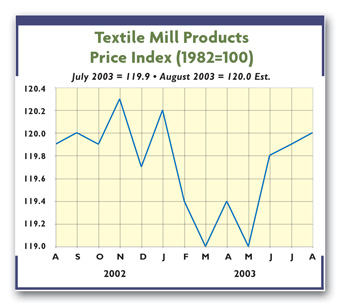
But demand trends tell only part of the story. Equally important are textile prices. And here the
news is negative, with overall mill quotes failing to budge from depressed year-ago levels, despite
rising raw material and other costs. Zero in on a key area like greige goods, and prices actually
have eroded a bit compared to year-earlier levels.


Profits And Margins Take A Hit


The impact of all this sluggishness is taking its toll on bottom lines — with most mills
sporting declines vis-à-vis a year ago. Thus, the industry’s overall after-tax earnings total has
dipped into red-ink territory, making it highly unlikely that mills will be able to even come near
last year’s $626 million profit performance.

Similar negative results are reported for after-tax margins — with the first-quarter 2003
0.3-percent red-ink reading for profits per dollar of sales running well under last year’s overall
1.3-percent positive rate. Much the same pattern is noted if you look at profits as a percent of
stockholders’ equity. And the just-ended second quarter doesn’t look any better, as such big firms
as Unifi and Dan River report losses.

The picture is even more disturbing when comparing recent results with those of 1998, when
after-tax profits were topping $2 billion — with a respectable 3.2-percent sales margin. Given
these numbers, it’s not surprising that more and more firms are filing for Chapter 11 bankruptcy
court protection. The latest is Pillowtex — maker of such renowned brands as Fieldcrest, Cannon,
Charisma and Royal Velvet. And it follows similar proceedings by Burlington Industries, WestPoint
Stevens, Malden Mills, Guilford Mills and Galey & Lord.


Import Worries Persist


The Pillowtex move in large part stems from the influx of cheap imports from Brazil, India,
Turkey and China. But it’s the latter nation that remains the industry’s biggest headache — and not
only because China is now the biggest contributor to our soaring textile and apparel trade
deficits. More troublesome is the likelihood of an even bigger wave of incoming Chinese shipments
in 2005. Faced with these threats, the industry continues to step up its campaign for relief — not
only by pressing Uncle Sam to impose standards that were agreed upon when China entered the World
Trade Organization, but also by pushing for an upward Chinese currency revaluation.


September 2003

The Specialty Fabrics Industry Gathers

IFAI Expo and its co-located events offer something for everybody in the industrial fabrics
industry.
This years Industrial Fabrics Association International (IFAI) Expo, to be held in
Las Vegas at the Las Vegas Convention Center Oct. 1-3, is expected to draw more than 8,000
attendees, according to IFAI, the Roseville, Minn.-based not-for-profit trade association that
organizes the annual gathering of the specialty fabrics industry. As of press time, 466 companies
have registered as exhibitors, although IFAI expects the number to reach more than 500. A total of
7,356 professionals from 54 countries attended the 2002 event, which hosted a record number of 490
exhibitors.Taking place concurrently with IFAI Expo are several other events tailored to the
industrial fabrics industry, including:an educational program that features 14 tracks covering
topics as varied as business and leadership, and architectural structures;an awards competition
that recognizes advancements in specialty fabric design and manufacturing;a professional
certification program;a keynote presentation by a US Navy captain;a Signage of Vegas Tour; anda
co-located conference that focuses on fabric structures.Educational ProgramsNearly 100 educational
programs that include case studies, paper presentations, seminars and hands-on workshops are
scheduled to take place alongside the Expo. According to IFAI, program offerings are created for
specific niche markets, including: architectural structures; awnings and canopies; business and
leadership; equipment and technologies; filtration textiles; inflatable recreational products;
marine fabrication; medical textiles; safety and protective products; signs and graphics; sports
and recreational products; and transportation textiles. In addition, IFAI has added the new textile
construction track, which is touted as a back-to-basics review of textile composition.2003
InternationalAchievement AwardsWith 26 categories, the International Achievement Awards recognize
new and innovative contributions made by end-product manufacturers to the specialty fabrics
industry. Photographs of this years entries will be shown at IFAI Expo. The Award of Excellence and
Outstanding Achievement Awards will be announced during the Awards Breakfast on Oct. 1.IFAI
Professional Certification ProgramsBesides being a showcase for the latest in specialty fabrics,
the Expo show floor also will serve as a testing site for certification of specialty fabrics
professionals.The IFAI Professional Certification Programs allow professionals to become certified
as Master Fabrics Craftsmen, Certified Craftsmen, Industrial Fabrics Managers or Certified Project
Planners. Those who become certified during IFAI Expo will be honored at the Chairmans Gala
reception and dinner on Oct. 3.An orientation session for the certification programs will take
place Sept. 30 from 4 p.m. until 6 p.m.Keynote PresentationThis years IFAI Expo will feature a
keynote presentation by US Navy Captain Michael Abrashoff on Oct. 2. Abrashoff will share with Expo
attendees his leadership-focused presentation, Its Your Ship, based on his book of the same
title.Signage Of Vegas TourAs part of the pre-Expo activities program, the Banner, FlagandGraphics
Association, a division of IFAI, has arranged the Signage of Vegas Tour, which will make stops at
three Las Vegas locations, including the Venetian Resort Hotel Casino for a look at its near-scale
replicas of Venetian landmarks and artwork. The tour is scheduled for Sept. 30.Fabric Structures
2003The Fabric Structures 2003 conference will be held in conjunction with IFAI Expo from Sept. 30
to Oct. 1. It will feature case studies demonstrating the benefits of using fabric as a building
material, unique design elements and resources available in the fabric structures market.Included
in the conference are keynote presentations by Kazuo Ishii, president, Membrane Structures
Association of Japan, and James Carpenter, sculptor and proprietor of New York City-based James
Carpenter Design Associates.
For more information about IFAI Expo 2003 and its co-located events, contact IFAI (651)
222-2508; (800) 225-4324; fax (651) 631-9334; www.ifaiexpo.com.

September 2003

Erhardt Leimer Introduces ELStraight

Spartanburg-based Erhardt + Leimer Inc. has introduced the ELStraight weft straightener in the
United States, Canada and Mexico.The company says ELStraight can be retrofitted quickly on existing
systems to offer high-performance web control and weft straightening using image analysis and
advanced computation methods. Features include: compact, integrated reading heads to facilitate
process setup and improve reliability; color display; and guided menus for simplified machine
interaction and process control. The system can accommodate up to 32 reading heads, with Ethernet
connections to a central control unit; three diagonal correcting rollers; and two or three bow
correcting rollers.ELStraight can be used with a range of fabric types at fabric speeds of up to
450 feet per minute and widths of up to 133 inches. Minimum measurement resolution is 0.05 degree.

September 2003

Viking Lobe Pumps Available For Specific Industrial Uses

Viking
Pump Inc., Cedar Falls, Iowa, has launched a new line of heavy-duty stainless steel Industrial Lobe
Pumps that conform with industrial application requirements for textile dyes, chemicals, resins and
coatings, latex, polymers, cellulose acetate and others. Two-bushing models offer a pressure range
up to 225 pounds per square inch (psi). Four-bushing models featuring shaft support on both sides
of the rotors offer a pressure range up to 400 psi. The company reports the bi-wing rotor design is
volumetrically efficient and enables handling of solids, while maintaining the product integrity of
shear-sensitive fluids. Sealing options are flexible, allowing a range of seals to be used.
Simplified timing and rotary end clearance adjustments without shims facilitate maintenance. Other
features include enlarged suction areas that provide flexibility in the ports, and reversible flow
direction.

September 2003

Holmes Appointed INDA President

The
Association of the Nonwoven Fabrics Industry (INDA), Cary, N.C., recently named Rory Holmes
president. Holmes will assume the position in October, replacing Ted Wirtz, who is retiring after
serving seven years as INDA president.A nonwovens veteran, Holmes joins INDA with more than 30
years of experience in nonwovens manufacturing and nonwoven product sales and marketing. Most
recently, he was the associate director of technology transfer at the Raleigh, N.C.-based Nonwovens
Cooperative Research Center at North Carolina State University. Commenting on Holmes appointment,
Dennis Tavernetti, INDA chairperson, said Holmes knowledge of the nonwovens industry, as well as
the industrys recognition of him, will be beneficial to INDAs expansion goals.

September 2003

Standard Mill Machinery Customizes Leesona 950

Standard
Mill Machinery Corp., West Warwick, R.I., is now rebuilding the Leesona Model #950 Take-Up Machine
to customer specifications. The company says the machine offers high productivity, improved package
consistency and simplified operation while saving labor costs in coating, extrusion, printing,
singeing and slitting operations.Model #950 includes a frame assembly, gear train assembly for
precision winding, compensator control to facilitate material removal and adjustment, adjustable
tension control, material break limit switch and preset speed function. It holds up to 10 spindles
and achieves speeds of 200 to 250 yards per minute, depending on material, arbor and feed.

September 2003

Coalition Seeks To Save Textile Jobs

Flash ReportBy Alfred DockeryCoalition Seeks To Save Textile Jobs
Textile executives want China safeguard and new trade policies.In mid-August, textile
executives representing the textile/fiber coalition gathered to announce a grassroots lobbying
campaign to save US textile jobs by slowing Chinese imports.More than 40 textile executives turned
up at the Grandover Hotel in Greensboro, N.C., and more than 30 gathered in Spartanburg at the
Piedmont Club. At both locations, they attended workshops on grassroots political action and held
press conferences to voice concerns about the effects of burgeoning Chinese imports.We are
concerned specifically about one thing jobs in this industry, said Allen E. Gant Jr., president and
CEO, Glen Raven Inc., Glen Raven, N.C. Since January of 2001, this industry has lost 299,000 jobs.
There is a direct correlation between the demise of this industry and manufacturing throughout this
country, and the trade policy of this country.The Greensboro and Spartanburg press conferences were
intended to reinforce the coalitions July 24, 2003, petition to the US government to invoke the
special China safeguard for textiles and slow the surge of Chinese imports on knit fabric, dressing
gowns, brassieres and gloves. Socks are expected to be the next category for which the safeguard
will be sought.John A. Emrich, president and CEO, Guilford Mills Inc., Greensboro, spoke
passionately about job losses at his company.We had to close seven and a half facilities, said
Emrich. That impacted 3,400 people. Quite frankly, as an industry, we are tired of having to look
people in the eye and tell them that we dont have jobs for them. We are tired of seeing whats
happening in other segments of manufacturing.The executives also want the US government to address
the devaluation of the Chinese currency, which constitutes a significant pricing advantage.

Textile executives gathered in Greensboro and Spartanburg to voice their grievances over
burgeoning textile imports from China. Pictured is Roger W. Chastain (at the podium) with other
textile executives at the press conference held in Spartanburg.We are not against free trade; we
are against unfair trade, said Jerry D. Rowland, president and CEO, National Textiles LLC,
Winston-Salem, N.C. There are several things about China you need to understand. Its currency is
devalued in the neighborhood of 40 percent. In addition, the textile industry in China is
50-percent owned by the government. It is a communist, managed economy that is absolutely
inundating the rest of the world with [its exports].At both press conferences, executives were
adamant about their plans to organize for political action. They made it plain that those who
support manufacturing will get the textile industrys support and the votes of its workers. Those
that dont may find themselves looking for a job.You are either with us or against us, Gant said. It
is not a complicated issue. You are either in favor of keeping American jobs and working with us,
or you are not. It is just that simple.I think Bush can forget that the Solid South is solid
anymore, and he is running a real risk of losing the next election, said Roger W. Chastain,
president, Mount Vernon Mills Inc., Greenville. We want to make sure that all of our people are
registered to vote. We want them to write letters to their congressmen. We want a grassroots
effort.Frustration and exasperation with import growth and job losses was evident on the faces and
in the voices of the speakers at both events.We are angry; we are fed up that the US government is
ignoring these massive job losses, said Richard Dillard, director of public affairs,
MillikenandCompany, Spartanburg. The United States lost 2.6 million good-paying, wealth creating,
middle class jobs in the last three years. There are now fewer manufacturing jobs in the United
States than there were in 1958.Beyond the China safeguards and currency manipulation, the coalition
would like the US government to step back and take a fresh look at trade policies, including
textile and apparel quotas that are set to expire on Jan. 1, 2005.

September 2003

Gaumer Offers Vaporizers For Process Industry Uses

Houston-based Gaumer Process Heaters, SystemsandControls has introduced a line of vaporizers for
textiles, man-made fibers, selective catalyst reduction and flare burn-off applications that
require controlled heat at high temperatures with low operating pressures. Gaumers vaporizers
enable the use of the vapor phase of recirculating fluids such as Dow Chemical Co.s Dowtherm® A and
Dowtherm J, Solutia Inc.s Therminol® VP-1, ammonia and liquefied gases to promote high
heat-transfer rates and close temperature control.

September 2003

September 2003

The
Association of the Nonwoven Fabrics Industry (INDA), Cary, N.C., elected the
following members to its Executive Committee:
Dennis R. Tavernetti, BBA Nonwovens Group, chairman;
Karl-Michael Schumann, Procter & Gamble, vice chairman, planning; and
Carl J. Lukach, DuPont, vice chairman, finance. Appointees to the committee
include
John M. Fly, Milliken & Company;
Walt Jones, Precision Fabrics Group Inc.; and
C.K. Wong, US Pacific Procurement Co. Ltd. New members elected to the Board of
Directors are
Gary Abyad, Clopay Plastic Products Co.;
Val Hollingsworth, Hollingsworth & Vose Co.;
C. Dru Kefalos, ExxonMobil Chemical Co.;
Steve Ogle, Leggett & Platt; and
Robert E. Pine, Elk Corp. of America.

The
Textured Yarn Association of America, Gastonia, N.C., elected the following
officers at its summer conference:
Richard White, Milliken & Company, president;
Chas Scott, Unifi Inc., first vice president, technical;
Tommy George, Spectrum Textured Yarns, second vice president, technical;
Jim McBride, Cognis Corp., vice president, membership;
Alasdair Carmichael, Carmichael International, vice president, publicity,
publications and archives; and
Jerry Eskew, Day International, vice president, conventions.
Jerry King, Milliken & Company, continues to serve as executive secretary.
Ulrik Frodermann, Barmag/Saurer Group;
Pat Murray, DuPont;
John Edwards, Nan Ya Plastics; and
Keith Adams, Burlington Industries Inc., were elected to the board.

Eliokem, France, has named
Michael O’Shaughnessy commercial director, US operations.

Lenzing Fibers Corp., Lowland, Tenn., has appointed
Craig Barker president and CEO; and
Peter Grant CFO and vice president, finance.
Peter Landl, former occupant of both positions, has been appointed to Lenzing’s
Board of Directors.

Michael Chubb has joined
Shuster Laboratories Inc., Canton, Mass., as vice president, sales.


September 2003

OMNOVA Presents Technology Awards

OMNOVA Presents Technology AwardsThree textile-related products are among the winners of Fairlawn,
Ohio-based OMNOVA Solutions Inc.s 2002 Technology Awards. Presented recently, the awards recognize
technology-based contributions by OMNOVAs engineering, technical, and product and market
development associates.OMNABLOC®, a durable, strong, environmentally sound styrene-butadiene-based
water-impervious carpet binder for health care and hospitality uses, was developed by James L.
Vaughn, Ph.D., and Bill Worley, Performance Chemicals. It can be applied using existing
manufacturing equipment.Endurion, a durable, pliable coating that withstands repeated cleaning, was
developed by Robert Sobieski, Rodney Cuevas and Dan Gottschalk, DecorativeandBuilding Products, for
use on woven fabrics used in health care and hospitality environments.An economical, lightweight,
vinyl-coated, polyester-backed automotive soft-top material engineered to provide noise abatement,
structural integrity, colorfastness, ultraviolet stability and flex resistance was developed by
Anthony Nix, David L. Fishel, Ronnie Bell and James V. Collins, DecorativeandBuilding Products; and
Dave Derse, field sales and marketing.
September 2003


Endurion provides water repellency to fabrics used in health care and hospitality
environments.

Sponsors