Campaign Seeks Relief From Chinese Imports


I
mporters of textiles and apparel say it’s all smoke and mirrors, but a coalition of 14
fiber and textile associations is conducting a major campaign to get government relief from rapidly
increasing imports from China. As China has become the largest exporter of textiles and apparel to
the United States, domestic manufacturers are waging a battle for what they say is their very
survival. China now has 20 percent of the US import market for textiles and apparel, and industry
leaders are concerned about what will happen when all textile and apparel quotas are removed by
January 2005.

The United States Association of Importers of Textiles and Apparel (USITA) says textile
manufacturers are relying on public relations, not facts, in their effort to curb Chinese imports
and the future threat they pose. USITA’s Executive Director, Laura Jones, charges that the textile
coalition is “holding press conferences and parading congressmen and governors before the cameras —
all smoke and mirrors — and not providing factual evidence that Chinese imports are disrupting
markets and displacing American jobs.” She says that instead of seeking “more protection,” US
textile manufacturers should be preparing for the day when all textile and apparel quotas will be a
thing of the past. At that time, she says, apparel importers and retailers “can finally make their
buying decisions like every other industry, focusing solely on which factories can deliver quality
goods on time at the right price” instead of wrestling with a complicated system of quotas. She
contends the removal of quotas will put “wasted money in the pockets of consumers.”

Even though an apparel import is an apparel import, US textile manufacturers realize some
benefits from the special trade agreements such as the North American Free Trade Agreement, the
Caribbean Basin pact agreements and bilateral agreements that require apparel imports receiving
special tariff and quota concessions to use fabric and yarn made in the participating countries.
They see the pacts as a way to compete with Chinese imports.

In their appeals to the government, textile manufacturers and their supporters in Congress
contend that competing with China is anything but fair. They say China manipulates its currency to
realize as much as a 40-percent price advantage; subsidizes its manufacturers; is a major illegal
transshipper; and can price its goods at any level in order to sell them because it has a
state-controlled economy.

The initial thrust of the coalition’s efforts was aimed at getting the government to use the
so-called safeguard mechanism in the United States/China bilateral agreement to reimpose quotas on
imports of dressing gowns, brassieres, knit fabrics, and work gloves, which were decontrolled last
year. Imports of those products have enjoyed double-digit growth since quotas were removed. The
interagency Committee for the Implementation of Textile Agreements has asked for comments from
interested parties to help it determine if the coalition’s petitions for relief are valid.


Textile Coalition Will Target 2004 Election Campaigns


Leaders of the textile trade coalition, recently joined by the Union of Needletrades,
Industrial and Textile Employees (UNITE), have made it clear they are going to do everything they
can to make textile trade an issue in next year’s presidential and congressional election
campaigns. In a series of meetings in the South and New York City, leaders of the coalition
mobilized textile company executives for what they say will be a major grass roots campaign to call
attention to the plight of the US industry and the need for government help.

The campaign will include voter registration drives to ensure that voters in textile
communities will have an impact on the upcoming elections.

In addition, the coalition hopes to spark e-mail and letter-writing campaigns to Congress
and the White House, underscoring the threat of textile trade with China. While the coalition does
not plan to target any particular candidates, it will support those candidates who understand the
textile trade issue and demonstrate a willingness to do something about it.

Although they have no particular candidates in mind at this time, there are some
textile-area congressional seats that will receive special attention. The retirement of six-term
Sen. Fritz Hollings (D-S.C.), a long-time supporter of the textile industry and its workers, will
focus special attention on the campaign in South Carolina. National Republican election officials
would love to see that seat swing into their camp. The contest for the seat of retiring Sen. Zell
Miller (D-Ga.) will likely see the Bush administration’s textile trade policies on trial. Some of
the other congressional seats in the textile belt could be heavily contested on the basis of the
textile trade issue.

Although President Bush swept the South in his 2004 election, the heavy loss of textile jobs
since he took office could become a major problem for him. Some textile industry leaders and their
lobbyists have indicated the South may not be all that solid if Bush does not come through on his
commitments to protect the interests of the textile industry
(See “Coalition Seeks To Save Textile Jobs,” www.TextileWorld.com, September 2003).

During a series of textile coalition-sponsored news conferences, textile company and union
officials were outspoken in their warnings to the Bush administration. Bruce Raynor, president of
the 250,000-member UNITE, said, “It is unacceptable for countries like China that don’t respect
basic human rights or environmental standards to flood our market, destroy entire industries and
put hundreds of thousands of men and women out of work.”

raynor
Bruce Raynor, president of UNITE

Roger Chastain, CEO of Mount Vernon Mills, said, “I think the Bush administration can forget
that the Solid South is solid any more, and he is running the risk of losing the next election.”

And Auggie Tantillo, Washington coordinator for the American Manufacturing Trade Action
Coalition, said, “Democrat or Republican …, we don’t care, the textile trade issue has to be the
centerpiece of the discussions as we go into the election cycle.”


October 2003
October 2003

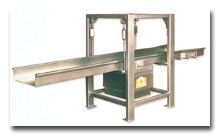
The HMC-18 model of the E-Z Slide Conveyor from
Eriez Magnetics, Erie, Pa., uses a counter rotating weight drive system to convey
fragile products forward.

bb_Copy_1
Eriez Magnetics’ HMC-18 E-Z Slide Conveyor

Cleveland-based
Astrup Co.’s line of NorthStar™ back-lit awning fabrics is now offered in a
78-inch width.

The
Digital Printing & Imaging Association (DPI), Fairfax, Va., has added a
Digital Ultraviolet (UV) Printing Information Center to the members-only section of its website,
www.dpia.org. The information center keeps DPI’s members informed of developments in digital UV
printing technology.

KoSa, Charlotte, has announced an 8- to 10-percent price increase on fine-denier
polyester staple fiber.

Great Lakes Chemical Corp., Indianapolis, has increased the price of its KP-140®
specialty additive by 6 cents per pound.

Hagemeyer North America, Charleston, S.C., has released new 2003-2004 maintenance
repair and operating products, and safety products catalogs.

Fairfield, Conn.-based
RBC Bearings’ Nice Ball Bearings Division has released a line of ground,
semiground and unground bearing assemblies.

The
Waitex Group has relocated to 135 West 36th St., New York, N.Y. 10018; (212)
967-8100; fax (212) 967-8180.

The four-strand, light-duty, continuous lift VALU-LIFT™ vertical conveyor from
TKF Inc., Cincinnati, handles cartons and unit loads weighing up to 50 pounds at a
speed of 118 feet per minute.

The P7 drive for industrial fans and pumps from
Yaskawa, New Berlin, Wis., is equipped with a liquid crystal display screen that
can display five lines of 16 characters in any of seven optional languages. Other features include
V/f control, 110-percent overload capability, and network communication and input/output options.


October 2003

Roll Concept Offers Thermal Transfer Roller

France-based Roll Concepts Alveotube® thermal transfer roller is available as either a cooling or a
heating roller, and can be used with temperatures up to 248°F. It is made from lightweight aluminum
to optimize thermal transfer, and its alveolar profile with six hollow chambers is suitable for
fluid circulation. The roller is 50 percent lighter than conventional rollers.Cooling units have a
tubular frame, and include two thermal rollers to cool both sides of the web and one idler roller
to increase the winding angle and guide the product.

October 2003

Changing Fiber Geography

In the long term, countries such as India and Indonesia could become major players in the
man-made fiber market.
An August 19, 2003, Wall Street Journal editorial offered an interesting
perspective on the United States trade deficit with China. Rather than accept the fact that the
current deficit is hurting US industry, the Journal posits:[I]n the first half of this year,
[Chinas] overall trade deficit with all countries fell 70 percent, so that it represented just 1.3
percent of its two-way trade.Chinas surplus with the United States is growing because companies
already exporting to the United States have been moving their production into China. A study by The
Institute of International Economics showed that 75 percent of the marginal growth in Chinas
exports to the United States was the result of this displacement effect.This is particularly true
for such labor intensive goods as toys and footwear which account for 28 percent of Chinas exports
to the United States. As Chinas market share of the US market in these goods [rose] to 60 percent
from less than 10 percent, the combined market shares of South Korea, Taiwan and Hong Kong [fell].
The same pattern holds true for other goods assembled in China.What an intriguing thought. If this
is true for footwear and toys (to say nothing of the ubiquitous other), is it also true for
man-made fiber Further, will displacement roll into pastures greener than Chinas Is China our only
import warrior, or should we be looking for the next displacement candidate A search of recent
literature suggests production changes among nations outside Chinas circle may really be the
long-term threat.Setting The StageMan-made fibers no longer are the sole purview of Europe and the
United States. In the United States, fibers were a net export industry until the early 1990s, at
which time huge amounts of fibers, fabrics and garments from Asia began to land on US shores an
onslaught fueled by a combination of national subsidy and investment policies, weakening Asian
currencies, and national fiscal determination to export Southeast Asia out of the economic
doldrums. South Korea, Hong Kong and Taiwan, particularly, binged into many markets but proved
merely to be the vanguard of a movement yet unfolding the arrival of China in the man-made fiber
field. China, blessed with hordes of people and unencumbered by a market economy that would tend to
exercise investment controls in low-margin businesses, arrived with a flourish and, in the process,
swept aside the growth ambitions of its continental neighbors in favor of a China-first policy.
Asian man-made fiber production grew from 45 percent of world production in 1990 to 72 percent in
2002. Simultaneously, Chinas share of Asian production grew from 20 percent in 1990 to more than 44
percent by 2002. Additionally, China achieved its dominance with a 72-percent operating rate as
late as 2002. If it manages to up that rate, it will inflict carnage on competitors.In the early-
to mid-1990s, Asian economies suffered in the shadow of Japans banking crisis and anticipated their
own similar fates, which were partially realized in the late 1990s with the horrific Asian currency
devaluation crisis. Early in the decade, Asian money flowed into the United States intent on
investing in man-made fiber production. States and localities stumbled all over one another to host
the new multibillion-pound facilities so easily promising jobs and economic nirvana for the
participants. Soon the Asian currency crisis caught up with Asian manufacturing in the United
States, and the direction changed to investment at home. After years of dependency on international
fiber sources, Asian fabric and garment manufacturers discovered that all of the added value
associated with garment manufacturing and exporting could remain in the host country if that nation
produced fibers and fabrics in addition to garments. There is no single day or event that marked
this epiphany, but a glance at Table 1, Total Man-Made Fiber Production, provides several
clues.Total world production of man-made fibers has grown at a 5.4-percent compounded annual rate
since 1990. As will be shown later, most growth came in filament production, but the point of Table
1 is to expose the geography of the production changes. As expected from even a cursory reading of
the contemporary press, man-made fiber manufacturers in industrialized nations have taken it on the
chin in the past 12 years. After 15-percent growth from 1990 to 1999, US production retreated to
1990 levels by 2001. Statistically, over the 12-year period, the industry showed a 0.15-percent
growth a mere rounding error. Western Europe struggling even more with high wages, social costs, a
wavering but largely strengthening euro (particularly in the 1999 to 2002 time frame) and low
returns in fibers lost position at the rate of 1.6 percent annually. Not surprisingly, however,
Asian production of man-made fibers leaped at a 9.6-percent annual rate from 1990 through 2002.
Leading the charge was China with a 17-percent-compounded rate of growth, but, somewhat
surprisingly, India and Indonesia stepped up commitment to man-mades with shipment from each
growing at about 12 percent annually. It appears South Korea and Taiwan combined, after early 1990s
run-ups of fiber production tied to local fabric and garment manufacturing, have been forced to see
the error of their ways and have cut production to below 1999 levels. China sucked up the excess
totally in line with the premise of the Wall Street Journal editorial.Missing from most current
literature are the positions of India and Indonesia in the man-made fiber race. During the 1990s,
both countries quietly raised capacity and production of both filament and staple to world-class
levels. Admittedly, investment slowed in the late decade, but recent announcements, particularly
from India, indicate that nations man-made fiber industry intends to become a world player. In an
August 18th article in the India Times, Union Textiles Minister Hussain announced formation of a
high-powered committee to chalk out the future growth strategy for various segments of [the]
textiles sector [W]e are setting up a committee to look into the problems of the sector to chart a
growth strategy for [the] post-Multi-Fibre Agreement era [Hussain] said textiles contributed about
8 percent to the countrys GDP [and] 30 percent to the countrys total exports [and] could reach $50
billion in the next five years after dismantling of quotas. This sounds like a warning shot across
the bows of traditional fabric and garment exporters to the United States. India boasts relatively
stable political and economic environments and likely will succeed in improving its share of world
exports. Recent unrest in Indonesia will deter investments, at least in the short term. Long-term,
it seems the logic prompting the original expansion of man-made fiber production will resurface and
compete again.The New Product MixTables 2 and 3 document a change long proposed by US fiber
manufacturers but mightily resisted by domestic fabric and garment manufacturers the switch to
filament fabrics from staple to enjoy the efficiencies of filament in fabric manufacturing.
Comparing Table 2, Man-Made Filament Production, to Table 3, Man-Made Staple Production, it easily
is seen that increases in world staple fiber production have lagged seriously behind filament. In
1990, filament represented 47 percent of total world man-made fiber production. By the end of the
decade, filaments share had risen to almost 57 percent.The interesting statistic in filament
production is its relatively slow growth in the last few years of the 1990s. Filament capacity was
installed in the go-go days of mid-decade fake silk. The consumer maintained her polyester/cotton
blend tendencies, however, and forced filament capacity utilization to lag, the most recent score
being 2002s achievement of 74-percent utilization. As filament production rose at an almost
7-percent annual rate, staple, with one geographic exception, was lagging seriously behind. As
calculable from Table 3, world staple manufacturing grew from 1990 through 2002 at a 3.33-percent
annual rate. While North American and European production fell annually at 1.5-percent rates, Asian
production rose at a 7.6-percent rate, virtually all of which occurred in China, India and
Indonesia. To be sure, incremental increases occurred across the entire Asian continent, but the
magnitude of change in these three countries eclipsed all the rest. In the 1990- 2002 period, total
world staple production rose from 17 billion pounds to 26.5 billion pounds. Total Asian production
increased by 10 billion pounds, including 6 billion in China and 2.5 billion in India and Indonesia
combined. Obviously, these three countries have focused their fiber strategies on polyester staple
to support lightweight garment manufacturing. Opportunities for import relief appear remote because
these same countries control 43 percent of available world capacity against their current 44
percent of world production. The list of new production plants in China and India is long evidence
of an attempt to increase capacity control even further. Looking To The FutureIt appears that the
Wall Street Journal editorial is in part correct, even for the man-made fiber business. China
certainly is a power in Asian textile politics and economics. Warning signs are appearing, however,
suggesting that the US fiber and textile industries had better not lose sight of the ever-shifting
geography of man-made fibers. Ever since World War II, the West controlled man-made fibers and
textiles. Recent geography appears to place the epicenter of textiles (and a number of other
non-textile products) in east Asia, specifically China. Slight rumblings are being heard, in part
driven by the expectation of truly open markets after full institution of the World Trade
Organization in 2005, but in other part driven by nationalistic hopes of displacing a substantial
portion of Chinas market share and becoming the next major player in the American textile market.
Download
Fiber World Feature Tables

Editors Note: This analysis focuses on three man-made fibers: nylons, including aramids;
polyesters; and acrylics, including modacrylics. Space limitations prevent inclusion of other
fibers, particularly olefin and spandex, although Textile World is developing similar analyses of
these fibers for future issues.

October 2003

CBD Technologies Grants Sub-License To Novozymes

CBD Technologies Inc., Bergenfield, N.J., recently granted Denmark-based Novozymes A/S a
sub-license to develop and market isolated catalytic and binding domains from cellulases for
textile and detergent industries under certain CBD Technologies patents licensed from the
University of British Columbia, Canada.

October 2003

Countdown To ITMA

The National Exhibition Centre, England, will host a record number of visitors and exhibitors
at ITMA 2003.October has arrived and Birmingham, England, awaits the global textile industry at
ITMA 2003. A record number of exhibitors and visitors are expected to attend the event, to be held
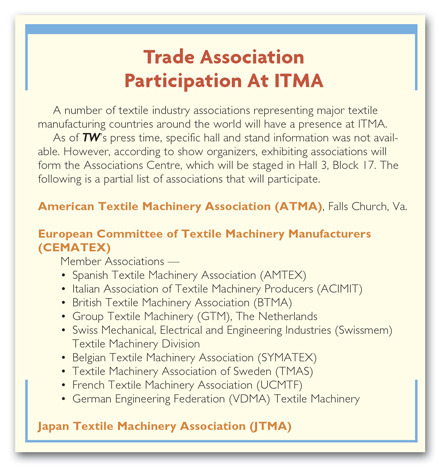
at Birminghams National Exhibition Centre (NEC), Oct. 22-29.Owned by the European Committee of
Textile Machinery Manufacturers (CEMATEX), ITMA 2003 has maintained its appeal as an important
event on the calendar of textile shows, despite emerging competition from other major, global
exhibitions. In addition to perusing the exhibition floor, visitors may participate in a number of
events surrounding the show. During the day, the ITMA Forum, entitled New Frontiers in Textiles
Moving MarketsandStrategic Innovations, will give visitors and exhibitors alike a chance to network
and discuss major issues affecting todays global industry. Six sessions, offered Oct. 23-25, will
cover a broad range of hot topics
(See Table 1).A panel of speakers will lead each session in a roundtable discussion the
format of which is designed to let the speakers, visitors and exhibitors drive the discussions.
Each two-hour session, which will open with a presentation by a panel member, is divided into a
90-minute discussion period and 30-minute conversation break. Refreshments will be served during
the break, and attendees will have an opportunity to meet with panelists and industry
colleagues.Participants must have a good command of the English language because the forum is an
English-speaking event, and simultaneous translations will not be available.There is plenty to do
and see in and around Birmingham each evening. The city boasts a large number of restaurants, bars
and pubs, as well as a large canal network for evening walks and barge rides. The NEC Arena is
hosting a variety of concerts during ITMA, including Mariah Carey and Christina Aguilera; and
various classical music, show tunes and other entertainment can be enjoyed at NECs Symphony Hall
almost every night during the show.Historically, ITMA has marked the introduction of many great
innovations in textile machinery. And, with the postponement from June to December of another
international show in 2003, ShanghaiTex, ITMA is the industrys first opportunity this year to see
key advancements first-hand
(See Savio Unveils Technology, TW, this issue).Following is a look at some of the wares to
be displayed during ITMA 2003
(For additional listings, see ITMA 2003 Exhibitors, TW, September 2003). ExhibitorsAlbany
International Italia S.p.A., Italy, will feature its endless needled felts and silicone-coated
belts for textile finishing processes. Hall 19, Stand DF19-1B.Aletti GiovanniandFigli S.r.l.,
Italy, will exhibit its range of finishing lines. A special band buffing machine; and peach pile,
sueding and pattern buffing equipment will be highlighted. Hall 7, Stand DF7-6J.Atlas Copco,
Sweden, will introduce two new oil-free air compressors, the ZR315 VSD and the ZH7000. Both
compressors provide 100-percent oil-free air power for spinning and weaving operations. Hall 11,
Stand W11-4B.

Atlas Copco’s ZR315 VSD oil-free air compressor

Brugman washing rangeBrugman, The Netherlands, will exhibit its full line of desizing,
scouring and bleaching, mercerizing, and continuous dyeing equipment. The Vanwyk Group of
companies, which acquired the rights to the Brugman name in 2002, has decided to reintroduce the
Brugman machinery program to the international textile market at ITMA. Primary stand contact:
Patrick Paap. Hall 6, Stand DF6-12A.Crosrol UK Ltd., England, will exhibit a new web belt that can
be retrofitted to existing Crosrol Mark 4 and Mark 5 cards. The belt offers enhanced performance
with output increases of between 11 and 22 percent, according to the company. Hall 2, Stand
SP2-9B.Datacolor, Lawrenceville, N.J., will showcase its latest tools for maintaining first-run
color efficiency for virtually any textile or apparel application. Around the theme From Mills to
Market, Datacolor will demonstrate: ColorTools, Windows®-driven software for color quality control;
Spectraflash Series X lab-grade spectrophotometers; the Mercury color measurement device; AutoLab
Modulo GT dispensers; Autofoam chemical application technology; DCIMatch complete color matching
and correction system; and many other products. Hall 6, Stand DF6-16A.Devrekha Exports, India, will
feature its patented jet-dyeing machine; a multi-nozzle, soft flow dyeing machine; a scouring
machine with caustic recovery system; a long-tube dyeing machine; and a sample dyeing machine. Hall
16, Stand DF16-8D. Elad Trading BV, The Netherlands, exhibiting for the first time, will present
information on its spare parts for Stork and Vald Henriksen machines, in addition to its new lab
padder. Hall 19, Stand DF19-15D.Fibreguide Ltd., England, will show its FG air-jet technology
featuring a tungsten carbide jet core. Products include the latest-generation FG5 twist jet, FG10
range for spinning applications, FG8 and FG8M technologies for microdenier spinning and draw
texturing applications, and FG9 jets for twisting and detorque. Primary stand contact: Philip J.
Leah. Hall 1, Stand SP1-9C.Fongs National Engineering Co. Ltd., Hong Kong, will exhibit the Ecotech
series of dyeing machines, which includes the ECO-6 high-temperature dyeing machine, the ECO-38
atmospheric dyeing machine, and the ECO-8 double-rope soft dyeing machine. In addition, the company
will highlight the ALLWIN Series package-dyeing machine. Hall 17, Stand DF17-7A.

Fong’s ECO-6 high-temperature drying machineH. Hergeth GmbH, Germany, will show various
preparation equipment, including automatic bale tie cutters, horizontal and inclined pluckers,
single and multi-roll openers and cotton cleaning machines, among other products. Hall 1, Stand
SP1-12B.Kluber Lubrication Munchen KG, Germany, will highlight its special lubricants for textile
machinery applications. Hall 20, Stand DF20-11A; and Hall 5, Stand K5-3A.Knotex Maschinenbau GmbH,
Germany, will introduce its new TS/2 TapeMaster warp tying machine, Knotex OptimalSpeed® for
program-controlled knot-tying speed efficiency, the DISPOS® spare parts management system and a
tying frame for monofilaments. Hall 9, Stand W9-5A.Macart Spinning Systems, England, will exhibit
its S300 machine, which represents a new approach to yarn manufacturing combining roving, spinning,
twisting, yarn bulking and take-up winding operations into a single operation. The S300 is suitable
for acrylic yarns in counts from 2/16 Nm to 2/42 Nm. Primary stand contact: David Titheridge. Hall
2, Stand SP2-9B.Marzoli S.p.A., Italy, will debut its C601 card, among other technologies. Hall 1,
Stand SP1-16B.Meera Industries, India, will show a new TFO twister for polyester and silk yarns,
and a high-speed servo-controlled rewinder with a touch-screen display panel. Hall 2, Stand
SP2-2E.Morrison Textile Machinery, Fort Lawn, S.C., will present its new SPECtrUM Indigo Dye and
Wash Boxes; FCS monitoring and control system; the Micro Saturator for high wet pickup
applications; as well as Morrisons Rubber Belt Unit, an integral part of its SANFOR compressive
shrinking range. Hall 6, Stand DF6-7D.NedGraphics BV, The Netherlands, will feature its software
and services for textile design, color matching, color separation, fabric and carpet simulation and
3-D presentation. Hall 8, Stand S8-4A.Novozymes A/S, Denmark, will have information on its enzyme
products for textile applications, including Scourzyme® L for cellulose fabric preparation.
Scourzyme L breaks down cotton pectin, thereby assisting in wax and oil removal. According to the
company, the enzyme provides effective, eco-friendly scouring of cellulose fabrics. Hall 8, Stand
DC8-5B.Osthoff-Senge GmbHandCo. KG, Germany, will exhibit its line of atmospheric and
high-temperature jigs with combined PC and PLC control systems, and inverter-controlled AC drives
with brake-drive power return, among other features. Hall 18, Stand DF18-3A.Roaches International
Ltd., England, will exhibit in Hall 7, Stand DF7-3A.Georg Sahm GmbHandCo. KG, Germany, will present
the new Twinstar fully automatic doffing precision cross winder, to be demonstrated in combination
with a doffing and handling system. The company also will display the 302E high-performance
rewinder and assembly winder with a Texkimp SA/M creel, and the Sahm 3002 R automatic
high-performance winder. Hall 1, Stand SP1-11A.Stalam S.p.A., Italy, will show the most up-to-date
versions of its radio frequency dryers including: the RF and RFA standard and air-assisted models
for all types of fibers and yarns; the LtrF and RFA/S low- and medium-temperature dryers for loose
stock, unwound tow/top slivers and hanks of yarn; the TCRF thermocontrolled batch-type dryers for
temperature-sensitive yarn packages and tops in bump/bobbin form; and RF/T continuous drying and
finishing equipment for woven fabrics. Hall 18, Stand DF18-9A.Strahm Textile Systems AG,
Switzerland, focuses on drying, coating, impregnating and thermobonding solutions for the textile,
nonwovens and composites industries. Strahm will launch the Fibroline unit, a high-voltage powder
impregnation system, at the exhibition. In addition, the company will show a newly developed line
of convection drying and thermobonding systems; and foulards, calenders, winders and accumulators.
Machinery on display at ITMA will be transferred to the companys new research and development
showroom after the exhibition. Hall 4, Stand NW4-4A.Tatham Ltd., England, will demonstrate new
developments in its Microweigh technology for carding machinery, its full line of woolen and
nonwoven cards, the Tatham Mule spinning system and the Magnum card for carpet yarns, among other
products. Primary stand contact: Tim Porritt. Hall 2, Stand SP2-9B.U. Engineering Co. Ltd., Japan,
will highlight its WE400 weft straightener, a web-guiding device, and Flat Expander and Miravo
wrinkle-removing rolls. Primary stand contact: Makiko Kosaka. Hall 19, Stand DF19-11B.Vetri
Engineers, India, will display Vetri top rollers for draw frames and combers, metal top rollers for
roving and ring frames, and spinning machine spare parts. Primary stand contact: S. Jaya Prakash.
Hall 4, Stand SP4-2B.Ph. Welker GmbH, Germany, will exhibit the Condibox-S conditioning system,
which provides up to a 50-percent reduction in energy costs, according to the company. Welker also
will show the Welkodur, a new stainless steel multi-layer protection system, which offers an
alternative to costly stainless steel housings for its machinery. Hall 2, Stand SP2-14B.In
November,
Textile World will begin its post-show coverage of ITMA 2003 and the innovative
technologies unveiled during the exhibition. The November issue will feature a Flash Report
comprising pictures taken during the show. The December issue will contain an overview of the show,
highlighting general trends. The first three issues in 2004 will offer in-depth coverage of the
technology offerings broken down by segment: January will feature opening, blending, carding,
spinning and material handling; February will cover weaving preparation, weaving, knitting and
nonwovens technologies; and March will wrap up
TWs ITMA coverage with dyeing, printing, finishing and quality control developments.

Download
ITMA Forum Program

October 2003

Heberlein Fiber Technology Offers New Yarn Products

Heberlein Fiber TechnologyOffers New Yarn ProductsSwitzerland-based Heberlein Fiber Technology Inc.
has introduced the MigraJet for filament spinning. According to Heberlein, MigraJet offers two main
advantages: improved spreading of reduced amounts of spin finish for uniform finish distribution to
the yarn core; and the production of a compacted yarn with no interlacing knots. Yarns spun using
MigraJet are more efficiently processed and exhibit improved dyeability, according to the company.
MigraJet is suitable for polyester, nylon, polypropylene and microfilament partially oriented,
high-orientation and fully oriented yarn spinning.Heberleins new-generation HemaJet® A-Series jet
cores for Taslan® air-jet texturing feature a modified geometry compared to the earlier T-Series.
According to the company, improvements attributable to the altered geometry include a compact, more
regular yarn; higher stability; and up to a 30-percent higher processing speed. The A-Series jet
cores are suitable for microfilament, fine yarn and polypropylene texturing.
October 2003


Heberlein’s MigraJet SP25-M161/CM26

BASF To Build Its First Wholly Owned Plant In China

Germany-based BASF AG is investing in a tetrahydrofuran (THF)/polyTHF® plant in China, scheduled
for completion in the fourth quarter of 2004. The facility, BASFs first wholly owned project in
China, is to be built in the Shanghai Chemical Industrial Park, Caojing/Shanghai.BASF intends to
utilize newly developed proprietary technology to produce THF, which subsequently will be converted
into polyTHF a component used in spandex and thermoplastic polyurethane manufacturing, among other
uses. The company hopes to become the preferred supplier of raw materials for spandex in China and
has launched a Chinese brand name for its polyTHF Bao Li Fu which means enrich your fabric. By
2010, we aim to generate 20 percent of BASFs sales and earnings in the chemical business in Asia
Pacific with 70 percent of those coming from local production, said Andreas Kreimeyer, member of
BASFs Board of Executive Directors.

October 2003

Unifi TSI Collaborate On Men39 S Pants

Universal
Fit mens casual pants are the result of a year-long collaboration between Unifi Inc., Greensboro,
N.C., and Tropical Sportswear International (TSI) Corp., Tampa, Fla.Unifis Reflexx performance
yarns, used in the pants fabric, provides up to 25-percent stretch in the warp and filling
directions of the woven fabric.Universal Fit is the first commercially available line of casual
mens pants to contain Reflexx yarns. The pants will be available this holiday season at department
stores such as Dillards, JCPenney, May Co., Federated Stores, Belk and others.

October 2003

Uhde KoSa Form Alliance

Germany-based Uhde GmbH and Houston-based KoSa have formed an alliance to build polyester (PET)
plants. Uhde, which formerly built plants for Hoechst AG, will work with KoSa, formerly Hoechsts
Trevira international PET business, to supply processes for the production of PET bottle resins,
technical filaments for tires and industrial yarns, and textile fibers and filaments based on KoSas
technologies. KoSa is pleased to cooperate with Uhde in this field, said James DelPiano, global
director, technology services, KoSa. Uhde brings the strong engineering capabilities to implement
polyester projects around the world from basic engineering to Lump Sum Turn Key, allowing KoSa to
expand its market.

October 2003

Sponsors