Holmfirth Dyers Upgrades Textile Management System

Holmfirth Dyers, England, recently upgraded to the latest version of England-based Bespoke Textile
Computer Systems Textile Management System. Progress, the new Windows®-based system, manages the
receipt of greige pieces, allocation of those pieces to orders, receipt of finished pieces from
work, dispatch and invoicing; and features a more intuitive and graphical interface than the
previous version. After having used the previous Bespoke system for 14 years, Holmfirth Dyers
decided to upgrade to the new system in order to improve work flow and increase ease of operator
use.

“I was delighted with the speed and efficiency of the installation, which was carried out
with the minimum of disruption to our operation,” said Geoff Goodman, financial director and
project manager, Holmfirth Dyers.

May 2004

Good News On The Labor Front


N
ot everything looks bleak these days, certainly when it comes to textile labor costs.
Examine the latest industry productivity and payroll figures, and it’s clear industry unit labor
costs have actually trended lower over the past year.

Look at productivity first — figures (showing a 10-percent decline in the industry workforce
and only a 3-percent decline in output) point to an annual efficiency gain of nearly 7 percent. Pay
increases for textile workers over the same period have averaged out in the relatively low 1.5- to
3.5-percent range. The two pertinent figures (a 7-percent productivity advance and a 1.5- to
3.5-percent pay gain) provide pretty strong evidence that textile unit labor costs have fallen
anywhere from 3.5 to 5.5 percent over the past 12 months.

p18_Copy_2


But Man-Made Fiber Tags Rise

Rising man-made fiber and yarn costs, however, are now a problem, offsetting some of the
positive effects of lower wage costs. To be sure, some of the upward impetus here comes from
firming demand. But a more important factor is probably a big jump in the cost of petrochemical
feedstocks as crude oil and natural gas prices head for new highs.

These costs are not trivial. Some two-thirds of polyester staple’s selling price is traceable
to petrochemicals. No surprise, then, that there recently have been posted increases in such key
areas as polyester and nylon. And given current trends, these increases are likely to continue into
summer and fall.

These advances haven’t as yet shown up in the government man-made fiber index — there’s
always a few months’ lag here.

TW
would expect this key textile price barometer to advance anywhere from 2 to 4 percent
over the next six months — with the biggest hikes likely to be centered in commodity rather than
specialty products.


Cotton Bears Watching Too

Cotton tags haven’t been nearly as firm as expected. Indeed, prices here recently were down at a
10-month low and not much above a year ago. Much of this can be attributed to less-than-expected
Chinese purchasing. Quotes are probably as low as they’re going to go, as global consumption this
year will top production by several million bales. Many analysts now maintain the natural fiber is
undervalued. TW would tend to agree, and expects spot prices to inch up slowly from recent lows.

Best bet for the next six months: a price average in the mid-60s range. While somewhat under
early-2004 highs, that would still be above the latest reported results.


Some Thoughts On Imports

Meantime, there’s also somewhat more encouraging news on the trade front. Incoming shipments so
far this year are up only 6 to 7 percent on a square meters equivalent basis. That’s well under
last year’s 9- to 10-percent advance and pretty much in line with TW‘s beginning-of-the-year
forecast.

A good portion of the market most vulnerable to easy Chinese penetration has already been
captured. Equally important are ongoing technological advances — witness continuing big jumps in
productivity — that the US industry has been achieving to remain competitive. Closely allied with
this are the ongoing development of new and improved products and increasing emphasis on flexible
manufacturing that allows domestic producers to attract customized markets.

Another factor could be the recent increase in textile import prices as the US dollar
weakens. At last report, import quotes were running better than 3 percent above a year earlier, in
marked contrast to the virtually flat pattern noted for domestic textile tags.


A Statistical Note


TW
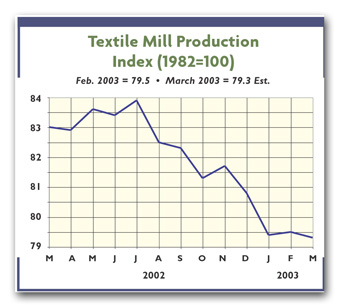
’s textile mill products price index shown on page 20 has been revised to reflect ongoing
changes in overall industry data collection — away from the old Standard Industrial Classification
approach and towards the new North American Industrial Classification System (NAICS). Since past
data under the NAICS breakdown are not available, the new series uses December 2003 as its
reference point.

This revision has resulted in lower index numbers than under the old 1982 base. Also note
that by linking the old and new series together,

TW
believes the chart presents realistic estimates of the month-to-month changes that have
occurred over the past year.


May 2004


GMI Completes Guilford Acquisition

GMI Merger Corp. (GMI)
, an affiliate of New York City-based Cerberus Capital Management LP, has
completed its cash tender offer to acquire the outstanding shares of Greensboro-based engineered
automotive, technical and apparel fabrics manufacturer Guilford Mills Inc. and has merged with the
company. GMI accepted for payment more than 5.1 million shares, or approximately 94 percent, of
Guilford’s common stock in the offer, and will convert all remaining publicly held shares into the
right to receive $19.00 net per share in cash. Guilford now operates as a wholly owned subsidiary
of GMI Holding Corp., also an affiliate of Cerberus.

May 2004

Tape Craft Merges Operations At Expanded Facility

Tape Craft Corp. (TC), a subsidiary of YKK Corp. of America, Marietta, Ga., has completed the
expansion of its Oxford, Ala.-based webbing manufacturing plant, where it has consolidated all of
its manufacturing, warehousing and distribution operations. TC says consolidation at one location
will enable it to better provide products and services to its customers. The facility utilizes a
one-directional manufacturing system developed by two engineers from YKK Corp., Tokyo. The system
enables increased throughput and reduced delivery lead-times and inventories.

carseat

Tape Craft webbing applications include safety straps in children’s car seats, among other
uses.

Myra Ray, vice president, manufacturing, TC, mentioned the US government as a current market
where opportunities exist for expansion. “Although TC has a long history in serving this market,
today’s military needs are much more sophisticated and high-tech than in the past,” Ray said. “Now
that our operations have been fully modernized, well be able to develop products to meet those
needs.”

“The US government represents an ideal growth opportunity for TC,” added Scott Nagasaki,
president, TC. “The business is consistent with YKK’s interest in pursuing developing markets that
will stay in North America. Our overall goal is to expand our reach into new arenas where we can
bring the full and diverse range of YKK products to the marketplace.

May 2004

Lenzing AG Acquires Tencel Group Of Companies

With May 4th as the effective date, Lenzing AG is taking over the entire Tencel group of companies.
The seller is Corsadi BV, part of the international financial group CVC. The purchase agreements
were signed on 4th May. The price of the transaction was not disclosed. The acquisition will
further strengthen Lenzing’s position as one of the leading manufacturers of high quality,
cellulose-based fibers in the world.

Karl Schmutzer, chairman of the Supervisory Board of Lenzing AG and managing director of
BandC Holding, the majority owner, regarded the step as an “absolutely sensible commercial decision
with far-reaching strategic significance for the Lenzing Group.” As a long-term investor, BandC
Holding, the core stakeholder of Lenzing AG, is providing the Managing Board with the security for
planning that it needs for such an investment, so that the Lenzing Group will be able to continue
its successful growth course.

Tencel operates one large-scale Lyocell plant in the United States (Mobile, Alabama) and
another in the United Kingdom (Grimsby), with a total nominal capacity of about 80,000 tons per
year. Including its UK support activities and marketing teams throughout the world, it has a staff
of about 350. Sales for 2003 were EUR 100 mill. The capacity of the Lyocell production site of
Lenzing AG at Heiligenkreuz, Austria, is about 40,000 tons. The Lenzing Group has a staff of more
than 4,000 worldwide, including 180 at Heiligenkreuz. During the last decade Tencel and Lenzing
each independently developed the Lyocell fiber technology and brought it to large-scale industrial
production.

“The acquisition marks a milestone for the Lenzing Group,” said Thomas Fahnemann, chairman of
the managing board of Lenzing. “We are tripling our Lyocell capacity and thereby reaching the
critical size that is necessary for a sustainable and profitable Lyocell operation. With Tencel,
the brand name, we are taking over a most successful brand, together with its international
marketing team.” By owning three Lyocell production sites, Lenzing will be able to use the
available capacities with much more flexibility in the future, as well as to respond in an optimum
fashion to market and customer needs.

“Last but not least, combining the technology and application know-how of the two groups will
considerably enhance their impact,” said Fahnemann. The Lenzing Group will be able to keep up its
further development of the Lyocell technology and to further accelerate the development of new
products. “We expect major stimuli for our development work from the broad mutual exchange of
experience and technology that has now become possible,” said Fahnemann.

The planned integration of Tencel is greatly facilitated by a new corporate organization with
market-oriented business units which was implemented at the beginning of the year.

May 2004

Optimistic But Uncertain


S
pinners continue to report strong volume across the board. The ring-spinning market is
very good at the moment and looks good through the first half of this year. One ring spinner said: “
We are running seven days a week and anticipate no slack-off whatsoever through the July 4th
holiday. Beyond that, the third quarter looks pretty good.”

Another spinner with a variety of spinning systems — ring, open-end and air-jet — said: “
Demand is good. We just don’t know how long it will last. We think it is driven by retailers’
inability to borrow against next year’s quota, as they have in the past. The stores are concerned
that they have goods on the shelves.”


Surf’s Up

On the man-made fiber side in particular, spinners are surfing a wave of raw material price
increases. It gets especially difficult when a downstream supplier has committed to prices with the
retailer for an entire season. As one spinner put it: “Price increases are very difficult, and
often they come out of our pocket. Fiber companies are only somewhat sympathetic because some of
them are going through financial difficulties of their own.”

That’s the bad news. The good news is, it appears retailers might be showing signs of
improved tolerance for price increases. One executive said he has read a few articles suggesting
Wal-Mart might be more accepting of price increases that are raw-material-driven.

He cited recent articles in the Wall Street Journal and AdAge. However, spinners are still
waiting to experience this trend firsthand.

On the cotton fiber side, prices seem to have stabilized, but no one is certain where they
are headed. One spinner noted: “The Chinese are the key to it, but nobody seems to know what [the
Chinese] are doing. I think cotton prices will be pretty stable from now until the next crop, but
that’s a guess.”


2005: Several Scenarios

Expectations about the effects of the 2005 World Trade Organization quota phase-out were all
over the parking lot.

One theory is that countries like China have run out of quota, or will run out very shortly.
When they do, they have to stop shipping goods, but may not stop producing them. This could lead to
a tsunami of inventory coming into the US market in early 2005.

One spinner allowed: “The first quarter of 2005 is going to be a little iffy unless we get
sufficient chase business out of the retailers to keep [the Caribbean Basin Initiative] and the
Americas going strong. The big question is what China will do, and how much it will continue to
produce in the last quarter.”

Another saw two possibilities for 2005: “One is that we hit a giant iceberg, and the whole
ship sinks because there is just no business for next year. More likely, there will be continued
erosion of the domestic market, but there will be a domestic market — between niche businesses and
businesses where customers have a better understanding of the local market, or can turn quickly.”

A third spinner was more optimistic. He said: “I don’t know that it will have that much more
of an effect than it already has. We’ve seen a paring down of the business over the last few years,
and I’m not so sure it is going to get much worse. I don’t think business will come to a screeching
halt.”


ATMI, AYSA, NCTO

Opinions also varied about the recent changing of the guard among the textile trade
associations. The American Textile Manufacturers Institute (ATMI) has closed, and the American Yarn
Spinners Association (AYSA) will close this summer. In their place will be the National Council of
Textile Organizations (NCTO).

One spinner was clearly negative: “It is an absolute crying shame AYSA will disappear. I’m
seriously concerned yarn spinners will not have any voice in this new organization.”

Another was more positive: “We are very supportive of that development. It’s better to
formulate one omnibus-type organization that can be more effective in Washington. With the right
lobbying effort and the right coordination among different industry sectors, we can still be
effective as a trade organization with NCTO.”

A third spinner also was fairly upbeat: “One unified voice is probably better than several
smaller ones. ATMI and AYSA both did good things in the past, but our industry now will probably
have more muscle as one group with a united front.”


May 2004


Cotton’s New Look


C
otton Incorporated, Cary, N.C., has a new advertising campaign, a new agency and a new
focus. “The Fabric of Our Lives” tagline – which has seeped its way into the subconscious of
almost every consumer – will be dropped from television advertising after 14 years. The company’s
new target area is women in the 21-to-34 age group. Extensive research, conducted by its new
advertising agency, DDB, New York City, showed women can’t have too many pairs of jeans, love to
shop and notice what people wear.

Cotton Incorporated named DDB as its new advertising agency in November 2003, after an
extensive three-month review. DDB replaces Ogilvy & Mather/New York, which served as Cotton
Incorporated’s agency of record for more than 30 years.

cottoninc
One of Cotton Incorporated’s first new commercials features mannequins in shop windows
dressed in various cotton apparel. The commercial ends with the tagline “What a great time to be a
girl.”

Cotton Incorporated will run seven new commercials on 16 networks, each representing a
different aspect of cotton. Each ad is playful and points up the pleasure of shopping. More than
100 different wardrobe selections appear in the ads, all made of cotton and cotton-rich fabrics.
All of the wardrobe items can be identified by going to Cotton Incorporated’s consumer website,
which will continue to operate at
www.thefabricofourlives.com.

One commercial features a Jack Russell terrier racing through the house grabbing clothing and
tossing it into a pile. The dog settles down on top of his pile, while a tagline reads: “COTTON –
Soft. Comfortable. Easy to Clean.”

In another ad, rows of jeans on store shelves are arranged by categories such as “Jeans your
boyfriend will notice,” “Jeans your old boyfriend will notice,” and “Jeans your old boyfriend’s new
girlfriend will notice.”

“We are very excited about this new television campaign,” said J. Berrye Worsham III,
president and CEO, Cotton Incorporated. “It marks the beginning of a new era at Cotton
Incorporated. Not only does this commemorate our first venture with DDB, but the debut of the new
commercials also marks the retirement of ‘The Fabric of Our Lives’ tagline from our television ads.
The focus of the new commercials celebrates women’s passion for shopping and for clothes, and
demonstrates the important role cotton plays in both.”

Lee Garfinkel, chairman and chief creative officer, DDB New York, added, “We believe we’ve
created a campaign for women that speaks directly to them. … Cotton is so dominant in today’s
clothing that we see an opportunity to directly associate cotton with the fun and joy of shopping.”

In addition to the television ads, DDB is developing an integrated media campaign for Cotton
Incorporated, which will include print, Internet and sales promotions. In support of the print
advertising, an aggressive schedule in more than 15 lifestyle, home and fashion magazines is
planned.

May 2004

Lenzing Opens China Office, Launches Microfiber Lyocell®

Austria-based Lenzing AG recently opened a new office in Shanghai, Lenzing Fiber Shanghai, to
handle sales tasks and expand Lenzing’s presence in China. “The sale of special fibers has recently
undergone a very positive development, inciting us to open the office in Shanghai,” said Thomas
Fahnemann, chairman. “With this foothold in the Chinese market, we aim to increase our annual
export volume.”

In other company news, Lenzing has introduced a microfiber version of its Lyocell® fiber.
Produced using Lenzing’s Low Fibrillation technology, the fiber was developed for the lingerie
sector.

May 2004

Eurocoton, FTA Endorse Istanbul Declaration

Two multinational coalitions of textile industry and apparel associations – the Committee of the
Cotton and Allied Textile Industries of the European Communities (Eurocoton), and the Andean
Textile Federation (FTA) – have added their names to the list of organizations that have endorsed
the Istanbul Declaration.

Eurocoton represents textile and apparel groups from 11 European countries including Austria,
Belgium, the Czech Republic, France, Germany, Greece, Italy, Poland, Slovenia, Spain and Turkey.
FTA is a coalition of textile industry associations from the Andean region of South America,
including organizations from Bolivia, Colombia, Ecuador, Peru and Venezuela.

The Istanbul Declaration urges an emergency meeting of the World Trade Organization to
consider a three-year extension of the deadline to implement the global phase-out of textile and
apparel quotas. It requests a “full review of global textile and clothing production, export and
market circumstances so as to determine whether to finalize the phase-out process on Jan. 1, 2008,
or to develop an appropriate alternative arrangement.” The declaration also warns of “massive job
disruption and business bankruptcies in dozens of countries dependent upon textile and clothing
exports” due to expected monopolization by China and a few other countries of global textile and
apparel trade if quotas are removed as currently scheduled on Jan. 1, 2005.

Thirty-nine textile and apparel trade organizations representing 31 countries in North
America, South America, Europe and Africa have endorsed the Istanbul Declaration. US groups include
the American Manufacturing Trade Action Coalition (AMTAC), the National Council of Textile
Organizations, and the National Textile Association.

“Every national textile association in this coalition faces a three-dimensional threat from
China’s highly subsidized export machine,” said Auggie Tantillo, AMTAC’s Washington coordinator.
“Coalition members face the loss of significant market share in their own domestic market, in
first-world markets and in critical developing-world markets.”

May 2004

Logistics: Shipping The Goods


T
here is a standard supply chain saying about having the right product in the right place
at the right time at the right price – it all comes back to that,” said Tony Ross, Cap Gemini Ernst
& Young’s (CGE&Y) Irving, Texas-based logistics and fulfillment consulting practice leader
for the Americas, when asked what logistics and supply chain management should strive to achieve.
“What I’d like to add is: having the right product in the right place at the right time at the
right price while maximizing profitability. That’s a very key phrase to add.”

In the past decade, manufacturing has seen tremendous gains in productivity and efficiency,
so much so that some companies now consider logistics and supply chain management the last frontier
in further achieving corporate leanness and maximizing profits.

For a textile industry that is going to be quota-free in 2005, one can count on it becoming
even more globalized than it is today. This provides another added incentive to fine-tune every
step of the supply chain.

supplyswirl
Photograph courtesy of Schneider Logistics Inc.


Outsourcing – A Welcome Trend


While the trend of outsourcing seems unstoppable in many aspects of manufacturing, and many
executives wince at the mere mention of the word, quite a few textile manufacturers are embracing
the idea of outsourcing their logistical needs to third-party logistics companies. 3PLs, logistics
parlance for third-party logistics suppliers, are companies that specialize in arranging and
managing some or all aspects of transportation and distribution on their clients’ behalf.

“Between the late 1980s and early ’90s, the 3PL market was born,” said Doug Olson, general
manager/vertical leader, manufacturing and consumer products, Schneider Logistics Inc., Green Bay,
Wis. “Why? Because many businesses in the ’90s started to focus on reengineering their core
competencies. They decided that there are companies out there that do transportation better than
they do. These [transportation] companies have a lot of experience, plus a lot of purchasing power
and knowledge in the market.” To demonstrate what kind of purchasing power 3PLs have, Olson said
Schneider Logistics, which is the 3PL arm of trucking company Schneider National Inc., purchases
more than $2 billion worth of transportation annually on its clients’ behalf. The majority of the
company’s business is between North America and Europe, but it is actively growing its emphasis on
Asia.

In China, where market-oriented manufacturing activities are springing up everywhere, 3PL is
one of the fastest-growing industries, according to the 2003 China Logistics User Survey, published
jointly last August by the Atlanta-based Georgia Institute of Technology (Georgia Tech), the
Singapore-based Logistics Institute Asia Pacific and the Beijing-based Institute of Logistics and
Transportation of the China Communications & Transportation Association.

One company that relies heavily on 3PLs is Atlanta-based athleticwear and activewear
manufacturer Russell Corp. Scott Mosteller, vice president of supply chain at the company’s
Athletic Group, which oversees branded merchandise such as Russell Athletic, said his division has
contracted a freight forwarder to handle its shipments from the 20 or so countries it sources from,
including Pakistan, India and Brazil.

“It’s a cost-benefit analysis of how much it would cost to use a freight-forwarding company
versus how much it would cost to build the same network in-house,” Mosteller said.

As the 3PL industry matures, some firms are starting to specialize in serving a particular
product sector or focusing on a specific mode of transportation.

“I believe as more and more companies begin to use 3PLs, the providers will develop
capabilities that are really tailored to a specific industry’s needs,” said John Langley, professor
of supply chain management at The Logistics Institute (TLI) and director of the Supply Chain
Executive Programs at Georgia Tech. “As they build up a critical mass of customers, [these
providers] also are trying to figure out their own core competencies. They may find out that they
really can’t be core-competent in serving a broad range of industries. If they focus on a specific
industry, they will not only do a better job for that industry, but they also grow their business
in that industry and maybe gain a much larger market share.”

“It could become attractive to us,” Mosteller said. “We are growing our sourcing volume year
by year, and as we get more total volume and units in, it’ll give us some flexibility to look at
specialization to reduce cost.”

mosteller
“It’s a cost-benefit analysis of how much it would cost to use a freight-forwarding company
versus how much it would cost to build the same network in-house.”

— Scott Mosteller, vice president of supply chain, Russell Corp.’s Athletic Group


Timing Is Everything


The logistical challenges faced by the textile industry are no different from those
experienced in other sectors of manufacturing – shrinking product cycles, multiple vendors and
manufacturing locations, rising expenses, and lack of process visibility, among others.

As with all other consumer goods, the textile product cycle is getting shorter and shorter.
Consumer tastes are fickle, and what sells today may be shunned tomorrow, which is why logistics
plays an important role in ensuring that the right products are at the retailers at the right time.

“The key is for companies to get their products at the lowest cost from their manufacturing
sources to their facilities and then to their stores without having to store the goods for a long
time,” CGE&Y’s Ross said. “For example, summer fashion is ordered or made the previous summer
or fall. Many retailers do not have large distribution centers or warehouses, and they don’t want
to receive the products in October or November of last year. They want to get it in January.

“In addition, retailers forecast what to allocate to each store, but the mix may have
changed by the time fashion comes around or the forecast didn’t hit quite accurately,” Ross
continued. “After they disperse the products to the stores, the stores then have to ship to each
other to rebalance inventory. We see inter-store shipment as an expense and a customer service
issue.”

A typical supply chain process flow starts with the manufactured goods being packaged and
shipped. Upon arrival at their destination, the goods then will be delivered to a distribution
facility where individual labeling and packaging take place. Finally, the retail-ready items are
delivered to the final retail outlet.

To reduce the amount of time products spend in transit, the logistics industry is looking
for ways to tweak the process. Atlanta-based UPS Supply Chain Solutions (UPS-SCS) offers what it
calls Distribution Center By-Pass. The company operates a number of logistics centers where much of
the shipment preparation work, such as labeling and palletizing according to final retail store
destination, is done. Because each pallet can include items from different manufacturers and
suppliers headed for the same final retail store, upon arrival at its destination, the pallet can
be transferred directly to the store, thus bypassing the distribution center.

One such logistics center that UPS operates is in Shenzhen, China, which serves the vast
manufacturing region of southern China.

trucksdocking
Cross-docking is not the only service offered by UPS Supply Chain Solutions. Other services
include technical repair/configuration, network management, supply chain design/planning and urgent
parts delivery.


An Ocean Away


Precise timing itself is a moving target. Add in the unpredictability that results from
shipping goods from suppliers on one continent to buyers on another, and ensuring a smooth
logistics operation becomes a science.

“More manufacturing continues to go overseas, and the supply chain has become elongated.
That makes it more complex,” said Lynette McIntire, director, UPS-SCS. McIntire pointed out that
instead of manufacturing textiles in South Carolina and shipping product to New York, production
now takes place in different countries across oceans, which means there are more steps to manage,
as well as more things that could go wrong in between. “The thing about being a global provider is
you adapt to the local condition – you make it work. The key is having reliable information,” she
said.

For the textile industry, the flow of goods is mainly from the new manufacturing regions,
such as Asia and Eastern Europe, to the markets in the West. “The logistics challenge of bringing
products from multiple manufacturers in, say, a given Southeast Asian region is consolidating those
manufacturers who might be from multiple countries to a port for export, then getting accurate
information as to how your containers are loaded, then tracking those containers, making sure when
they get to a port in the United States that they’re then moved effectively and efficiently whether
by rail or truck,” Ross said.

“In most supply chains, especially for international, you’re looking at trying to connect
maybe 20 or 30 different entities to get a product from its original source through to its end
consumer,” Schneider’s Olson said. “Trying to make that work and simplify it so everybody
understands the goal is hard. A good company will make sure [the different parties in its supply
chain] understand what its needs are and what the drive is for the company’s mission.”

In other words, the supply chain cannot be treated as stand-alone pieces; instead, it
involves an integrated and synchronized flow of both goods and information. “A highly integrated
supply chain is one whose participating companies communicate and work effectively together,” TLI’s
Langley said.

Such integration, or visibility as Mosteller calls it, is what Russell hopes to achieve with
its transportation supplier. “The main issue that we have struggled with is visibility of the
product coming through the supply chain,” he said. “In many cases, we lose visibility of it when it
leaves the supplier until it shows up at our doorstep. Knowing that the containers have actually
reached Los Angeles and are waiting in Customs would be important for us to know, especially for
something that’s timely. A lot of times, instead of having that at our fingertips on our keyboard,
we have to actually call, and [the freight forwarder] has to trace it down.”

This is where technology can play a role. In fact, the question of how to leverage
information technology to achieve supply chain objectives is one of the topics that came up during
meetings of the Supply Chain Executive Forum, an industry group founded by TLI and led by Langley,
who pointed out there are software tools available to help companies better understand and forecast
their logistics needs, such as cost and time.

“Supply chain visibility tools are going to go a long way for people to get a good handle on
their product flow,” Ross said. “As they get information about their product flow, it’s going to
reveal to them where there may be cost reduction opportunities because a lot of new information
becomes available.”

On the other hand, Olson stressed that technology can only help so much. “Logistics is about
people, process and technology,” he said. “Technology is an enabler. But the more important thing
is, do the companies that you are trying to align with really understand and have good processes?
Do their people understand the processes? Are the processes aligned with the technologies?
Sometimes people have the technologies, but the processes don’t align, and you don’t have an
effective organization.”

oceanship
UPS Supply Chain Solutions uses ships — along with trucks, planes and railcars — to
transport freight for its diverse customers.


Rising Costs


One challenge that faces manufacturers and transportation providers alike is the recent
run-up in fuel prices. Manufacturing has moved to regions where low labor costs are attractive;
but, will the increasing cost of shipping negate any gains in production costs?

In addition, because of the geographic shift of manufacturing centers, demand for freight
capacity has become very unbalanced – namely, there is extremely high demand for routes going from
Asia, particularly China, to the West, but not vice versa. This also has driven up shipping
expenses as ocean and air carriers try to cover their costs of sending back empty containers.

“The last couple of years have been a great situation for asset-based providers to get rate
increases, and they’ve continually gotten those because the market balance is allowing them to,”
Olson said. “If managed effectively through a logistics provider, it can offer you alternatives or
help to effectively negotiate rates.

“In the near term, the ocean [shipping] industry is in a very good position to continue to
get increased rates. It all has to do with a balance of capacity and demand. But, if a new ocean
line enters the lane, that could rapidly change. In that industry, it’s about asset utilization.”


The End Goal


Almost all industry experts agree that the ultimate goal of logistics is to improve
operation efficiency and customer satisfaction.

However, improving operation efficiency through logistics is more than just lowering the
costs of shipping products. “Logistics should not only be an income statement activity where it’s
just an expense or line item,” Olson said. “In other words, when I spend X amount of transportation
dollars, it should start to leverage the balance sheet. It should start to reduce the cost of
working capital by taking inventory out of the pipeline. That frees up capital dollars for either
more investment or further acquisitions.”

UPS’s McIntire agreed. “Many companies look at supply chain cost simply as the cost per kilo
from point A to point B, and not at how much is tied up in inventories, and so forth,” she said.

In terms of satisfying customers’ needs, it is easy to make the mistake of assuming speed is
the only thing that matters. “The goal is to make sure service requirements are met exactly – that
is, making sure shipments are on time, which means not late and not early,” Langley said.


What Does The Future Hold?


How can the industry prepare for the future? The advice logistics experts offer to the
industry is: Collaborate and reconfigure.

“I see a continuing emphasis on the participating organizations in the supply chain
coordinating and collaborating because they have to in order to satisfy their customers’
requirements,” Langley said. He added that TLI – whose members include companies that are involved
in the different stages of the supply chain, such as manufacturers, retailers, 3PLs and technology
firms – was established precisely to encourage more collaboration. “The goal is that when issues
come up, you can find somebody in the room who can help address it,” he said.

“A lot of manufacturers have got to look at their supply chain and reconfigure. They need to
ask if they are set, from a logistics perspective, to be able to collaborate, because the future is
collaboration,” Olson said. “I see a lot of reconfiguration [of the network] – when companies are
out there trying to collaborate, they realize that there are only so many suppliers in their
network they can truly collaborate with.”

There is no doubt that logistics and supply chain management are important operational
aspects of any company. To see just how important, consider this, as suggested by Ross: The current
CEO of Wal-Mart Stores Inc. rose up from the logistics and transportation ranks.


You Say Logistics,

I Say Supply Chain Management


To the layman, the terms “logistics” and “supply chain management” are sometimes used
interchangeably. But, to those whose job is to move goods from manufacturing point A to retail
point B, logistics is one process, albeit an important one, within the scope of supply chain
management.

According to Georgia Tech’s Langley, logistics refers to the transportation aspect of a
supply chain operation. “I believe supply chain management is really a new way of managing an
entire business,” he said. “Logistics is a key process area within the broader area of supply chain
management. The activities that comprise logistics individually and collectively can include
transportation, warehousing, distribution, and the integration of all that.”

May 2004

Sponsors