May 2004


Seydel-Woolley & Co. Inc., Atlanta, has promoted

Elton Bahnsen
to executive vice president;

Roger Hayes
to vice president, sales and technical services;

Russell Ruggieri
to vice president, research and development, and technical support; and

David Green
to president, Seydel International Inc.

Galey & Lord Inc., Greensboro, N.C., has named

Leonard F. Ferro
CFO, and has promoted

Gary A. Robinette
to vice president, information technology.

Avondale Mills Inc., Monroe, Ga., has promoted

Stephen Felker Jr.
to manager, corporate development. Felker takes over the duties of

Craig S. Crockard
, corporate vice president, planning and development, who has retired.

felker

Felker

Cotton Council International, Washington, has named

Robert W. Norris
, Calcot Ltd., president.

Springs Industries Inc., Fort Mill, S.C., has appointed

Dean Riggs
executive vice president, quality and corporate services; and has promoted

Chris Baker
to head of bath products,

Torrence Shealy
to retail account team leader, and

Steve Pianowski
to head of decorative floor coverings.

West Point, Ga.-based
WestPoint Stevens Inc. has named

Angela Allen
director, sourced bed product development;

Caroline D. Warthen
director, global product procurement; and

Scott Maddalene
vice president, bed merchandising.

The Brussels-based
European Disposables and Nonwovens Association has appointed

Pierre Wiertz
general manager.

wiertz

Wiertz

Mohawk Industries Inc., Calhoun, Ga., has elected

Phyllis O. Bonanno
, International Trade Solutions Inc., to its Board of Directors.

Clariant International Ltd., Switzerland, has named

Walter Vaterlaus
chief communications officer.

May 2004
Trade Agency Predicts Chinese Import Surge


T
he US International Trade Commission (ITC) has issued a sweeping report that concludes
China will become the supplier of choice for major US textile and apparel importers and retailers
after import quotas are removed in January 2005. The study, requested by the US Trade
Representative (USTR), confirms what domestic textile manufacturers and importers have been saying
all along. ITC says China can make “almost any type of textile and apparel product at any quality
level at a competitive cost.” This conclusion has sent shock waves through the textile
manufacturing and importing communities.

To avoid the risk of a complete takeover by China, the report says, importers are looking to
develop trade relations with low-cost country alternatives to China such as India, which has a
large manufacturing base for textiles and apparel and a large supply of relatively low-cost skilled
labor. The report also mentions Bangladesh and Pakistan as possible alternative sources. ITC says
Vietnam and Indonesia also could be players, but it notes Vietnam is not a member of the World
Trade Organization (WTO) and has a quota agreement with the United States. Indonesia is considered “
somewhat risky because of its political and social unrest.”

ITC also raises the concept of what it calls second-tier suppliers, which could share in
niche markets or those markets in which quick turnarounds are important. The report says that as US
retailers and textile importers strive to balance cost, flexibility, speed and risk in their
sourcing strategies, Mexico and nations in the Caribbean Basin and Central America could become
important suppliers. However, the degree of success, the report says, is dependent upon whether
there are Central American and hemispheric free trade agreements that permit use of third-country
fabrics. ITC believes manufacturers in those areas could service US retailers’ needs for quick
turnarounds as a result of fashion changes or mid-season orders. US textile manufacturers can
benefit from the regional preferential agreements as long as they have a yarn-forward rule of
origin that requires yarn and fabric used in apparel to be made in the participating countries.

Another factor that could temper a complete Chinese takeover is the uncertainty about how and
whether the United States and other developed countries will attempt to use the safeguard mechanism
that permits countries to impose quotas on Chinese imports if it can be demonstrated that they
threaten to disrupt markets.


Urge To Merge Hits Industry Unions, Labor Associations

Reflecting the downsizing and consolidations that have been taking place in the textile and
apparel industries, manufacturing associations and labor unions have announced plans to create new
organizations that they hope will strengthen their positions in Washington and elsewhere. Leaders
of the American Textile Manufacturers Institute (ATMI) and the American Yarn Spinners Association
have formed a new coalition called the National Council of Textile Organizations (NCTO), whose
primary focus will be on lobbying the federal government on international trade and regulatory
issues. The new organization will result in the demise of ATMI, which for more than 50 years has
been the major voice for the textile industry in Washington. ATMI has fallen on hard times in
recent years as a result of the defection of some of its key members over policy differences, and
the downsizing of the industry. These defections and industry downsizing led to an erosion of its
income. While ATMI at one time had a staff of more than 40 professionals addressing a broad range
of industry issues, its staff had shrunk to six people at the time the formation of NCTO was
announced. ATMI representatives Cass Johnson, an international trade expert, and Robert Dupree, a
highly respected textile lobbyist, will be at the core of the NCTO staff.

Allen E. Gant Jr., who has been named NCTO chairman, said the new organization should help
strengthen the textile industry’s lobbying efforts because its membership will include a complete
range of textile manufacturers, fiber producers, machinery manufacturers and other industry
suppliers. He said the weight of all segments of the industry will be brought to bear on “focused,
unified efforts” to deal with what many consider life or death issues facing the industry. Gant
believes this unified voice will be “good for the industry and good for its supporters on Capitol
Hill.”

The urge to merge also has hit textile and apparel organized labor. In July, the Union of
Needletrades, Industrial & Textile Employees (UNITE) and the Hotel Employees & Restaurant
Employees (HERE) will merge into what will be known as UNITE HERE. The combined membership of the
new union will be 440,000 compared with the present UNITE membership of 180,000.

Bruce Raynor, who will be general president of the new union, says the merger “substantially
increases our ability to fight for the rights of our members and tens of thousands of new members
that we will represent in the future.” He said the union will be stronger at bargaining tables, on
shop floors, in city halls, in state capitols and in Washington. While Raynor said the merged union
will deal with a number of labor/management issues, he told Textile World it will continue to “lead
the fight” to save textile and apparel and other manufacturing jobs that he said are being
threatened by the Bush administration’s liberal international trade policies.


Textile Industry, AFL-CIO To Seek Trade Sanctions

The US textile industry has a powerful new ally in its efforts to stem the growth of imports
from China. In what is believed to be an unprecedented action, the American Federation of Labor –
Congress of Industrial Organizations (AFL-CIO) is appealing to the government to invoke sanctions
on Chinese imports under Section 301 of the Trade act of 1974. While Section 301 petitions have
been used widely by manufacturers, including textiles, in the past, this is believed to be the
first time such an action has been taken by a labor union. The petition charges China with a long
list of labor rights and working conditions abuses. Among other things, the 13 million-member union
charges that China uses enforced labor to hold down its manufacturing costs, and as a result, it
competes unfairly with American-made products. The petition calls for tariffs to be levied on its
exports of manufactured goods until China reforms its labor practices.

In a related development, the Coalition for Fair Currency, of which ATMI is a founding
member, is filing a Section 301 petition based on China’s alleged currency manipulation. ATMI
contends China maintains an artificially pegged currency value that amounts to as much as a
40-percent subsidy for its exports to the United States. The coalition, which includes some 20
manufacturing and agricultural associations, will seek sanctions on a wide range of products,
including textiles and apparel. The initial Chinese reaction to the petitions is that imposing the
sanctions would be a violation of WTO rules. The Bush administration has 45 days to respond to the
petitions.


Textile Associations Seek Extension Of Quotas

US textile trade associations have launched a campaign to convince WTO members to extend until
January 2007 textile and apparel quotas that are due to expire in January 2005. Textile trade
associations in Turkey and Mexico were the first to come on board, and they will seek further
support in scores of countries that are likely to lose out when the long-standing quota system is
dismantled. The effort is designed to prevent what many officials inside and outside of governments
see as a takeover of much of the textile and apparel trade by China and a handful of other
countries if quotas are allowed to expire in 2005. The textile associations contend that “
circumstances associated with the textile and clothing quota phase-out process have changed
dramatically” since the adoption of the phase-out process was agreed to in 1995. Ziya Sukun of the
Turkish textile and apparel association said, “[T]he creation of a monopoly position by a very few
countries will be disastrous to many developing economies.”

Meanwhile, USTR Robert B. Zoellick was headed in another direction as he wrote to the WTO
officially notifying it that the US government continues to support the phase-out. The action was
hailed by the United States Association of Importers of Textiles and Apparel, whose executive
director, Laura E. Jones, said, “This should put an end to any speculation — there is no turning
back now.”

While textile trade associations may press for continuation of the quotas, it is a
contentious issue, and the governments involved will have a hard time backing off their
commitments.


April 2004


Quality Fabric Of The Month: Toxic Clean Up

Researchers at The Institute for Environmental and Human Health at Texas Tech University (TIEHH), Lubbock, Texas, have developed a flexible, drapable nonwoven composite substrate for a decontamination wipe that is effective in neutralizing toxic chemicals used in chemical warfare and pesticides. Seshadri Ramkumar, Ph.D., who heads up the research project, said a patent has been applied for in connection with this application. The research is supported by a grant from the US Army Research, Development and Engineering Command, Aberdeen Proving Ground, Md.

The composite was developed using Austria-based Fehrer AG’s H1 needleloom technology. The H1 system uses an oblique, asymmetrically curved needling zone and straight movement of the barbed needles, causing them to penetrate through the fiber mat at an angle, pushing from opposite sides to interlock the fibers in a criss-cross pattern. Ramkumar said the process requires fewer needle penetrations than traditional needling processes and provides superior web properties, and the technology enhances the construction of composite and hybrid products. He also said the process is very practical and cost-effective. “Needlepunch productivity is higher than weaving, plus intermediate processes such as spinning are eliminated, which lowers production costs,” he explained.

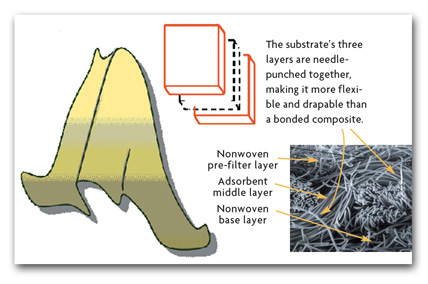
The composite substrate developed for the wipes comprises a needlepunched prefilter layer, an adsorption layer and a needlepunched base layer. The three layers are needlepunched together in a final interlocking. “The resulting fabric needs no other means of bonding, which would make it stiff. That is the beauty of needlepunching,” Ramkumar said, noting that the fabric’s drapability allows it to follow body contours and get into crevices of objects that must be decontaminated. He also said the fabric could become the inner layer of a protective suit.

qfom_Copy_10

qfom_Copy_10

The prefilter and base layers contain a “skin-friendly” fiber such as cotton or polyester, Ramkumar said. “In the middle layer, I have used a special activated fiber, which gives adsorption and also is flame-retardant,” he continued. “We have proved that the top and bottom layers do not affect the adsorption/protection characteristics of the middle layer. My Ph.D. student Utkarsh ‘Kar’ Sata has worked under my supervision and proved this statistically.”

Ramkumar is using the H1 technology to develop a variety of other fabrics as well. He is receiving support from the National Cotton Council, Cotton Incorporated and the Texas Food and Fibers Commission for the development of lightweight and ultra-lightweight cotton and natural fiber nonwovens for value-added products.


For more information about TIEHH’s research project, contact Seshadri Ramkumar, Ph.D., (806)
885-0228;
s.ramkumar@ttu.edu.


April 2004


April 2004

The following Wichita, Kan.-based
Koch Industries personnel will assume positions at INVISTA™ Inc., Wilmington,
Del., upon completion of its acquisition by Koch Industries subsidiaries:

Steve Kromer
, senior vice president, strategy, sourcing and business development;

Kevin Fogarty
, president, Polymers and Resins;

Gerold Linzbach
, president, Textile Fibers; and

David Duncan
, vice president.

Greg Biederman
, global business director, C-12, specialties and terethane, Invista, will become vice
president, specialty products.


Cotton Incorporated, Cary, N.C., has elected

William S. Weaver
chairman of the Board of Directors.

Diann P. Shearer
,

Keith A. Bram
,

Fenton T. Eure Jr.
,

Marshall M. Newton
and

Thad Freeland
have been named alternate board members.


weaver


Weaver

Gildan Activewear Inc., Montreal, has named Chairman and CEO

H. Greg Chamandy
chairman of its executive committee; and appointed President

Glenn J. Chamandy
to the additional position of co-CEO. Glenn Chamandy will assume full responsibility for
that position after serving alongside Greg Chamandy during a one-year transition period.

The National Cotton Council (NCC), Memphis, Tenn., made the following appointments
at its recent annual meeting:

Woody Anderson
, Anderson Farms, chairman;

Woods Eastland
, Staplcotn Cooperative, vice chairman;

Stephen G. Felker
, Avondale Mills,

Charles Owen
, Glenbar Gin, and

Gail Kring
, PYCO Industries, vice presidents; and

Andy Jordan, Ph.D.
, vice president, technical services. The NCC also has named

Stephen Slinsky, Ph.D.
, senior economist, economic services; and has honored

Gaylon Booker
with the 2004 Harry S. Baker Distinguished Service Award for Cotton.

Innovo Group Inc., Commerce, Calif., has promoted

Pierre Levy
to general manager, apparel operations.


C. Ted Koerner
has joined Martinsville, Va.-based
Luckenhaus Technical Textiles Inc. as vice president and general manager, North
America.


Cotton Council International (CCI), Washington, has made the following
appointments:

Robert A. Carson Jr.
, Buckskin Plantation, chairman of the Board of Directors;

David Stanford
, Plains Cotton Cooperative Association, president;

Gary W. Taylor
, Cargill Cotton Co., first vice president;

David L. Burns
, Stewartsville Enterprises, second vice president;

Michael M. Adams
, Staplcotn Cooperative, treasurer; and

Mark D. Lange
, National Cotton Council, secretary. CCI has named

David L. Hand
, Southwest Irrigated Cotton Growers Association;

R. Dale Grounds
, Paul Reinhart Co.;

William G. Winburne
, Anderson-Clayton Marana Gin;

Mark D. Williams
; and

Clyde T. Sharpe
directors.


Eugene Proffit
has been named general manager,
Stork Prints America Inc., Charlotte. Proffit takes over the position from

Copeland Willis
, executive vice president and general manager, who will retire May 1.


proffit


Proffit

Galey & Lord Inc., Greensboro, N.C., has named to its Board of Directors

Blon Dean Brown Jr.
, Hampshire Advisory Partners;

Lawrence F. Himes
, Duro Textiles LLC;

John Kourakos
;

Charles W. McQueary
, Corinthian Health Services Inc.;

Richard Redden
; and

Michael Rich
, Highland Capital Management.

At its recent annual meeting, the
Association of the Nonwoven Fabrics Industry (INDA), Cary, N.C., elected the
following members to its Board of Directors:

Jon Behm
, CardinalHealth;

Paul L. Latten
, KoSa;

John Michaud
, Green Bay Nonwovens;

Greg Roscoe
, Colbond Nonwovens; and

Jim Schaeffer
, PGI Nonwovens. Elected to the executive committee were:

Dennis Tavernetti
, BBA Fiberweb™, chairperson;

Karl-Michael Schumann
, Procter & Gamble, vice chairperson, planning;

Carl J. Lukach
, DuPont Nonwovens, vice chairperson, finance; and

Lee Sullivan
, Freudenberg Nonwovens North America, past chairperson. Appointees to the executive
committee also included

John M. Fly
, Milliken & Company;

Walt Jones
, Precision Fabrics Group Inc.; and

C.K. Wong
, US Pacific Nonwovens Industry Ltd.


April 2004


Spinners Reap CBTPA Benefits


S
pinners looking for good news should check out the American Yarn Spinners Association’s
just-completed analysis of Caribbean Basin Trade Partnership Act (CBTPA) trade.

The analysis shows US exports of yarn and thread to the region, which were relatively static
prior to 2000, have increased dramatically through 2003. Total exports of yarn and thread to the
region totaled 45 million pounds in 1999, the year before preferences were established. By 2003,
that number had increased to 351 million pounds. Exports of US fabric made from US yarns also have
increased, as have exports of knit fabrics to the region.

On a related note, a machinery supplier noted that quite a few US knitters are setting up
shop in the Caribbean and Central America. Major players either building plants or having
production facilities already in the region include Russell Corp. and Fruit of the Loom. Some
ring-spinning (RS) capacity is expected to follow the knit and dye plants south, but open-end (OE)
production is expected to stay in the United States. Three factors make OE a stay-at-home
technology: an extremely low labor component; higher electricity costs abroad; and the cost of
shipping cotton to the region.


Ring Is Still King

Spinners report overall volume is great, particularly for RS yarns. One spinner summarized
current business conditions as “better than imagined a year ago, but I fear it is the calm before
the storm. Everyone is concerned about what will happen when the quotas come off.”

On the OE side, volume is decent but not as strong as RS. Pricing pressure remains an issue
here. Denim demand is firming up, and styles are moving toward RS yarn. At least one major denim
producer is moving its plants back onto a seven-day schedule. Pricing remains tight.


Cotton Market Looks For Direction

One mill executive noted “The cotton market can’t seem to figure out a direction, which makes it
difficult to plan.”

An industry observer expressed surprise that there wasn’t a big drop in business when cotton
prices went up. “I haven’t seen anyone fall off and start standing because their customers are not
giving orders,” he said.

A cotton merchant, asked about trends in the cotton trade, said it is “discouraging that the
domestic textile industry is fading away or going offshore.” He noted our “fearless leaders still
promise better things to come.”

He doesn’t believe it, but said he “still won’t vote for a Democrat.” When asked how the
coming quota phase-out would affect the cotton business, he replied, “What quota phase-out?”

Mill men, who are much closer to the quota situation, are reviewing their options and making
plans. One suggested spinners should “start looking at your customer base, pick the survivors and
position yourself to supply them wherever they are going to be.”

Another said, “When China unleashes its volume and other countries try to hold on, it will be
an ugly scenario.”


US Cotton Exports, China’s Mill Use Rise

In its March report, the US Department of Agriculture (USDA) gauged US 2003-04 cotton production
at 18.2 million bales. Both mill use and exports were up from February’s report of 6.3 million
bales and 13.8 million bales, respectively. Total export commitments through the week ending
February 26 were almost 11.8 million bales, about 2.2 million bales higher than total sales for the
same period in the 2002-03 marketing year.

World cotton production for the 2003-04 crop year was raised 210,000 bales to almost 93
million in the USDA’s latest report. Brazil and Australia together accounted for the increase. The
world mill use estimate rose 640,000 bales to 97.9 million, largely due to a predicted increase in
China’s mill use.

January total cotton consumption by domestic mills was 238.2 million pounds for a seasonally
adjusted annualized rate of 6.49 million bales, according to the US Department of Commerce. Last
January’s annualized rate was 7.37 million bales.

On the man-made side, one fiber trader noted price increases in polyester and polypropylene
are being driven by rising oil prices. He expects prices to stabilize, trend back down and then
rise some more, “because that’s what they always seem to do.”


April 2004


Cognex Sensors Receive Award


Natick, Mass.-based Cognex Corp.’s
In-Sight® 4000 Series vision sensors have won an Editors’ Choice Award from Control Engineering
magazine. The award recognizes service to the control engineering industry, technological
advancement and market impact.


supplier_Copy_6

Cognex Corp.’s award-winning In-Sight® 4000 Series vision sensor


The In-Sight 4000 Series is among 35
products chosen from a field of thousands that were featured in the magazine in 2003. It also is
the second In-Sight product to have received the award.


April 2004


Unifi, Lenzing Implement Sopheon Accolade® Solution

Unifi Inc., Greensboro, N.C., and
Lenzing AG, Austria, have selected Minneapolis-based Sopheon Corp.’s Accolade® product portfolio
management (PPM) software to support and automate the Stage-Gate® product development process
methodology the companies are using.

Sopheon reports its PPM technology increases product development efficiencies, including a
success or failure prediction rate of 84 percent for proposed product or service concepts,
shortening of time-to-market by up to 30 percent and a 50-percent reduction of spending waste.

Unifi, a producer of textured yarns, is using Accolade in product development and marketing
operations in its North Carolina facilities and later this year plans to implement it in facilities
worldwide.

Lenzing, a manufacturer of cellulose fiber, is using the solution in its research and
development, quality control, and sales and marketing operations.


April 2004

Fulida Selects Atlas Copco Compressors

The Xiaoshan Fulida Textile Co.,
China, a privately owned textile manufacturer with annual weaving capacity of more than 100 million
meters, and dyeing and printing capability of 130 million meters, has chosen Sweden-based Atlas
Copco’s oil-free air compressors to operate all of its weaving looms.

After installing two ZR250 oil-free rotary screw compressors in 1998, Fulida now has ordered
one ZR425 and five ZH7000-5 oil-free centrifugal compressors. Atlas Copco says the ZR series
provides reliable, efficient operation with low energy consumption and no risk of oil
contamination.

The compressors are supplied with an Atlas Copco FD series refrigerant dryer to remove
moisture from the operating system. The delivery pressure dewpoint remains constant at 3°C at a
pressure drop of 0.2 bar.


April 2004


Bayer Spinoff To Be Named Lanxess

Germany-based Bayer AG has chosen Lanxess as the permanent name for NewCo, a recently formed
company comprised of certain parts of Bayer Chemicals and Bayer Material Science
(See
Textile
World News,
TW, December 2003)
.

“We believe that the name is goal-oriented and forward-looking,” said Axel C. Heitmann,
Ph.D., CEO designate of Lanxess. “This name is a combination of the French word lancer, meaning to
set in motion, and the English word success. It conveys our credo: We are aiming for success, as
quickly as possible.”

Named to Lanxess’s Management Board are: Heitmann; Ulrich Koemm, Ph.D.; Matthias Zachert;
Bruce Olson; and Martin Wienkenhover, Ph.D. The company’s formation is largely complete. Bayer
expects Lanxess to be virtually independent by July 1, and expects stock market placement by early
2005.

April 2004

China Safeguard Restraints Remain In Effect

The first action taken by the US government to restrain the growth of Chinese imports will likely
remain in effect for the remainder of this year, as the 90-day period for bi-lateral consultations
on the issue has expired. The US has placed a 7.5-percent growth rate cap on imports of knit
fabric, dressing gowns and brassieres under the so-called safeguard provisions in the US-China
bilateral textile agreement, which permits the imposition of quotas where it can be demonstrated
that there is market disruption. After quotas were removed from the products in question in 2001,
imports surged, and the American Manufacturing Trade Action Coalition (AMTAC) and others filed a
petition with the US government seeking relief. The interagency Committee for the Implementation of
Textile Agreements ruled in favor of the textile industry last Nov. 18, and the time clock was
started on a 90-day consultation period, but there was no agreement from the Chinese.

AMTAC Washington Coordinator Augie Tantillo said that while his organization was pleased with
the action, it would like to see a comprehensive agreement that would limit the growth of all
sensitive textile and apparel exports to levels that would not disrupt the US market in the future.
Since that is not likely to happen, the US industry can be expected to chip away at the problem by
filing additional safeguard petitions when it believes it can be demonstrated that additional
products are disrupting or threatening to disrupt US markets. Retailers and other importers of
textiles and apparel were strongly opposed to the safeguard petitions, as they said they were based
on politics rather than documented evidence of disruption.

April 2004

Sponsors