Grob Horgen Highlights New Developments

Switzerland-based Grob Horgen AG has introduced FERmono® heddle frames, and has developed a new
heddle dampening system and new thread eye size.

Suitable for heavy frame loads, the 140-millimeter (mm)-high stainless-steel frame staves of
the FERmono heddle frames were designed with an optimum ratio of stiffness to weight.

According to Grob Horgen, the new dampening system reduces the wear of heddle end loops and
carrying rods by decreasing heddle vibration to a minimum.

In addition, the company claims a new thread eye size of 6.5 by 2.5 mm can guide a wide
variety of warp yarns effectively and smoothly.

May 2004

Catbridge Introduces Advanced Surface Winder

Catbridge
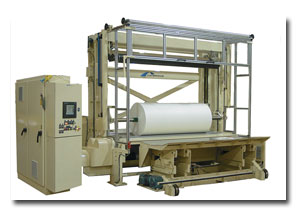
Machinery, Parsippany, N.J., has designed its Model 210 Surface Winder especially for narrow-width
slitting and rewinding of materials measuring up to 200 inches in width. The company reports the
winders state-of-the-art digital technology enables precise tension control, which allows
configuration of the system for materials ranging from low-tensile nonwovens to paper board. The
system includes a large color touch-screen interface to provide feedback and control.

np
Model 210 Surface Winder from Catbridge Machinery

Features include integrated automatic knife positioning capabilities and full recipe storage
for quality control. Catbridge engineers can conduct remote monitoring and diagnosis via an
integrated network, which also enables them to provide system upgrades.

May 2004

Batson To Represent SMIT In United States Canada

Batson Group Inc., Greenville, has signed an exclusive agreement with Italy-based SMIT S.p.A. to
represent SMIT’s entire line of weaving equipment, spare parts and service in the United States and
Canada. SMIT’s products include the economical G6300 rapier weaving machine and its latest
generation, the GS900, as well as the G6300F terry weaving machine and the JS900 air-jet weaving
machine. The JS900, introduced at ITMA 2003, is built on a common platform, which allows for a
variety of configurations and, therefore, can be adapted to a variety of weaving situations,
according to SMIT.

newweaving
SMIT’s JS900 features a terminal with a multilingual keyboard and display.


May 2004

Efficiency Versus Effectiveness


I
n a past article, a labor/capital-employed productivity measure was modeled
(See ”
Will
Productivity Save US Textiles
?” November 2001)
. This index was for products in Standard
Industrial Classification (SIC) Code 22, and compared the amount of fiber converted into consumer
products with the amount of production labor dollars necessary to effect that conversion. Initial
calculations produced ratios that suggested firms making SIC 22-category textiles spent 68.7 cents
to convert 1 pound of fiber to finished products in 1991, and, through technology spending or
development, reduced that by almost 25 percent in the following decade. Unfortunately, in the same
time period, production employment in SIC 22 industries fell precipitously, suggesting that either
productivity investments had been wasted, or offshore competitors were so determined to export
their way out of the Asian financial crisis (commonly known as the Asian Flu) that no amount of
improved productivity could stem the import tidal wave. Investment capital appeared to take flight
to parts unknown.

In an attempt to improve the analysis, time has been spent over the past several years
refining the case to better understand the implications of efficiency movements in the model,
starting with the adoption of a new data source. Textile World’s basic data resource remains the
Fiber Economics Bureau (FEB), although for the updated model, it now uses a different FEB data
subset, “The Textile Fiber End-Use Survey.” This provides more detail about the flow of SIC 22
products through apparel, home fashions and industrial end-use channels.

Combined with new Bureau of Labor Statistics (BLS) labor data driven by large quantities of
historical SIC data and the new, more detailed North American Industrial Classification Series
(NAICS) data, the new FEB data set provided opportunities to filter out some of the
larger-poundage, lower-labor-cost end-uses and concentrate on traditional fabric constructions that
are most under the import gun – knitted and woven materials headed for apparel and/or similar home
fashions markets.
p33_Copy_2


Definitions And Assumptions


Before reviewing details of the model, some underlying assumptions must be made:

•    SIC 22 refers to fibers used in woven, knitted, braided and nonwoven
textile mill products, including finishing activities but not including the cut-and-sew operations
usually associated with apparel or made-up home fashions products.

•    All man-made and natural fibers are included except textile glass and
vegetable fibers – such as sisal, bast and others – and cigarette filtration materials.

•    Industrial and Other Consumer Products, accounted for in SIC subsets
2290 through 2299, include narrow fabrics; medical, surgical and sanitary products; transportation
fabrics; all types of tires; hose and belting for home, transportation and industrial uses; felts,
not including felted carpets or felted apparel items; filtration fabrics; sewing thread; rope,
cordage and line; bags and bagging; coated and protective fabrics; paper and tape reinforcing
materials; fiberfill, stuffing and flock; plus an assortment of smaller categories such as book
bindings, luggage, shoe fabrics, tobacco and agricultural cloth, wipes, wall coverings, laundry
supplies, mops, carrier fibers, bale wrap, cable binding and civil engineering fabrics.

This category also includes significant poundage of “Unallocated Nonwovens.” This is a
bucket category arrived at by knowing the total pounds reported for nonwovens minus those assigned
to identifiable end-uses such as diapers, medical surgical materials, paper and tape reinforcing,
coated and protective fabrics, and others. Examples of unallocated nonwovens include apparel
linings, furniture scrim, home and commercial building materials and protective packaging
materials.

p34_Copy_7


Efficiency Versus Effectiveness


These terms are not synonymous. The former is measurable against certain output through
models, and effectiveness, or efficacy, is measured in the external investment marketplace. The
market allocates capital to industries and companies offering returns exceeding the return on
capital available in the external market.

In a January 2001 article in the Wall Street Journal, author Richard Foster quoted Jack
Welch, former General Electric CEO: “[Corporate life] is driven by the contradictions of survival;
it cannot succeed without excellent operations, but it will fail if it focuses primarily on
operations. The corporation is afflicted with the survivor’s curse, operational efficiency at
virtually any cost, including exclusion from market-driven efficiencies of capital allocation.
Control processes, designed to ensure the continuity of operational efficiencies, deaden … the
need for change.” In Welch’s world, change is Schumpeter-like; it means creative destruction of
products to make and offer products and services that maximize the return on invested capital, thus
satisfying the capital allocation demands of the marketplace.

Basic questions facing textiles focus on what the industry will look like tomorrow. The
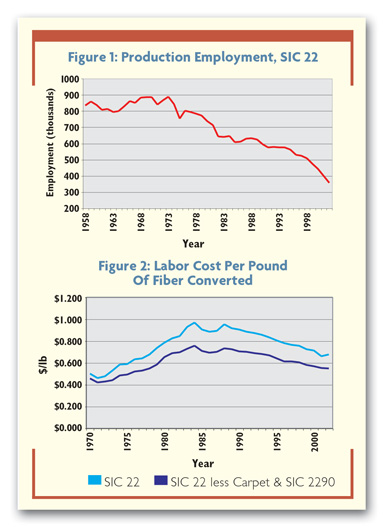
human cost of recent industry history is shown in Figure 1, Production Employment in SIC 22. The
story is well known – layoffs, bankruptcies, consolidations and closings. What is not shown,
however, is the impact of technology as these human costs run up. In 1970, SIC 22 manufacturers
employed 885,000 production workers who converted 9.45 billion pounds of fiber into finished
products. By the end of 2002, production employment had dropped by 60 percent. But at the same
time, direct labor costs for SIC products had risen (in current dollars) from $2.45 per hour to
$11.72 per hour, a 5-percent compounded annual rate of increase. Total direct labor had skyrocketed
from $4.3 billion to a recession- and import-reduced level (from the 1997 high of $11.5 billion) of
$8.6 billion in 2002. This produces the anomaly seen in Figure 2, Labor Cost Per Pound Of Fiber
Converted, which suggests 30 years of investment appears to be somewhat for naught; and production
labor costs per pound of product converted to SIC 22 products rose from $0.457 per pound in 1970 to
$0.546 in 2002, a compounded annual rate of increase of 0.55 percent. Productivity, as measured by
the difference between wages and labor costs, seems to have increased by almost 4.5 percent
compounded annually.

Parenthetically, the wages, not adjusted for inflation, of the SIC 22 production worker grew
5 percent compounded annually from 1970 through 2002. On a constant dollar basis, with 1995=100,
SIC wages rose by 4.56 percent compounded annually.

Figure 2 leads to the question: With the announced investments in new equipment, why are
labor costs continuing to rise ahead of attempts at control? This led to an examination of the
product mix in SIC 22. More specifically, has a dramatic change in product mix impacted labor
costs? So far, it is possible to categorize eight product areas that have enjoyed unusual growth in
the 1970-to-2002 period: carpets; coated and protective fabrics; tires; nonwovens – both
medical/surgical types and a myriad of undefined smaller end-uses; cordage and twine; fiberfill;
and other consumer-type and industrial end-uses. Were these the culprits in this labor/cost rise?

Examination of these products reveals that the technologies for manufacturing tufted
carpets; braided or twisted ropes; dry-, melt- and other-laid nonwovens – and the replacement of
radial-type tires over traditional bias ply tire support materials – differ from those set forth
for traditional SIC 22 materials. Examination revealed that production and labor-cost data were
available for the identified materials, which, with the exception of carpet, fell into the SIC 2290
to 2299 subgroups. Not surprisingly, and without exception, labor costs for carpet and the SIC
subgroups were lower than those for SIC 22. This means eliminating SIC 2290 to 2299 items from the
SIC 22 total reveals the true higher labor costs of traditional woven and knitted materials.


Patents


The industry’s apparent commitment to apparel and import-sensitive home fashions, combined
with its desire to improve productivity revealed another path. Was the industry investing in new
technologies simply to increase productivity, or were there some fundamental changes underway that
would reshape the way America does business in textiles?

The private ownership nature of the textile industry makes it difficult to determine the
investment of true research and development. Historically, researchers have used a surrogate for
the movement of and return on capital through technology. The stand-in employed here is widely used
– the number of patents issued to an industry. Granted, technology can provide advancements in both
basic and applied research – the former more likely to meet the demands of Schumpeter’s creative
destruction by developing a new business, and the latter more focused on improved efficiencies.
This dichotomy tends to muddy conclusions about research and development expenditures, but it is
logical to conclude that an industry willing to invest in research, basic or applied, has better
odds of finding a business-changing product or process. If you don’t invest in either, you don’t
have many chances of uncovering your next business.

A sampling was conducted of the more than 300,000 patents issued under the banner of
textiles since 1852, looking at those issued under Current US Classifications (CCL): 139, Textiles,
Weaving; 28, Textiles, Manufacturing; and 66, Textiles, Knitting. These three categories cover
approximately 56,000 patents, or 18.5 percent of all patents issued to textiles. The sampling
focused on discovering areas of new business development – as a cursory examination suggested that
these covered more fundamental processing questions, while the remaining patents tended to approach
aesthetics and more efficient ways to do the same business. Of the remaining 250,000 patents,
82,400 are in CCL 427, Textiles, Coatings; 67,700 in 424, Textiles, Biocide Treating; 64,400 in
252, Textiles, Finishes; 19,300 in 57, Spinning/Twisting/Winding; and 14,400 in 19, Textiles, Fiber
Preparation. Closer examination is planned to further segment these patent categories.

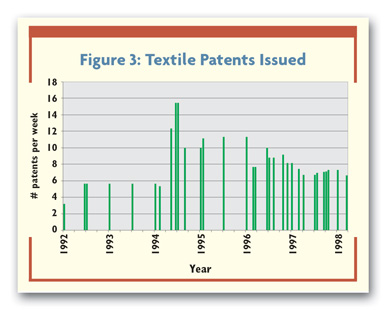
Figure 3, Textile Patents Issued, provides an interesting peek at development. In the three
selected CCLs, the number of patents issued each week from 1852 through 2004 was charted. Up to the
early 1930s, approximately five patents were issued each week in these textile CCLs. A surge in the
early ’30s currently defies explanation, but it may represent either finalizing the dyestuff work
started during World War I or increased attention to the new world of man-made fibers and the
technologies needed to adapt fabric-forming equipment to these new materials. The World War II
years brought increased technological developments, some of which resulted in industry- and
marketplace-changing events such as nonwovens, tufting, durable press and improved machinery
materials. The ability of man-made fibers to be designed for specific end-uses opened new doors
virtually daily.

Man-made fibers provided both good and bad news. The fibers’ adaptability forced new fibers
into almost every fabric construction ever created. In the 1960s and 1970s, fiber company
development officers prowled the hallways of every mill, intent on substituting their new fiber for
whatever the mill currently was running, irrespective of changes in the utility afforded by the new
material. Fabric development became the purview of the fiber producer, transferring that creative
investment to an up-the-food-chain participant. Fiber companies usurped the traditional
mill/converter/manufacturer distribution channel, sometimes armed with wads of advertising
allowances in return for a logo display. The mill assumed a lesser position in the channel;
research became efficiency-focused as every mill tried to use the same new fibers to make the same
fabrics as its competitor. Through the 1970s and 1980s, the sample seems to indicate that, with the
notable exception of nonwovens, mill development centered on efficiency, and fiber company
development focused on new fibers, finishes and end-uses. Product line creative destruction was all
but ignored by traditional SIC 22 manufacturers.

Enter imports. By the late 1980s and into the 1990s, fiber company profit margins were
sorely tested by a combination of too much domestic capacity and textile world-dominating ambitions
from Asia. Development and patent issuances dropped to less than one per day. Product strategy
evolved to “efficiency will keep us whole.” Efficacy – that is, are we invested in the right
business? – fell by the wayside.


Back To The Future


Return to Figure 2, Labor Costs Per Pound Of Fiber Converted. Despite receiving multiple
patents in the past 15 years and despite forcing labor conversion costs to 65 cents per pound, well
below the mid-90-cents-per-pound level to which they had risen in the middle and late 1980s, the
traditional textile industry still is being hammered by cheap imports and losing employees and
companies to technology, consolidations, closures and bankruptcies. There seems to be no respite
from the deluge. Today’s exporter is China; tomorrow it will be another developing economy. Where
is the industry to turn?

Strangely, it is suggested that the same technologies that the industry ignored can supply
the wherewithal for resurgence. This does not mean that, miraculously, all will be well, but it
does suggest that technology is the long-term answer. Short-term, there likely will be additional
mill closings and consolidations as more fabric users answer the siren call of cheap manufacturing
labor in the developing world.

Long-term, businesses must change. Long-term, textiles will mean technical textiles plus
home fashions, including carpet. In some cases, the form utility of the product – carpet, for
example – precludes serious import competition. In others, the need for information and adherence
to specifications inhibits imports. Apparel manufacturing is moving offshore rapidly, so
manufacturers must find those areas with some type of “technological wall” between them and the
dedicated offshore producer. The same nations that provide cheap apparel labor increasingly are
building fiber and fabric plants aimed at keeping all the value added in garment manufacturing at
home. While the jury still is out on increasing imports of home fashion materials, the
technological ability of the American textile workforce pleads for investment to survive by
creating new markets using technical textiles.

US textile manufacturers have done a yeoman’s job of filling fabric needs. However, there is
no gaping hole in distribution just waiting for the next mill to arrive. FEB data for the last
several years reveals that poundage consumed in apparel has decreased from 1995 highs under the
weight of imports and the lingering effects of the 1990 recession; poundage destined for non-carpet
home fashions has stagnated in the same time period; while fibers in carpet continued to grow
through 2002. As fibers destined for industrial (more technical) areas continue to grow, it must be
pointed out that a substantial portion of this growth is reflected in increased fiber consumption
in nonwovens and fiberfill products. There is no easy entry to technical fabrics. It will take a
total revision of thinking and a totally new way to go to market with innovative, creative
offerings.

Traditional marketing strategies focus on a four-unit matrix:

•    Offer the same product to existing markets. This strategy involves price
cutting to gain advantage – bad for competitors but good for overall distribution as lower prices
attract new purchasers.

•    Offer existing products to new markets. This requires the offerer to
provide distributional creativity – for example, Ford’s morphing the Model 150 pickup truck into
the Explorer and opening the sport utility vehicle market.

•    Offer new products to existing markets. The offerer provides
product/service creativity – for example, General Motors’ use of basic Blazer technology to create
the Escalade. Cadillac reread its traditional buyer profile and discovered an undercurrent of
excitement among Baby Boomers that prior management had ignored.

•    Offer new products to new markets. This is most difficult because the
offerer is not a readily recognizable voice in either venue. Polypropylene manufacturers integrated
downstream into nonwovens and developed new markets for new products. In many ways, polypropylene
nonwovens creatively destroyed traditional SIC 22 markets.


A Few Ideas


The future of textiles lies in rethinking its role. Historically consigned to the role of
component manufacturer, textiles must adopt the mantle of product/market leader. The system
designer/producer requires an aura of control sadly lacking in many firms whose standard approach
is reactive. Spend capital in leading developments; don’t wait for new fabrics and ideas to drop
magically from the sky on the shoulders of the next style pixie.

Maybe nanomaterials are an answer. Can nylon – long thought to be stronger than steel – be
used in rod-like constructions to achieve the same strength and stress deflections in concrete or
other matrices? Why can’t nylon be on the floor as carpet and reinforce the floor like rebar? Are
there additional uses for carbon fibers? What would happen if every golfer could carry one
additional club or more spars were made from fibers? Glass has built a large business in the marine
trades. Fiberglass hulls are preferred because sailors want to enjoy the boat, not work on it. Do
opportunities exist for increased use of fiberglass in automobiles? Maybe the industry has to build
glass repair shops and thereby provide a complete system supporting increased use of glass
sandwiches. Do additives or applications exist that can turn a basic, run-of-the-mill yarn into a
conductive material, a resistive material, or who knows what type of material?


A Caveat


Current United States trade policy is, to be kind, somewhat of a hash. Many believe that the
North American Free Trade Agreement (NAFTA) model works, and expanding beyond the original borders
is important. That said, however, the first real attempt to expand the concept – the Central
American Free Trade Agreement (CAFTA) – through trade preference levels contains holes large enough
to allow millions of yards of non-CAFTA and non-NAFTA fabrics to achieve preference status, hardly
an encouraging sign for trade equality.

The playing field probably will never be level, but at least one can hope it will be
predictable. Risk is the enemy of creativity and innovation. Political risk currently inhibits US
mill investments that could advance world textile technology.


May 2004

CAISA Opens Packaging Plant In El Salvador

Cajas Internacionales S.A. de C.V. (CAISA), an El Salvador-based packaging plant financed by Korean
and US investors, has begun operations and now offers complete packaging and shipping solutions to
exporters operating in Central America. PROESA, El Salvadors national promotion and investment
agency, assisted CAISA in establishing the plant and will continue to provide support through its
aftercare program.

PROESA President Carlos Quintanilla Schmidt (right) inspects CAISA’s production with Korean
Ambassador Don Ock-Joo Kim (second from left) and CAISA investors.

“The establishment of CAISA is the result of a lot of hard work by PROESA to attract foreign
investors that strengthen the supplier network for the regions textile and garment manufacturers
and all manufacturers who export from Central America,” said Carlos Quintanilla Schmidt, president,
PROESA; and vice president, El Salvador.

CAISA plans to invest approximately $30 million in the region, according to Kevin Ahn,
CAISA’s president. The company manufactures packaging materials in El Salvador from raw materials
it imports from the United States and Canada; and offers express delivery services, product
inventory management and packaging solutions to its customers, which include Wal-Mart, Gap and
Target, among others. The plant has the capability to produce 4 million square meters of boxes
monthly, which the company anticipates will be used in business generated through the Central
American Free Trade Agreement.

May 2004

Istanbul Prepares For ITM 2004

The inaugural International Istanbul Textile Machinery Exhibition (ITM 2004) will take place at
Tuyap Fair Convention and Congress Center in Istanbul, Turkey, June 1-6. Organized by Tekstil
Teknoloji Magazine and Teknik Fair Organization, the event will feature textile machinery,
equipment and accessories; textile chemicals and dyes; laboratory equipment and quality control
systems; and CAD/CAM and CIM applications and automation systems from 450 companies worldwide.
Approximately 80 percent of the exhibitors will come from the United States, Belgium, England,
France, Germany, Italy, Spain, Switzerland, China, India, Japan and Korea. Organizers expect more
than 50,000 visitors from countries throughout the Middle East and Asia, the Pacific region,
Eastern Europe and North Africa, as well as from Western Europe and the United States. Textile
manufacturing segments to be represented at ITM 2004 include: fiber preparation; yarn preparation;
spinning; nonwovens and industrial textiles; weaving preparation; weaving; circular knitting; and
dyeing, printing and finishing.

May 2004

Unifi Halts Kaiping Talks, Pursues Own Subsidiary In China

Greensboro, N.C.-based Unifi Inc. has discontinued discussions with China-based Guangdong Kaiping
Polyester Enterprises Group (Kaiping) and Guangdong Kaiping Chunhui Co. Ltd. (Chunhui) to set up a
joint venture to manufacture and sell certain polyester and nylon products. Unifi made the decision
to halt the effort after determining that Kaiping will not be able in the near term to finalize a
definitive agreement, which would result in a delay in receiving the necessary regulatory approvals
and push the closing further into the future.

Unifi announced that, in place of the joint venture, it plans to pursue a greenfield strategy
in China, by which it will establish a wholly owned subsidiary to manufacture and process textured
polyester and nylon yarns in that country. The company is investigating possible sites for the
operation, which will be furnished with equipment taken out of service in the United States,
England and Ireland. It expects to announce a location for the new venture shortly.

“[W]e believe that the decision to pursue a start-up activity with a wholly owned subsidiary
is the best strategy for getting on the ground in China during the calendar year 2004,” said Brian
Parke, president and CEO. “This strategy allows us to produce product sooner while using less of
our cash reserves. We plan to apply the same business model that grew Unifi into one of the world’s
leading producers and processors of textured yarns to our subsidiary in China.

May 2004

Quality Fabric Of The Month: Fire Wall

New regulations often create opportunities for manufacturers to develop new or improved products for specific markets. Such is the case with the State of California’s new Technical Bulletin (Cal. TB) 603, which mandates that, effective Jan. 1, 2005, mattresses, box springs and
futons sold in that state to consumers must be open-flame-resistant. The regulation, which also serves as a model for a proposed national standard, has spurred a number of fiber and fabric producers to introduce compliant products that will enable end-product manufacturers to stay competitive.

Among the players in this market is Johnston Textiles Inc., Phenix City, Ala., whose Phenix Barrier® woven and nonwoven fabrics contain a proprietary blend of readily available raw materials that provide protection from open-flame sources. The company — a niche manufacturer formed earlier this year when a management team from Johnston Industries Inc. acquired that company’s fabric and
testing businesses — says the products can be produced on conventional textile equipment and offer an affordable solution to meet or exceed Cal. TB 603 requirements.

“Our products are highly specialized, and performance is their most important aspect,” said L. Gene Cone, president and CEO. “Johnston Textiles is in the business of developing technical textile solutions that meet our customers’
customers’ needs.


qfom_Copy_11

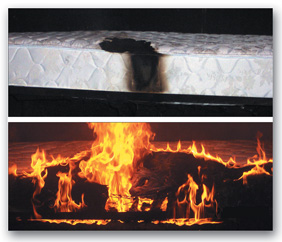
The photographs above, taken three minutes into a burn test, compare the flame resistance
of a mattress made with Phenix Barrier® (top) with that of a standard mattress (bottom).


“Mattresses are a case in which legislation has finally caught up with the need. For example, Johnston already supplies flame-resistant products to institutional markets, such as the US Navy,” Cone continued. “We now have some very unique products that offer a good balance between performance and cost.”

Phenix Barrier W is a soft, drapable woven cotton/coated fabric for use on high-fuel-load mattresses such as those made with a high proportion of urethane. Phenix Barrier NW is a needled nonwoven fabric made from blended fibers. Used on the top panel of the mattress, it provides added cushioning as well as flame resistance. The two products can be combined in a mattress — with the
nonwoven fabric on the top and bottom panels and the woven on the borders, where the coil springs place more tension on the fabric, which over time would cause fiber-to-fiber slippage in the nonwoven barrier. The woven fabric also is used on pillow-top mattresses where the pillow top joins the mattress and off-gassing could occur from the mattress filling.

The barrier fabric is placed between the filling and the ticking. In open-flame testing, the ticking burns, but the barrier resists the flame and maintains its strength, insulating the filling from the flame and the oxygen it requires to burn. Johnston also will be conducting accelerated aging tests to simulate effectiveness over time.

“We’ve come up with a simple solution — using a nonwoven barrier on the panels and a woven barrier on the sides — that should still be effective 10 years later,” said Marty Odum, vice president, market development. “Even the nonwoven product should maintain its strength.”

The company says numerous bedding manufacturers have expressed interest in using Phenix Barrier in their mattresses.


For more information about Phenix Barrier®, contact Bill Maher (770) 502-9752;
bmaher@johnstontextiles.com.


May 2004


Industry Beefs Up Lobbying Organization


A
s US textile manufacturers gear up for what some industry leaders have called a life or
death struggle over international trade, the industry’s lobbying operations have gone through some
major changes. It appears the new-look lobbying operations will have a broader reach and presumably
more influence, and their leaders expect them to play a major role in the upcoming presidential and
congressional elections.

Gone is the American Textile Manufacturers Institute (ATMI), which for more than 50 years was
a major voice for the industry in Washington. In its place is the new, more broadly based National
Council of Textile Organizations (NCTO). The American Yarn Spinners Association, which from time to
time played a major role in Washington, also soon will be phased out, but there will be an office
in Gastonia, N.C., to provide administrative assistance to the Southern Textile Association, the
Textured Yarn Association of America, the Craft Yarn Association and others.

NCTO was launched at a Capitol Hill news conference, at which NCTO Chairman Allen E. Gant
Jr., CEO of Glen Raven Inc., said the new organization would serve as the “central policy
development and implementations body” of the US textile industry in matters involving international
trade and governmental regulations. What NCTO brings to the table is an organization that for the
first time incorporates all segments of the textile industry from fiber to yarn to fabric and gives
major suppliers such as machinery manufacturers, power companies, banks and other suppliers to the
industry an equal voice. Gant believes the new organization can have “significantly more clout”
than the textile industry has had in the past.

One of the industry’s shortfalls in the past has been that while it is viewed as a powerful
regional industry with a lot of friends on Capitol Hill, it has fallen short of its goals when it
has run up against the free trade philosophies of several administrations. The new-look lobbying
organizations may be able to help change that with a broader geographic reach, and they will
benefit from the growing concern in Washington over the loss of American jobs to overseas
competition.

The 76-member American Manufacturing Trade Action Coalition (AMTAC), which has a strong
textile element, reaches into a much broader range of states and congressional delegations, with
members representing metalworkers, paper products companies, chemical manufacturers and
woodworkers.

AMTAC’s approach is to go beyond textiles and demonstrate the harm being done to many
manufacturing industries by what it sees as illegal and unfair trade practices such as currency
manipulation, illegal transshipments and export subsidies offered by overseas countries to their
domestic industries.

In connection with some issues AMTAC has been joined by the Union of Needletrades, Industrial
and Textile Employees, which itself will be expanded to include hotel and restaurant workers come
June.

A third textile lobbying force is the National Textile Association (NTA), a result of the
merger of the Northern Textile Association and the National Knitwear Association. Having 150
members with manufacturing facilities in the United States, Canada and Mexico, and representation
in Washington, NTA adds further to the geographic reach of the textile lobby.

All of these organizations and their supporters in Congress have a basic goal of developing
fair trade as opposed to the free trade policies they say have resulted in the loss of 3 million
manufacturing jobs, including 86,300 in textiles alone this past year. They plan to conduct
grass-roots education efforts with employees and in communities where plants are located, to
explain the link between job losses and free trade. In addition, they will meet with candidates and
promote greater voter registration and get-out-the-vote campaigns. They do not plan to endorse
specific candidates in the congressional or presidential elections, but they will support
candidates who demonstrate a strong commitment to saving American jobs.

At the launch of NCTO, Rep. John Spratt (D-S.C.) said: “The American textile industry is
battered by import competition. To fight back we need new ideas, new organizations and new
resolve.”

It will be interesting to see if the new lobbying organizations are the key to getting the
job done.


Free Trade Versus Fair Trade

While US textile manufacturers, their supporters in Congress, importers and the administration
all contend that the industry can compete in an atmosphere of fair trade, the question is how to go
about getting there in the face of low-wage overseas manufacturers, currency imbalances, illegal
transshipments, high tariffs and a rash of non-tariff barriers to trade. When you move beyond the
free trade versus fair trade rhetoric, there are a number of areas — some highly controversial —
where the United States and other governments are being pressed to help the beleaguered US textile
industry:


Free Trade Agreements


The administration, textile manufacturers and importers of textiles and apparel all believe
that preferential trade agreements with individual countries or groups of countries in a region can
provide at least part of the solution to the problem of dealing with burgeoning imports from China
and other Asian countries. However, they disagree as to how free trade agreements should be
structured. Textile manufacturers want strict yarn-forward rules of origin with no tariff
preference levels (TPLs) or cumulation that permits use of a given amount of yarn and fabric from
non-participating countries. Importers and the administration say TPLs and cumulation are necessary
to provide them with flexibility that will help make them less dependent on China and a handful of
other major suppliers.


Combatting Illegal Transshipments


All parties are agreed that something must be done to eliminate illegal transshipments that
evade quotas and take advantage of the tariff preferences in free trade agreements. The General
Accounting Office has uncovered what it says are serious flaws in the policing of textile and
apparel imports. Little is likely to change, however, as Customs officials devote most of their
resources to policing illegal drug traffic and the increasing demands of homeland security.


Section 301 Petitions


In a dramatic, unprecedented move, the American Federation of Labor – Congress of Industrial
Organizations (AFL-CIO) has filed a petition under Section 301 of the Trade Act of 1974, which
permits the United States to invoke sanctions against countries engaged in unfair trade. This
action charges that Chinese trade is unfair because of its labor-rights abuses. In a related
action, a coalition of manufacturers, including textiles, has filed a Section 301 petition accusing
the Chinese of unfair trade because of currency manipulation, which amounts to a subsidy for its
exports. How the administration reacts to the petitions is crucial, as favorable action could lead
to a whole new ball game that could result in sanctions against a wide range of products.


Safeguard Mechanism


The US textile industry has successfully used a provision in its bilateral agreement with
China that permits the imposition of quotas on products where it can be demonstrated they are
causing market disruption. The administration supported the industry’s first such petition, and a
7.5-percent growth cap has been placed on three product categories for 2004. US textile
manufacturers are pressing for a comprehensive agreement that would place similar caps on the
growth of all textile and apparel exports of sensitive products. That action is strongly opposed by
retailers and other importers of textiles and apparel.


Extension Of Import Quotas Beyond 2005


There is a movement underway, spurred by US textile manufacturers, to extend the deadline for
removing all textile and apparel quotas beyond the currently planned date of Jan. 1, 2005
(See “
Textile World News,” this issue)
. This will be a very hard sell, as members
of the World Trade Organization (WTO) have agreed to that date, and it would be difficult for many
countries, including the United States, to back off that commitment now.


WTO Trade Negotiations


The WTO has launched a trade liberalization effort calling for worldwide tariff reductions.
The US textile industry is opposed to any tariff cuts until other nations bring theirs down to US
levels. Domestic importers of textiles and apparel, on the other hand, want the US tariffs phased
out as soon as possible.

The extent to which any or all of these actions will be taken and what impact they might have
is problematic. But in this election year, US textile manufacturers are going to give it the old
college try.


May 2004


Shakespeare Co Announces Price Increases

Shakespeare, a subsidiary of K2 Inc. Sporting Goods, has announced its plans to increase filament
as well as polymer prices effective May 31, 2004.

In commenting on the planned increases, Doug Kale, vice president of sales for the company,
said, “We have worked diligently over the past several years to contain our continually escalating
costs. Investments have been made to improve efficiencies and quality. At this point, however, we
find it necessary to increase our prices in order to continue to invest in our operations and
technologies.”

For additional information, contact Doug Kale at cdk@shakespeare-mono.com.

April 2004

Sponsors